
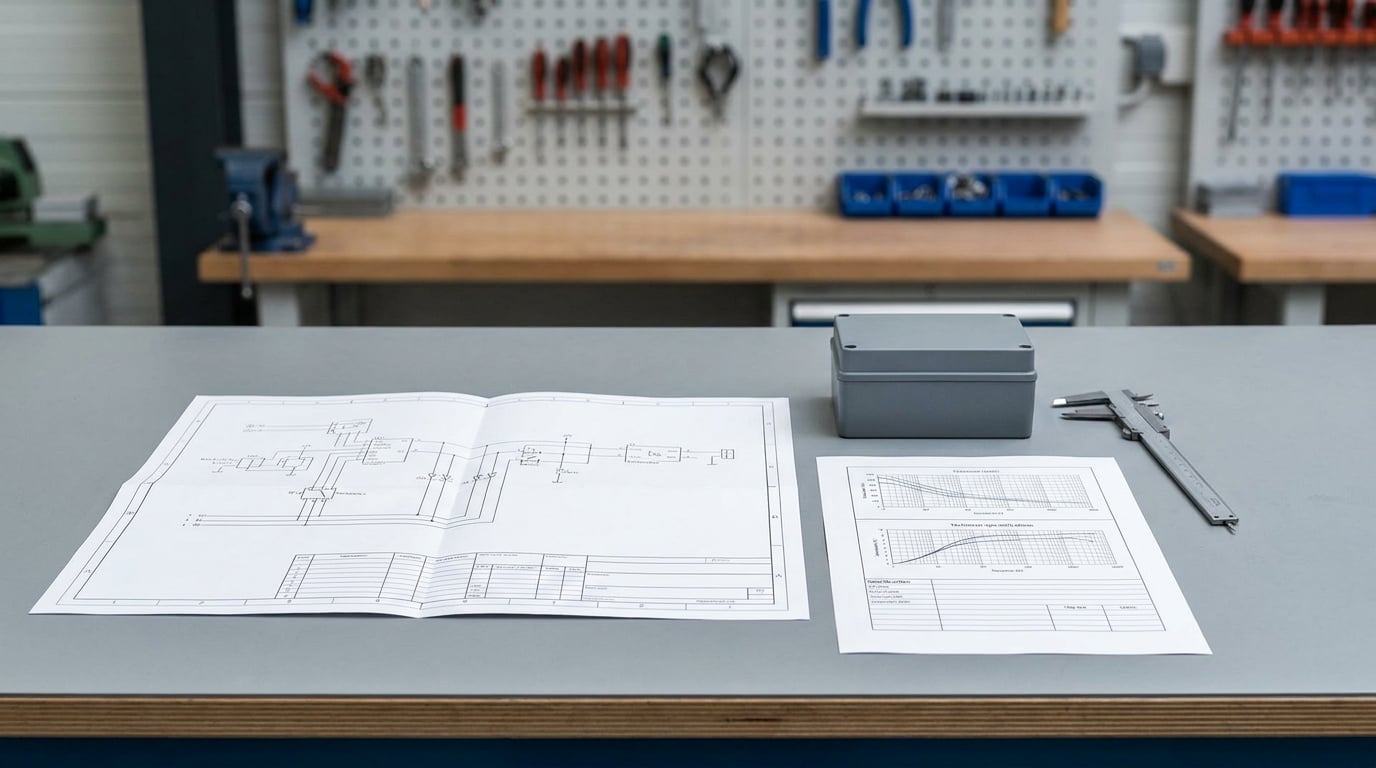
Quoting a custom plastic part means giving a manufacturer a defined part, a defined resin, a defined quantity, and a defined set of commercial terms, so the price that comes back is a price rather than a guess. Most RFQs fail not because the supplier is slow, but because the buyer left the important decisions open. Two shops given the same photo and the same part name will return numbers that differ by a factor of two, and both will be defensible. The fix takes about a day of preparation, and this guide walks through how to quote a custom plastic part from first draft to a number you can compare. Updated for 2026.
Table of Contents
- What You Need Before You Request a Quote
- Step-by-Step: How to Quote a Custom Plastic Part
- 1. Define the Part and Intended Use
- 2. Create a Complete Drawing or Model
- 3. Specify the Material and Performance Requirements
- 4. Estimate Quantity, Reuse, and Tooling Needs
- 5. Define Finish, Packaging, and Delivery Requirements
- 6. Build the Supplier RFQ
- 7. Evaluate and Normalize the Quotes
- 8. Confirm the Quote Before Placing the Order
- Common Mistakes That Make Quotes Unusable
- Frequently Asked Questions
- Can I request a custom plastic part quote without a final drawing?
- What is a DFM review, and should I request one before getting a quote?
- How should I compare two custom plastic part quotes with different quantities?
- Should a supplier’s plastic part quote itemize molds, fixtures, and testing separately?
- What terms should I use to control drawing and specification changes after the quote?
- Conclusion
What You Need Before You Request a Quote
A request for quote, or RFQ, is just a structured question. The more of these fields you fill in, the smaller the range of prices you will get back. Gather the following before you contact a supplier:
- A 3D CAD model in STEP or IGES format, not just a screenshot.
- A dimensioned 2D drawing with datums and tolerances.
- A list of critical-to-quality dimensions, separated from cosmetic ones.
- The exact resin grade, or the properties you need from the resin.
- Virgin, recycled, or blended material, if it matters to you.
- Reinforcement type and percentage, such as unfilled or glass-filled.
- Annual volume and total program volume, not just the first order.
- Color, surface finish, texture, and cosmetic grade.
- Packaging, labeling, and master carton quantities.
- Freight destination and any incoterm you prefer.
- Target cost per part and the lead time your program needs.
- Compliance requirements: food contact, medical, automotive, or traceability.
Anything on that list you cannot answer is not a blocker, but it is an assumption someone will make for you. Write the assumption down yourself, in your own words, and send it along.
Step-by-Step: How to Quote a Custom Plastic Part
Eight steps take you from a rough idea to a quote you can compare against other quotes. The order matters, because each step feeds the next one.
1. Define the Part and Intended Use
Start with what the component has to do, not with what shape it should be. A part that sits in a 60C enclosure, clips under load, and lives for five years has different requirements than a cosmetic cover for a consumer device.
Write down the assembly method, the operating environment, and the failure mode you are most worried about. Fatigue, creep, chemical exposure, and UV exposure all change the resin choice and the inspection plan.
Check: if you cannot finish the sentence “this part must not ______,” the request is not yet defined enough to quote accurately.
2. Create a Complete Drawing or Model
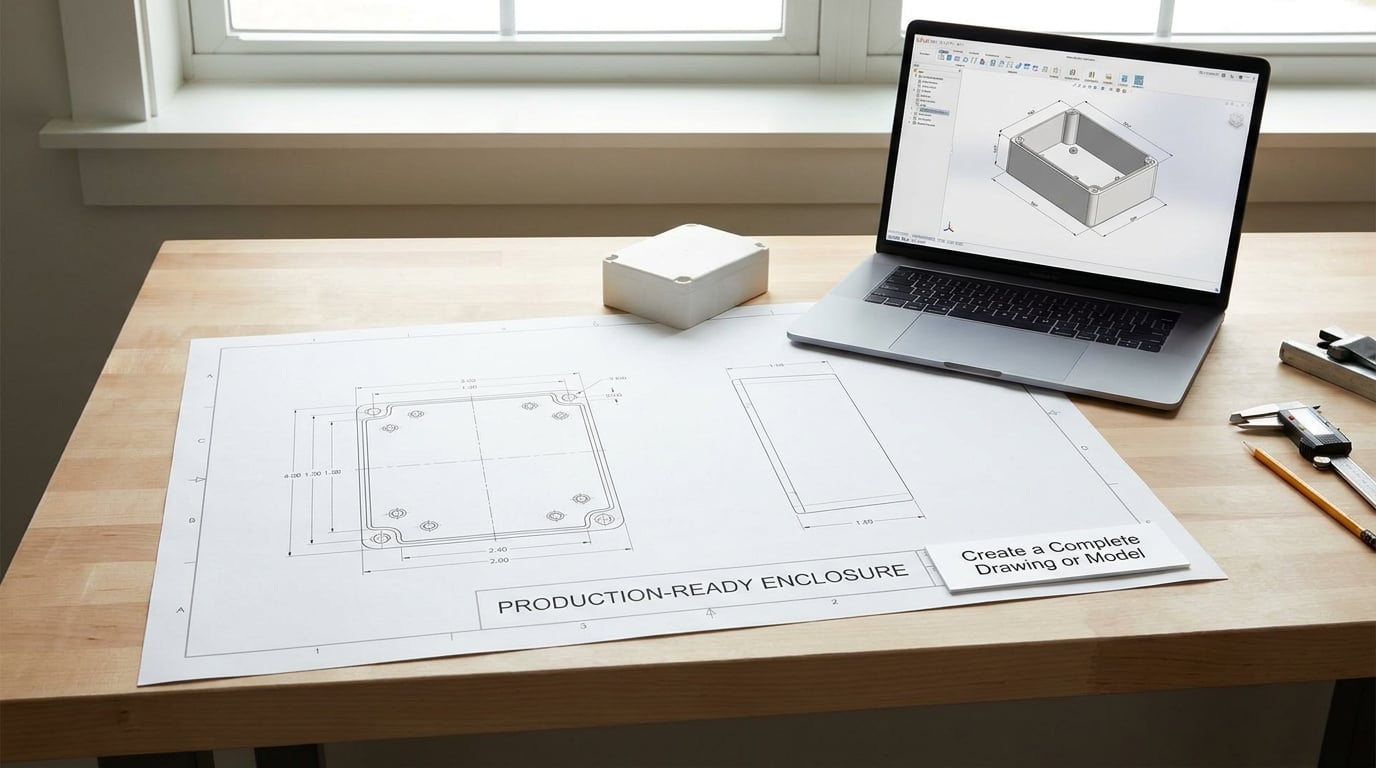
This is the single highest-leverage step. To quote a custom plastic part accurately, the supplier needs an unambiguous, production-ready definition of the geometry, and a STEP file plus a drawing is the standard way to deliver it.
On the drawing, state the units, name the datums, and call out every dimension that has a tolerance. Mark which of those are critical to function and which are cosmetic. Show the parting direction and draft where you can, and flag any undercut, internal thread, or side action the supplier might otherwise price as an expensive surprise.
Add a general surface texture note and separate cosmetic surfaces from functional ones. If a surface will be visible in the finished product, say so, and say what level of appearance you are expecting on the first articles.
Check: open the STEP file yourself and confirm it contains the solid part, not just a surface shell or an assembly with a dozen sub-components.
3. Specify the Material and Performance Requirements
“PP” or “ABS” alone is not enough to price a part. Those family names cover dozens of grades with different flow rates, impact behavior, and shrinkage factors, and the shrinkage difference alone can change your tolerance stack.
Ask for the grade you want if you have one, or list the properties that matter: continuous service temperature, impact behavior, chemical exposure, UV stability, electrical rating, and food contact status. State clearly whether the part is natural, unfilled, glass-filled, flame-retardant, or made from recycled content, since reinforcement changes both price and warpage.
Ask for material certification or a resin traceability statement if your application needs it. Without that request, most suppliers will simply quote whatever is on the shelf that week.
Check: separate the mandatory properties from the preferences. A supplier who hears six requirements and one wish will price the wish like a requirement.
4. Estimate Quantity, Reuse, and Tooling Needs
Quantity drives more than the material line. It decides cavity count, whether the tool is aluminum or production steel, whether you pay for a hot runner, and whether a quick-change insert is worth it at all.
Break your volume into stages. One-time prototypes, a pilot batch, a first production release, and forecasted annual demand are four different numbers, and quoting all four together is the most useful thing you can do for your own planning. State whether this is new tooling or a repeat run on a tool the supplier already has, and whether you own that tool.
Say whether the quote must include first articles, dimensional samples, destructive testing, and the cost of sending samples back to you. Suppliers will otherwise assume the simplest possible answer and add the rest as change orders later.
Check: confirm that the quantity you send is the quantity the supplier will price at, and that it matches your purchase order plan.
5. Define Finish, Packaging, and Delivery Requirements
Cosmetic specifications are where quotes quietly diverge. Specify the texture family you want, the color standard you are matching to, and the acceptable color variation. Then say plainly which surfaces are visible and which are hidden.
Packaging affects cost more than buyers expect. Individual bags, trays, master carton quantities, labels, ESD protection, and pallet configuration all show up in the quote, and two suppliers can differ here by enough to change the ranking.
Give a delivery destination with a postal code and name the freight terms you want quoted. Domestic, air, and ocean moves are not interchangeable, and the terms decide who carries the risk at each step.
Check: read the packaging line as a receiving dock would. If you cannot picture how the cartons are labeled and stacked, ask.
6. Build the Supplier RFQ
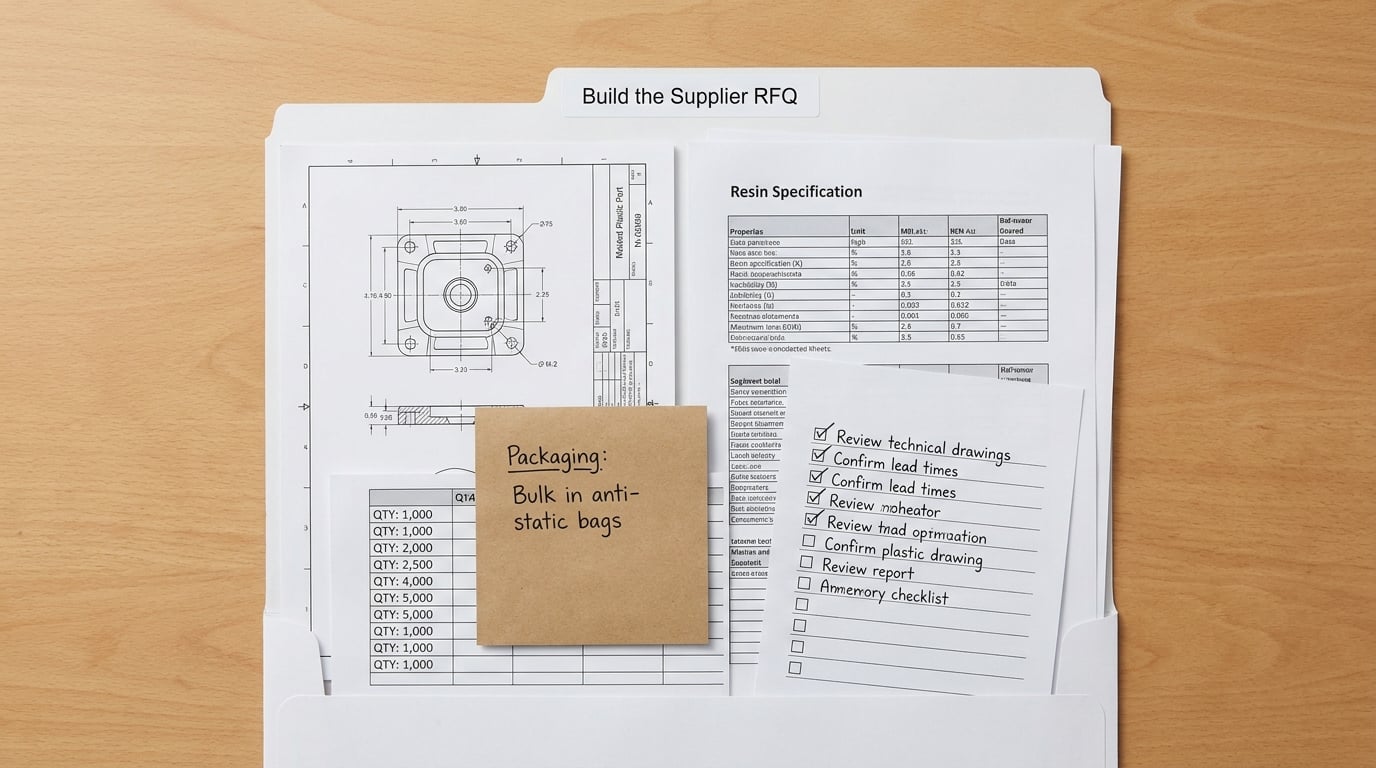
Now assemble the request. A workable RFQ has labeled sections, so a supplier can price it without emailing you eight times for clarification.
The technical section carries the drawing, the model, the tolerances, the material, and the finish. The quantity section carries the staged volumes. The commercial section asks for tooling price, unit price at each volume, minimum order quantity, payment terms, and quote validity period. The schedule section asks for tooling lead time, first article timing, and production lead time as separate numbers.
End with an assumptions block written in your own words. That single section prevents the most common failure mode: a supplier quietly assuming a different steel, a different runner system, or a different cavity count, and burying that assumption in the number.
Ask for line-item transparency. You want resin, tooling, setup, secondary operations such as degating or trimming, packaging, and freight shown separately, not blended into one figure. A supplier who returns a single all-in number has told you nothing you can negotiate.
Check: a good RFQ invites clarifying questions. Buyers on engineering forums consistently notice the difference between a shop that quotes blind and a shop that asks focused questions back first.
7. Evaluate and Normalize the Quotes
Compare total landed cost at your own quantities, not the piece price on the quote. Start by lining the line items up in the same order for every supplier:
- Tooling covers design, steel, cavities, and the runner system. Ask who owns it and what the expected life in cycles is.
- Setup and trial covers machine time, T1 trials, and revisions. Ask how many trial shots and how many revisions are included.
- Resin covers material per part. Ask what price basis is used and how increases get passed through.
- Secondary operations covers degating, trimming, assembly, and printing. Ask whether it sits in the piece price or gets billed separately.
- Packaging covers bags, trays, cartons, and labels. Ask whether it is charged per piece or per carton.
- Freight covers delivery to your dock. Ask which incoterm applies and whether the price assumes domestic freight.
- Payment terms cover the deposit, the balance, and any net terms. Ask whether a deposit is required before the first cut.
Then normalize. If supplier A quoted 10,000 pieces and supplier B quoted 50,000, you are comparing two different programs. Ask each one to restate the unit price at the same quantity, and ask both to state the resin price basis and the validity period of the quote.
When two quotes differ a lot, look at architecture before you look at margin. A single-cavity cold-runner tool in production steel and a four-cavity hot-runner tool in pre-hardened steel can produce identical parts with very different one-time costs and very different unit costs at volume.
Check: put the lowest total landed cost at your real volume at the top of your list, and read the payment terms before you celebrate.
8. Confirm the Quote Before Placing the Order
A quote is not a contract, and the gap between the two is where projects go wrong. Before you issue a purchase order, get the assumptions confirmed in writing: the approved drawing number and revision, the material grade, the tolerance scheme, the inspection plan, the packaging format, the lead times, and the number of first articles.
Add change control. State that no change to geometry, material, tolerance, or quantity happens without a written revision and a new price and schedule.
Settle tooling ownership, maintenance responsibility, and transfer terms while you are still on good terms. Buyers on r/AskEngineers and r/manufacturing ask this question constantly, and it is far easier to agree at the quote stage than after a project ends badly.
Agree on communication checkpoints: when the DFM feedback is due, when the trial report arrives, and who signs off the first article.
Check: a complete quote names its assumptions, its exclusions, its tooling, its unit pricing, its lead time, and its terms. If one of those six is missing, the quote is not ready to order against.
Common Mistakes That Make Quotes Unusable
Almost every bad quote traces back to a small omission on the buyer side. These are the ones that cost people real money.
Sending an incomplete drawing. A screenshot cannot be priced for tolerances, because tolerances are not visible in a screenshot. Send the drawing and the model, and revision-label both.
Writing vague tolerances. “General tolerance plus and minus five thousandths” on every feature tells the supplier you have not decided what matters. Tag each feature as critical or cosmetic, and give tight numbers only where the function demands them.
Quoting inconsistent quantities. If you send 5,000 to one shop and 50,000 to another, you have learned nothing. Send identical quantities, or ask each supplier to price a common volume ladder.
Omitting compliance needs. Food contact, medical, or automotive requirements change the resin, the documentation, and sometimes the supplier. If you need it later, you will pay to re-quote.
Comparing prices at different volumes. Unit price falls steeply as the cavity count goes up and tooling spreads out. Normalize before you compare anything.
Leaving packaging undefined. Undefined packaging turns into per-piece bagging charges, or into cartons your warehouse cannot handle.
Accepting a lead time with no production baseline. Ask what is included. Design approval, resin procurement, mold steel machining, EDM work, finishing, T1 trials, and revision cycles each add weeks, and different suppliers include different subsets.
A few negotiation habits help. Ask every supplier the same questions in the same order so replies are structurally comparable. Ask for the quote as line items rather than a total. And give a realistic target cost and volume so the supplier can propose a design that hits it, instead of quoting the most expensive way to make what you drew.
Frequently Asked Questions
Can I request a custom plastic part quote without a final drawing?
Yes, most suppliers will quote from a 3D model, a hand sketch with key dimensions, or even a physical sample, but you should expect a wider range and a label on the estimate. For a physical sample, expect to pay for reverse engineering or scan work, which is quoted as a separate one-time charge. The honest framing is: an early request gets you a range and a conversation, a released drawing gets you a real price. Forum buyers report the same thing, with sample-and-photo RFQs returning numbers that are impossible to compare.
What is a DFM review, and should I request one before getting a quote?
A design for manufacturability review is a supplier looking at your geometry before committing to a price, and it usually flags undercut features, thin walls, missing draft, deep pockets, and parting lines that would force expensive tooling. Ask for it explicitly as a deliverable in the RFQ rather than hoping for it. Reviewers in the plastics community treat a supplier willing to comment on the part before quoting the tool as a strong trust signal, and the feedback often removes cost from the quote instead of adding it.
How should I compare two custom plastic part quotes with different quantities?
Ask both suppliers to restate unit price at the same quantity, ideally your real annual demand, then compare total landed cost at that volume. Check whether tooling is a one-time charge and how many cavities the tool has, since a higher cavity count can justify a higher tooling price and a lower unit price. Make sure freight, packaging, and secondary operations are inside both numbers, and that both quotes use the same resin price basis and validity period before you treat the gap as real.
Should a supplier’s plastic part quote itemize molds, fixtures, and testing separately?
Yes, and it is reasonable to ask for that format in the RFQ itself. You want tooling, machine setup and trial shots, resin, secondary operations, packaging, and freight shown as separate lines. Without that breakdown you cannot tell whether a low piece price was bought with a heavy tool deposit, or whether testing was quietly left out of scope. If a supplier insists on a single all-in figure, ask in writing which line items are included, and get the answer before you compare it to anyone else.
What terms should I use to control drawing and specification changes after the quote?
Tie the purchase order to a specific drawing number and revision, and require a written change order before any geometry, material, tolerance, or quantity change, with the effect on price and schedule stated in that change order. Also fix the approved first article, the inspection plan, the lead time baseline, and the quote validity period in the same document. Practical Machinist threads on plastic RFQs show the same lesson: the projects that stall are the ones where the definition moved after the price was agreed.
Conclusion
The most accurate custom plastic part quote starts before the supplier is involved, with a controlled definition of the part, the resin, the quantities, and the commercial terms. Write your assumptions down, send the same packet to several qualified suppliers, and normalize the answers before you compare them.
Start with the drawing and the quantity table today, since those two items do most of the work.