
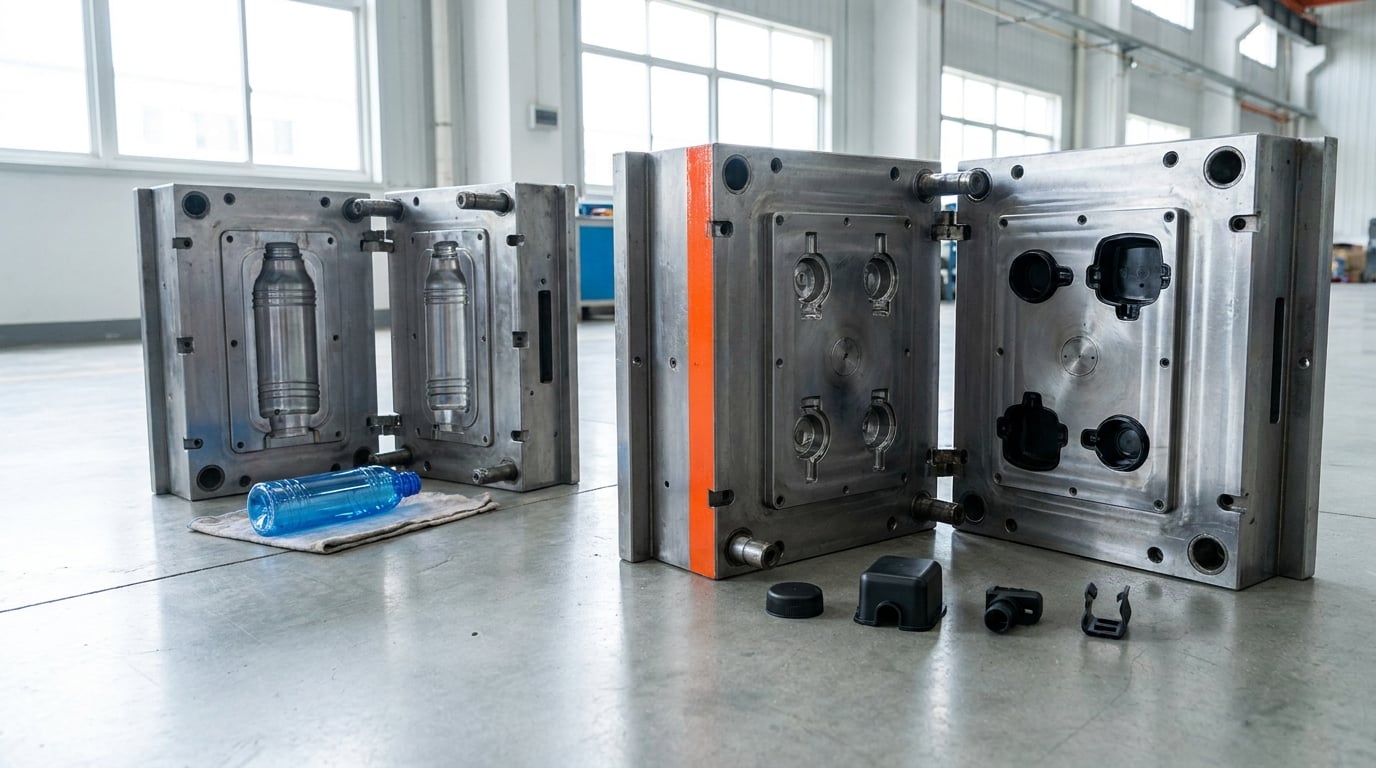
A family mold is better when several different parts leave your building together in similar quantities. A single-cavity mold is better for prototypes, tight-tolerance parts, complex geometry, and demand you cannot yet predict. Volume, part compatibility, and how much the design will still move decide it.
That is the whole argument, honestly. Everything else is detail, and the detail matters a lot once you have real part geometry in front of you. I have watched both strategies go into production, and the failure modes are predictable in each case, which is good news for you.
What follows is the comparison I wish a supplier had laid out plainly before quoting tooling: what each mold costs in machine time, where the parts come out wrong, and the handful of questions that settle the decision in one meeting.
Table of Contents
- Family Mold vs Single Cavity Mold at a Glance
- Production Output and Cycle Time
- Tooling Cost and Production Economics
- Part Consistency, Tolerance, and Quality Control
- Flexibility, Maintenance, and Tooling Changes
- Best Applications for Each Mold Type
- Which Should You Choose?
- Frequently Asked Questions
- The Decision in One Paragraph
Family Mold vs Single Cavity Mold at a Glance
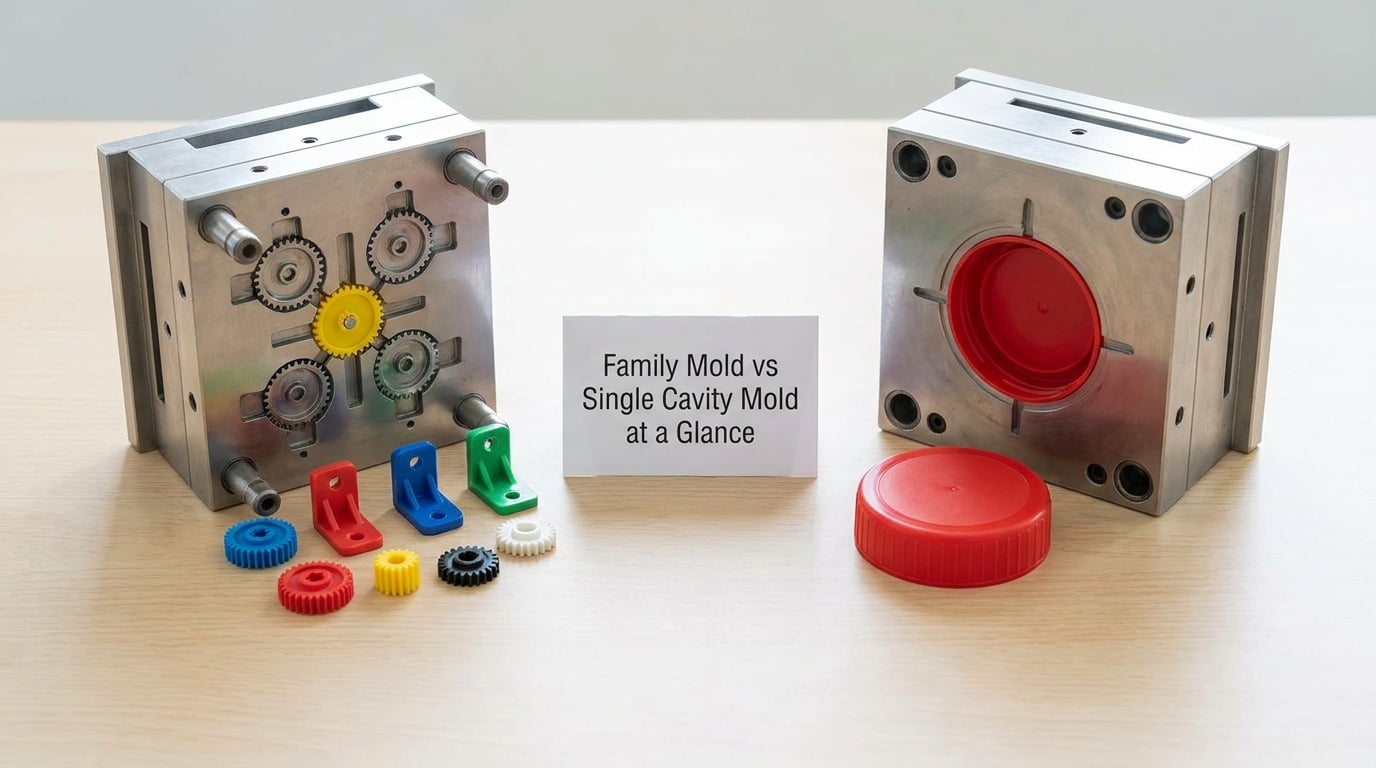
The question “family mold vs single cavity mold which is better” only has one honest answer: it depends on whether your parts are partners in an assembly. A family tool trades a simpler, faster, more forgiving mold for a cheaper total tooling bill across several parts. That trade is a good one for model kits and small hardware sets. It is a bad one for a medical part with a half-millimeter tolerance and a demand curve nobody has seen yet.
What is a single-cavity mold?
A single-cavity injection mold is a tool with exactly one cavity, so it produces one plastic part per cycle. Every gate, cooling circuit, and ejector pin in that tool serves that one part shape, which means the whole process is tuned to a single job and nothing is holding the rest of the design back.
What is a family mold?
A family mold is a multi-cavity tool whose cavities each produce a different part, usually several components of the same assembly, in a single shot. One press of the cycle fills a lid, a dish and a base. The runner system has to feed all of them at once, and the cooling system has to bring all of them down at a compatible rate.
How is a family mold different from a multi-cavity mold?
A multi-cavity mold repeats the same part, four identical buttons or eight identical vials, which is the easiest way to raise output. A family mold makes different parts that belong together. The multi-cavity tool is a volume multiplier; the family tool is a packaging strategy that also happens to cut tooling cost.
What is the difference between a mold and a cavity?
The mold is the entire steel tool, including the mold base, cores, cooling lines, gating, and ejection. A cavity is one shaped negative space inside it that forms one part. One cavity in a mold means one part per cycle, so the number of cavities, not the size of the tool, is what sets output.
| Factor | Family mold | Single-cavity mold |
|---|---|---|
| Parts per cycle | One complete set, often 2 to 6 different parts | One part |
| Upfront tooling spend | More than one simple tool, less than building every part separately | Lowest entry cost for one part |
| Cost per part at volume | Lower once several parts share one base | Higher on tooling, lower on machine time |
| Cycle time | Set by the slowest-cooling part in the set | Set only by that one part |
| Cavity balance difficulty | Hard; different volumes, walls, and flow lengths | Simple; one fill pattern to tune |
| Dimensional consistency | Cavity-to-cavity variation on tight features | Best achievable repeatability |
| Design changes | A revision hits every cavity at once | One part, one revision, one cost |
| Maintenance and downtime | More circuits and gates to maintain; a failure stops the set | Fewer wear points |
| Inventory handling | Sets stay whole if volumes stay matched | Each part counted independently |
| Strongest use case | Assemblies ordered together in similar numbers | Prototypes, complex or critical parts, uncertain demand |
Read the table from the bottom up when you are choosing. The top three rows describe what you gain. The rest describe what you take on, and the maintenance and design-change rows are the two that people forget until the program is already running.
Production Output and Cycle Time
A single-cavity tool running a 30-second cycle makes 120 parts an hour. A four-cavity family tool with the same part repeated makes 480. That is the easy case. The interesting case is a family tool making four different parts, because the cycle is not an average.
Cycle time in a family mold is set by the slowest-cooling part
Every cavity in the tool shares one mold open time, one press stroke, and one cooling period. The thickest-walled part, or the one with the highest shrinkage, dictates that period, and every faster part sits in the mold waiting for it. A family of a small clip, a thin cover, and a thick handle runs at the handle’s cooling time, and the clip gets carried along for the ride.
This is the single most under-explained drawback of family tooling, and it is the reason a four-part family mold is not four times the output of a single-cavity mold. Suppliers who quote you parts per hour on a family tool without naming the slowest part are quoting you a number they cannot hit.
What output looks like in practice
Assume three similar parts, each around 30 seconds of cooling on its own, and a 45-second cycle once the combined tool adds fill, pack, and ejection time. One single-cavity tool on one machine makes 120 of one part an hour. One family tool on one machine makes three parts in 45 seconds, which is 240 individual parts an hour, or 15 seconds of machine time per part instead of 30.
Now make the set mismatched. A thin cover that cycles in 15 seconds joined to a thick base that needs 60 produces three parts every 60 seconds. Per-part machine time rises to 20 seconds, the cover is no longer fast, and the value of the shared tool has quietly shrunk.
| Strategy | Parts per cycle | Cycle time | Parts per hour | Seconds per part |
|---|---|---|---|---|
| Single cavity, thin cover alone | 1 | 15 s | 240 | 15 |
| Single cavity, thick base alone | 1 | 60 s | 60 | 60 |
| Family tool, matched 30 s parts | 3 | 45 s | 240 | 15 |
| Family tool, mismatched 15 s and 60 s parts | 3 | 60 s | 180 | 20 |
Runner design moves this number as much as the part does. A cold runner has to fill and then be removed as waste, a hot runner keeps the melt hot to the gate and cuts that scrap, and a hot runner in a family tool has to deliver identical pressure to cavities with different demands. That last point is where most family tools get their extra debugging hours.
Tooling Cost and Production Economics
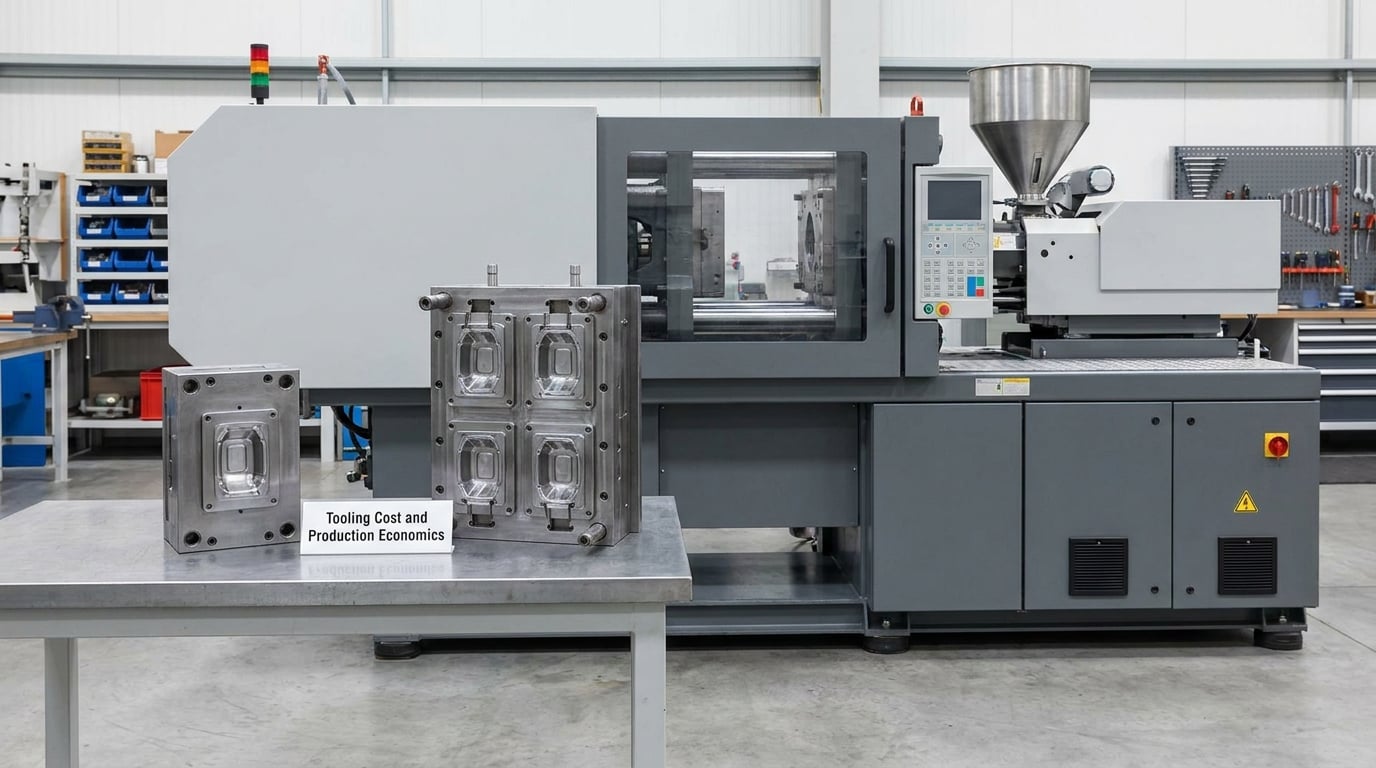
Tooling cost is the argument that sells family molds, and it is a real argument. A family tool is not cheap, but it is usually less expensive than building one dedicated tool for every part in the assembly, because the mold base, the machine setup, the maintenance schedule, and the engineering hours are shared across cavities.
Where the saving actually comes from
Index three separate production single-cavity tools at 3.0 cost points in total. A family tool covering the same three parts typically lands near 1.8 points, roughly 60 percent of the separate-tool spend, and it produces all three parts in the same shot. Spread across the parts, the tooling cost per part drops from 1.0 point to about 0.6, a saving in the neighborhood of 40 percent on the tooling line of your quote.
That is the upside. The downside is that a family tool charges every part the slowest part’s cycle, adds gates and cooling circuits that need attention, and locks all three parts to one revision date. If the cover design changes, you change the whole tool, not one cavity.
Overtooling is the risk nobody prices in
A family tool is a bet that demand for all the parts moves together. Order the base 80,000 times, the lid 12,000 times, and the clip is discontinued after 6,000, and you have paid for one tool to make 6,000 clip sets while 74,000 bases sit on a shelf. The tool did its job perfectly. The inventory plan did not.
The other version of the same mistake is tooling ahead of demand. A complex family tool in aluminum or pre-hardened steel is a large sunk cost, and sunk costs do not care how well the program eventually runs. When volume is uncertain, staged tooling beats one big family tool: prototype on a simple single-cavity aluminum tool, run the market, then commit to production tooling once the volumes are real.
Material choice changes the economics
Aluminum prototype tools build fast and cost the least, and they are the right answer for hundreds to a few thousand parts. Pre-hardened P20 steel is the production default for most molded parts, and hardened stainless such as H13 is worth the step up for high-volume programs, abrasive resins, or cosmetic surfaces that must stay glossy. Family tools lean stainless more often than single tools, because you have more invested and more downtime to protect.
Before approving any quote, ask whether mold ownership, maintenance schedule, and shot count are written into the contract, and where the spare inserts live. A family tool with a replaceable insert per cavity is far more serviceable than one solid block, and that difference shows up in year three.
Part Consistency, Tolerance, and Quality Control
Every independent cavity in a family tool is its own small mold with its own wear, its own cooling, and its own chance of filling slightly differently. That is where the quality story lives, and it is the reason experienced molders default to one mold per part.
Projected-area balancing is the core design problem
Before steel is cut, a good toolmaker balances each cavity’s projected area around the sprue the way you balance weights on a scale pan, with the sprue as the fulcrum. A small cavity sitting opposite a large one tips the mold toward flash on the light side and short shots on the heavy side. A veteran toolmaker on an Eng-Tips thread described it as balancing area, not parts, and argued the plan has to happen before the mold base is ordered, not after.
Two numbers frame the practical window. All cavities need to fill within roughly 2,000 psi of each other, family tool pressure typically tops out around 12,000 psi, and the clamp ceiling near 500 tons rules out large projected areas. A part set that fails those checks is not a family mold, no matter how willing the supplier is to quote it.
Dimensional repeatability also erodes as cavity count climbs. Supplier guidance commonly puts the loss around 4 to 8 percent on tight features, which is fine on a 3 mm wall and unacceptable on a 0.05 mm medical seal. More cavities means more gates, more cooling circuits, and more process variables drifting independently.
Common family mold defects and where they start
| Symptom | Likely cause | What to do |
|---|---|---|
| Short shots in one cavity | Frozen or undersized gate, long runner, unbalanced flow | Re-gate the far cavity, open gates, rerun mold flow analysis |
| Flash on light cavities | Projected area tipped toward the heavy side, parting line mismatch | Rebalance around the sprue, inspect parting line fit and venting |
| Sink marks on the thick part | Cooling circuit sized for average wall, not the thickest | Rebalance or re-circuit cooling, add gating to the thick feature |
| Weld lines on the cover | Split flow around a gate, or opposing flow in a small part | Move or reshape the gate, adjust speed profile, add a side action |
| One part drifting out of tolerance | That cavity wears faster than its neighbors | Track per-cavity, add cavity pressure sensing, plan insert replacement |
| Incomplete assembly sets | Parts consumed at different rates, all cavities run every shot | Sort by cavity, balance inventory, block off unwanted runners |
Quality control on a family tool is also more demanding as an administrative task. SPC charts need to be readable by cavity, not just by part, otherwise a single drifting cavity hides inside a good average. On a single-cavity tool, one process window and one trend line cover the whole problem.
Flexibility, Maintenance, and Tooling Changes
A family mold runs all its cavities on every shot, whether or not that part is needed today. That single fact drives most of the complaints practitioners have about them, and it is worth pricing in before you fall for a per-part cost that assumes perfect demand.
Running a partial set
When demand shifts, you have three options and none of them are free. You can block off the unwanted runner branches and eat the pressure imbalance that follows, run the full set and sort the surplus into stock you may never consume, or hot-tip the gates so you lose only the resin in a cold slug. Suppliers who can show you a hot runner in the quoted tool have already thought about this, and it is a fair question to ask.
Maintenance and downtime
A family tool has more wear points than a single-cavity tool: more gates, more cooling circuits, more ejector pins, more slides. Rodon Group, a contract molder, put it plainly, saying most molders recommend one mold per part and that family molds tend to produce inferior products with more downtime from maintenance issues. That is a practitioner view, not a law, and plenty of well-planned family tools run for years, but the direction of the claim matches what you will see on your own floor.
One practical difference: on a single-cavity tool, a worn component costs you production of one part. On a family tool, a failed insert can stop the only tool that makes four parts, so a spare insert and a maintenance agreement matter more than they would otherwise.
Design changes and inventory integrity
An engineering change on a single-cavity tool is one insert, one revision, one cost. On a family tool the same change is repeated across every affected cavity, and the timing window for all the parts tightens because they can no longer be sourced separately. Color-matched sets add another wrinkle, since a change of resin batch can break pairs that were molded weeks apart. Model kits and cosmetics packs are where this bites first.
Best Applications for Each Mold Type
The strongest case for a family mold is parts that are consumed together. The strongest case for a single-cavity mold is anything where you are not sure yet.
Choose a family mold when
- The parts ship in the same box and are consumed at the same rate, so a set is always complete.
- Sizes are close enough to balance. Molds commonly publish volume-difference limits of about 20 percent for small parts stepping down through 15 and 10 percent to 5 percent for parts 10 inches and larger, and the same ladder applies to surface area.
- Wall thickness is similar, so one cooling circuit design suits every cavity.
- Volume is high and stable, so the extra engineering and higher per-shot cost amortize.
- Geometry is forgiving, with no cosmetic surface or tight tolerance riding on a single cavity.
Classic fits: model and toy kits, small hardware sets, disposable assemblies, low-cost consumer products, and any commodity part family ordered in matched quantities for years.
Choose a single-cavity mold when
- You are in prototype or new product introduction and demand is still a guess.
- The part carries a tight tolerance, a cosmetic surface, or a regulatory requirement where cavity-to-cavity variation is unacceptable.
- Geometry is complex, with deep cores, sliders, or thin sections that already consume your molding window.
- Parts are consumed at different rates, or any part may be discontinued while the others continue.
- The part is large or heavy, where projected area, shot capacity, or clamp force rules out multiple cavities.
- You want fast, forgiving troubleshooting and a simple process window your operators can hold.
This is why a Practical Machinist buyer said a single-cavity mold did not shock him, that three molds is not unreasonable when the sizes differ, and that part size decides the question. Practitioners reading the Eng-Tips thread reached for a blunter phrase, calling family molds the work of the devil, while accepting them for low volume. Reddit users in r/manufacturing took the opposite line, arguing that if the parts are roughly the same size, one tool beats two. Both camps are describing the same constraint: compatibility.
Which Should You Choose?
Run three questions in order. If the answer to any of them is no, build single-cavity tools.
- Do these parts belong to one assembly, and are they consumed together? If they are stocked and sold separately, a family tool creates inventory problems instead of solving them.
- Are the volumes similar and the demand stable? If one part runs five times the others, or the program is unproven, separate tools are safer.
- Are size, wall thickness, and material compatible across the set? Run the feasibility check before anyone quotes steel.
Feasibility check before you commit to a family tool
| Part size band | Max volume difference | Max surface area difference |
|---|---|---|
| Under 2 inches | 20 percent | 20 percent |
| Mid-size parts | 15 percent then 10 percent | 15 percent then 10 percent |
| 10 inches and larger | 5 percent | 5 percent |
Those thresholds come from published mold shop guidance rather than a physical law, but they are a useful screen. A set that fails them can sometimes still be built, with careful runner and gate design, and toolmakers routinely run family tools that looked impossible on paper.
Questions to ask before approving tooling
- What is the cycle time with every cavity filled, and which part sets it?
- How do you balance projected area around the sprue, and can you show me the fill result per cavity?
- What is the real parts per hour at a stated scrap allowance?
- Is the runner cold or hot, and what happens to pressure balance if I block off a branch?
- Which cavities take replaceable inserts, and where do spare inserts live?
- Can you sort or identify parts by cavity so we can track wear per cavity?
- Who owns the tool, and what are the terms for moving it to a second molder?
Require mold flow analysis and first-article samples before mass production, and require the per-cavity report from that trial, not just the sample dimensions. That single document tells you more about future consistency than any sales conversation will.
Frequently Asked Questions
What is a single-cavity mold?
A single-cavity mold is an injection molding tool with exactly one cavity, so it makes one plastic part per cycle. Every gate, cooling circuit, and ejector pin serves that one part shape, which keeps the process easy to balance and easy to change. A multi-cavity tool repeats the same part, while a family mold makes different but related parts.
What is the difference between a mold and a mold cavity?
The mold is the whole tool, including the mold base, cores, cavities, cooling lines, gating, and ejection system. A cavity is one shaped negative space inside it that forms one part. A single-cavity mold has one cavity, a four-cavity tool has four identical ones, and a family mold has several cavities that each make a different part.
What is the typical injection molding cycle time?
Most production cycles run roughly 20 to 60 seconds, and cooling time is usually more than half of it. Thin-wall parts cycle quickly, while thick or high-shrinkage parts need longer to cool. In a family mold the slowest-cooling part sets the cycle for every cavity, so a mismatched set runs at its slowest member’s pace.
How much does an injection mold tool cost?
Cost tracks part size, complexity, material, and cavity count. Prototype aluminum tools are the least expensive and are usually retired after tens of thousands of shots. Production P20 or H13 steel tools commonly last hundreds of thousands of shots to more than a million. A family tool costs more than one simple single-cavity tool but less than building each part separately.
What is the average lifespan of a plastic injection mold?
It depends on material, resin, cycle time, and tolerance. Aluminum prototype tools typically deliver tens of thousands of shots, pre-hardened P20 steel often runs 100,000 to 300,000, and hardened H13 stainless can exceed a million. Glossy surfaces, abrasive resin, and tight tolerances shorten that life, and a family tool ages at the rate of its most heavily loaded cavity.
How many cavities should an injection mold have?
There is no magic number. One cavity suits prototypes, complex geometry, and tight-tolerance parts. Identical parts can be stacked into a multi-cavity tool when shot capacity and clamp force allow. Use a family tool when the parts share an assembly, run in similar numbers, and are close enough in volume and wall thickness to balance in the same shot.
The Decision in One Paragraph
Family mold vs single cavity mold, decided in order: shared assembly, similar volumes, compatible geometry. All three yes means a family mold, because you get a whole set per cycle and a tooling bill roughly 40 percent lower per part than building each tool separately. Any one of them no means single-cavity tools, and you keep the tolerance, the troubleshooting simplicity, and the freedom to run a part on its own schedule.
Start the conversation with your three questions, ask for the per-cavity cycle time and first-article report, and the tooling quote will answer itself. Tooling is the one purchase in a molded program that you cannot revise cheaply after the parts are on a shelf, so spend the extra meeting on it.