
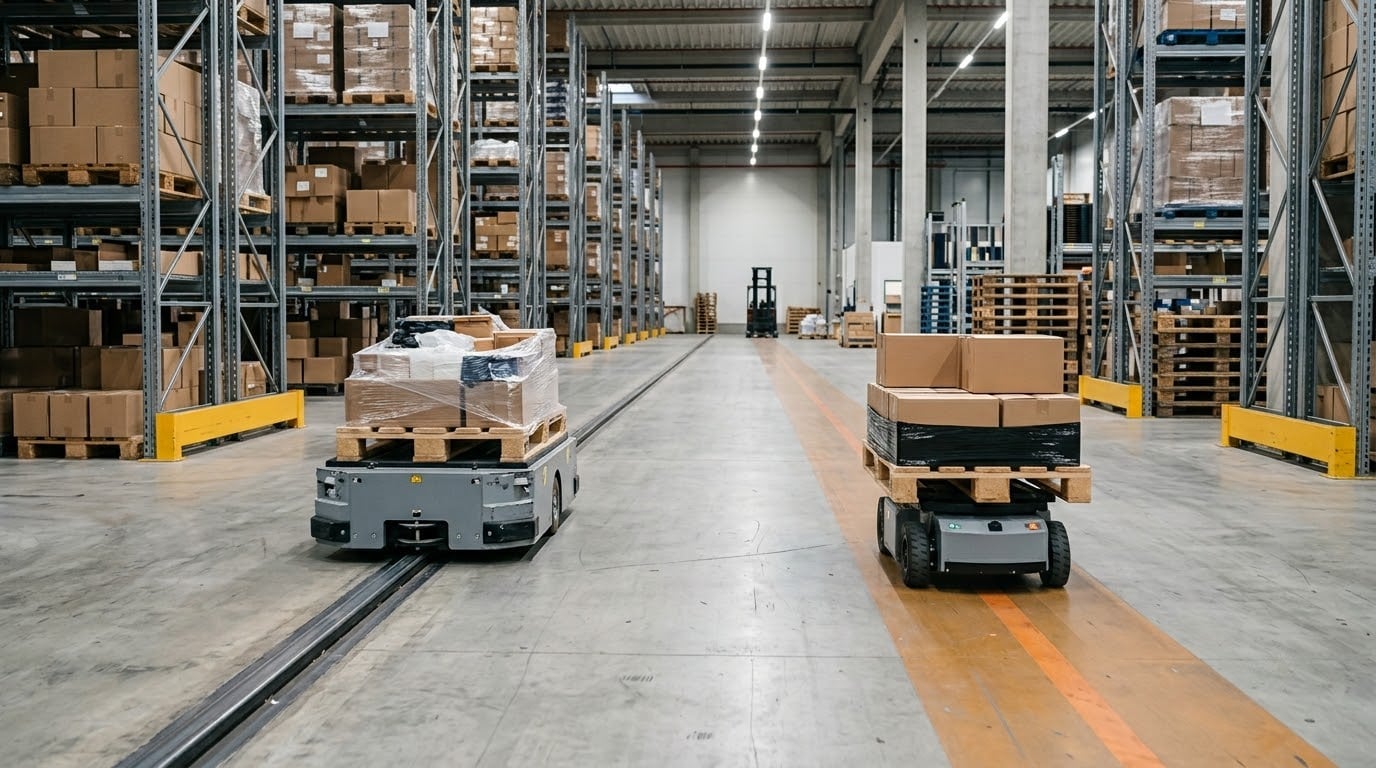
There is no universal winner in the AMR vs AGV in warehouses debate. An automated guided vehicle wins on stable, repetitive loops with predictable routes, and an autonomous mobile robot wins whenever your layout, traffic or order mix changes from month to month. The right answer depends on how much your floor plan moves over the next five years.
I work with warehouse and plant teams making exactly this call, and the mistake I see most often is picking the technology first. Map the work first, then the vehicle falls out of it almost every time.
Table of Contents
- AMR vs AGV in Warehouses at a Glance
- What is the difference between AMRs and AGVs?
- How do AMRs navigate a warehouse?
- How do AGVs follow routes?
- Which system is more flexible when warehouse layouts change?
- Which system handles more warehouse tasks?
- AMR or AGV: cost, deployment, and maintenance
- AMR vs AGV safety and warehouse integration
- Which Should You Choose?
- Nine questions to ask any AGV or AMR supplier
- Frequently Asked Questions
- Conclusion: Choose the right mobility model for your warehouse
AMR vs AGV in Warehouses at a Glance
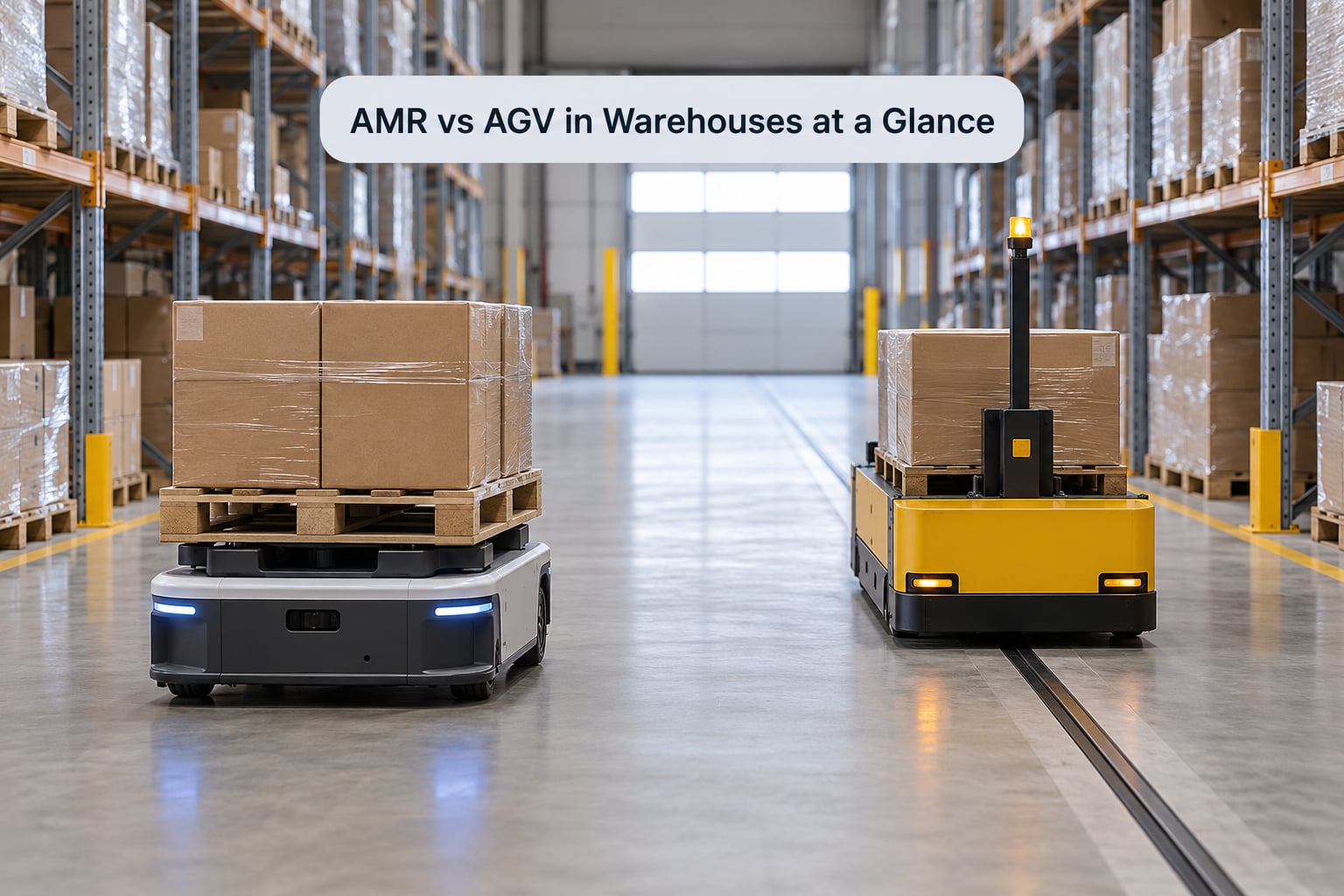
This table is the fastest way to see where the two diverge. Every row is a decision you will actually face during evaluation.
| Criterion | AGV (automated guided vehicle) | AMR (autonomous mobile robot) |
|---|---|---|
| Navigation | Follows guidance in or on the floor: magnetic tape, buried wire, reflective markers or QR codes | Builds and localizes inside a digital map using SLAM with LiDAR, cameras and odometry |
| Route flexibility | Fixed. New route means new guidance hardware and downtime | Any mapped aisle, changed in software in minutes |
| Blocked path | Stops and waits, or takes a defined bypass if one exists | Reroutes around the obstruction while the mission stays open |
| Control model | Centrally dispatched; the fleet manager assigns every mission | Mission-driven; vehicles negotiate and prioritize largely on their own |
| Deployment time | Weeks to months, dominated by floor work | Days to weeks for a first zone, then near-instant expansion |
| Infrastructure | Guidance hardware, potentially conveyor or workstation interfaces | Wi-Fi coverage and a mapped, drivable floor |
| Layout volatility | Poor fit. Every relocation is a project | Strong fit. Reconfiguration is a mission change |
| Typical tasks | Pallet moves, line-side replenishment, trailer loading, WIP transfer on fixed loops | Tote and carton transport, goods-to-person, returns, staging, cross-facility runs |
| Upfront spend profile | More money in infrastructure, less per vehicle | More money per vehicle and in software, minimal floor work |
| Best fit | Stable, dedicated, high-repetition workflows | Mixed traffic, seasonal demand, changing product mix |
What is the difference between AMRs and AGVs?
The difference between AMRs and AGVs is where the thinking happens. An AGV is told exactly where to go and follows a defined path, while an AMR builds its own understanding of the floor and decides how to get there.
An AGV detects guidance hardware under or beside it and tracks it continuously. Something blocks the lane and the vehicle stops, because its logic only knows about the lane.
An AMR scans continuously for people, forklifts, pallets and dropped loads, then computes an alternative route in real time. Its mission stays the same even when the path changes.
Both move totes, pallets and carts, and both sit under the same US safety standard, ISO 3691-4, with the companion ANSI/RIA R15.08 applied in North America. The difference is autonomy of route, not quality of the lift.
How do AMRs navigate a warehouse?
AMRs navigate with a map built from the sensors already on the vehicle, plus software that keeps them located inside it.
SLAM, short for simultaneous localization and mapping, does the core work. LiDAR spins and sweeps a laser across the space to measure distances and build a map on first run. Cameras and depth sensors add obstacle classification, so a person and a pallet leg get treated differently.
VSLAM, visual SLAM, uses camera imagery instead of or alongside laser, which some sites prefer in environments where laser reflections off glossy surfaces cause trouble. Wheel encoders and an inertial measurement unit track motion between scans.
Localizing means knowing, continuously, where the vehicle sits inside that map. Path planning then happens every cycle: given a mission, the software picks a route, checks it against other vehicles, and re-checks it if the world changes. No tape goes down during any of this.
How do AGVs follow routes?
AGVs follow routes because the route is physically built into the floor.
Magnetic tape or a buried wire carries a signal the vehicle reads through a sensor underneath it. Reflective markers or QR codes work the same way in reverse: the vehicle reads position from fixed points it passes. Optical and laser guidance add distance measurement on top.
A central controller assigns missions, reserves route segments, and holds vehicles at intersections so two AGVs never enter the same section at once. That coordination is excellent, and it is also the source of the rigidity, because the whole schedule assumes the lanes stay where they were drawn.
Tape and markers wear. Pallet jacks and forklift tires cross them daily. Every repair to guidance hardware is a line-down event in that zone.
Which system is more flexible when warehouse layouts change?
AMRs are more flexible when warehouse layouts change, and the gap widens with every move. This is the single most decisive practical criterion, and practitioners raise it more than any other.
An AGV route change means stopping the zone, removing or laying guidance hardware, remapping the controller and restarting. Teams routinely postpone a needed re-slotting because the downtime is real, so the old flow keeps running long after it stopped fitting.
An AMR handles the same change as a software edit. Update the map, redefine the mission, and traffic resumes around whatever the floor looks like now.
Seasonal demand is the other place this shows. A fulfillment center that adds pick zones every October can grow its AMR fleet and remap between peaks. An AGV facility expanding into seasonal space is laying new guidance every year.
If you expect brownfield expansion, a new building, or a product mix that shifts quarterly, flexibility is not a nice-to-have. It is the whole case.
Which system handles more warehouse tasks?
AMRs cover a wider range of tasks per vehicle, while AGVs still hold an advantage on repeatable loops where a purpose-built attachment is bolted to the vehicle for one job.
On the AMR side, a modular top module means the same chassis carries a tote, a carton stack, a shelf bin or a pallet depending on the mission. That general-purpose character is why AMRs took over goods-to-person, returns processing, staging moves and cross-facility transport.
AGVs do not lose on payload. Heavy pallet movement, line-side replenishment to a fixed point, and trailer loading are exactly the repeatable, high-dedication work they are built for. When the same pallet goes from receiving to the same rack every day, a dedicated vehicle with a fork or roller top is hard to beat.
Cold chain and hazardous material transport deserve separate verification rather than an assumption. Ask any vendor how their equipment behaves at your actual temperature range and duty cycle, and get it in writing. Community discussion around cold-chain selection stays thin enough that nobody can shortcut the test for you.
AMR or AGV: cost, deployment, and maintenance
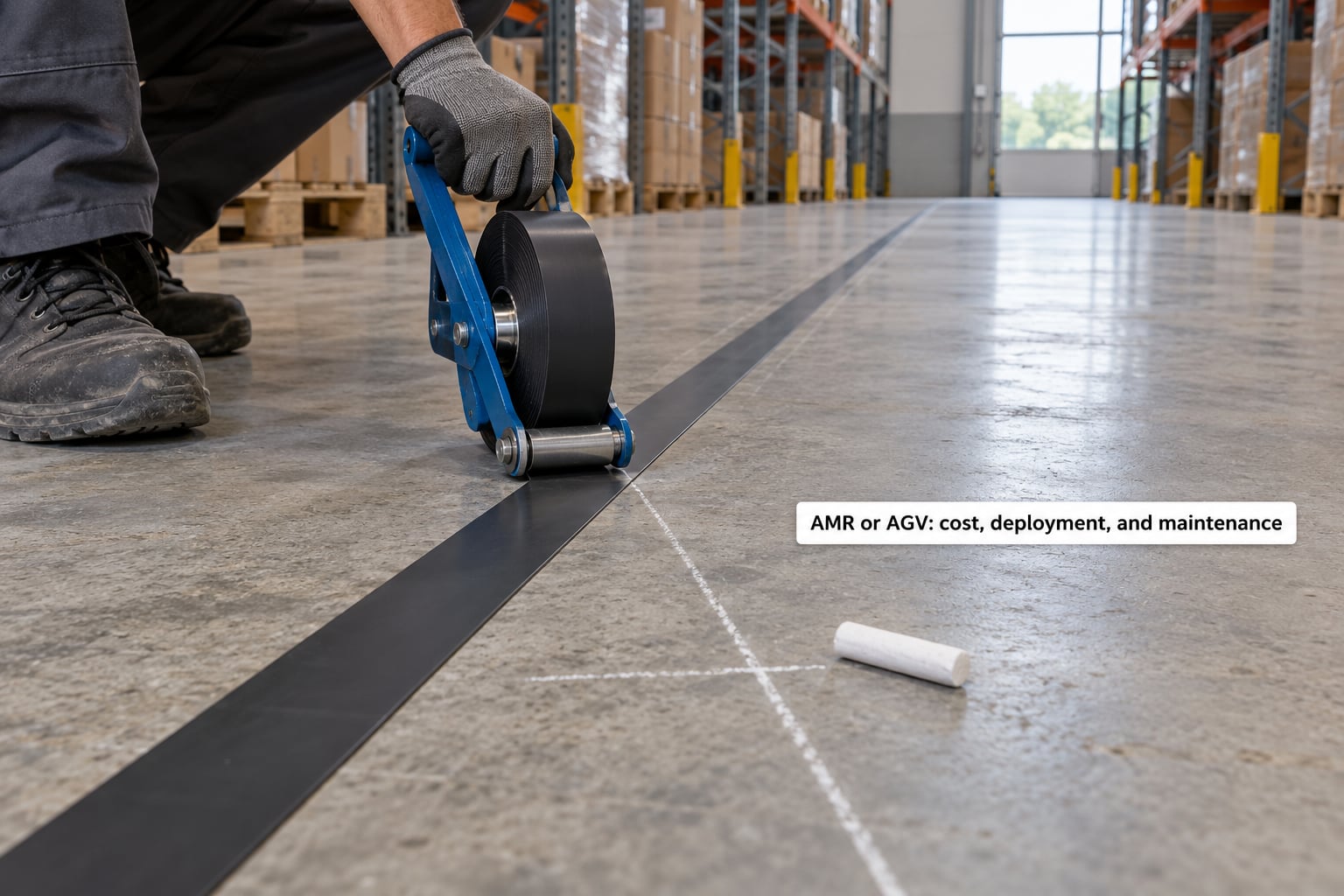
AGVs move more of your spend into infrastructure; AMRs move more of it into vehicles and software. Which one costs less over the life of the facility depends almost entirely on how many times your floor plan changes.
Upfront, an AGV project typically carries lower per-vehicle cost and higher project cost, because guidance hardware, controller work and sometimes conveyor interfaces have to be built. One AMR vendor puts the added AGV infrastructure at roughly 15 to 30 percent of total project cost, which is a vendor figure rather than an industry average, so treat it as a directional marker rather than a quote.
Over five to seven years, the arithmetic can flip. Every relocation on an AGV system carries tape or wire removal, re-laying, controller remapping and lost production hours. Several changes a year turns into a recurring expense that no line item ever showed up on.
Maintenance looks different too. AGV guidance is a wear item with a known replacement cycle. AMR maintenance is more software and sensor work, plus batteries.
Charging deserves a plan before you buy, not after. For multi-shift or near-continuous operation, ask whether vehicles charge opportunistically during idle moments, how many charge docks the plan needs, and whether battery swap stations fit your floor. Undersized charging quietly caps throughput and turns into a bottleneck nobody modeled.
Labor profiles differ as well. AGV installation is a construction project with a specialist crew. AMR deployment is closer to an IT rollout with a mapping run.
AMR vs AGV safety and warehouse integration
Both system types fall under the same functional safety standard, so safety is not a tiebreaker on paper. The practical difference is how right-of-way gets managed once humans, forklifts and robots share an aisle.
ISO 3691-4 covers driverless industrial trucks and their systems, and ANSI/RIA R15.08 is the US adoption of the same requirements for industrial mobile robots. Both mean scanners, emergency stop, safe speed limiting and audible or visible movement indication. Ask for certification specific to your region before accepting a demo.
The operational difference is congestion. Narrow aisles, shared staging lanes and convergence points create choke points where vehicles queue. Centralized AGV control is very good at assigning right-of-way on known lanes. AMRs negotiate dynamically, which is faster in open space and messier at a pinch point unless you set rules: one-way aisles, priority by direction, yield points at crossings, and defined handoff zones where humans step out of the robot lane.
On integration, both need a real handshake with your warehouse management system or ERP. The AMR side is usually simpler, because missions are defined in software rather than by controller logic tied to physical lanes. Elevator and door interfaces, multi-floor routing and MES connectivity should be written into the scope, since they are custom work in both cases.
One item worth raising early is cybersecurity. Remote fleet software and cloud management raise the exposure compared with a closed controller. Ask how updates are delivered, what authentication looks like, and whether the system keeps working when connectivity drops.
Which Should You Choose?
Choose AMRs when your floor plan, traffic or order mix changes often, and choose AGVs when you have stable, repetitive, fixed-route loops with predictable flow. Facilities with distinct zones often run both.
AMR vs AGV in warehouses: the facts that settle it
Before evaluating a single vendor, gather five things about your operation:
- Layout volatility. Count planned moves and re-slotting events over the next three years. Frequent change points to AMR.
- Payload and attachment needs. Tote, carton, pallet or a dedicated fixture. Standardized loads point to AMR; a single heavy fixed loop points to AGV.
- Traffic profile. Shared aisles with people and forklifts favor the dynamic rerouting of AMRs, provided you can publish right-of-way rules.
- Integration surface. Which WMS, ERP or MES systems must issue missions, and how much custom interface work will be needed.
- Demand trajectory. Seasonal peaks and expansion favor a fleet you can add to and remap without construction.
Then run a pilot with a measured baseline rather than a demo in a vendor’s showroom. One zone, a defined task, a set period, and numbers from before and after.
Track more than labor savings. Useful measures include cycle time per run, on-time internal deliveries, congestion events at known choke points, the exception rate where a robot needed human intervention, and stockout incidents in supported locations. Set a scale trigger, such as a high share of missions completing without manual help, before you expand. Documented triggers beat optimistic assumptions.
Hybrid fleets are worth a serious look. A trailer-loading loop or a fixed line-side loop rarely benefits from a mobile map, while the picking floor almost always does. Most vendors now let one fleet manager schedule both, but confirm that integration is supported rather than assumed.
Nine questions to ask any AGV or AMR supplier
These cut through the demo-day enthusiasm quickly:
- Show me deployments in facilities like mine, including my temperature range and duty cycle.
- What safety certification applies to my region, and can I see the documentation?
- What happens to my layout change after go-live, and what does it cost?
- How do right-of-way rules work in shared aisles, and can I define them?
- What is the integration path with my WMS or ERP, and who writes the interface?
- How do charging and battery swap work across my shifts?
- Is the fleet software open through an SDK or API, and what happens if I switch vendors?
- What do the first 90 days look like, and who owns the mapping and training?
- What KPIs will we measure together, and what result would make you recommend a smaller system?
Frequently Asked Questions
What is the difference between AGV and AMR?
An AGV follows a fixed, predefined path using guidance in or on the floor such as magnetic tape, buried wire or reflective markers, and it stops when that path is blocked. An AMR builds a map with SLAM using LiDAR, cameras and odometry, then plans and replans its own route around obstacles and people without any floor infrastructure.
Which is more expensive, an AGV or an AMR?
AGV projects usually carry lower per-vehicle cost and higher infrastructure cost, with one vendor putting added AGV infrastructure at roughly 15 to 30 percent of total project cost. AMRs cost more per unit and less in floor work. Over five to seven years, repeated AGV re-guidance and downtime can flip that comparison if your layout changes often.
Which is better for a warehouse with changing layouts?
AMRs are the better fit when layouts change often, because a new route is a software and mission change rather than a construction project. Re-slotting on an AGV system means laying or removing guidance hardware, remapping the controller and losing production time in that zone, which is why many facilities keep running a layout they have outgrown.
Can AMRs replace AGVs in an existing facility?
Often yes, and many brownfield sites migrate one loop at a time rather than all at once. Existing guidance hardware stays in place for the AGVs still running, while AMRs take on the zones with the most layout change. Vendors increasingly schedule both types from one fleet manager, but confirm that mixed-fleet support is native before you plan on it.
Do AMRs need magnetic tape or floor markers installed?
No. That is the defining practical difference between the two technologies. AMRs navigate with onboard sensors and SLAM mapping, so they need a mapped, drivable floor and reliable wireless coverage, but no tape, wire or markers. Guide tape, wire or markers are an AGV requirement, and their wear and upkeep is a recurring cost of that choice.
Can AGVs and AMRs work in the same facility?
They can, and many sites run a hybrid fleet. Centralized AGV control is strong at assigning right-of-way on known, dedicated lanes, while AMRs handle the open floor and the changing parts of the operation. The shared element is right-of-way: publish one-way aisles, priority rules and yield points so people, forklifts and robots behave predictably in shared lanes.
Conclusion: Choose the right mobility model for your warehouse
The AGV versus AMR decision comes down to one question: how much does your floor plan change over the next five to seven years? Stable loops with dedicated lanes favor an AGV. Mixed traffic, seasonal peaks and re-slotting favor an AMR, despite the higher per-vehicle cost.
Start by mapping your task paths, layout volatility, payload requirements, integration needs and expected demand. Then ask a vendor to demonstrate on your floor, against your load and your traffic, rather than in a showroom. That comparison still matters more in 2026 than it did five years ago, and it is the only one that reflects your operation.