
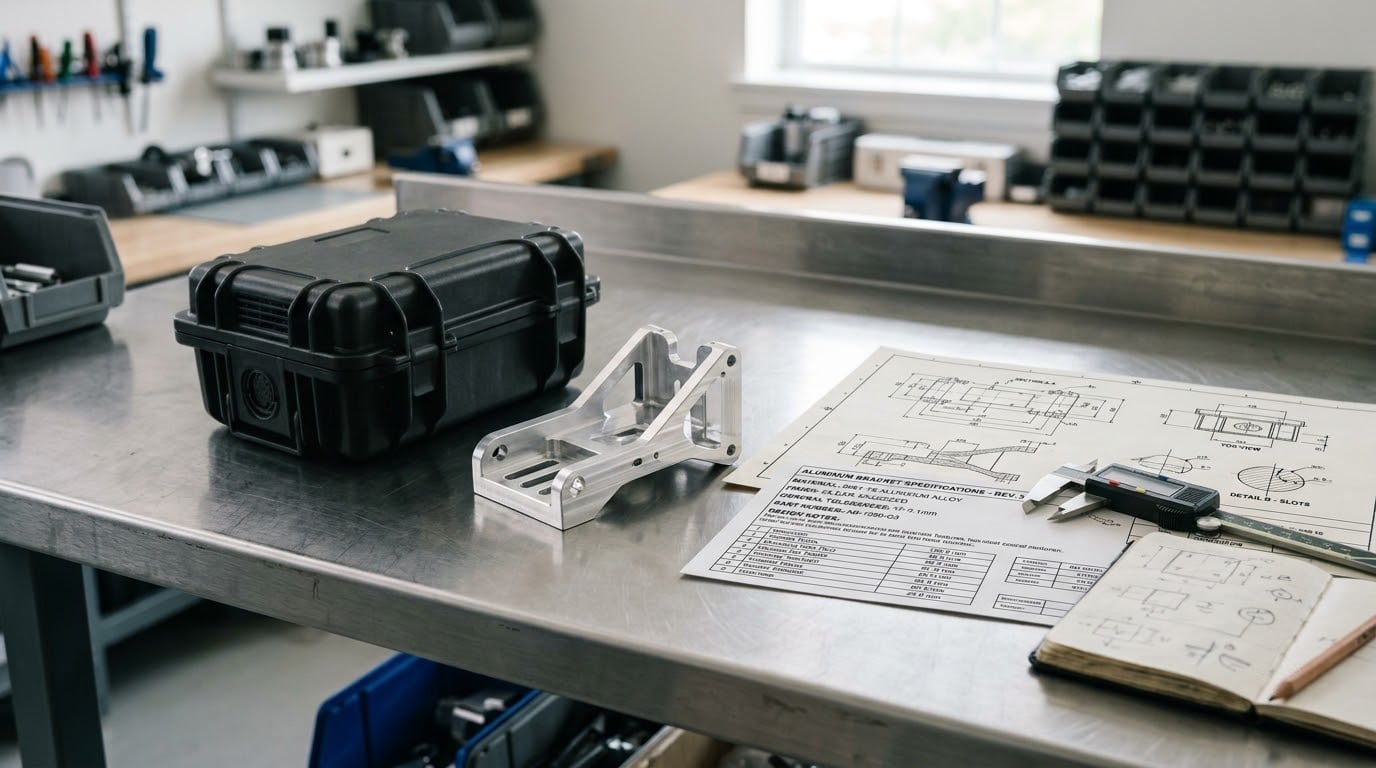
How to find suppliers for manufacturing comes down to turning a rough product idea into a written specification, building a wide list of candidates, verifying who actually owns the machines, and comparing quotes that all cover the same scope. Suppliers come from industrial directories, trade associations, referral networks, marketplaces, and factory audits. A first shortlist takes two to four weeks; a full approval with samples and a pilot run takes closer to two months.
Most sourcing failures aren’t caused by a bad factory. They come from sending vague requests, comparing quotes that quietly include different things, and trusting a certification photo instead of a production line. The process below is the one that keeps those problems out.
Two terms come up constantly, so define them once. A manufacturer transforms raw materials into finished goods on its own equipment and its own shifts, and it can repeat that run hundreds of times. A supplier is the broader term: it sells you something, and it may or may not make it. A wholesaler or trading company sells goods made by someone else. When you work with a supplier who is not the factory, you are buying convenience and you should price it as such.
Table of Contents
- What You Need Before You Contact Any Supplier
- How to Find Suppliers for Manufacturing: Step-by-Step
- Define the Part, Process, and Purchase Requirements
- Build a Supplier Universe That Fits the Project
- Screen Candidates for Real Manufacturing Capability
- Request Quotes That Can Be Compared Fairly
- Verify Quality Systems, References, and Financial Readiness
- Validate the Process With Samples or a Trial Run
- Negotiate Price, Tooling, Quality, and Delivery Terms
- Run a Controlled Pilot and Approve the Supplier
- Domestic and Overseas Sourcing: What Actually Changes
- Common Mistakes That Cost Buyers Money
- Frequently Asked Questions
- What is the fastest way to find suppliers for manufacturing?
- How many suppliers should a company contact for quotes?
- Should a new manufacturing supplier pass an audit before receiving an order?
- How do you verify that a manufacturer can meet your quality requirements?
- Should tooling be owned by the customer or the supplier?
- How much should a supplier reduce price for a larger production volume?
- Conclusion: Start With a Scored Supplier Shortlist
What You Need Before You Contact Any Supplier
Suppliers price what you describe. If the description is thin, you get a quote for a guess, and you will pay for the gap later. Gather the following before you send the first request for quotation.
- A finished-part drawing or tech pack. Not a sketch. Dimensions, tolerances, surface finish, material grade, and the critical-to-quality features marked.
- A bill of materials. Every component, with the specification you intend to buy, plus anything you are open to substituting.
- Volume scenarios. Prototype quantity, first production quantity, and a realistic 12-month forecast. Suppliers price tiers, and the tier you land in changes the unit economics completely.
- Quality requirements. The inspection level you intend to hold, the defect classes that matter, and any standard your customer has imposed on you.
- Compliance needs. RoHS or REACH declarations, FDA registration, UL listing, CE marking, or your own customers’ supplier qualification requirements.
- A target cost. Not a number you publish to suppliers, but a number you know, built from your margin target and your selling price.
- Delivery terms. Ship-to address, packaging format, and Incoterms. If the candidate is overseas, the trade term decides who pays freight, duty, and insurance. Our Incoterms guide for manufacturing buyers walks through the ones that come up most.
- Weighted selection criteria. Decide what you are scoring before you see any pricing. Capability and quality response time, landed cost, lead time, communication, certification fit, and financial stability.
Write the weights down before the first call. Buyers who set criteria after seeing quotes tend to pick whichever one came in cheapest and then discover the mismatch three weeks into production.
One more thing to prepare: a non-disclosure agreement, if the design is not yet public. Send the NDA before the drawing, not after. A supplier who argues about signing one is telling you something useful about how your design will be handled.
How to Find Suppliers for Manufacturing: Step-by-Step
Define the Part, Process, and Purchase Requirements
Step one is deciding what you are actually buying. A part can be made several ways, and each way carries different cost, tolerance, and tooling implications. A plastic enclosure might be injection molded, 3D printed for prototypes then molded for production, or machined from a block for short runs.
Name the process you have in mind and say why. Suppliers who disagree with your process choice are useful to hear from, but only if you asked a question rather than issuing an order. Tell them the annual volume, the target cost per piece, and the latest date the finished goods are needed at your dock.
Then state the purchase requirements plainly: packaging format, carton quantity, labelling, barcodes or lot codes, and the delivery location. Every one of those gets priced, and the ones you leave undefined get priced by the supplier’s own preference.
You know this step worked when two different suppliers, given the same package, ask you the same clarifying questions. If their questions are wildly different, your package is missing something. Common gaps are surface finish, thread specifications, and the acceptable variation on anything you marked critical.
Build a Supplier Universe That Fits the Project
You want a long list, not a short one. The standard approach is to cast wide in five or six directions and only narrow down once you have enough candidates to compare.
- Industrial directories. Thomasnet and IndustryNet for North American shops, Kompass for international coverage, Maker’s Row and MFG.com for smaller job shops and prototype work.
- Process-specific marketplaces. Sourcify and similar platforms for overseas contract manufacturers that publish verifiable factory profiles rather than storefronts.
- Trade associations and shows. The specialist trade fair for your process is still the highest-signal room you can walk into. Exhibitors are pre-qualified in a way directory listings are not.
- Referral networks. Buyers consistently report better results from a warm introduction than from cold email. If your company has done this before, ask who bought similar parts and whether they still work with them.
- NAICS codes and public records. The code tells you whether a company is classified as actually manufacturing in that process or merely reselling. Shipment databases such as ImportYeti or Panjiva can trace a competitor’s product back to the factories that make it.
- Targeted web searches. Process plus material plus region. “5-axis CNC machining aluminum aerospace” returns a different list than “prototype machining,” and the second one fills with brokers.
Referrals outperform cold outreach in most buying circles I have heard from, and directories carry listings that go years without anyone checking them. Treat both as starting points, never as a shortlist.
Separate candidates into three piles as you go: a factory that plausibly runs your process, a company that might, and a lead that does not. Most of your research time should go to the first pile.
Volume changes the search itself. Above a few thousand pieces a year, contract factories with dedicated capacity are the right target. Below a few hundred, job shops and small-batch specialists often serve you better, because a plant set up for a 50,000-piece run will price your 200-piece order as an exception and treat it that way. Say the volume in your first message so nobody wastes a week quoting work they are not equipped for.
If you are deliberately diversifying away from a single country or a single supplier, search by process within the region rather than by country name. Vietnam, India, Mexico, and Türkiye all have real clusters in specific processes, and “aluminum die casting in Vietnam” returns a shorter, better list than “Vietnam suppliers.” Cluster knowledge travels fast through trade associations and freight forwarders, who will tell you which regions actually run which processes.
Reverse-engineering works too, and it costs nothing but patience. Take a product you admire apart, note every component, then use a shipment database to see who shipped comparable goods and to which ports. That gives you a factory name in the country you actually want to buy in, and it tells you the volume they are already running at. Knowing that a plant ships containers of a related part every month is stronger evidence than any profile page.
Outsourcing the search is reasonable in three situations: you have no one on staff who can read a drawing and spot a bad process claim, you are buying in a language or country where you cannot find your way around on your own, or the volume justifies it. A sourcing agent charges a percentage of order value, commonly in the single digits, and in exchange screens factories, negotiates, and manages production for you. Compare that against the cost of a full-time buyer plus the defects you would not have caught.
Screen Candidates for Real Manufacturing Capability
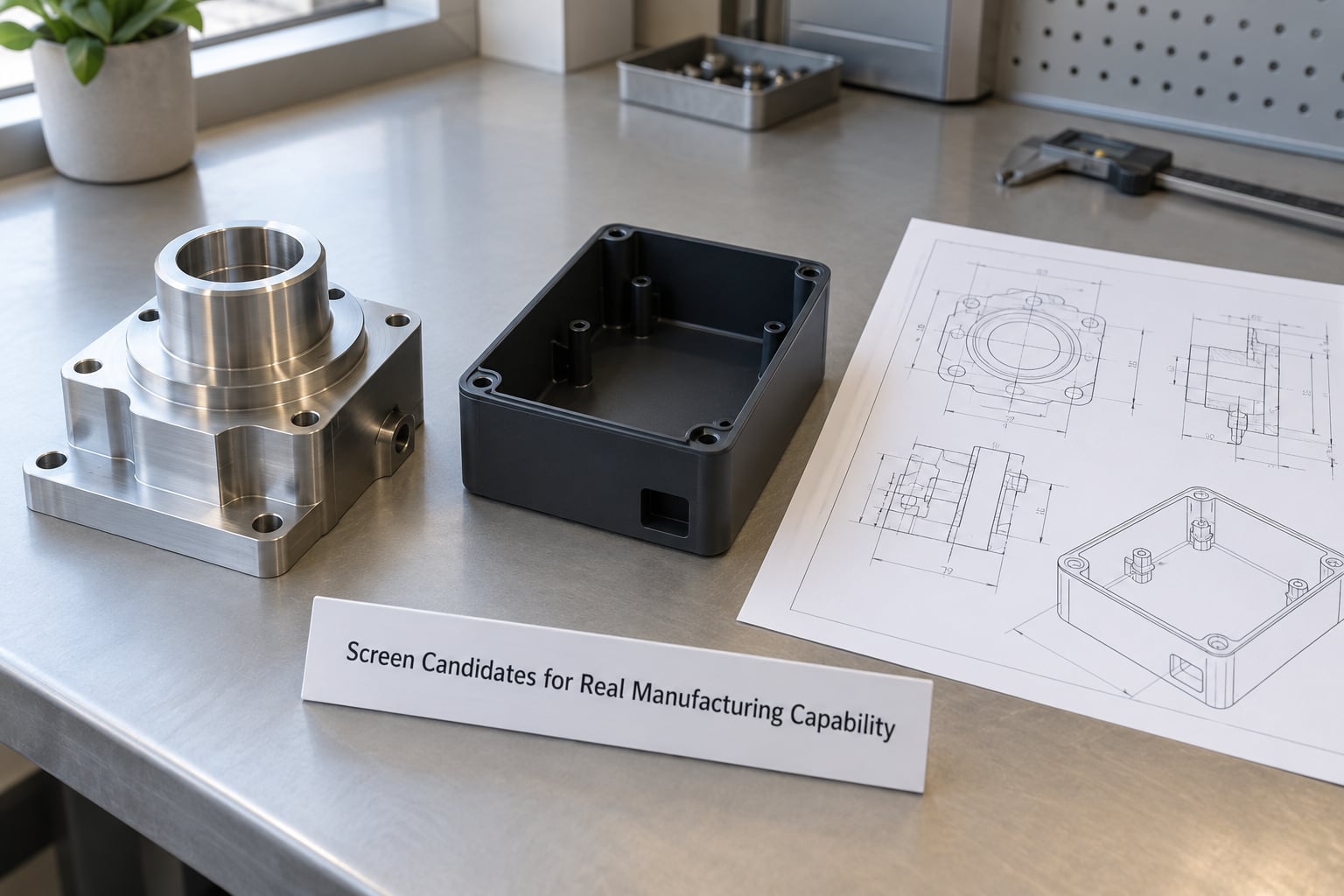
Screen before you ask for pricing. A quote from a company that cannot make the part teaches you nothing useful, and it wastes weeks of everyone’s calendar.
Check what equipment they actually own, whether they run your process as a primary business or a sideline, and whether they have engineers on staff who can answer a tolerance question without escalating it. Ask for the machine list with manufacturer and model, then sanity-check it against the process. A shop claiming five-axis milling with a single older machine is telling you something about the rest of its claims.
Confirm capacity. A 20-job shop that already has six months of booked capacity cannot promise you a 30-day lead time, no matter what the quote says. Ask what percentage of the plant’s output is available in your window.
Ask about minimum order quantity, sample cost, tooling cost, and how long they have been operating. Long-tenured operations with stable staffing are a different risk than a shop that opened last year with rented machines.
Ask to see the floor. A live video walk that pans continuously from raw stock through machining to assembly is hard to fake, and a supplier who refuses one is telling you the machinery is not theirs.
You know this step worked when each surviving candidate can describe, in their own words, how your specific part gets made, and the descriptions differ from each other in the way real processes do.
Engineering support is the piece most buyers forget to probe. A shop with a resident engineer who can read a drawing, suggest a design tweak that removes a secondary operation, and write a process sheet will save you money you never see. A shop that routes every technical question to email will consume your engineering team’s time and still miss the easy improvements.
Ask about their difficult parts, not their average ones. “Show me something you made that fought you” tells you about problem-solving, tolerance capability, and how they behave when a run goes sideways. Every experienced shop has one, and the ones that answer honestly are the ones worth the phone calls.
Request Quotes That Can Be Compared Fairly
Comparing quotes only works when the quotes cover the same scope. Send every candidate the same package and the same list of inclusions, and require an itemized response.
Your RFQ should specify: the drawing revision, material grade and source, tolerances and inspection level, tooling scope, sample and first-article charges, packaging format, delivery location and Incoterm, quoted lead time, payment terms, and unit price at each of your three volume scenarios.
Ask them to state what is excluded. A quote that excludes surface finishing, or excludes freight, or assumes a different material, is not wrong, it is just not comparable. The fastest way to compare is to write exclusions into the RFQ itself as required line items with a “not included” box.
Build a landed cost column rather than a unit price column. Freight, duty, insurance, inspection fees, tooling amortisation across your order, scrap allowance, and payment terms all belong in the sheet. Our guide to comparing manufacturing quotes on equal terms has a structure for that sheet.
Landed cost is the number that decides whether a product works. Add up the piece price, the per-unit share of tooling and setup, inbound freight and insurance, duty and any tariffs that apply to your classification, inspection and testing fees, packaging, the cost of money on your payment terms, and an allowance for the defect rate you actually expect rather than the one promised. Divide by the quantity that arrives saleable.
Two line items get forgotten most often. The first is scrap and rework, which on a thin-tolerance part can add several percent without anyone writing it down. The second is the working capital sitting in a deposit you paid two months before the goods existed. Both belong in the comparison even though neither appears on the supplier’s invoice.
Then look at the spread. Quotes within about 15 percent of each other usually mean you have a real competitive field. Quotes that vary by 60 percent mean scope is still different somewhere, and that is worth another round of questions before you score anything.
Read lead times as commitments rather than estimates. The number that matters is the one broken down into tooling, first article, production, and transit, because the pieces move at different speeds and only the longest one sets your date. A supplier quoting a 25-day total lead time when four of those days are ocean freight has told you production takes about three weeks, which is a different piece of information.
And give everyone the same deadline. Suppliers who return a quote days after your field has closed are not competing for the work, whatever their unit price says.
Verify Quality Systems, References, and Financial Readiness
Certifications matter, but they are a floor, not a ceiling. ISO 9001 tells you a company has a documented quality system and has been audited for it. It does not tell you they can hold your tolerance on a Tuesday when they are behind schedule.
Verify the certificate rather than the PDF. Check the issuing body, the certificate number, the scope, and the expiry. A certificate that names a different facility, a broader scope, or an expired date tells you the supplier’s paperwork discipline is not what you assumed.
Match the certification to the requirement. ISO 9001 covers quality management broadly. ISO 13485 is the medical devices standard, ISO 14001 is environmental, and social audits such as SMETA or BSCI address labour conditions. For US-bound goods, know the forced-labor import restrictions that apply to your inputs and ask whether the supplier can trace material back to the mill.
For buyers who work in regulated spaces, the list gets specific fast. Medical devices need ISO 13485 and usually a documented design control process. Electrical products need safety certification for the destination market. Anything with electronics needs RoHS and often REACH declarations. Food-contact and drug-contact materials need their own compliance path. Ask which of these the supplier already holds, and if the answer is none, ask what it would take and how long, because a certification gap is a scheduling problem you want to know about before the pilot, not after.
Then ask for references from customers in a comparable product category, and actually call two of them. Ask what the supplier was like during a delivery problem, not just whether they were easy to work with. That question surfaces more than a dozen polite adjectives will.
Check business stability: years operating, employee count, whether the entity on the invoice matches the entity on the business license, and whether insurance certificates are current. An unexplained mismatch between the company name on the quote and the company name on the payment account is worth a very slow conversation.
You know this step worked when you hold a reference who will answer a follow-up question six months from now.
If the supplier is overseas and you cannot travel, hire an independent audit firm to walk the floor. A good report tells you more than a certificate ever does: the actual machine list, observed worker-to-machine ratios, whether the inspection equipment is calibrated and used, sub-suppliers on the floor, and a gap list with a corrective action plan attached. Ask for the raw observations, not a single score.
Third-party inspection during production is a separate purchase from the audit, and for a first order it is worth the fee. Someone counts the pieces, measures a sample against the drawing, and photographs the cartons before they are sealed. It does not replace your own incoming inspection, but it moves the discovery point upstream, where the money is still recoverable.
Validate the Process With Samples or a Trial Run
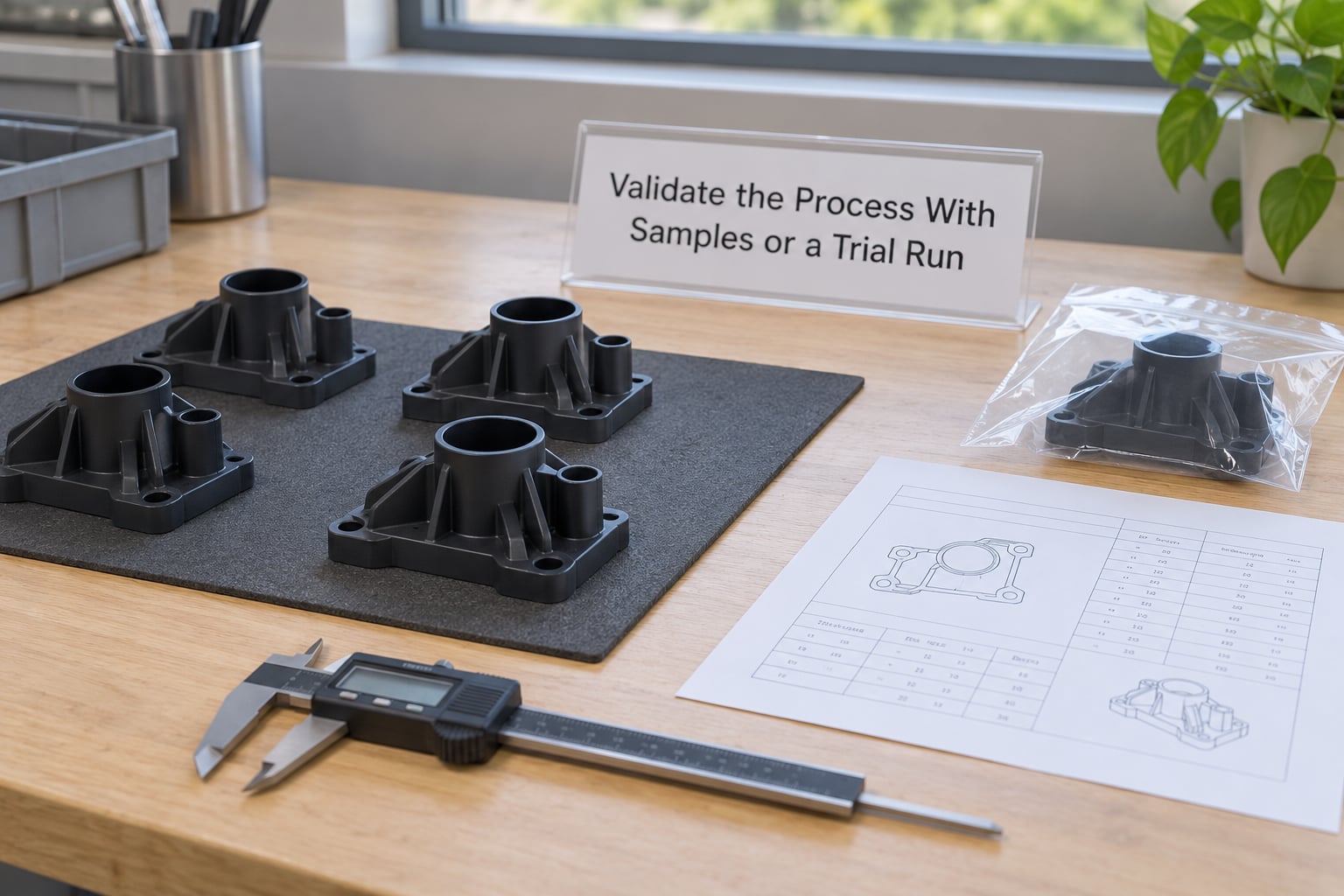
The gap between the sample and the production run is where supplier relationships get tested. Push validation earlier rather than later, and validate more than once.
Start with material samples and a finished appearance sample, so you agree on what acceptable looks like before anyone argues about defects. Then move to the first article: the first production piece made under production conditions, submitted with a dimensional report against every characteristic on the drawing.
Define the acceptance level in writing rather than saying “looks fine.” A general AQL of 2.5 for major defects, with zero critical defects, is a common baseline. What matters is that the supplier measures against the same criteria you will hold later, and that the criteria were set before the parts existed.
Test the function, not only the dimensions. A part can measure perfectly and still fail in assembly because the mating edge is in the wrong place. A packaging test matters too: if the part arrives scuffed inside a box that is too tight, the damage happened after the part passed inspection.
Approve and physically sign one production-intent unit as the golden sample. Send one to the supplier, keep one in your own file, and mark both with revision and date. Every future dispute about quality gets settled against those two objects instead of against memory.
For expensive tooling or long lead-time processes, ask for a limited production run rather than a single article. It exercises the real setup, the real operators, and the real measurement routine, and it exposes the scheduling problems a lone prototype never will.
Write a short test plan before the samples arrive, so the people measuring them know what they are looking for. List the critical dimensions, the functional test that matters, the cosmetic standard you agreed, and the failure mode you most expect. Test the same items on every supplier’s sample, because the only meaningful comparison is side by side.
Then take notes while the parts are still on the bench, including the things you might otherwise forget: how long the supplier took to respond to a question, whether they flagged a specification problem you missed, and whether the sample arrived in packaging you could actually store and ship. Those observations are free quality data.
Negotiate Price, Tooling, Quality, and Delivery Terms
Negotiation is easier when you arrive with a completed quote in hand from three other suppliers and a written scoring sheet. You are not asking for a favour, you are selecting among defined terms.
Work through the commercial items in this order.
- Volume pricing. Ask for the price at each of your forecast tiers in writing, along with the quantity that unlocks each tier. Ask what happens to the price if volume falls short in a quarter.
- Tooling. Separate the tooling charge from the piece price and document ownership, maintenance responsibility, storage, and transfer if the relationship ends. Cover this in your NDA and tooling ownership clauses before any metal is cut.
- Capacity commitment. Get a written statement of how much capacity is reserved for you and what notice period applies to schedule changes.
- Quality terms. AQL level, defect classification, rework and credit policy, the procedure for nonconforming material, and who pays for the freight when a shipment is rejected.
- Change control. No material, process, or sub-supplier substitution without written notice and your approval. This is where tooling quietly changes alloy and nobody notices for two years.
- Payment terms. For a new relationship, a deposit with the balance against inspection is normal. Net terms come later, once delivery performance exists.
- Liability and warranty. What the supplier covers on a defective lot, and how the claim is made.
Every one of these belongs in a written manufacturing agreement, not in email. The document matters less as legal theatre than as a shared list of what everyone agreed to, at the moment they agreed to it.
Time zone and language differences cost more than buyers expect, and the fix is procedural rather than heroic. Agree at the start on a single communication channel, a fixed response window, and the language for anything contractual. Keep drawings and inspection reports in writing where a date and a number appear, since a spoken percentage point and a written one turn out to be different things later.
For an overseas supplier, put a single named person on both sides as the owner of the order, and require your contact to have production access rather than sitting only in a sales inbox. Suppliers who will not name the production manager are usually not going to let you talk to them either.
Escalation deserves a rule in advance. Decide what happens if the pilot order misses its date, what happens if a lot fails inspection, and who at each side has the authority to stop a shipment. Suppliers respond well to a clear, pre-agreed procedure because it removes the awkwardness of an ad hoc argument, and you avoid the situation where a rejected lot sits in a warehouse because nobody was authorised to say no.
Run a Controlled Pilot and Approve the Supplier
The pilot run exists to test the supplier under real conditions, at a size where losing the money hurts without ending the project.
Write acceptance criteria before the pilot starts. Target defect rate, dimensional conformance, on-time delivery against the promised date, responsiveness on a technical question, and how they handle one deliberately awkward change request. Give each criterion a value so the result is a number rather than a feeling.
Watch the communication routine closely. A supplier who reports a problem before you find it is worth more than one who never reports anything, even when both have the same defect rate. Set a fixed weekly call at first, with an agenda, then loosen it as things stabilise.
Log every defect and every corrective action with dates. This becomes the supplier scorecard you use for the next order, and it is the only memory you will have when prices rise and you need to decide who gets your volume.
At the end of the pilot, make one of three decisions explicitly: approve, revise with a named list of things to fix and a re-run date, or replace. Writing the decision down prevents the slow drift where a supplier who failed the pilot keeps receiving orders because nobody ever closed the file.
Then keep the scorecard running. Track on-time delivery against the promised date, defect rate found at incoming inspection, responsiveness, and how many change requests they processed without a schedule slip. Review it with the supplier quarterly rather than only when something goes wrong, because a supplier hearing good news once a year has already decided who they really are.
Approval is also the moment to name your second source. Pick a part that is not on your critical path, take a comparable second supplier through the same screening, and keep them warm with small orders. A backup that has never made your part is not a backup.
Domestic and Overseas Sourcing: What Actually Changes
Where a part is made changes lead time, MOQ flexibility, communication, and your exposure to duty and freight. It does not reliably change unit cost once tooling, freight, and inventory carry are counted, which is why the decision deserves numbers rather than instinct.
Domestic sourcing gives you shorter transit, easier auditing, same-language engineering conversations, and lower duty exposure on parts assembled domestically from imported components. You pay more per piece, you have fewer candidates, and many shops set minimums of a few hundred units.
Overseas sourcing widens your candidate pool dramatically and usually lowers the piece price on labour-intensive processes. You take on transit time built into the lead time, duty and tariff exposure, communication overhead, and the verification problem, where a supplier’s claim about their own capability is the only evidence you get without a visit.
Regions close to the US tend to sit between the two. Mexico and Central America for assemblies and machined components, Vietnam and India for labour-intensive work, Türkiye for European-bound supply chains. None of them is uniformly cheaper, and the clusters differ by process, so the honest answer is that the right region depends on your part and your target market.
One rule holds regardless of location. The closer you sit to the supplier, the less your lead time is inflated by transit and the less of your schedule you are trusting to a carrier. If a supplier’s quoted lead time is mostly ocean freight, the manufacturing problem they have is smaller than the schedule problem you have.
Common Mistakes That Cost Buyers Money
Almost every expensive sourcing mistake is a shortcut that looked reasonable at the time. These are the ones that repeat.
- Comparing incomplete quotes. The cheapest sheet is usually the one missing freight, finishing, or tooling amortisation. Build the landed cost comparison before anyone falls in love with a number.
- Choosing on unit price alone. A supplier 20 percent higher on piece price and 40 percent better on defect rate is usually cheaper once you count returns, rework, and your own time.
- Treating a marketplace badge as verification. Paid placement tiers tell you who bought marketing, not who owns a factory. A store that will not show you its floor has told you something.
- Ignoring capacity. A supplier who cannot absorb your volume will either miss dates or subcontract the work without telling you. Ask what percentage of output is committed to you.
- Accepting a certificate without checking it. Verify the number and the scope with the issuing body. An expired or mismatched certificate is not a paperwork detail, it is a signal about the rest of the documents.
- Placing a large order before production validation. The first article is cheap insurance. The bulk run is not.
- Sending drawings before the NDA. Once your design is in someone else’s inbox it is out of your control, and reverse-engineering from a finished sample is straightforward.
- Leaving terms in email. Prices change, people change, and memory changes faster. A short signed agreement protects you from all three.
- Running a single supplier indefinitely. A qualified second source for the same part is insurance you build during a calm period, not during a crisis.
- Sourcing from directories without checking liveness. Listings persist for years after a shop closes or changes process. Confirm the shop still runs the equipment before you count it.
- Comparing a supplier against a broker. A trading company can quote your part and pass it to someone else. Decide early whether you need a factory or an intermediary, and price the difference in margin rather than treating the two as the same thing.
- Skipping your own incoming inspection. Every shipment still gets a check against the drawing, even after the supplier has been audited. AQL sampling tells you a lot is acceptable; it does not tell you the individual part in your customer’s hand is right.
The recurring theme is that almost every one of these skips a step to save a week, then costs a month. Sampling before production, verifying a certificate number, and writing down an agreed tolerance are all cheap. Discovering after a 5,000-piece run that the alloy quietly changed is not.
Two red flags deserve separate mention. The first is a supplier who will not accept payment terms other than full payment upfront to an unfamiliar account. The second is one who pressures you to skip the sample because the timeline is tight. Both behaviours are common in the sourcing world, and both are easy to decline politely.
A third pattern is subtler: a supplier who agrees to every term you propose, instantly, with no questions. Flexibility usually signals interest, but total agreement on MOQ, lead time, payment, inspection, and liability with zero pushback on any of them more often means they have not read what you sent or they are expecting to renegotiate once you have committed.
None of these are reasons to walk away on the spot. They are reasons to slow down, ask one more specific question, and see whether the answer is as fast as the first one was.
Frequently Asked Questions
What is the fastest way to find suppliers for manufacturing?
The fastest route is a process-specific search plus two directories rather than a general marketplace. Search the exact process, material, and region, then work through a domestic industrial directory and an international one. Trade association member lists are fast and usually more accurate than directory listings. Most buyers find a viable longlist in a week once they have a finished drawing.
How many suppliers should a company contact for quotes?
Contact five to eight candidates and expect three to five complete quotes. Fewer than three makes comparison meaningless, and more than eight usually means your screening was too loose to send them out. Send every one the same RFQ package so the responses are comparable, and score them against criteria you set before the first quote arrived.
Should a new manufacturing supplier pass an audit before receiving an order?
For low-risk, low-value parts a sample and first-article check often suffice. For regulated products, custom tooling, high-volume commitments, or anything touching your customers’ qualification requirements, yes, audit before you commit. Use an independent third-party auditor rather than the supplier’s own assessor, and ask for the findings plus the corrective action plan, not a pass or fail stamp.
How do you verify that a manufacturer can meet your quality requirements?
Verify certification numbers with the issuing body, then test capability rather than paperwork. Ask for a first-article report with measurements against your drawing, request a reference in a comparable product category, and run a limited production run. A signed golden sample, held by both sides and marked with the drawing revision, settles most future disagreements before they start.
Should tooling be owned by the customer or the supplier?
For custom tooling built specifically for your part, the customer should own it. State that in the agreement before the first cut, and record the serial number of every tool produced. Supplier-owned tooling is normal for standard or reusable dies where the cost is recovered across many customers, but custom molds and fixtures are usually worth taking ownership of for the life of the part.
How much should a supplier reduce price for a larger production volume?
Reductions vary widely by process and setup burden, so treat any fixed expectation as fiction. Setup time and material yield dominate the first order and fall away as volume rises, which is why price breaks are steepest in low-volume processes. Ask for the price at each of your forecast tiers in writing, with the quantity that unlocks it, and check whether the tier resets if a quarter falls short.
Conclusion: Start With a Scored Supplier Shortlist
The first thing to do is write the RFQ. Everything downstream gets easier when suppliers are quoting the same specification, the same volumes, and the same inspection level.
Then do three things in this order: set the weights on your selection criteria before any pricing exists, build a long list from directories, trade associations, referrals, and targeted searches, and screen candidates for real equipment and capacity before asking for a quote. Verification comes last because it is what converts a shortlist into a decision.
Buyers who work this way take longer on the front end and far less time on the back end. The supplier that clears a defined bar in week three is much cheaper than the one you discover in month four.
Keep the finished specification, the weighted criteria, and the scored shortlist in one file. When the second and third projects start, you will reuse almost all of it, and the suppliers who were good the first time are usually still there. As of 2026, the buyers who move fastest are not the ones with the biggest budgets; they are the ones who stopped sending vague emails and started comparing verified evidence.