

To negotiate with suppliers well, you prepare before you speak: define what you need, know what you will do if you say no, price the deal on total cost rather than unit price, and trade concessions instead of handing them over. Most supplier negotiations that go wrong do so in the first ten minutes, before anyone has agreed to anything.
That matters because the buyer is usually the smaller, less informed party. The supplier can see its own cost structure, its capacity plan, and how badly it wants your business. You can see a quote. The gap between those two information sets is where good negotiation happens, and preparation is how you close it.
Table of Contents
- What You Need to Prepare
- Step-by-Step: How to Negotiate With Suppliers
- 1. Define Requirements, Priorities, and Non-Negotiables
- 2. Research Market Prices and Supplier Options
- 3. Set a Target Price and a Walk-Away Point
- 4. Open With a Specific Proposal
- 5. Trade Concessions Instead of Giving Them Away
- 6. Probe, Listen, and Resolve Objections
- 7. Compare Final Offers on Total Cost
- 8. Document the Agreement and Set Performance Follow-Up
- Common Mistakes That Cost Buyers Real Money
- Frequently Asked Questions
- Conclusion
What You Need to Prepare
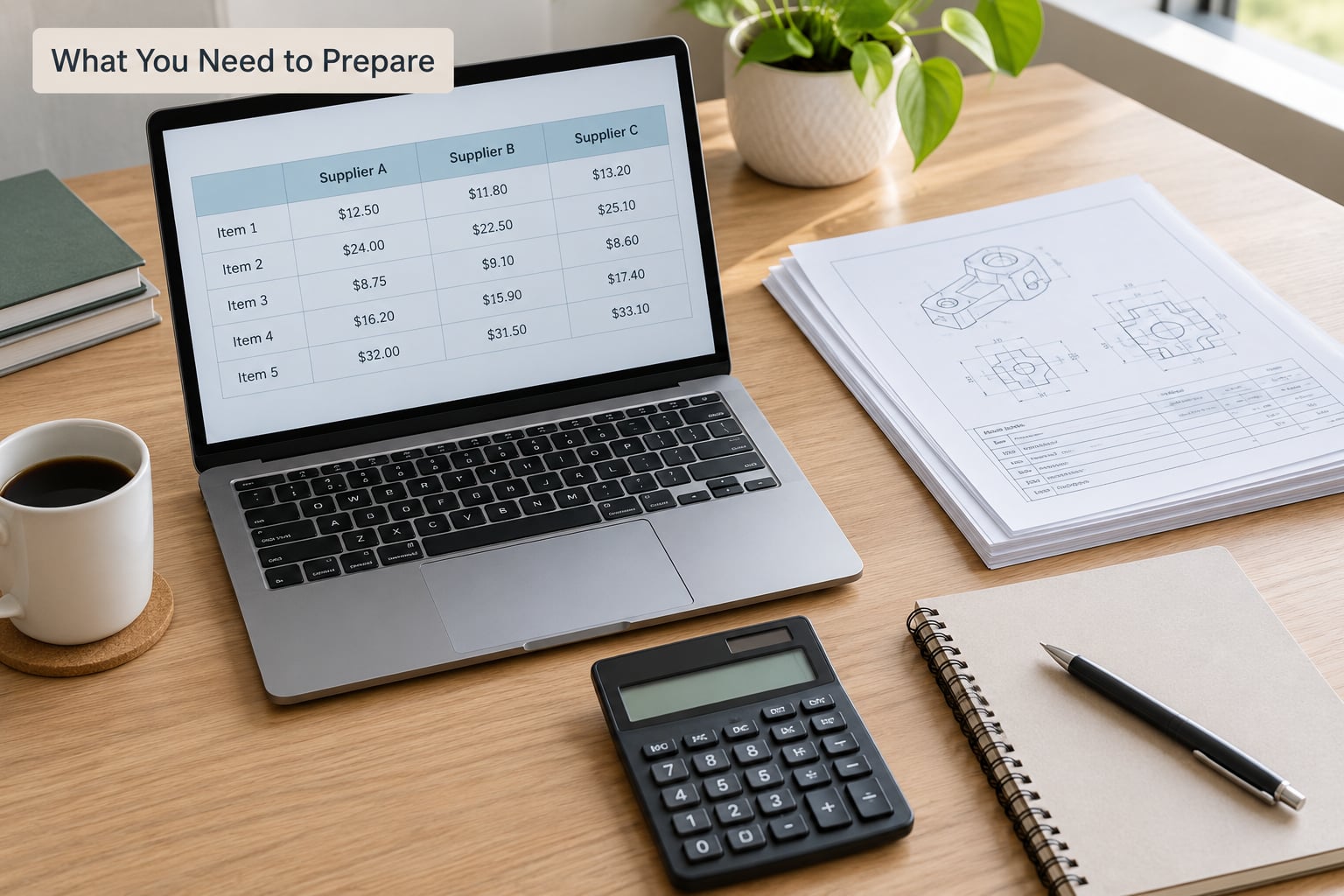
Walk in with a packet, not a memory. The items below take a few hours to assemble and they change how the conversation goes, because you stop asking the supplier for information you could have found yourself.
- Written requirements. Part numbers, material grades, tolerances, packaging format, annual volumes, and delivery schedule. If the spec lives only in someone’s head, you cannot negotiate against it.
- Spend and performance history. What you buy, how much, at what price, and how the supplier has performed: on-time delivery, defect rate, invoice accuracy, response time.
- A target and a walk-away point. Two different numbers, written down before the meeting.
- Alternatives. Names of at least two other suppliers you have qualified, or could qualify, and what switching would cost in time, tooling, and qualification effort.
- Decision authority. Who signs, who approves, and what you can commit to on the spot.
- A cost breakdown request. Buyers on procurement forums repeatedly recommend asking for a line-item cost breakdown with every quote. Suppliers usually refuse the first request and accept it once you frame it as a mutual effort to hold costs down.
- Your concession list. Everything you could give that would mean something to the supplier: volume, forecast visibility, payment terms, longer commitment, faster payment for tooling.
The last two items matter most and get skipped most. Without a target, you negotiate against their anchor. Without a concession list, every give you make is a pure loss.
Step-by-Step: How to Negotiate With Suppliers
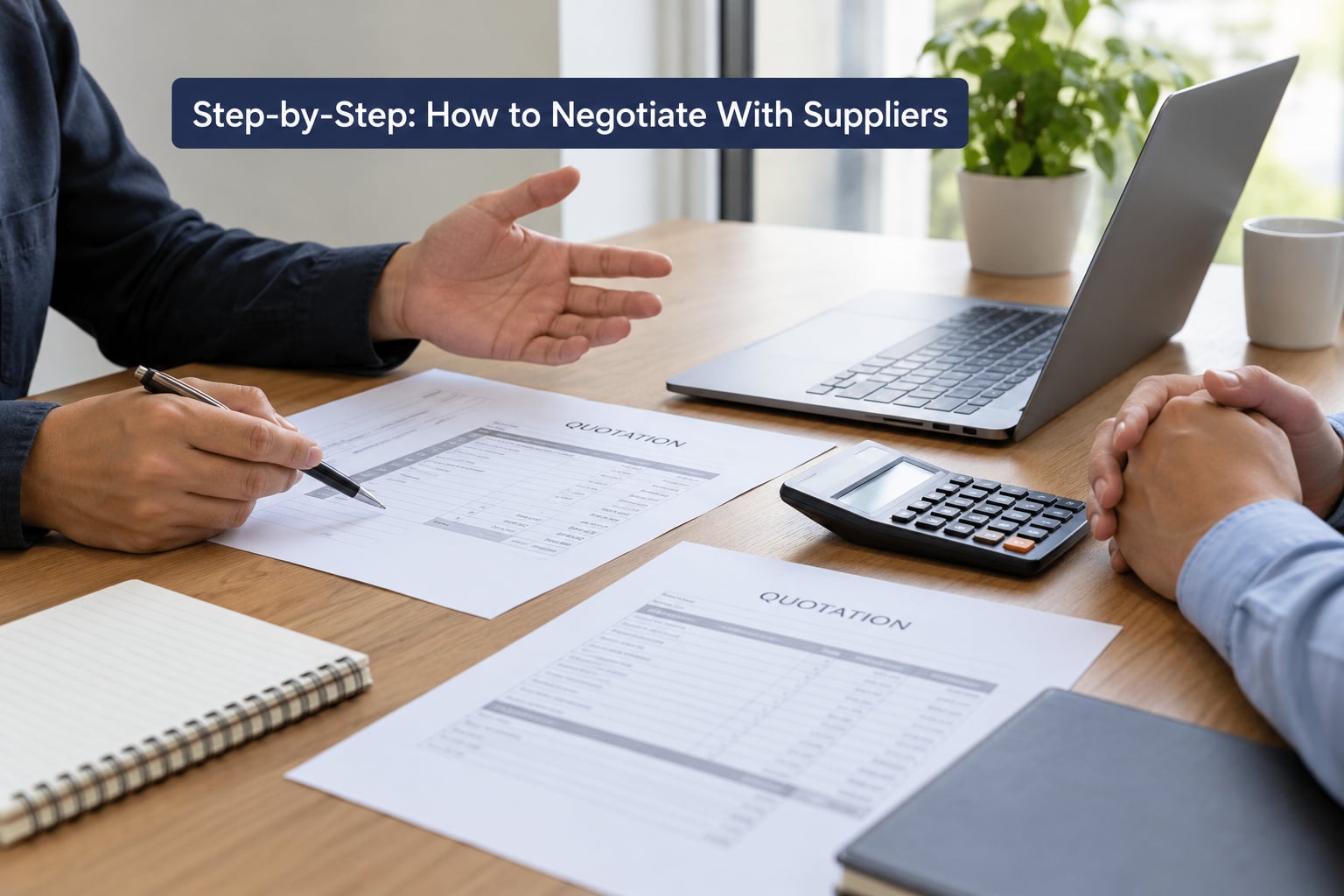
1. Define Requirements, Priorities, and Non-Negotiables
Split your requirements into two lists before you speak to anyone. Technical requirements are the things that must be true: material, tolerance, regulatory status, packaging format. Commercial priorities are the things you would trade: unit price, lead time, payment terms, order minimums.
Write down your non-negotiables explicitly. A typical list: certification requirements, no new tooling without written ownership terms, defect rate below a stated threshold, on-time delivery commitment. Everything outside that list is available currency.
2. Research Market Prices and Supplier Options
Set your criteria and their weight before you request quotes, not after you have them. Practitioners on r/procurement are blunt about this: decide what matters and how much it matters, then solicit. Fixing the weights after the bids land quietly turns an evaluation into a justification.
For resin, molded parts, packaging, kitting, assembly, and freight, market data exists even when a supplier’s cost sheet does not. Commodity indices give you the resin and substrate reference. Freight indices and published rate benchmarks cover transportation. For converted labor, published regional wage levels plus an honest estimate of cycle time will tell you whether a piece price is out of line. If you are comparing internal conversion cost, how to calculate machine hour rate gives you the framework to build a should-cost number from cycle time and burden.
Then look at the supplier’s position. Are they running full? Have they just lost a large customer? Are they quoting long lead times because capacity is tight? A supplier in a strong market will not move much on price, and knowing that before you ask saves you an hour of frustration.
3. Set a Target Price and a Walk-Away Point
Your target is what you will propose. Your walk-away point, often called the reservation point, is the lowest acceptable total cost given your requirements. The gap between the two is your negotiation range.
Build the target on total cost, not the piece price. Add freight, inbound inspection, scrap and rework, packaging waste, inventory carrying cost, expediting fees, and the cost of any changeover you will pay for. Two quotes can differ by several percent on paper and end up within a percent of each other once those items are counted, and the one that looked cheapest can be the more expensive one.
Write the walk-away point down, then write what makes you walk. “If they cannot hold lead time at six weeks, we qualify the second source” is a walk-away. “I feel like we should push harder” is not.
4. Open With a Specific Proposal
Make the first offer deliberately, and make it complete. Anchor high enough that the supplier has to move, specific enough that it can be evaluated.
A usable opening script:
“Based on the volume we ran last year and our forecast for the next twelve months, we would like to structure this as a two-year agreement. Here is what we are asking for: unit price at the tier you quoted at 500k units, 4% below your current list, net-60 payment terms, a 30-day lead time with a written commitment, and tooling owned by us with the amortization schedule attached. What would it take on your side to make that work?”
That script does several things. It names a number the supplier has to answer, it trades a two-year commitment for price and terms, and the final question invites a solution rather than issuing a threat. Threatening a supplier you cannot leave puts you on the defensive immediately.
Then stop talking. Silence after an offer is uncomfortable and productive, and it is the most underused tactic in procurement.
5. Trade Concessions Instead of Giving Them Away
Every move you make should buy something back. If you offer a higher volume, ask for a lower tier break. If you offer net-90, ask for a price hold through the end of the year. If you accept a longer lead time, ask for a lower piece price or free packaging changeovers.
A simple ladder works well. Start with your full ask. When they cannot meet part of it, concede the least valuable item you can live with, and name what you get for it. Reduce your asks slowly, in uneven steps, rather than a smooth series of equal concessions, which signals you have room left.
One rule covers most mistakes here: never give a concession that you were not asked for. Volunteering a give teaches the supplier that gives are available.
6. Probe, Listen, and Resolve Objections
Price pushback is rarely a real objection. It is usually one of a handful of actual problems: the volume is smaller than they need, the material price has moved, the tooling is complex, the changeover is costly, the part has a defect history, or the regulatory paperwork is a hassle.
Ask instead of countering. “Walk me through how that price is built” gets you the cost drivers. “What would have to change for this to work” gets you their reservation point. Then check the answer against what you know about the market.
When a constraint is real, say so plainly. “That resin index has moved and I can see that” buys credibility, and a supplier who believes you understand their position will talk more freely about the parts you can actually solve. If you want to go deeper on interest-versus-position framing, the principles in Getting to Yes by Fisher and Ury and the work published through the Harvard Program on Negotiation are the reference most buyers return to.
7. Compare Final Offers on Total Cost
When the final proposals come back, normalize them before you decide. Put every quote in the same structure: unit price at your actual volume, freight, tooling and amortization, packaging, payment terms, lead time, defect allowance, and validity period.
Watch three things that quietly erase a price advantage. Payment terms have a real cost: moving from net-30 to net-90 on a large monthly spend is a meaningful working capital swing. Minimum order quantities can force you to buy material you do not need yet. A longer quoted lead time can hide expedite costs you will pay later, along with the line stoppages that come with them.
If two suppliers land within a percent of each other on total cost, decide on delivery reliability and responsiveness. Cheapest is a poor tie-breaker for a part that stops your line.
8. Document the Agreement and Set Performance Follow-Up
Nothing is agreed until it is in writing. The document should carry: unit prices and tier breaks, payment terms, lead times, quality requirements and defect tolerances, delivery schedule, tooling ownership and amortization schedule, price escalation and index clauses, change and revision procedures, corrective action process, renewal dates, and exit and transition terms.
Attach measurable service levels rather than intentions. A written service level agreement with a supplier on-time delivery figure, a defect rate ceiling, and a response time is checkable; “they will be responsive” is not. Set a review cadence on the calendar now, with KPIs defined in advance: on-time delivery, defect rate, price variance against the agreement, and response time.
For injection molding and plastics work specifically, get three clauses explicit: who owns the mold and on what terms it transfers to you, how amortization is calculated and over how many parts, and how resin cost changes are passed through. A piece price with an undefined index clause is a price that will move without your agreement.
Common Mistakes That Cost Buyers Real Money
Most of these are recoverable if you catch them. The recovery move matters more than the mistake.
Negotiating on price first
The first thing on the table becomes the frame. Open with the whole commercial picture: term length, volume, terms, lead time, quality, service levels. Price arrives inside a package instead of standing alone.
Giving concessions without asking for anything
An unrequested give is a giveaway, and suppliers price accordingly. Stop and restart with a rule: every move gets something back. Recovery is simply naming it after the fact, when you next discuss terms.
Going in without a walk-away
No real alternative means no bargaining power, and the supplier can tell. If you are sole source, say what switching would cost you in time and money; that cost is a fact worth naming, because it is often less extreme than the supplier assumes.
Accepting the first offer
The first offer is a test. Ask one question about how it was built, request it in writing with the assumptions attached, and use the time between rounds to check the numbers against market references.
Confusing the lowest quote with the best deal
Buyers on r/procurement describe spending days comparing suppliers, picking the cheapest, and regretting it. Score the bids on a weighted grid with the weights set before the quotes arrived, and keep delivery performance in the score.
Leaving verbal agreements unwritten
If it is not in the document, it is not a commitment. Send a short written recap within 24 hours of the call: agreed terms, open items, dates, owners. That email is part of the negotiation, not clerical work.
Frequently Asked Questions
What is procurement negotiation?
Procurement negotiation is the stage where buyer and supplier agree commercial terms: price, volume, payment terms, lead time, quality requirements, and service levels. The goal is not the lowest unit price but the best total value over the life of the agreement, while keeping a supply relationship that survives the next material change in the market.
What are the 5 steps of negotiation?
Preparation, discussion, proposal, bargaining, and agreement. Preparation covers requirements, BATNA, and target. Discussion is where you probe and listen. Proposal is your specific ask. Bargaining is where concessions get traded. Agreement is the written document with measurable service levels, renewal terms, and exit terms attached.
What is BATNA and why does it matter in supplier negotiation?
BATNA stands for Best Alternative to a Negotiated Agreement: what you will do if you do not reach a deal. It matters because it defines your walk-away point, and a real alternative is the strongest source of bargaining power you can bring to a meeting. A real alternative, with its cost in time, tooling, and qualification effort stated honestly, changes how a supplier prices risk.
How do I negotiate my contract with a supplier?
Know your BATNA, fix your non-negotiables, gather spend and performance data, then open with the complete commercial ask rather than price alone. Trade every concession for something back. Compare final proposals on total cost including freight, payment terms, and lead time. Document prices, lead times, quality requirements, tooling ownership, and service levels before anyone signs.
What is the 70/30 rule in negotiation?
The 70/30 rule is a rule of thumb among procurement practitioners, not a validated statistic. It says roughly 70 percent of a negotiation is decided before the meeting through research, bargaining power, and preparation, leaving about 30 percent to in-meeting execution. Useful as a prompt to prepare harder, but do not treat the ratio as evidence.
What should I negotiate besides price?
Payment terms, volume tier breaks and rebates, lead time and capacity reservation, tooling ownership and amortization, defect and rework allowances, price escalation and resin index clauses, freight and packaging terms, minimum order quantities, and written on-time delivery and quality commitments. Most of these are worth more over a year than a single percentage of unit price.
Conclusion
Start with the prep packet, not the meeting. Pull twelve months of spend and delivery data, write down your non-negotiables, set a target and a walk-away point, and list two alternative suppliers. That is a day of work that changes the terms of every conversation that follows.
From there the method is straightforward: define requirements and priorities, research market prices, set the target, open with a complete and specific proposal, trade concessions rather than giving them, ask questions when the supplier pushes back, compare final offers on total cost, and get everything into a written agreement with service levels and review dates.
Supplier negotiation is a process with a document at the end of it, not a confrontation with a supplier. The relationship outlives the deal, so the aim is terms you can both execute for two years.