
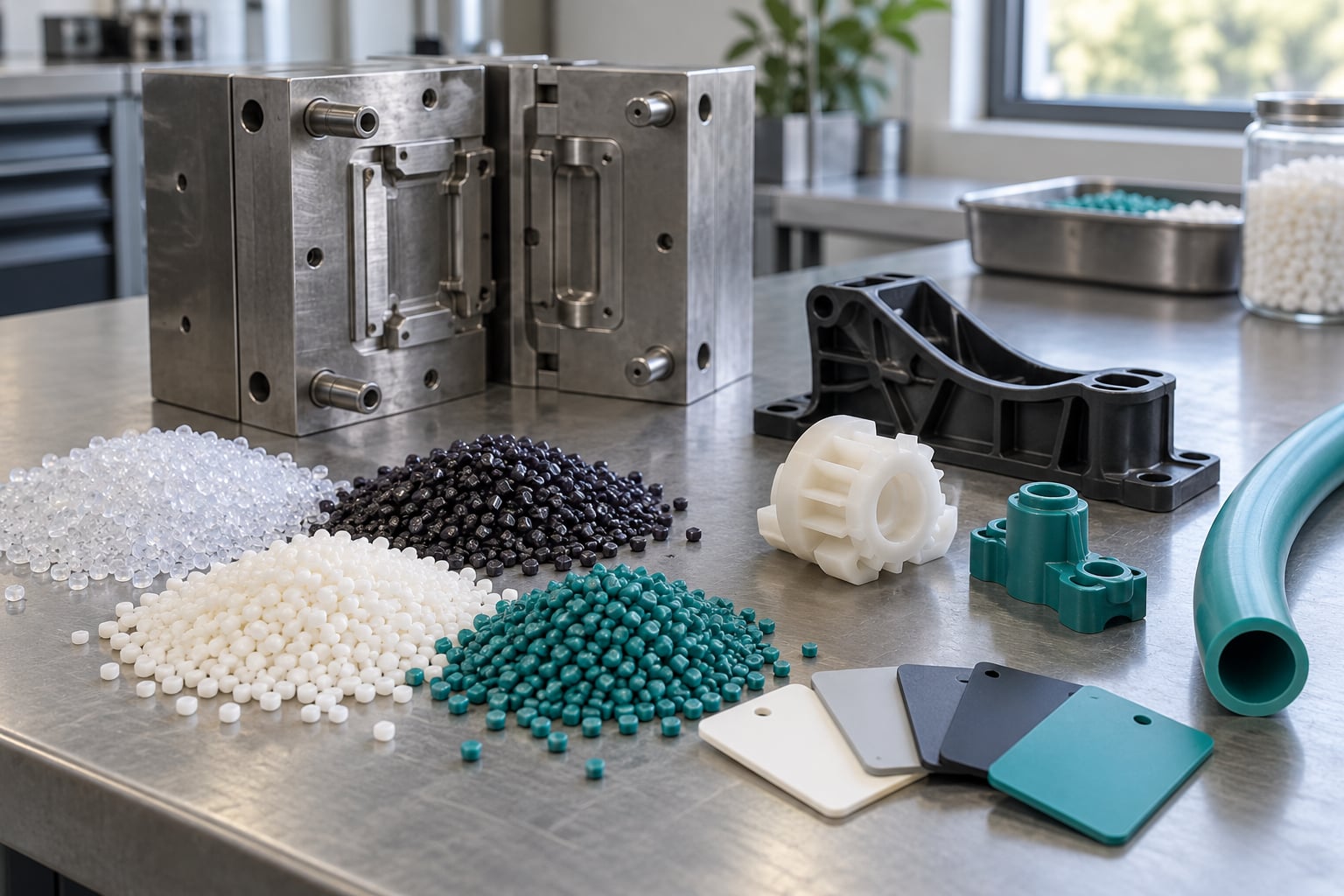
Types of plastic and their uses come down to a short list of properties: density, impact strength, temperature limit, chemical resistance and how the resin flows under a molding press. The twelve plastics below are the ones most often specified in US manufacturing, packaging and product development work, from commodity polyolefines to engineering resins like nylon and polycarbonate.
Most products that fail early do so for a boring reason. The material was picked for cost and appearance, then the assembly ran 10 degrees hotter than the resin could take, or a chemical in service quietly attacked it. Knowing how each family behaves before you cut a tool is cheaper than finding out in a validation run.
Updated for October 2026.
Table of Contents
- Types of Plastic and Their Uses at a Glance
- 1. Acrylonitrile Butadiene Styrene (ABS)
- 2. Acetal Copolymer (POM)
- 3. Acrylic (PMMA)
- 4. High-Density Polyethylene (HDPE)
- 5. Low-Density Polyethylene (LDPE)
- 6. Nylon (Polyamide or PA)
- 7. Polycarbonate (PC)
- 8. Polyethylene Terephthalate (PET and PETG)
- 9. Polypropylene (PP)
- 10. Polystyrene (PS)
- 11. Thermoplastic Polyurethane (TPU)
- 12. Ultra-High-Molecular-Weight Polyethylene (UHMWPE)
- Frequently Asked Questions
- Conclusion
Types of Plastic and Their Uses at a Glance
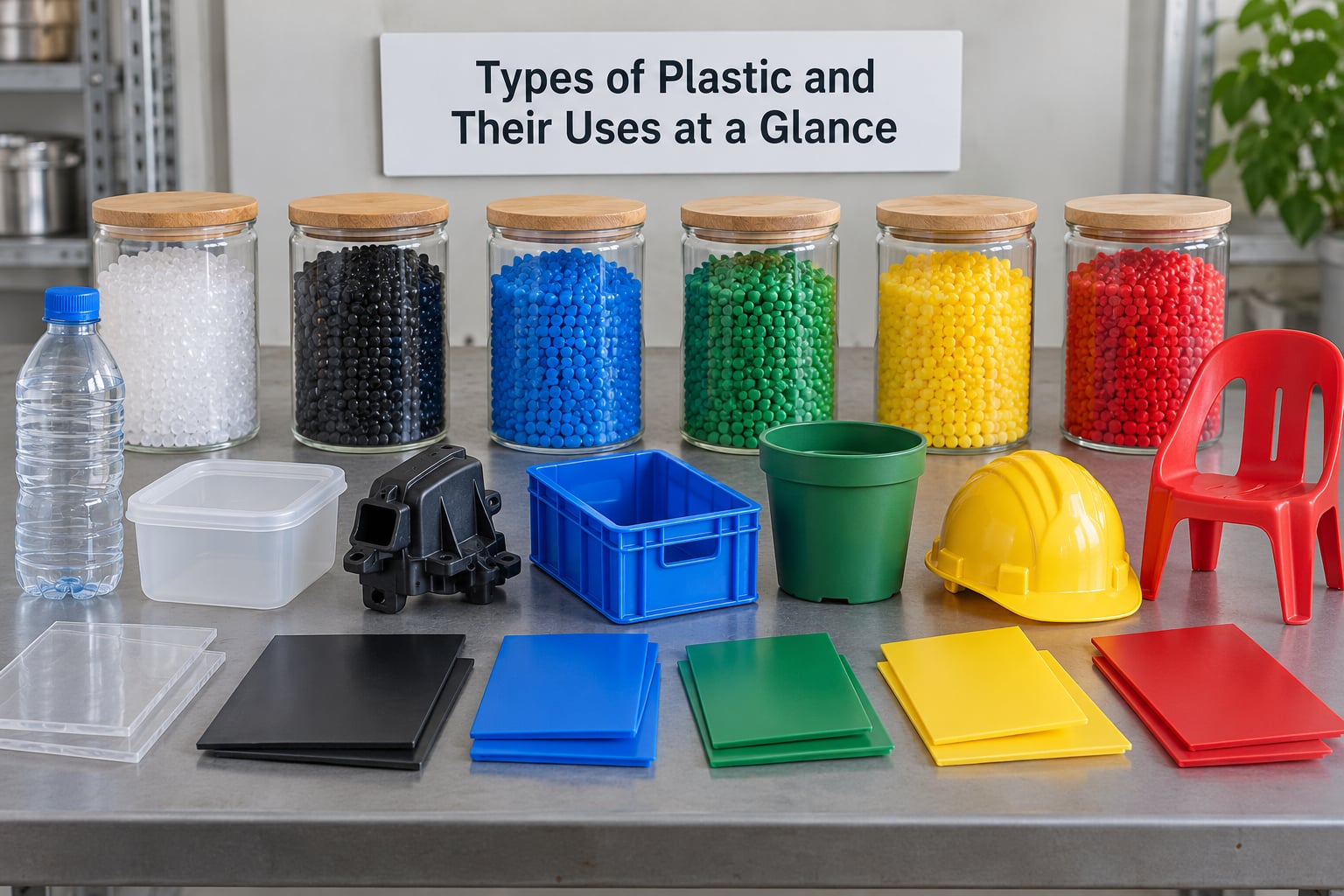
The table below covers properties, the molding process each resin suits, the uses it appears in, and the limitation that most often rules it out.
| Plastic | Key properties | Typical processing | Common uses | Main limitation |
|---|---|---|---|---|
| ABS | Tough, rigid, good impact strength, easy to finish | Injection molding, extrusion | Enclosures, automotive interior trim, appliance parts | Poor UV resistance without stabilizers |
| Acetal (POM) | Very low friction, stiff, dimensionally stable | Injection molding | Gears, bushings, bearings, clips, hinges | Weak in strong acids and alkalis |
| Acrylic (PMMA) | Optically clear, hard, easy to polish | Injection molding, extrusion, thermoforming | Signage, display stands, lenses, lighting parts | Brittle, scratches easily |
| HDPE | Stiff, tough, moisture and chemical resistant | Injection molding, blow molding, extrusion | Jugs, caps, tubing, containers, outdoor goods | Creaks, warps, hard to print on |
| LDPE | Soft, flexible, tough, low density | Extrusion, injection molding | Film, bags, liners, tubing, caps | Softens in hot liquids |
| Nylon (PA) | Wear resistant, strong, tough at thin sections | Injection molding, extrusion | Gears, connectors, bushings, textiles | Absorbs moisture, dims change |
| Polycarbonate | Very high impact strength, transparent, heat resistant | Injection molding, extrusion, thermoforming | Shields, helmets, device housings, lenses | Scratches, degrades in hot water |
| PET and PETG | Clear, strong, good barrier, orientation-capable | Stretch blow molding, thermoforming, extrusion | Bottles, trays, films, fibers | Heat limited; PETG hygroscopic |
| PP | Light, chemically resistant, fatigue resistant, heat tolerant | Injection molding, extrusion, fiber spinning | Caps, tubs, packaging, auto parts, fibers | Brittle at low temperature |
| PS | Rigid, low cost, easy to color, foams easily | Injection molding, extrusion, thermoforming | Food boxes, cups, cutlery, insulation | Brittle, low heat resistance |
| TPU | Flexible, elastic, abrasion resistant | Injection molding, extrusion | Cable jackets, gaskets, films, wearables | Attacks by hot water and some solvents |
| UHMWPE | Extremely tough, wear resistant, very low friction | Compression molding, press sinter | Wear strips, liners, rollers, implants | Heavy, hard to machine, no melt flow |
How to compare types of plastic and their uses
Start with the service conditions, not with the resin catalogue. Write down the highest temperature the part sees, the chemicals it contacts in use and during cleaning, the load and direction of that load, and whether the appearance has to be clear, textured or painted.
Then check process fit. A material that performs well in a tensile test can be a poor choice if it cannot fill a thin wall, wets the fiber you need for stiffness, or holds enough viscosity at the shear rate your cycle produces.
Every molded or extruded item also carries a resin identification code under the ASTM D7611 system, numbered 1 through 7. PET is 1, HDPE is 2, PVC is 3, LDPE is 4, PP is 5, PS is 6, and 7 is a catch-all for other resins such as polycarbonate and ABS. The number tells you the polymer family only. It is not a recyclability rating, which is the single most common misunderstanding we run into when a customer assumes the triangle symbol guarantees recovery.
Two questions decide the rest. How much of the total cost sits in the resin versus the tooling and cycle time, and what has to happen to the part at end of life.
1. Acrylonitrile Butadiene Styrene (ABS)
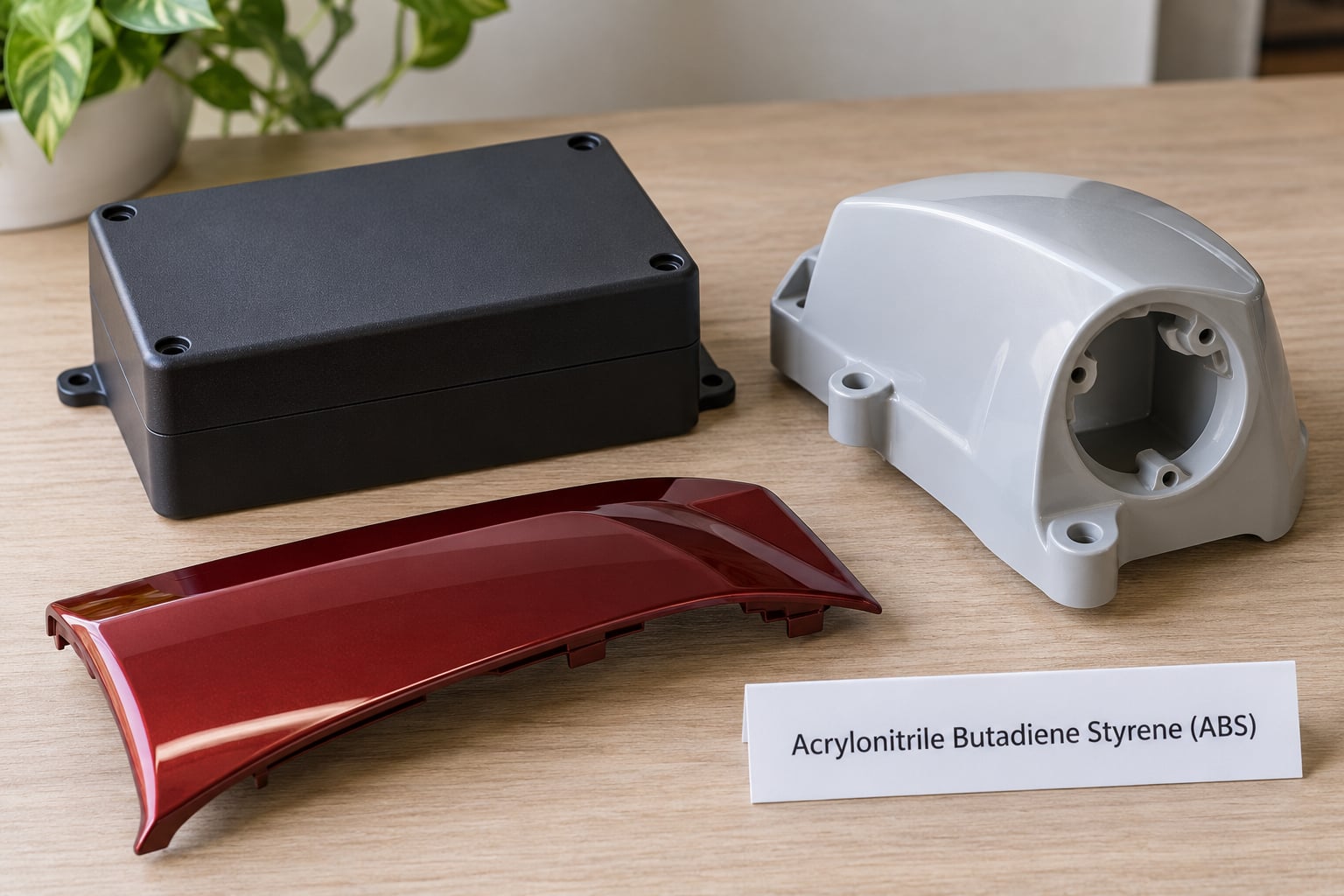
ABS is the workhorse engineering thermoplastic for housings and trim. The acrylonitrile gives it stiffness and chemical resistance, the butadiene supplies impact toughness, and the styrene contributes surface gloss. Density sits near 1.05 g/cm³ with a melt temperature around 230°C.
Typical applications include remote control bodies, medical equipment housings, automotive interior panels, vacuum cleaner parts, and keyboard keycaps. It machines well, takes paint and texture readily, and a wide color range is available in standard grades.
The limitation is outdoor exposure. Unstabilized ABS yellows and goes brittle under ultraviolet light after a season or two, so exterior parts need a UV-stable grade or a coating. Continuous service temperature is roughly 85°C, which rules out hot environments.
2. Acetal Copolymer (POM)
Acetal, usually written as POM, is chosen where two moving surfaces must slide against each other for years. Its friction coefficient is low enough that many designs drop grease entirely, and it holds its dimensions under load without creeping the way polyethylene does.
You will find it in small gears, bushings, bearings, latch clips, hinges, cam followers and precision fittings in fuel systems. Because it machines to tight tolerances and resists wear, it competes with metal in assemblies where a plastic part is lighter and quieter.
Two cautions. Acetal absorbs some moisture, so dimensional specs for a part living in a wet environment need headroom, and strong acids and alkalis attack it. It also needs UV stabilization for sunlight exposure, and its upper continuous service temperature is around 80°C in air.
3. Acrylic (PMMA)
PMMA is the plastic people mean when they say clear plastic that still looks like glass. Light transmission is close to 92%, it polishes to a deep gloss, and it holds its color better outdoors than polycarbonate. Density is about 1.18 g/cm³.
Uses include point-of-purchase display stands, signage, museum vitrine glazing, lens elements, LED diffuser lenses, light guides and skylight panels. In medical work it shows up in blood collection tubes and device covers where clarity matters more than impact strength.
Brittleness is the trade. PMMA cracks under sharp impact and stress concentrates, and its surface scratches more readily than glass or polycarbonate. For anything that will be hit, struck or cleaned with solvents, consider polycarbonate or a hard-coated acrylic instead. Service temperature tops out near 70 to 90°C depending on grade.
4. High-Density Polyethylene (HDPE)
HDPE is the stiffest of the common polyethylenes because its chains are packed closely, and that stiffness is why it holds the shape of a jug. It is moisture-proof, resists most acids and alkalis, and shrugs off impacts without cracking.
Applications include milk and detergent jugs, shampoo bottles, screw caps, automotive coolant and washer reservoirs, trash cans, playground equipment, and pipe. Blow molding dominates large hollow parts, injection molding handles caps and closures, and extrusion covers tubes and film.
Watch for three behaviors. HDPE creeps under sustained load, so a shelf bracket needs a generous safety factor. It stiffens and can crack in cold conditions, which matters for parts shipped through winter. And because the surface is low-energy, ink and paint adhesion need flame or plasma treatment first.
5. Low-Density Polyethylene (LDPE)
LDPE is the flexible sibling of HDPE, with longer, more branched chains that cannot pack tightly, so density drops to about 0.92 g/cm³. That branching is what gives LDPE its stretchiness, softness and impact resistance.
That makes it the default for carrier bags, produce bags, bin liners, shrink film, cling wrap and agricultural film. It also appears in tubing, catheter and medical tubing, cable and communication wire jackets, and soft-touch grip surfaces on handles and tools.
Where HDPE holds a shape, LDPE stretches, so it is a poor choice for anything needing stiffness. It also softens quickly in hot liquid, which rules it out for boiling or near-boiling service, and it can be hard to bond to other plastics without treatment. If you are weighing two polyethylenes for a container, our guide to HDPE vs PP for containers walks through the comparison.
6. Nylon (Polyamide or PA)
Nylon is the first choice for small, precise, wear-loaded parts. It combines high tensile strength with good abrasion resistance, and it machines cleanly into gears, bushings, rollers and connectors that run at moderate temperatures.
Beyond mechanical parts, nylon fiber dominates carpets, apparel, brushes, tents and automotive airbags. PA6 and PA66 are the grades you will meet most: PA66 stiffer and more heat-resistant, PA6 easier to process and better against impact and chemicals.
The real constraint is moisture. Nylon absorbs water, which plasticizes the resin, drops stiffness and lets dimensions move. The change is reversible as the part dries, but on a tight-tolerance assembly in a humid environment it matters. Nylon also needs UV stabilization outdoors, and strong acids are a problem.
7. Polycarbonate (PC)
Polycarbonate has the highest impact strength of the common engineering resins. A sheet or molded part will take a hard strike and bend rather than shatter, which is exactly why it is specified for safety eyewear, visors, helmets, hockey shields, and machine guards. It is also optically clear and holds heat far better than acrylic, with a glass transition near 147°C.
Electronics housings, backlit light guides, connectors and medical device bodies rely on the same combination of clarity, stiffness and dimensional stability. Thin-wall PC parts can be tough to fill because of high melt viscosity, so tooling design and processing matter.
Two limits to plan around. The uncoated surface scratches readily, so hard coating or a textured grain is common on visible parts. And while PC tolerates cold water well, prolonged exposure to hot water and steam slowly degrades it, a problem in dishwasher and medical sterilization cycles.
8. Polyethylene Terephthalate (PET and PETG)
PET is the resin behind nearly every clear water and soft drink bottle on a shelf. It crystallizes tightly, which gives it strength and a good barrier against oxygen and moisture, and stretch blow molding aligns the chains for a panel that handles pressure without thinning.
Beyond bottles, PET appears in thermoformed trays, blister packaging, food jars, strapping, and as polyester fiber in clothing and industrial webbing. Density is about 1.38 g/cm³, and glass transition sits around 70 to 80°C, so PET is not a hot-fill material without special grades.
PETG is the glycol-modified variant, used where PET is too brittle. It is clearer, tougher and slower to crystallize, which makes it the common choice for clear durable parts, machine guards, retail displays and 3D printing filament. The trade is processing: lower heat resistance, higher sensitivity to moisture during drying, and slower cycle times because the melt is less fluid.
9. Polypropylene (PP)
PP is the lightest of the common commodity plastics at roughly 0.90 g/cm³, and it handles heat better than any other polyolefin, tolerating boiling water and steam with standard grades. It also has the best chemical resistance of the polyethylenes and does not take a stress crack nearly as easily.
Cap and closure production is PP’s biggest job, followed by takeaway containers, yogurt tubs, straw assemblies, food containers, automotive interior and under-hood parts, and household ware. Fiber spinning turns it into carpet, upholstery fabric and filters, and it forms the living hinges used on box lids and containers because it survives thousands of flex cycles.
The weakness is cold. PP turns brittle near freezing, so a snapped lid or hinge can shatter in a freezer. Pigmented grades also fade and chalk when exposed to UV unless a stabilizer is added, and paint adhesion needs treatment. If the part lives outdoors or in a freezer, test that condition rather than trusting the general grade.
10. Polystyrene (PS)
PS is the cheapest rigid resin in common use and the easiest to mold, so it turns up in huge volume in packaging. General-purpose polystyrene is clear and brittle; high-impact polystyrene adds rubber modifiers that make it far tougher and opaque.
Typical products are yogurt and margarine tubs, takeaway food boxes, beverage cups, disposable cutlery, clamshell packs, and retail display pieces. Extruded polystyrene foam appears as packing material and wall insulation, and sheet is used for ceiling tiles. Compact discs and their jewel cases were built from PS, and legacy equipment housings still use it.
Brittleness is the defining limitation. Sharp corners and thin sections crack, and impact modifiers cost money and add cycle time. Heat resistance is poor, roughly 70°C in normal service, so polystyrene is not a microwave material. It also shrinks noticeably on cooling, so tight-tolerance parts need good tooling and process control.
11. Thermoplastic Polyurethane (TPU)
TPU bridges the gap between a rubber and a rigid plastic. It is elastic, soft to the touch, and takes abrasion far better than rubber while still being injection moldable. That combination drives a lot of cable and protective-film production.
You will find it in cable jackets, wire and tubing, sports shoe soles, gaskets, seals, vibration pads, protective screen films, inflatable items and wearable bands such as fitness trackers. Medical uses include tubing and catheter components where flexibility and toughness are both required.
TPU grades run from soft and rubbery to rigid, and they generally cost more per pound than the commodity polyolefins and mold more slowly because of high melt viscosity. The practical weakness is chemistry: hot water, steam, humidity and polyester-based polyols attack many grades, so sterilization cycles need a hydrolysis-resistant formulation, and outdoor parts need UV stabilization.
12. Ultra-High-Molecular-Weight Polyethylene (UHMWPE)
UHMWPE is HDPE with an enormously longer chain, and that length gives a combination nothing else matches: very high abrasion resistance, extreme toughness and a friction coefficient near ice. Chunks of it have replaced steel in dock fenders and truck bed liners because wear simply takes years instead of months.
Applications include conveyor wear strips, chute liners, rollers, bushings, boat and dock hardware, cut-resistant gloves, and marine components. In medicine, highly cross-linked UHMWPE is the bearing material in total hip and knee replacements, where it serves millions of patients for decades.
Processing is the constraint. The resin does not flow like a normal melt and will not injection mold on standard equipment, so parts are made by compression molding, a ram press, or by machining from a solid block. It is also heavy and expensive per part for anything large, softens in service around 80°C, and creeps under sustained high load.
Frequently Asked Questions
What are the 7 different types of plastic codes?
The seven resin identification codes under ASTM D7611 cover the most common plastics. Code 1 is PET, used for drink bottles and food trays. Code 2 is HDPE, used for milk jugs and detergent bottles. Code 3 is PVC, used for pipe and cable. Code 4 is LDPE, used for bags and film. Code 5 is PP, used for caps and tubs. Code 6 is PS, used for food boxes and foam. Code 7 is other, covering polycarbonate, ABS and other resins. The number identifies the polymer only, not recyclability.
What are five uses for plastic?
Five major uses for plastic are food and beverage packaging, medical devices such as syringes and catheters, building and construction components like pipe and window profiles, automotive parts such as bumpers and interior trim, and electrical insulation for wire and cable. Plastics serve each sector because they are lightweight, corrosion-resistant, electrically insulating and inexpensive to form into complex shapes at high volume.
What are type 4 plastics?
Type 4 plastic is low-density polyethylene, LDPE, identified by the number 4 inside the resin code triangle. It is soft, flexible, lightweight and tough, which is why it is used for carrier bags, bin liners, produce bags, shrink film, tubing and wire jackets. LDPE stretches easily, so it is unsuitable for parts needing stiffness, and it softens in hot liquids, which rules it out for boiling or near-boiling service.
What are type 7 plastic products?
Type 7 is the catch-all resin code for plastics outside codes 1 through 6, most often polycarbonate and ABS, and sometimes polycarbonate blends, nylon and other engineering resins. Type 7 products include eyeglass lenses, helmets and face shields, CDs, baby bottles, medical device housings, electronic housings and automotive interior trim. Because the category mixes many different polymers, it is not usually accepted in curbside recycling programmes.
Which resin numbers are recyclable?
Codes 1 and 2, meaning PET and HDPE, are the easiest to recycle and are accepted by most curbside programmes in the United States. Codes 4, 5 and 6 for LDPE, PP and PS are accepted only in some regions, and film in particular must go to store drop-off points because it jams sorting equipment. Codes 3 and 7 are rarely accepted, though PVC pipe and some type 7 items are recovered in dedicated streams. Local rules decide, so check your programme before sorting.
Which is better, HDPE or PET?
PET is better for clarity, stiffness and barrier performance, which is why it dominates beverage bottles and clear food packaging. HDPE is better for impact resistance, chemical resistance and cost, so it wins for jugs, caps, containers and pipe. For recycling, white and colored HDPE sorts more cleanly by color than PET does, though both are widely recycled where the programme exists.
Conclusion
Pick the material by writing down what the part has to survive, not by picking the cheapest resin that passes a first look. Temperature, chemicals, load, appearance, cycle time and end-of-life handling are the six inputs that actually decide it.
Once that list exists, request resin samples and datasheets, mold a small article from each candidate, and test it in the worst-case condition rather than the nominal one. For chemical exposure specifically, see our guide to selecting a plastic for chemical resistance; for anything sitting in sun, read how to choose a plastic for UV exposure before specifying a color. Getting the resin right up front is the cheapest engineering decision in the whole program.