
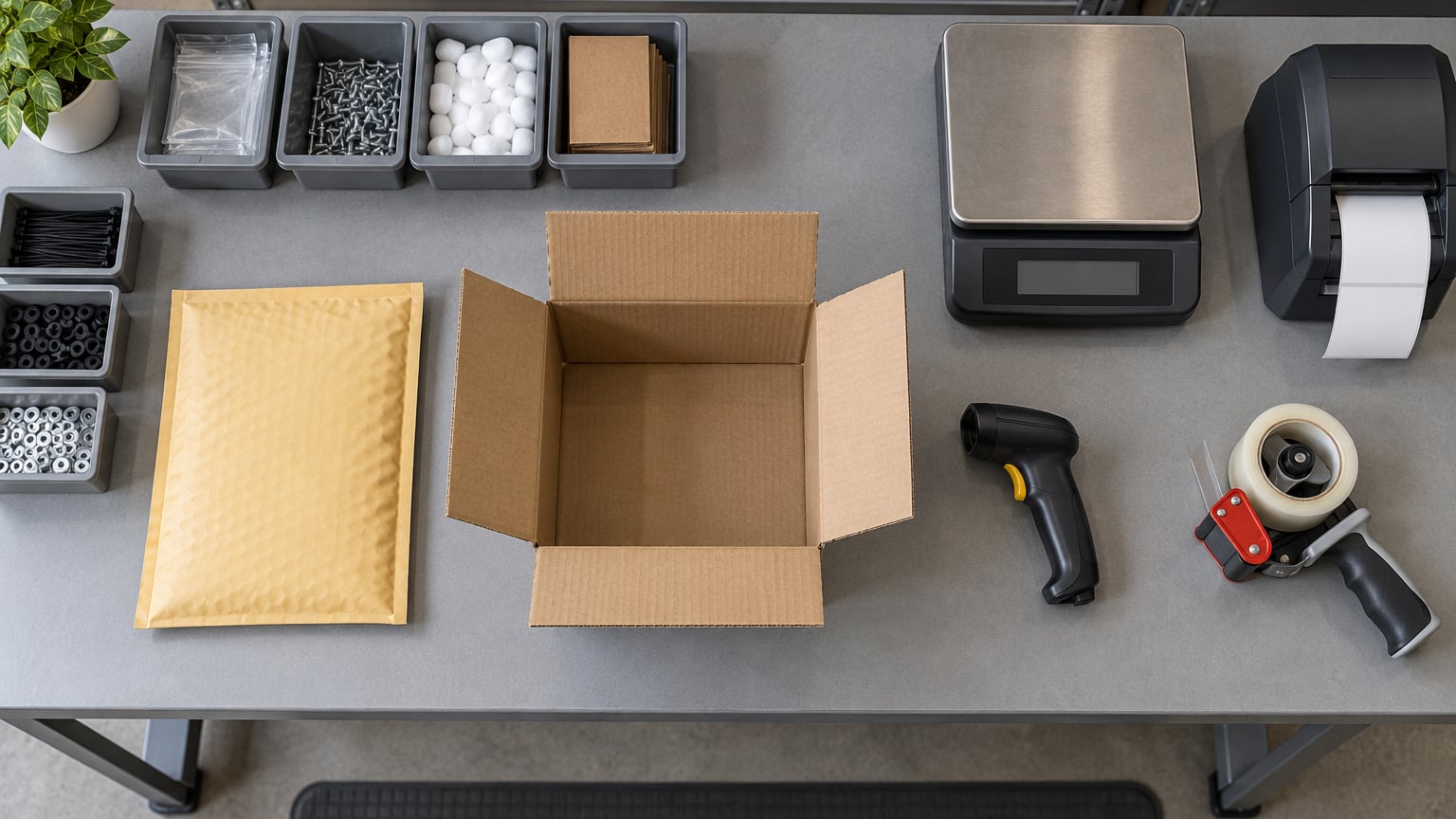
The pick and pack process explained in plain terms: a released customer order turns into a picked, verified, boxed, labelled parcel sitting on an outbound dock ready for a carrier. A picker retrieves the right SKUs from storage, a packer confirms and boxes them, and the shipment is staged and handed off. Everything between order receipt and carrier pickup lives inside that cycle.
I’ve watched operations teams treat pick and pack as one long task. It is easier to manage as a set of stages with defined outputs, and each stage has its own failure modes. Get the stages right and accuracy, speed, and cost stop fighting each other.
This guide covers the full 2026 workflow for both e-commerce fulfillment centers and industrial parts warehouses, including the metrics that tell you whether it is working.
Table of Contents
- What Is the Pick and Pack Process?
- How Does the Pick and Pack Process Work?
- What Happens During Picking?
- What Happens During Packing and Verification?
- Who Performs Each Step in a Pick and Pack Operation?
- What Equipment and Software Are Used?
- Pick and Pack Process for Manufacturing and Plastic Components
- How Is Pick and Pack Performance Measured?
- How Can Common Pick and Pack Errors Be Prevented?
- How Can a Pick and Pack Process Be Improved?
- Frequently Asked Questions
- What is the difference between pick and pack and kitting?
- Is pick and pack suitable for plastic injection-molded parts?
- What is the most accurate way to verify a picked order?
- How many items should a picker or packer handle per hour?
- Should pick and pack operations use barcodes or RFID?
- When does pick and pack automation become cost-effective?
- Conclusion
What Is the Pick and Pack Process?
The pick and pack process is the warehouse fulfillment workflow that converts a customer order into a shipped parcel. A picker retrieves the correct SKUs from storage, a packer verifies and boxes them with protective materials, a packing slip and a shipping label, and the parcel is staged and handed off to a carrier. It is the core cycle of every pick and pack warehouse.
Three boundaries keep the definition honest. Pick and pack is order-level work, one order at a time. Putaway moves finished goods into storage and happens before an order exists. Kitting assembles multiple components into a defined assembly, and while a kit may later be picked as a single unit, the two processes are managed differently.
What a pick and pack warehouse is
A pick and pack warehouse ships individual, relatively small orders rather than palletized freight. The work is measured in lines per hour and orders per shift. Understanding how that differs from a bulk operation explains most of the design choices that follow.
| Factor | Pick and pack warehouse | Bulk distribution center |
|---|---|---|
| Order profile | Many small orders, mixed SKUs, frequent releases | Few large orders, full pallets or cases |
| Handling unit | Tote, carton, parcel | Pallet load |
| Primary constraint | Labor at the pick face and pack station | Space, dock appointments, freight capacity |
| Accuracy driver | Scan validation at pick and pack | Pallet count and seal integrity |
| Success metric | Order accuracy and cycle time | Dock-to-stock time and trailer utilization |
Inputs, outputs, and accountability
The input is a released order with committed inventory, an assigned ship service, and a ship-by date. The output is a scanned, manifested parcel. Accountability sits with the order manager for release and the promise date, the supervisor for stage throughput and exception handling, and inventory control for anything that makes the physical count disagree with the system.
How Does the Pick and Pack Process Work?
The workflow runs in six stages, and each one produces a specific artifact that the next stage consumes. When a stage’s output is missing, the failure shows up downstream as a mis-pick or a missed cutoff.
| Stage | Main output | Most common exception |
|---|---|---|
| Order release and allocation | Pick list with locations, quantities, lot rules | Insufficient available stock in the requested SKU |
| Picking | Toted order with scanned confirmations | Empty bin or an unrecorded location change |
| Staging and consolidation | Complete order on one cart, single destination | Multi-line order split across two carts |
| Verification and packing | Closed carton with packing slip and protection | Quantity mismatch found at the scan |
| Labelling and manifesting | Shipping label applied, DIM weight captured, order scanned shipped | Address or service mismatch against the order |
| Handoff to carrier | Manifest handed off, parcel scanned at the dock | Late release misses the carrier cutoff |
A worked example makes the handoffs concrete. A mold maintenance order for 48 components releases at 08:00 from the ERP. Inventory allocation confirms the resin lot and two spare heater cartridges are available. The picker collects six totes across two zones, confirming each location by scan. The packer consolidates them into one carton, records the resin lot number on the packing slip, and stages it in the B2B outbound lane.
What Happens During Picking?
Picking is physical retrieval of items from storage to fulfill an order, and it is where most of the walk distance and most of the errors live. A warehouse management system generates the pick list, the picker follows a routed path, and each item is scanned to confirm both the item and the location.
Four allocation behaviours matter most.
- Location confirmation. The scan tells the system which bin the item came from. If someone relocates stock without updating the system, the next picker is sent to a location that no longer holds the item.
- Lot and serial control. For controlled materials, the pick list carries the required lot or serial range so the picker captures traceability at the moment of collection, not from memory later.
- FIFO and FEFO rules. First in, first out applies to general stock. First expiry, first out applies to anything with a shelf life, and the system directs the picker to the oldest compliant date first.
- Shortage and substitution handling. A short pick stops the line. The picker flags the shortage, inventory control decides whether to substitute an approved alternate or release a partial shipment, and the decision gets recorded against the order.
In a manufacturing warehouse this looks different from e-commerce. There are fewer orders and far more SKU relationships. A picker collecting a seal kit needs the gasket, the O-ring set, and the retaining clip from three different bins, and a missing clip makes the kit useless even though every line was “picked.” Kit completeness, not line count, is the real output.
Scan-based validation is what keeps this honest. A pick confirmed by barcode removes the guesswork of visual matching on similar-looking parts, and it writes the inventory decrement in the same action. Reviewers and operators consistently point to scanning as the single cheapest accuracy control available.
What Happens During Packing and Verification?
Packing is the stage where the order is confirmed against what was requested, protected against handling, containerized, closed, labelled, and manifested. It is the last chance to catch a picking error before it becomes a return.
Verification comes first. The packer scans each item against the order and reconciles quantities. A mismatch stops the order for inventory control rather than being quietly corrected at the bench.
Protective packaging follows the risk. Fragile or cosmetic surfaces need dunnage and separation so parts cannot contact each other in transit. Sharp or threaded components get sleeves. Dust-sensitive or plated surfaces get bagged before they enter the carton.
Container selection is where cost and damage trade off. A carton too large adds void fill, material and dimensional weight charges. A carton too small causes damage and a re-pack. A documented box size per order profile removes that judgment call, and it makes the packing slip’s declared weight match reality.
Closure and labelling finish the physical work. Tape pattern follows the weight class, the shipping label is applied in a flat, scannable position, and a final scan validates the label against the order and captures the packed weight and dimensions. For appearance-sensitive parts, machine vision inspection systems can verify cosmetic condition at the same point, which catches defects that a weight check never would.
A useful packing slip carries the order or customer reference, the line items with quantities, the lot or serial numbers where traceability applies, the ship-to address, and the package count when an order ships in multiple cartons. Anything a receiving customer needs to reconcile the delivery belongs on that document.
Who Performs Each Step in a Pick and Pack Operation?
Roles blur in small operations and separate cleanly in larger ones. What matters in either case is that every exception has one named owner.
- Order managers release orders, set priority, and own the promise date and carrier service selection.
- Inventory control owns cycle counts, location accuracy, lot records, and every shortage and substitution decision.
- Pickers execute the pick list and confirm each location and item by scan.
- Packers verify, protect, containerize, close, label, and manifest.
- Quality personnel handle inspection hold, nonconforming material, and lot-specific release decisions.
- Warehouse supervisors balance zones, stage work, and decide what gets escalated when a stage falls behind.
- Shipping and dock teams sort by carrier and cutoff, build the manifest, and record the handoff.
Handoffs are where accountability thins out. A picker who finds an empty bin hands the problem to inventory control, not to the packer. A packer who finds a quantity mismatch hands it to inventory control, not to shipping. Writing that rule into the standard work instruction is what stops a shortage from quietly becoming a short shipment.
What Equipment and Software Are Used?
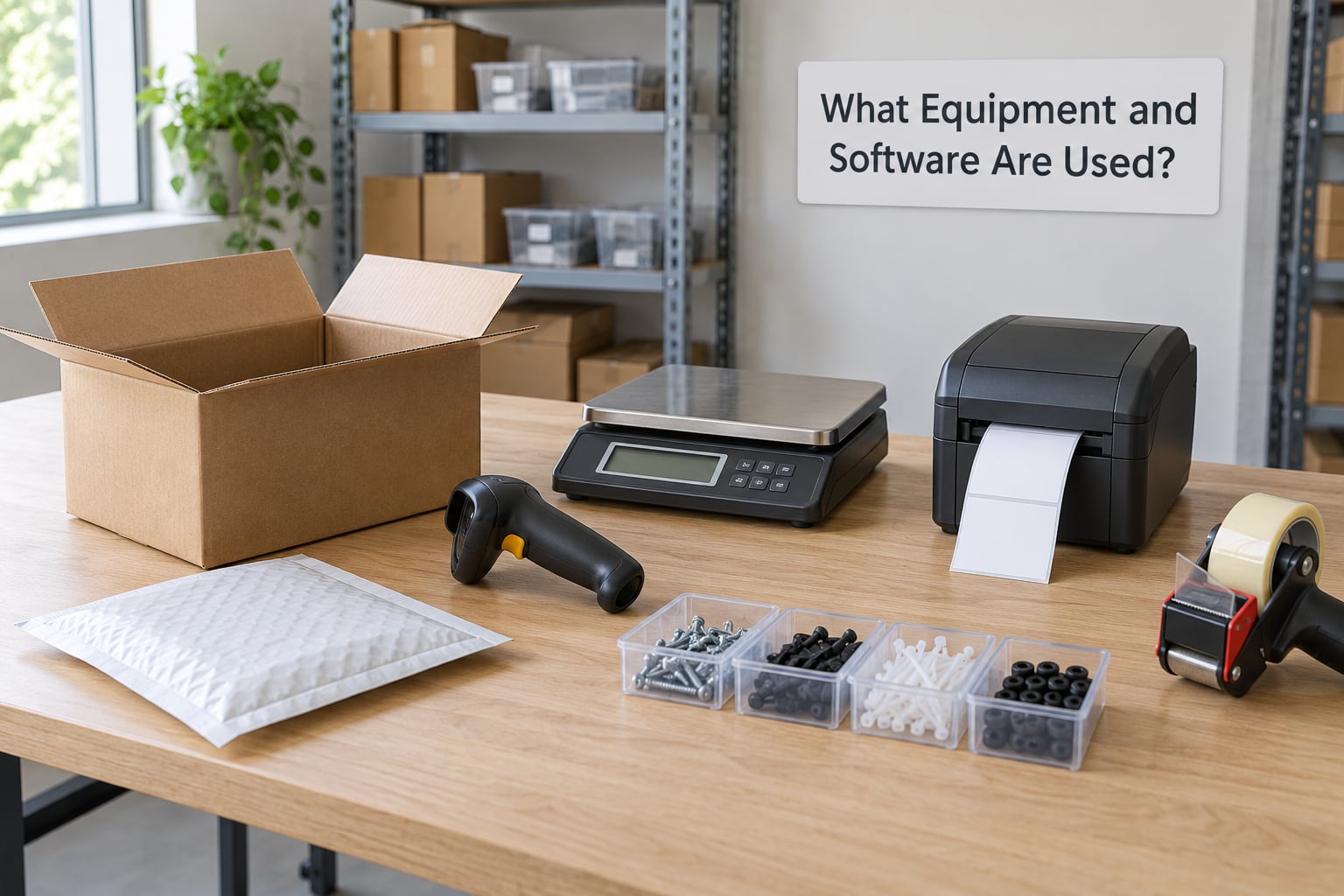
Each piece of equipment solves one specific problem in the cycle. Listing them by the problem they fix makes the selection conversation much easier.
- ERP or order management system holds the order, the promise date, and the customer data. It decides what must ship and when.
- Warehouse management system turns orders into task sequences. It handles slotting logic, wave release, pick path sequencing, and inventory decrements at scan.
- Barcode scanners and RF terminals validate location and item in one action and are the primary defense against mis-picks.
- Carts, totes, and pallets carry the work. Totes keep a multi-line order together through the pick face; carts set the staging sequence for the pack station.
- Packing benches with a scale combine the work surface and the dimensional weighing step so packed weight is captured at the station.
- Label printers print the shipping label, and for regulated or lot-controlled shipments the compliance and lot labels.
- Tape guns and staplers close the carton to a defined pattern by weight class.
- Conveyors and sortation move and direction parcels toward the right carrier lane once volume justifies the footprint.
- Cartonization tools recommend the smallest box that fits an order profile, which is where material and dimensional cost are actually controlled.
Automation is more uneven than the marketing suggests. Automated storage and goods-to-person systems work well in high-volume, high-SKU-count operations with predictable tote profiles. Piece picking at an individual bin location resists automation, because the parts are irregular and the presentation is messy. Scan-to-pick and lightweight conveyance usually pay back before robotics does.
Pick and Pack Process for Manufacturing and Plastic Components
Molded plastic parts change the priorities. Cosmetic surfaces, thread condition, resin lot identity and kit completeness matter more than carton cost, and a scratched transparent part is a rejected part even when the SKU and quantity are right.
The workflow adapts in predictable ways. Individual parts are bagged before they touch each other or the carton wall, and machined or threaded features get caps or sleeves. Hardware, labels, and inserts ship in the same carton as the parts they belong with, and the packing slip carries the resin lot so a customer complaint can be traced back to a specific tool run.
Kit completeness needs its own check. Scanning every component line is necessary but not sufficient, because a kit with a missing clip still scans clean. The verification step confirms the kit definition itself, not just the parts. Where cosmetic condition carries contractual requirements, statistical sampling plans set the inspection level so the effort matches the risk.
Documentation travels with the shipment. The lot number, the inspection record and the certificate of conformance belong in the carton, because the receiving engineer needs them at the moment of unpacking, not three weeks later.
How Is Pick and Pack Performance Measured?
Metrics tell you which stage is actually failing. A single throughput number hides a picking problem behind a fast pack station, so track the stages separately.
| Metric | What it measures | How managers should read it |
|---|---|---|
| Picks per hour | Line-level picking speed per person | High rates with high error counts mean the pace is unrealistic for the layout |
| Lines per hour | Total order lines handled per labor hour | Compare by zone, since travel distance drives the spread between zones |
| Order cycle time | Order receipt to carrier handoff | The end-to-end number; a long tail here usually means a release problem, not a picking problem |
| Pick accuracy | Lines confirmed correct as a percentage of lines picked | Any sustained figure below target should trigger a location audit before blaming staff |
| Pack accuracy | Orders packed correctly as a percentage of orders packed | Captures quantity errors that picking accuracy alone will miss |
| Order throughput | Orders completed per shift | Useful for staffing; compare against plan rather than against a fixed benchmark |
| Dock-to-stock time | Receipt to available inventory | Feeds directly into pick accuracy, since stale records cause mis-picks |
| Cost per order | Labor, material, and freight cost divided by orders shipped | The figure that survives scrutiny from finance; track it by order type, not as one blended average |
| On-time shipment | Orders handed off before the carrier cutoff | Backward scheduling turns this into a release-time target rather than a hope |
Backward scheduling is the practical version of that last metric. If a carrier arrives at 16:00, handoff needs to be complete by 15:30, the final pick wave should release no later than 14:00, and packing capacity has to be sized for the orders in that wave. Every stage then has a clock instead of an assumption.
How Can Common Pick and Pack Errors Be Prevented?
Each error type has a different root cause and a different control. Treating them as one accuracy problem is why they keep coming back.
| Error | What it looks like | Root cause | Prevention control |
|---|---|---|---|
| Mis-pick | Wrong SKU in the carton despite stock being available | Visual matching, unlabelled look-alike bins, no scan confirmation | Scan-to-pick at location and item; unique bin labelling |
| Location error | Picker sent to an empty location | Stock relocated without a system update | Scheduled cycle counts on fast-moving bins; move transactions enforced |
| Short shipment | Order ships incomplete | Shortage resolved informally and not recorded | Hard stop on shortage, inventory control sign-off before partial release |
| Quantity error | Right SKU, wrong count in the carton | Count-by-eye at pick, or a full tote treated as one unit | Scan each unit, or scan-counted totes with a system quantity |
| Damaged packaging | Arrives broken or scuffed | Oversized carton, thin dunnage, or no separation between surfaces | Standard box size per order profile, defined tape pattern, damage-focused packing standard |
| Mislabel | Parcel routes to the wrong address or service | Manual label entry, address not confirmed against the order | Label printed from the order record and scanned back before handoff |
| Unrecorded lot | Traceability gap discovered at customer complaint | Lot captured from memory or written on a note | Lot or serial captured by scan at pick and printed on the packing slip |
| Missed handoff | Order ready after the cutoff | Waves released too late, packing capacity undersized | Backward scheduling from carrier cutoff with a release-time control |
Document the standard work for each control. New hires follow the same sequence as experienced staff, and shift changes stop resetting the process. That single habit removes more recurring errors than any piece of equipment.
How Can a Pick and Pack Process Be Improved?
Improve the process in dependency order. Equipment choices made before the basics are clean tend to hide the problem rather than fix it.
- Validate item locations. Count the bins that generate the most mis-picks and correct any that disagree with the system. Nothing downstream is reliable until this is done.
- Eliminate travel. Review slotting with ABC analysis, so fast-moving, high-frequency SKUs sit closest to the pack stations. Re-cut the pick path so it does not cross itself.
- Standardize packaging. Define one box size per order profile and a documented protective standard per part family. This is usually the fastest material-cost saving available.
- Introduce scan confirmation. Scan location and item for every line. Extend the scan to lot and serial numbers where traceability applies.
- Simplify handoffs. Give each exception one named owner and one trigger. Fewer handoffs between stages means fewer places for information to disappear.
- Attack recurring exceptions. Review the top exception codes weekly and fix the cause rather than coaching the symptom.
Only after that should you assess slotting changes, labor design, or automation. Goods-to-person and automated storage pay off on stable, high-volume, high-SKU profiles. A low-volume facility with irregular molded parts will get more from better slotting and disciplined scanning than from a conveyor project.
Returns deserve their own process, and it feeds back into pick and pack. Every returned carton is a record of what went wrong at pack. Our reverse logistics process guide covers the receiving side and how to close that loop with the packing standard.
Frequently Asked Questions
What is the difference between pick and pack and kitting?
Pick and pack fulfills a customer order: items are retrieved from storage, verified against the order, boxed, labelled, and shipped. Kitting assembles components into a defined kit, often for assembly or service use, and stores the kit as a new stock unit. A kit can later be picked as a single item, but it is created first, then picked. Kitting is a production step; pick and pack is an order fulfillment step.
Is pick and pack suitable for plastic injection-molded parts?
Yes, with adjustments for cosmetic surfaces and traceability. Individual parts should be bagged or sleeved before they touch each other or the carton wall, threaded and machined features need caps, and hardware or labels ship in the same carton as the parts they belong with. The packing slip should carry the resin lot so any complaint can be traced to a specific tool run. Kit orders need a completeness check beyond per-line scanning.
What is the most accurate way to verify a picked order?
Scan-to-pick at both the location and the item, then a second scan at the pack station against the order line. The pick scan catches wrong-item and empty-bin errors at the source; the pack scan catches quantity mismatches before the carton closes. For kits, add an explicit check against the kit definition, since every line can scan correctly while a component is still missing. Visual confirmation adds nothing once scanning is available.
How many items should a picker or packer handle per hour?
There is no universal figure, because travel distance, order complexity and part weight dominate the result. A more useful approach is to set a target lines-per-hour by zone, measure it for two to four weeks, then treat a sustained gap as a layout or slotting problem rather than a performance problem. Compare zones against each other rather than against a number borrowed from another operation.
Should pick and pack operations use barcodes or RFID?
Barcode scanning suits most operations because it is cheaper, faster to deploy and easier to troubleshoot, and it handles SKU, location, lot and serial data well. RFID pays off where a large number of small, loose items must be handled without line-of-sight reading, or where inventory visibility must stay accurate between touches. For most pick and pack workflows, barcodes at location and item deliver the accuracy benefit at a fraction of the cost.
When does pick and pack automation become cost-effective?
Automation earns its cost back on stable, high-volume profiles with many SKUs and repeatable tote presentation. Goods-to-person and automated storage usually need consistent throughput and a high daily order count to justify the footprint and the maintenance. Scan-to-pick and light conveyance usually pay back earlier, including at lower volume. Low-volume facilities handling irregular molded parts gain more from better slotting and disciplined scanning than from robotics.
Conclusion
The pick and pack process is a chain of handoffs: release, pick, stage, pack, label, ship. Accuracy survives only as long as each handoff stays explicit and verified.
Start with three things. Map the current flow stage by stage so you can see where a released order actually stops. Check item and location accuracy on the bins that generate the most errors. Then name one owner for each exception type. Equipment, slotting changes and automation all build on those three, and without them they mostly hide the problem.