

A warehouse safety checklist is a repeatable set of yes/no inspection points covering walking surfaces and emergency exits, material-handling equipment, racking and loading docks, fire protection and emergency preparedness, and personal protective equipment. Walking the building on a fixed cadence with one is the cheapest control a facility has, and in the US it is the practical way to stay aligned with OSHA General Industry Standards.
Most checklists fail the same way. Someone fills the form from a desk, finds nothing worth reporting, and the same hazard sits there three months later. The difference between a checklist that catches problems and one that rubber-stamps a week is whether the person walking it knows what to look for.
Below are the ten inspection areas I would cover on any warehouse safety checklist, what to verify in each one, and how often it needs revisiting. Use the table first for the whole picture, then take each section as it applies to your site. The same list adapts to a cold store, a 3PL fulfillment center, or a chemical warehouse once you add the area-specific lines in sections 8 and 9.
Table of Contents
- Warehouse Safety Checklist at a Glance
- 1. Clear Aisles, Walkways, and Emergency Exits
- 2. Stable Storage Racks and Pallet Systems
- 3. Forklifts, Pallet Jacks, and Material-Handling Equipment
- 4. Housekeeping and Waste Management
- 5. Fire Protection and Emergency Equipment
- 6. Lighting, Electrical, and Utility Systems
- 7. Personal Protective Equipment and Employee Practices
- 8. Loading Docks, Doors, and Vehicle Interfaces
- 9. Hazardous Materials and Chemical Storage
- 10. Training, Incident Response, and Recordkeeping
- Frequently Asked Questions
- How often should a warehouse safety checklist be completed?
- Who should perform and review the warehouse safety checklist?
- What should happen when a safety hazard is found?
- Is a warehouse safety checklist the same as a formal OSHA inspection?
- What are the most common warehouse safety hazards?
- How should a warehouse safety checklist be documented?
- Conclusion: Start With the Highest-Risk Areas
Warehouse Safety Checklist at a Glance
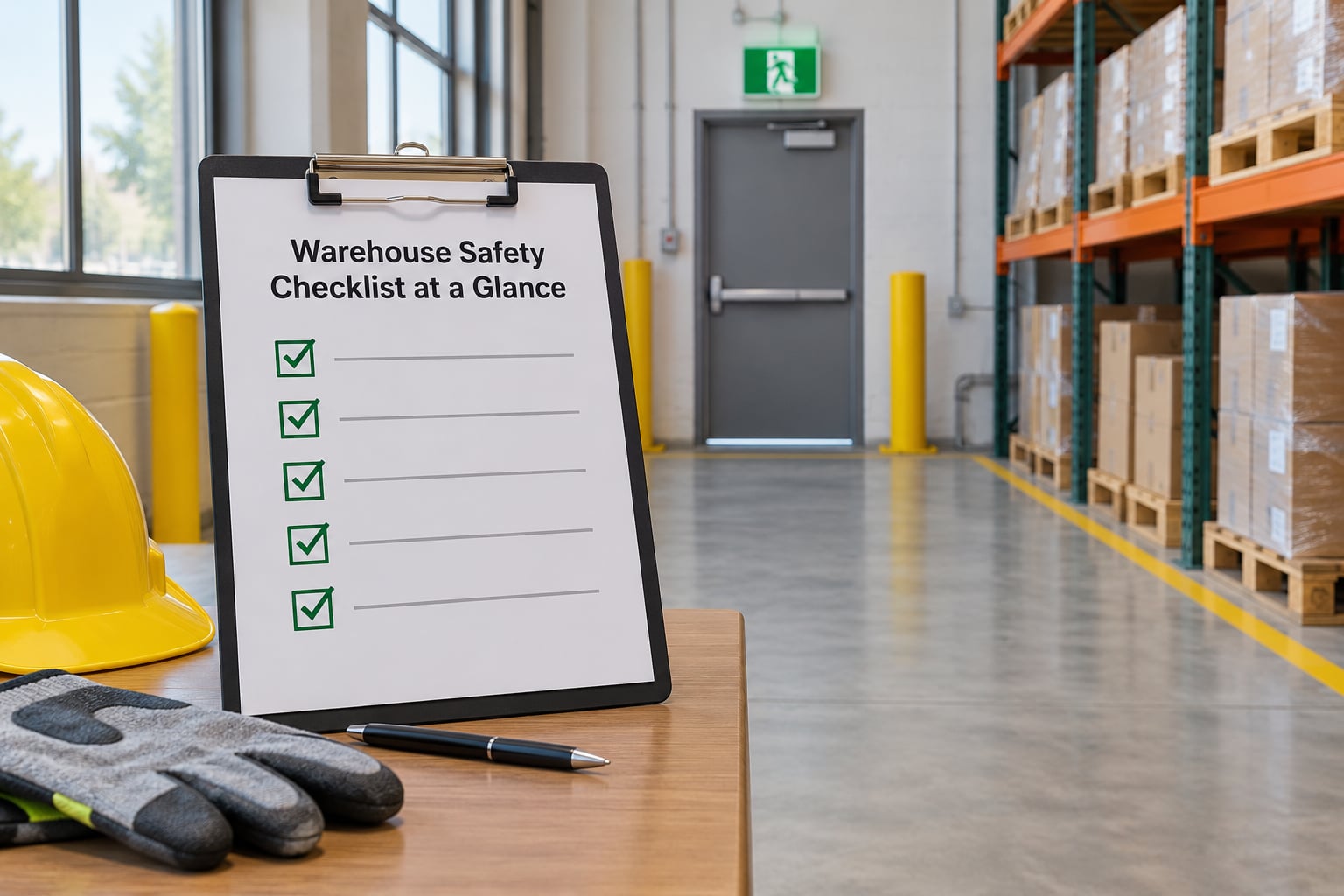
The table below is the working version of the whole warehouse safety checklist. Each row is one inspection area, what you confirm inside it, who owns the walk, and how often it repeats. Print it, laminate a copy for the dock office, and mark every line OK, Not OK, or N/A as you go.
| Inspection area | What to verify | Responsible | Frequency |
|---|---|---|---|
| Aisles and walkways | Clear routes, floor markings, door operation, unobstructed exits | Area supervisor | Daily sweep, weekly formal |
| Racking and storage | Uprights, beams, safety pins, foot guards, load signs, pallet condition | Racking lead or contractor | Weekly visual, annual competent |
| Forklifts and PIT equipment | Pre-shift check, forks, mast, tires, brakes, horn, battery, tags | Operator, then supervisor | Every shift |
| Housekeeping | Spills, debris, broken pallets, packaging waste, bin condition | Zone leads | Daily |
| Fire and emergency | Extinguishers, alarms, emergency lights, exit signs, first aid, drill routes | Facilities or safety lead | Monthly visual, annual service |
| Lighting and electrical | Lumens, exposed wiring, outlet condition, panel access, ventilation | Maintenance | Monthly walk, annual electrician |
| PPE and practice | Availability, correct use, worn footwear, hi-vis, training records | Supervisors and HR | Weekly observation |
| Docks and doors | Dock plates, levelers, restraints, chocks, dock lights, trailer condition | Dock supervisor | Daily, plus per vehicle |
| Chemicals and hazmat | Labels, safety data sheets, containment, ventilation, spill kits, access | EHS lead | Weekly, plus on new stock |
| Training and records | Certification, refresher dates, incident logs, corrective actions closed | Safety manager | Monthly review |
Mark each line with a status rather than a tick. A tick hides whether the item passed or simply was not looked at, and N/A is a real answer that should be justified, not a default.
1. Clear Aisles, Walkways, and Emergency Exits
A blocked exit is the finding that ends an inspection conversation, so check routes first and walk them as a pedestrian rather than from the forklift seat. Confirm that marked walkways are continuous, that floor striping is still legible where traffic has worn it away, and that nothing is stored in an aisle even temporarily.
Look for the small stuff that turns a straight route into a trip hazard: cable runs crossing the floor, pallet corners protruding past the rack line, a cardboard stack left by the pick station, or a floor patch that has lifted at the seam. Slips, trips, and falls stay one of the leading categories of warehouse injury, and most of them start with an object that was moved and put back wrong.
Then verify the exits themselves. Doors should open from inside without a key or special knowledge, swing in the direction of travel, and never be propped or chained. Emergency lighting and illuminated exit signs need to be visible from any point on the approach, and 29 CFR 1910.37 is the section that holds you to keeping exit routes free and unobstructed. In the UK, the equivalent expectation sits under the Regulatory Reform (Fire Safety) Order 2005.
How to record findings on your warehouse safety checklist
Note the location by aisle number and rack bay, not by a general description. “Aisle 12 clear” tells the next inspector nothing in six months; “aisle 12, 40 ft from the dock door, four cartons left of pick face” is fixable the same shift.
2. Stable Storage Racks and Pallet Systems
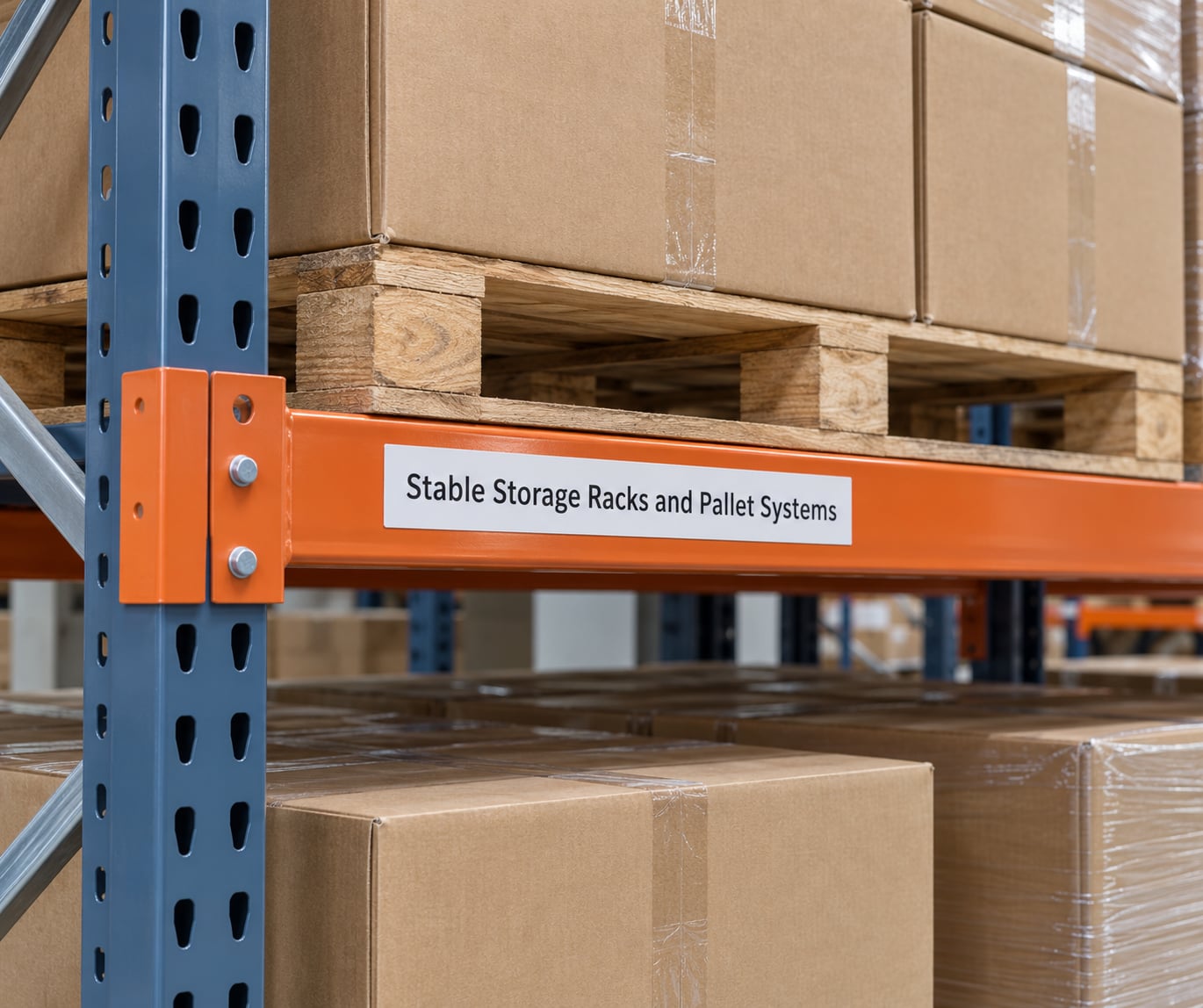
Racking failure is the highest-consequence hazard in most warehouses because it injures people who were nowhere near the storage task. Walk the aisles and look for bent or damaged uprights, missing beam connectors, missing safety pins at beam-to-upright junctions, and foot guards stripped away by a forklift at the end of the run.
Check the loads themselves, not just the steel. Cartons should sit squarely on the beams with the load sign readable, and pallets should be intact: no split stringers, no protruding nails, no missing deck boards. A pallet carrying a half-ton load that sits on two stringers and a bit of cardboard is a suspended load waiting for the wrong forklift. If your operation builds work tables and staging areas from carton flow, the load rules in how to set up a kitting line in a warehouse are the same ones to write into the form.
Watch stacking height against the bay rating, and confirm that nothing is stored above the top beam level or in the flue space above, where it can fall onto someone in the aisle below. Keep a damage log with dated photographs and a repair status for each hit. If the same upright gets flagged twice, it comes out of service until a competent person signs it back in.
3. Forklifts, Pallet Jacks, and Material-Handling Equipment
Every powered industrial truck gets a documented pre-shift inspection by the operator who is about to use it, and a defect found on that check takes the truck out of service until it is repaired. The practical items operators actually test are the horn, seat belt, tires, forks, mast and chains, hydraulics, brakes, steering, lights, emergency stop, inch control, and accelerator linkage.
The most commonly reported violation pattern in real operations is not a mechanical defect. It is an unattended forklift left running with the forks raised, the parking brake off, and the key still in the ignition. Watch for that specifically during behavior observations, along with the other recurring behaviors: driving with forks high, failing to slow at blind corners, and riding a pallet instead of walking beside it.
4. Housekeeping and Waste Management
Housekeeping is where a warehouse either looks controlled or does not, and it is the cheapest line on the checklist to fix on the spot. Sweep for spills, loose stretch wrap, banding strips, flattened cartons, and pallet fragments in the aisles, and check that bins are intact, closed, and not overfilled.
Pay attention to where waste actually goes. An overfilled recycling cage beside a pedestrian route creates a lean-to obstruction and a fire load in one move. Make sure waste is pulled before it reaches capacity, that oily rags and solvent waste go into closed metal containers rather than open drums, and that the compactors and balers sit in guarded areas with their keys controlled.
One practical trick is to photograph the worst aisle at the start of the shift and again at the end. If the two pictures look the same, the sweep either did not happen or did not include that aisle.
5. Fire Protection and Emergency Equipment
Fire protection fails quietly, so give it a date on the calendar rather than relying on someone noticing. Confirm every portable fire extinguisher is mounted, accessible, sealed, in date, and visible without moving stored goods; that pull stations are unobstructed; and that the alarm panel shows a normal status with no silenced or trouble indicators.
29 CFR 1910.157 covers portable extinguishers and includes the monthly visual check by employees, with annual maintenance by a qualified service company, so put both on the cadence table. Confirm that sprinkler heads keep their required clearance above and below, commonly 18 to 36 inches, and that nothing has been added to the ceiling grid that now sits in the spray path.
Emergency lighting gets a functional test on its schedule, not a visual guess that the panel light is on. Check that first aid kits are stocked and in date, eyewash stations are unblocked and flushed per schedule, spill kits are sealed and located where a spill would actually happen, and that the posted evacuation plan matches the current floor layout. If you have changed the layout since it was printed, reprint it.
6. Lighting, Electrical, and Utility Systems
Poor lighting turns every other line on this checklist into guesswork, and it drives the eye strain and mis-picking complaints that show up as near misses. Walk the aisles at the height where people actually work, not from a standing overview, and look for dead fixtures, flickering tubes, and dark areas at the base of racking where trip hazards hide.
Electrical checks belong to a qualified person, but you can still look for the warning signs: exposed or damaged conduit, missing faceplates on outlets, scorch marks, extension leads daisy-chained together, and panels or breaker cabinets blocked by stored goods. Access panels for electrical, gas, or water equipment should be clear for the full 36 inches of working space that codes generally require in front of them.
Utilities deserve the same attention. Confirm that sprinkler risers and shutoffs are visible and unobstructed, that overhead pipes are supported and not dripping, that compressed air lines and guards on rotating equipment are intact, and that charging areas for forklift batteries are ventilated, dry, and marked no smoking.
| Reference figure | Typical value | Where it shows up |
|---|---|---|
| Pedestrian clearance from moving truck routes | About 1 m | Aisle and yard segregation |
| Manual handling guideline figures (UK) | 25 kg for men, 15 kg for women | Lifting limits and equipment selection |
| Sprinkler head clearance | 18 to 36 inches | Storage height and ceiling work |
| Extinguisher visual check | Monthly | Fire protection round |
| Extinguisher maintenance | Annual, by a service company | Fire protection round |
| Minimum aisle width (US) | 44 inches, wider where local code requires | Aisle and storage layout |
| Electrical panel working clearance | 36 inches | Clear storage discipline |
7. Personal Protective Equipment and Employee Practices
Personal protective equipment is the last line, not the first, and it only works if it fits, is stocked, and is worn without being asked. Keep a supply of spare safety footwear, high-visibility vests, gloves in the right cut level, and eye protection at the point of use, and check the PPE stock during the walk rather than discovering an empty shelf after an injury.
Condition checks tell you little about practice. This is the line item where you watch behavior: is the operator belted in, are pedestrians staying in marked routes, is anyone lifting a load that clearly needs a second person or a mechanical aid, and are people walking rather than texting under a load. Safety professionals describe exactly this gap as the missing half of a condition-based checklist.
Write observations up neutrally. “Operator observed driving at floor speed through a pedestrian zone” is actionable; “operator careless” gets ignored and teaches people to hide the next observation.
8. Loading Docks, Doors, and Vehicle Interfaces
The dock is where pedestrians, rolling stock, and trailers meet, and it is the highest-energy part of the building. Check that dock plates and levelers sit flush and lock properly, that wheel chocks are available at every position and applied before anyone steps into a trailer, and that vehicle restraints are engaged when the trailer is parked.
Confirm dock doors and gates operate smoothly, dock lights illuminate the trailer interior, and the trailer itself is sound before you unload: check the floor for rot, the bulkhead for damage, the landing gear and brake condition, and that the trailer is not connected to a storage or ventilation line.
Separation is the control that matters most. Pedestrian crossings should be marked and physically separated where the traffic pattern allows, blind corners need mirrors or cameras, and the rule that no one crosses a dock face while a truck is reversing should be enforced without exception. Check that wheel chocks, dock locks, and the trailer restraints all appear in the warehouse safety checklist for this site specifically, because the mix of equipment differs at every dock.
9. Hazardous Materials and Chemical Storage
If you hold chemicals, aerosols, batteries, or cleaning chemicals, this section turns the checklist into a hazmat inspection. Every container needs a legible label matching the product inside, and the safety data sheet for each chemical must be reachable from the workstation where the chemical is used, not filed in an office two departments away.
Storage needs to be compatible: oxidizers away from flammables, acids away from bases, and liquids on spill containment rather than on bare shelving. Confirm ventilation in the storage area, restricted access so untrained people cannot help themselves, and secondary containment sized for the largest container in the space.
Check the spill response kit is stocked for the chemicals present, that waste containers are labelled and closed, and that eyewash or a drench facility sits close enough to reach in seconds. When a new chemical arrives, add it to the checklist before it enters stock, and if a line is going to be signed off by someone who does not read sheets every day, how to interpret a material safety data sheet makes a useful handover reference.
10. Training, Incident Response, and Recordkeeping
How the training and records lines close the loop
Conditions tell you about the building. Training and records tell you whether the program actually ran, which is what an inspector or an auditor asks for first. Confirm every powered industrial truck operator holds current certification, that refresher evaluations happened on schedule, and that new hires signed off on the site safety briefing before working unsupervised. Task-level risk work closes the same gap from the other direction, and 10 job safety analysis examples for manufacturing show how a role gets broken into steps before the checklist ever reaches the floor.
Then check the paperwork trail. Each incident and near miss should have an entry, a cause, and an action. If the same hazard shows up as a Not OK three months running, the corrective action never took, and the fix is to change the system rather than to remind the same person again.
Keep completed inspection sheets and corrective action logs for at least one year. Practitioners point out that while a written record of every forklift pre-shift check is not necessarily mandated, keeping one is strong evidence when someone asks how the program ran on a given day. Record what you found, where, who owns it, and when it closed.
Frequently Asked Questions
How often should a warehouse safety checklist be completed?
Run a daily sweep of aisles, docks, housekeeping, and any forklift pre-shift checks. Do a formal supervisor walk weekly, a full documented warehouse safety checklist inspection monthly including the extinguisher visual and emergency lighting test, and a full audit annually. Re-inspect after any layout change, racking change, incident, or near miss, and immediately after a new chemical enters stock.
Who should perform and review the warehouse safety checklist?
The area supervisor usually walks the zone, ideally with a safety team member and someone who works there every day, because the people closest to the task notice conditions a manager walks past. Rotate inspectors so the same eyes do not become blind to a familiar hazard. The safety manager reviews the results, assigns owners, and tracks what stays open past its due date.
What should happen when a safety hazard is found?
Fix what can be corrected safely on the spot, such as clearing a walkway or removing a damaged pallet from service. Anything beyond that gets logged with a precise location, an owner, and a due date. Serious hazards, damaged racking, or defective equipment come out of use until repaired and verified. Re-inspect the location after the fix and record what closed it.
Is a warehouse safety checklist the same as a formal OSHA inspection?
No. An OSHA inspection is carried out by a compliance officer under the agency’s authority, and you get no notice of the visit. Your internal checklist is a self-inspection tool you run on your own schedule to find and correct hazards before an inspection happens. Following the general duty clause plus the relevant 1910 standards keeps you prepared, but it does not substitute for the agency’s own walk-through.
What are the most common warehouse safety hazards?
In rough order of how often they turn into injuries: slips, trips, and falls from clutter, spills, and worn floor markings; being struck by forklifts or pallet jacks; manual handling injuries from lifting and repetitive work; falls from racking when a load shifts or a person climbs; dock and trailer incidents; and chemical exposure in hazmat areas. Fire and emergency response failures are rarer but carry the worst outcome.
How should a warehouse safety checklist be documented?
Keep it on a single sheet per area with a status for every line, either OK, Not OK, or N/A, plus a finding location, an owner, a due date, and a closure note for anything Not OK. Paper works fine if it gets filled in on the walk rather than at a desk. Hold completed sheets and corrective action logs for at least one year, since they are what proves the program ran during an audit.
Conclusion: Start With the Highest-Risk Areas
Do not try to complete all ten areas in one shift on day one. Start where a mistake kills someone quickly: emergency exits and clear walking routes, forklift condition and operator behavior, racking integrity, and dock controls. Add fire protection and emergency equipment next, because a failed alarm or an inaccessible extinguisher turns a small incident into a bad one.
Then finish the remaining lines. Assign a named owner and a due date to every Not OK, keep the completed sheets for a year, and track which areas keep producing repeat findings. If the same aisle or the same dock face fails three months running, the problem is the process, not the person walking it. Once the walk habit is in place, the warehouse safety checklist stops being paperwork and becomes the cheapest safety control you operate.