
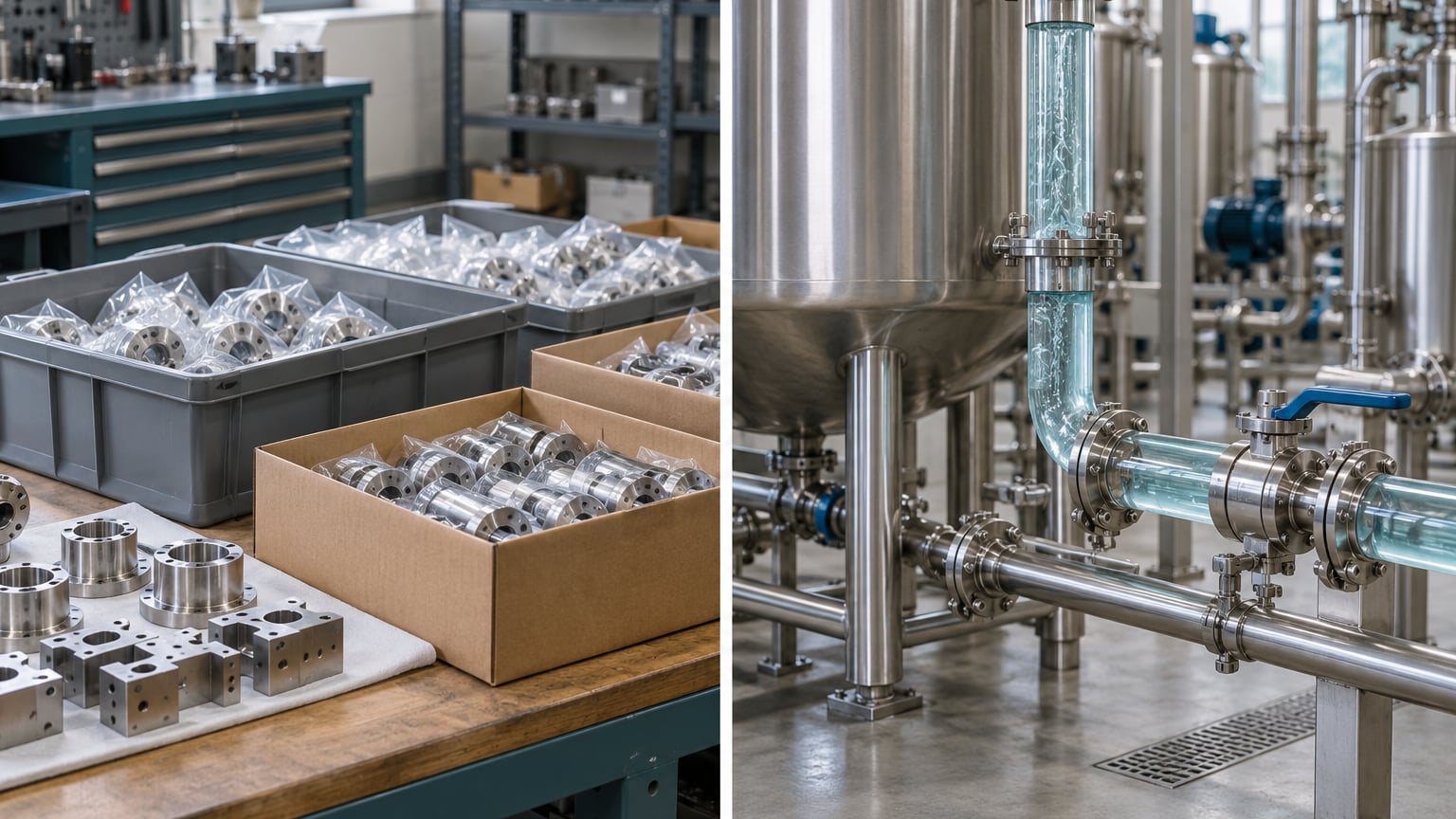
Discrete vs process manufacturing is the split between producing countable, individual items you can put a serial number on, and producing bulk output where ingredients are blended or transformed according to a formula. The distinction decides your controlling document, your unit of measure, your traceability rules, and honestly, whether your ERP will ever agree with you. Most plants are not purely one or the other, so knowing where your product actually sits matters.
I have watched this distinction cost a company months. A food plant runs a discrete ERP, ignores yield variance, and for two years quietly misprices every batch. Another builds a custom-configured machine with 400 unique configurations and tries to schedule it with a process recipe. Both mistakes are avoidable once you know the tests.
Table of Contents
- Discrete vs Process Manufacturing at a Glance
- What Is Discrete Manufacturing?
- What Is Process Manufacturing?
- Production Flow and Product Handling
- Materials, Inventory, and Traceability
- Scheduling, Changeovers, and Capacity
- Quality Control and Regulatory Requirements
- Cost Structure and Automation
- Which Should You Choose?
- Frequently Asked Questions
- Can a company use both discrete and process manufacturing?
- What is the difference between a discrete product and a process product?
- Is injection molding discrete or process manufacturing?
- Which manufacturing model is easier to automate?
- How do quality systems differ between the two models?
- How do I choose the right manufacturing model for a new product?
- The Short Version
Discrete vs Process Manufacturing at a Glance
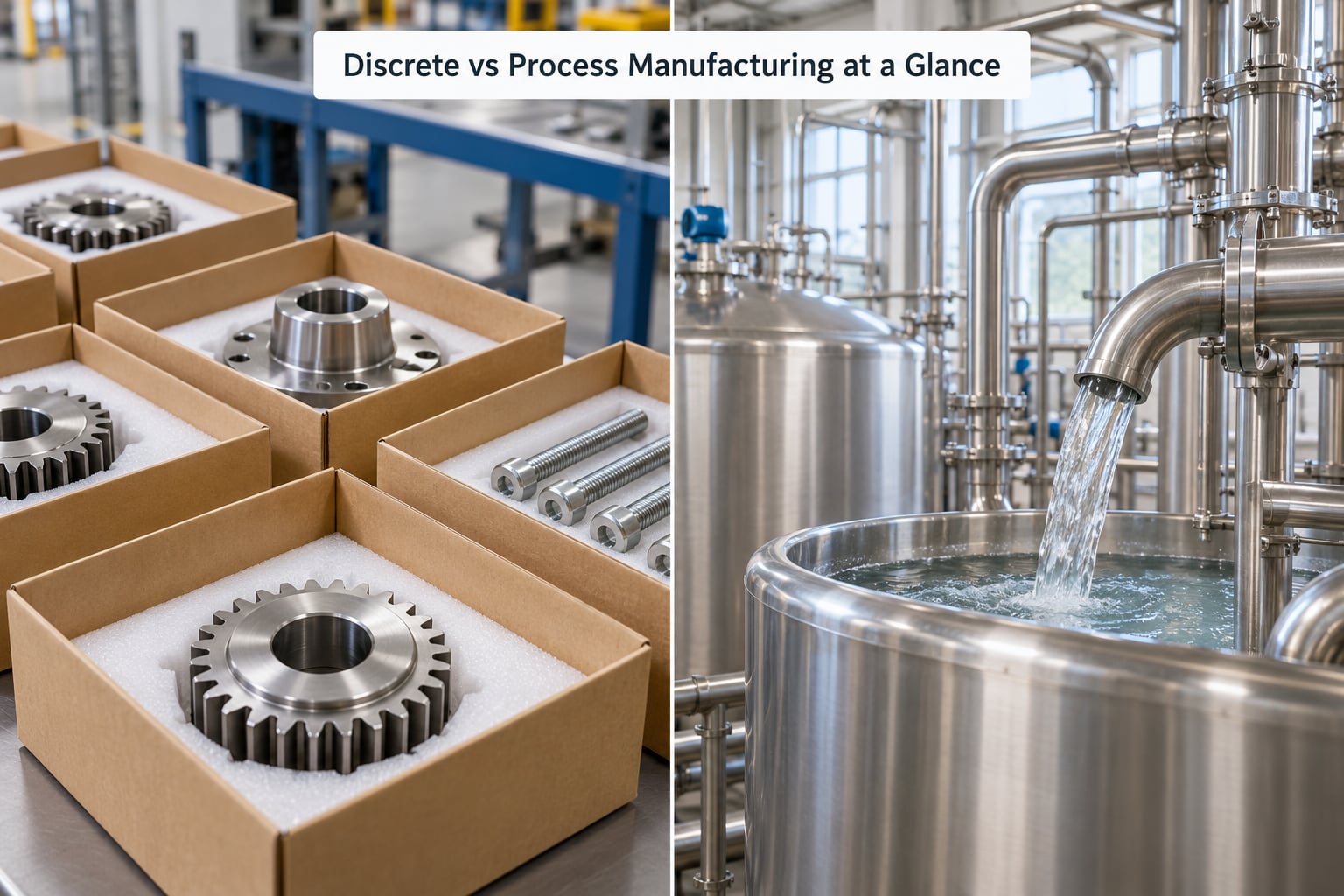
This table is the reference version. Every row is an operating decision you will eventually have to make, so it is worth scanning down the middle column rather than reading left to right.
| Attribute | Discrete Manufacturing | Process Manufacturing |
|---|---|---|
| Core output | Identifiable, countable units | Homogeneous bulk material or liquid |
| Blueprint | Multi-level bill of materials | Formula or recipe with ingredient quantities |
| Unit of measure | Each, piece, kit | Gallon, liter, pound, kilogram |
| How output is measured | Counted and weighed as finished goods | Weighed, gauged or sampled mid-process |
| Reversibility | Can be disassembled into component parts | Cannot be separated back into ingredients |
| Production approach | Build, assemble, fabricate | Mix, blend, transform |
| Work flow | Routing through defined work centers | Batch order or continuous flow through vessels |
| Traceability | Serial number per unit, lot per batch | Lot or batch number, sometimes with shelf life |
| Inventory rotation | FIFO | FEFO, driven by expiration dates |
| Quality control | Inspection points, first article, final check | In-process monitoring, sampling, validated recipes |
| Typical order object | Production order | Batch order |
| Material yield | Fixed, near 100 percent, scrap is a known cost | Variable, evaporation and reaction loss are normal |
| Costing method | Standard BOM costing with labor and burden | Formula costing with actual yield variance |
| Customization | High, configuration and make-to-order | Low, recipe changes are costly to validate |
| Core KPIs | Cycle time, OEE, schedule adherence, scrap rate | Yield, batch variance, uptime, cycle time per unit |
| Common industries | Automotive, aerospace, electronics, machinery, furniture | Food, beverage, chemical, pharma, paint, coatings |
One row deserves emphasis before the rest. In discrete manufacturing, one plus one equals two; you put two parts in and two parts come out. In process manufacturing, one plus one usually comes out less than two, and that shrinkage is chemistry, evaporation and reaction yield rather than a defect nobody logged.
What Is Discrete Manufacturing?
Discrete manufacturing produces individual, identifiable products that can be counted, labeled and tracked as separate entities. The finished good exists as distinct units, and each unit can carry its own serial number through assembly, test and shipment.
The controlling document is a bill of materials, usually multi-level. A chair is the clean example: seat, back, four legs, struts and hardware, each with a quantity, each sourced from a supplier or a work center. Kitting and bill-of-materials structure are where discrete plants spend most of their planning time.
Discrete work moves as a routing. A production order releases parts to specific work centers in sequence, and each work center reports its own quantities back. Changeovers between jobs are the main enemy of productivity, which is why setup reduction gets so much attention on discrete floors.
How a discrete production order actually runs
The order lifecycle is well established: estimate and schedule the order, release it, pick and issue components, run each routed operation, report good and scrap quantities, then close. Because every operation has a defined time, the system can promise a date and be held to it.
Scrap is measurable and attributable. If a machining cell produces 40 of 50 housings, the 10 rejects have a reason code, a cost and an owner, and they show up in the standard costing variance. Nothing is lost in a haze of yield variation.
Discrete Manufacturing Examples
Assembling a car from thousands of identifiable components on an assembly line is the example most people reach for first, and it holds up. So do printed circuit board assembly, machine tools, furniture, medical device sets and injection-molded parts. If you can hold it in one hand and point at the serial plate, it is discrete.
Our reference on multi-shot injection molding is a good example of a discrete process: the output is countable parts, even though the tooling that shapes them is complex.
What Is Process Manufacturing?
Process manufacturing blends or transforms raw materials in bulk according to a formula or recipe, producing a homogeneous output that cannot be separated back into its inputs. A batch of soup is soup; you cannot un-blend it into carrots and stock. That irreversibility is the defining technical fact, not a side effect.
The controlling document is a formula listing ingredients with quantities in weight or volume units, and it must be scaleable. Scaling a soup recipe from a 4-quart tub to a commercial run means multiplying every quantity and watching seasoning, thickener and cook time behave differently at larger batch sizes. Getting that wrong is how a product ships off-taste at best, and dangerous at worst in pharma where it becomes a dose-strength error.
Process manufacturing runs either as discrete batches in a vessel or as a continuous flow. People searching for the difference between discrete and continuous manufacturing processes usually want this split, because process manufacturing is the umbrella and batch versus continuous is the choice inside it.
Batch vs Continuous Process Manufacturing
| Factor | Batch Process | Continuous Process |
|---|---|---|
| Flow | Charge, run, empty, clean, repeat | Uninterrupted feed with continuous discharge |
| Output size | A set quantity per run | Steady volume over hours or days |
| Cost profile | Charging and changeover costs per run | Low unit cost at high throughput |
| Typical examples | Pharma batches, cheese vats, specialty coatings, resin batches | Bottled water, refined sugar, cement, refined oil, bottled beverages |
| Traceability unit | Batch number | Time window or continuous run identifier |
| Volume flexibility | Easy to run small quantities | Economical only above a minimum rate |
How plastic bottles are made is a useful concrete case: the blow-molding line runs continuously, while the resin compounding stage upstream runs as batches. Same product family, both process models.
Production Flow and Product Handling
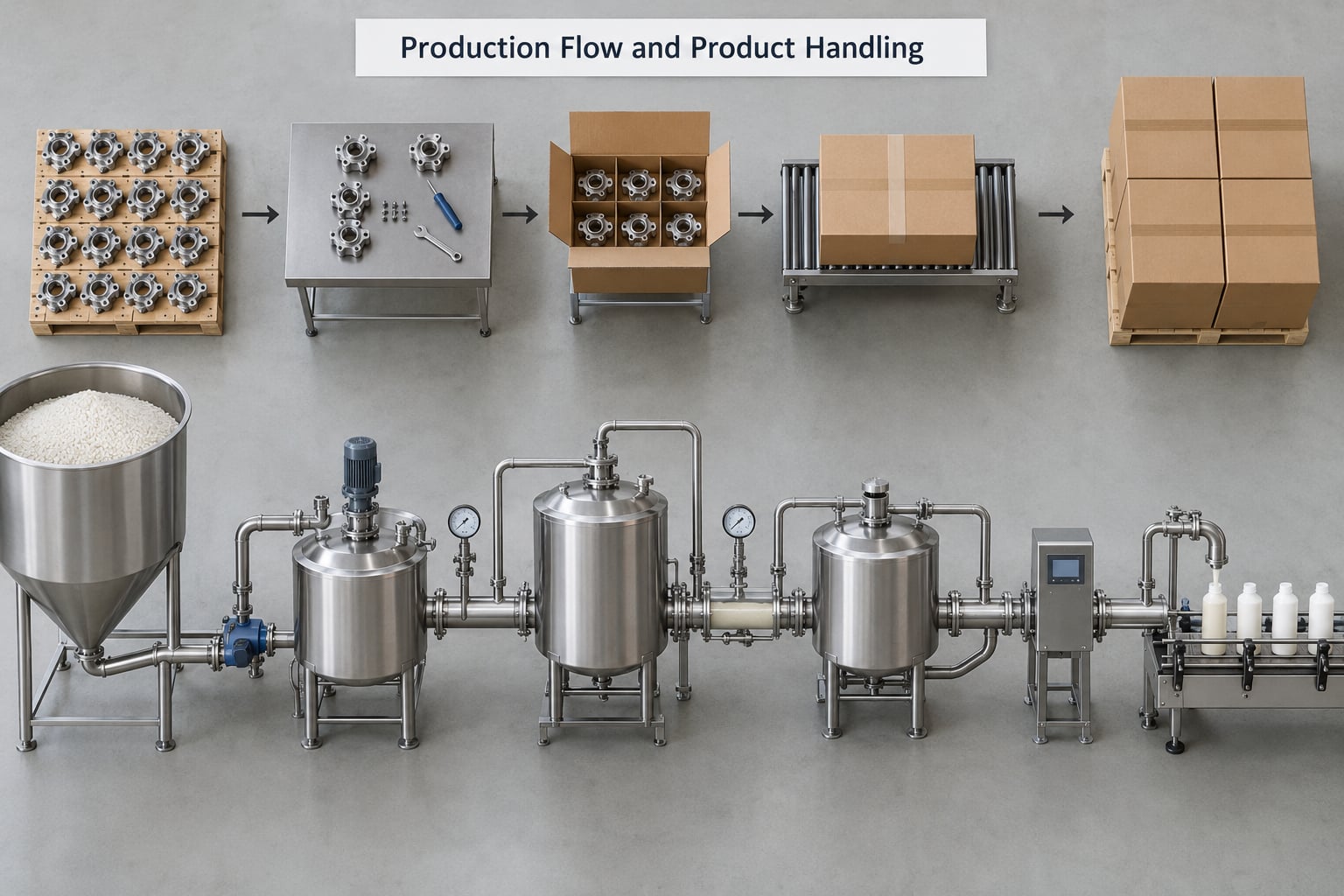
In discrete manufacturing, work travels as a sequence of identifiable objects. A unit moves from work center to work center in a tote, and its identity travels with it. You can stop the line between operations, hold a part for two days, and resume without changing anything about the material.
In process manufacturing, work travels as a tracked material stream with a changing state. A vessel holds a mix whose composition shifts continuously as reactions proceed, so pausing mid-run is not a scheduling decision, it is a process event that affects the batch. This is why process scheduling revolves around campaigns and sequences rather than delivery dates for individual orders.
Finished goods handling follows from that. Discrete output moves through discrete warehouses with locations, totes and picking lists. Process output moves through tanks, silos and bulk handling, and packaging happens near the end of the line as a separate discrete step. A canned soup is a hybrid product: the contents are process-made and the can is a discrete part.
Materials, Inventory, and Traceability
Material control differs in kind, not just in software. Discrete plants issue components against a production order and expect them consumed as listed, which is why back-flush consumption works so cleanly: pick for the whole order, post what actually ran. Anything left over is a measurable variance.
Process plants issue ingredients against a batch, and actual usage will not match the formula. Evaporation, moisture pickup and reaction conversion all move the number. Co-products and by-products make it stranger still: a refinery produces several saleable streams from one input, so cost allocation has to split a shared cost across them, and a discrete costing model has nowhere to put that.
Inventory rotation follows from shelf life. Discrete inventory mostly runs FIFO. Process inventory with dated inputs and outputs runs FEFO, and expiration dating is a master-data field rather than an afterthought. Treating a process plant as FIFO-only means writing off inventory that was still good and shipping inventory that was not.
Traceability follows the same split. Discrete products are traced by serial number forward to the customer and backward to the work orders, and that is what lets you recall one unit rather than a shipment. Process products are traced by lot or batch number, which means a recall targets a wider population and takes longer to scope, but it also covers the supplier lot, the tank, the operator and the exact time window, which discrete serial tracking never had to capture.
Scheduling, Changeovers, and Capacity
Discrete scheduling runs finite capacity against work centers with known cycle times, so the promise date means something. Setup and changeover time is scheduled explicitly, because switching from one part number to another costs real minutes that someone has to own. Line balancing is a standard job, and a missed balance shows up as a visible bottleneck station.
Process scheduling deals in campaigns: run the same formulation across a block of time because cleaning and changeover are expensive, then clean down and switch. A pharmaceutical plant that changed formulation every day would spend its capacity in cleaning. Capacity is also shaped by vessel size, and the minimum economic batch is a real constraint that engineers plan around.
Maintenance planning differs too. Discrete equipment failure stops a work center and shows as lost cycle time. In continuous process, failure shuts down a flow, so uptime and scheduled turnaround planning carry more weight than changeover optimization. Emergency shutdown procedures and preventive schedules are built around continuous running rather than around a shift.
Quality Control and Regulatory Requirements
Discrete quality control is inspection-based. Parts are measured against a drawing, first articles are checked at setup, and finished units go through final inspection or automated vision. Nonconformance produces a discrete reject that is quarantined, sorted, reworked or scrapped, and the count is exact.
Process quality control is monitoring-based. Critical process parameters are measured while the batch runs, samples are pulled at defined points, and release testing determines whether the batch ships. A process capability number is far more meaningful than a pass rate because the goal is a stable, repeatable distribution rather than a stack of good units. An out-of-spec result applies to a whole batch, which is why HACCP and preventive controls sit at the center of food safety, while GMP governs pharma release and documentation.
On the discrete side, the equivalent frameworks are AS9100 for aerospace, ISO 9001 generally, and DFARS and NIST controls for US defense work. The common thread is configuration control, serial-numbered records and first article inspection. Process documentation instead carries batch records, recipe revision control, allergen and nutritional calculations, and release signatures. An auditor on the process side is looking for proof the batch was made to a controlled version of the formula.
Cost Structure and Automation
Discrete costs are dominated by labor, tooling and setup. Tooling in injection molding or stamping is a large capital item amortized over volume, and labor content per unit falls as volume rises, which is why discrete plants invest in hard automation, robotics and assembly cells once volume justifies it. Flexibility is valuable: a discrete plant that can switch between configurations serves customization for a premium.
Process costs are dominated by throughput, raw material consumption and yield. A unit that costs the same to make whether you run the line at 60 or 100 percent means the economics live in volume and in the material yield percentage. That pushes investment toward continuous systems, in-process sensors and automated controls, because the return comes from running longer and losing less material rather than from making each unit faster by hand.
Automation difficulty follows that same shape. Discrete automation is hard because the parts vary; robot programs, vision and flexible tooling handle variety. Process automation is hard because the process is continuous and must be monitored without stopping; sensors, PLCs and process historians handle stability. Each is straightforward once you accept the constraint the model imposes.
Which Should You Choose?
The model is not really a choice for most plants; it follows from what the product physically is. What you can choose is whether you run it correctly. Five questions settle the classification in about ten minutes.
1. Can you count your output? If you can point at it and number it, you have discrete manufacturing. If you would have to weigh it, gauge it or sample it to know how much you made, it is process.
2. Can the finished good be disassembled back into usable parts? A bolted frame comes apart into hardware you can reuse. A blended coating does not come apart at all. This test is the fastest way to explain the difference to someone who thinks process manufacturing is just discrete in bulk.
3. Is the recipe fixed and fixed in quantity, or does it scale? If a component is always exactly one piece per assembly, you want a bill of materials. If quantities shift with batch size and the target is a property rather than a part count, you want a formula with yield tracking.
4. Do you need to trace a single unit to a customer, or a lot to a recall scope? Serial tracking is the discrete answer. Lot tracking with expiration and FEFO rotation is the process answer, and it is also the more demanding one, because the recall question comes from the regulator rather than the customer.
5. Does the product need to be released by measurement rather than by inspection? When a batch ships or fails on a lab result and a process capability trend, you are running a process model even if the physical output looks like an object.
Choose discrete when the product is a countable assembly, variation is a feature, and the customer wants options. Choose process when the material is bulk, the recipe is the intellectual property, consistency matters more than variety, and volume justifies a dedicated line.
Most real plants are hybrid, and that is fine rather than a problem. A beverage plant runs continuous mixing and blow-molding under process rules, then runs the bottle filling, capping and case packing under discrete rules. A plastics compounder runs resin batches and then sells them as discrete pellets by the pound. The practical advice is to keep the two models separated in your system and in your paperwork, because the moment you mix BOM logic and formula logic on the same order, costing and traceability both get quietly wrong.
That warning is worth stating plainly, because it is the most expensive mistake in this space. Deploying a discrete-first ERP on a process operation usually does not fail loudly. It produces plausible numbers that quietly ignore yield variance, have no field for expiration dates, and rotate inventory FIFO because nobody told it not to. The cost lands on the financial statements months later, and the recall that it cannot scope is the expensive one. Check that any software partner has actually run continuous or batch process work in the product they are proposing, not just discrete projects with a good logo.
Frequently Asked Questions
Can a company use both discrete and process manufacturing?
Yes, and most mid-size plants do. A beverage plant runs continuous mixing and blow-molding as process work, then fills, caps and case-packs under discrete rules. The practical rule is to keep the two models separated in your ERP, costing and traceability rather than mixing BOM logic and formula logic on the same order.
What is the difference between a discrete product and a process product?
A discrete product is a countable, identifiable unit with its own serial number that can be disassembled into component parts, such as a car or a circuit board. A process product is homogeneous bulk output made from a formula, measured by weight or volume and impossible to separate back into its ingredients, such as soup, paint or resin.
Is injection molding discrete or process manufacturing?
Injection molding of discrete parts is discrete manufacturing: the output is countable molded parts tracked by lot or serial number, produced against a bill of materials and a routing. Compounding and pelletizing of resin is process manufacturing, since it blends bulk material into a homogeneous output measured by the pound.
Which manufacturing model is easier to automate?
Neither is easier, they are hard in different ways. Discrete automation is hard because parts vary, so it needs robot programs, vision and flexible tooling. Process automation is hard because production is continuous, so it needs sensors, process control systems and monitoring that works without stopping the line.
How do quality systems differ between the two models?
Discrete plants inspect discrete units against specifications and lean on AS9100, ISO 9001 and first article inspection, producing exact reject counts. Process plants monitor critical parameters during the run, sample at defined points and release or reject a whole batch, governed by HACCP in food or GMP in pharma, with process capability trends carrying more weight than pass rates.
How do I choose the right manufacturing model for a new product?
Ask five questions: can you count the output, can the finished good be disassembled, is the recipe fixed or scalable, do you need serial or lot traceability, and does release come from inspection or from measurement. Countable, configurable, reversible products want discrete; bulk, recipe-driven, irreversible products want process.
The Short Version
Discrete vs process manufacturing comes down to a question you can answer in one line for any product. If you can count it and take it apart, you are running a bill of materials, a routing, serial numbers, inspection and FIFO. If you can only weigh it, you are running a formula, a batch or continuous flow, lot tracking with expiration dates, in-process monitoring and FEFO.
Start with the five questions above on one real product line, not the whole plant. Whatever the answers say, write down the unit of measure first, because everything downstream in the system depends on that single field being right.