
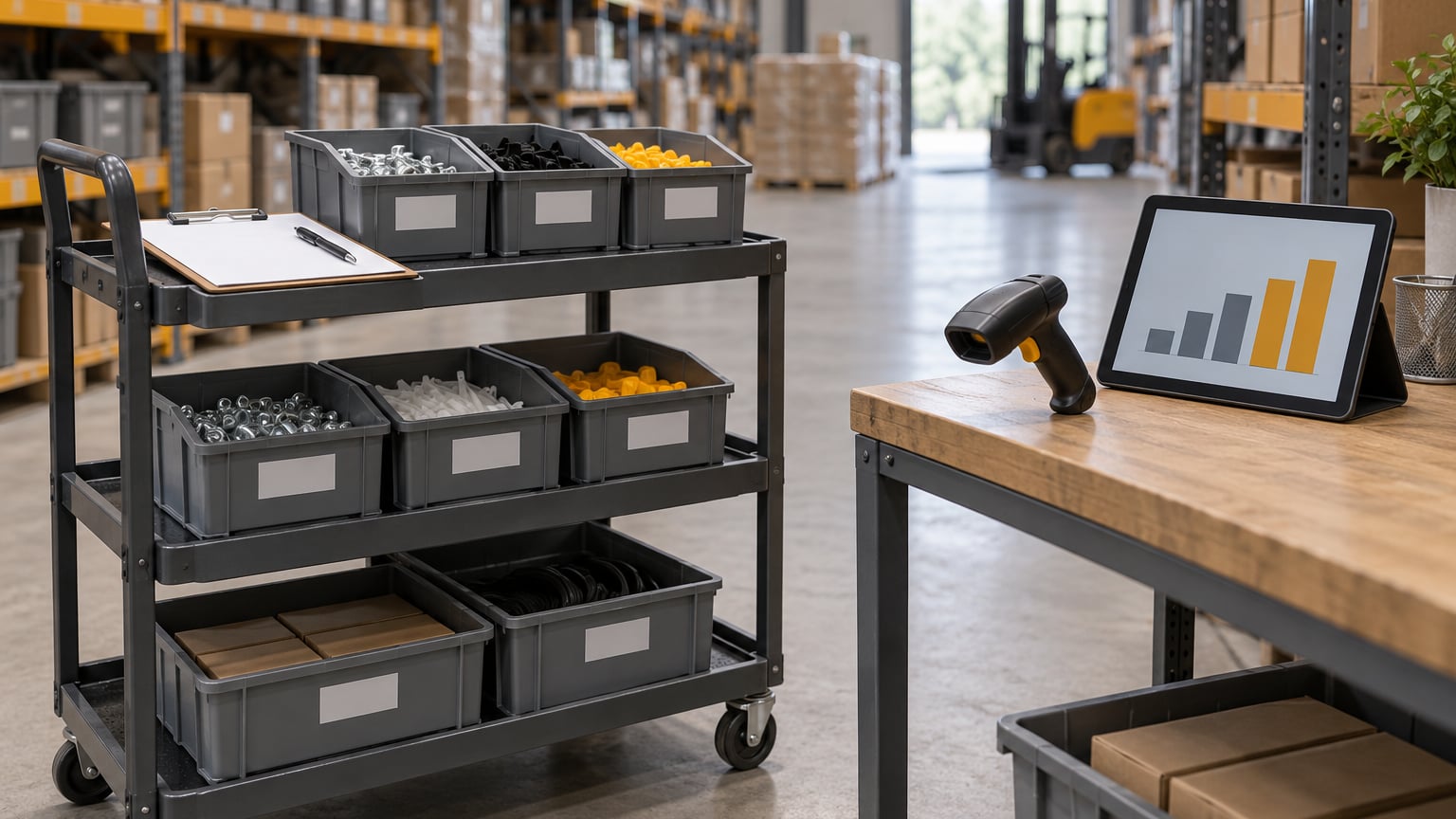
Periodic vs perpetual inventory systems differ on one thing: timing. A periodic inventory system counts stock at intervals and updates the books only when the count is finished, while a perpetual inventory system updates every balance the moment a receipt, issue, or sale is recorded. Neither is automatically better. Periodic suits smaller, lower-volume operations where counting is cheap and easy. Perpetual suits anything where transactions outrun the counting calendar, which is most warehouses and nearly every manufacturer.
Most companies that people think of as sophisticated still start periodic. Small shops and job shops do it because nobody has time to count every bin, and for a low-value, single-location operation that is a reasonable trade. The trouble shows up later, when a physical count turns up a gap nobody can explain and the book record is three weeks stale.
This guide walks through how each system works, what it costs in labor and accuracy, and how to decide which one fits your operation. It also covers what actually changes on the balance sheet, because the accounting difference drives most of the operational difference.
Table of Contents
- Periodic vs Perpetual Inventory Systems at a Glance
- How Periodic vs Perpetual Inventory Systems Work
- Inventory Accuracy and Timing Differences
- Cost, Staff Time, and Scalability
- Reporting, Traceability, and Inventory Control
- Which Should You Choose?
- Frequently Asked Questions
- Which inventory system is more accurate: periodic or perpetual?
- Are perpetual inventory systems only for large businesses?
- How often should a periodic inventory system be counted?
- Can a company use both periodic and perpetual inventory methods?
- Is cycle counting the same as a perpetual inventory system?
- What records does a perpetual inventory system require?
- Conclusion: Choose the System That Matches Your Control Requirements
Periodic vs Perpetual Inventory Systems at a Glance
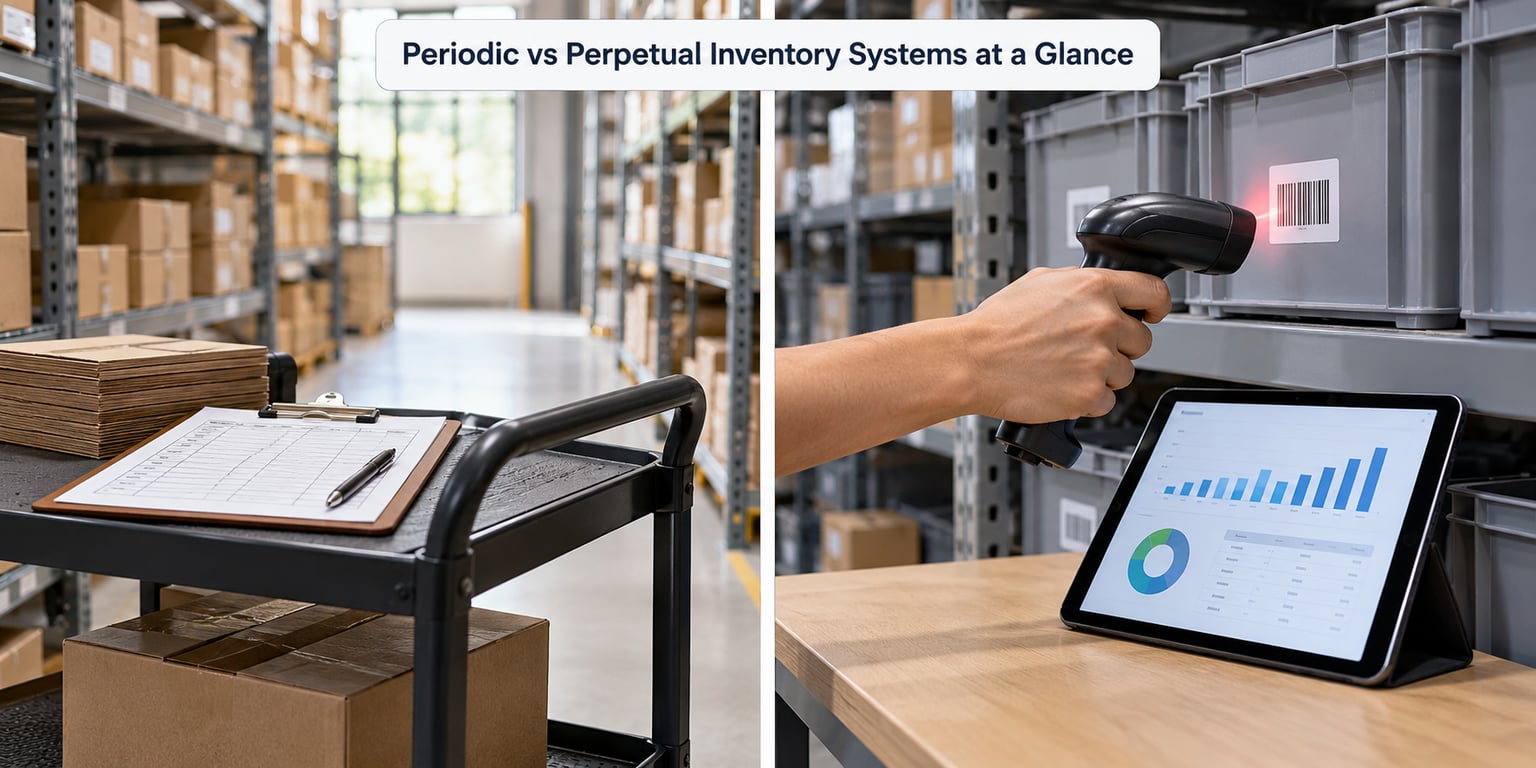
The table below is the short version. Everything after it expands on one row or another.
| Criterion | Periodic | Perpetual |
|---|---|---|
| How inventory updates | At a physical count, usually monthly or quarterly | With every transaction, in real time |
| Cost of goods sold timing | Calculated at period-end | Calculated at each sale or issue |
| Purchase recording | Purchases, returns, discounts, and freight-in accounts | Direct debit to Inventory |
| Book accuracy between counts | Estimate, can drift for weeks | Close to physical if transactions are all recorded |
| Setup cost | Low, spreadsheet and a good count sheet | Software, scanners, labels, integration, training |
| Staff time | Lumpy: big pushes at count time | Continuous and light per transaction |
| Reporting available | End-of-period statements only | Any time: value, turns, reorder, variance |
| Lot and batch traceability | Difficult without extra records | Natural if lots are captured at receipt |
| Shrinkage detection | Found at count, cause often unknown | Found near the transaction that caused it |
| Best fit | Small or single-site, low volume, simple stock | Multi-site, high volume, manufacturing, ecommerce |
| Main drawback | You manage blind between counts | You pay more and still have to count |
How Periodic vs Perpetual Inventory Systems Work
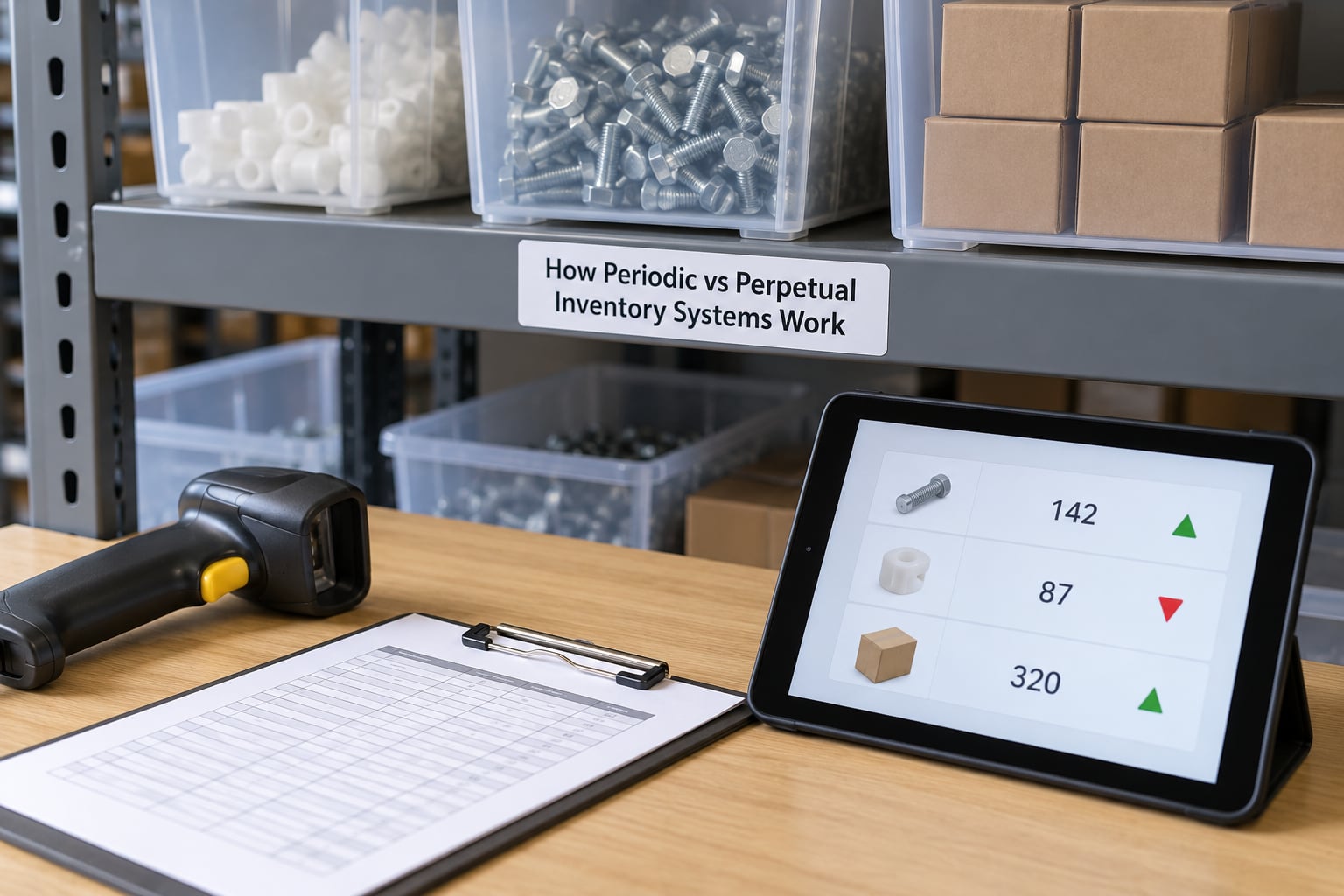
What a periodic system does at each count
Under a periodic system, the general ledger holds an inventory figure from the last count and nothing touches it until the next one. Purchases land in temporary accounts: Purchases, Purchases Returns and Allowances, Purchases Discounts, and Freight-In.
At period-end you shut down counting, add up the sheets, and run the math in one pass:
Goods available for sale = Beginning inventory + Net purchases
Cost of goods sold = Goods available for sale − Ending inventory
Everything gets closed out into Inventory and COGS at once. That simplicity is the whole appeal, and it is genuinely simple. One formula, one count, one adjustment.
What a perpetual system does at each transaction
A perpetual system has no waiting period. A purchase debits Inventory and credits Cash or Accounts Payable. A sale debits COGS and credits Inventory using whichever cost flow assumption you set, then reduces the balance by the same amount.
The result is that Inventory on the balance sheet carries a live number, and COGS lands in the income statement as activity happens rather than in a lump at quarter end. Every movement also leaves a trail: date, quantity, location, user, and in many systems the reason code.
A worked example: resin, molded parts, packaging supplies
Say a small plastics shop starts January with 10,000 lb of resin at $1.20 per lb, a bin of 4,000 molded parts at $0.75 each, and 500 boxes of packaging film. January purchases run 20,000 lb of resin at $1.30, so beginning inventory plus net purchases gives 30,000 lb of resin available at $37,800 total.
The January count comes back with 7,500 lb of resin on hand. Ending inventory for resin is 22,500 lb at the most recent cost, which puts COGS at roughly $15,750 for the month. That single number lands on the income statement once.
Under perpetual, each drum consumed posts its own cost line. A 500 lb drum issued at $1.30 debits COGS $650 immediately and cuts resin to 7,000 lb. Month-end produces the same total if nothing was missed, but you can see the resin balance at 11:00 on a Tuesday, and you can tell which job consumed which drum.
That last part is why manufacturers gravitate toward perpetual. Cost of goods manufactured needs consumption data by work order, and a periodic count cannot hand you that after the fact.
Inventory Accuracy and Timing Differences
A periodic system’s book figure is an estimate that ages the day the count ends. Shrinkage, damaged material, a mislabeled bin, a transfer that never got documented, a double-issue on a paper traveler — each of these sits in the books as if nothing happened until a count catches it. By then the error has usually mixed with a dozen others and nobody can point to the transaction.
Perpetual narrows the window enormously. If resin drops by 400 lb and no issue was posted, the system flags it, and someone can check that bin the same day. The gap between what the book says and what is actually on the shelf stays small as long as people keep recording movements.
That last clause is the honest catch. A perpetual system does not count anything by itself. If someone walks out with a case of parts and nobody scans it, the record is confidently wrong and no faster than a periodic book would have been.
Check frequency is where the two meet. Most perpetual operations still run scheduled cycle counts, often on an ABC basis where high-value items get counted most often, while periodic operations run a full count on a fixed calendar. The difference between cycle counting and physical inventory counting is worth understanding before you settle on a schedule.
Practical rule: if you cannot name the date of your last verified count, your accuracy claims are a guess. Perpetual systems make that question cheap to answer. Periodic systems make it expensive.
Cost, Staff Time, and Scalability
Periodic’s cost sits in labor, and it is lumpy. Two people walking the racks with a clipboard for two days is not a rounding error, and that cost lands whether the count goes perfectly or not. It also interrupts operations: aisles get blocked, shipments wait, and pickers lose time.
Perpetual’s cost sits in setup. You buy software, label bins, deploy barcode or RFID scanning, train people on a new routine, and clean up the transaction discipline that may not have existed before. Scanners are the cheap part; getting every receipt, issue, and transfer captured once, every time, is the expensive part.
Both costs are real, and they do not scale the same way. Periodic counting time grows roughly with the number of SKUs, the number of locations, and how many counts you run in a year. Perpetual cost grows mostly with transaction volume and user training, then flattens.
Here is where the crossover sits. At a few hundred SKUs in one building, periodic counting may genuinely be cheaper. Past a thousand SKUs, two sites, or a steady flow of small transactions, the count labor and the losses from stale data usually outweigh the software. Comparing label and tag strategies can help if scanning hardware is on your list, and RFID vs barcode for inventory tracking covers that tradeoff directly.
Disruption deserves its own note. A periodic count stops work. A perpetual scan does not.
Reporting, Traceability, and Inventory Control
Reporting is where periodic runs out of road. At period-end you get a value, a COGS figure, and a gross margin. That is enough for financial statements and not much else. You cannot ask what resin moved last week, which bins are trending, or whether a customer pull consumed more than its bill of materials allowed.
Perpetual answers those questions continuously. Reorder points, usage trends, days of cover, and turnover ratios come straight out of the transaction log. Variance analysis gets sharper too, because you can isolate the transaction where book and physical diverged instead of reconciling a quarter of unknowns.
Lot and batch traceability is the other big one. Capturing the lot at receipt, then following it through issues, is straightforward in a perpetual system and painful in a periodic one. If your work touches regulated material, customer-specific material, or anything subject to a recall, that difference decides the question for you.
Cost flow methods work in both systems, but they land differently. FIFO, LIFO, and weighted average all describe which layer of cost leaves the shelf. Under perpetual, the method applies at every single transaction. Under periodic, you apply it once at the count, across goods available for sale. The totals converge in a stable period; they diverge sharply when prices are moving fast, which is exactly why CFA candidates fixate on the LIFO comparison.
Both systems have real limits. Periodic reports stale data. Perpetual reports confident data that depends entirely on human discipline upstream.
Which Should You Choose?
Choose periodic when the count is cheap and volume is low
Periodic is defensible when you have one location, a few hundred SKUs or fewer, low transaction volume, no lot tracking requirement, and a team that can count accurately in a day or two. It also works for businesses with genuinely valuable inventory where the reporting requirement ends at financial statements.
Choose perpetual when transactions outrun counting
Perpetual earns its cost when you have multiple locations, high SKU counts, a shift operation where stock moves while nobody is watching, perishable or high-shrinkage material, lot traceability requirements, or a need for reorder signals more current than the last count. If a stockout or an overstock would cost more than a few thousand dollars a year, the software is not the expensive part.
Use ABC inventory analysis before you commit. If your A items are 20 percent of the SKUs and most of the dollars, a disciplined periodic count with tight controls on those items may serve you better than a full perpetual rollout done badly.
How to move from periodic to perpetual without a bad quarter
Switching is a process, not a purchase. A sequence that works:
- Count everything and reconcile. The opening perpetual balance is only as good as that count.
- Pick the valuation method and write it into your policy, since it drives every future transaction.
- Clean up the item master: real SKUs, real units of measure, real locations.
- Label bins and locations so a scan has somewhere to land.
- Start with raw materials and finished goods at one site, the highest-value and highest-volume items.
- Run perpetual and a periodic count in parallel for one full cycle, then compare shrinkage before and after.
Parallel running is the step people skip, and it is the step that tells you whether the new numbers are trustworthy.
Frequently Asked Questions
Which inventory system is more accurate: periodic or perpetual?
Perpetual is more accurate between counts because every receipt and issue updates the balance as it happens, so book inventory stays close to physical stock. Periodic records are estimates that age until the next count. Neither is self-correcting though: a perpetual system stays accurate only if every transaction is actually captured.
Are perpetual inventory systems only for large businesses?
No. Perpetual is practical for a small shop with a few hundred SKUs if the owner or one employee records every movement as it happens. Software entry costs are lower than they used to be, and the counting time saved often pays for it. The deciding factor is transaction discipline, not headcount or revenue.
How often should a periodic inventory system be counted?
Monthly or quarterly works for most businesses, chosen so that the interval matches how fast stock moves and how much a miscount would cost you. Fast-moving or high-value items need shorter cycles even inside a periodic setup, and a mid-cycle spot check on your most valuable items catches problems before the full count does.
Can a company use both periodic and perpetual inventory methods?
Yes, and many businesses do at the accounting level by reporting periodically while running operations on live records, or by treating raw materials perpetually and finished goods periodically. The caution is staying consistent within each material category, since mixing methods inside one category distorts COGS and makes variance analysis unreliable.
Is cycle counting the same as a perpetual inventory system?
They solve different problems. Cycle counting is a counting schedule that verifies a slice of inventory on a rolling basis. Perpetual inventory is a recording method that updates balances with every transaction. A perpetual system with no cycle counting eventually drifts, and cycle counting works well even under a periodic setup.
What records does a perpetual inventory system require?
You need an item master with SKUs, units of measure, and locations, plus a transaction log covering receipts, issues, sales, transfers, adjustments, and scrap. Each entry needs a date, quantity, location, and unit cost. Lot, batch, or serial data is added when traceability applies, and a documented valuation method ties the records together.
Conclusion: Choose the System That Matches Your Control Requirements
Pick perpetual if your transactions happen faster than anyone can count, if stock moves across locations, or if you need lot-level history and current reorder signals. Pick periodic if you have one site, limited SKUs, low volume, and a counting job that fits inside a day.
Four things to do first. Map every transaction that touches inventory today, including the ones nobody records. Estimate your annual counting hours and multiply by a loaded labor rate to get a real periodic cost. Define the accuracy you actually need per material category rather than company-wide. Then test the candidate system against a real week of messy operations instead of a clean demo.
If that test shows you cannot capture every movement reliably, fix transaction discipline first. A perpetual system on top of broken habits is just a periodic count with extra steps.