
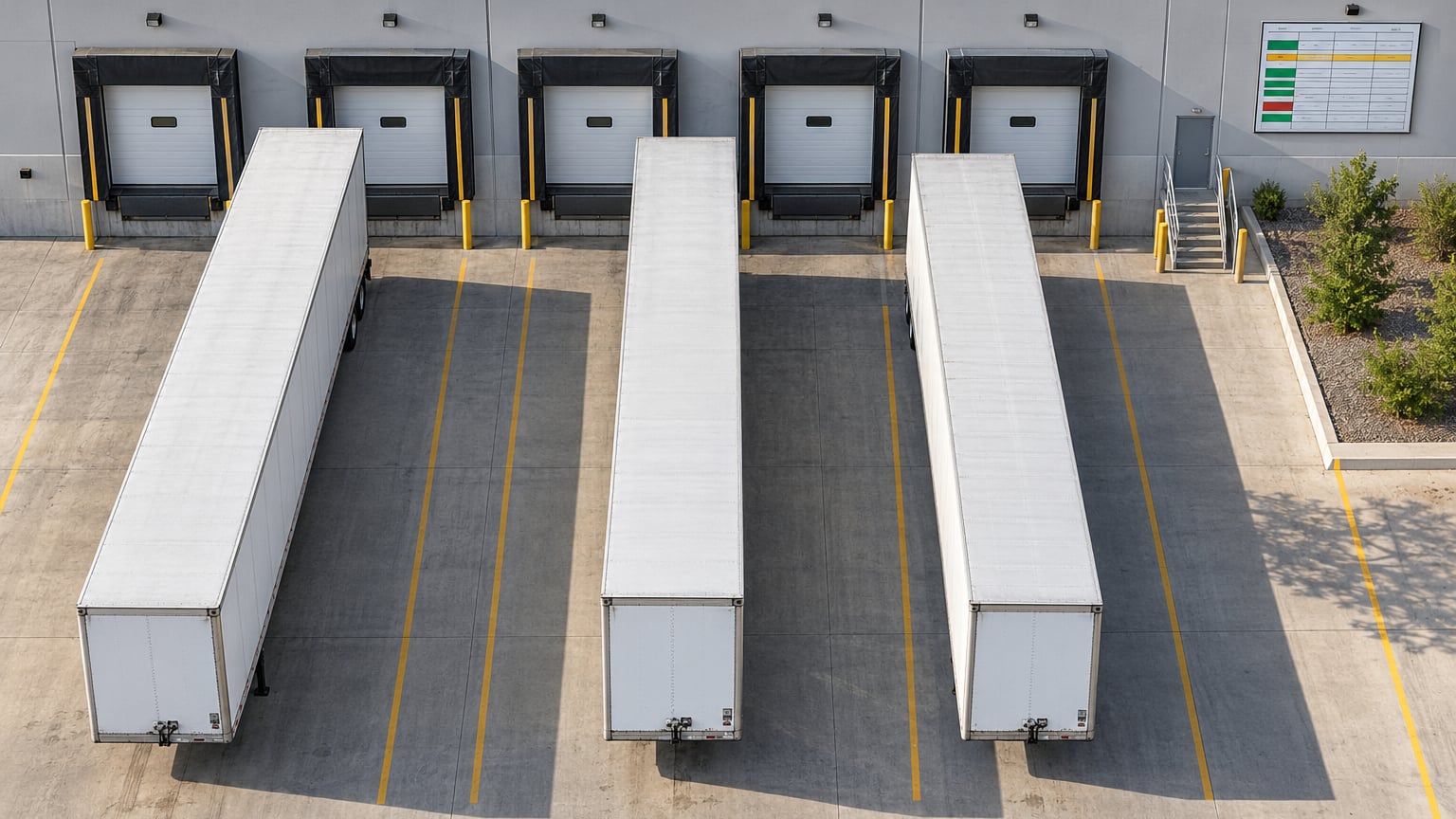
Dock scheduling is the practice of assigning planned arrival windows and specific dock doors to inbound and outbound trucks, so each load meets the labor, equipment and staging space that is actually available that shift. Done well, it shortens truck waits, cuts detention charges and keeps product flowing to the next step instead of sitting on a trailer in the yard.
The trouble is most facilities run dock scheduling like a suggestion. A whiteboard fills by 9 a.m., six trucks arrive for three doors, and the afternoon crew inherits a queue nobody planned for. The tips below are the ones that actually change how a day runs, whether you are booking slots by hand or through scheduling software.
Table of Contents
- Dock Scheduling Tips for Warehouses at a Glance
- 1. Set Appointment Windows by Operational Capacity
- 2. Separate Inbound and Outbound Appointment Rules
- 3. Build the Schedule Around Dock and Equipment Constraints
- 4. Add Buffer Time Without Creating Yard Congestion
- 5. Match Appointment Volume to Labor Coverage
- 6. Standardize Appointment Reminders and Communication
- 7. Create Priority Rules for Time-Sensitive Freight
- 8. Use a Visible Queue and Yard Management System
- 9. Measure Dock Performance and Adjust the Rules
- 10. Document Exceptions and Continuously Improve the Process
- Frequently Asked Questions
- Conclusion
Dock Scheduling Tips for Warehouses at a Glance
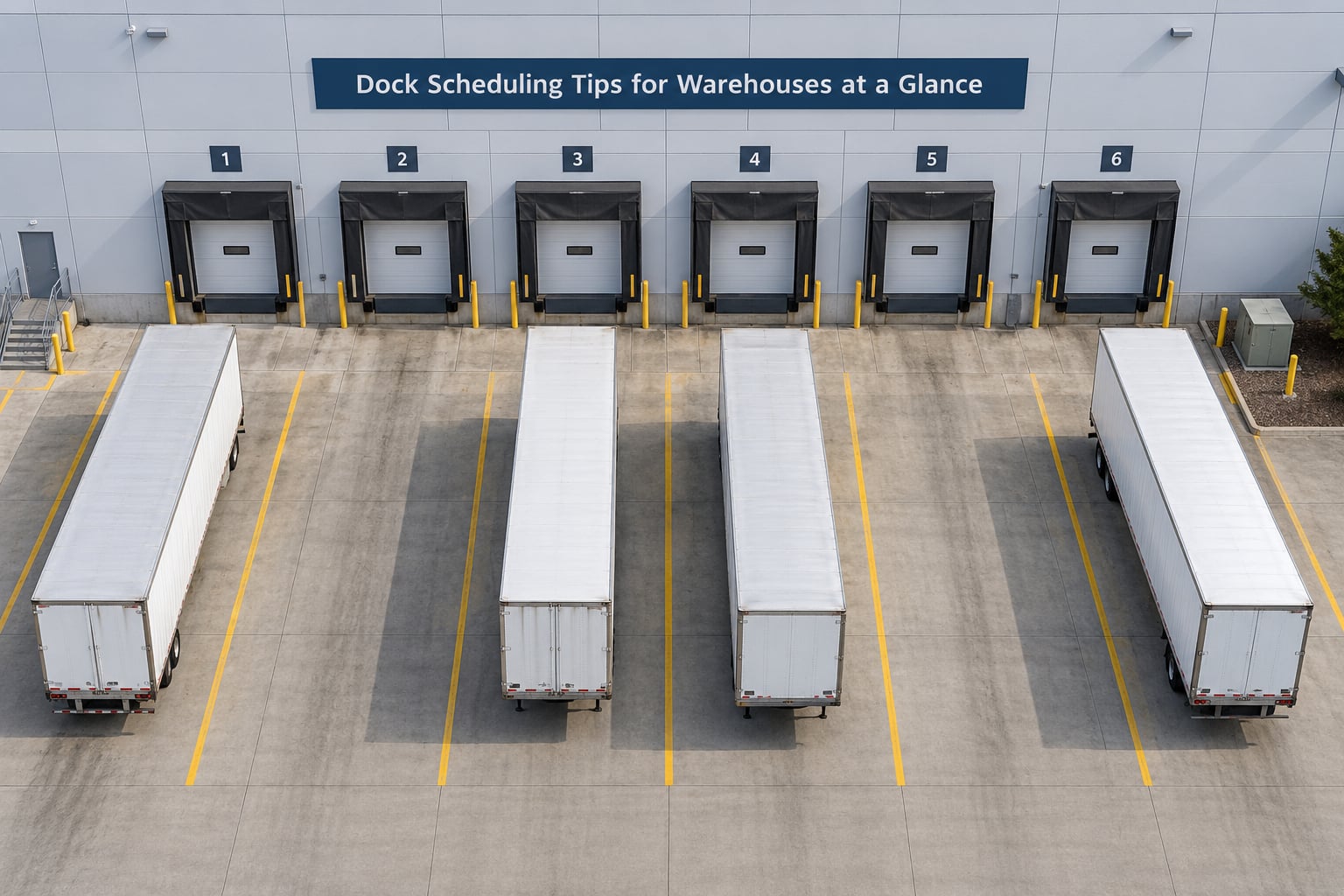
Here is the short version of all ten tips and the problem each one solves.
| Tip | Problem it fixes | Do this |
|---|---|---|
| 1. Capacity-based windows | Slots booked faster than doors can unload | Size slots from labor and load type, not door count |
| 2. Separate inbound and outbound | Receiving and shipping fight for the same crew | Split doors, windows and queue rules by direction |
| 3. Plan around dock constraints | Refrigerated or oversized load sent to the wrong door | Assign doors by height, trailer length and handling needs |
| 4. Controlled buffer time | One late truck cascades through the whole day | Hold recovery gaps and set early and late grace rules |
| 5. Match volume to labor | Arrivals peak when two people are on the dock | Align the appointment calendar to the shift staffing curve |
| 6. Standardize communication | Drivers guess where to check in and what to bring | One repeated message sequence for every appointment |
| 7. Priority rules | Everyone claims urgency and the queue stalls | Rank freight by perishability, value and line risk |
| 8. Visible queue | Nobody knows which door is free right now | Live status for checked-in trailers and open doors |
| 9. Measure performance | Improvements are argued instead of shown | Track adherence, turn time and receive-to-putaway time |
| 10. Document exceptions | The same problem recurs every Friday | Log exception loads and feed fixes back into the rules |
1. Set Appointment Windows by Operational Capacity
Start from the work behind the load, not from the calendar. A full 53-foot trailer of full pallets takes far longer to unload than a straight truck carrying four mixed pallets, and a floor-loaded container needs equipment your dock may not have.
Write down the realistic handling time per load class, then divide your available dock hours by that number. If a door gives you eight productive hours and a mixed-pallet load averages 45 minutes including put-away, that door holds roughly ten appointments, not twenty. Publishing twelve slots there guarantees a queue by mid-morning.
Why fixed 30-minute blocks break down
Uniform blocks feel tidy on a spreadsheet and punish you twice. Short loads waste productive door time, and long loads overflow their slot and push everything behind them backward. Slot length by load class is the single biggest upgrade most facilities can make without buying anything.
2. Separate Inbound and Outbound Appointment Rules
Receiving and outbound loading compete for the same people, forklifts and yard lanes, even when they use different doors. When both directions share one calendar, the morning outbound wave quietly consumes the crew that was supposed to unload the inbound wave.
Give each direction its own window set, its own queue and its own check-in instructions. A simple split works: inbound appointments in the first half of the shift, outbound staging built before the outbound wave, with a hard rule that inbound appointments never borrow outbound staging lanes.
3. Build the Schedule Around Dock and Equipment Constraints
Not every door can take every trailer. Before any appointment is confirmed, the schedule should already know which doors are restricted by height, trailer length, refrigeration, hazardous materials handling, inspection requirements or crane needs.
Make those constraints visible to carriers at booking time instead of at the gate. A driver who learns at check-in that the refrigerated load must go to door 14 has already lost twenty minutes of your crew’s time. Encoding the rule into the appointment removes the conversation entirely.
4. Add Buffer Time Without Creating Yard Congestion
Every schedule runs late sometimes, so hold small recovery gaps rather than booking doors wall to wall. A ten to fifteen minute gap after a heavier load absorbs the variance that would otherwise push the next appointment into a queue.
Pair the buffer with written early and late rules. Decide how far ahead a driver can check in, how late an appointment runs before it is re-sequenced, and what happens when a truck that is running late is followed by a truck that is early. Without a stated rule, the dock manager decides in real time, and that is how cascades start.
5. Match Appointment Volume to Labor Coverage
Your appointment calendar is really a labor plan in disguise. If the receiving crew drops from four people to two at 14:00, the schedule should get lighter at 14:00 too, and the carriers need to know that months in advance.
Compare your planned appointment count per hour against the staffing curve for that day, including forklift operators, quality inspection staff and yard moves. This is where shift planning matters as much as dock planning; if your crews rotate on a fixed pattern, dock windows should rotate with them rather than staying flat all week.
6. Standardize Appointment Reminders and Communication
Write one message sequence and send the same content every time. Confirmation of the window and door, arrival instructions, the address and entrance to use, paperwork required, how to check in, and the reschedule contact all belong in the same place, in the same order.
Send a reminder 24 hours out and again a few hours before. When the driver checks in, capture arrival time automatically, because those timestamps are what turn an argument about detention into a fact. Facilities that insist on an appointment still see trucks show up on time, because the reminder does the enforcing for you.
7. Create Priority Rules for Time-Sensitive Freight
Exceptions will happen, but a schedule where anyone can claim urgency is a schedule with no order at all. Rank freight by a short, published list: perishables and temperature-controlled loads, high-value goods, production-critical components that stop a line, then everything else by appointment time.
Cap how many priority slots a carrier can hold per day, and expire unreleased priority bookings automatically. A priority rule with no limit simply becomes a second schedule that everybody uses, which is worse than no rule at all.
8. Use a Visible Queue and Yard Management System
Whether it is a screen at the dock office, a board with magnetic lanes, or yard management software, the queue has to be visible to the people making decisions. It should show which trailers are checked in, which door each one is working, which door is free, who is behind, and what is delayed.
Without that view, yard moves become guesswork and drivers walk the aisles asking for a door. With it, the coordinator reorders the queue in seconds when an inspection hold appears, and the drivers in the yard can see it happening.
9. Measure Dock Performance and Adjust the Rules
Dock scheduling tips only stick when the numbers move. Track a small set each week and review them with the receiving leads, not just at month end.
- Appointment adherence = on-time appointments divided by total appointments, times 100.
- Average turn time = arrival to departure, door open to door close.
- Receive-to-putaway time = unload start to the load being stowed and available.
- Dock utilization = productive door hours divided by scheduled door hours.
- Exception rate = loads needing an exception path divided by total loads.
Utilization sitting far below target usually means slots are too long or the calendar is underloaded. Turn time climbing while adherence stays flat points at the load mix, not the carriers. Measure before you retrain anyone.
10. Document Exceptions and Continuously Improve the Process
Every schedule eventually meets something it did not plan for: a missing advance ship notice, a short load, damage on arrival, an inspection hold, a forklift breakdown, a weather closure. What matters is what happens next.
Give problem receipts their own path so one bad load does not block a door for the rest of the shift: move it to a defined exception area, keep the paperwork with it, and get it resolved on a named timeline. Log the reason, then review the log monthly. Two recurring reasons usually mean the rule is wrong, not the people following it.
Frequently Asked Questions
How long should a dock appointment slot be?
Slot length should match the work behind the load, so one size rarely fits. A full trailer of uniform pallets typically needs 60 to 90 minutes including put-away, a mixed-pallet straight truck 30 to 45 minutes, and a cross-dock-only load 20 to 30 minutes. Time a random sample of real appointments for two weeks before you publish any windows.
How should you handle trucks that arrive early?
Set one rule and communicate it in writing: drivers may check in a defined period before the window, and unloads do not begin before the window opens unless the door is idle and the load is priority freight. Early trucks park in assigned staging lanes, not at the dock. Without a stated grace rule, early arrivals quietly consume crew time and reset the morning.
Is scheduled receiving better than first-come, first-served?
Scheduled receiving wins once arrival volume is unpredictable, because it spreads labor demand and keeps detention predictable. First-come, first-served is simpler and fairer when volume is low and steady, which is common in small operations. Many facilities run a hybrid: appointments for scheduled freight, first-come-first-served for overflow and unplanned trucks.
How do you calculate appointment adherence?
Divide on-time arrivals by total appointments for the period and multiply by 100. Define on-time as arriving within the published grace period, and decide in advance whether it means the truck checked in or the unload actually began, since those differ at a busy dock. Review the number weekly by carrier so one chronic offender does not hide inside a facility average.
Do we need dock scheduling software for a small warehouse?
If you handle fewer than roughly ten trucks a day with predictable arrival times, a shared calendar and a clear policy usually work fine. Software earns its place when appointments span multiple sites, carriers book their own slots, or coordinators spend real time reconciling spreadsheets and phone calls. Warning signs are double-booked doors, missed appointments nobody can explain, and detention charges you cannot trace to timestamps.
How do we know dock scheduling is working?
Track appointment adherence, average turn time, receive-to-putaway time, dock utilization and exception rate, and compare them to the baseline from before you started scheduling. Improvement usually shows first in turn time and detention, then in labor overtime and carrier complaints. Give the process a full quarter before judging it, because the labor plan needs a cycle to catch up.
Conclusion
Start here, in order. Map your real dock capacity by measuring how long each load class actually takes. Publish appointment windows sized to that capacity. Separate inbound from outbound so the two waves stop competing. Write the early, late and reschedule rules down and send them to every carrier before day one.
Then measure. Appointment adherence, turn time and receive-to-putaway time, reviewed weekly with the people on the dock, turn opinions into adjustments. The best dock scheduling tips for warehouses are the ones that survive contact with a real Tuesday morning, and these are built to. For the labor side, it helps to compare shift scheduling models for factories so your crew pattern and your dock calendar agree, and for the commercial side, minimum order quantity negotiation tips help you shape order patterns that make appointments easier to honor.