
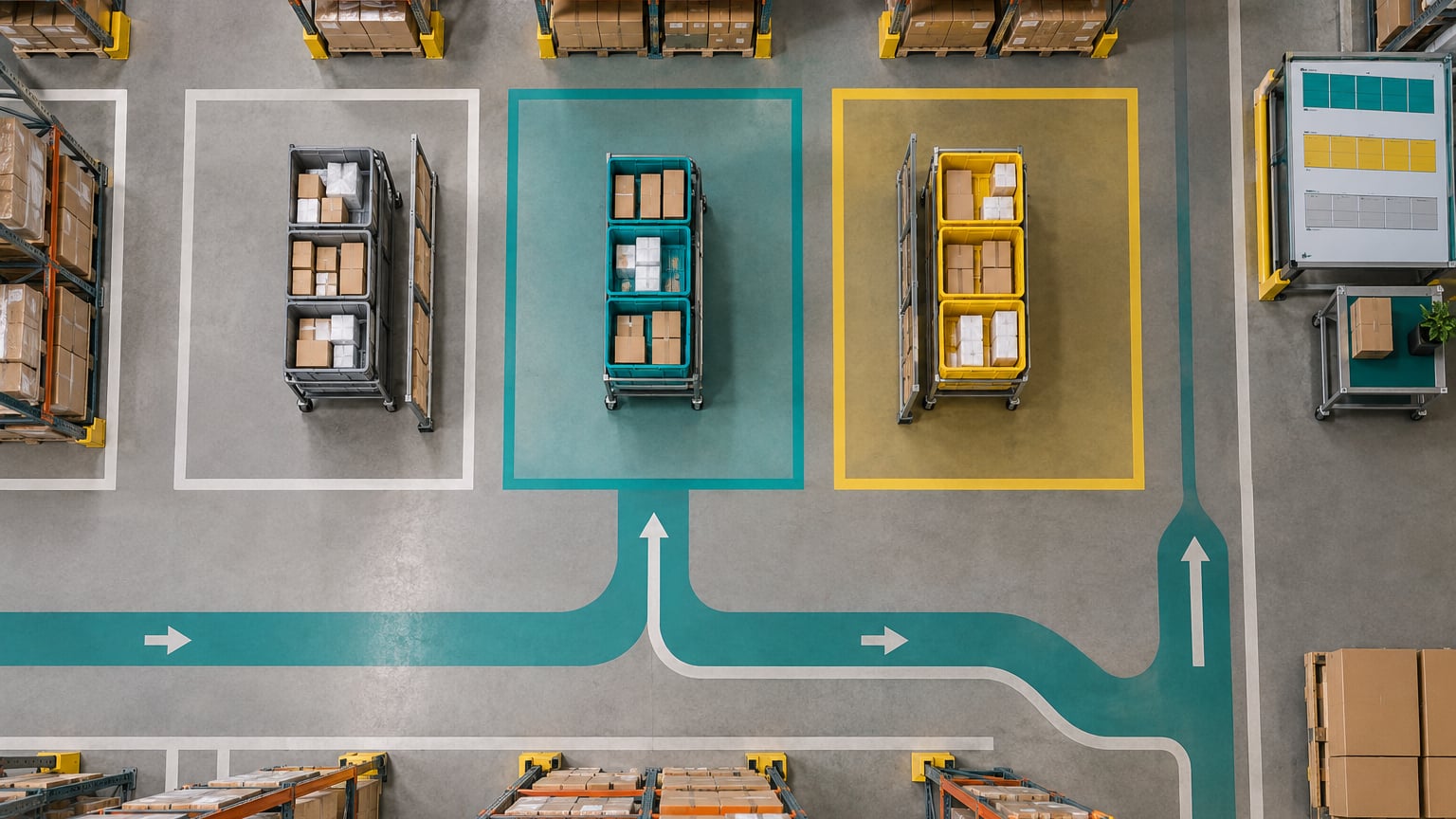
Short answer: batch picking is cheapest to run and cuts travel by grouping orders that share SKUs, wave picking is best when you need control over when orders hit the floor, and zone picking wins on travel and speed in large, well-balanced operations. Most warehouses end up running a hybrid of all three.
That matters because order picking can account for roughly 50-55% of total warehouse operating cost. Whichever strategy you pick changes your labor hours, your floor congestion, and how often a picker touches the same aisle twice for one order. Picking sits in the middle of the five core warehouse processes, between putaway and packing, so every hour you lose there comes straight out of throughput.
What follows is a vendor-neutral comparison, because the honest answer is that no single method wins everywhere. Batch picking vs wave picking vs zone picking is really a question about your order profile, your SKU count, and how much sortation capacity you can afford after the pick.
Table of Contents
- Batch Picking vs Wave Picking vs Zone Picking at a Glance
- How Batch, Wave, and Zone Picking Work
- Which Method Minimizes Warehouse Travel?
- How Do They Handle Order Priority and Service Levels?
- Accuracy, Labor, and Automation Requirements
- Which Strategy Fits Different Order Profiles?
- How to Choose and Implement the Right Picking System
- Which Should You Choose?
- Frequently Asked Questions
- Conclusion: Choose the Method That Fits Your Operation
Batch Picking vs Wave Picking vs Zone Picking at a Glance
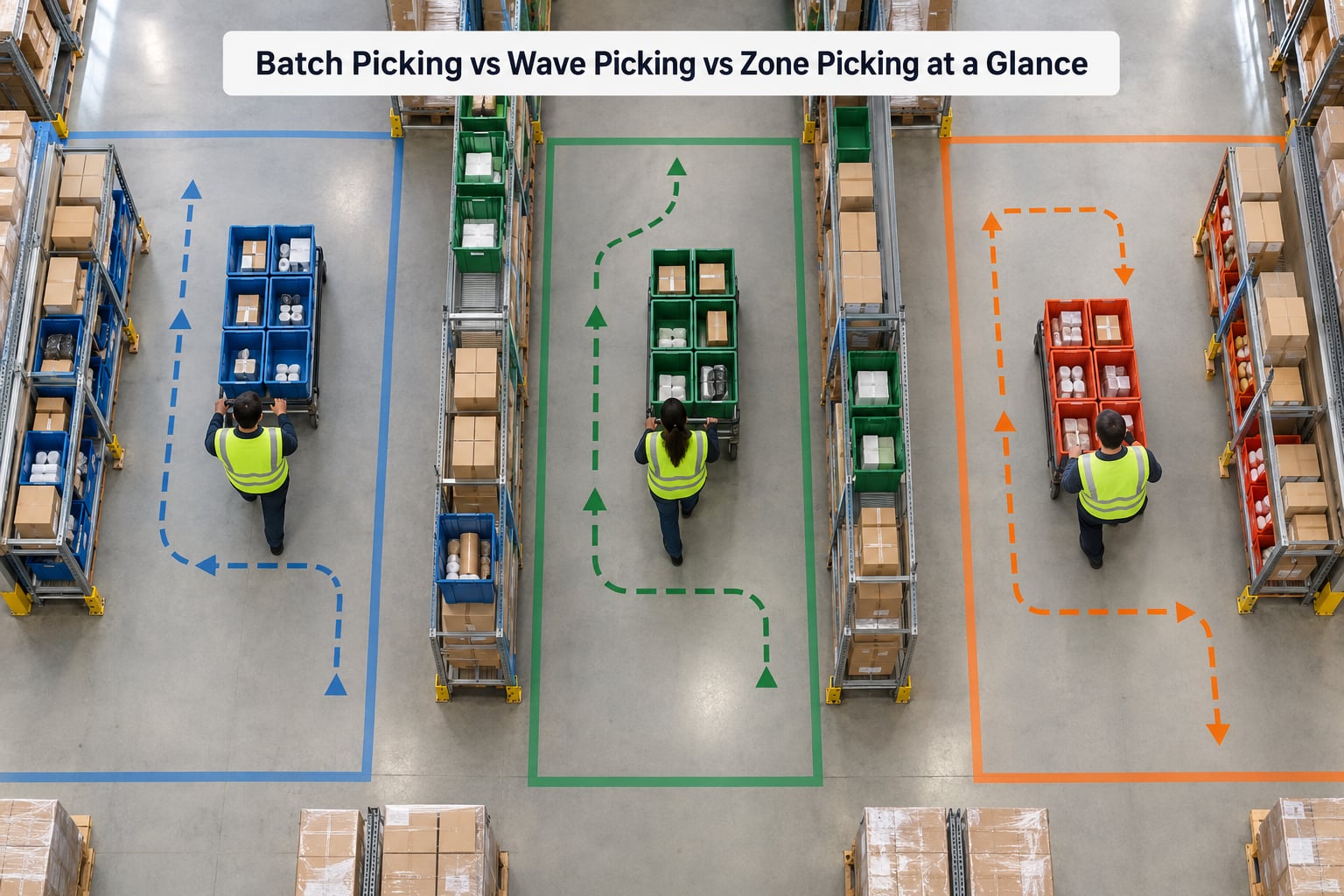
| Criterion | Batch Picking | Wave Picking | Zone Picking |
|---|---|---|---|
| Best use case | Orders sharing many of the same SKUs | Varying order mix with firm shipping cut-offs | Large floors, high SKU counts, steady staffing |
| Picking order | Grouped by SKU or order similarity | Ordered by release time, carrier, or priority rules | Each picker works their own zone, order by order |
| Travel pattern | One pass per SKU, items split into separate totes | Depends on how the wave is sequenced | Short, repeated loops inside a fixed area |
| Labor requirement | Few pickers plus a consolidation station | Pickers plus sortation and pack support | Enough bodies to staff every zone at once |
| Order profile | Small multi-line orders, high SKU overlap | Mixed lines, ecommerce peaks, deadlines | Steady flow, similar line counts per order |
| Accuracy considerations | Consolidation becomes the accuracy checkpoint | Scan-verified release and sortation | Specialization, but more handoffs to track |
| Scalability | Degrades as SKU overlap falls | Scales with software and sortation capacity | Scales with square footage and zones |
| Implementation difficulty | Low to moderate | Moderate to high | High, because zones must be balanced |
| Typical application | Parts, grocery, consumables, retail replenishment | Ecommerce fulfillment centers, 3PLs, parcel networks | Large distribution centers, apparel, general merchandise |
Two columns in that table matter more than the rest. How orders are grouped decides where the labor hour goes, and the sortation requirement decides whether your pick rate gains actually survive to the packing station.
How Batch, Wave, and Zone Picking Work
What is batch picking?
Batch picking is a method where the warehouse groups orders that share SKUs and sends a picker through them together. It works by picking a SKU once, splitting it into separate totes for each order in the group, then moving to the next SKU. It is best suited to orders that overlap heavily, such as parts orders or replenishment lists.
A picker might walk aisle 14, pick 40 units of one component, and drop 10 into tote A, 8 into tote B, and 22 into tote C. The travel is shared across three orders instead of walked three times.
The same batching instinct shows up outside fulfillment. If you run your own small production runs, our guide to injection molding at home covers how small batches change material handling and part labeling.
What is wave picking?
Wave picking releases orders to the floor in scheduled time-based windows rather than sending everything at once. It works by holding orders back, grouping them into waves by cut-off, carrier, priority, or picking zone, then releasing each wave when the plan calls for it. It is best suited to operations where cut-off times and sortation throughput drive the day.
Think of a shipping cut-off at 3pm. Instead of dumping 6,000 order lines on pickers at 7am, the WMS releases waves so the last parcels reach sortation in time to make that truck and nothing gets released too late to be useful.
What is zone picking?
Zone picking, also called pick and pass, divides the warehouse floor into physical zones and assigns one picker to each area. It works by having each picker gather their portion of every order in their zone, then hand the order to the next person or conveyor for the remaining zones. It is best suited to large floors where travel dominates the pick.
Pickers become specialists in a narrow set of SKUs, which cuts travel sharply and improves familiarity with the pick face. The catch is that every order must move through every zone in sequence, so a slow zone stalls the order behind it.
Batch Picking vs Wave Picking vs Zone Picking: Core Differences
The central difference is what each method organizes. Batch picking organizes the work itself, grouping orders or lines so the pick sequence is efficient. Wave picking organizes the timing, releasing groups of orders against real-time workload priorities. Zone picking organizes space, dividing pick responsibility across fixed warehouse areas.
One practical way to see it: batch changes the tote, wave changes the clock, zone changes the map. A warehouse can run all three at once without conflict, which is exactly why most do.
Which Method Minimizes Warehouse Travel?
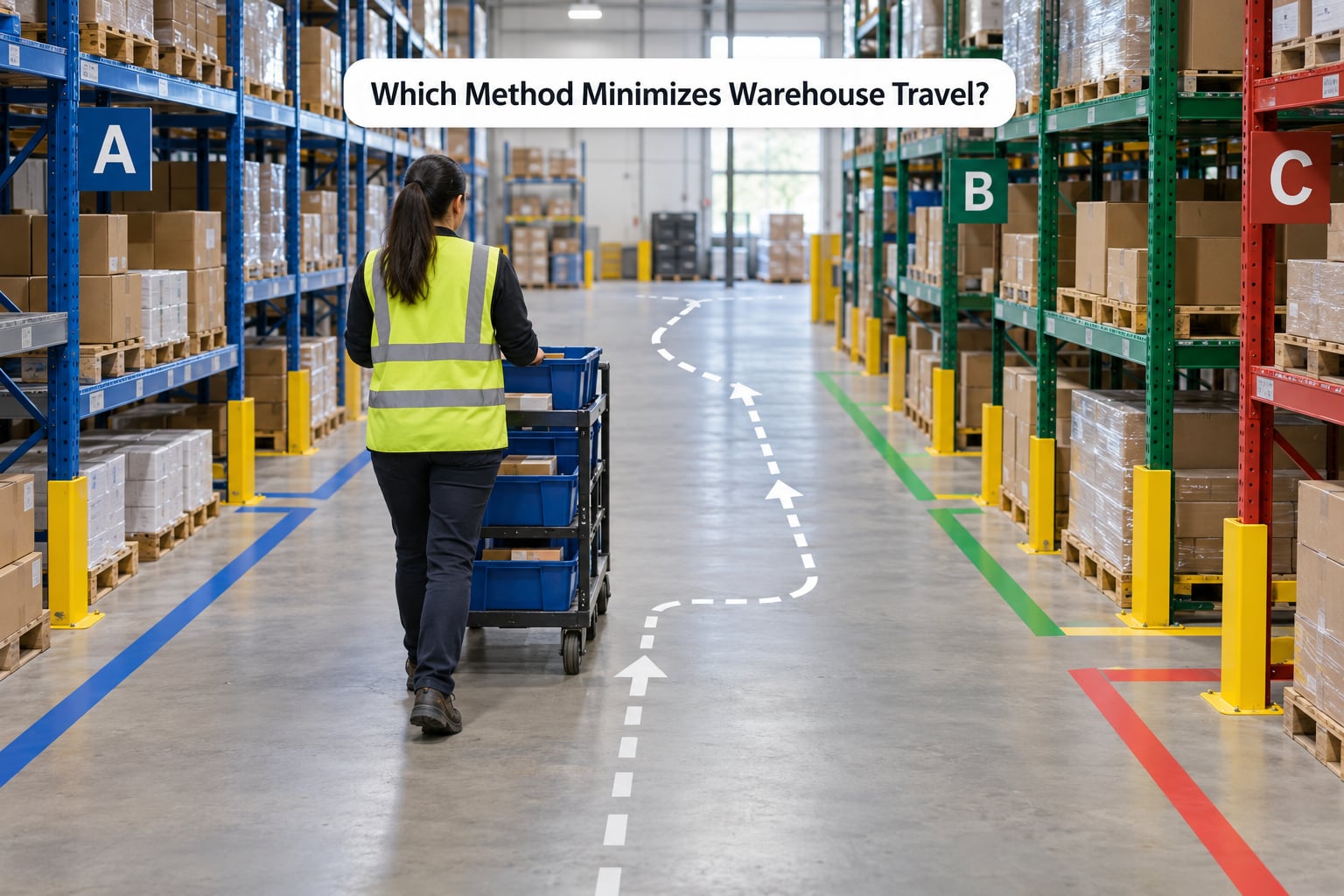
Zone picking usually minimizes travel, because a picker never leaves their assigned area. Travel is bounded by the size of the zone, and pickers build real familiarity with the fastest path through it. If your zone is 15 aisles instead of 300, that is where the savings come from.
Batch picking can get close to zone picking on travel when SKU overlap is high, but only when the software sequences properly. Sequenced by SKU, the picker walks a clean aisle route. Sequenced by order, a batch picker duplicates the same inefficient walk you had before, with extra consolidation work added.
Wave picking is a scheduling method rather than a travel method, which is why the term gets misused. A wave does not inherently cut travel. What matters is how the lines inside the wave are sequenced and whether the release window keeps pickers from crisscrossing the building chasing items that just moved during replenishment.
Watch congestion, not just distance. Two methods that produce identical walk length feel completely different when one sends half the floor into the same aisle at 10am. A wave release that staggers pickers often beats a “more efficient” batch run that clusters everyone in one block.
How Do They Handle Order Priority and Service Levels?
Batch picking handles priority badly by default. Work is grouped before priority is applied, so an urgent order can end up inside a batch and wait for the whole group to finish. If you need hot orders pulled out, you have to rebuild the batch around them.
Wave picking is the strongest of the three on priority, because the release decision is a software decision. You can hold an order back, bump it to the front of the next wave, split waves by carrier and service level, or reserve pick capacity for a rush. That control is the main reason operations under service-level pressure move toward waves.
Zone picking is the most awkward. Every order passes through every zone, so a line sitting in a slow or understaffed zone holds up work that is otherwise complete. A zone design with one overloaded zone and four light ones gives you the worst of both: the travel savings of zoning and the delay of a queue. Balancing zones by SKU velocity and pick-line volume, not by square footage, is the whole game.
Accuracy, Labor, and Automation Requirements
Error exposure sits in a different place for each method. Batch picking concentrates risk at consolidation, where a split quantity goes into the wrong tote and nothing catches it until pack-out. A scan-verified consolidation station is what turns batching into an accuracy gain rather than an accuracy gamble. Our walkthrough of how to reduce warehouse picking errors covers the verification steps that make this stick.
Wave picking spreads risk across more handoffs: release, pick, transport, sortation, pack. Each one needs a scan or a verification step, otherwise a wave that releases 3,000 lines at once creates 3,000 chances to pick into the wrong cart.
Zone picking adds handoffs by design, one per zone boundary. Pickers specialize and make fewer SKU-related mistakes, but coordination errors replace selection errors, so the WMS needs clear order status tracking.
Staffing and training
Batch picking needs the fewest bodies on the floor but adds a consolidation role. Zone picking needs the most, because every zone must be covered simultaneously or throughput drops. Wave picking needs a balanced mix and the discipline to release on schedule, which is a scheduling job as much as a floor job. New pickers ramp fastest in a zone because the SKU list is short and consistent.
Technology each method needs
Batch picking without a WMS is genuinely hard to optimize, because the whole value is in the grouping logic. Wave picking needs wave scheduling plus sortation and conveyance to absorb the release. Zone picking needs location and zone management, and it is the easiest of the three to pair with voice picking, mobile scanning, automated storage, and AMR or AGV fleets carrying totes between zones.
Goods-to-person systems often borrow the wave concept: orders are released in groups to a staging area and served by robots or conveyors, which is really wave release with the walking removed.
Which Strategy Fits Different Order Profiles?
Match the method to the work, not the other way round.
- Small, single-line orders with heavy SKU overlap: batch picking. Parts, grocery, and consumables are the classic fits.
- Mixed line counts with firm carrier cut-offs: wave picking, because release timing is the constraint.
- High SKU counts in a large building: zone picking, since travel is the dominant cost.
- Repetitive replenishment work between stores: batch picking, where the same SKU list repeats all day.
- Ecommerce peaks with same-day shipping promises: wave picking with priority rules, so rush orders get released first.
- Steady high-throughput distribution with stable staffing: zone picking, because zones only pay off when every zone stays staffed.
- Operations with specialized pick faces or bulky goods: zone picking with dedicated faces for oversized items.
- Multi-client 3PL work: wave picking, which separates client work cleanly by carrier and service level.
Most ecommerce operations end up combining batch consolidation with wave release, because orders overlap enough to group but vary enough to need control over timing.
How to Choose and Implement the Right Picking System
Work through these six questions in order, and the answer usually falls out on its own.
- How many order lines per hour, and how many per order? Many short lines favor batching. Long, varied orders favor waves.
- What share of orders share SKUs? High overlap makes batching pay off quickly. Low overlap makes it dead weight.
- How many active SKUs and how big is the floor? Large floors with high SKU counts point to zoning.
- What are your service commitments? Hard cut-offs and same-day promises argue for wave release.
- Can you staff every zone at once? If the honest answer is no, do not zone yet.
- What can you afford after the pick? Batching and waving both push work into consolidation and sortation. Count those bodies before you commit.
| Order volume | SKU count | Start with |
|---|---|---|
| Low to moderate | Low | Batch picking, or plain discrete picking |
| Moderate | High | Zone picking with tight zones |
| High | High | Wave release with zone pick faces |
| High | Low | Batch picking plus automated sortation |
| Variable peaks | Any | Wave picking for the peak, batch for the base |
How to run the pilot
Do not convert the whole building at once. Pick one product family, one client or channel, and one shift, and run the new method against the old one for four to six weeks. Hold staffing, layout, and order mix constant so the numbers mean something, and write down your baseline before you start.
Watch four measures: lines picked per labor hour, order picking accuracy, on-time shipment against cut-off, and consolidation or sortation cost per order. Travel time per line is useful too, but it is a leading indicator rather than an outcome.
The most common mistakes are predictable. Zones sized by square footage instead of pick volume, a batch method with no prep area for consolidation, no WMS optimization behind the grouping, and picking knowledge that stays siloed in a few experienced people’s heads instead of living in the system.
Which Should You Choose?
Choose batch picking when your orders share SKUs and your labor budget is tight. It gives the fastest improvement per dollar spent, as long as you have a consolidation station and a WMS that can sequence it.
Choose wave picking when service levels, cut-off discipline, or mixed order profiles are the problem. It costs more to run because of sortation, but it gives you the release control that batching cannot. This is the usual answer for ecommerce fulfillment centers.
Choose zone picking when travel is eating your pick rate and you can staff the floor reliably. It is the biggest structural gain and the hardest to reverse, because zone boundaries, slotting, and staffing all have to be designed together.
Pick a hybrid when your demand is mixed, which is most of the time: wave release sets the timing, zone pick faces handle the travel, and batch consolidation groups the lines once they are picked. Optimize labor hours per order first, then accuracy. Everything else follows from those two.
Frequently Asked Questions
Can a warehouse combine batch, wave, and zone picking?
Yes, and most larger operations do. A common pattern is wave release for timing, zone pick faces for travel, and batch consolidation for orders whose lines share SKUs. The WMS handles the layering, since zones can be the physical structure while waves define when work is released and batches group what the sortation station sees. Treat it as one design problem, not three separate projects.
Is wave picking better than batch picking for ecommerce?
For ecommerce, usually yes, because wave picking controls release timing and that is what same-day shipping promises depend on. Batching is cheaper to run and groups orders efficiently, but it gives you less control over which orders move first and when. The trade is cost against flexibility: waves require sortation capacity and scheduling discipline, while batching requires a solid consolidation area.
What is the main disadvantage of zone picking?
The hard cut-off. Every order passes through every zone in sequence, so a slow zone, a missing picker, or an unbalanced SKU assignment holds up orders that are otherwise finished. Zones also need enough bodies to cover every area at once, which makes staffing the real constraint. If you cannot staff the floor reliably, zoning will underperform a simpler batch approach.
Does zone picking require a WMS?
In practice, yes for anything beyond a small operation. Zone picking depends on accurate location data, order status across zone boundaries, and clear ownership of work in progress. Without a WMS, tracking where a half-picked order sits becomes a whiteboard exercise that scales badly. Small facilities can run zones manually, but expect coordination to consume the travel savings.
How do you know which picking method is performing best?
Compare methods on the same four measures over the same period: lines picked per labor hour, order picking accuracy, on-time shipment against cut-off, and consolidation or sortation cost per order. Travel time per line helps explain the movement, but it is not the outcome you are managing. Run each method against a fixed order mix and fixed staffing, or the comparison will tell you nothing.
Conclusion: Choose the Method That Fits Your Operation
Batch picking wins on simplicity and cost, wave picking wins on control, and zone picking wins on travel. Pick the one that matches your order overlap, your service commitments, and how reliably you can staff the floor, then pilot it on one product family for four to six weeks.
Measure lines per labor hour, pick accuracy, on-time shipment against cut-off, and sortation cost per order. That last number is where the surprise lives, because batching and waving both push work downstream, and an unmeasured consolidation queue will quietly eat every gain the picking change produced.