

Minimum order quantity negotiation tips come down to one move: find out what actually creates the supplier’s minimum, then offer something that lowers their cost or raises what they recover from you. The quoted MOQ is a cost-recovery threshold, not a policy, and that is exactly why it moves.
A minimum order quantity is the smallest number of pieces a supplier will produce or sell in one order, set so the supplier recovers the fixed setup and changeover costs of running a production line for your goods. Setup cost does not shrink when the run gets smaller, so the floor exists to keep the math positive.
This guide is written for US buyers sourcing plastics, packaging, and components, whether you are placing a first production run, a wholesale order, or a repeat purchase that has outgrown its original terms. Last updated October 2026.
Table of Contents
- Minimum Order Quantity Negotiation Tips at a Glance
- 1. Separate MOQ From Total Demand Visibility
- 2. Ask What Creates the Supplier’s Minimum
- 3. Negotiate a Smaller Pilot Run
- 4. Offer a Forecast Instead of a Promise
- 5. Trade Volume for Flexible Order Timing
- 6. Negotiate Price at the Correct Volume Tier
- 7. Use Packaging and Component Standardization
- 8. Negotiate a Shared Ramp-Up Plan
- 9. Ask for Payment-Term Tradeoffs
- 10. Confirm Every Term Before Placing the Order
- Frequently Asked Questions
- What is a good MOQ for a first production run?
- Is minimum order quantity negotiable with suppliers?
- How do I calculate the minimum order quantity I can afford?
- Why is my packaging minimum higher than the product minimum?
- What is a typical MOQ for injection molded plastic parts?
- What should I do when a supplier refuses to lower the MOQ?
- Conclusion
Minimum Order Quantity Negotiation Tips at a Glance
Every tip below attacks a different part of the supplier’s cost base, which is why they are worth trying in order. The trade-off column matters as much as the tactic: a lower MOQ almost always costs you something, and the buyer who knows what they are paying for negotiates better than the buyer who just keeps asking.

| Tip | Supplier issue it addresses | Trade-off you accept | Strongest question or request |
|---|---|---|---|
| 1. Separate MOQ from demand | Their screen for serious buyers | You share real forecast data | Which quantity does your cost model actually require? |
| 2. Find what creates the minimum | The real cost constraint | Time spent asking precisely | What drives the minimum on this item: material, setup, changeover, or packaging? |
| 3. Negotiate a pilot run | Risk of a full run they cannot absorb | A higher unit price or setup fee | Would you run a validation lot at a smaller quantity? |
| 4. Offer a forecast, not a promise | Uncertainty about reorder | Forecast accuracy you must honor | Does a range with dates change the minimum? |
| 5. Trade volume for timing | Their inventory and scheduling risk | Less of your own flexibility | Can we do a smaller lot with predictable call-offs? |
| 6. Price at the right tier | Cost recovery at your volume | Setup, freight, packaging charges | Show the tier table with the quantity for each unit price. |
| 7. Standardize packaging and parts | Print plates, colors, tooling, changeovers | Less design freedom | What changes if we use a standard color and dimension? |
| 8. Share a ramp-up plan | Production sequence uncertainty | A longer, staged schedule | Can we phase this by SKU, size, or market? |
| 9. Trade payment terms | Your cash, their cash exposure | A higher MOQ or deposit | What payment structure would unlock a smaller run? |
| 10. Confirm every term | Silent drift between quote and PO | None, it is the whole job | Get the confirmed quantity, price, and timing in writing. |
1. Separate MOQ From Total Demand Visibility
A quoted minimum and your actual requirement are two different numbers, and most failed negotiations mix them up. Buyers ask for a lower MOQ as though it were a favor, when the supplier is really screening for whether the account is worth scheduling.
The useful move is to separate the two explicitly. Tell the supplier what your forecast says over six or twelve months, then ask what their cost model requires for a single run rather than for the relationship.
Say something like: “Our realistic demand is between 1,200 and 2,000 pieces over the next year, starting with a first run. What does a single run need to look like for you?” That is honest, and it converts a plea into a conversation about economics.
2. Ask What Creates the Supplier’s Minimum
The strongest MOQ negotiation question is not “can you lower it” but “what drives it”. Suppliers set minimums from fixed costs: material purchases, machine setup, changeover time, print plates, labor, or overhead spread across the run. Once you know which one binds, you know which lever to pull.
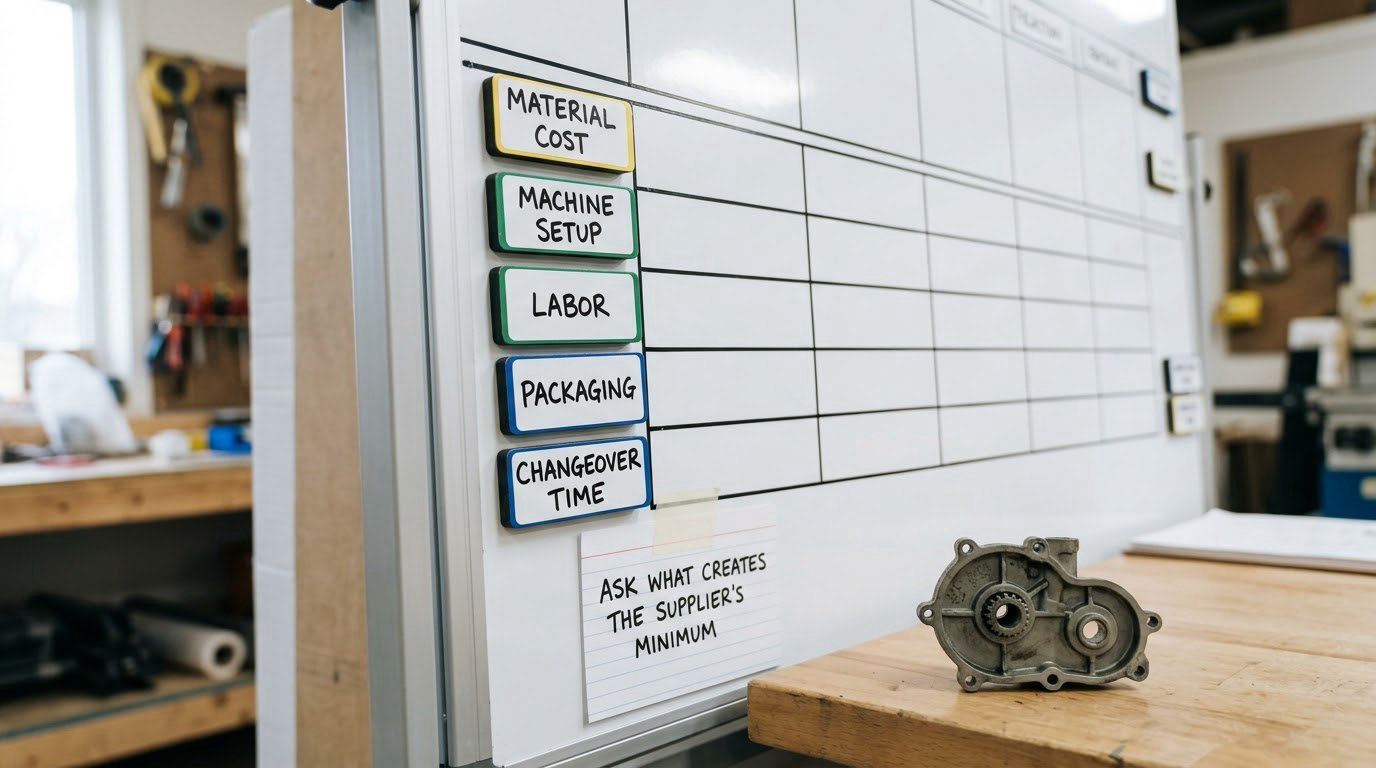
Four different minimums hide inside a single quoted number, and buyers routinely negotiate the wrong one. The product minimum belongs to the factory, the packaging or print minimum often belongs to a printer, the material or mill minimum belongs to the resin or film supplier, and a minimum order value is a commercial rule rather than a physical one.
A supplier who already explained the mechanism has usually moved as far as they can. Buyers who push past that point tend to get quoted rather than answered, and the thread goes quiet.
3. Negotiate a Smaller Pilot Run
A pilot run converts the supplier’s biggest objection, which is the risk of producing a quantity they cannot absorb, into something manageable. Ask for a validation lot sized to a test rather than a launch, and define quality in writing so the small run is not treated as a favor.
Write down what the pilot has to prove. Cycle time, first-article dimensions, packaging performance, or sell-through in a single market are all reasonable. Then agree in advance on what the move to a larger run looks like: quantity ranges, timing, and who confirms it.
The cost is usually a premium per unit or a flat setup fee, not a refusal. On platforms like Alibaba, sellers routinely go under a stated minimum for more per piece. r/FulfillmentByAmazon buyers put the mechanism plainly: the lower the quantity, the higher the price has to stay to justify it.
4. Offer a Forecast Instead of a Promise
Suppliers discount volume they can see coming, and a forecast is the cheapest thing you can offer. The distinction that matters is between a promise you cannot keep and a range you can defend.
Give monthly ranges over two or three quarters rather than one annual total, name the dates, and state what would change the picture: a delayed launch, a seasonality shift, a channel decision. Buyers on r/Entrepreneur warn against bluffing reorder volume, because a missed reorder costs you the relationship and the next quote.
Ask whether the forecast changes anything. Some suppliers will hold a lower minimum against a documented reorder schedule even when they will not reduce the per-unit price. That is a real concession and it costs you nothing at the moment you sign.
5. Trade Volume for Flexible Order Timing
Flexible order timing lowers the supplier’s risk just as effectively as a larger quantity does. If their concern is inventory sitting in a warehouse, then call-offs and staggered releases solve the same problem they were trying to solve with the MOQ.
Propose a smaller lot with predictable dates, or several smaller releases against one production slot. A supplier who charges for the setup once and then fills your orders on a schedule is giving up less than a supplier who absorbs an unsold batch.
The trade-off is yours to price. Call-off commitments reduce your flexibility to change quantities, so agree on how much notice you need to adjust and how far ahead the schedule locks.
6. Negotiate Price at the Correct Volume Tier
Price and quantity are two dials on the same lever, and buyers lose money by negotiating only one. Ask for the full tier list: the quantity required at each unit price, and every charge that sits outside the per-piece number.
How to use the volume tier list when you negotiate a minimum order quantity
Read the tier table as the supplier’s own cost model in reverse. A quoted unit price that looks attractive may be offset by a setup fee, a tooling charge, a minimum freight weight, or a packaging minimum that forces you to buy packaging you do not need yet. Ask for those as separate line items before you accept any tier.
Then compare tiers against your cash, not against the headline. Two r/Entrepreneur threads make the same point independently: a lower MOQ often means a higher cost per piece, so total landed cost is the only comparison that matters.
A fair test is to take the tier you are considering, add freight and packaging to it, and divide by the number of sellable pieces. Do the same at the tier above. If the jump is small, the lower tier may be cheaper all in.
7. Use Packaging and Component Standardization
Packaging minimums are frequently higher than product minimums, which is why a buyer can agree to a low MOQ on the product and still be stuck on the carton. Print plates, custom colors, and special dimensions each carry their own setup cost, and a printer will not waive any of them.
The lever is standardization. Ask what changes if you use a standard color from the supplier’s existing range, a dimension they already hold in tooling, or packaging they print for other customers. On the factory side, ask whether an existing component in their catalogue can cover your first run unbranded.
Print method matters too. Offset runs typically need quantities in the low thousands to make sense, while digital folding cartons quote from much smaller runs. Buyers should ask which method the price assumes before accepting it.
Repacking carries its own obligation: in some markets, the party that repackages a finished product becomes the manufacturer of record for safety and traceability purposes. Ask before you plan to decant and relabel someone else’s units.
8. Negotiate a Shared Ramp-Up Plan
A staged plan gives the supplier a production sequence they can plan against while you start with one SKU, one color, one size, or one market. It is the middle ground between accepting a full MOQ and fighting for an unrealistic exception.
Lay out the phases with quantities and dates: a small run for one market, a follow-on run once sell-through is known, then a full production run at the volume tier. Suppliers respond well to this because it replaces an uncertain single order with a schedule they can staff.
r/procurement buyers point out that high-leverage niche products are often where a supplier will accept a smaller run, because the item matters more than the quantity. Ask whether your item is one of those.
9. Ask for Payment-Term Tradeoffs
Payment terms are currency most buyers forget to spend. A supplier who cannot lower the MOQ on the product may be able to change what they recover from you, and cash timing is easier to move than quantity.
Raise the options in one message: a higher minimum in exchange for net terms, a deposit structure, billing at milestones, or a smaller deposit on a longer lead time. Some suppliers will accept a shorter production window in return for a larger deposit.
Know your own floor before you ask. Buyers on r/smallbusiness who succeeded on domestic suppliers generally did it by accepting a slightly higher per-piece price, not by winning a lower minimum outright.
10. Confirm Every Term Before Placing the Order
Every term you failed to confirm becomes a term the supplier decides for you later, and small orders carry more of these gaps than large ones. Confirm the whole picture in writing before the purchase order goes out.
Work through this list with the supplier: unit price and the quantity it applies to, the minimum itself, lead time and whether it starts at deposit or at order confirmation, tooling or setup fees and who owns the tooling afterwards, freight terms and delivery location, payment milestones, quality requirements and inspection method, and what happens to price and timing if quantities change.
Two questions catch most surprises. First, ask whether the minimum applies per SKU or across the whole order, which buyers on r/ecommerce report is genuinely confusing. Second, ask the supplier to state what would have to change for the minimum to change, and get the answer in writing.
Frequently Asked Questions
What is a good MOQ for a first production run?
A good first-run MOQ is one your cash and your demand can absorb without stranding inventory. For a market test, a few hundred pieces is often enough to measure sell-through. For a repeat wholesale order, match the minimum to realistic demand over two quarters rather than to the lowest number a supplier will accept.
Is minimum order quantity negotiable with suppliers?
Usually, yes, because a minimum is a cost calculation rather than a fixed rule. Suppliers commonly accept a smaller run at a higher unit price, a flat setup fee, a documented reorder forecast, or staged call-offs. What does not move is a material or mill minimum, custom color masterbatch, or new tooling, because those costs are real and fixed.
How do I calculate the minimum order quantity I can afford?
Take the cash you can commit without harming payroll or inventory, subtract freight, duties, and any setup or tooling fees, then divide what remains by your realistic sell-through per month over six months. That gives you a maximum order value. Ask the supplier for the unit price at several quantities and check whether any tier fits inside your ceiling.
Why is my packaging minimum higher than the product minimum?
Because the product and the packaging are produced by different businesses with different fixed costs. Print plates, custom colors, and special die cuts each carry setup charges, and a printer’s economics work at a different quantity than a factory’s. Ask for the product minimum and the packaging minimum separately, and ask whether standard colors or existing tooling would lower the print run.
What is a typical MOQ for injection molded plastic parts?
It depends on tooling and material. New single-cavity tooling plus a small production lot commonly lands in the low thousands of parts, while multi-cavity tools and higher volumes bring the minimum down per piece. Resin is often bought by the pallet or the drum, and custom color masterbatch has its own minimum from the compounding step.
What should I do when a supplier refuses to lower the MOQ?
Stop pushing on quantity and ask what the minimum is tied to. If it is a mill minimum or new tooling, the number will not move and you are better off finding a different route: a distributor, a catalogue or stock item, a supplier that already runs a similar product, or a trading company that splits batch minimums. If it is their cost model, offer a forecast, a staged plan, or a higher unit price.
Conclusion
Do one thing before your next quote goes out: ask the supplier what specifically drives their minimum, in writing, then match a realistic forecast or a staged purchasing plan to that constraint. The buyers who get small first runs are the ones who made the supplier’s economics work, not the ones who pushed hardest.