
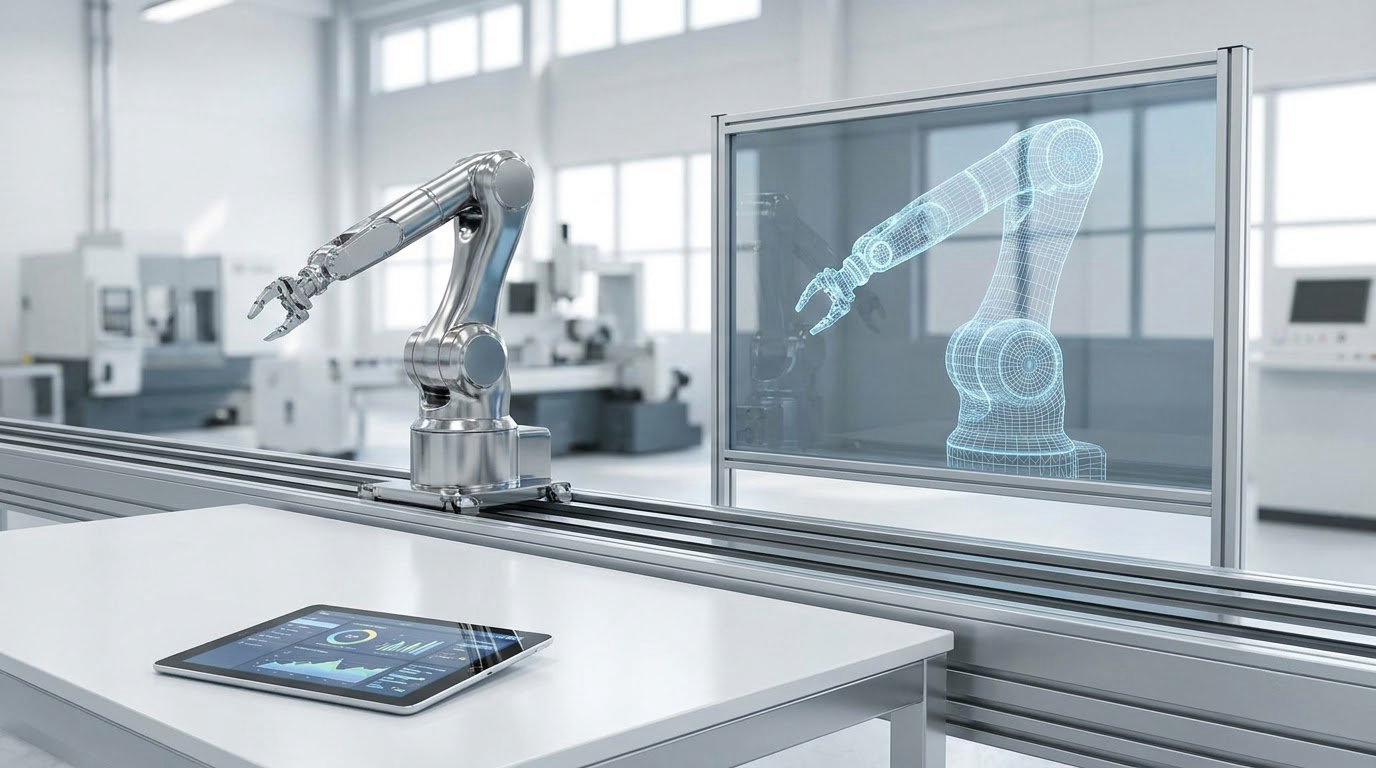
A digital twin in manufacturing is a live virtual replica of a machine, production line, or process, fed by real-time sensor data so engineers can watch performance, test changes safely, and catch failures before they stop the line. It is not a static 3D drawing, and it is not a marketing term — though some vendors use it that way.
Plenty of people meet the phrase in a vendor demo and walk away unconvinced. Practitioners argue on forums about whether twins deliver real operating value or are mostly repackaged dashboards, and that skepticism is healthy. The technology is genuinely useful, but only for a defined problem, on equipment that produces trustworthy data, and with someone on the floor willing to act on the output.
This guide walks through what a digital twin actually is, how the data moves, what it costs to build, and where it falls short.
Table of Contents
- What Is a Digital Twin in Manufacturing?
- How Does a Digital Twin in Manufacturing Work?
- What’s the Difference Between a Digital Model and a Digital Twin?
- What Does a Digital Twin in Manufacturing Do?
- Where Are Digital Twins Used in Manufacturing?
- What Are the Main Benefits of a Digital Twin?
- What Technology Is Needed to Build One?
- How Do You Implement a Digital Twin in Manufacturing?
- How Much Does a Digital Twin Cost?
- What Are the Biggest Challenges and Risks?
- Frequently Asked Questions
- Conclusion
What Is a Digital Twin in Manufacturing?
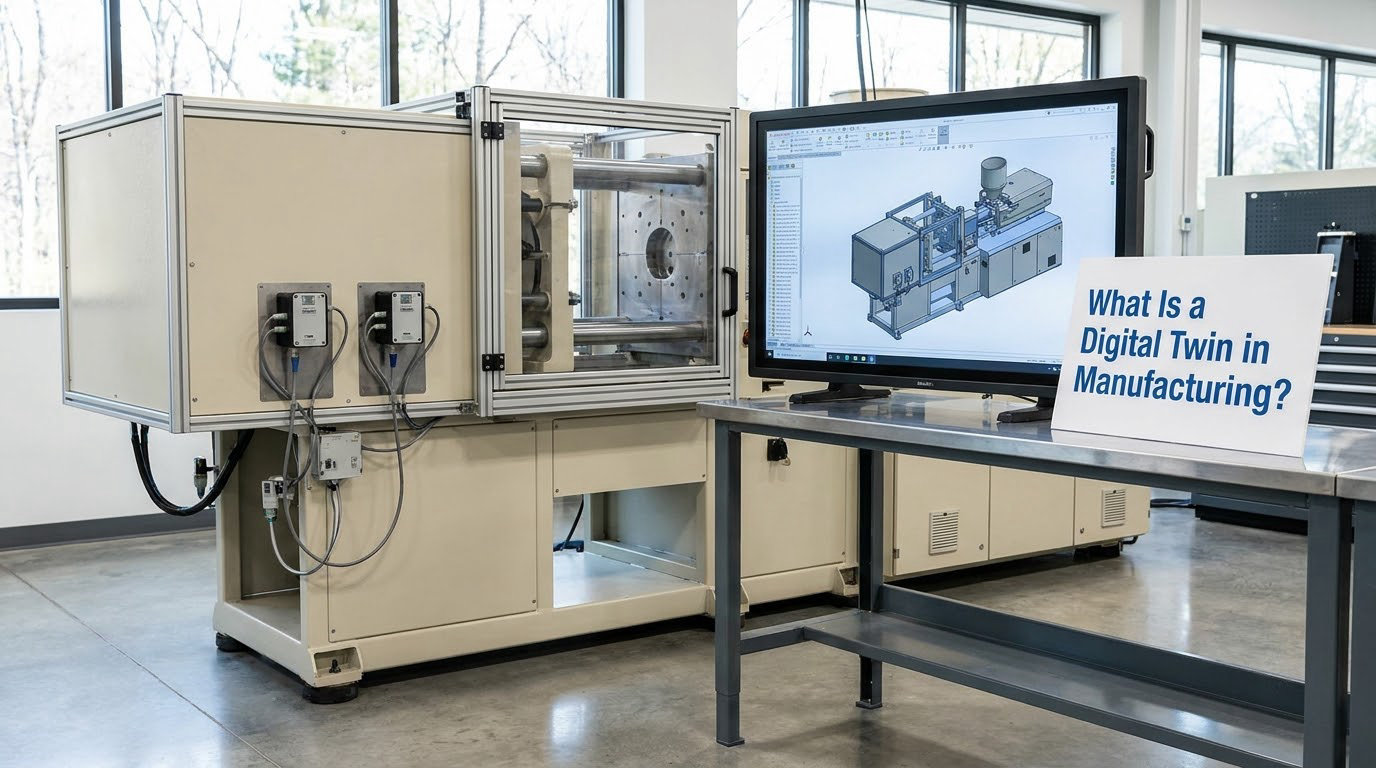
A digital twin in manufacturing is a continuously updated virtual replica of a physical asset, production line, or process, connected to real-time data so you can monitor performance, test changes virtually, and predict failures before they happen on the shop floor.
The word that does the work in that sentence is continuously updated. A conventional model tells you what the machine was designed to do. A twin tells you what the machine is doing right now, and what it will probably do in an hour.
Think about an injection molding cell. The twin holds the machine geometry, the current tool, the material grade, the cycle it is running, the barrel and mold temperatures, the hydraulic pressure trace, and the cavity pressure reading from the sensor port. When a rejection spike starts at 3 a.m., the twin shows the same spike, and the model can be asked which input moved first.
The term itself was popularized by Dr. Michael Grieves in the early 2000s and further articulated at NASA’s Johnson Space Center, where mirrored systems on the ground tracked spacecraft in flight. NASA later distanced itself from the phrase, but the underlying idea stuck: one authoritative model, fed continuously by the real asset.
How Does a Digital Twin in Manufacturing Work?
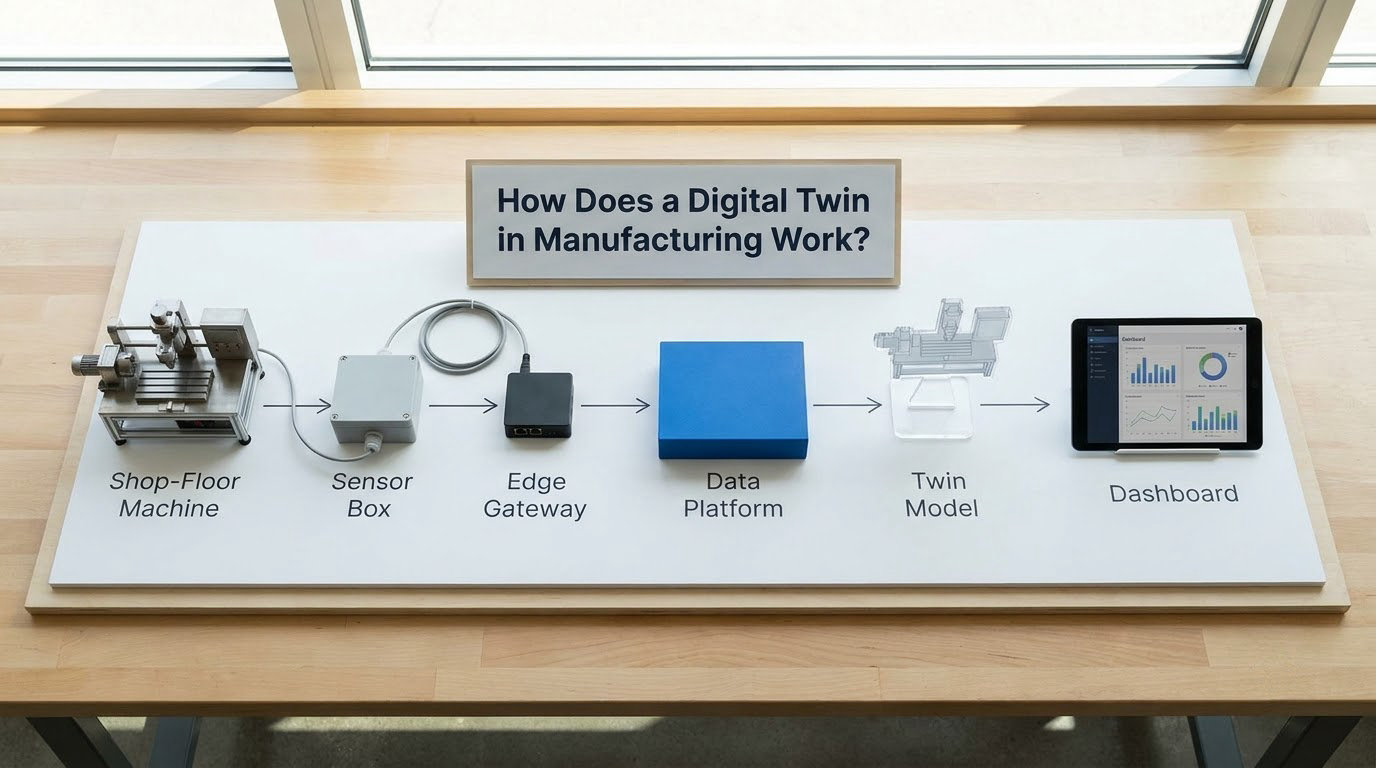
Data flows one way from the asset into the model, and the model’s output flows back as a decision. Sensors capture the physical state, a platform cleans and stores it, the model updates, and analytics compare what is happening against what should be happening.
Physical assets and real-time data
The physical layer is the machine itself and whatever measures it. Temperature, vibration, pressure, motor current, cycle counts, weight, and energy draw come from sensors, PLC tags read through a SCADA system, or controller data exposed by the machine builder. On a plastics line this usually means barrel zone temperatures, screw torque, injection pressure, and the cycle counter on the molding machine.
Sampling rates matter here. A vibration reading at one sample per minute tells you very little about a bearing; the same reading at thousands of samples per second will show you the fault signature. This is where a lot of projects quietly under-deliver, because the sensor was installed for reporting rather than for diagnosis.
The virtual model and simulation engine
The virtual layer combines geometry, physics, and logic. Geometry comes from 3D CAD data, the bill of materials, and the machine tool configuration. Physics comes from thermal, mechanical, or fluid models — a motor thermal model, a drivetrain load model, a hydraulic circuit. Logic comes from the control sequence itself.
That combination is what makes a twin more than a dashboard. A dashboard can tell you the barrel temperature is high. A twin can run a virtual cycle with a different cooling time and tell you what the part temperature would be before you change the recipe.
Feedback, control, and decisions
The third step is where value is created or lost. Most useful twins do not close the loop directly to a machine; they send information to a person or to a supervisory system that decides. A work order gets raised, a recipe change is queued for the next planned changeover, a spare part is ordered before the failure, or an operator gets an alert on a screen at the line.
A twin on a plastics line that only produces a weekly report is an expensive dashboard. A twin that flags a nozzle-heater degradation trend two shifts before the cycle starts stretching is doing real work.
What’s the Difference Between a Digital Model and a Digital Twin?
Most confusion comes from vendors using one word for several different things. A static model and a digital twin can share the same 3D geometry, and they behave nothing alike once you need an answer.
| Approach | Data connection | Direction of data flow | Update frequency | Typical use |
|---|---|---|---|---|
| Static digital model (CAD) | None | None | Only when the design changes | Design review, drawings, fit checks |
| Simulation | Manual inputs, often offline | One-way, asset to model | Only when a study is run | What-if studies on a proposed change |
| Digital shadow | Live, one-way | Physical to model only | Continuous | Monitoring, dashboards, anomaly detection |
| Digital twin | Live, bidirectional | Both ways | Continuous | Monitoring plus prediction, optimization, and decision feedback |
A digital shadow is a one-way street: real data flows in, nothing flows back. That is enough for monitoring and a good first step, and plenty of plants stop there usefully. The twin adds the return path — model output that changes a decision or, in closed-loop cases, a setpoint on the machine.
One caution on the terminology: the industry also splits twins into prototype, instance, and aggregate. A prototype twin is built before the asset exists to test a design. An instance twin is tied to one specific physical asset. An aggregate twin spans many assets, such as every machine of a given type across a plant network.
What Does a Digital Twin in Manufacturing Do?
A digital twin in manufacturing does eight things well enough to be worth building. Not every deployment needs all of them, but a project that cannot name three is usually a dashboard project in disguise.
- Condition monitoring — continuous visibility into how an asset is behaving, replacing periodic manual checks.
- Fault prediction — estimating degradation ahead of failure so maintenance happens on a schedule, not on an alarm.
- Simulation of changes — testing a recipe, speed, or tool setting in the model before committing on the floor.
- Optimization — finding the cycle time, energy draw, or quality yield that best fits the constraint you actually care about.
- Root cause analysis — tracing a defect or a slowdown back through the process variables to the change that caused it.
- Virtual commissioning — testing control logic and line behavior before the equipment is installed or powered up.
- Maintenance planning — scheduling work based on actual condition and usage rather than a fixed calendar.
- Production improvement — using what the model learned to shorten changeovers and raise overall equipment effectiveness.
Virtual commissioning is the one that pays off before the machine ever runs, which answers a question practitioners keep asking in forums: is a twin useful ahead of commissioning? Yes, and for a brand-new line it may be the most valuable phase, because the control logic gets tested in simulation rather than discovered during a costly ramp-up.
Where Are Digital Twins Used in Manufacturing?
Most plants start with one asset class rather than the whole floor. These are the applications that come up most often.
- Machining and CNC spindles — tracking spindle load and vibration to schedule tool changes and catch bearing wear before the spindle trips.
- Injection molding — correlating barrel zones, cavity pressure, and cycle time to reduce short shots and flash without slowing the cycle.
- Packaging lines — balancing filler, capper, and labeler rates so a minor stop at one station does not starve the rest.
- Warehouses and intralogistics — simulating order waves, slotting, and labor allocation against real pick-path data.
- Quality control and traceability — linking every defect back to the machine settings, material lot, and shift in effect at that moment.
- Predictive maintenance — the classic case: rotating equipment, compressors, pumps, and motors with continuous condition data.
- Energy management — attributing compressed air, heating, and idle power draw to specific lines and shifts.
- Supply-chain planning — testing a supplier delay or a demand spike against the production plan before either occurs.
Injection molding is a good example of a process twin rather than an asset twin. The asset is the machine; the process is the whole recipe-to-part system, including the mold, the drying, and the material lot. Most of the useful insight sits in the process, which is why the twin has to model more than the machine itself.
What Are the Main Benefits of a Digital Twin?
The benefits people actually repeat are operational: less unplanned downtime, faster troubleshooting, better first-pass quality, shorter changeovers, lower scrap, and maintenance scheduled on evidence instead of habit. Rockwell Automation has published case results from a food manufacturer showing roughly 80% less downtime and more than a 10% throughput gain, which is the kind of headline number that makes the case internally.
Those figures come from specific plants under specific conditions, not from the average project. Benefits show up when three things hold: the data is good enough to act on, the scope matches a real decision someone makes, and the organization has the authority to change how it works. Miss any one of those and you get an expensive mirror.
A quieter benefit is faster troubleshooting. When an engineer can reproduce a failure in the model, the diagnosis time drops from hours of physical probing to a short list of candidate causes. On a remote-support call across three time zones, that difference is the whole argument.
What Technology Is Needed to Build One?
You need seven layers to make a digital twin in manufacturing work, and no single vendor sells all of them as one product.
- Sensors and instrumentation — the physical measurement layer, sometimes retrofitted on older machines.
- Industrial networking — OPC UA, MQTT, or proprietary protocols carrying data off the controller.
- Edge computing — local filtering, buffering, and protocol translation where cloud round trips are too slow or connectivity is unreliable.
- Data infrastructure — a time-series store or manufacturing data historian that holds high-frequency telemetry properly.
- Simulation and modelling software — physics-based or data-driven models, often multiphysics for thermal, mechanical, and electrical behavior.
- Analytics and applications — dashboards, alerts, optimization routines, and the integration layer that feeds MES, ERP, or CMMS systems.
- Cybersecurity — segmentation, identity, and access control, since an industrial twin opens a path into the control network.
Two integration points deserve particular attention. First, the enterprise systems: MES (manufacturing execution system), ERP (enterprise resource planning), and CMMS (computerized maintenance management) already hold work orders, material lots, and schedules, and a twin that cannot read them will produce insights no one can act on. Second, data ownership: some of the data a twin needs may sit with a machine vendor under a service contract, or may not have been collected at all.
Do you need a digital twin in manufacturing for every machine?
No, and trying to cover everything is the most common way these projects fail. A phased approach beats a full deployment: pick the asset with the highest downtime cost and the best data coverage, prove the value there, then expand to assets that share a platform or failure mode.
Start where the decision is expensive and the data is already there. A line that stops three times a quarter with a known root cause will repay the effort faster than a fleet of assets with intermittent minor faults and no sensors.
How Do You Implement a Digital Twin in Manufacturing?
This eight-step sequence reflects how the projects that survive beyond the pilot stage tend to be run.
- Define the business problem. Name a number, not a capability. “Cut unplanned downtime on the molding cell” works. “Build a smart factory twin” does not.
- Choose the pilot asset. Pick equipment with meaningful downtime cost, stable operation, and existing sensor coverage.
- Establish data ownership. Confirm who owns the controller data, who can grant access, and which signals are actually available.
- Connect or instrument the equipment. Retrofit sensors where needed and verify sampling rate, timestamp accuracy, and data continuity.
- Build and validate the model. Compare model output against measured reality until the gap is small enough to trust for decisions.
- Run simulations. Test the specific changes you want to evaluate, in a sandbox, with known safe limits.
- Integrate into operational decisions. Route outputs into the work order system, the shift meeting, or the control layer where people already act.
- Scale gradually. Add assets only after the first one produces a number you can defend.
Track four metrics that mean something on a plant floor: unplanned downtime hours per month, mean time to repair (MTTR), scrap or defect rate, and average time to diagnose a fault. Mean time between failures (MTBF) and overall equipment effectiveness (OEE) are useful too, though both move slowly and can mask a lot.
Set the baseline before you build. A twin that starts measuring after installation will make almost any improvement look good, and you will lose the argument internally a year later.
How Much Does a Digital Twin Cost?
There is no single figure, and anyone quoting one without knowing the asset is guessing. Cost scales with scope, asset complexity, and how much instrumentation already exists. These are the factors that move the number.
| Cost factor | What drives it | How to control it |
|---|---|---|
| Scope | One machine, one line, a plant, or a multi-site network | Start with one asset and expand on evidence |
| Sensors and retrofit | Whether the machine is already instrumented | Reuse existing PLC tags where they are good enough |
| Data infrastructure | Time-series storage, historian, cloud or on-premises | Sample and aggregate rather than storing everything raw |
| Software | Simulation licences, platform subscriptions, analytics tools | Open-source modelling where the requirement is modest |
| Integration work | Connections to MES, ERP, CMMS, and legacy protocols | Limit the first pilot to systems you can actually read |
| Engineering labor | Building and validating the model, then keeping it valid | Budget for maintenance of the model, not just creation |
| Organizational change | Training, new roles, shift-level adoption | Put a champion on the floor, not just in the IT team |
A single-asset pilot is lower risk than an enterprise-wide model for a simple reason: it fails cheaply. If the data turns out to be insufficient or the team does not adopt it, the loss is bounded to one machine instead of a multi-year program. Larger deployments also pull in the plant-wide integration problems, which is where schedules usually slip.
One cost people forget: the model needs maintenance. A twin validated against a machine in January is not validated against that machine in October, once the tool has changed twice and a sensor has been replaced with a slightly different model.
What Are the Biggest Challenges and Risks?
Every challenge below has a practical mitigation, and knowing them in advance is most of the battle.
- Poor data quality. Missing timestamps, inconsistent units, and sensors that drift quietly. Mitigation: audit data quality before modeling anything, and treat the first validation run as a data project rather than a modeling project.
- Legacy and brownfield integration. Older machines with proprietary controllers and no documented tag lists. Mitigation: budget for a protocol-mapping exercise up front and prefer assets with OPC UA support.
- Model drift. The asset changes; the model does not. Mitigation: schedule revalidation after every recipe change, tool change, or major repair.
- Cybersecurity exposure. A twin is a live path from the IT network to process data. Mitigation: segment the network, use unidirectional gateways where possible, and give the twin read-only access by default.
- Skills gaps. Few people combine controls knowledge, simulation, and data engineering. Mitigation: cross-train a maintenance or process engineer rather than hiring only from outside.
- Vendor lock-in. Proprietary data formats that make the second tool expensive. Mitigation: keep the raw telemetry exportable and independent of the model layer.
- Unclear return on investment. Benefits spread across maintenance, quality, and engineering, so no single department owns them. Mitigation: agree the baseline metric and the owner before the pilot starts.
- Pilot purgatory. A successful demo that never reaches a shift. Mitigation: require a decision to be made using the twin output in week one of production use.
The skeptical view deserves a fair hearing. A twin cannot tell you why a fault happened when the sensor for that condition was never installed, and it cannot fix an incentive problem where maintenance schedules are set by a calendar regardless of condition. Technology does not remove those constraints.
Frequently Asked Questions
What are the four types of digital twins?
Taxonomies vary, which is why the count differs by source. The common classification is three: prototype, instance, and aggregate. Prototype twins test a design before the asset exists, instance twins track one specific physical asset, and aggregate twins span many assets of the same type. A second classification works by scope instead: component, asset, process, and system. Most plants start with an asset-level instance twin.
How are digital twins made?
A digital twin in manufacturing is built in layers. Sensors and controller tags capture measurements from the physical asset, a network and edge gateway move that data, a time-series platform stores and cleans it, and a model combines it with 3D geometry, physics, and control logic. Analytics compare measured behaviour against modelled behaviour, and the resulting insight goes back to an operator or a control system as a decision.
What are the downsides of using digital twins?
The recurring complaints are consistent: poor data quality undermines every result, retrofitting sensors on old machines is slow and expensive, the upfront effort is large relative to the first visible win, and the model needs constant revalidation as the asset changes. Skills are scarce, and a twin that opens a path into the control network creates security exposure. Most failed projects are scoping problems, not technology problems.
Can digital twins work with legacy systems?
Yes, but expect more effort. Older machines usually expose data through proprietary protocols or a limited tag list, so a protocol-mapping exercise comes before any modeling. Brownfield deployments also tend to need sensors retrofitted where a greenfield line would have them from day one. Many teams get better results by starting with newer assets on the same floor than by forcing the oldest machine first.
How do you measure digital twin ROI?
Track a small set of metrics that a plant manager already watches: unplanned downtime hours per month, mean time to repair, mean time between failures, scrap or defect rate, cycle time, and overall equipment effectiveness. Record the baseline before the twin goes live. Improvement in overall equipment effectiveness is the most meaningful signal, and it moves slowly, so pair it with a faster metric like time to diagnose a fault.
Do I need a digital twin for every machine in my plant?
No. Covering an entire plant at once is the most common reason these programs stall, because the integration effort scales faster than the value. Pick one asset with high downtime cost and reliable data, prove a measurable result there, then extend to assets sharing a platform or failure mode. A twin that changes one decision every week is worth more than a plant-wide model nobody opens.
Conclusion
A digital twin earns its place when it changes a decision. Not when it renders a detailed 3D view, and not when it produces a dashboard nobody checks.
Pick one high-value machine or process with a problem you can put a number on, audit whether the data needed to solve it actually exists, and validate the model against measured reality before anyone builds on it. If the first twin saves one unplanned stop and one engineer two hours of diagnostic work, you have your expansion case. If it does not, you have learned that cheaply, which beats finding out after a plant-wide rollout.