
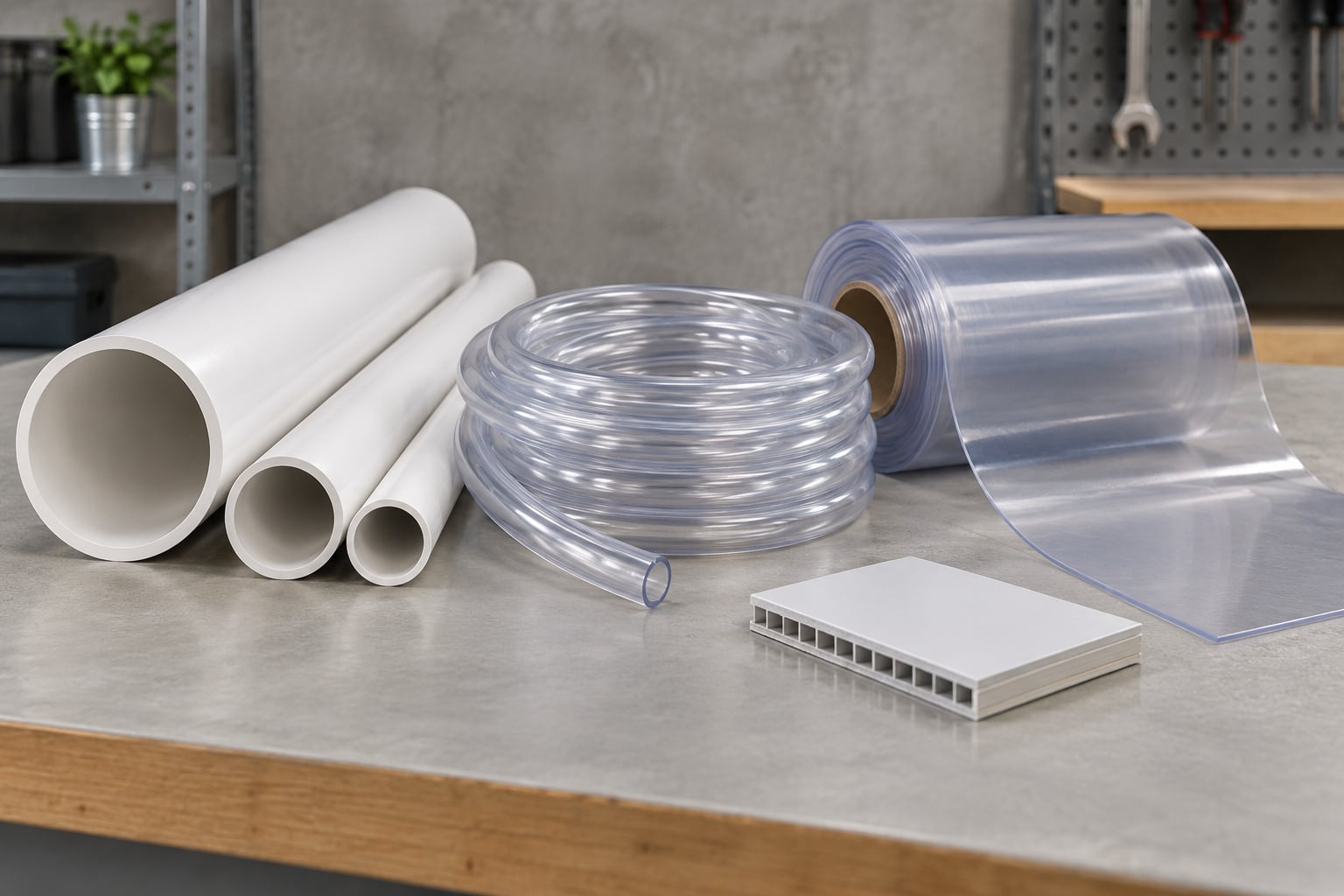
PVC and vinyl are usually the same material. Vinyl is the family name for a group of plastics built on the vinyl monomer, and PVC (polyvinyl chloride) is the member of that family you will find in almost every product labeled vinyl, from pipe and siding to flooring and records. So the honest answer to the PVC vs vinyl question is: they are not two competing materials. Vinyl is the category, PVC is the most common thing in it.
The confusion persists because brand labels, spec sheets, and sales pages swap the two words freely, and because a small but real group of materials genuinely are vinyl without being PVC. Vinyl ester, polyethylene-EVA vinyl, vinyl acetate, and chloroprene rubber all sit in the vinyl family. Once you know which of those you have, the material choice becomes straightforward.
Table of Contents
- PVC vs Vinyl: What Is the Difference? at a Glance
- What Is PVC?
- What Is Vinyl?
- How Are PVC and Vinyl Related?
- How Do the Materials Compare?
- Rigidity and Flexibility
- Chemical and Weather Resistance
- Processing and Manufacturing Methods
- Durability, Safety, and Lifespan
- Recycling and Environmental Impact
- Which Should You Choose?
- Frequently Asked Questions
- Conclusion
PVC vs Vinyl: What Is the Difference? at a Glance
Here is the shortest useful comparison. Rigid PVC is the pure-polymer, unplasticized form; flexible vinyl is the same polymer softened with a plasticizer or supplied as a plastisol liquid.
| Attribute | PVC (polyvinyl chloride) | Vinyl, broadly defined |
|---|---|---|
| What the name means | One specific polymer | A family of plastics sharing the vinyl monomer group |
| Relation to each other | Is a vinyl | Includes PVC plus vinyl ester, PE/EVA vinyl, vinyl acetate, chloroprene |
| Base chemistry | Vinyl chloride monomer, about 57% chlorine by weight | Varies by member; some members contain no chlorine at all |
| Flexibility | Rigid by default, flexible when plasticized | Rigid to highly flexible depending on the member |
| Key additives | Plasticizer, stabilizer, filler, pigment, UV package | Wide open; crosslinkers and elastomeric blocks are common |
| Processing routes | Extrusion, calendering, injection molding, plastisol coating | Molding, coating, calendaring, and rubber-style processing |
| Glass transition temperature | About 80 C unplasticized; lower once plasticized | Member-specific |
| Continuous service temperature | Roughly 60-80 C depending on grade and formulation | Member-specific |
| Chemical resistance | Strong against acids, alkalis, salts, and water; attacked by many solvents | Member-specific |
| Recyclability | Technically recyclable, often contaminated by additives and mixed construction | Only some members have established recovery streams |
| Typical uses | Pipe and fittings, profiles, conduit, cable, siding, flooring, records | Flooring, roofing membrane, records, sealants, coatings, elastomers |
| Odor | Pungent when heated; low off-gassing once fully compounded | Member-specific |
What Is PVC?
PVC is polyvinyl chloride, a thermoplastic polymer built by joining vinyl chloride monomer (VCM) molecules into long chains through addition polymerization. The industrial route runs through suspension polymerization, which produces the white powder resin that compounders buy. The first commercial PVC came around the mid-1920s, and the material grew into one of the most widely produced plastics in the world.
Two numbers explain most of PVC’s behavior. Chlorine makes up roughly 57% of the polymer by weight, which is why PVC resists water, salt, and fire so well. And the unplasticized polymer has a glass transition temperature near 80 C, which sets the ceiling for heat use. Below that soft point, rigid PVC holds its shape; above it, it becomes unusable.
Rigid PVC vs plasticized PVC
Rigid PVC (often written uPVC, UPVC, or R-PVC) is the resin with little or no plasticizer. It stays stiff, is dimensionally stable, and is the version used for pipe, window profiles, conduit, and rigid wall panels. Molded housings, blister packs, and electrical fittings fall into the same family.
Plasticized PVC, usually called flexible vinyl, is the same backbone with a liquid added. The plasticizer molecules slip between the polymer chains and lower the glass transition temperature, so the material bends, folds, and rolls without cracking. Flexible PVC is what you have when a flooring plank curls at 4 inches, what a garden hose is made of, and what a soft-touch packaging film feels like.
What gets added to PVC resin
Raw resin on its own processes poorly and degrades quickly, so every commercial PVC compound carries an additive package, and that package is where two products with identical labels can behave very differently.
- Plasticizers turn rigid resin into flexible material. DOP was the historical standard; DOTP and non-phthalate alternatives are now common in flooring and consumer goods.
- Stabilizers protect the polymer from heat degradation during processing. Ca-Zn and organotin systems are current practice; lead-based stabilizers still exist in older or regional product.
- Fillers such as calcium carbonate reduce cost and change stiffness. Flooring and siding compounds use them heavily.
- UV stabilizers and pigments control weathering and color. Indoor grades often leave these out, which is why the same profile fades faster outdoors.
- Flame retardants and biocides appear in specific regulated applications.
If a supplier will not tell you what is in the additive package, you cannot predict how the part ages. This is the gap that shows up later as cracking, discoloration, or migration, and it is worth comparing against what causes brittleness in plastic parts before blaming the resin.
What Is Vinyl?
Vinyl is a chemical descriptor, not a single product. In strict terms it refers to the vinyl group, the CH2=CH- fragment that appears at one end of the vinyl monomer, and to the family of polymers built from monomers carrying that group. Vinyl chloride is one member of that family. Vinyl acetate, vinyl ester, and ethylene-vinyl acetate are others.
The vinyl monomer family
Four members come up constantly in procurement conversations, and only the first is PVC:
- PVC (vinyl chloride) accounts for the overwhelming majority of products sold as vinyl, and it is the only common member with substantial chlorine content.
- Vinyl ester is a thermoset or semi-cured resin used in fiber-reinforced composites and chemical-resistant coatings. It is chemically related to vinyl but is not PVC, and it does not melt for remolding the way PVC does.
- PE/EVA vinyl is a polyethylene or ethylene-vinyl-acetate-based material marketed as vinyl flooring. It can contain no chlorine at all, which makes it a genuinely different material in terms of chemistry, odor, and end-of-life handling.
- Chloroprene rubber (neoprene) sits at the family boundary as an elastomer rather than a thermoplastic, and it is the vinyl-adjacent material most often confused with PVC gaskets and seals.
Why labels use vinyl loosely
Three reasons explain the blurring. First, “vinyl” is a friendly consumer word that buyers already understood before the chemistry caught up, so marketers kept using it for products that did not change. Second, flooring and siding specs inherited the term from the flooring industry, where almost everything really is flexible PVC, then carried it into categories like rigid core planks that are not pure PVC. Third, nobody wants to print a full polymer name on a box, so the short label wins.
The result is that a spec reading “vinyl” tells you a category, not a material. A spec reading “PVC” tells you a polymer but still leaves out the plasticizer, stabilizer, and filler package.
What the word vinyl does not mean
Vinyl is not rubber and not linoleum. Linoleum is a natural product made from linseed oil, cork, and wood flour, and it shares nothing with the vinyl monomer. Rubber flooring is natural or synthetic rubber, chemically distinct again. And a record disc is not a different material from a floor, which is a question that comes up often enough that collectors ask it directly. In practice, “vinyl” on a product like that almost always means the same polyvinyl chloride used in flooring, pipe, and sticker vinyl.
How Are PVC and Vinyl Related?
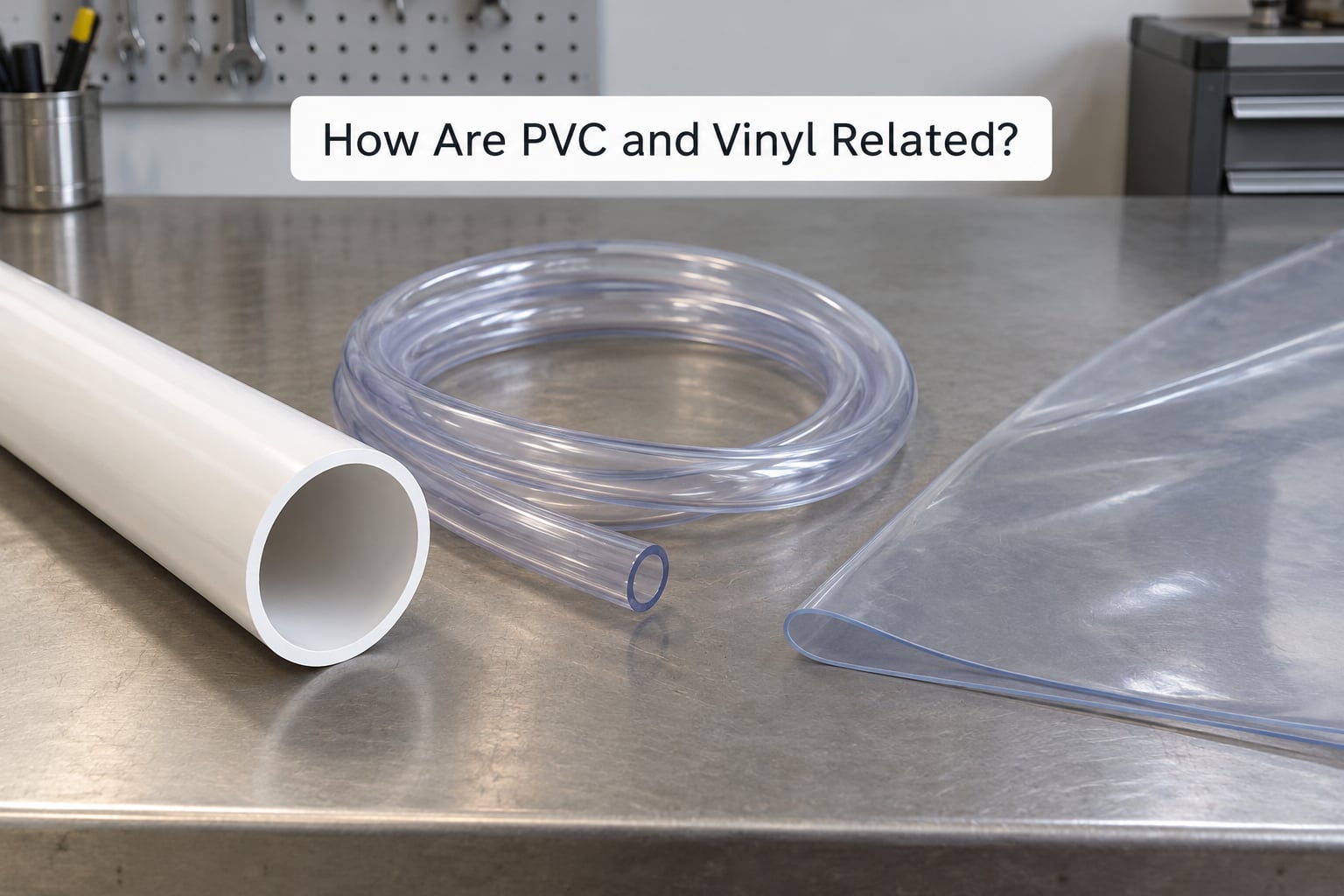
PVC is to vinyl what oak is to hardwood flooring, and the analogy is worth the time it takes. Vinyl describes a chemical family defined by a shared molecular group. PVC describes one polymer inside that family, built from one specific monomer. When a product label says vinyl, the most probable truth is that it is PVC, compounded with additives and converted into a sheet, film, profile, or molded part.
The practical rule follows from that. Use “PVC” when you want to pin the polymer. Use “vinyl” when the family name is what you mean, and always pair it, as in vinyl flooring or vinyl siding, so nobody reads it as a record. The moment a material in your hand is not PVC but still vinyl, the family term is doing the real work and the polymer name has moved to vinyl ester or PE/EVA vinyl.
Flexibility is the one lever that changes a PVC compound without changing its family. Adding a plasticizer turns the same chains into a soft, foldable sheet. No new polymer forms; the material just behaves differently because the chains can slide past each other.
How Do the Materials Compare?
Within the PVC world, the comparison that actually matters at a spec review is rigid against plasticized, because both carry the PVC name and they perform nothing alike.
| Property | Rigid PVC (uPVC) | Flexible / plasticized vinyl |
|---|---|---|
| Stiffness | High; holds dimensions without support | Low to medium; bends and conforms |
| Plasticizer content | Minimal or none | Typically a substantial share of the compound by weight |
| Glass transition | Near 80 C | Pushed well below ambient by plasticization |
| Chemical resistance | Strong against acids, alkalis, salts | Good, but plasticizer choice governs solvent attack |
| Common processing | Extrusion, injection molding, pressure forming | Calendering, extrusion, plastisol coating, lamination |
| Typical parts | Pipe and fittings, profiles, conduit, housings | Flooring, hose, seals, cable jacket, film, upholstery |
| Failure mode to watch | Brittle cracking under impact or UV exposure | Hardening, migration, and plasticizer loss over years |
Rigidity and Flexibility
Rigid wins whenever a part has to hold a shape under load or heat. Pipe, window profiles, and electrical conduit all depend on the unplasticized form, because a plasticizer would soften the wall and let the part creep.
Flexible wins whenever the part has to bend, seal, drape, or absorb vibration. Gaskets, tubing, cable jackets, upholstery skins, and printed film all fall here. The tradeoff is durability: flexible vinyl hardens over time as plasticizer migrates away from the surface or is drawn out by heat and contact, and the material that started soft ends up stiff, and sometimes brittle, far sooner than the rigid version would have.
Molecular weight also shifts these properties. Resin suppliers grade PVC by K-value, a viscosity index tied to chain length: lower K-values flow better in calendering and coating, higher K-values give the mechanical strength pipe and profiles need. Two products both labeled flexible vinyl can sit at opposite ends of that range and behave accordingly.
Chemical and Weather Resistance
Chlorine content is the reason PVC handles water, salt, and most acids and alkalis so well. That same chlorine works against thermal and ultraviolet stability, which is why the continuous service temperature for general PVC sits around 60 to 80 C and why outdoor grades need an explicit UV package.
Solvent resistance is the other limit most people learn the hard way. PVC resists water, oils, and weak alkalis well, but many organic solvents, ketones, and chlorinated solvents attack it. Flexible grades can be more vulnerable still, because a plasticizer with poor solvent resistance shows up as staining, swelling, or loss of properties in service.
Weathering follows the formulation, not the label. Unstabilized rigid PVC outdoors will discolor and embrittle within a season or two. A properly stabilized outdoor grade with UV absorbers and a suitable stabilizer package lasts for years. A flooring plank is a different case again, where the surface layer and the backing chemistry set the wear and water resistance rather than the bulk resin.
Processing and Manufacturing Methods
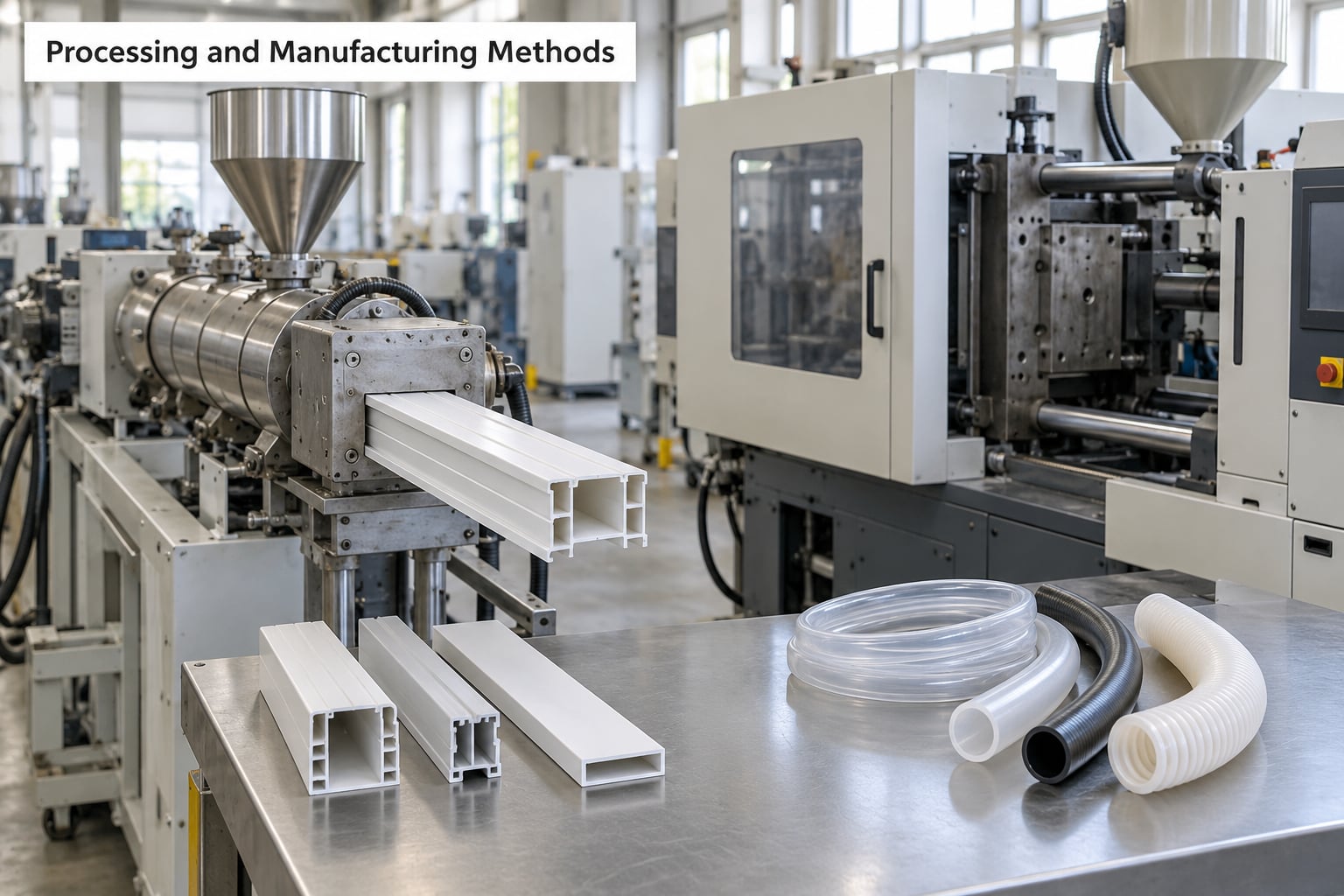
Processing route is where a converter’s real decision shows up, and it differs sharply between the two forms of PVC.
Calendering
Calendering rolls a plastisol or compound into a sheet between heated rollers, and it is the standard route for flooring, wall covering, and printed film. Gauge control at the roll gap, fusion temperature, and gel content in the film decide whether the sheet is under-fused or scorched.
Extrusion
Extrusion forces molten compound through a die, and rigid PVC uses it for pipe, profiles, conduit, and siding. The material is shear-sensitive, so melt temperature, screw design, and stabilizer package have to be matched or the pipe develops yellowing and brittle spots.
Injection molding and plastisol coating
Injection molding handles housings, fittings, and connectors, where the K-value of the resin and the mold temperature control fill, weld lines, and sink. Plastisol coating liquid-slushes or sprays onto parts, then fuses in an oven, which is how valve bodies, battery separators, and coated fasteners are made.
The practical point for a buyer: converters cannot substitute grades freely. A pipe compound that flows well through an extrusion die may weld poorly in an injection mold, and a calendering film formula may not fuse on a coating line. Write the grade and processing method into the purchase order, and make the mark permanent. That is where the marking question comes in: laser marking plastics and what works by resin is worth a look before anyone picks a labeling method, since laser settings that pit or craze one polymer simply erase themselves on another.
Durability, Safety, and Lifespan
There is no single service life for anything called vinyl, and any supplier claiming one has simplified past the useful part of the answer. An indoor rigid profile, an outdoor siding panel, and a flooring plank in a wet room do not age the same way.
- Rigid PVC is dimensionally stable and chemically inert, with the main risks being impact cracking at low temperature and UV embrittlement without stabilization.
- Outdoor vinyl adds stabilizers, UV absorbers, and pigments. Weathering then shows as gradual chalking and loss of impact strength rather than sudden failure.
- Flexible vinyl ages through the plasticizer rather than the polymer, with hardening, shrinkage, and surface migration being the usual signals.
On safety, PVC is self-extinguishing, which is a direct benefit of its chlorine content. During processing it is a different conversation: decomposition releases hydrogen chloride, so ventilation and temperature control are not optional. The pungent smell at a hot line is hydrogen chloride, not a normal resin odor, and it is a real indication that conditions are too severe.
Consumer products get a further layer of review. Low-emission certifications exist for flooring and interior trim, and phthalate-free or non-phthalate plasticizer claims are now common marketing language. Neither tells you anything on its own, so read the certification rather than the badge.
Recycling and Environmental Impact
PVC is chemically recyclable. That statement is true and it is routinely stretched past what happens in practice. Clean, single-polymer PVC offcuts recycle well, and hard rigid PVC is the most straightforward case. Flooring is the hard case, because a plank is a multilayer composite of wear layer, print film, and backing, and the layers do not separate economically.
Contamination is the deciding factor. PVC has a high chlorine content, and chlorine mixed into a recycling stream at low levels causes problems in the other plastics. Most converters therefore keep PVC streams strictly separate, which is exactly why take-back programs matter and why the absence of one is itself information.
Plasticizers and stabilizers shape the end-of-life options. A formulation with heavy filler loading produces a lot of low-value regrind, and lead-based stabilizer content in older material complicates recovery further. Kettle logic helps here too: if you need to know what a material is before you scrap it, it should be documented at purchase time rather than reverse-engineered at disposal. A bill of materials that names the resin and additive package removes the guessing.
Which Should You Choose?
Choose by function, then confirm by specification. The decision usually resolves in a few minutes once the vertical is clear.
Rigid PVC for pipes, profiles, housings, and chemical handling
Take rigid PVC when the part holds a shape, carries a pressure, resists chemicals, or has to survive heat. Pipe and pressure fittings, window and door profiles, electrical conduit, cable tray, chemical storage tanks, and injection-molded housings are the standard list. It is also the better choice when recycling at end of life matters, because the stream is cleaner.
Flexible vinyl for tubing, seals, jackets, upholstery, and signage
Take flexible vinyl when the part bends, seals against a gap, takes vibration, or has to drape. Laboratory and medical tubing, garden and industrial hose, gaskets and weatherstripping, cable insulation and jacketing, upholstery and coated fabric, shrink film, and printed signage or decal stock all sit here. Specify the plasticizer family explicitly, and treat the service temperature as a function of that choice rather than a property of vinyl.
Flooring, siding, pipe, and records, sorted out
Four categories generate most of the confusion, and each has its own answer.
- Flooring. Sheet and tile vinyl is flexible PVC in a layered build: a wear layer on top, a print film carrying the design, and a backing below. Rigid core products labeled SPC or WPC are composites that contain PVC alongside filler or wood fiber, so they are not pure PVC and do not behave like sheet vinyl.
- Siding and window coverings. Vinyl siding is rigid PVC, typically a cellular or foam-core profile rather than a solid sheet. The main competing material in blinds is TPC, a thermoplastic elastomer chosen for heat resistance.
- Pipe. PVC pipe is rigid PVC, pressure-rated by standard and formulation. Flexible PVC pipe exists for certain drain and irrigation duties, but pressure applications are rigid territory.
- Records. A record disc is PVC, the same polymer family as the floor. The difference is formulation and thickness, not identity. The reason collectors argue about sleeves is real: PVC sleeves have been reported to migrate plasticizer onto stored records, causing hazing and a surface noise over time, so archival people avoid PVC sleeves for that reason.
How to write the spec so quotes actually compare
The fix for most quote-to-quote confusion is language, not chemistry. State the resin, then the form, then the additive package, then the processing route. “Rigid PVC, schedule-rated pipe compound, lead-free Ca-Zn stabilized, extruded” is a line two suppliers can quote comparably. “Vinyl” is not.
When a sample arrives instead of a datasheet, a few quick observations narrow it down fast. A rigid, faintly off-white profile that rings when tapped and does not flex is unplasticized PVC. A soft, pliable, often slightly glossy sheet that smells faintly sweet or chemical is flexible PVC. Matte surfaces with a printed film layer and a visible core are typical rigid core flooring rather than sheet. A cross-section tells you more than the face: fillers show as a dull, chalky interior, and multiple distinct layers mean a composite. When identification has to be documented rather than guessed, testing methods beat eyeballing every time.
Frequently Asked Questions
Is vinyl the same as PVC?
Mostly, yes. Vinyl is the family name for plastics built on the vinyl monomer, and PVC is the member behind nearly every consumer product sold as vinyl, including flooring, siding, pipe, and records. The exceptions matter: vinyl ester composites, PE/EVA vinyl flooring, and chloroprene rubber are vinyl but are not PVC.
Is vinyl a type of plastic?
Yes. Vinyl names a family of synthetic polymers, and every common member is a plastic in the technical sense of a molded or extruded polymer. What varies is the chemistry: PVC carries about 57% chlorine by weight, while PE/EVA vinyl can contain none at all, which is why a no-chlorine product can still legitimately be called vinyl.
Is vinyl rubber or plastic?
Vinyl is plastic, not rubber, though elastomers like chloroprene sit near the boundary. Linoleum is the other common mix-up, and it is a natural material made from linseed oil, cork, and wood flour with no vinyl monomer involved. Rubber flooring is natural or synthetic rubber, a separate chemistry entirely.
What does LVP stand for in flooring?
LVP stands for luxury vinyl plank, a cut version of flexible PVC sheet vinyl sold as interlocking or glue-down planks. LVT is the tile format of the same construction. VCT is the older asbestos-era commercial tile, and SPC and WPC are rigid core composites that contain PVC alongside calcium carbonate or wood fiber rather than being pure PVC.
How can you tell if a product is PVC or another vinyl?
Check the documentation first, because a datasheet or bill of materials settles it faster than any physical test. On a sample, rigidity and a chalky cross-section suggest unplasticized PVC, while softness, a slight sheen, and a chemical odor point to plasticized PVC. A multilayer cross-section means a composite such as SPC or WPC, not a single resin.
Conclusion
PVC and vinyl are not rivals. Vinyl is the chemical family, PVC is its dominant member, and the word vinyl on a label tells you a category rather than a material. Start every specification with the resin type, then the form, the additive package, the processing route, and the end use. Once that is written down, the material choice takes about five minutes. Updated for October 2026.