
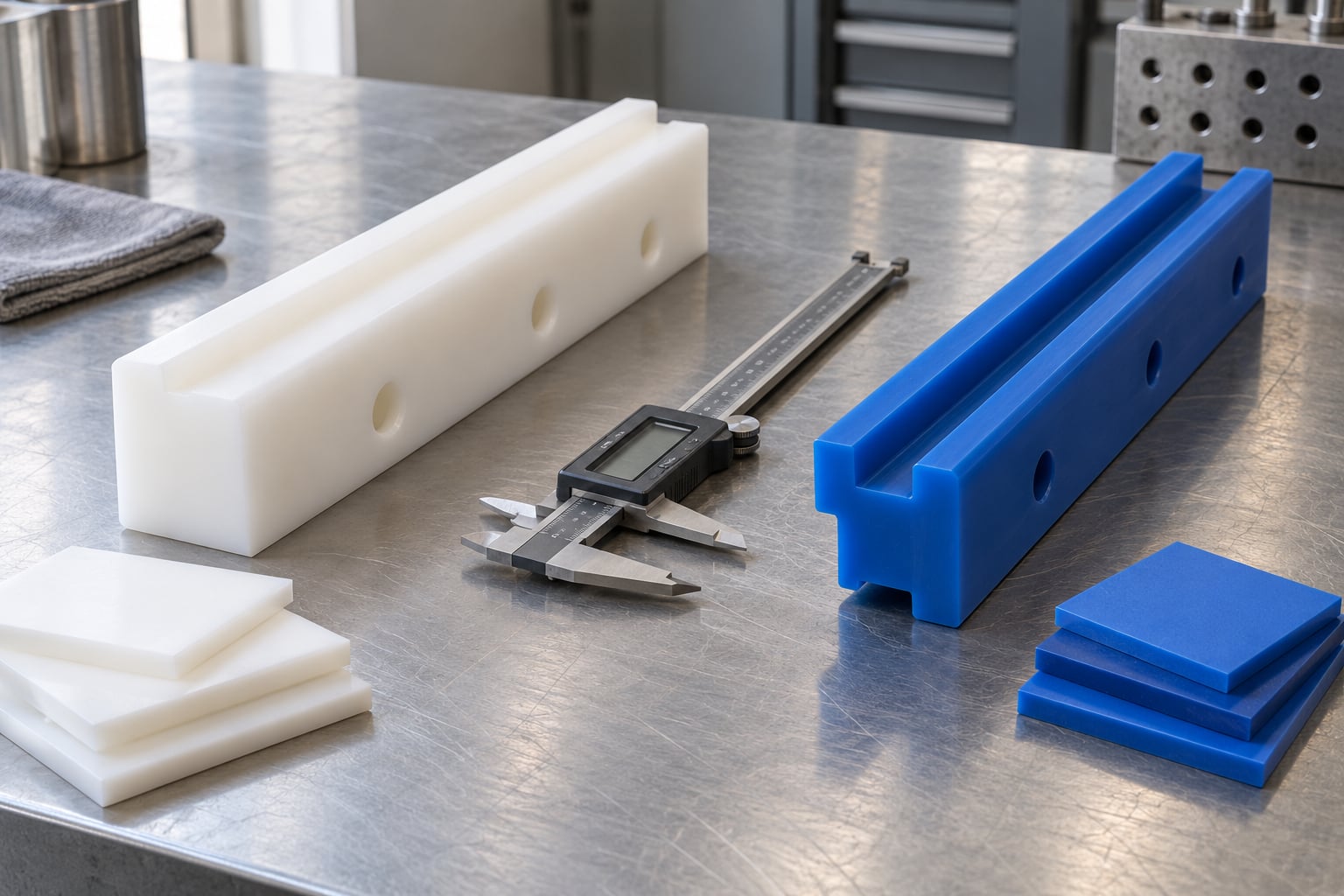
Choose UHMW when two surfaces rub, slide or abrade against each other under real load, and choose HDPE when structural stiffness, weldability and part size matter more than wear life. UHMW outlasts HDPE in abrasion and sliding contact by a wide margin; HDPE holds its shape better, welds easily and costs far less per pound. That is the short version of the uhmw vs hdpe for wear parts decision, and the rest of this guide is the detail behind it.
Table of Contents
- UHMW vs HDPE for Wear Parts at a Glance
- What Is UHMW and What Is HDPE?
- Abrasion and Wear Resistance: Which Polymer Lasts Longer?
- Impact, Flexibility, and Ductility in Wear Parts
- Friction, Sliding, and Surface Behavior
- Chemical, Moisture, and Temperature Resistance
- Machinability, Welding, and Fabrication
- Cost, Weight, and Lifecycle Value
- Which Should You Choose?
- Frequently Asked Questions
UHMW vs HDPE for Wear Parts at a Glance
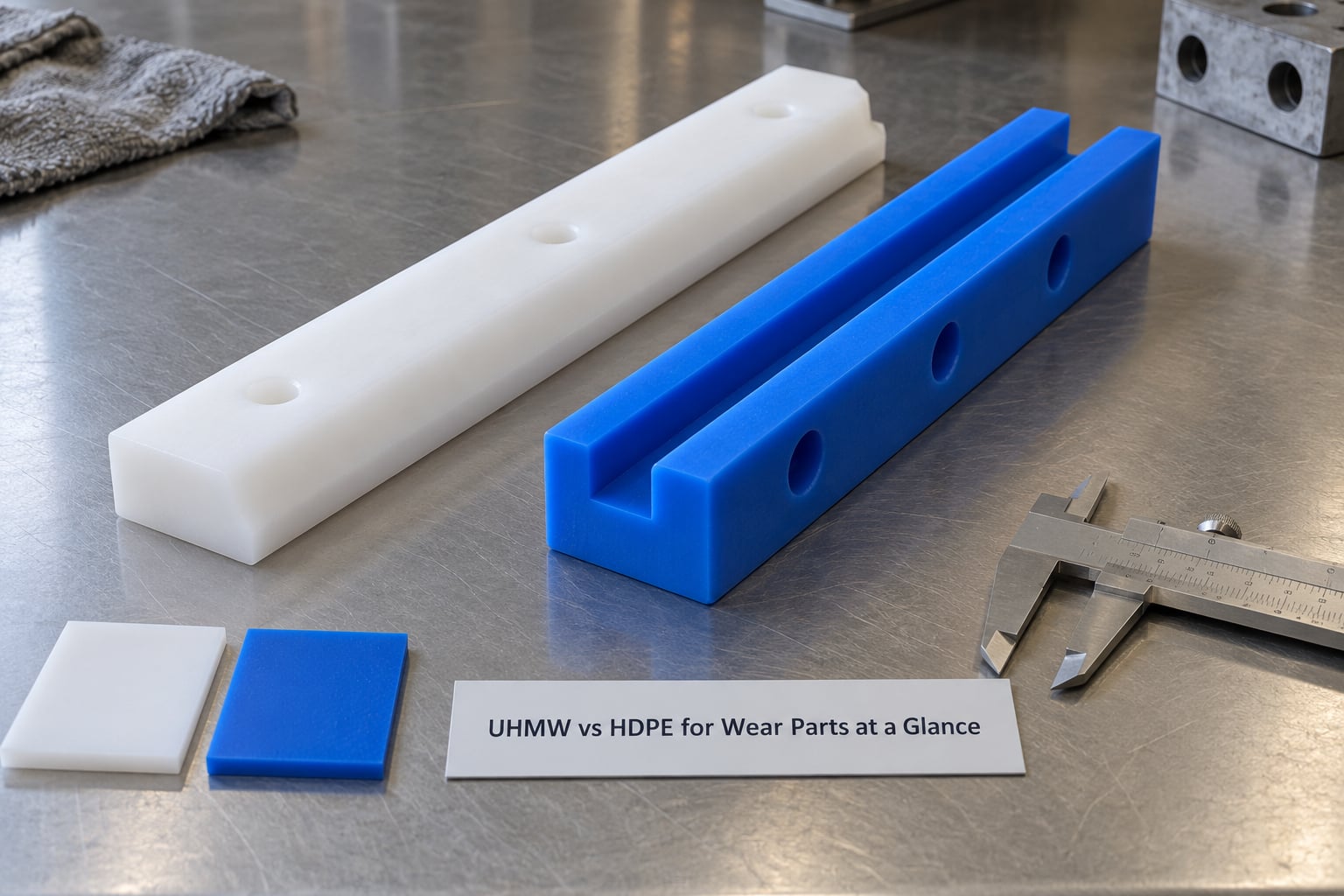
The table below is the fastest way to narrow the field. Values are typical ranges for unfilled virgin grades, not specification guarantees.
| Property | UHMW | HDPE | What it means for a wear part |
|---|---|---|---|
| Density | 0.93-0.94 g/cm3 | 0.94-0.96 g/cm3 | Both float on water, so buoyancy is not a deciding factor |
| Molecular weight | 3-6 million g/mol | 200,000-500,000 g/mol | The single biggest difference between the two |
| Tensile strength | 20-40 MPa | 20-30 MPa | Similar numbers, very different behaviour in service |
| Elongation at break | 200-350% | 300-600% | Both are ductile; HDPE stretches more |
| Shore D hardness | 60-70 | 55-65 | UHMW resists cutting and gouging better |
| Dynamic coefficient of friction | 0.10-0.20 | 0.20-0.35 | UHMW runs against steel with little or no lubricant |
| Abrasion resistance | Very high; typically several times HDPE and many steels under test | Moderate; the baseline most other comparisons use | Sets replacement interval more than material cost does |
| Service temperature (continuous) | Up to about 80 C | Up to about 80-100 C | Neither is a high-temperature material |
| Water absorption | About 0.01% | About 0.01-0.05% | Both suit outdoor and washdown service |
| Compressive creep / permanent set | Higher creep; sag under sustained load | Lower creep; holds dimension longer | The main reason to pick HDPE on structural wear parts |
| Machining | Machineable but gummy and heat-sensitive; generous material allowance needed | Cuts cleanly and predictably | HDPE wins for tight-tolerance machined components |
| Welding | Not practical with standard polyethylene welding | Standard hot-air and butt welding | HDPE wins for large fabricated wear blocks |
| Typical forms | Sheet, rod, block, compression-molded parts, filled grades | Sheet, extruded profiles, pipe, injection-molded parts | Availability of stock sizes |
| Relative cost | Higher per pound | Lower per pound | Compare installed cost per year of service, not purchase price |
One rule covers most cases: if the part rubs against something, UHMW wins. If the part holds something up, resists a shock or gets welded into an assembly, HDPE usually wins.
What Is UHMW and What Is HDPE?
Both are polyethylenes, which is why the comparison keeps coming up in the same conversations. HDPE has relatively short chains and few branches, so it packs tightly into a dense, stiff, weldable plastic used for pipe, tanks, drums and bags. UHMW has the same repeating ethylene backbone but with chains perhaps ten times longer, and that chain length is what changes almost every property a wear part depends on.
UHMW also has very few branches, so it forms dense crystalline regions that tie with the entanglements between chains. Pull on it and the chains slide past each other instead of snapping; put a sharp edge into it and the material flows around the edge rather than chipping. Practically, that produces a surface which polishes itself in service and resists the gouging that eats softer plastics.
In manufacturing terms, HDPE arrives as extruded sheet and profile, molded parts, or welded assemblies. UHMW arrives as compression-molded sheet and plate, ram-extruded profile, molded blocks and rods, or filled grades with zinc oxide, carbon black or ceramic added for higher stiffness and load capacity. Stock sheet is the common starting point for both, and most replacement wear strips are cut and drilled from it.
Abrasion and Wear Resistance: Which Polymer Lasts Longer?
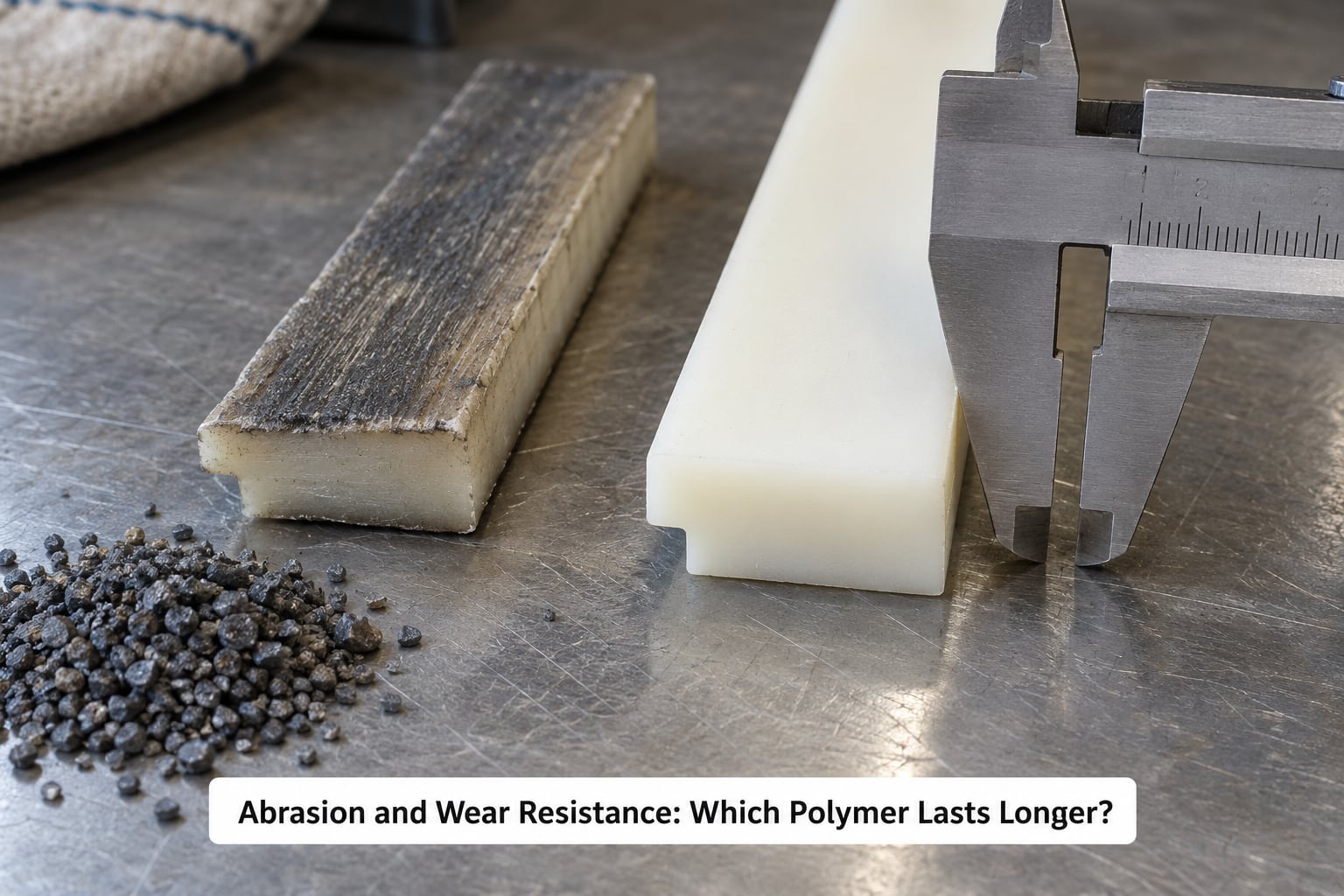
UHMW lasts longer. Under sliding and abrasive testing, unfilled UHMW typically shows several times the abrasion resistance of HDPE, and filled UHMW grades go higher still. That gap shows up directly in service life, because wear strips, chute liners and guide rails in bulk material handling usually fail by material simply disappearing from the wear surface.
Match the wear mechanism before the material label
Three different mechanisms are often lumped together under the word abrasion, and they respond to different properties:
- Sliding wear, where one surface rubs another under load. UHMW wins easily here because its very low friction reduces heat and because its surface is hard enough to resist smearing.
- Abrasive wear, where hard particles like sand, coal dust, aggregate or glass-filler cut into the surface. Chain length helps, but filler content helps more, so a ceramic or zinc oxide filled UHMW grade can outperform plain UHMW by a wide margin.
- Cutting or impact wear, where sharp chunks or loading impacts gouge the material. Here UHMW’s toughness and ductility matter more than hardness, and it survives what HDPE cannot.
A quoted multiple like 100 or 250 times HDPE usually comes from a Taber abrasion test under ASTM D4060, and those tests are run on small discs in a controlled rig with a fixed load and a fresh abrasive wheel. That is useful for ranking materials against each other. It is not a service-life prediction for your chute, where load, speed, particle size, temperature, contamination and geometry all change the result. Compression under ASTM D695 tells you something similar about stiffness and yield behaviour. Treat published multiples as a screening tool, not a warranty.
How to get a number you can plan maintenance around
Ask for a wear rate in the actual application: millimetres of material lost per hour, or hours to a wear depth limit, measured on a comparable line. If nobody can supply that, instrument a trial part with a depth gauge at fixed intervals and record the curve yourself. Track wear depth, not just visible failure; the last millimetre happens long after the part starts losing accuracy.
Two details change wear life more than most datasheet differences. Surface finish matters, because a rougher surface traps abrasive particles and cuts harder. Filler content matters, because a filled grade resists penetration far better, though it also stiffens the part and raises friction slightly.
Impact, Flexibility, and Ductility in Wear Parts
UHMW tolerates shocks and edge impacts better than HDPE, while HDPE stays rigid where UHMW deflects. A chute liner taking a heavy rock or a truck bed taking a chain drag is an impact problem, and UHMW’s long chains absorb the energy without cracking. A guard panel bolted to a machine frame, a skid under a forklift, or a snap-fit retainer that must hold a position are stiffness problems, and HDPE answers those better.
Low temperature changes the picture only slightly. Both polyethylenes stiffen as they cool, and both become less tolerant of a sharp notch at very cold temperatures. When you want real impact data for a cold-climate application, test coupons rather than trusting a generic figure; our guide to how to test plastic parts for impact resistance covers the setup. Related failure modes such as environmental stress cracking are covered in what causes brittleness in plastic parts.
UHMW’s weakness here is deflection under sustained load. A wear strip that fits perfectly at installation can sag within months if it carries a constant load, and the sag gets worse as the material warms. HDPE’s shorter chains give it more resistance to permanent set, so it holds its fit longer in exactly the conditions where creep matters.
Friction, Sliding, and Surface Behavior
UHMW’s dynamic coefficient of friction against steel typically sits around 0.10-0.20, HDPE’s around 0.20-0.35. In practice that means a UHMW guide rail or chain guide can run dry with little drag, while an HDPE part often needs grease or a wet-lubricated environment to stay efficient.
That low friction cuts both ways. UHMW tends to build a thin transferred film on the counterface, which many engineers see as a benefit because it polishes the mating surface over time and can quiet a running chain. It also makes retention awkward: glue and adhesive have little to bite into, and rivets can deform and allow hole elongation during service. Engineers on eng-tips commonly bolt UHMW slab wear strip rather than riveting it, so a worn strip can be swapped without wrecking the surrounding structure. Use countersunk fasteners and large washers so the head does not stand proud and become a snag point.
HDPE behaves more predictably in stick-slip terms and holds a bolted or welded joint more securely. If the part is a dynamic slide pad where stick-slip would upset a positioning system, HDPE is often the calmer choice.
Chemical, Moisture, and Temperature Resistance
Both materials are chemically resistant to water, weak acids, weak alkalis, salts and many common detergents, which is why both are used outdoors, in washdown areas and in marine settings. UHMW edges ahead on concentrated acids and alkalis, aromatic solvents and some fuels. Neither handles strong oxidising acids, and neither shrugs off prolonged solvent exposure, so verify against compatibility data for the specific fluid and temperature rather than assuming.
Separate short-term exposure from continuous service. A splash of chemicals during a washdown cycle is a very different design case from a part sitting in a bath. Ask the supplier for compatibility data covering the concentration and temperature you actually have.
Humidity matters little to either polymer because water absorption is around 0.01%. Temperature is the real ceiling. Continuous service for both tops out near 80 C, with HDPE tolerating somewhat more before softening. UHMW becomes soft and creeps dramatically as it approaches that limit, so a UHMW wear strip in a hot process is a poor choice even though it is the tougher material in every other respect. Above that range, consider a filled grade or a different polymer family altogether.
Machinability, Welding, and Fabrication
HDPE machines like a soft aluminium: stable, forgiving, and easy to hold tolerance on. UHMW machines, but it is gummy and heat-sensitive, and it grows as the cut heat builds. Machinists on Practical Machinist describe holding tolerance on UHMW as the harder problem, and the practical fixes are consistent: leave generous material allowance on every dimension, work from all sides in lighter passes, keep sharp tools, and let the part cool between cuts rather than chasing a hot part straight into a measurement.
For wear parts specifically, the usual route is sawing, drilling and countersinking from sheet or plate, with CNC machining reserved for geometric features that need it. If you are verifying finished dimensions, our CMM inspection basics for plastic parts guide covers the checks that catch warping and creep before the part goes into service.
Welding separates the two cleanly. HDPE is standard hot-air and butt weldable, so large fabricated wear blocks, hopper liners and dock fender faces can be built up from sheet and welded into one rigid piece. UHMW does not weld with standard polyethylene equipment; filled grades can be joined by special methods, but bolted or mechanically retained UHMW is the normal answer. That makes UHMW easy to replace as a discrete wear element and difficult to integrate into a welded structure, which is a real design trade-off rather than a material defect.
Cost, Weight, and Lifecycle Value
HDPE costs less per pound and is easier to fabricate, so the entry cost is lower. UHMW costs more per pound and more per machined hour. On a wear surface that touches abrasive material every hour of every shift, that difference almost always disappears once you count replacements and downtime.
The calculation is simple. Annual cost equals material plus fabrication plus replacement count times the full changeout cost, which includes labour, crane time, lost production and often a line restart. A strip that costs twice as much and lasts six times as long wins easily. The case reverses when the part is barely a wear surface in the first place: a structural skid plate or a welded hopper liner that is replaced once in a decade is cheaper in HDPE.
Weight plays a small role. Density is close enough between the two that shipping and handling rarely decide anything, though lighter-than-water parts do need to be secured against buoyancy in flood or marine conditions.
Which Should You Choose?
Work down this table by part type rather than by industry, since the same wear part type tends to fail the same way across sectors.
| Wear part type | Recommended material | Why |
|---|---|---|
| Abrasive chute or hopper liner | UHMW, filled grade for abrasive bulk material | Abrasive particles cut rather than rub; filler resists penetration |
| Conveyor wear strip | UHMW | Continuous sliding contact with low friction and long wear life |
| Chain guide rail | UHMW | Low friction reduces chain drag and drive load |
| Dock fender face and marine slide pad | UHMW | Impact plus abrasion plus water exposure |
| Unloaded wear-facing plate, guard panel, skid | HDPE | Stiffness, low cost and easy welding matter more than wear life |
| Large welded liner or fabricated block | HDPE | Welds into one rigid piece at lower cost |
| Bushings and bearing blocks | UHMW for dry, low to moderate load; HDPE for stiff, low-speed, lightly loaded fits | Friction and wear favour UHMW, creep and dimensional stability favour HDPE |
| Sheaves, sprockets, pulley faces | UHMW | Wear plus noise damping, both favour UHMW |
| Continuous service above about 80 C | Neither; consider filled UHMW or another polymer family | Both soften and creep near that limit |
Grade choices worth specifying
Virgin resin outperforms regrind in wear life because chain length is not uniform in recycled material. Ask whether the quote is virgin or regrind, and specify it. Filled grades (zinc oxide for stiffness and creep resistance, carbon black for UV stability, ceramic for abrasion) change the properties substantially, so name the filler rather than ordering a generic wear plate.
When neither polyethylene is right
Nylon, acetal homopolymer, PTFE and bronze-impregnated bushings each win where the two polyethylenes are marginal. Nylon absorbs moisture and is tougher at impact, acetal machines and holds tolerance better, PTFE has the lowest friction of all, and bronze-impregnated bearings carry far higher loads. Forum comparisons among engineers generally settle on the same order: UHMW is the value pick for wear plate because it is more wear resistant than nylon and much cheaper, while the others fill specific gaps.
Frequently Asked Questions
Is UHMW better than HDPE for wear parts?
Yes, whenever two surfaces rub or slide under load. UHMW wears far more slowly, has a lower coefficient of friction and resists impact better than HDPE. HDPE stays the better choice where stiffness, weldability and low part cost dominate, such as structural skid plates or large welded liners that are barely a wear surface at all.
What is the difference between UHMW and HDPE?
Both are polyethylenes. The difference is chain length: HDPE runs roughly 200,000-500,000 g/mol while UHMW runs 3-6 million g/mol. Those long chains give UHMW its abrasion resistance, low friction and toughness, while HDPE’s shorter chains give it stiffness, dimensional stability and weldability.
Is HDPE suitable for abrasion-resistant parts?
HDPE handles light to moderate abrasion, such as guides running against smooth chain or wear faces in low-dust areas. Once grit, sand or aggregate is involved, HDPE wears quickly and the part needs frequent replacement. For abrasive service, choose UHMW, ideally a filled grade, and confirm the wear rate on a trial part before ordering in volume.
Can UHMW and HDPE be machined or welded?
Both can be machined and both saw and drill cleanly. HDPE machines more predictably and holds tighter tolerances; UHMW is gummy and grows as it cuts, so leave generous material allowance and work from all sides in light passes. Only HDPE welds with standard hot-air and butt equipment, which makes it the practical choice for large fabricated wear blocks.
Which material is better for outdoor wear components?
For a rubbing outdoor part such as a wear strip, chain guide or fender face, choose UHMW. It handles UV exposure, rain and impact well and needs no lubrication. For an outdoor part that carries static load rather than sliding contact, choose HDPE, which resists creep and sagging better. Above about 80 C continuous service, neither is the right answer.
How do I choose between UHMW and HDPE for a chute or guide?
Ask what touches the part. Abrasive bulk material means UHMW, ideally a filled grade. A smooth chain, cable or sliding surface means UHMW for the lower friction. If the part only resists impact and carries a steady load with no sliding, HDPE will hold shape longer. Above 80 C, or where load and speed are both high, consider a bushing-grade material instead.
Start by writing down what the part actually rubs against, how hot it gets and whether it carries a continuous load. That answer points at UHMW or HDPE on its own. Then confirm the choice with a trial part, measure the wear rate, and set a replacement interval before the part is in service rather than after it fails.