
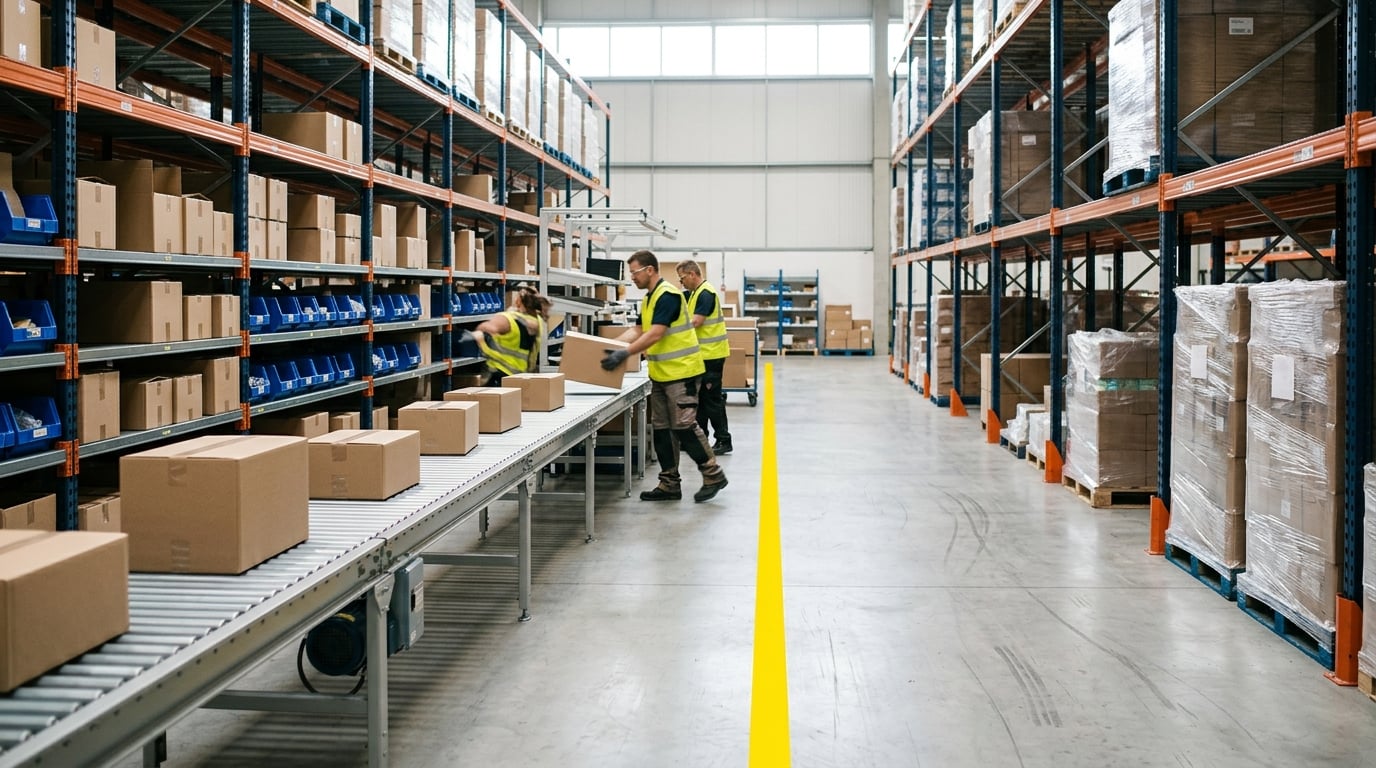
Slotting optimization in a warehouse explained in one sentence: it is the practice of deciding where each stock keeping unit lives, based on how fast it moves, how heavy and awkward it is, and which items ship together, so pickers walk less and orders ship faster. Put the fastest sellers within a short walk of packing, push slow movers to the back wall, and most of the walking in a pick operation gets shorter without adding a single labor hour.
The idea is simple. The execution is where warehouses get it wrong, usually because they slot by alphabet or by SKU count instead of by demand, then never revisit the plan. What follows is the method I would walk a warehouse manager through: the data you collect, the factors that decide placement, the five-step cycle, the implementation sequence, and the handful of numbers that tell you whether any of it worked.
Table of Contents
- What Is Slotting Optimization in a Warehouse?
- How Does Slotting Optimization Work?
- How Does Warehouse Slotting Differ from Random Storage?
- What Data Does a Warehouse Need Before Optimizing Slots?
- What Factors Should Determine Where a Product Is Stored?
- How Do Fast-Moving, Slow-Moving, and Hard-to-Handle Products Fit into Slotting?
- What Are the Main Benefits of Warehouse Slotting Optimization?
- How Can a Warehouse Implement Slotting Optimization?
- How Do You Measure Whether Slotting Is Working?
- What Mistakes Do Warehouses Make When Optimizing Slotting?
- When Is a Fixed, Hybrid, or Dynamic Slotting Plan Better?
- Frequently Asked Questions
- What are the most effective slotting strategies for warehouses?
- Do I need warehouse slotting software to optimize my warehouse?
- How often should warehouse slotting be updated?
- How long does a slotting project take to implement?
- What is a golden zone in warehouse slotting?
- How do I know if my warehouse slotting is working?
- Conclusion
What Is Slotting Optimization in a Warehouse?
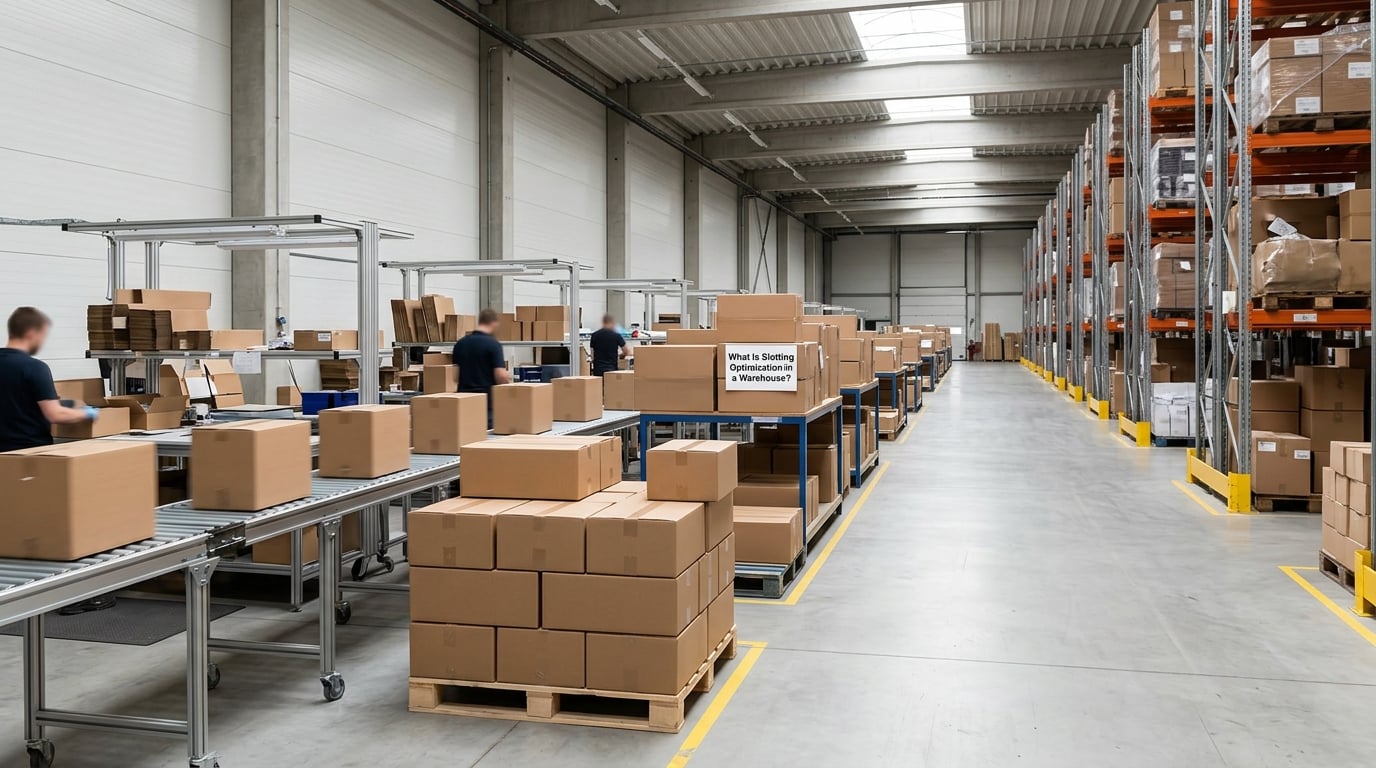
Slotting optimization is the assignment of specific storage locations to specific products using demand, physical, and handling data, with the goal of cutting picker travel, protecting accuracy, and using space well. Walking time is the largest controllable cost inside a pick operation, so where a product sits decides how much labor an order consumes.
Three outcomes follow from every good slotting plan. Pick paths get shorter, which lifts orders per picker hour. Ergonomics improve, because heavy items stop living at shoulder height. And space utilization rises, since grouping by size and turnover stops slow movers from squatting in prime forward pick locations.
How slotting differs from routine replenishment
Replenishment is a task someone does today. Slotting is a decision about the map itself. Putting more cases of the same item into the same forward pick location is replenishment; moving that location to the end of the pick path because demand changed is slotting.
That distinction matters because replenishment problems get solved on the floor in minutes, while slotting problems sit underneath every pick for years. If your fast movers are three aisles deep, no amount of replenishment discipline will fix it.
How Does Slotting Optimization Work?
Slotting optimization runs as a five-step cycle that repeats as demand shifts. Each step produces an output the next step consumes, and the final step feeds back into the first.
Step 1: Profile the demand
Pull twelve months of order line history and count how many times each SKU was picked in each month. Look at the pattern, not just the total. A product that moves steadily year-round and a product that spikes every November need different locations even if their annual totals match.
Step 2: Band the SKUs by velocity
Sort by pick frequency and cut the list into A, B, and C bands. A common starting point: A items are roughly the top 20 percent of SKUs that generate 70 to 80 percent of pick lines, B items the next 30 percent, and C items the long tail of rarely touched products.
Step 3: Score each SKU against location attributes
Now weigh the factors that decide placement: travel distance to pack, pick frequency, cube per unit, unit weight, handling flags, and order affinity with other SKUs. A scoring pass in a spreadsheet is enough for a few thousand SKUs. Larger catalogs usually run the same rules inside a warehouse management system.
Step 4: Assign locations
Place A items in the golden zone, the height band from roughly hip to shoulder where a person can lift and turn without twisting. Reserve the fastest floor-level positions next to the pack station for the top movers by line count. Then fill outward and upward in descending velocity order.
Step 5: Validate and re-slot
Measure pick rate and travel distance before and after. If the numbers did not move, something in the assignment is wrong, usually a group of fast movers sitting behind a slow-moving neighbor. Feed the results back into step one on a fixed cadence.
How Does Warehouse Slotting Differ from Random Storage?
Random storage drops any available location without regard to the product. Fixed storage assigns each SKU one permanent home and keeps it there. Organized slotting sits between the two, and the choice affects travel, labor productivity, visibility, and how much effort implementation takes.
| Consideration | Random storage | Fixed slotting | Optimized slotting |
|---|---|---|---|
| How a location is chosen | First available spot | One permanent home per SKU | Scored against demand and physical fit |
| Picker travel | Longest and most unpredictable | Short after a good design, then drifts | Short and re-tuned on a schedule |
| Space utilization | Poor, products scatter | Good once tuned | Best, cube and turnover matched to location |
| Inventory visibility | Hard, homes drift constantly | Simple, one address per SKU | Simple, plus recorded velocity per address |
| Flexibility | Maximum, nothing is locked | Low, changes are disruptive | Medium, changes are planned changes |
| Implementation effort | Almost none | High, one full move of inventory | High up front, lower ongoing cost |
| Best fit | Overflow and quarantine areas | Stable catalogs with low churn | Ecommerce, retail DC, and 3PL operations |
Neither extreme wins everywhere. Random storage is genuinely useful for overflow space and for quarantined returns, where the goal is containment rather than speed. Fixed slotting suits a stable catalog where SKUs rarely change, such as a spare parts warehouse.
The trap is treating fixed slotting as permanent. A fixed map that is never re-scored turns into random storage within a year, just with better signage.
What Data Does a Warehouse Need Before Optimizing Slots?
You need eight data inputs. A warehouse missing any one of them can still improve, just with less certainty and more manual work.
- SKU velocity — pick lines per SKU per week, ideally by day of week, not just monthly totals.
- Order line frequency and order composition — which items appear on the same order, and how often.
- Current pick locations — where each SKU lives now, plus the travel distance from each to the pack station.
- Replenishment times — how long a full forward pick location takes to refill, and how often it runs out.
- Case dimensions and unit cube — required to know whether the product even fits the candidate location.
- Unit weight and case weight — drives both ergonomics rules and which locations can carry the load.
- Handling requirements — fragile, hazardous, temperature-controlled, oversized, or awkward-to-grip stock.
- Storage capacity data — locations by type, weight rating, height band, and available cube.
Most warehouses can pull the first four from a warehouse management system today. The last three usually live in a spreadsheet somewhere, and that spreadsheet is worth building before you start rather than during.
What Factors Should Determine Where a Product Is Stored?
Placement is a ranking problem with hard constraints underneath it. These are the factors I weight, roughly in this order.
Velocity
Pick frequency dominates everything else. An A-band SKU that accounts for three percent of your catalog may account for seventy percent of your walking. Its location should be treated as prime real estate with no exception.
Distance to pack
Once velocity is set, the shortest path from the pick location to the pack station wins ties. A thousand picks a day at fifty extra meters each is twenty million meters of walking a year that produces nothing.
Weight and reach height
Heavy items go low, generally below waist height, where lifting is strongest. Light, frequently picked items go into the golden zone between hip and shoulder. The heaviest, least-picked items go to the floor or to mezzanine space reached by forklift, never by hand.
Dimensional fit and cube
A product that occupies half a pallet should not sit in a one-pallet position with dead air around it. Match cube to location and let long items run along the rack beam rather than across it.
Order affinity
When two or three SKUs show up on most of the same orders, place them side by side. Affinity grouping is often worth more than pure velocity ranking on catalogs with lots of kit or bundle orders.
Handling and safety constraints
Some products are not free to move anywhere. Hazmat goes where the fire code and your insurance terms require, temperature-controlled stock goes in the cold room, heavy concentrate goes near the dock. These are constraints, not preferences, and the scoring pass filters them out before ranking.
Replenishment distance
The last factor is the one most plans miss. A fast-moving SKU in a location six aisles from bulk storage may need replenishment three times a shift, and each replenishment trip competes with picking. Weight that travel too.
How Do Fast-Moving, Slow-Moving, and Hard-to-Handle Products Fit into Slotting?
Picture a mid-size ecommerce warehouse with roughly 8,000 SKUs. Here is how the bands and the exceptions land in a real building.
The A band, about 1,600 SKUs generating most of the pick lines, sits in the first two picking modules facing the pack station. Floor-level positions closest to the conveyor go to the top 50 movers by line count. The golden zone, hip to shoulder, holds the rest of the A band. Nothing in the A band lives above shoulder height.
The B band, roughly 2,400 SKUs, fills the remainder of the front modules and the start of the second run. Some B items get a small forward pick buffer of one or two cases so replenishment trips stay short, and the rest live in their home location with a zero or one-case buffer.
The C band, about 4,000 SKUs, moves to the back wall, the upper levels, and off-site or overflow storage. These items earn their space, but not the prime of it. Anything picked less than once a month is a candidate for drop-shipping or vendor-direct rather than a shelf in your building.
Where the exceptions go
Oversized goods like furniture or tires take floor or yard positions near the dock so no one carries them down an aisle. Fragile glass and liquids get low, non-stacked, padded locations away from the pick face where a dropped case would land in a traffic lane. Hazmat and aerosols go to the designated ventilated area, separated from food and from ignition sources.
Temperature-controlled stock never shares space with ambient items, so it gets its own room and its own slotting logic. Awkward-to-grip products, anything a picker has to twist or cradle to move, go to a low or wide location even if velocity would argue otherwise, because a sprained shoulder costs more than a few extra steps.
What Are the Main Benefits of Warehouse Slotting Optimization?
Eight measurable benefits show up when a slotting change is done properly. The number you are really chasing is orders per picker hour, because it converts everything else into labor cost.
- Shorter pick paths — fewer meters walked per order line, measured directly from your system.
- Higher orders per picker hour — the headline number; travel time is a large share of a pick cycle.
- Lower labor cost per case — fewer hours to ship the same volume, and less overtime exposure on peak days.
- Better space and cube utilization — velocity matching frees forward pick space and improves cube fill in reserve storage.
- Fewer pick errors — grouped and clearly labeled locations reduce address mistakes and quantity shorts.
- Better accuracy on reorders — predictable locations mean a second picker can find the same item blind.
- Safer work — heavy items low, nothing heavy above shoulder, fewer long carries, fewer trip hazards.
- More resilient operations — a designed map absorbs a new SKU launch or a seasonal spike without chaos.
In most facilities walking accounts for a third to half of a picker’s shift. Cutting travel by a meaningful fraction is why slotting is usually the cheapest productivity project available.
How Can a Warehouse Implement Slotting Optimization?
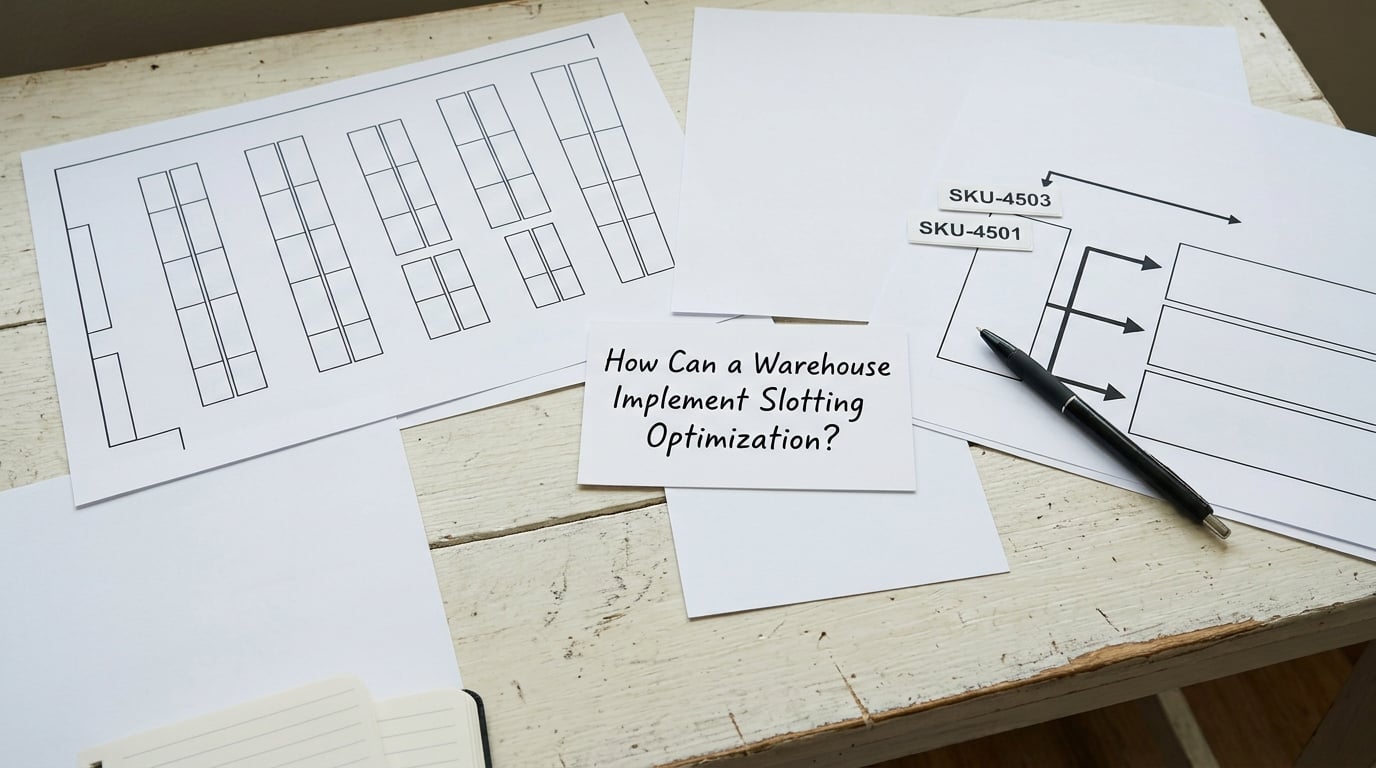
Implementation runs as a seven-step sequence. Expect six to twelve weeks for a first pass on a single module, longer for a full building move.
1. Set the goal and baseline it
Write down the number you want to move, usually orders per picker hour or travel distance per order line, and measure where you are today. A plan with no baseline cannot be evaluated, and you will not know later whether the new map helped.
2. Map the building as it actually is
Walk it with a stopwatch and a tape measure. Record every pick location, the pack station position, bulk storage, and the walking distance between them. Layout drawings drift from reality, and the drift is usually where the fast movers are hiding.
3. Analyze demand and classify
Export the order line history, band the SKUs, and flag handling constraints. This is the longest step and the one most worth doing properly. Everything downstream depends on the classification being honest.
4. Write the location rules
Turn the analysis into a short, teachable document. A items go in the golden zone in the first module. Over 20 kg goes below waist height. Kit items go adjacent. Hazmat goes to the designated area. Six to ten rules cover most facilities, and a supervisor can hold them in their head.
5. Pilot on one module
Do not move the whole building at once. Re-slot a single module of 400 to 600 SKUs, run two weeks, and compare pick rate and accuracy against the same period before the change. You will find mistakes cheaply this way.
6. Update the system and the labels
A location change that is not recorded in the warehouse management system, the replenishment logic, and the pick list labels creates three different maps. Pickers will follow the oldest one they find. This is the step most often skipped and the one that quietly kills a slotting project.
7. Train, publish, and review
Walk the floor with the team, show the before and after pick path, and explain the reasoning. Post the new slot map at the pack station. Then set a re-slot review on the calendar before you leave the meeting.
How Do You Measure Whether Slotting Is Working?
Eight numbers tell you whether slotting is working. If you can only track three, track the first three.
- Orders per picker hour — the primary outcome measure, taken over full weeks, not a good afternoon.
- Average travel distance per order line — usually available as a system report, or measurable with a simple floor audit.
- Pick path time per line — separates walking from handling so you know which one improved.
- Order cycle time — from order release to ship confirmation, which is what the customer feels.
- Location utilization — how full forward pick locations run, and how often they hit empty.
- Pick accuracy rate — wrong location, wrong item, and short pick as separate counts.
- Replenishment frequency per location — a rising count means the buffer is sized wrong for the velocity.
- Labor cost per case — the final reconciliation, including overtime hours.
Compare against a matched baseline period rather than last week. Seasonality and volume swings will fool you otherwise, and a good month after a bad change is the most common false positive in this work.
What Mistakes Do Warehouses Make When Optimizing Slotting?
Five failures account for most disappointing slotting results. Each has a straightforward fix.
1. Slotting by SKU count instead of velocity
Having more SKUs does not mean picking more units. A long tail of slow movers can outnumber the A band ten to one while contributing a fraction of the pick lines. Fix: classify on pick frequency, never on catalog size.
2. Optimizing for velocity and ignoring safety
Pure velocity ranking eventually puts a 25 kg case at shoulder height because that is where the empty slot was. Fix: apply weight and reach rules as hard filters before ranking, not as tie-breakers after.
3. Ignoring the replenishment path
A fast mover stored far from bulk storage generates trips all shift. Fix: add replenishment travel distance to the scoring, and size the forward pick buffer to the pick rate.
4. Moving locations without updating labels and the system
Every unmapped change creates silent mis-picks that show up weeks later in an accuracy report nobody connects to the move. Fix: treat the label print, the system update, and the map update as one task with one owner.
5. Treating the first plan as permanent
Demand shifts with seasons, suppliers, and assortments. A map designed in January is wrong by October. Fix: book the re-slot review at the same time you book the original project.
When Is a Fixed, Hybrid, or Dynamic Slotting Plan Better?
The right model depends on how stable demand is and how much technology you are willing to run.
Fixed slotting
One permanent home per SKU, reviewed occasionally by hand. It suits stable catalogs with low churn: industrial spare parts, lab supplies, bulk commodities, and any operation where SKU mix barely moves. Simple to run, and it does not need anything beyond a system of record.
Hybrid slotting
Fixed homes for the bulk of the catalog, with a dynamic forward pick area in front where the top movers are re-assigned frequently. This is the most common working model in ecommerce and 3PL operations. It fixes the slow movers, where mistakes are cheap, and churns the fast ones, where the money is.
Dynamic slotting
Software re-places SKUs continuously or on a nightly cycle using live pick data, sometimes with an optimization engine on top. It suits high-volume, high-SKU-count operations and seasonal businesses, and it works best inside an AS/RS or a tightly controlled racking system where every location is addressable. The tradeoff is that the system will move things your team has memorized, so change management is part of the work.
A small warehouse with a few thousand SKUs and no warehouse management system does not need dynamic slotting. A monthly spreadsheet classification and a one-day re-slot of the pick face will outperform an unmaintained algorithm.
Frequently Asked Questions
What are the most effective slotting strategies for warehouses?
The most used strategy is velocity or ABC slotting, which places the SKUs that generate roughly 70 to 80 percent of pick lines closest to packing. Product affinity grouping is next, keeping co-ordered items adjacent. Size-and-weight slotting places heavy items low and bulky items near the dock, and zone-based slotting separates fast, medium, and slow movers into distinct modules. Most facilities combine all four rather than choosing one.
Do I need warehouse slotting software to optimize my warehouse?
No, not for a small operation. With a few thousand SKUs, a spreadsheet of pick frequency by month plus a hand-drawn rack map is enough to band products and assign locations. Software pays for itself when you have tens of thousands of SKUs, frequent churn, or need travel distance computed automatically across the whole building.
How often should warehouse slotting be updated?
Quarterly is a sound default for a stable catalog. Monthly suits high-turn operations with lots of new SKUs, and nightly or continuous re-placement makes sense for very high volume. Run an off-cycle review when a major assortment change, a layout change, an equipment change, or a seasonal ramp lands, since any of those invalidate the current map.
How long does a slotting project take to implement?
Plan on six to twelve weeks for a first pass on a single module, including data extraction, classification, rule writing, the physical move, and label updates. A full building re-slot typically runs three to six months, and moving every SKU at once is almost always slower and riskier than phasing it module by module.
What is a golden zone in warehouse slotting?
The golden zone is the height band from roughly hip to shoulder, where a picker can reach, lift, and place an item without bending, stretching, or twisting. Placing the fastest and most frequently handled SKUs here is one of the highest-return moves in a slotting plan, because it removes the strain that drives injuries and slows every pick.
How do I know if my warehouse slotting is working?
Track orders per picker hour, average travel distance per order line, and pick accuracy, and compare them against a baseline period of similar volume. If travel fell but orders per hour did not, the bottleneck is elsewhere, usually handling time or replenishment. Review the numbers over several weeks because seasonality will make single-week comparisons misleading.
Conclusion
Start with the data you already have. Export twelve months of order line history, band your SKUs by pick frequency, and find out where your top fifty movers actually sit today relative to the pack station. That single picture usually tells you more than any software demo.
Then write six location rules, pilot them on one module, and measure pick rate before and after. Update the labels and the system in the same week you move stock, and book the re-slot review before you leave the pilot. Slotting optimization in a warehouse is not a one-time project; it is a scheduled habit, and the facilities that treat it that way are the ones whose pick rates keep improving without extra headcount.