
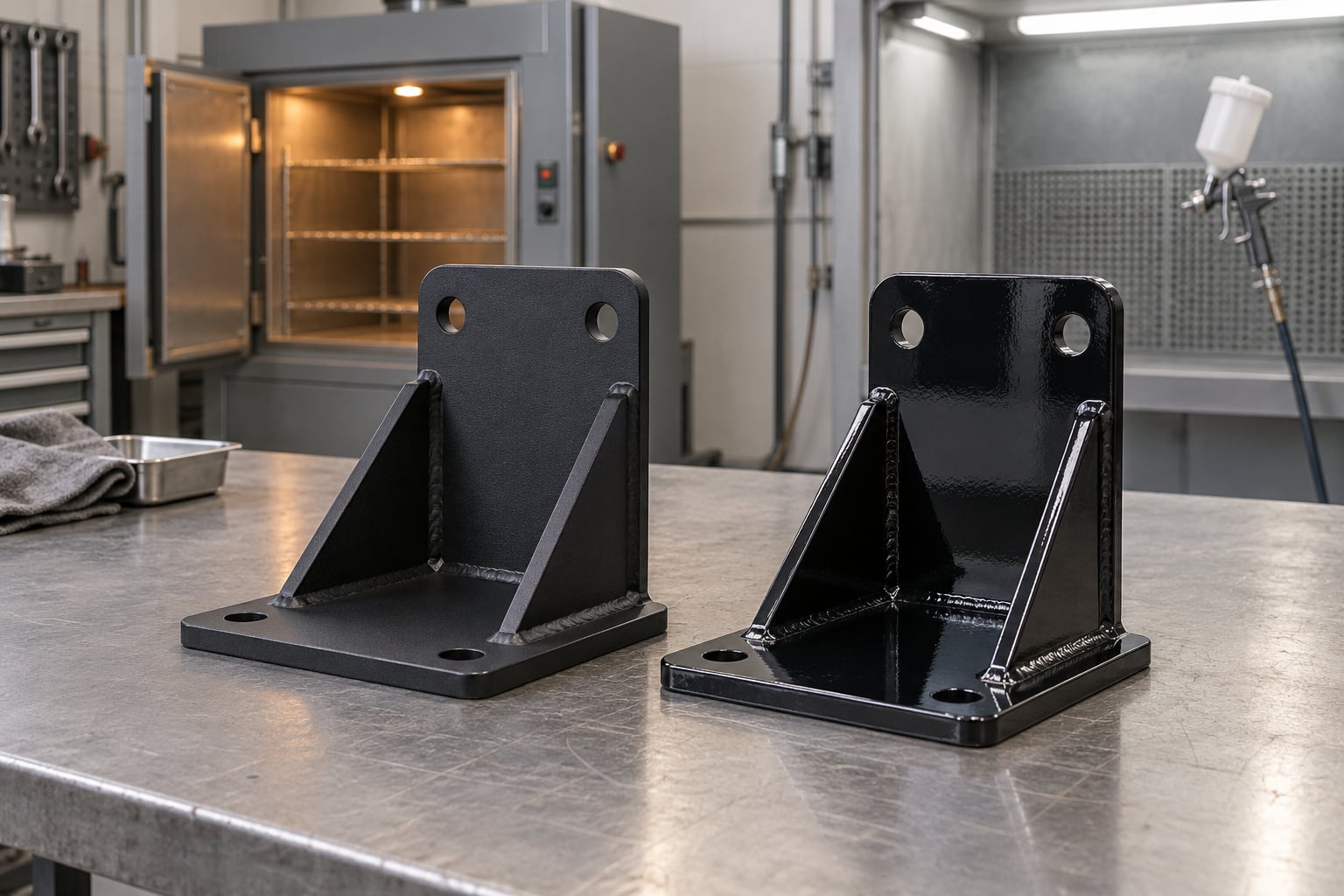
If you need a metal part to survive handling, weather and chemicals, powder coating is usually the stronger finish. If the part needs a thin build, a precise color match, easy field touch-up, or you are coating a small batch on a tight budget, painting wins. Between powder coating vs painting metal parts, prep quality matters more than the process you pick.
Shops that run both finishes on the same welded steel bracket learn this fast: the part that failed first was the one with sloppy blasting, not the one with the weaker chemistry. That is the part most guides leave out.
This guide lays out how each process is applied and cured, how the films behave under chips, corrosion, UV and chemicals, what each one costs per part, and a numbered framework for choosing. It also covers the cases where neither powder nor paint is the right answer, because anodizing, e-coating and plating solve a few problems both of them struggle with.
Table of Contents
- Powder Coating vs Painting Metal Parts at a Glance
- What Is the Difference Between Powder Coating and Painting?
- How Durable Are Powder Coated and Painted Metal Parts?
- What Appearance and Color Options Do They Offer?
- Which Process Is Better for Different Metal Parts?
- Powder Coating vs Painting: Cost, Processing, and Production
- Powder Coating vs Painting: Safety and Environmental Considerations
- How to Choose Powder Coating or Painting for a Metal Part
- Which Should You Choose?
- Frequently Asked Questions
- Conclusion
Powder Coating vs Painting Metal Parts at a Glance
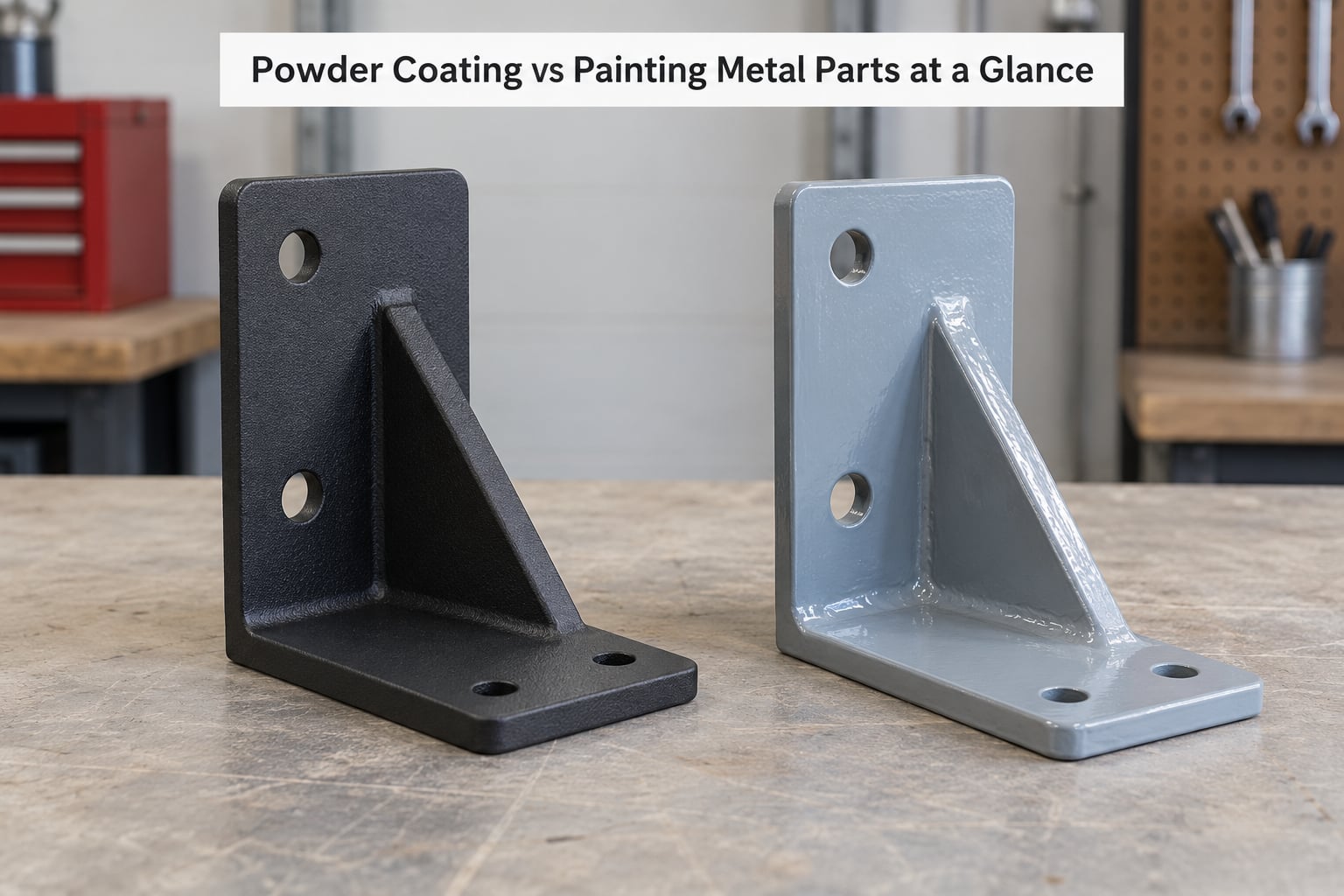
The table below is the short version. Each row is a criterion fabricators and procurement teams actually argue about.
| Criterion | Powder coating | Liquid painting |
|---|---|---|
| Application method | Electrostatic spray of dry, charged polymer powder | Conventional or HVLP spray of solvent-based or waterborne liquid |
| Typical film thickness | 1.5 to 4 mils, often 2 to 3 mils | 0.5 to 2 mils wet, 0.5 to 1.5 mils dry |
| Build on sharp edges | Thinner on edges unless application is corrected; needs careful racking | Thinner on edges too, but easier to correct with a touch-up gun |
| Curing | Bake, typically around 400°F for 10 to 20 minutes at metal temperature | Air dry, force dry, or low-temperature bake depending on chemistry |
| Chip and impact resistance | Higher; thick thermoset film resists stone chips and gravel | Moderate; softer films dent and chip sooner |
| Abrasion and wear | Very good on wheels, frames and hardware | Good on appearance parts, weaker on contact surfaces |
| Corrosion resistance | Strong barrier, but only as good as pretreatment and thickness underneath | Depends heavily on primer and film build; thin films undercut easily |
| UV fade and chalking | Varies a lot by chemistry; outdoor-grade polyester and hybrid resist chalking well | Automotive paint carries superior UV inhibitors and holds gloss color longest |
| Color range and matching | Broad RAL and Pantone library; metallics and special effects need production runs | Nearly unlimited color mixing; touch-up matching is straightforward |
| Thin build or fine detail | Poor; powder obscures threads, casting texture and machined detail with orange peel | Good; thin films hold fine detail and crisp edges |
| Repair and touch-up | Difficult; a chip means sanding and recoating or a return to the line for a re-bake | Easy; clean, abrade, prime, spray and blend in the shop or the field |
| Material usage | Transfer efficiency around 60 to 70 percent, with overspray reclaim and up to 97 percent utilization | Transfer efficiency around 30 to 35 percent; much of the overspray is lost |
| VOC and air handling | No VOC in the coating; needs dust control and extraction in the booth | VOC present in solvent-based paint; needs ventilation and air permit compliance |
| Capital requirement | Gun, booth, oven, pretreatment line; meaningful capital and space | Gun, booth, air supply; far less capital, low capital per part |
| Best fit | Frames, enclosures, wheels, railings, outdoor infrastructure, appliance panels | Cars, color-critical parts, small batches, thin or heat-sensitive parts |
What Is the Difference Between Powder Coating and Painting?
Powder coating is a dry-finish process: electrostatically charged polymer powder is sprayed onto a cleaned, pretreated metal part and cured in an oven. Painting applies a liquid coating that dries by evaporation or by a low-temperature bake. Everything downstream, from film thickness to repair method, follows from that one difference.
How powder coating is applied and cured
The part is degreased, pretreated or abrasive blasted, hung on a grounded rack, and sprayed while the powder carries a static charge that pulls it to the metal. It then goes into a curing oven, typically near 400°F for 10 to 20 minutes at metal temperature, where the thermoset powder melts, flows and crosslinks into one continuous film.
That melt-and-flow step is why powder coating is nearly always a thicker finish. It also means the part has to survive heat, and it is why a plastic-bodied or thin-wall part can warp in the oven.
How liquid painting is applied and cured
A painted part gets cleaned and blasted, usually to a controlled profile, then primed, sprayed with wet paint and left to flash off. Some systems air dry; others bake at lower temperatures to force the cure, and two-pack coatings simply crosslink as they lose solvent.
Liquid paint builds in passes, so an operator can add material exactly where it is thin. That control is the whole argument for paint on a part with edges, threads or tight tolerances.
Why film thickness behaves differently
Thick film helps resist chips, abrasion and undercutting corrosion. It also hides detail, adds weight, and can look like orange peel. A 3-mil powder film on a small threaded fastener is not just decorative; it can change the fit. Paint at 1 mil rarely does that.
For reference, thicker film also raises impact resistance, because a thicker layer absorbs an impact before the substrate is reached. That is why wheels, rocker panels and chassis parts tend to look better in powder.
How Durable Are Powder Coated and Painted Metal Parts?
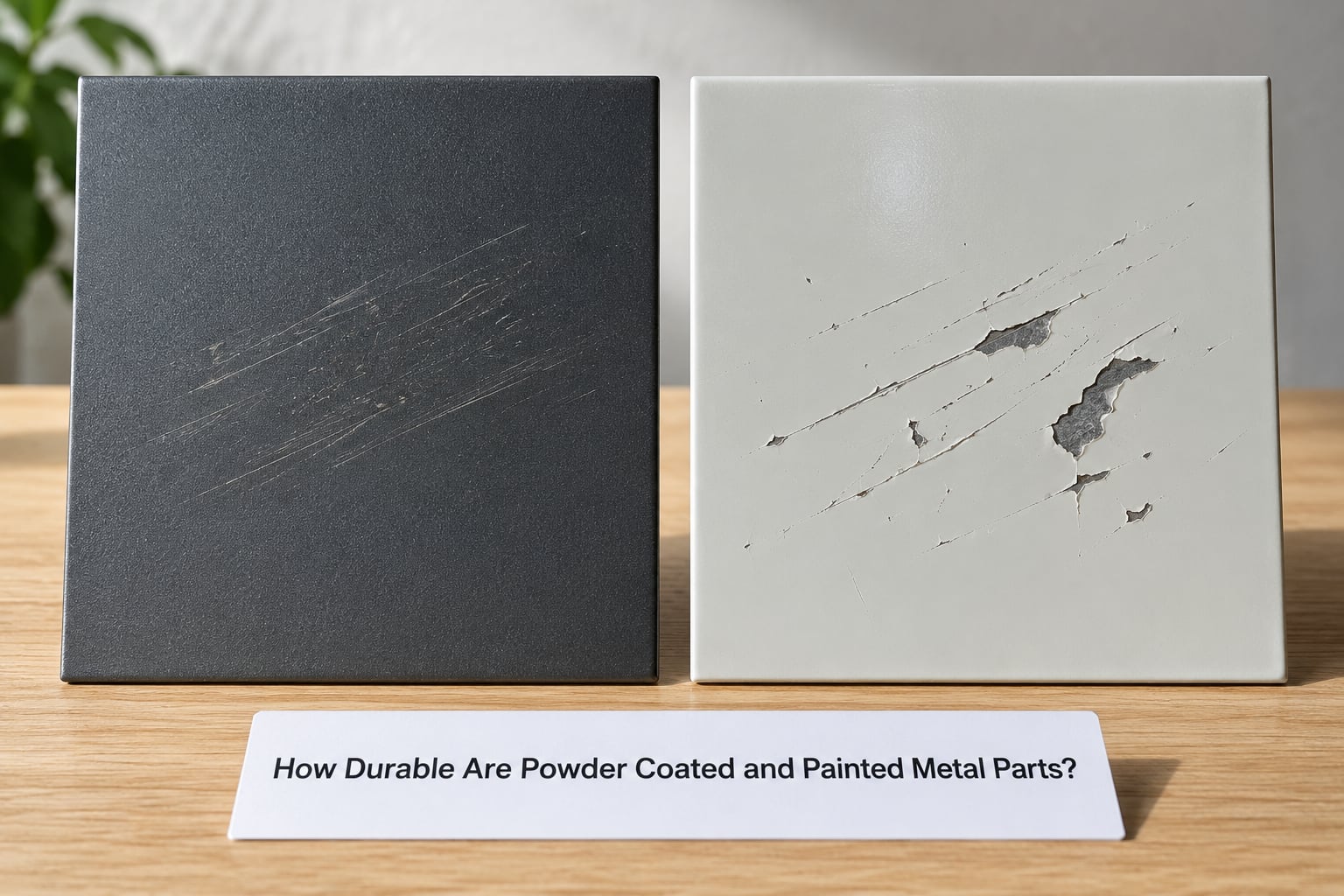
Powder coating vs painting metal parts: how each film wears
Powder coating is generally more durable than paint, but only where the film is continuous and the substrate was properly prepared. A powder coat over an oily, un-pretreated bracket will fail sooner than a well-primed painted part, because corrosion finds the weak spot under the coating.
Chips, abrasion and impact
A cured thermoset powder film is tougher and thicker than a typical paint film, so it shrugs off rocks thrown up from the road and pallet-jack impacts. Paint, especially a single-stage industrial finish, dents and chips sooner and leaves a visible scar because the film is thin.
Detailers who work on powder coated wheels tend to describe them as unusually grippy and long-wearing, while still noting that automotive paint has better UV inhibitors. That distinction matters more in sunlight than in a chip test.
Corrosion resistance
Powder performs well as a barrier because a 2 to 3 mil film is a long path for water and salt. Its weakness is edge coverage: a sharp edge with a thin coat can rust first and undercut the coating from behind.
Liquid paint depends on the primer for most of its corrosion protection. Skip the primer, spray too thin, and the rust stain will appear faster than it would under powder. Pretreatment matters more here than almost anyone admits.
UV exposure, chalking and fade
Outdoor powder does not fade the way quality automotive paint does, because outdoor-grade polyester and hybrid powders hold pigment and gloss far better than cheap blends. Users on enthusiast forums consistently report that epoxy and cheaper powder coats chalk and dull in direct sun, and that switching powder type fixed the problem.
If color stability over fifteen years is the priority, a two-stage urethane paint system is still hard to beat. Powder is the value choice for matching that durability at lower cost.
Chemical exposure and maintenance
Powder resists solvents, oils and mild chemicals well, and it cleans with soap and water. Oil-based paints can be lifted by gasoline or strong solvents, while epoxy powder can chalk under strong UV. A useful warning from practitioners: WD-40 and similar penetrating oils will stain and soften some powder and paint films with prolonged contact, so keep it off finished surfaces and wipe it off.
What Appearance and Color Options Do They Offer?
Both processes cover the practical color wheel, so color is rarely a deciding factor on its own. What differs is the finish quality you get and how easy it is to match later.
Gloss, texture and color consistency
Because powder melts and flows, it gives a consistent, slightly textured gloss, semi-gloss, matte or fine-texture finish across a whole rack, and repeatability batch to batch is excellent. Orange peel is normal and some people prefer the smoother look of paint.
Paint, particularly a sprayed automotive finish, gives a smoother, more reflective surface with better flow and clarity. Two-stage paint also holds a deep gloss that powder generally cannot match without a clear topcoat.
Color matching, metallics and touch-up
This is where painting is clearly better. A painter can mix a small batch to match an existing panel, blend a scratch so the repair is nearly invisible, and match a supplier’s color in minutes.
Powder colors come from a production run. If you buy a new box a year later, the batch may not match exactly, metallics and speckles are nearly impossible to blend, and reclaiming overspray mixes colors and makes future matches harder. Anodizing is a separate process with its own color limits, discussed in our guide to choosing a surface finish for molded parts, which covers the same thinking applied to non-metal components.
Which Process Is Better for Different Metal Parts?
Substrate, geometry and service environment decide more than preference. Here is how the two processes handle common materials.
| Material | Powder coating | Painting |
|---|---|---|
| Carbon steel | Excellent with blast and pretreatment | Fine with primer; watch for edge undercut |
| Aluminum | Very good; chromate pretreatment adds adhesion, and a powder coat can replace a chemical primer | Very good with a conversion coating or suitable primer |
| Stainless steel | Good, but requires a roughened or etched surface for adhesion | Good with a stainless-rated primer |
| Cast iron | Good, though casting sand and pores can trap residue | Good with epoxy primer |
| Galvanized steel | Good; pretreat to prevent hydrogen outgassing | Good with a compatible primer |
| Heat-treated or plated parts | Risk of hydrogen embrittlement if not baked promptly; confirm with the supplier | No bake required for air-dry systems |
| Rubber and plastic | Not applicable; the oven would damage them | Works with the right primer, or paint directly |
| Thin-wall or heat-sensitive parts | Poor; oven temperature can warp the part | Good, with air dry or a low bake |
For welded steel frames, powder wins on chip resistance and rack-to-rack consistency. For sheet metal enclosures, powder avoids runs and sags that plague a heavy wet coat on a vertical panel. For aluminum machined parts, both work, but if the part is an enclosure where the color is the product, paint offers a better surface.
Threaded and machined components should be masked or powder should be applied with care, because a thick film on threads is a real assembly problem. If your process also has to prove the part is still in spec after finishing, coordinate-measuring-machine inspection basics are worth reading before you lock the coating. Parts in high-temperature service often need neither: a silicone or ceramic coating handles what powder and paint cannot.
Finishing is not the only operation that changes a surface, by the way. If you are choosing between paint and a molded-in color on plastic parts, the tradeoffs are similar, and we cover them in painting vs in-mold decorating for plastics.
Powder Coating vs Painting: Cost, Processing, and Production
Powder usually wins on material cost per part, because a much higher share of the coating ends up on the part. Powder transfer efficiency runs around 60 to 70 percent, and with overspray reclaim, powder utilization reaches up to 97 percent. Liquid paint transfer efficiency is roughly 30 to 35 percent, with the rest lost to overspray and cleanup.
Paint is cheaper to start with. A booth, a good gun and an air supply are far less capital than a curing oven, a wash line and a blast cabinet. The breakeven is about volume: outsourcing per part costs more as volume rises, so shops with steady production pull the operation in-house, while shops with occasional jobs should keep paying a coater per part.
| Cost driver | Powder coating | Painting |
|---|---|---|
| Material per part | Lower; reclaim recovers most overspray | Higher; overspray is largely lost |
| Primer | Often eliminated on aluminum and steel | Usually required, adding a coat and labor |
| Labor | One gun pass, batch oven loading | Primer pass, color pass, possibly a clear |
| Equipment and space | Oven, booth, blast, pretreatment | Booth, air, dryer; much smaller footprint |
| Rework | Strip or recoat; a bake is required either way | Sand and re-spray, no oven needed for air dry |
| Environmental handling | Low; little waste stream | Paint and solvent storage, fire codes, waste disposal |
Throughput is the other side of the ledger. A powder oven runs a rack every 10 to 20 minutes, while paint can cycle much faster when air dried. Cure temperature also sets your throughput: a part that cannot take 400°F is not a powder candidate no matter how good the finish looks in a sample.
Powder Coating vs Painting: Safety and Environmental Considerations
Powder coating contains no solvent and no VOC in the coating itself, which is the main reason regulators and EHS managers like it. The EPA has recommended powder coating as a lower-emission finishing option, and shops report large reductions in volatile organic compounds when they convert a line.
It is not free of hazards. Fine powder is a respiratory irritant, and the extraction and filtration on a powder booth have to be sized for it. Powder collected in the booth has to be evaluated before reuse, because a clear or silver color contaminates the reclaim and can ruin future batches. Metal parts entering and leaving a 400°F oven are the biggest burn risk in the process.
Painting has its own profile. Solvent-based paint puts VOC into the air, so ventilation, air permits and possibly a vapor recovery unit come into the budget. Paint storage is a flammable-liquid hazard that triggers fire codes. Disposal is regulated: spent solvent, contaminated rags and wash water go through formal hazardous waste handling, not the regular bin.
On worker exposure, both are manageable with the right gear and air monitoring. The difference is that powder is a nuisance dust problem, while paint is a vapor and flammability problem, and shops often find the paint side is the harder one to permit.
How to Choose Powder Coating or Painting for a Metal Part
Here is the framework I walk a customer through, in order. Answer each question and the answer usually makes itself.
- What is the substrate? Steel, aluminum and cast iron powder well. Stainless needs a roughened surface. Plastics and rubber rule powder out.
- Can the part take the oven? If the part warps, discolors or is heat sensitive at 400°F, powder is out and paint is in.
- What film thickness do you need? Under about 1 mil, or on threads and precision fits, painting is the only realistic process.
- What is the service environment? Coastal, chemical, road salt or high abrasion pushes toward powder. Long-term color and gloss in direct sun pushes toward automotive paint.
- How important is appearance versus protection? Fine casting detail, engraving and crisp edges argue for paint. Uniform texture and consistency argue for powder.
- How will it be repaired? If the part ships and gets scratched in the field, paint is far easier to touch up. Powder usually means a return to a line.
- What is the volume? Low volume or one-off work: outsource to a shop either way. Steady volume: powder lines justify the capital faster.
- What does the color have to do? A standard RAL or Pantone in stock is easy in powder. A custom color, a metallic match or a restoration gets paint.
- How good is your surface prep? Both processes live or die here. If the part is oily, welded, or blasted inconsistently, fix prep before comparing finishes.
Is powder coating or painting better for a repaired metal part?
For a field repair, painting is better. Clean the damaged area, abrade back to sound coating or bare metal, spot prime if you hit steel, and spray color. The part does not need a re-bake, and the blend is close enough that most people will not notice.
Repairing powder is a shop job. You have to abrade the defect, re-apply powder and put the part back in an oven, or use a liquid touch-up paint that will never quite match a textured powder surface. For a small part in the field, paint over powder coat is a pragmatic call, and plenty of shops do it, but it is a repair, not a restoration.
Which Should You Choose?
Choose powder coating when: the part is steel or aluminum, can take a 400°F bake, will see abrasion, chips, weather or chemicals, needs a consistent finish across a batch, and will be produced in enough volume to justify the oven. Frames, enclosures, railings, wheels, panels and infrastructure all fall here.
Choose painting when: the part is heat sensitive or thin, needs a film under 1 mil, has fine detail or threads to preserve, needs an exact color match or a custom color, will be repaired in the field, or the job is small enough that owning an oven makes no sense. Cars, restoration work, prototypes and low-volume parts land here.
Choose neither when: the real requirement is anodic oxide on aluminum, a conductive or sacrificial plating layer, an e-coat dip for uniform coverage in a complex assembly, or a high-temperature ceramic or silicone coating. Anodizing gives aluminum a harder, thinner, more corrosion-resistant oxide with excellent color control; e-coating reaches into assembled areas spray cannot; plating adds conductivity, wear resistance or a sacrificial zinc layer. If you are choosing a finish for a CNC aluminum part, that three-way comparison is worth reading before you spec anything.
One caution worth repeating from the forums that cover this topic best: results vary more between shops than between processes. A well-prepped part in a cheap paint job beats a rushed powder job every time.
Frequently Asked Questions
What are the downsides of powder coating?
The main drawbacks are repair and color flexibility. A chip cannot be blended like paint; it needs abrading and a re-bake, or a liquid touch-up that will not match the texture. Powder also needs a 400°F oven, so thin-wall or heat-sensitive parts are out, and it obscures fine threads and casting detail. Custom colors and metallics come from production runs, which makes matching harder. And the booth, oven and blast equipment cost real capital.
Is it better to paint or powder coat?
Powder is better for durability, chip resistance, corrosion barrier, consistent finish and lower VOC. Paint is better for thin builds, fine detail, exact color matching, custom colors, easy field repair, heat-sensitive parts and low-volume work. The honest answer is that surface preparation decides more than the choice of coating. If the part is properly cleaned, blasted and pretreated, either process performs well.
How long does powder coating last on metal?
On a well-prepped steel or aluminum part in a normal environment, a quality outdoor-grade powder coat commonly lasts 10 to 20 years without needing repair. Coastal, chemical or road-salt exposure shortens that, and cheap or interior-grade powder chalk and fade in direct sun. Liquid paint on a good primer can last comparably in mild conditions, and automotive two-stage paint holds gloss and color the longest of anything here.
What materials can be powder-coated?
Carbon steel, aluminum, stainless steel, cast iron and galvanized steel can all be powder coated, provided the surface is clean and pretreated. Stainless needs etching or roughening to hold adhesion, and galvanized parts need pretreatment to prevent hydrogen outgassing. Rubbers, plastics and most heat-sensitive parts cannot, because the part has to survive a bake near 400°F. Paint handles those substrates with the right primer.
Can I powder coat without sandblasting?
You can, but you should not expect the same adhesion. A light scuff or grit blast followed by a good wash and pretreatment is usually enough for a small job. For heavy-duty work, salt spray, or a part that has been welded, abrasive blasting to a clean profile is the standard. Skipping it is the most common reason a powder coat peels or rusts early. Paint has the same requirement, so prep is not a powder-specific problem.
Does powder coating fade over time?
Good outdoor powder does not fade much. Polyester, hybrid and automotive-grade powders hold color and gloss through years of sun, where epoxy powders and cheap blends chalk to a dull grey. Paint behavior depends on the system: two-stage urethane has the best UV inhibitors of any finish here. If long-term color stability is the main goal, powder can still deliver it, as long as you specify the right powder chemistry and reject chalking grades.
Conclusion
Start by defining four things for the part: where it will live, what performance it has to deliver, what shape and substrate it is, and what the finished part has to look like. Answer those and the coating choice makes itself most of the time.
If the part can survive an oven and will be handled, weathered or abraded, powder coating is usually the better long-term answer. If it cannot, if the color has to match something specific, or if it will be scratched in the field, paint is the right call. And if neither process meets the requirement, look at anodizing, e-coating or plating before you spec a coating that will have to fight the job.
One last thing worth saying plainly: in powder coating vs painting metal parts, preparation wins. Budget real time and money for cleaning, blasting and pretreatment, and the rest of the decision takes care of itself.