
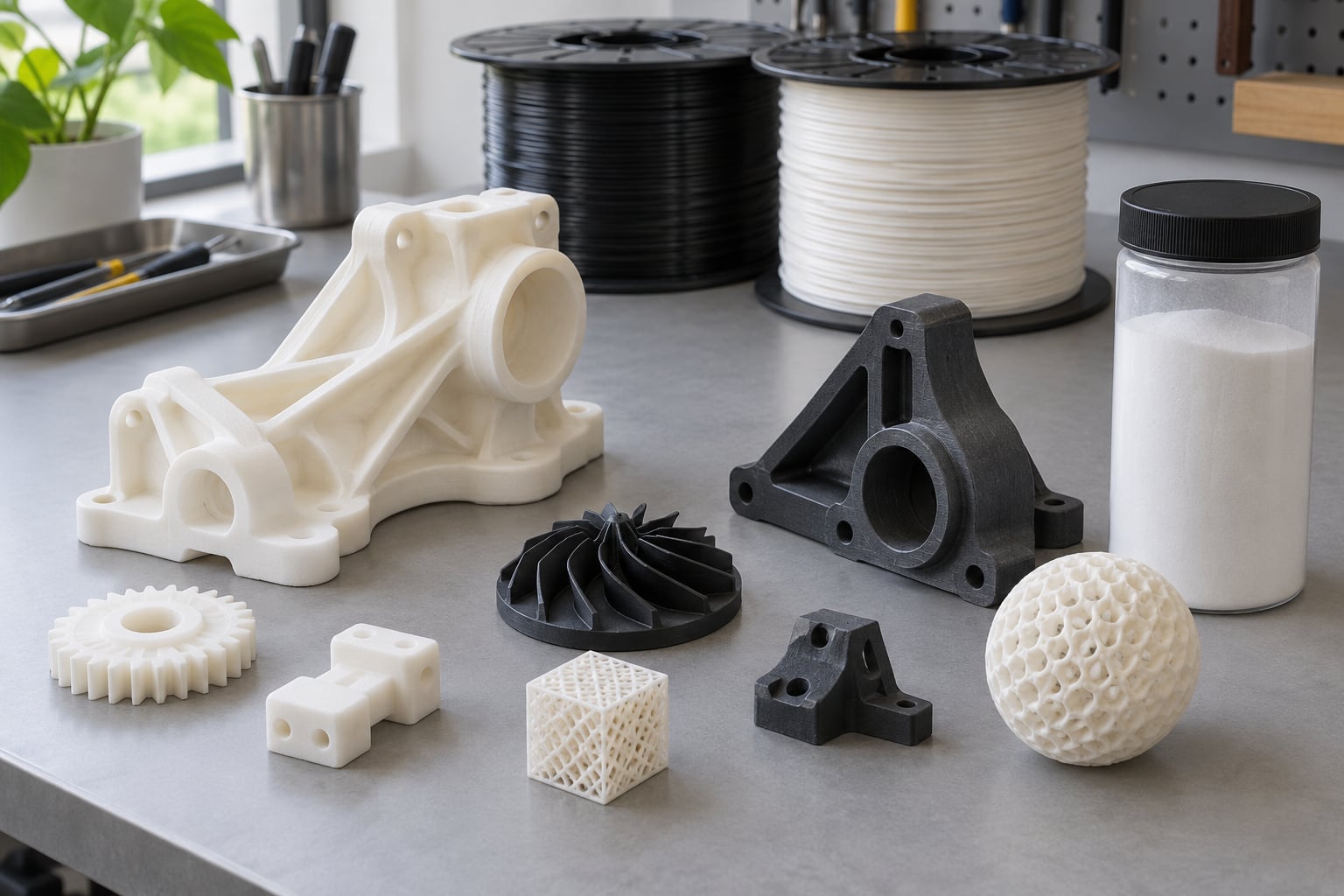
Short answer first: how much does 3D printing cost per part? A one-off prototype typically lands between USD 3 and USD 60, and once you order 50 or more of the same item you are usually looking at USD 1.50 to USD 12 each. Material is the smallest line on that invoice. Machine time, hands-on labor and setup are what actually move the number.
The trouble is that most cost articles stop at filament weight, so they underprice parts by a factor of ten or more. This guide breaks the real per-part number into its parts, shows a worked calculation, and tells you which levers actually bring it down.
All figures below are typical US ranges. Real quotes move with region, supplier, material grade, geometry and market conditions, so treat them as planning numbers and validate them against two or three real bids.
Table of Contents
- 3D Printing Cost per Part: Typical US Ranges
- What Affects the Price
- Ways to Save
- Frequently Asked Questions
- How much does a service bureau charge for a 3D-printed part?
- Is 3D printing cost based mainly on material or machine time?
- How much does 3D printing cost for tight-tolerance production parts?
- When is 3D printing cheaper than injection molding?
- What information does a service bureau need to quote a 3D-printed part?
- Is buying a 3D printer cheaper than using a service bureau?
- Conclusion: Start With a Three-Quote Cost Model
3D Printing Cost per Part: Typical US Ranges
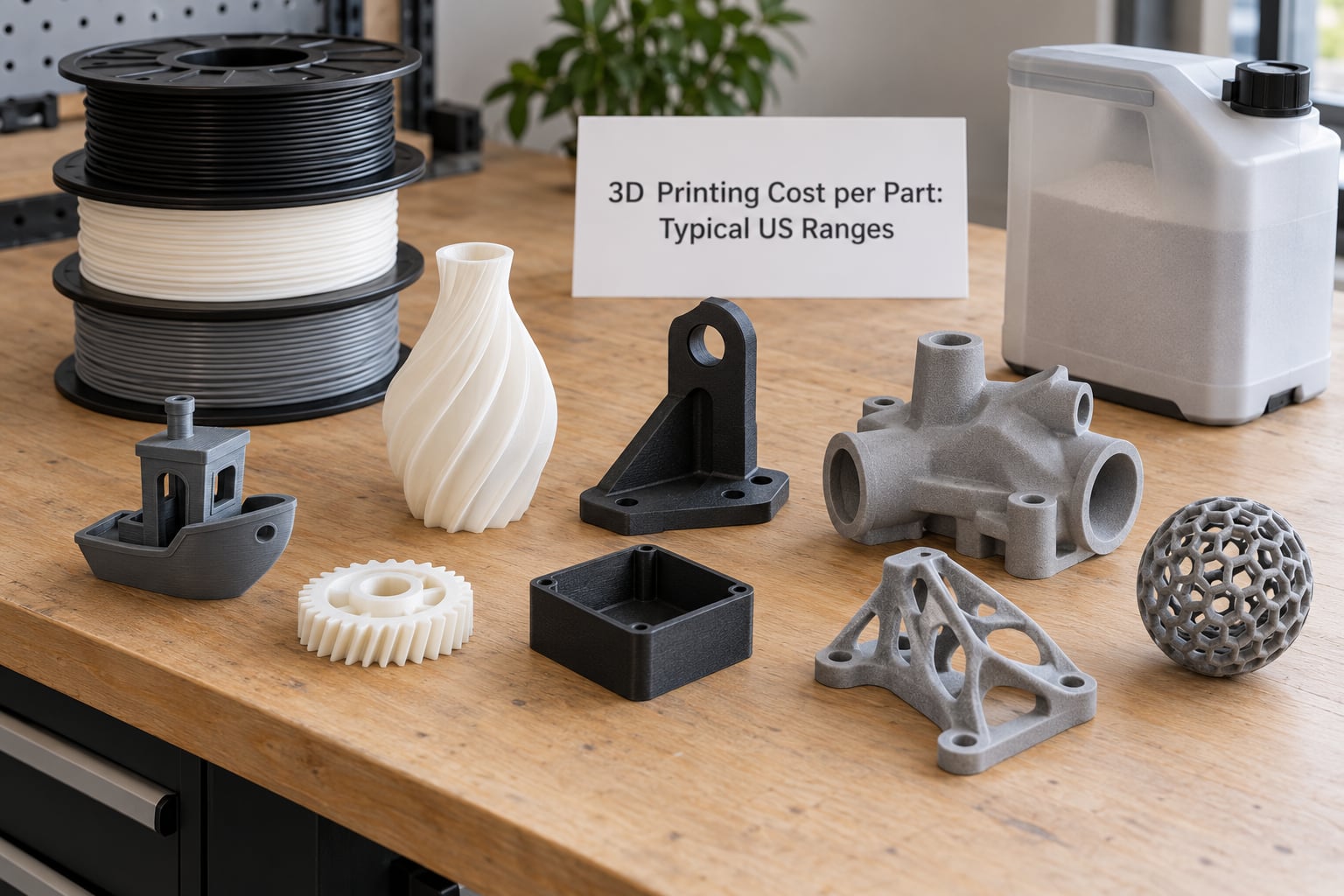
Cheap desktop FDM parts and SLS or metal production parts sit at opposite ends of the scale. A small PLA piece on a hobby machine can land near USD 3 all-in, while a titanium bracket produced on an industrial machine can run past USD 300 a piece without anyone doing anything unusual.
How Much Does 3D Printing Cost per Part by Process?
| Process | One-off prototype | 20 to 100 piece run | Where it fits best |
|---|---|---|---|
| Desktop FDM (PLA, PETG, ABS) | USD 3 – 25 | USD 2 – 12 | Fit checks, jigs, low-strength brackets, cosplay props |
| Industrial FDM / large-format | USD 40 – 150 | USD 15 – 60 | Full-size panels, ducting, end-use housings |
| SLA / DLP resin | USD 15 – 90 | USD 6 – 35 | Fine features, dental and medical models, watertight prototypes |
| MJF (multi-jet fusion nylon) | USD 25 – 120 | USD 8 – 40 | Complex geometries, batch production, powder reuse |
| SLS nylon | USD 30 – 150 | USD 10 – 45 | Strong end-use parts, no support structures, lattices |
| PolyJet multi-material | USD 60 – 250 | USD 25 – 90 | Appearance models, patterns, soft-touch prototypes |
| Metal DMLS / SLM (aluminum, steel, titanium) | USD 120 – 600 | USD 40 – 200 | Functional end-use parts, medical, aerospace, tooling inserts |
The spread inside each row matters more than the spread between rows. Material choice moves a per-part price by a factor of three. Tight tolerances and a machined or polished finish can double it overnight, and that has nothing to do with the process itself.
3D Printing Part Costs by Size and Quantity
| Part size | Typical FDM prototype | Low volume, 5 to 50 pieces | Production, 100 pieces or more |
|---|---|---|---|
| Small, under 50 g, simple geometry | USD 3 – 10 | USD 1.50 – 5 | USD 0.80 – 3 |
| Medium, 50 to 250 g, some supports | USD 10 – 35 | USD 5 – 18 | USD 3 – 10 |
| Large, over 250 g or tall enough to hit build volume | USD 35 – 120 | USD 20 – 60 | USD 12 – 40 |
Small parts punish you, and it is worth being blunt about why. A keychain-sized piece may use less than a dime of filament and still absorb half an hour of setup, removal, cleanup, packaging and platform fees. Above roughly 100 parts per order, fixed costs per order shrink enough that the cheap part starts behaving like its material cost suggests it should.
Large parts have the opposite problem. They hit build volume limits, need more support structure, and often force a slower nozzle or lower infill to fit at all. Add that to a part that must be heat-stroked or stress-relieved afterwards and the per-part number climbs faster than the gram count suggests.
One more thing worth saying plainly: print time on its own tells you very little. A ten-hour print of a chunky dragon and a ten-hour print of a thin, tolerance-critical bracket are entirely different products. Finish, tolerance and geometry class move the price, not the clock.
What Affects the Price
Every legitimate per-part quote is the same eight components. Quote any vendor that cannot show you these, and you are looking at material cost dressed up as a price.
- Material. Budget PLA lands near USD 18 to 26 per kilogram, PETG around USD 20 to 30, ABS and ASA roughly USD 22 to 35, TPU USD 35 to 55, and PA12 nylon USD 60 to 110. Photopolymer resin runs USD 40 to 90 per kilogram before wastage. Metal powder is a different order again: aluminum USD 90 to 140 per kilogram, stainless steel USD 120 to 200, titanium USD 300 to 600, Inconel well above that.
- Machine time. Charged at a fully loaded hourly rate. For a USD 500 desktop FDM machine, a realistic loaded rate sits near USD 1.00 an hour. Industrial SLS runs USD 60 to 150 an hour, and metal machines USD 250 to 500 an hour, because those rates carry staffing, facility cost and capital recovery.
- Electricity. Smaller than people expect on a desktop machine. A 150 W average draw for one hour is 0.15 kWh, which at a US residential rate of USD 0.17 per kWh comes to about three cents. Even a 400 W machine running flat out lands near seven cents an hour. Electricity matters on industrial hardware and barely registers at the desktop.
- Depreciation. Purchase price divided by expected productive hours. A USD 400 printer that delivers 2,000 hours of usable production before replacement contributes USD 0.20 an hour. That is the most commonly forgotten line on a small print farm’s spreadsheet.
- Hands-on labor. Bed preparation, part removal, support clearing, sanding, washing and curing, inspection, packaging. Community practice on print forums settles somewhere near USD 35 an hour for this work, valued separately from unattended machine time.
- Post-processing and finishing. A raw print is not a finished part. Tumbling, bead blasting, heat treatment, stress relief, machining critical faces and painting each add a fixed cost that dwarfs the material on a small part.
- Failure and scrap allowance. Add 5 to 15 percent. FDM with an aggressive brim, supports under overhangs and a first-layer adhesion problem pushes toward the top of that band. SLS and MJF powder machines sit at the bottom because there is no first layer to fail.
- Overhead. Space, climate control, software, insurance, consumables, capital. Allocating overhead per machine hour is what separates a real business rate from a hobby rate.
Geometry feeds straight into all of that. Large unsupported overhangs force support structures, which consume material and demand removal time. Tall thin walls need slower speeds and more layers. Small holes below the nozzle diameter cannot be printed at all on FDM and force a redesign or a process change to SLA.
Dimensional tolerance and surface finish decide which price tier you land in. As-printed FDM typically lands around plus or minus 0.3 mm, SLA around plus or minus 0.1 mm, and SLS about plus or minus 0.15 mm. Asking a bureau to hold plus or minus 0.05 mm on a metal part moves the quote into machined-plus-printed territory, which is a different budget conversation.
How Much Does 3D Printing Cost per Part Change with Volume?
Volume cuts cost in a predictable order. Material gets cheaper in bulk, machine packing improves so you waste less of the build plate, setup and cleanup amortize across more parts, and the scrap rate usually falls because the process has settled.
| Line item | 1 part | 10 parts | 100 parts |
|---|---|---|---|
| ABS material, 95 g each at USD 24 per kg | USD 2.28 | USD 2.05 | USD 1.85 |
| Machine time, 6.5 h each at USD 1.00 | USD 6.50 | USD 6.20 | USD 5.80 |
| Hands-on labor at USD 35 per hour | USD 26.25 | USD 5.25 | USD 2.10 |
| Failure allowance | USD 2.80 | USD 0.68 | USD 0.49 |
| All-in cost per part | USD 37.83 | USD 14.18 | USD 10.24 |
The labor row does most of the work. Cutting handling from 45 minutes per part down to 9 minutes is what a batch buys you, and no material negotiation comes close.
Now separate cost from price, because this is where beginners lose money. A 45 percent margin means selling at cost divided by 0.55, so that USD 37.83 part becomes roughly USD 69. A 100 percent markup doubles it to about USD 76. Those two prices sound similar and are not: the first leaves about USD 31 of gross profit, the second about USD 38, and only one of them is the number a buyer can compare against another quote.
Buy versus own follows from the same arithmetic. A USD 500 desktop printer contributes about USD 0.25 an hour of capital cost over its life, so it essentially never competes on machine rate alone; it competes because it converts idle hours into parts. An industrial SLS system carrying about 12 percent annual capital, staffing and facility cost lands near USD 1 million a year all-in. Spread over 2,500 build hours that is USD 400 an hour, above most bureau quotes, while 4,000 hours brings it under USD 250. Utilization decides whether owning industrial capacity wins, and it is the same build-versus-buy logic described in how to calculate total cost of ownership for a part.
| Annual demand | Own a desktop printer | Use a service bureau |
|---|---|---|
| 1 to 20 parts | Best, if you own a machine already | Freight and minimum order fees dominate |
| 20 to 200 parts | Strongest case, labor amortizes | Reasonable, compare against your labor rate |
| 200 to 1,000 parts | Needs two machines and part-time staff | Volume tiers usually win on price |
| 1,000 parts or more | Industrial capacity with proven utilization | Keep as a second source and for overflow |
At higher annual volumes the comparison stops being about printers at all. Tooling, cycle time and setup amortization take over, and the side-by-side of both processes is worth reading before you commit to either route: 3D printing vs injection molding cost breakdown.
Ways to Save
Cut material before you cut anything else. Shelling a solid body into a thin wall with internal ribs often removes 60 to 70 percent of the material with no loss in stiffness. Then orient the part so the layers run along the load path rather than across it, which lets you drop infill density without weakening the part.
Redesign to remove supports. Self-supporting angles of 45 degrees or steeper, bridging where the part allows it, and splitting an assembly into two parts that print without support each save both material and removal labor, which is the expensive part of the job.
Tighten tolerances only where the function demands it. Loosening a fit from plus or minus 0.1 mm to plus or minus 0.2 mm can move a part down a price tier outright, and it costs nothing if mating parts were never measured to that standard.
Prototype in the cheapest process that answers your question. An FDM print at USD 8 answers fit and proportion questions. Reserve SLA, SLS and metal for the questions only those processes can answer.
Consolidate builds and quote by the plate, not by the part. A bureau filling 80 percent of a build plate charges a fraction of what the same plate at 15 percent occupancy costs per piece. If your parts tile together, say so in the request.
Ask for volume tiers in writing and re-quote at the next quantity break. A supplier quoting 250 units has usually already priced a 500-unit tier, and that quote is free to ask for.
Compare at least three service bureau quotes line by line. Ask which machine, which material grade, which tolerance class and which finish tier sit behind the number. Quotes that bundle freight, packaging and customs duty are hard to compare with quotes that do not, and on small orders that bundle can be a quarter of the invoice. If you have never sent a formal request, our guide to quoting a custom plastic part shows the line items to specify so the responses line up.
Finally, price your own time. Counting filament and print time alone is the single most common pricing mistake in this industry, and it is why so many small jobs quietly lose money even when they look busy.
Frequently Asked Questions
How much does a service bureau charge for a 3D-printed part?
Service bureaus typically quote USD 3 to 25 for a small FDM part, USD 10 to 45 for SLS nylon, and USD 40 to 200 for a metal part. The quote should itemize material, machine time, labor, post-processing and freight. If it arrives as one number with no breakdown, ask for the line items, because on small orders the hidden setup and packaging charges are where the margin hides.
Is 3D printing cost based mainly on material or machine time?
Machine time, then labor, then material. On a typical desktop part, material is under 10 percent of all-in cost, machine time around 20 percent, and hands-on labor the rest. That is why a heavier part in a cheap polymer is not automatically expensive, and why a lightweight part that takes an hour of cleanup can be. Powder-based processes narrow the gap because nesting is better and there is no first layer.
How much does 3D printing cost for tight-tolerance production parts?
Tight tolerances move you out of pure additive pricing. Holding plus or minus 0.05 mm on a metal part usually means printing near-net and machining critical features, which can double the per-part cost. A realistic range for tight-tolerance SLS nylon is USD 30 to 90 a part, and for machined and printed metal USD 120 to 400. State the tolerance and the critical dimensions in the request rather than asking for precision in general.
When is 3D printing cheaper than injection molding?
Almost always below a few hundred units, and rarely above. An injection molding tool commonly runs into five figures before the first part exists, plus a multi-week lead time and a minimum order. Additive printing carries no tooling cost and starts producing immediately. The crossover depends on part size, complexity and annual volume, so model both sides rather than assuming one number settles it.
What information does a service bureau need to quote a 3D-printed part?
Give them a watertight STEP file where possible, the material and grade, the quantity, the critical dimensions with their tolerances, the surface finish you need, and the delivery date. State whether the part is a prototype or a functional end-use item. That package of information is usually enough for a firm quote the same day. A screenshot and an STL with no tolerance notes will come back as a guess with a wide range around it.
Is buying a 3D printer cheaper than using a service bureau?
Below about 200 parts a year, owning usually wins if someone already has a machine and someone else can run it. Above that, service bureaus win on capital, labor and machine rate, and they win earlier if nobody is employed to load plates and remove parts. The comparison that matters is your fully loaded hourly cost against their quote, not the filament price against their per-part price.
Conclusion: Start With a Three-Quote Cost Model
Per-part cost is material, machine time, electricity, depreciation, labor, post-processing, a scrap allowance and overhead, then divided by your required margin. Material is the piece you can see; the other seven are the piece that decides whether the job makes money.
Before you request quotes, pin down five things: the part geometry, the material, the quantity, the finish and the tolerances. Send the same packet to three suppliers and compare the returned numbers line by line. You will find the spread between quotes is far smaller than the spread between processes, which is where the real savings live.