
A bill of lading is a legally binding document issued by a carrier to a shipper that details the type, quantity, and destination of goods being carried. It works as a receipt for the cargo, as evidence of the contract of carriage, and — when it is negotiable — as a document of title. That is bill of lading explained for a plant or trading team: how the document works, what each section means, and what your team should confirm before accepting it.
Most people meet the document for the first time during an argument: cargo sitting at a port, an invoice that cannot be paid, and a PDF nobody is sure is genuine. Knowing how the bill works prevents most of those situations.
Table of Contents
- What Is a Bill of Lading?
- How Does a Bill of Lading Work in a Shipment?
- What Are the Main Types of Bills of Lading?
- What Key Information Does a Bill of Lading Include?
- How Does a Bill of Lading Transfer Title or Control?
- What Is the Difference Between a Bill of Lading and Other Freight Documents?
- What Should Manufacturers and Buyers Check Before Accepting It?
- What Are the Most Common Bill of Lading Errors?
- How Does a Bill of Lading Help With Freight Claims and Disputes?
- Frequently Asked Questions
- Is a bill of lading a title document?
- Who fills out a bill of lading?
- Why are three originals of a bill of lading issued?
- What is the difference between an original bill of lading and a sea waybill?
- Why was my bill of lading rejected under a letter of credit?
- How long should a bill of lading be retained?
- Conclusion
What Is a Bill of Lading?
Three separate things are packed into one piece of paper, and that is why it is worth understanding each one. The bill records what the carrier received, it records the terms the carrier agreed to, and in its negotiable form it decides who may walk away with the cargo.
The carrier issues it. A truckload carrier issues a domestic bill for a road move; an ocean carrier or its agent issues one for a sea move. A freight forwarder or NVOCC may draft the paperwork on the shipper’s behalf and issue its own house bill, while the ocean line issues a separate master bill for the same cargo.
What are the three functions of a bill of lading?
- Receipt of goods — evidence that the carrier took custody of a stated quantity of cargo on a stated date.
- Contract of carriage — evidence of the terms the carrier accepted, including routing, freight prepaid or collect, and agreed conditions of carriage.
- Document of title — when negotiable, the document that lets its lawful holder obtain the cargo at destination.
It is not an invoice. The invoice states what you are charging; the bill states what the carrier received and the terms of the move. A packing list itemizes your cartons. The freight bill, or freight invoice, shows what the carrier charges for carriage and is a separate accounting document that never releases cargo.
How Does a Bill of Lading Work in a Shipment?
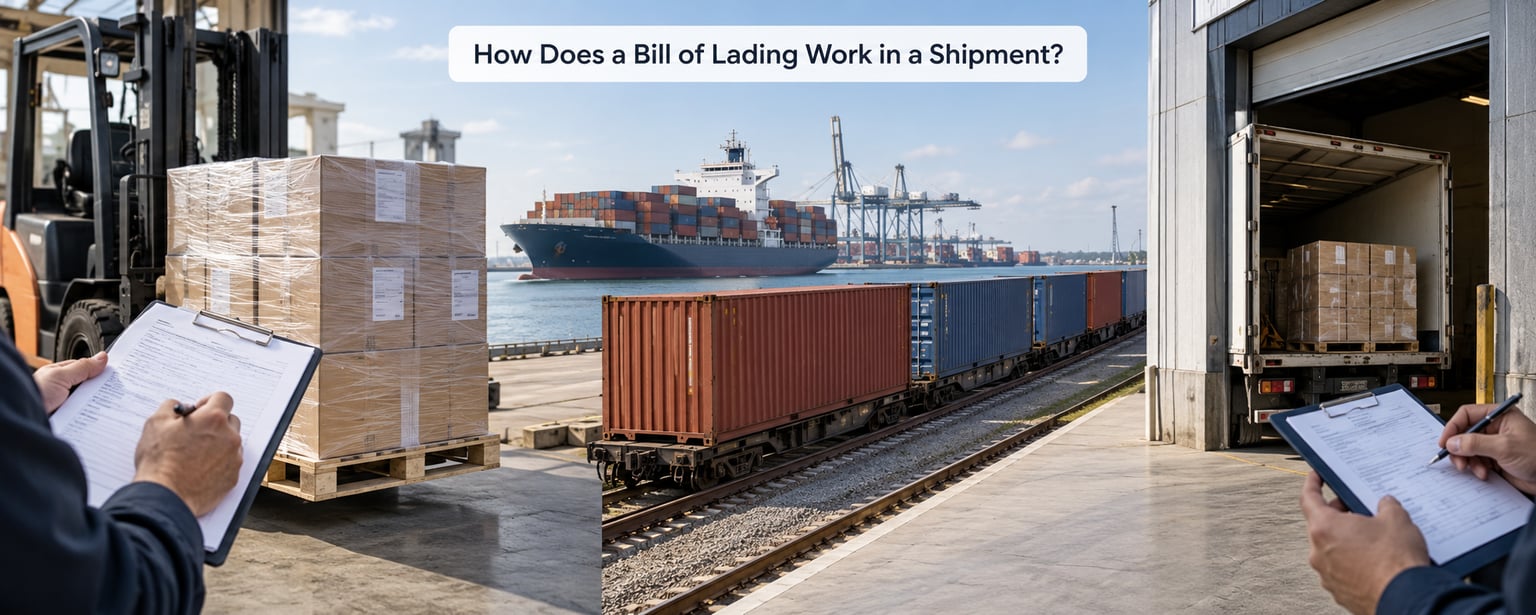
The document travels with the shipment, but it is created, issued, transferred, and closed in a fixed order. Operations teams that follow these steps usually catch problems while they are still cheap to fix. The staging and loading work that happens upstream is covered in material handling systems for resin explained, and the piece counts it produces are exactly what lands on the bill.
- Order and booking. The purchase order and shipping instructions go to the carrier or forwarder, who books space and returns a booking or draft for checking.
- Pickup and documentation. The driver or terminal records pieces, package count, weights, container and seal numbers, and any condition notes on the bill at the moment of loading.
- Carrier acceptance. The carrier or its agent signs and issues the bill. The signature and the stated number of originals matter — an unsigned draft is not a bill.
- In-transit amendments. A change of consignee, a corrected port, or a redated notation can be made in transit only where the rules and the carrier permit it. Assume changes are hard, not routine.
- Arrival and release. At the port of discharge, the carrier releases cargo against the original, an authorized telex or electronic release, or a sea waybill plus identity proof. Nothing moves without one of those three.
- Proof of delivery. The signed delivery receipt and any exception notes close the movement. Note visible damage on the spot, photograph it, and get it in writing before the truck pulls away.
- Closing the file. Match the final bill, the invoice, the packing list and the customs entry. Clear any exception note in writing and keep the set for your retention period.
Step seven is where most of the missed cost hides. A discrepancy found during file close is a bookkeeping problem; the same discrepancy found during a claim is a negotiation with a carrier.
Who fills out a bill of lading, step by step
The shipper, or the freight forwarder working on the shipper’s behalf, types the draft. That party supplies the parties, the routing, the cargo description, and the purchase order reference.
The carrier or its agent then verifies the draft, adjusts what does not match the booking, signs, and issues the original. A forwarder acting as carrier for its own account issues a house bill for the shipper while the ocean line issues a master bill covering the same container. Nobody else signs.
That last point is worth remembering during a dispute. If you accepted a house bill, the party you pursue is the forwarder, and the ocean line is a separate conversation.
What Are the Main Types of Bills of Lading?
Types are usually named by negotiability or by the journey leg they cover. The table below is a general description of how the terms are used in practice; the exact legal effect depends on the governing law and the carriage contract.
| Type | What it means | Negotiable | Where it fits |
|---|---|---|---|
| Straight bill | Named consignee takes the cargo; nobody can redirect it by endorsement. | No | Domestic moves, trusted trading partners, shipments with no payment risk |
| Order bill | Consigned to order, so control passes through endorsement. | Yes | Letter of credit shipments, prepayments, any sale where payment depends on the document |
| Sea waybill | Non-negotiable receipt used on intra-trade routes; no original to surrender. | No | Container moves between major trades where the parties know each other |
| Telex or electronic release | The original is surrendered at origin and the carrier is instructed in advance to release at destination. | No, once surrendered | Shorter hauls where courier delays would cost free time |
| Master bill | Issued by the ocean line for the whole consignment on the vessel. | Usually | The carrier’s own record of the container leg |
| House bill | Issued by the NVOCC or forwarder to the shipper for the same cargo. | Usually | Consolidated and groupage shipments; your contract and your claim sit here |
| Through bill | One issuer covers the combined rail, road, and sea legs. | Yes | Intermodal moves where you want one party responsible end to end |
| Shipped on board | Confirms cargo is actually on the vessel, with the on-board date. | Yes, if the order bill form is used | Letter of credit presentations that require evidence of loading |
| Received for shipment | Confirms the carrier took custody, with no onboard date. | Yes, if the order bill form is used | Cases where the bank accepts a receipt date instead of a loading date |
What is the difference between a straight bill and an order bill?
A straight bill names one consignee and releases only to that party. An order bill is consigned to the order of a named party — often a bank — and control passes when the document is endorsed. That single difference decides whether payment and cargo release are linked or independent.
Order bills are the norm for international sales paid by documentary collection or letter of credit. Straight bills are common on domestic moves where the seller and buyer already have a working relationship.
Master versus house bills on a consolidated move
One container of molded parts from a supplier in Asia to a distributor in Europe is really two documents. The ocean line issues a master bill from the Asian port to the European port. The NVOCC that sold you the space issues a house bill from its own origin to your delivery address, and that is the contract you actually have.
The practical effect: your house bill governs your claim, your release instructions, and your payment terms, even though the ocean line carried the container. If the forwarder’s paperwork is wrong, the ocean line will not fix it for you.
That routing logic sits downstream of a sourcing decision, and nearshoring vs offshoring tradeoffs explained covers how the choice changes who ends up holding the paper at destination.
Clean and claused bills
A clean bill carries no exception note about the condition of the cargo. A claused bill carries one — something like “packages crushed” or “contents short” written in the remarks box. Banks treat the two very differently, and a clause that the buyer considers minor can be enough to stop a documentary presentation.
How the Incoterm decides who issues the bill
Under the Incoterms 2020 rules published by the ICC, who arranges carriage decides who issues the bill. On an FOB sale the buyer books and pays the freight, so the buyer’s forwarder produces the bill naming the buyer’s forwarder as shipper. On a CFR or CIF sale the seller books the main carriage and produces the bill in the seller’s name.
That is why the same shipment can have a completely different bill depending on the term. Check the term against the party shown as shipper before anything else.
What Key Information Does a Bill of Lading Include?
Read a bill from the top down in four groups: the parties, the routing, the cargo, and the terms. Every field below tells you something you need to confirm against your own records.
Parties and agent
Shipper, consignee, notify party, and the carrier or issuing agent with its signature. Check that legal names match your master records exactly, including suffixes like Inc., Ltd, or GmbH, because a mismatch can hold a shipment at the terminal.
Routing and carrier details
Port of loading, port of discharge, place of receipt and place of delivery, carrier name, vessel name and voyage number, and forwarder reference. The forwarder reference is the number you quote when you call about the move.
Cargo description
A plain description of the goods, piece count, package type, gross weight, volume, container number, seal number, and hazard markings where relevant. A vague line like “general merchandise” creates problems at customs and on any claim.
References and instructions
Purchase order or contract number, internal release number, special instructions, and the negotiated terms: freight prepaid or collect, shipper’s load and count, declared value, number of originals issued, and the issue date.
The two fields people forget are the number of originals and the freight term. One tells you how many documents you must collect; the other tells you who owes the carriage charge.
Why the paper original is losing ground
Digital bills of lading are now issued on several major trade lanes and are recognized under English law changes that allow an electronic document to take the place of a paper one when the parties agree. The fields are the same, the transfer works by endorsement in the system rather than by ink and courier, and the document arrives the day it is issued.
Ask your forwarder which form the lane uses before assuming you need a couriered original. On a short haul, chasing paper that has already been replaced with a release instruction is a common cause of avoidable storage charges.
How Does a Bill of Lading Transfer Title or Control?
Control and ownership are different things, and mixing them up causes expensive confusion. A negotiable bill transfers control of the cargo when it is properly endorsed and delivered. Whether it transfers legal title to the goods themselves depends on the sale contract, the governing law, and how the original document was created.
Consider a resin order of 24 metric tons sold on credit terms. The buyer pays 30 days after shipment. Loading the container does not make the buyer the owner, and it does not give them anything to present at the terminal. The buyer’s protection is the contract plus the shipment record.
If instead the buyer pays before loading, the seller asks for an order bill consigned to order of the issuing bank. The bank holds the document, the buyer cannot collect the cargo, and payment controls release. That is the whole mechanism in one line.
Shipping a manufactured product on your own bill of lading therefore never transfers ownership of the goods. It transfers custody, and at most, a claim against the carrier.
What Is the Difference Between a Bill of Lading and Other Freight Documents?
Five documents sit in the same folder and get confused constantly. They have different purposes, different authors, and different users.
| Document | Purpose | Issued by | Issued when | Main user |
|---|---|---|---|---|
| Bill of lading | Receipt, carriage contract, and document of title | Carrier or its agent | At pickup or loading | Carrier, consignee, bank, customs |
| Commercial invoice | States the sale: goods, price, terms, parties | Seller | At or after shipment | Buyer, customs, accounts receivable |
| Packing list | Itemizes cartons, quantities, weights, dimensions | Seller | With the load | Warehouse, receiving, customs |
| Purchase order | Authorizes the sale and sets the terms | Buyer | Before shipment | Seller, procurement |
| Freight bill | Charges for carriage and accessorial services | Carrier or broker | After the move | Accounts payable, freight audit |
| Certificate of insurance | Confirms cover is in place for the transit | Insurer or agent | At origin | Bank, buyer, claims handler |
Only the bill of lading releases cargo. The invoice releases money. Keeping those two roles straight prevents the classic mismatch where the invoice was paid, the original was never collected, and the container sits at the port accruing charges.
What Should Manufacturers and Buyers Check Before Accepting It?
Ask for the draft before the carrier issues the final bill. That single step is the most useful review in the whole process, and it takes a few minutes rather than weeks of fixing.
- Parties. Shipper, consignee, and notify party names match your master data character for character.
- Cargo description. The description reflects what is physically in the container, not a general category.
- Quantities and weight. Piece count and gross weight agree with the packing list and with what was weighed.
- References. Purchase order and internal release numbers appear where your team expects them.
- Routing. Load and discharge points, vessel and voyage, container and seal numbers are plausible for the booked move.
- Terms. Freight prepaid or collect matches the sale terms, and the number of originals is what you can actually collect.
- Clean status. No exception clause on the face of the bill unless you know exactly what it says.
- Signature. Signed and dated by the carrier or its named agent, with the agent’s capacity stated.
- Cross-document consistency. Invoice, packing list, and bill agree on quantities, weights, and description.
- Authenticity. For international moves, confirm the bill number directly with the carrier or line using a number you already hold. Do not use a phone number or a bank detail from the document you are trying to verify.
Buyers should run the same list against the copy they receive, since the buyer’s copy is what customs and their bank will read.
Teams that bought a part instead of making it inherit the shipping habits of whoever they chose. Make or buy decision analysis explained covers that handover, and a bill of lading is usually where a sloppy handoff surfaces first.
How to check a bill for authenticity in five minutes
Scans of fraudulent bills circulate by email, and the standard trick is to send an invoice demanding a payment to a new account. The document looks plausible; the bank details are the trap.
Confirm the bill number by calling the carrier or the forwarder on a number you already had before the shipment arrived. Check that the vessel and voyage number match a real sailing for that service. If anyone asks you to change payee details citing the bill of lading, stop there — a bill of lading never carries payment instructions.
Practitioners working in freight forwarding forums treat the carrier verification call as routine rather than paranoid, which is exactly the right level of attention for it.
What Are the Most Common Bill of Lading Errors?
These repeat far more often than new ones do. Each one has a straightforward fix at the draft stage.
| Error | Why it causes problems | Fix |
|---|---|---|
| Wrong or abbreviated consignee name | The terminal will not release to a party that does not match their records. | Copy the legal name from master data and confirm it before the final issue. |
| Vague cargo description | Customs queries, classification delays, and weak claim evidence. | Describe the goods plainly, with the material and the article type. |
| Quantity mismatch with the invoice | Bank refusal under a letter of credit, or a payment hold on the buyer’s side. | Reconcile the bill against the invoice and packing list before submitting. |
| Missing or unauthorized signature | The document has no evidentiary value and no one will act on it. | Request a signed copy from the carrier or its agent. |
| Inconsistent weights | Freight invoices get disputed, and accessorial charges follow the wrong tier. | Weigh once, at the loading point, and use that figure on all documents. |
| Improper endorsement | Title does not pass, so the party holding the document cannot collect the cargo. | Check the endorsement chain line by line before dispatch. |
| Unreported damage or shortage | The carrier can resist the claim, and the record no longer matches reality. | Record it on the delivery receipt, photograph it, and notify the carrier the same day. |
| Wrong place of delivery or late on-board date | Bank rejection on a documentary presentation. | Check the dates against the vessel schedule and your credit terms. |
How Does a Bill of Lading Help With Freight Claims and Disputes?
The bill is the spine of the evidence. It names the parties, dates the custody transfer, describes the cargo, and records the terms the carrier agreed to. A claim file without it is an argument; a claim file with it is a comparison.
Three things carry the most weight. The on-board or pickup date establishes the timeline for filing. The exception record shows what was wrong at handoff. The delivery signature shows who accepted the cargo and in what condition.
That is why a note made at the door is worth more than a note made next week. Record visible damage or shortage on the delivery receipt before signing, take photographs, and send the carrier a written notice the same day. A clean signature on a receipt with a short shipment quietly weakens your position.
For disputes between buyer and seller, the bill is usually the neutral reference both sides accept, because neither party wrote it. Comparing the bill with the invoice and the purchase order settles most quantity and description arguments without anyone having to take anyone’s word for it.
One cost note deserves mention. Where a bill is issued but the document, or its release instruction, arrives after the cargo, the delay shows up as storage and demurrage at destination. Free time after arrival is set by each carrier and is often short, so a courier that misses a sailing can turn a routine move into a week of charges.
Two separate charges sit under that heading. Demurrage applies when the container sits at the terminal or port beyond free time. Detention applies when it has been released to the consignee but not returned. They are billed by different parties and are easy to confuse on a single invoice.
When a plant team checks an invoice after delivery, the record that causes the argument is usually the carrier’s weight-out or scale ticket. Disagreements there tend to come down to the weight tier used for billing rather than any real difference in the goods.
Frequently Asked Questions
Is a bill of lading a title document?
A negotiable bill of lading is treated as a document of title to the cargo, which is why the party holding it can obtain the goods. A straight bill, a sea waybill, and a telex release are not documents of title. Note that control of the document and legal ownership of the goods are separate questions, and ownership follows the sale contract and the governing law rather than the bill itself.
Who fills out a bill of lading?
The shipper or freight forwarder provides the cargo details, routing, and parties. The carrier or its agent then verifies, signs, and issues the bill. In a consolidated move the forwarder or NVOCC issues a house bill for the shipper while the ocean line issues a master bill for the same cargo. Your team reviews the draft before issue rather than after.
Why are three originals of a bill of lading issued?
Negotiable bills are traditionally issued in sets of three originals because the shipper, the intermediary bank, and the consignee each may need one. Endorsing one original passes title; the remaining originals are cancelled so they cannot be used a second time. This is a customs and banking convention rather than a physical requirement, which is why modern practice often uses a telex release or an electronic equivalent instead.
What is the difference between an original bill of lading and a sea waybill?
An original bill of lading is a negotiable document that must be presented to obtain the cargo, which is why it suits sales where payment depends on the document. A sea waybill is non-negotiable and is released against identity proof only. Sea waybills are faster and cheaper because no paper is couriered, but the buyer has no document control over the shipment.
Why was my bill of lading rejected under a letter of credit?
The usual causes are data that does not match the credit: a different consignee wording, a description that does not correspond to the invoice, a missing on-board notation, an unsigned document, or an endorsement to a party the credit does not name. The governing rules, such as UCP 600, require the documents to correspond with one another. Review the draft set against the credit before the originals are couriered.
How long should a bill of lading be retained?
Retention periods depend on your jurisdiction, tax rules, and contractual obligations, and they differ from one country to another. As a working practice, keep the full set for the period your finance and legal teams require, which is often several years for cross-border trade. Store the document with the invoice, packing list, and customs entry so a claim or audit can be answered without a search.
Conclusion
Start with three actions. Match the bill of lading against the purchase order and packing records, item by item. Verify the parties and the cargo description against master data before the bill is issued. Resolve any exception note in writing before you close the shipment file.
Everything else follows from those three. A bill of lading explained this way is a record of custody and a set of agreed terms, and handled at the draft stage it becomes a routine record instead of the thing that stops a container at a port.