
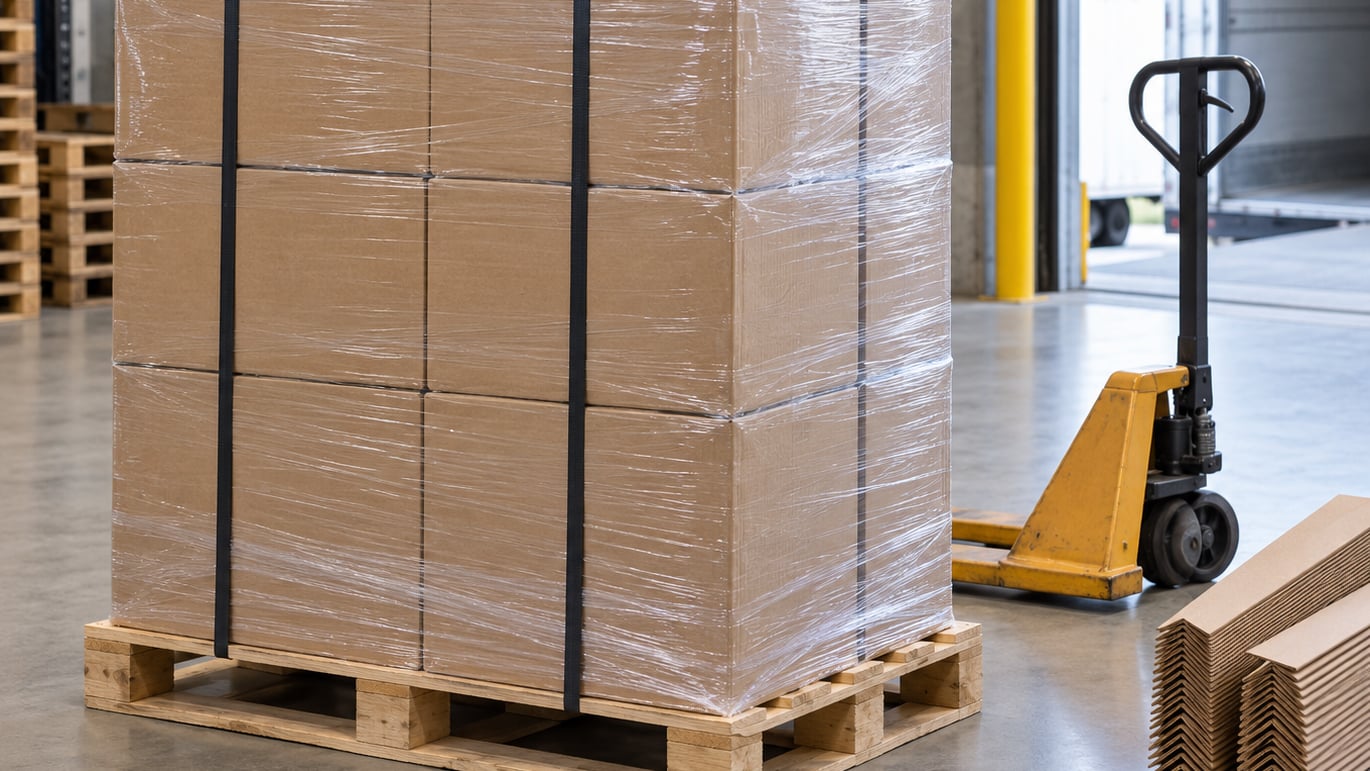
To ship a pallet you need a sound pallet, a load stacked so nothing overhangs or leans, a securing method that keeps everything one unit, and freight paperwork that matches what the driver actually weighs. Most shipping problems trace back to one of those four things being rushed.
Budget two or three hours for a single domestic pallet if you have a pallet jack, tape gun and wrapping film in the building. The first shipment is always the slow one because you are measuring, weighing and re-measuring. After that it becomes routine.
Table of Contents
- What You Need
- How to Ship a Pallet: Step-by-Step
- Step 1: Confirm the Pallet and Load Requirements
- Step 2: Build a Stable, Even Pallet Load
- Step 3: Protect and Secure the Products
- Step 4: Inspect the Pallet Before Shipping
- Step 5: Choose the Right Freight Service
- Step 6: Classify, Quote, and Book the Shipment
- Step 7: Prepare the Carrier Handoff
- Step 8: Track Delivery and Resolve Exceptions
- Common Mistakes
- Frequently Asked Questions
- How do I properly pack a pallet for shipping?
- Can a pallet be shipped through FedEx or UPS as a parcel?
- How do I ship a pallet without a forklift or loading dock?
- What is LTL shipping and when should I use it?
- Do I need an ISPM-15 stamped pallet for international shipping?
- How do I file a damage claim when a pallet arrives broken?
- Conclusion
What You Need
Gather this before you touch a single carton. Half of the delays we see come from discovering at pickup that a document or a piece of equipment was missing.
Shipment information
- Origin and destination ZIP codes, including whether the receiving end has a dock
- Piece count, total weight, and the dimensions of the finished load
- Declared value and what the goods are made of
- Delivery window, appointment rules, and any liftgate requirement
Documents
- A bill of lading (BOL), which most domestic LTL carriers still require for shipper reference and claims
- A commercial invoice and packing list for any international movement
- Any purchase order or consignment paperwork the consignee expects on arrival
- Your account number with the carrier, or broker, you will book through
Equipment and packaging
- A pallet that matches the goods and the handling method
- A pallet jack, hand truck, or forklift with a deck wide enough for the load
- Stretch film at least 70 gauge, corner boards, edge protectors, and banding straps with a tensioner
- A pallet scale or certified scale location, plus a tape measure
- Slip sheets for slippery or unstable product stacks
- Desiccant and a moisture barrier for long transit or weather-exposed routes
Safety supplies
Cut-resistant gloves, steel-toe footwear, and a back-safe way to move heavy cases. A wrapped pallet with a bad load can shift sideways when a fork goes under it, and that is how most warehouse injuries happen.
How to Ship a Pallet: Step-by-Step
Step 1: Confirm the Pallet and Load Requirements
Start by deciding whether this is domestic or international, one pallet or several, and whether a full truck will be needed. International moves trigger wood packaging rules that domestic moves ignore entirely.
Then check the receiving facility. Some warehouses cannot take a 48 by 40 inch pallet at all because their equipment is sized for Euro pallets, and some are more than a lift truck away from the dock door. Ask before you build the load, because repalletizing on arrival costs money and time you will not get back.
Confirm the carrier’s limits too. Weight caps, maximum length, and prohibited or restricted items differ between carriers and between service levels. A load that is fine on one lane gets refused on another.
Step 2: Build a Stable, Even Pallet Load
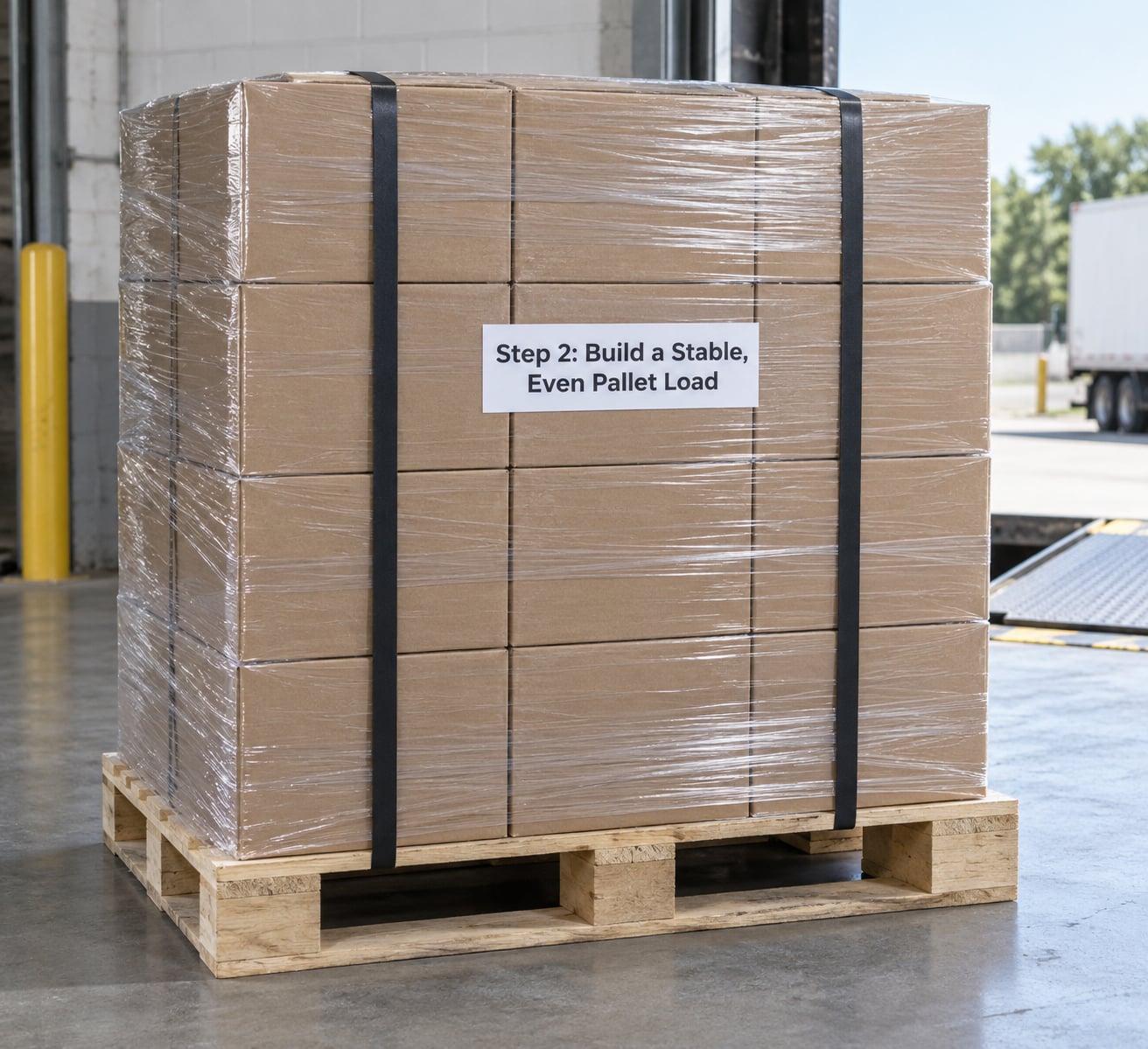
Pick a pallet that fits the footprint of your product with almost no overhang on any side. In the US the 48 by 40 inch GMA pallet is the default choice, and choosing it means your load fits more handling equipment than anything else you could pick. If you are unsure how a pattern handles your product, how to choose a pallet pattern for shipping walks through stringer, block and four-way entry options.
Check the pallet itself before you load it. Look for stringers or blocks that are soft, split, or missing, and for deck boards with nail heads sticking up or old banding wire left behind. A damaged pallet is the single most common reason a driver refuses a pickup.
Build from the bottom up with the heaviest, densest cases on the base layer. Interlock each layer against the one below it rather than stacking every case in a straight column, and never exceed the pallet’s rated capacity. Keep the load within the footprint, keep the weight centered, and let the weight sit flat on the deck boards.
Step 3: Protect and Secure the Products
Anchor the film to the pallet deck, not to the product, and wrap the load and pallet as one unit. Several shippers treat five full passes of 70 gauge film on the base layer plus two on the top as the floor for a normal stack, and heavier loads need more.
Wrap the base layer tightly, overlap each pass by at least half the film width, and keep tension high enough to pull the boxes together without crushing them. If you are weighing film against heat-shrink tunnels, the comparison in stretch wrap vs shrink wrap for pallet loads is worth a few minutes before you buy film in bulk.
Add corner boards on every vertical edge of a tall load and edge protectors along the top and bottom rims. Above roughly 1,500 pounds, most shippers add banding straps over the top with a tensioner, because film alone stretches and the load then settles in transit.
Protect against the environment as well as movement. For long routes or winter conditions, add a moisture barrier over the top of the load and desiccant inside the cartons. On long ocean moves, wrap with UV-resistant film or the load will be brittle when it unloads.
Step 4: Inspect the Pallet Before Shipping
Walk around the finished load before it leaves the building. Push the top of the stack with both hands: if the load shifts, rocks, or feels soft in the middle, the film is not tight enough or the stack is unbalanced.
Then run a checklist:
- Pallet sound, clean, and free of splinters, protruding nails, and old banding wire
- No overhang on any side and no leaning cases
- Film continuous from the deck to the top with no tears or loose tails
- Labels present on at least two sides and on every individual package
- Weight measured after wrapping, not estimated from case counts
- Handling instructions visible, such as this side up or protect from moisture
Photograph the wrapped load before it leaves. That image set is your evidence if the freight arrives damaged, and carriers rarely pay a claim without it.
Step 5: Choose the Right Freight Service
Choose LTL when your load is too heavy or too large for parcel but will not fill a truck. That covers most single-pallet shipments, and the carrier takes the freight to a terminal where it is combined with other shipments, which is why the class and the packaging quality decide the price.
Use parcel only when every box clears the carrier’s size and weight limits on its own. Palletized freight often will not qualify as parcel at all, so measure the boxes before assuming you can drop them off like normal packages.
Go expedited when a line stop or a production schedule cannot absorb a delay, and go dedicated or FTL when the load fills a full truck or the goods are too fragile to survive a terminal. Air freight makes sense for small, expensive, urgent pallets with long shelf lives.
Step 6: Classify, Quote, and Book the Shipment
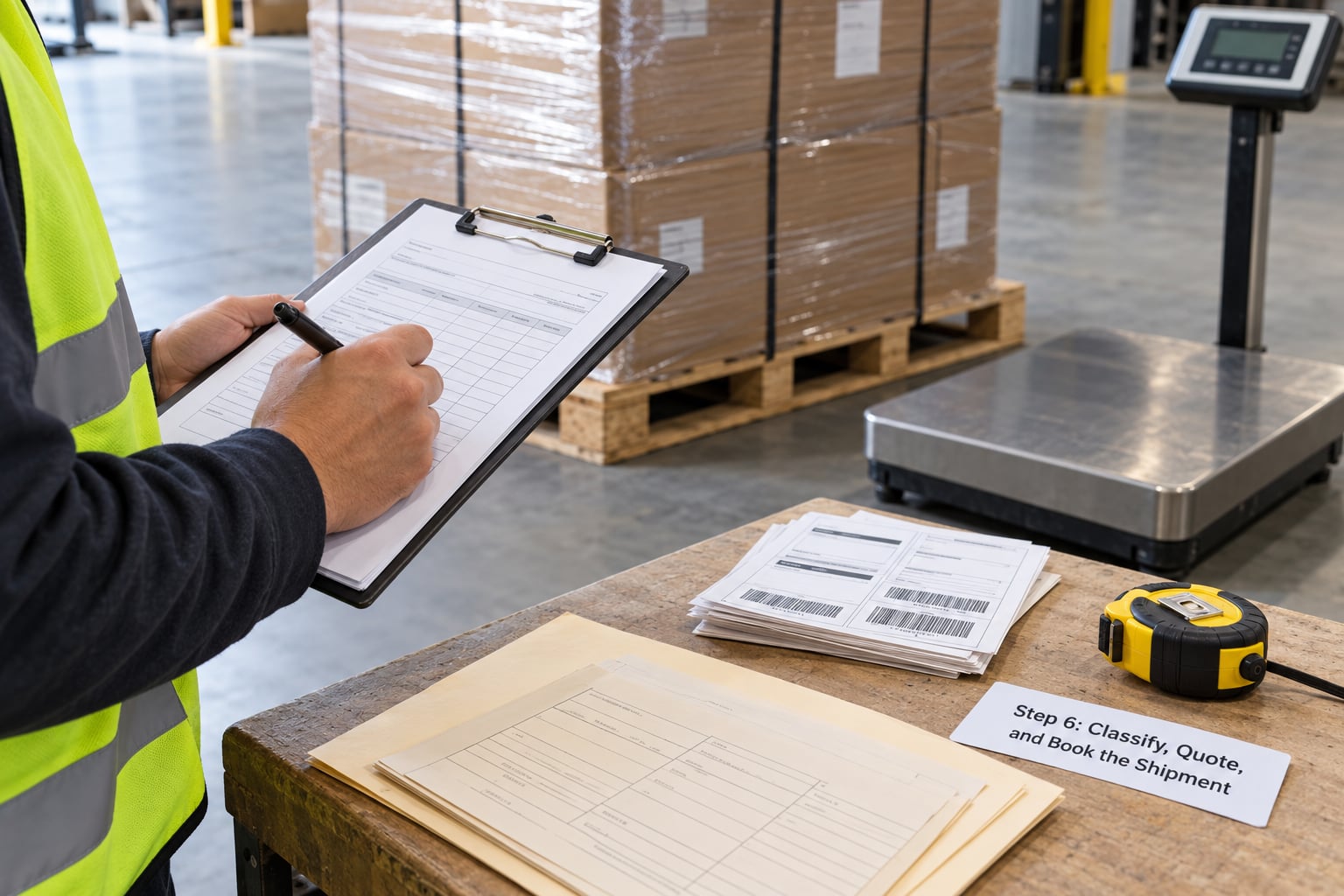
Freight class comes from the commodity, its packaging density, and how it is handled, and it is set by NMFC item numbers. Dense, heavy, hazardous or fragile goods fall into lower rated classes than light ones. If the class on the quote does not match your product, expect a reclassification charge on the invoice.
Give the carrier exact dimensions after wrapping, an accurate weight, the correct piece and pallet count, and the class. Ask what accessorial charges apply: liftgate service, inside pickup, residential delivery, and appointment fees can each appear separately, and it is easier to plan for them up front than to argue about them later.
Compare quotes on the same lane with the same service level and the same list of charges included. Booking platforms and brokers can be quicker than calling a carrier directly, and direct contracts usually carry a lower base rate, so it pays to check both once.
Step 7: Prepare the Carrier Handoff
Give the driver what the receiving location needs to move your freight without calling you. That means a BOL with the shipper, consignee, origin, destination, piece count, weight, class, and any declared hazardous materials, plus a pro forma invoice if the consignee bills by reference.
Label the pallet on two sides so it can be read from either direction in the trailer, and duplicate the labels on the individual cartons. Put one label under the wrap where it will not be scuffed, and one outside the wrap where it is always visible. If your BOL is on the pallet, slip it into a clear sleeve so it does not tear in weather.
Tell the receiver what equipment the delivery needs. If there is no loading dock, the pickup and the delivery both need liftgate service or inside pickup, and someone has to be there with a pallet jack on the other end. Confirm the receiving hours in writing, because a missed appointment window turns a smooth handoff into a redelivery charge.
Step 8: Track Delivery and Resolve Exceptions
Tracking on LTL is less precise than parcel because of the terminal transfers, but it still tells you where your freight is and whether the appointment is confirmed. Watch the last leg rather than the whole route, since that is where exceptions appear.
If something goes wrong, act the same day. For damage, photograph the freight before it is moved, keep all packaging, and note any visible damage on the delivery receipt before signing it. A clean receipt without notation usually ends the conversation early.
For a reweigh or reclassification charge, pull your scale tickets and your BOL and compare them against what the carrier billed. A reweight happens when the stated weight and the scale disagree, so shipping with a verified weight is the cheapest defense there is. If the numbers do not line up, send the documentation to the carrier’s billing team or your broker and ask for the scale ticket from the terminal.
Common Mistakes
Almost every avoidable freight cost traces to a short list of mistakes.
- Estimated weight. Weigh the wrapped load on a scale. Estimated weight leads to a reweigh, and the reweigh fee is charged on top of the higher of the two weights.
- Weak or damaged pallets. Inspect the deck and stringers every time. Carriers refuse bad pallets at pickup, and the delay costs more than the pallet.
- Too little stretch wrap. Add passes on the base layer and top out the load. Film that is stretched thin tears on the first stop and the boxes shift from there.
- Overhang. Even a small overhang weakens the load, and some carriers will not accept it. Resize the pallet rather than letting the product hang over the edge.
- One-sided labels. A label that faces the wall is a label nobody sees. Duplicate it on two sides and on every carton.
- Late booking. Same-day or next-day requests limit your carrier choices and often add a spot market premium. Book several days ahead.
- Undocumented damage. No photos before the freight is moved and no notation on the receipt usually means no claim.
Frequently Asked Questions
How do I properly pack a pallet for shipping?
Build the heaviest layer on the pallet deck, interlock each layer against the one below it, and keep every case inside the pallet footprint so nothing overhangs. Wrap the load and the pallet as one unit with five or more passes of 70 gauge film on the base layer and two on top. Add corner boards on the vertical edges and banding straps above roughly 1,500 pounds. Label two sides and photograph the finished load.
Can a pallet be shipped through FedEx or UPS as a parcel?
Usually not. Parcel services have strict size and weight limits per box, and freight on a pallet generally moves through their LTL or freight divisions instead. FedEx Freight, UPS Freight and similar regional carriers take full pallets as standard freight. A small quantity of heavy cartons under parcel limits can ship as parcel, but measure each box first because a pallet is not eligible simply because it is smaller than a truck.
How do I ship a pallet without a forklift or loading dock?
Request liftgate service at pickup and at delivery, and have someone available with a pallet jack at both ends. Book the liftgate as an accessorial on the quote rather than hoping the driver carries one, and confirm receiving hours. A pallet jack or hand truck handles the dock-to-truck gap on a level surface, but anything with steps or a raised dock needs a liftgate and a clear path.
What is LTL shipping and when should I use it?
LTL means less-than-truckload: your freight shares a trailer with shipments from other shippers and pays for the space it uses. It is the standard choice for a single pallet or a few pallets moving too far for parcel but not enough to fill a truck. Rates come from the freight class, which reflects the commodity, its density and how it must be handled, plus distance and any accessorial charges.
Do I need an ISPM-15 stamped pallet for international shipping?
For international shipments, yes, in most cases. ISPM-15 is a phytosanitary standard for wood packaging, and a heat-treated pallet must carry an HT stamp with the IPPC mark to be accepted on export and import. Domestic LTL moves within the US generally do not require the stamp. Unmarked wood packaging is one of the most common reasons an export shipment gets held at customs.
How do I file a damage claim when a pallet arrives broken?
Photograph the freight and the packaging before anything is moved or thrown away, keep all wrap, boards and straps, and write any visible damage on the delivery receipt before signing it. File the claim with the carrier or broker promptly, usually within a few days, and attach your pre-shipment photos plus the BOL. Without that documentation carriers routinely deny claims, and the freight company liability release on the receipt is worth reading closely.
Conclusion
Four things decide whether a pallet shipment goes smoothly. Verify the pallet, weight and receiving requirements before you build anything. Stack it flat with no overhang and secure it with film, boards and banding. Weigh and measure the wrapped load so the paperwork matches reality, then get carrier confirmation on the class, accessorials and delivery appointment before the truck arrives.