

If you have ever sent the wrong procurement document to a supplier, you already know the cost: a month of silence, a room full of answers you cannot compare, and a supplier relationship that never recovers. Choosing between an RFI, an RFP and an RFQ comes down to one question — how much do you already know about what you are buying? An RFI asks what suppliers can do, an RFP asks how they would solve a defined problem, and an RFQ asks what they will charge for a specified item. Get that match right and the sourcing cycle shortens.
That is the whole of the rfq vs rfp vs rfi differences in one line, and the rest of this guide is the detail: what each document contains, how much work it creates for the supplier, what you can legally do with the response, and how the three usually appear in sequence.
The labels are conventions rather than fixed legal categories. Practitioners on r/procurement make the point repeatedly — the acronym matters far less than the substance of what you are asking for, and two companies can call the same document different things without anyone being wrong. What follows is the working definition most buyers actually operate against.
Table of Contents
- RFQ vs RFP vs RFI Differences at a Glance
- What Is an RFI and What Does It Ask for?
- What Is an RFP and What Does It Ask For?
- What Is an RFQ and What Does It Ask For?
- RFI vs RFP vs RFQ: How Much Detail Should You Provide?
- RFI vs RFP vs RFQ: What Kind of Supplier Response Do You Want?
- RFI vs RFP vs RFQ: Which One Keeps Pricing Comparable?
- RFI vs RFP vs RFQ: When Should You Use Each Request?
- How to Choose the Right Request for a Manufacturing Purchase
- Which Should You Choose?
- Frequently Asked Questions
- Conclusion
RFQ vs RFP vs RFI Differences at a Glance
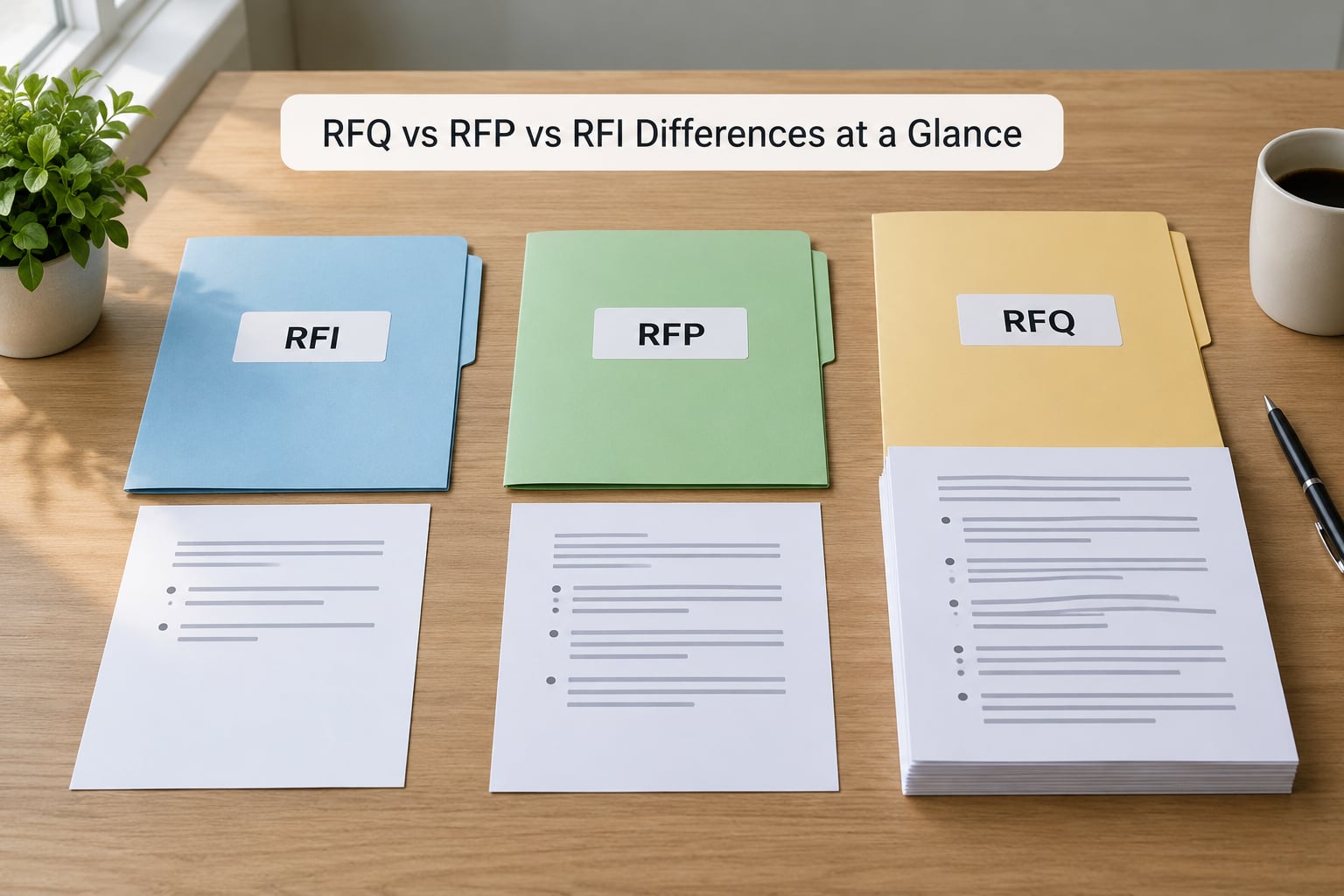
The rfq vs rfp vs rfi differences come down to certainty. An RFI is issued when the need is still fuzzy and you need market and capability information. An RFP is issued when the need is clear but the solution is not — you want approaches, qualifications and a plan. An RFQ is issued when the specification is fixed and only the numbers are missing, so you want comparable pricing and delivery terms against a known scope.
| Attribute | RFI | RFP | RFQ |
|---|---|---|---|
| Full term | Request for Information | Request for Proposal | Request for Quotation |
| Core purpose | Gather market, capability and supplier information | Get a tailored solution to a defined need | Get comparable prices for a defined item or service |
| Stage in the sourcing cycle | Early, exploratory | Mid to late, after shortlisting | Any time the specification is fixed |
| Level of detail you supply | Light — themes and questions | Heavy — scope, requirements, deliverables | Heavy and precise — drawings, grades, tolerances, quantities |
| What the supplier returns | Written answers to questions | A proposal: approach, team, timeline, sometimes price | An itemised quote with price, lead time and terms |
| Pricing in the response | Rarely, and usually excluded | Sometimes, for costed proposals only | Always — that is the point of the document |
| Legally binding | No | Normally no, unless marked binding | The quote is an offer; a signed purchase order is what binds |
| How you evaluate | Coverage and credibility of answers | Scored matrix on weighted criteria | Normalised price, lead time, terms, total cost |
| Typical buyer effort | Low | High — authoring, evaluating, moderating clarifications | Medium — heavy on data cleanup |
| Best fit | Unknown supplier pool, unknown capability | Complex, solution-based or capital purchase | Repeat production parts, materials, packaging, standard services |
One caveat before the definitions. TechTarget’s analyst note is worth repeating: most organisations only need one or two of these three documents for any given purchase. Running all three on every buy is how supplier goodwill disappears and how internal teams end up evaluating four hundred pages nobody had time to read.
What Is an RFI and What Does It Ask for?
A Request for Information is a structured question set sent to a supplier or a market to find out what they can do, what they have done, and whether they are worth a further conversation. It deliberately does not ask for a proposal or a price. The supplier answers in prose or a simple template, and you use those answers to build a picture of the available options.
Typical RFI content covers a handful of areas: manufacturing process and plant description, material and resin sourcing, quality certifications, tooling capability, capacity and lead-time ranges, past programme experience, and general commercial terms such as payment expectations. Where the certification question is the real filter, our guide to IATF 16949 vs ISO 9001 differences is worth reading before you write the question, so you ask for the right standard rather than a generic quality system.
A manufacturing example: a plant has a recurring cosmetic defect in an injection-molded housing and wants to know whether regional suppliers run in-process measurement. Rather than invite quotes for the part, the buyer sends an RFI asking which suppliers run CMM or vision inspection, at what tolerance, and on what sample size. Six responses come back. Two are ruled out immediately, and the remaining four go into an RFQ with proper drawings.
If the defect itself points at a process mismatch rather than a faulty part, stop earlier still and settle the process question first — the differences between extrusion and injection molding will tell you whether you are even asking the right suppliers.
What an RFI does not include matters as much as what it does. No scope of work, no deliverables, no pricing, no contractual terms, and no commitment on either side. That non-commitment is exactly why an RFI is usually the first document in the sequence — and also why it is frequently wasted.
Why RFIs get ignored, and when the RFI is just a screening step
Vendors report low RFI response rates when there is no clear signal that a real project follows. An RFI is only worth a careful answer when the buyer is genuine about the next step, and the way to signal that is to name the programme, the rough volume and the intended timeline.
If your RFI is just a screening step for suppliers you already know you want, ask yourself whether you need a document at all. A targeted questionnaire to four known suppliers, with a short deadline, gets the same information in a fraction of the effort — and that fact is where most lean manufacturing operations land.
The construction RFI is a different document entirely
In construction, an RFI usually means something else entirely: a formal question from the contractor to the design team asking for a clarification on drawings, specifications or site conditions, with a formal response that becomes part of the contract record. Field teams treat these as high-stakes documents because they can shift scope and cost.
Procurement teams treat the same acronym as a market research tool. The collision causes real disputes, particularly where a subcontractor is also a bidder. If you work in both worlds, state which meaning you mean in the document title itself.
What Is an RFP and What Does It Ask For?
A Request for Proposal asks shortlisted suppliers to describe how they would deliver a defined outcome. The need is understood, the scope is written, and you want to see each supplier’s approach before you commit — the technical method, the project team, the schedule, the risks they flag, and often a costed view of at least part of the work.
An RFP response normally contains an executive summary, a technical approach, qualifications and references, a delivery plan with milestones, assumptions and exclusions, and a price schedule if the buyer asked for one. The point of an RFP is not price. The point is to compare approaches against criteria you set in advance, which is why a well-run RFP always ships with a scoring matrix.
That matrix usually splits requirements into mandatory and desirable. Mandatory items are pass or fail — the supplier either can run that process, hold that certification, or meet that regulatory requirement. Desirable items are scored on a scale, and the weights add up to 100. Publishing those weights before responses arrive is what makes the award defensible.
Asking for more than you need is the classic RFP failure. A buyer who demands a compliance matrix, a full quality manual, a sample part, a named project team and a costed schedule from every invited supplier gets a slower response, more speculative content, and a shortlist that mostly reflects who had bandwidth rather than who is best.
Most RFPs are non-binding, and it is worth saying that plainly on the first page. If you need a binding commitment, that belongs in a contract, not in a document you send to eight companies at once.
What Is an RFQ and What Does It Ask For?
A Request for Quotation asks suppliers to price a specific, already-defined thing: a part, a material, a volume of packaging, a service with a defined frequency. The buyer already knows what they want, and the open question is what it costs and when it can be delivered.
Comparable quotes depend almost entirely on what you send. For a molded component that means the drawing or model file, the resin and grade, the annual and per-release quantity, acceptable tolerances and cosmetic standard, color and texture requirements, packaging format, the shipping destination and delivery terms, and any Incoterms that apply.
For a packaging program the equivalent list is substrate and caliper, print process, number of colors, coating or laminate, structural design, die lines, finished dimensions, units per case, and the annual run split across sizes. For raw resin it is the polymer, grade, melt flow index, color and additive package, and the delivery schedule in metric tons per month.
The quality of an RFQ is measurable in the replies. If two suppliers quoted the same specification but one priced the tooling and the other did not, the RFQ was incomplete, not the suppliers.
RFI vs RFP vs RFQ: How Much Detail Should You Provide?
Provide detail in proportion to how settled your requirements are. An RFI needs enough structure to make answers consistent — the same questions to everyone, in the same order. An RFQ and an RFP need the opposite: exhaustive specification, because ambiguity at that stage converts directly into non-comparable responses.
Too little detail in an RFQ is the expensive mistake. Suppliers fill your gaps with assumptions, and every assumption lands in a different line of the quote. Tooling appears in one price and not another. Freight is excluded by the overseas supplier and included domestically. Tolerance interpretation shifts the piece price by more than the entire quoted margin.
Too much detail in an RFI is the annoying one. A supplier asked to answer forty specific questions about a programme you have not scoped will answer the easy ones and leave the rest. You spend three weeks chasing clarifications to learn what a two-page capability summary would have told you.
The practical rule follows the maturity of the need. Discovery needs questions. Pricing and proposals need specifications. When you find yourself writing an RFP to find out whether a supplier can do the work, you have the sequence backwards — the qualification belongs in the RFI stage.
How much detail should you provide before an RFQ?
Enough that two suppliers reading the same document would build the same thing. That is the only test that matters. If your drawings still carry a “TBD” on a critical dimension, you are not ready to quote — go back to engineering first.
Cost of authoring follows the same gradient, and it is worth planning for because the internal hours are rarely counted. An RFI typically takes a buyer a day or two to assemble. A full RFP with a scoring matrix, a compliance matrix and an evaluation plan is measured in weeks of internal effort before it ever leaves the building, and practitioners have reported spending roughly 60 hours on the writing alone for a single mid-sized project. The actual evaluation then takes as long again.
An RFQ sits in between: cheap to write, expensive to clean up. If the specification is complete, two suppliers quote in a day and comparison takes an afternoon. If it is not, you spend a week emailing clarifications and normalising line items that were never meant to match.
| Measure | RFI | RFP | RFQ |
|---|---|---|---|
| Typical shortlist size | 8 to 15 suppliers | 3 to 5 suppliers | 3 to 6 suppliers |
| Supplier effort per response | A few hours | Days to weeks | Hours to a few days |
| Response window | 1 to 2 weeks | 3 to 6 weeks | 1 to 3 weeks |
| Time from issue to award | 2 to 4 weeks | 6 to 12 weeks | 3 to 6 weeks |
| Internal effort to evaluate | Low | High, scoring and moderation | Medium, data normalisation |
| Main failure mode | Too few genuine responses | Vague, non-comparable proposals | Quotes that do not match |
These are planning ranges rather than promises, but the shape is consistent across sectors: the more supplier effort you request, the more your own team owes in return. If nobody is assigned to evaluate, do not issue.
RFI vs RFP vs RFQ: What Kind of Supplier Response Do You Want?
Decide the output before you choose the document, because the output drives everything downstream. An RFI produces capability answers in the supplier’s own words. An RFP produces a tailored solution you score against criteria. An RFQ produces a number in a structure you specified, which is the only format of the three that reliably allows apples-to-apples comparison.
RFI answers tell you who is credible. They are useful, cheap and hard to score objectively, which is why RFIs tend to produce a gut feel and an informal shortlist. That is fine when you only need a sense of the market, and dangerous when you are building an audit trail for a regulated purchase.
RFP proposals tell you how the work gets done. The response is longer, takes suppliers days rather than hours, and gives you material to negotiate with — because assumptions, exclusions and a proposed timeline are all things you can push back on. The risk is anchoring on the most polished writer rather than the most capable supplier.
RFQ quotes tell you what it costs. Because you control the template, you can normalise everything: unit price, tooling, setup, freight, duty, payment terms, lead time, volume breaks, validity period. That control is the whole advantage, and it disappears the moment you let five suppliers answer five different questions.
Confidentiality also varies. An RFI reveals very little. An RFP can expose your full requirements and sometimes your budget. An RFQ exposes the precise specification and, usually, your target volume and delivery location — so treat it as confidential and mark it as such if the details matter.
RFI vs RFP vs RFQ: Which One Keeps Pricing Comparable?
An RFQ keeps pricing comparable because it is the only one of the three built around a fixed specification. Same scope, same template, same response deadline, so differences in the numbers reflect real differences in supplier cost rather than differences in what each supplier assumed.
Price alone still misleads. Two quotes that differ by 15 percent can describe entirely different products once you normalise them. Check that every quote states the same lead-time assumption, includes or excludes tooling and setup explicitly, covers freight and duty to a named destination, applies the same payment terms, and breaks out volume breaks at the quantities you actually buy.
Then add the items that never appear in the headline number: quality documentation costs, first article inspection, packaging engineering, and the internal hours your own team will spend managing the supplier. The lowest quote is frequently not the lowest total cost.
Ask every supplier to fill in the same spreadsheet. It sounds obvious, and it is the single change that most improves quote comparison in a first sourcing round — because the work shifts from reading prose to reading cells, and the errors surface immediately.
Where RFT, RFO and tender fit
RFT, request for tender, is used mostly in government, public sector and construction contexts, where a tender is a formal, often sealed, competitive process with published rules. RFO, request for offer, is a softer variant of an RFP that invites offers without a full proposal structure.
The practical advice from contracting professionals is not to argue the label but to state the rules in the document: response deadline, whether the response is binding, how long you will hold the offer open, and what happens next. WIFCON discussions on the topic keep circling the same point — under federal-style contracting rules, a mislabelled document can create protest risk, so the substance and the stated terms have to agree.
RFI vs RFP vs RFQ: When Should You Use Each Request?
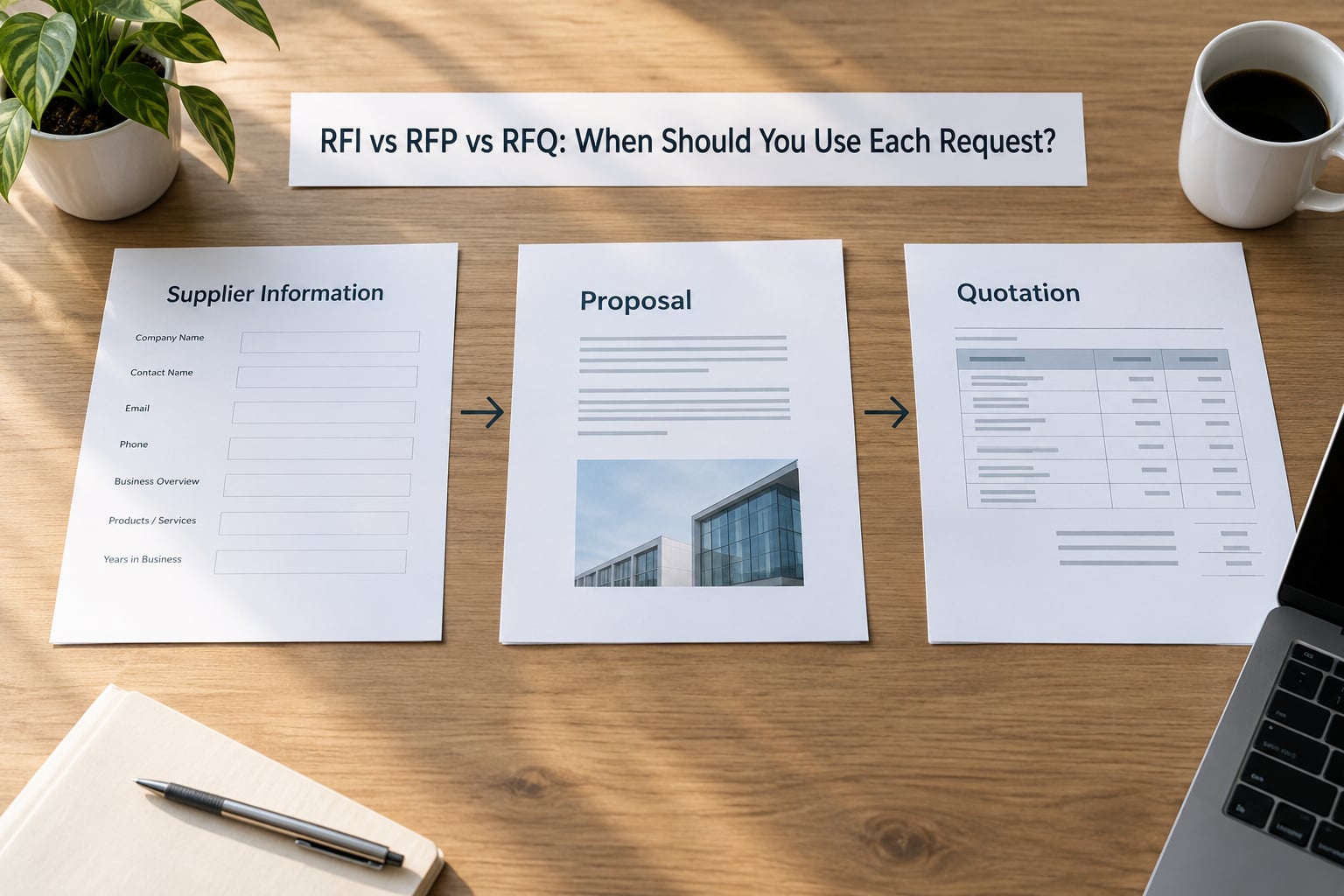
Use an RFI when you do not yet know whether the supplier pool can meet your requirement, and use an RFQ when you know exactly what you are buying. Use an RFP when the answer depends on how a supplier would approach the work rather than on what the part costs.
Example one: qualifying a new plastic material supplier
A manufacturer has a resin dependency it wants to reduce. The requirements are still open — grade, colour, additive package and volume are all undecided. The right first move is an RFI asking which polymers each supplier compounds, what certifications they hold, and what minimum volumes they run.
The answers narrow the field to three candidates. The buyer then defines grades and annual volumes and issues an RFQ, and pricing becomes comparable because the specification is now written. No RFP is needed at all, because nothing here requires a supplier to design a solution.
Example two: a packaging program with several formats
A consumer goods company is replacing a mixed board of packaging formats and cannot yet choose between a structural redesign and a print-only change. There is a genuine solution question, so an RFP is the right document: suppliers propose an approach, show the trade-offs, and return a costed option for at least the baseline.
The evaluation runs on weighted criteria — cost per unit, line changeover time, recyclability, minimum order quantity and lead time. Because the requirement is open, this is not a job for an RFQ, and a pure RFI would hand back opinions without a plan.
Example three: a custom molded component for a new program
The geometry is frozen, the material is chosen and the annual volume is known. This is textbook RFQ territory. The buyer sends drawings, the resin specification, tolerances, cosmetic requirements, packaging format and destination, and asks for unit price, tooling cost amortised over the stated volume, lead time and payment terms. If the component combines two materials rather than one, the choice of forming method still has to be settled before drawings are issued, and the insert molding versus overmolding differences are the comparison to read first.
The one trap is supplier design support. Even here, a small design-for-manufacture question can be better handled as a short technical clarification alongside the RFQ than by converting the whole thing into an RFP.
How to Choose the Right Request for a Manufacturing Purchase
Five steps will get you to the right document most of the time, and the order matters more than the detail.
- Write the buying objective in one sentence. If you cannot, the purchase is not ready for any document.
- Rate the maturity of the problem. Unknown capability means RFI. Known capability with an open solution means RFP. Known solution with a fixed specification means RFQ.
- Decide what suppliers must return. Answers, a proposal, or a priced quote. This is the clearest single test, because it dictates the template and the effort you are asking for.
- Standardise the response format. For an RFQ that means one shared spreadsheet; for an RFP it means a fixed structure and a compliance matrix; for an RFI it means a fixed question order.
- Escalate only when the information exists. Move from RFI to RFQ or RFP once you can write the requirements, not before. And skip the RFI entirely when you already know your suppliers.
A staged approach works well in practice: issue an RFI to a broad market, shortlist on capability and fit, then run an RFQ against the shortlist. Add an RFP only where the solution itself is the unknown, and run it in parallel with pricing rather than in front of it, so you are not waiting on one to learn the other.
Two mistakes show up repeatedly. The first is issuing an RFP before requirements are clear, which produces vague responses and wasted supplier effort. The second is inviting too many vendors to evaluate properly — a large buyer team that issues far more requests than it can assess ends up with skipped responses and thin participation.
Which Should You Choose?
Choose an RFI for supplier discovery, an RFP for a complex or customised solution, and an RFQ for a defined scope that needs prices. In manufacturing, the RFQ is the workhorse for repeat parts, materials and packaging; the RFP earns its place on tooling programs, line automation and new product development where the approach matters as much as the number.
Pick the wrong one and the cost is predictable. Too early an RFP gives you six vague proposals and an award you cannot defend. An RFQ on an undefined part gives you six prices for six different parts. An RFI where you needed a commitment gives you a shortlist and no basis for choosing between them.
The safest pattern for most buyers is staged: qualify, then price or propose, then award. You can compress it when you already know your market, and you should not feel obliged to run all three documents simply because the option exists.
Frequently Asked Questions
What is the main difference between an RFI, RFP, and RFQ?
An RFI gathers information about suppliers and the market without asking for a solution or a price. An RFP asks shortlisted suppliers to propose how they would deliver a defined outcome. An RFQ asks suppliers to price a specific, already-specified item. The difference is certainty: an RFI is for exploration, an RFP for an open solution, an RFQ for a known scope.
Can I combine an RFI, RFP, and RFQ?
You can, and many buyers do, but keep them clearly separate documents with separate deadlines. The normal sequence is an RFI to qualify suppliers, then an RFQ for comparable pricing, with an RFP for shortlisted suppliers where the approach matters. Issuing all three at once confuses suppliers about what is being asked and makes it hard to tell whether a response was complete.
Is an RFQ the same as a request for proposal?
No. An RFQ and an RFP differ in what they ask for and in what you can do with the answer. An RFQ returns a price against your specification, so responses compare directly. An RFP returns an approach, team and schedule, which you score against weighted criteria. Some buyers ask for both in one package, but if price is your decision criterion, an RFQ is the right document.
Which request should I use when selecting a new manufacturing supplier?
Start with an RFI when you do not know whether the supplier pool can meet your process, capacity or certification requirements. Once you know who is capable and your requirements are written, issue an RFQ for pricing. Add an RFP only when the solution itself is open, such as a packaging redesign or a new tooling program where you want competing technical approaches.
How do I make supplier quotes comparable?
Send one shared spreadsheet that every supplier must complete, with the same rows: unit price, tooling, setup, freight, duty, payment terms, lead time, volume breaks and validity. Fix the specification fully before you send it, name a single delivery destination, and state the quantities you want priced. Then normalise before you compare, so differences reflect real supplier cost and not different assumptions.
Does an RFI need to include pricing?
Usually not. An RFI is an information-gathering document, so pricing belongs in the RFQ that follows. Asking for indicative pricing in an RFI creates two problems: you get numbers built on assumptions that will not survive a real quotation, and some suppliers will decline to quote a project that has not been defined. If you want a price signal early, ask for a price range per unit and say clearly that it is non-binding.
Conclusion
The rfq vs rfp vs rfi differences reduce to one decision: match the document to how much you already know. Exploration means an RFI, an open solution means an RFP, and a fixed specification means an RFQ.
Start by writing the requirements and deciding what you need suppliers to hand back — answers, a proposal, or a quote. Then pick the format that matches the maturity of the purchase, standardise the response, and escalate only once you have the information to justify the next step.