

To find HTS codes for imports, write down exactly what the product is, what it is made from, and how it functions, then work down through the current US Harmonized Tariff Schedule at hts.usitc.gov and test your candidate codes against the General Rules of Interpretation. For a straightforward manufactured part, most of that takes about twenty minutes. The hard cases are the ones with two materials, an unusual assembly, or an intended use that changes the answer.
One thing to get straight before you start: the importer of record owns the classification decision. Not the supplier, not the freight forwarder, not the lookup tool. Your broker can advise and file, but the code on the entry summary is yours, and CBP holds you to it afterwards.
That is why a copied answer is a liability. A supplier in another country may be reporting under its own tariff schedule, which shares only the first six digits with yours. This guide covers the process we would run through a new part number: document, research, compare, verify, record.
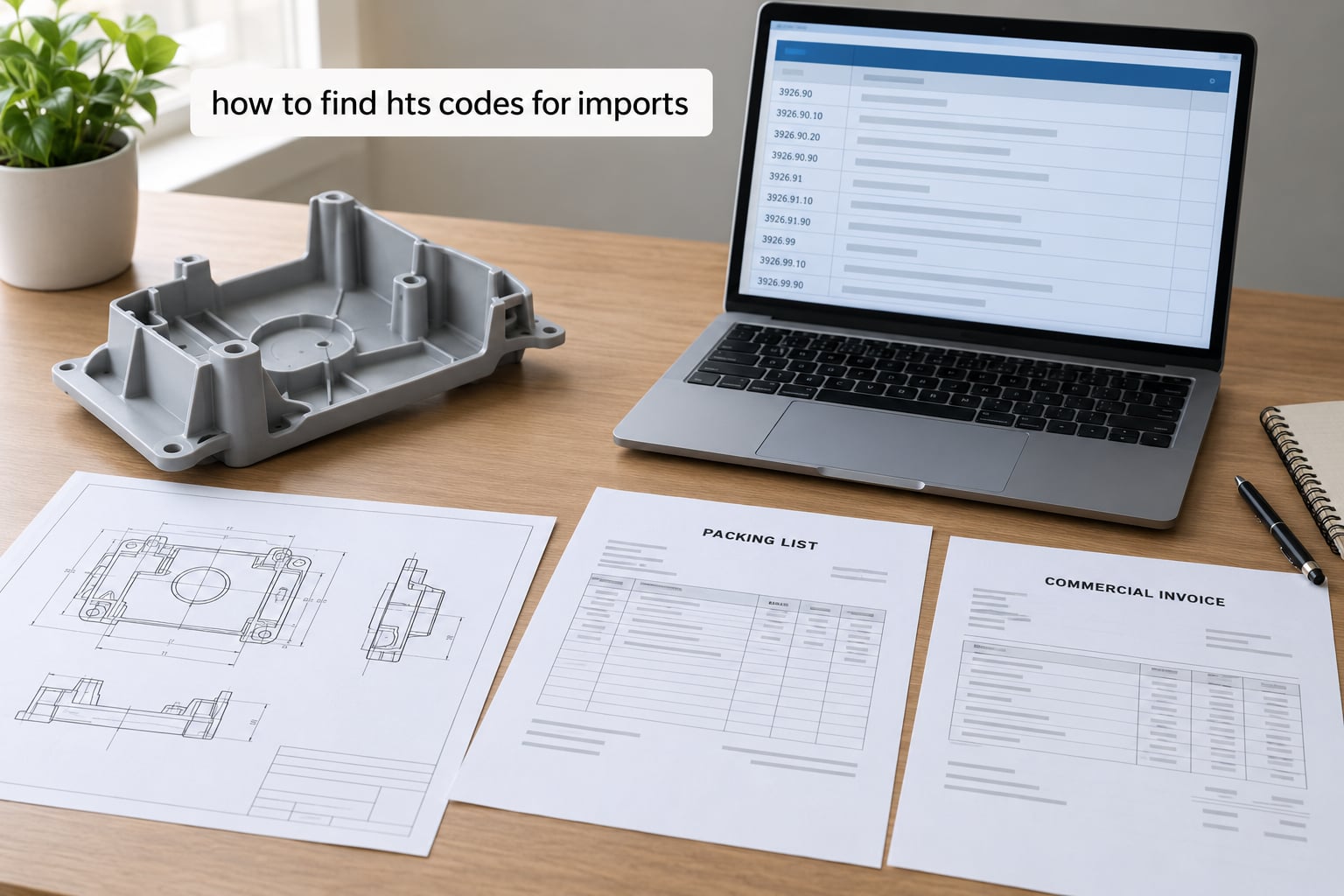
Table of Contents
- How to Find HTS Codes for Imports: What You Need
- Step-by-Step
- 1. Define the Product Before Searching the Tariff Schedule
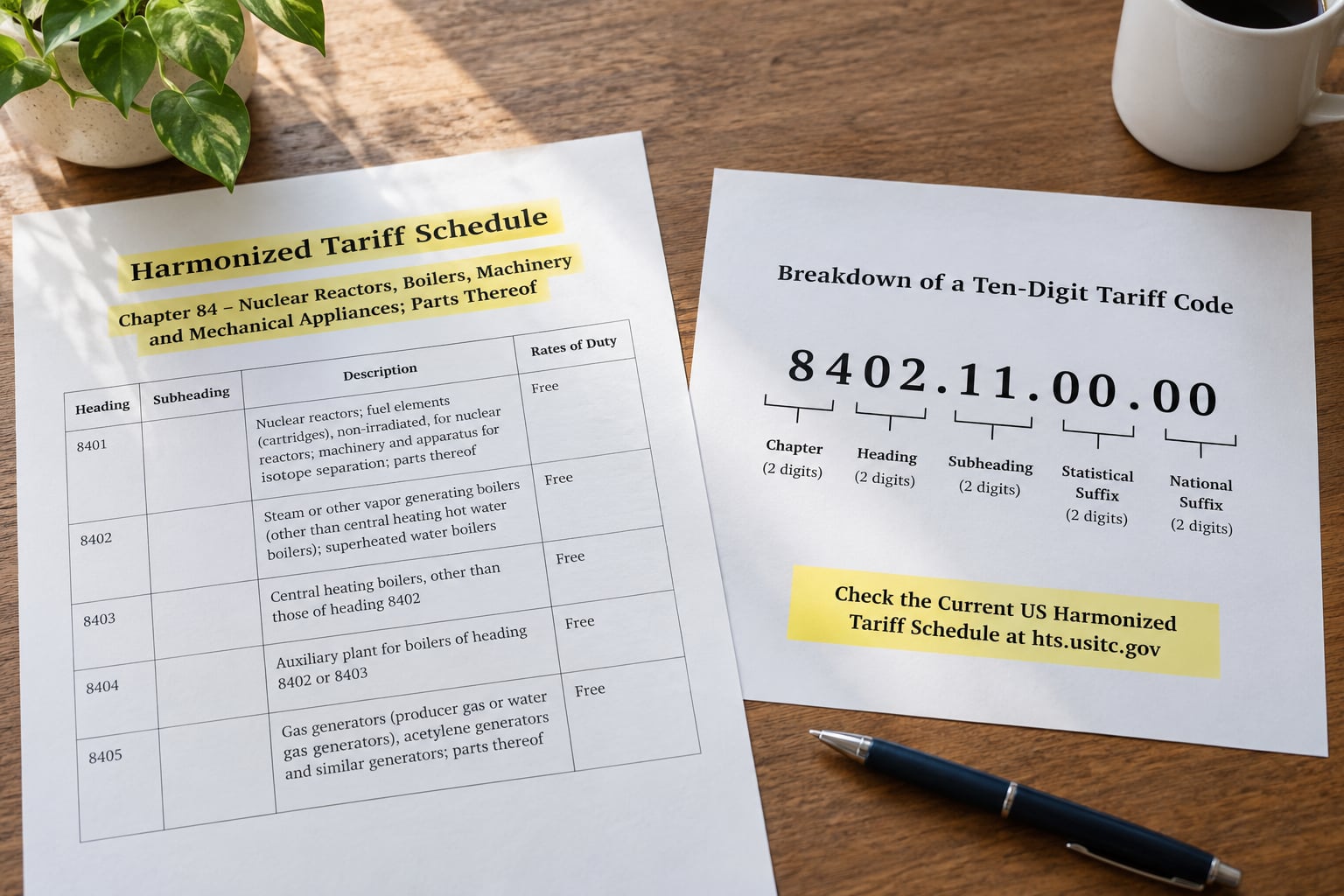
- 2. Check the Current US Harmonized Tariff Schedule at hts.usitc.gov
- 3. Use Product-Specific Classification Tools Carefully
- 4. Compare Competing Codes and Read the Legal Notes
- 5. Verify the Classification With a Customs Professional
- 6. Record the Result and Review It Before Future Orders
- Common HTS Code Mistakes
- Frequently Asked Questions
- Conclusion
How to Find HTS Codes for Imports: What You Need
You cannot search a tariff schedule with a product name. You need enough detail to search with, and most failed classifications fail here, not in the schedule itself.
- A precise product description. Not “plastic bracket.” Name the resin, the color, whether it is molded or machined, and whether it ships loose, bagged, or assembled with other parts.
- Material and component facts. A bill of materials with percentages by weight, plating or coating information, and the material of every significant component.
- Function and intended use. What the part does once it leaves the box, and what it is used with. Several headings turn on this single fact.
- Form of factor. Pellet, sheet, tube, molded article, or a set put together and sold as one unit.
- Country of origin. Where the goods were made, not where they were shipped from.
- Supporting records. Commercial invoice, packing list, technical drawings, product specification sheets, and any lab or compliance reports you hold.
- Access to current official sources. The current edition of the USITC Harmonized Tariff Schedule, the CROSS rulings database, and your own broker’s contact.
If a drawing shows a single molded part in a single resin, you have enough to classify. If you are looking at an assembly of a molded housing, two steel fasteners, and a printed label, you have a composite good, and that changes the method entirely.
Step-by-Step
1. Define the Product Before Searching the Tariff Schedule
Write a classification brief in one paragraph before you open any database. State what the item is, what it is made from, how it is shaped or assembled, how it functions, who uses it, and whether it is a part, a component, a tool, a container, or a finished article.
That last part catches more mistakes than people expect. A stainless steel bracket that ships loose as a component and a stainless steel bracket welded into a finished appliance are different articles, and they can land in different headings. You will hear importers argue about this one on r/CustomsBroker more than any other classification question.
Write the brief down and keep it. It becomes the first page of your classification file later, and it is exactly what an auditor asks to see.
2. Check the Current US Harmonized Tariff Schedule at hts.usitc.gov
Start at the current edition, not a saved PDF from an earlier year. The schedule is revised every year, and several popular pages on the internet still treat an old edition as current, which is how importers end up filing against a heading that no longer reads the way they remember.
Search with material plus function plus form, not with a marketing name. “Polypropylene granules in primary forms” finds the heading. “AlphaPoly PP-920” finds nothing. Similar logic applies to a machined steel valve body and to a polyester film roll.
Once you land on a heading, do not stop at the heading. Work down through subheadings and statistical suffixes until you reach the 10-digit line, then read the notes attached to the section and the chapter. Those notes legally define the scope, and the General Rules of Interpretation require you to apply them before you compare candidate headings.
Note the rate in Column 1 general, but do not treat it as your landed duty. Chapter 99 provisions and Section 301 or 232 actions can add a percentage on top, and those lines carry their own codes. Ignoring the Chapter 99 overlay is the most common reason a budgeted duty rate turns out to be wrong by a wide margin.
3. Use Product-Specific Classification Tools Carefully
Automated tools are good for one job: producing a shortlist you then argue with. They are not good at owning the decision. Every tool on the market, whether it is a free classifier or a paid platform, is producing an educated guess from a description you typed, and several of them will give you confident prose instead of admitting the description is too thin.
CROSS is the most useful of the official tools, and it is free. It holds thousands of published rulings where CBP answered a real classification question about a described article. Search it in the same material-plus-function-plus-form style. Then read the ruling itself and check the facts against yours, because a ruling on a similar-looking article is not a ruling on yours.
Two warning signs mean a ruling does not apply to you: the material in the ruling differs from your bill of materials, or the ruling turns on a use your customer does not have. Practitioner blogs make the same point, that recycled codes across purchase orders are the number one accuracy killer, more damaging than any single bad search.
4. Compare Competing Codes and Read the Legal Notes
When two headings both look plausible, you are usually choosing with the General Rules of Interpretation rather than with preference. GRI 1 sends you to the section and chapter notes first. GRI 3(a) puts the article in the heading that gives the most specific description. GRI 3(b) resolves a composite good or a set by essential character, meaning the component that gives the good its identity. GRI 6 catches what slips through and sends it to the nearest heading above.
A worked example: an injection-molded housing in glass-filled nylon with a stamped steel bracket bonded to it and two stainless screws. GRI 3(b) asks which component defines the article. If the housing carries the function and the bracket only mounts it, the housing usually controls. If the bracket is the functional heart and the housing is a carrier, the analysis can go the other way. The reasoning matters more than the outcome, because that is what you will have to defend.
Write down why you rejected the alternatives. Two sentences each: the heading you chose, the heading you passed over, and the rule that decided it. That paragraph is your defense if the entry is flagged years later.
5. Verify the Classification With a Customs Professional
Escalate when the product is new to you, the goods are multi-material, the duty exposure is meaningful, or a previous shipment on the account has been examined. A broker will review your brief, tell you what they would file, and usually catch the section or chapter note you skimmed.
A binding ruling from CBP is a different tool. You request it through e-Allegations, it is binding on CBP for the classification you described, and it stays in place until the underlying facts change. It is worth the wait when a product line will run for years, when the tariff exposure is large enough to matter, or when no comparable CROSS ruling exists. It is not needed for every shipment, and it does not protect a product that does not match the description in the request.
The question brokers field most often is whether exposure is personal or corporate. It depends on facts you do not control, so the practical answer is to keep the written reasoning. An importer who documented a careful GRI analysis is in a very different position from one who never looked.
6. Record the Result and Review It Before Future Orders
Save the classification in a file with the code, the full product description, the bill of materials, the duty rate you assumed, any Chapter 99 overlay, the CROSS rulings you relied on, and your broker’s name. Put the cross-referenced question about how long an HTS code stays valid into that same file as a review date rather than leaving it open-ended.
Set a re-review trigger for every one of these: a change of resin grade, a plating or coating change, a redesign that alters function, a new country of origin, a new trade action covering your heading, or the annual schedule revision. Changing a material to shift a duty rate is the single most common route from lawful tariff engineering into misclassification, and the fact that a change is small and invisible is exactly what makes it dangerous.
Common HTS Code Mistakes
These are the errors that account for most of the bad classifications we see, each with the fix that stops it.
- Classifying by product name alone. A catalog name tells you nothing about material or function. Fix: classify from the bill of materials and the specification sheet, not the listing.
- Copying the supplier’s code. Their code may belong to a different country’s tariff schedule, which shares only the first six digits with yours. Fix: treat it as a lead, verify it yourself against your own product facts.
- Ignoring material and function. Same shape, different resin, different heading. Fix: check the section and chapter notes before you accept a heading that looks right visually.
- Using an outdated schedule edition. Fix: open the current edition at hts.usitc.gov every time you classify a new part, and note the edition in your file.
- Missing Chapter 99 overlays. The base Column 1 rate is not the whole rate. Fix: check whether a Section 301, 232, or reciprocal measure applies to your code and origin.
- Filing the wrong code for the filing. An Importer Security Filing needs the 6-digit HTSUS level; the entry summary needs the full 10 digits. Fix: confirm which level the specific filing asks for before you fill it in.
- Documenting nothing. Fix: keep the brief, the rejected candidates, and the rule you applied. Reasoning is what survives an exam; a code alone does not.
One more worth calling out: do not use a broader heading to dodge a specific rate. A broader heading with a lower number looks clever on paper and reads as evasion to an examiner.
Frequently Asked Questions
Who determines the HTS code for my import?
You do, as the importer of record. The US International Trade Commission publishes the schedule, CBP interprets and enforces it, and a broker may recommend a code, but the accuracy of the classification on the entry summary rests with you. For ambiguous, high-value, or novel products, request a binding ruling from CBP so the answer is settled before your next order, and keep your written reasoning either way.
Can I find an HTS code from a 6-digit HS code?
Partly. The first six digits of an HTS code are the international HS subheading, so you can start there and work down through the US statistical suffixes, which is often the fastest route. But the last four digits are US-specific and set the actual duty rate, so a foreign 6-digit HS code narrows the field without giving you the answer. A supplier’s foreign code is a lead, not a classification.
Where can I find a list of HTS codes?
The current edition of the Harmonized Tariff Schedule at hts.usitc.gov is the authoritative list, and it is free to search and download. For how courts and CBP have actually classified similar goods, search published rulings in CROSS. Exporters need a different list: the Schedule B numbers published by the US Census Bureau. There is no single downloadable file that fits all three purposes.
What happens if I use the wrong HTS code?
Expect additional duties on the entry, and possibly holds while CBP reviews the goods. If the code was wrong in a way that understated duty, you can face penalties assessed per violation and audit exposure that reaches back over prior entries. Marking and origin problems can add their own issues. The usual cause is a copied code nobody re-checked, which is also the easiest one to fix.
Do I need a different tariff code for exports?
Yes. Imports into the United States are classified under the HTS, and exports out of the United States are reported under Schedule B numbers from the US Census Bureau. The two systems do not line up digit for digit, and the export number is not a substitute for an import code. If your business both imports and exports the same article, keep both numbers on file, each with its own date reviewed.
How long does an HTS code stay valid?
A code stays valid until the facts behind it change or the schedule does. Revise it after a material swap, a redesign that changes function, a change of country of origin, or an annual schedule revision that alters the heading. There is no notification system telling you a code went stale, which is exactly why importers with an annual classification review catch problems before an entry does.
Conclusion
Start with the product, not the schedule. Document the material, the function, and the form of the article, then work through the current USITC Harmonized Tariff Schedule and test your candidates against the General Rules of Interpretation and the section notes. Check CROSS for how similar goods were actually classified, and confirm the answer with your broker before you commit a high-value or high-duty order.
Then write it down. A saved code with its reasoning and a review trigger is worth more than a faster search, because it is the version of your classification that still holds up years later.