
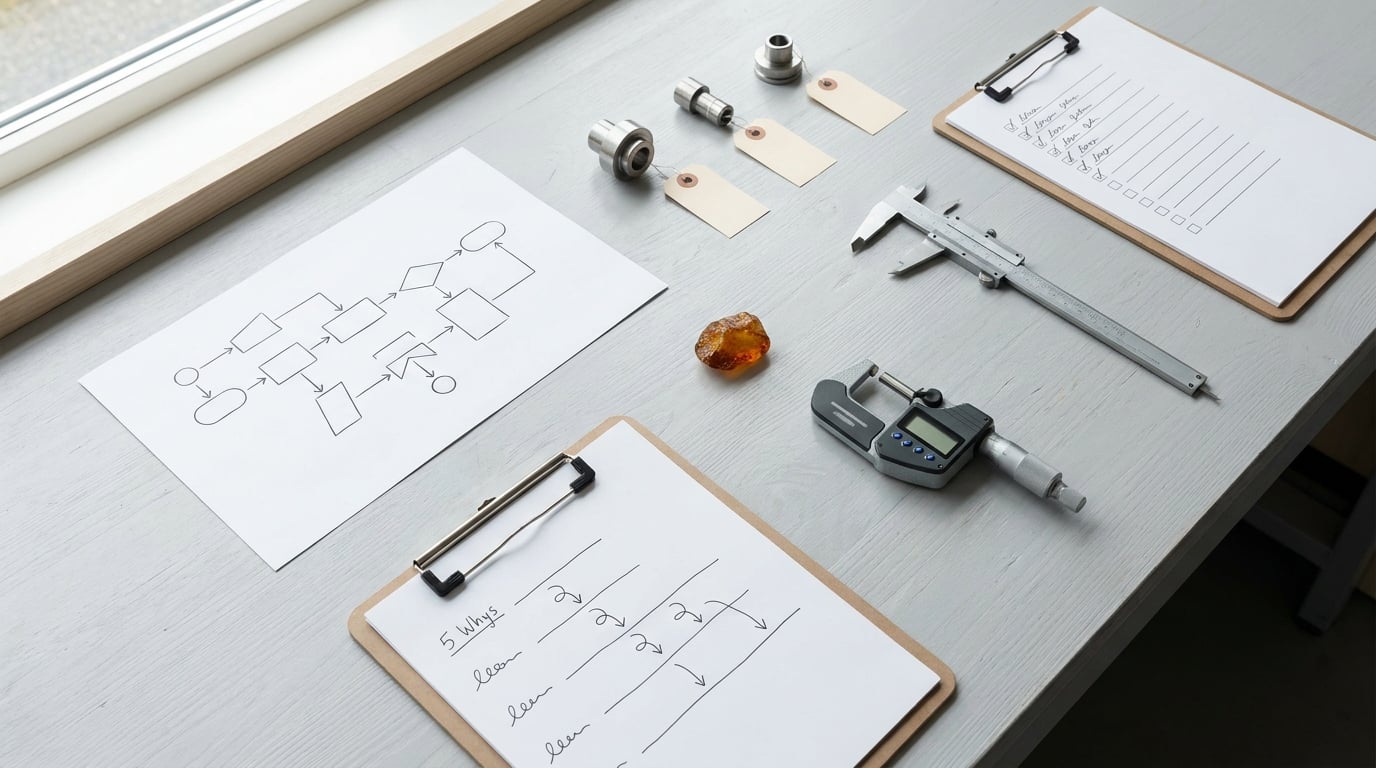
8D problem solving is a team-based method for containing a problem, proving its root cause, and locking in a fix so it cannot come back. It runs nine ordered steps, D0 through D8, and this guide walks the 8D problem solving process step by step with the deliverable each stage owes the next one.
Ford Motor Company built it in the 1980s and published it as Team Oriented Problem Solving (TOPS), a sixty-page manual piloted at Dearborn. Quality teams in automotive, aerospace, medical device, food, electronics, and increasingly healthcare, service, and software operations still run it as the default corrective-action method under ISO 9001 and IATF 16949. Most investigations run three to six weeks from kickoff to closure, though a supplier quality issue with an overseas root cause can run longer.
Here is the whole method in one list, before we get into the detail:
- D0: Prepare the problem-solving team and decide the response level.
- D1: Establish a cross-functional team with the skills to solve it.
- D2: Describe the problem with 5W2H so everyone sees the same defect.
- D3: Develop interim containment to stop the damage from spreading.
- D4: Analyze and establish the root cause, verified with evidence.
- D5: Select and implement permanent corrective actions.
- D6: Implement and validate corrective actions against the data.
- D7: Prevent recurrence by updating the systems that allowed it.
- D8: Recognize the team and formally close the 8D.
You will hear the method called eight steps or nine steps. Both are correct: D1 through D8 are the eight disciplines, and D0 is the planning gate that many organizations added later.
Table of Contents
- What You Need Before You Start
- The 8D Problem Solving Process Step by Step
- D0: Prepare the Problem-Solving Team
- D1: Establish the Team
- D2: Describe the Problem
- D3: Develop Interim Containment Actions
- D4: Analyze and Establish the Root Cause
- D5: Select and Implement Permanent Corrective Actions
- D6: Implement and Validate Corrective Actions
- D7: Prevent Recurrence
- D8: Recognize the Team and Close the 8D
- Common 8D Mistakes and How to Avoid Them
- Frequently Asked Questions
- What is the 8D problem solving process step by step?
- When should an 8D report be started?
- Is D0 part of the official 8D process?
- How long should an 8D investigation take?
- What is the difference between containment, corrective action, and preventive action?
- How do you prove the root cause in an 8D report?
- Conclusion
What You Need Before You Start
The disciplines in 8D fail for a boring reason far more often than they fail for a technical one: the team starts before it has evidence. Gathering these five things first is most of the work.
Problem data that already exists
Pull whatever has already been written down: the customer complaint, the internal nonconformance report, the supplier’s rejection notice, defect photos, measurement records, the lot or serial numbers involved, and the dates the defect showed up. If your quality system has no way to attach that data to a case, fix that gap before the next investigation rather than during this one.
The right people on the team
An 8D team needs someone who can operate the process, someone who can measure it, someone who can read the design intent, and someone with authority to change a schedule or a control. That is usually a process or manufacturing engineer, a quality engineer, a line supervisor or operator, and a design or product engineer. Add a supplier representative when the suspect part comes from outside, and add the customer when a formal response is due to them.
Physical and recorded evidence
Keep the defective units. Tag them and date them, because within two weeks nobody remembers which part came off which machine. Along with the parts, gather gauge readings, machine logs, operator comments from all three shifts, material certifications, and the last good units for comparison. Most weak D4 sections fail simply because the good units were thrown away at the start.
Authority to contain
Decide up front who can stop a line, hold a shipment, sort an entire inventory, or issue a supplier chargeback, and get that authority in writing. Containment is the step teams most often delay, and delay is what turns a contained defect into a recall.
A form people can actually fill in
Whether it is a controlled form, a quality system record, or a spreadsheet, the 8D form needs the same fields every time: case number, part and serial, D0 through D8 with one dated entry each, names and signatures at the sign-off points, and a field for evidence attachments. A form that asks for narrative prose under each discipline will be gamed. A form that asks what was produced, by whom, on what date, and where the attachment lives will not.
Knowing when 8D is the wrong tool
8D suits a repeatable defect with a physical or documented failure mode. For a one-off strategic problem with no failure mode, an A3 is lighter. For a problem where you cannot state the symptom in numbers, run 5 Whys alone first. For a chronic variation problem that needs statistical proof, DMAIC gives you more measurement structure than 8D does.
The 8D process at a glance
Each step has a named output. If a discipline has no output, it did not happen.
| Step | What you produce | Typical owner | Tools used |
|---|---|---|---|
| D0 Prepare | Response level, target dates, team shortlist, emergency actions | Quality manager | Check sheet, meeting |
| D1 Team | Named team with roles and a charter | Team leader | RACI, skills matrix |
| D2 Describe | 5W2H problem statement plus Is/Is Not analysis | Quality engineer | 5W2H, Is/Is Not, photos |
| D3 Contain | Containment plan, quantity and location check, verification | Production or logistics | Sort, 100 percent inspection, stock audit |
| D4 Root cause | Verified occurrence cause, verified escape cause, escape point | Engineering | 5 Whys, fishbone, Pareto, SPC, DOE, trials |
| D5 Select fix | Chosen permanent corrective actions, owner and date each | Team leader | Feasibility review, cost/risk comparison |
| D6 Validate | Validation run, before and after data, approval signature | Quality engineer | Statistical comparison, capability check |
| D7 Prevent | Updated documents and lessons-learned record | Document control | Horizontal deployment, FMEA update |
| D8 Close | Sign-off, team recognition, archive | Approval authority | Review meeting |
The 8D Problem Solving Process Step by Step
The method alternates between divergence and convergence. D1 and D2 gather people and facts, D3 stops the bleeding, D4 opens up into candidate causes and then narrows to proven ones, and D5 through D8 close it out. That back-and-forth is deliberate, and the reason each step feeds the next is traceable: the corrective action in D5 exists because of the verified cause in D4, and the cause in D4 is credible because of the description in D2.
D0: Prepare the Problem-Solving Team
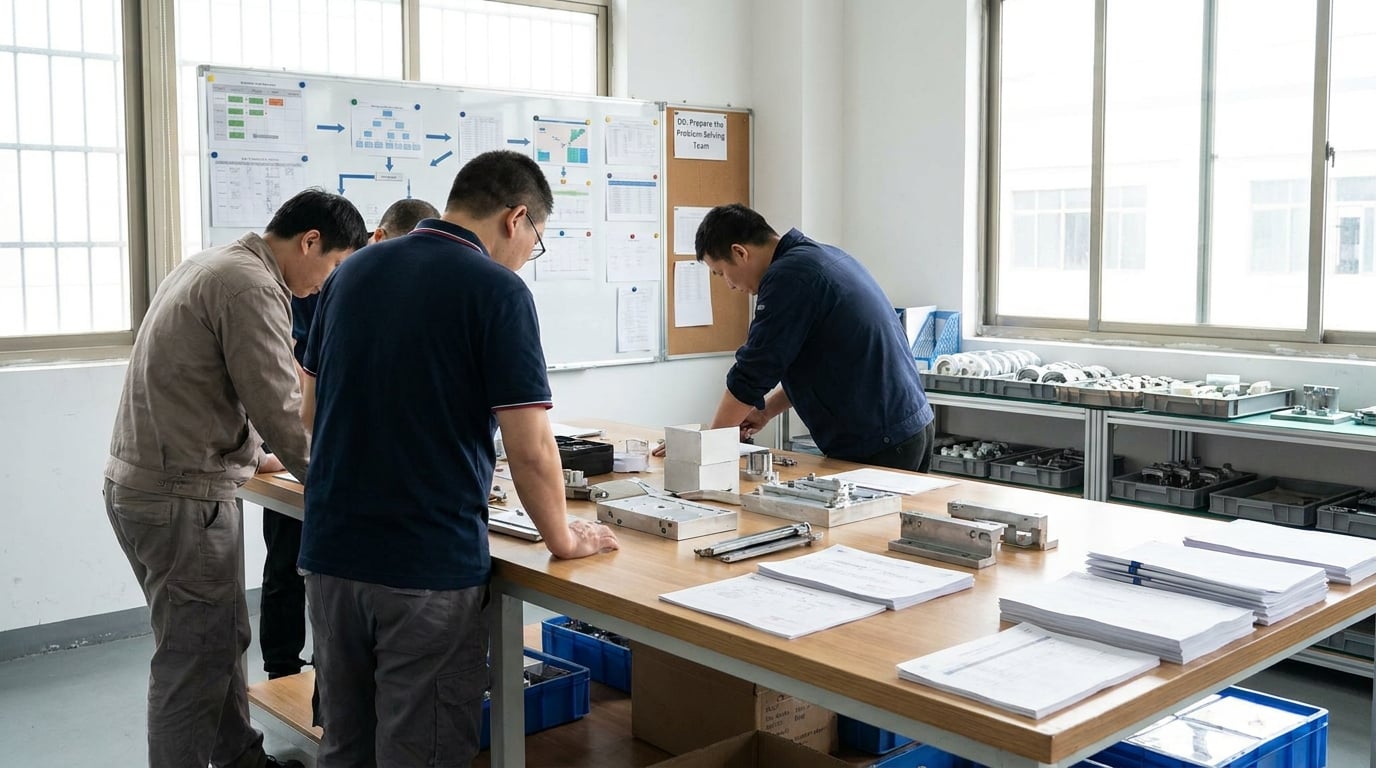
D0 answers a single question: does this need a full 8D, a short containment action, or a monitor-and-wait decision? D0 also fixes the response level, which sets the clock. A high response level usually means customer-facing, safety-related, or a defect escaping to the customer, and it commits you to daily contact and a fast containment. A low response level is an internal deviation with no exposure, and it can run on a normal timeline.
The output is a short readiness file: what is known, what is still unknown, who is on the shortlist, what the target dates are, and any emergency action needed in the next twenty-four hours. In many plants the emergency action is physical: stop the line, quarantine the last known good unit and the first known bad unit, and pull the last three shifts of production.
Where 8D has become formal, D0 is a gateway rather than a stage, and the assessing questions are short. Is the defect a safety or regulatory risk? Has it reached the customer? Is it systemic or isolated? Is the volume large enough to justify the resources? Answer no to all four and a five-why analysis is often the right-sized answer.
D1: Establish the Team
Pick a team that owns the whole process, not a department that only sees its own handoff. On a casting defect you want the furnace operator, the maintenance tech, the process engineer, the quality engineer, and the design engineer who set the tolerance. A team of five or six beats a committee of fifteen, because the people in the room have to disagree with each other in real time.
Name a team leader who is not the most senior person present. The leader’s job is to hold the schedule, drive to closure, and keep the investigation factual. Assign a named owner for each discipline before the first meeting so nobody inherits D4 by default.
Every D1 output should include contact rules. Does this team report to the customer directly, or through the account manager? Who signs the final response? If the case involves a supplier, get written agreement that the supplier shares data at the pace the timeline requires.
D2: Describe the Problem
This is where most of the quality is won or lost, and it is the step 8D problem solving reports most often rush. A good problem statement answers 5W2H: what object, what defect, where on the part, how many, when, who found it, and what the impact is. “Product is bad” is not a problem statement. “Bore diameter on part X, 12 of 400 units from the Tuesday night shift, 0.15 mm over the 0.05 mm upper limit, causing 0.8 mm press interference downstream” is.
Run an Is/Is Not analysis right after it. Fill the columns with the specific, the random, and the difference. The mismatch between what differs and what stays constant is usually the first real clue, and it comes before any brainstorming about causes.
Then compare against a known-good standard: a part from a good lot, a drawing revision, a control plan, a work instruction. Document the operating conditions too. Line, shift, machine, tooling, material lot, operator, ambient conditions, and the revision of every document in use at the time. Teams regularly find that the defect correlates with a machine that was converted last month, and they never wrote that down.
The D2 deliverable is a written description that an engineer who was not in the room can read and picture the defect without asking a question.
D3: Develop Interim Containment Actions
Containment protects the customer and the plant while the real analysis runs. It is not a fix, and it should never be written up as one. The distinction matters: containment is temporary and reversible, while a corrective action changes the process.
Typical containment actions, roughly in order of severity: stop shipment and notify the customer, stop the line, quarantine all suspect inventory back to the last known good check, sort or rework existing stock, 100 percent inspect the remaining WIP and finished goods, and add a temporary check to the process until D5 lands.
Write containment as a plan with a quantity, a location, and a verification method. “Sort all product” is not a plan. “Inspect 100 percent of the 6,400 units from lot 4417 through lot 4422, using a digital micrometer calibrated 2026-09-12, reject anything above 0.05 mm, record results in the containment log, and have the quality engineer verify ten readings per shift” is a plan.
The verification step is what separates containment from wishful thinking. Someone independent has to confirm that the sorted quantity actually covers everything shipped, and that no suspect material moved during the sort. Note the containment verification date, because it is usually the first question an auditor or a customer asks.
D4: Analyze and Establish the Root Cause
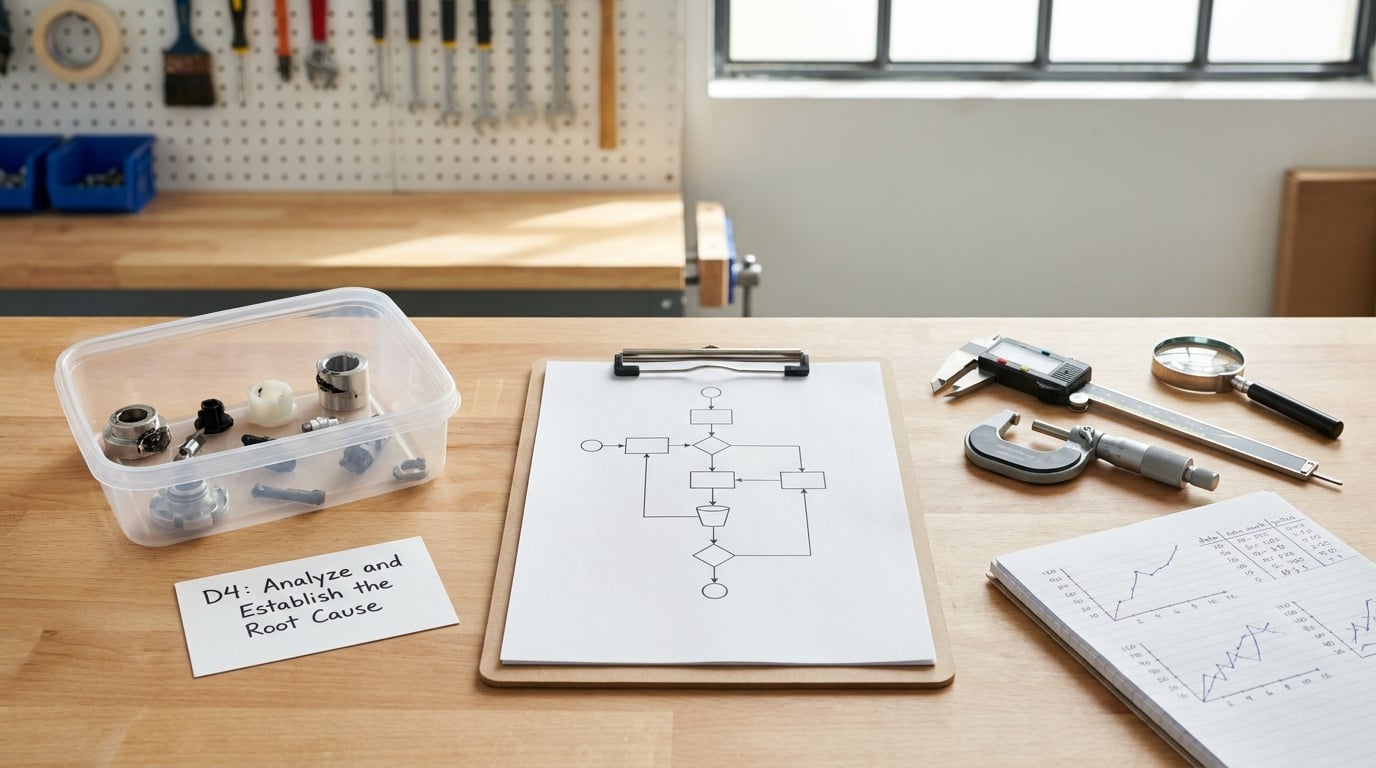
Root cause analysis in 8D has to produce two verified causes, and this is the distinction practitioners collapse most. The occurrence cause explains why the defect was produced. The escape cause explains why the existing controls did not catch it before it left. A report that finds only the occurrence cause is half finished, because the same failure can still escape through a different path next time.
Generate candidates broadly first, then narrow. A fishbone or Ishikawa diagram with the standard categories, people, methods, machines, materials, measurement, and environment, is good for widening the search. A Pareto chart of defects by machine or by shift is good for narrowing it, because it shows where the volume actually sits. 5 Whys walks a single branch down to a cause you can act on, and it is weakest when the team jumps to “operator error” at why two.
Then verify, which is the part ASQ singles out as the failure point: causes must be proven, not agreed on in a meeting. A 5 Whys chain is a hypothesis. Test it by reproducing the defect deliberately under controlled conditions, by pulling the data that shows the correlation, or by demonstrating that fixing the cause makes the defect go away. If you cannot demonstrate all three, write down which evidence supports the cause and what remains assumed.
Escape point analysis, part of Ford’s Global 8D approach, adds a question: what was the earliest point in the process where a control could have caught this and did not? Walk the flow from design through part production, assembly, final inspection, packaging, and shipping, and mark each control. The first control that should have caught the defect is the escape point. Fixing that control, not just the cause, is what stops the failure from taking a different route out next time.
Watch for the analysis patterns that produce weak D4 sections: changing several variables at once so you cannot attribute the result, collecting data after the fix instead of before, and drawing a fishbone so full that every box has three causes and the diagram tells you nothing.
D5: Select and Implement Permanent Corrective Actions
Now choose actions that remove the verified causes rather than soften the symptoms. For an occurrence cause caused by a worn fixture, that means replacing or modifying the fixture and setting a replacement interval, not telling operators to check more carefully. For an escape cause caused by a gauge that was never calibrated, that means adding the gauge to the calibration schedule and adding the check to the control plan.
Each action needs a named owner and a date, and it needs to be reviewed for feasibility before it is promised. A change that costs a second of cycle time on a high-volume line is a different decision from the same change on a low-volume line, and the team has to know that before the customer hears a date. Check that the action does not create a new risk somewhere else in the process.
The D5 output is a list of actions, each traceable to a specific verified cause, each with an owner, a date, and a verification method already defined.
D6: Implement and Validate Corrective Actions
Run the revised process and then prove it worked, in that order. Validation means a meaningful sample over a meaningful period, compared against the data you collected before the change. If the pre-change defect rate was 3 percent on 400 units, validating on 30 units the day after the change proves nothing. State the sample size, the duration, and the acceptance criterion in the report, and show the before-and-after numbers side by side.
Where the process produces measurable characteristics, check capability against the specification rather than just counting defects. Confirm no new defect type appeared. And get the approval signature from someone with the authority to accept the change, because unsigned corrective actions are the most common audit finding in 8D reports.
D7: Prevent Recurrence
D7 asks what will stop this failure from happening again, and it is the step most often left nearly blank. The answer is usually a set of document and system updates: the control plan gains a check, the work instruction is revised, the drawing or specification is corrected, the FMEA gets a new or re-rated failure mode, the inspection plan changes, and the affected suppliers or process owners are told so it can be deployed horizontally to other lines, parts, or sites.
Horizontal deployment is the part that turns one fix into an organization. If the same failure mode exists in a sister line or a related part number, the D7 record should say so explicitly and name who is checking it. Skipping this is how the same defect shows up three plants over two years.
Confirm the updates actually landed. A revision number in a document control system is evidence; a promise in a meeting is not. Close the loop with the document controller and record the effective dates, then capture what the team learned in a lessons-learned record that the next team can actually find.
D8: Recognize the Team and Close the 8D
The last discipline is a formal review with the approver, not a rubber stamp. Walk the eight completed disciplines, confirm the validation data, confirm the D7 updates are live, and confirm the containment actions have been retired properly, including any temporary checks added during D3. Then close the report with a signature and a date.
Recognize the team by name. ASQ puts it plainly: the organization is obliged to thank the team formally, and that is not a morale nicety. A method that only ever surfaces when something went wrong trains people to hide the next one, and you will not find the next one in time.
Decide the customer’s role before the report goes out. Some customers want the 8D as the response to a formal complaint and will score it. Others want a summary. Sending the full internal report by default often reveals more than the customer needs and creates commitments you have not resourced.
Common 8D Mistakes and How to Avoid Them
These are the failures that show up again and again in 8D reviews and customer audits. Each one has a simple fix.
Treating the symptom as the cause
The team names the visible defect as the root cause and writes a corrective action that only hides it. Rework instructions, extra inspection, and operator retraining are containment and screening, not corrective actions. Ask of every proposed action: if this change is in place, would the cause still be able to produce a defect? If the answer is yes, keep analyzing.
Delaying containment
Teams that argue about root cause for a week before isolating suspect material are the ones that end up recalling. Containment comes at D3, before analysis, and it is done with whatever certainty exists at that hour. You can always widen the sort later; you cannot un-ship a pallet.
Adopting a cause nobody verified
The 5 Whys chain is a hypothesis until evidence supports it. Brainstormed causes accepted by nod go straight into corrective actions, and when the fix does not hold, the report has no way to explain why. Every occurrence and escape cause needs a demonstration, a data set, or a reproduction trial, and the report should say which one it used.
Changing several things at once
Fix the material, the fixture, and the work instruction in the same week and no result tells you which change worked. Then the real cause stays in the process, and the problem returns on the next production run. Change one thing, validate, then move to the next.
Skipping the escape cause
Plenty of 8D reports explain how the defect was made and say nothing about how it left the building. That gap is why an identical failure escapes again through a different inspection point. Use escape point analysis, identify the first control that should have caught it, and correct that control specifically.
Collapsing D5 and D6
Treating selecting the fix and validating the fix as one step means nobody checks whether the change actually worked, or the change ships before anyone has run the process. Keep them separate. D5 chooses and schedules, D6 runs and proves, with numbers, in a defined sample.
Writing an unfalsifiable problem statement
Quality issues, dimensional problems, and intermittent faults are not 5W2H statements. If the description cannot be read by someone who was not on the line, the analysis that follows will drift, and the team may end up solving a different problem than the one the customer reported.
Forgetting prevention and team credit
A report that ends at D6 has fixed one lot. D7 is where the organization stops paying for the same defect twice, and D8 is where the team learns that reporting an issue was a reasonable thing to do. Reports that close on schedule with a blank D7 and no recognition get the next problem reported late.
Frequently Asked Questions
What is the 8D problem solving process step by step?
The 8D process runs D0 through D8: prepare and set the response level, establish a cross-functional team, describe the problem with 5W2H, contain the immediate impact, prove the root cause for both occurrence and escape, select a permanent corrective action, implement and validate it, update systems to prevent recurrence, and close with team recognition. Each step has a defined deliverable that feeds the next.
When should an 8D report be started?
Start an 8D when a defect has a defined failure mode and the exposure justifies the resources: a customer complaint, a supplier rejection, a repeated internal nonconformance, a process deviation, or any safety or regulatory concern. If a symptom is isolated with no exposure, containment plus a short 5 Whys is often enough. Many organizations make the trigger a documented rule, such as any defect reaching the customer or two similar nonconformances on one line within a quarter.
Is D0 part of the official 8D process?
D0 is not one of the eight disciplines. D1 through D8 are the disciplines themselves, and D0 is the planning gate many organizations added, where the response level is set, emergency actions are taken, and the team is assessed. That is why some sources describe 8D as eight steps and others as nine. The practical effect is the same: D0 happens before the team formally starts, and skipping it is a common cause of late containment.
How long should an 8D investigation take?
Most 8D investigations run three to six weeks from kickoff to closure. Containment in D3 should happen within the first day or two, root cause in D4 within two weeks, and corrective action validation in D6 by week three or four, with D7 and D8 closing the case. High response levels compress the timeline considerably. Supplier issues with overseas data collection routinely take longer, and teams should agree an interim update cadence rather than let a silent supplier stall the report.
What is the difference between containment, corrective action, and preventive action?
Containment protects against the problem continuing, temporarily: quarantine, sort, stop shipment, or add an inspection. A permanent corrective action removes the verified root cause so the defect cannot be produced again. A preventive action updates the systems that allowed the defect to escape or recur, such as control plans, FMEAs, drawings, training, and specifications. In the 8D sequence they sit at D3, D5 and D6, and D7, and they are not interchangeable.
How do you prove the root cause in an 8D report?
Prove it by demonstration rather than agreement. Reproduce the defect under controlled conditions, pull the data that shows the correlation across lots, shifts, or machines, or remove the cause in a trial and show the defect disappears. Attach the evidence to D4 and state clearly whether it supports the occurrence cause, the escape cause, or both. Where evidence is incomplete, write that down as an assumption with the check that will close it, rather than presenting a 5 Whys chain as proof.
Conclusion
Contain first, then think. Isolate the suspect material and hold the shipment before anything else, because that decision is reversible later and almost never reversible early.
After containment, write one precise 5W2H problem statement, pull the team that touches the process, and run D4 until you have a verified occurrence cause and a verified escape cause, with evidence attached to each. Then fix the cause, prove the fix with a before-and-after sample, update the documents that let the failure through, and close the report with a signature and a name on the recognition line. That sequence is the whole of 8D problem solving, and skipping any of it is where repeat costs come from.