
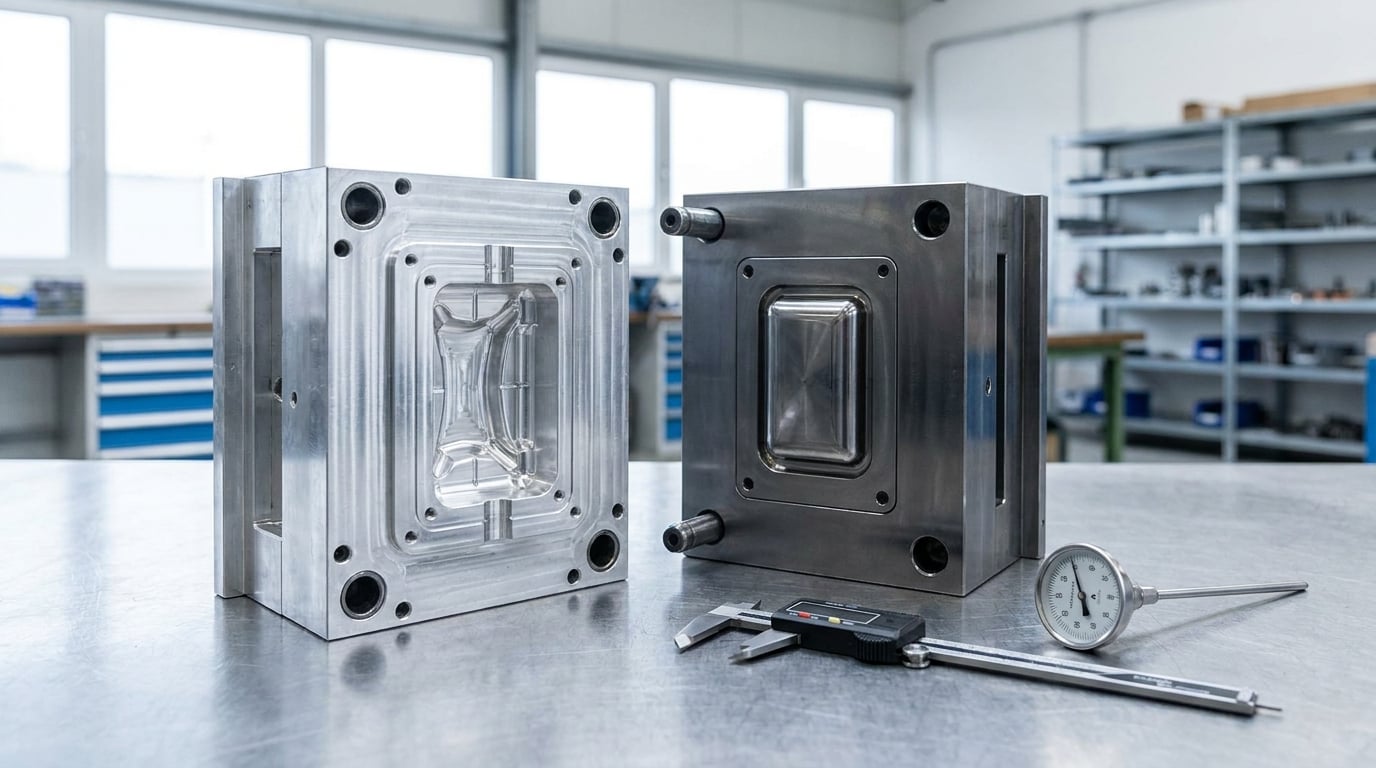
The short version: aluminum tooling is cheaper, faster to machine and cools the part faster, which makes it the right call for prototypes, short runs and thermoforming. Steel tooling costs more up front and takes longer to build, but it holds its dimensions and resists wear through hundreds of thousands of shots, which is why high-volume injection molding and die casting still run on steel.
Neither material is universally better, and most of the arguments you will find online compare them unfairly. What you are really choosing is how much of the part’s accuracy and surface quality you want the tool to hold, and for how many cycles.
One thing worth saying up front: this is injection and forming tooling, not casting metallurgy. Searches for the disadvantages of aluminum extrusion or the best metal for casting land on the same results page, and they are asking about different processes entirely.
Table of Contents
- Aluminum vs Steel Molds at a Glance
- What Is the Difference Between Aluminum and Steel Molds?
- Aluminum vs Steel Mold Cost
- Aluminum Mold Pros and Cons
- Steel Mold Pros and Cons
- Which Material Handles Heat and Cooling Better?
- How Do Mold Materials Affect Accuracy and Surface Finish?
- Aluminum or Steel for Injection Molding, Thermoforming, and Die Casting?
- How to Choose Between Aluminum and Steel Molds
- Aluminum vs Steel Molds: Which Should You Choose?
- Frequently Asked Questions
- Conclusion: Choose for the Production Requirement
Aluminum vs Steel Molds at a Glance
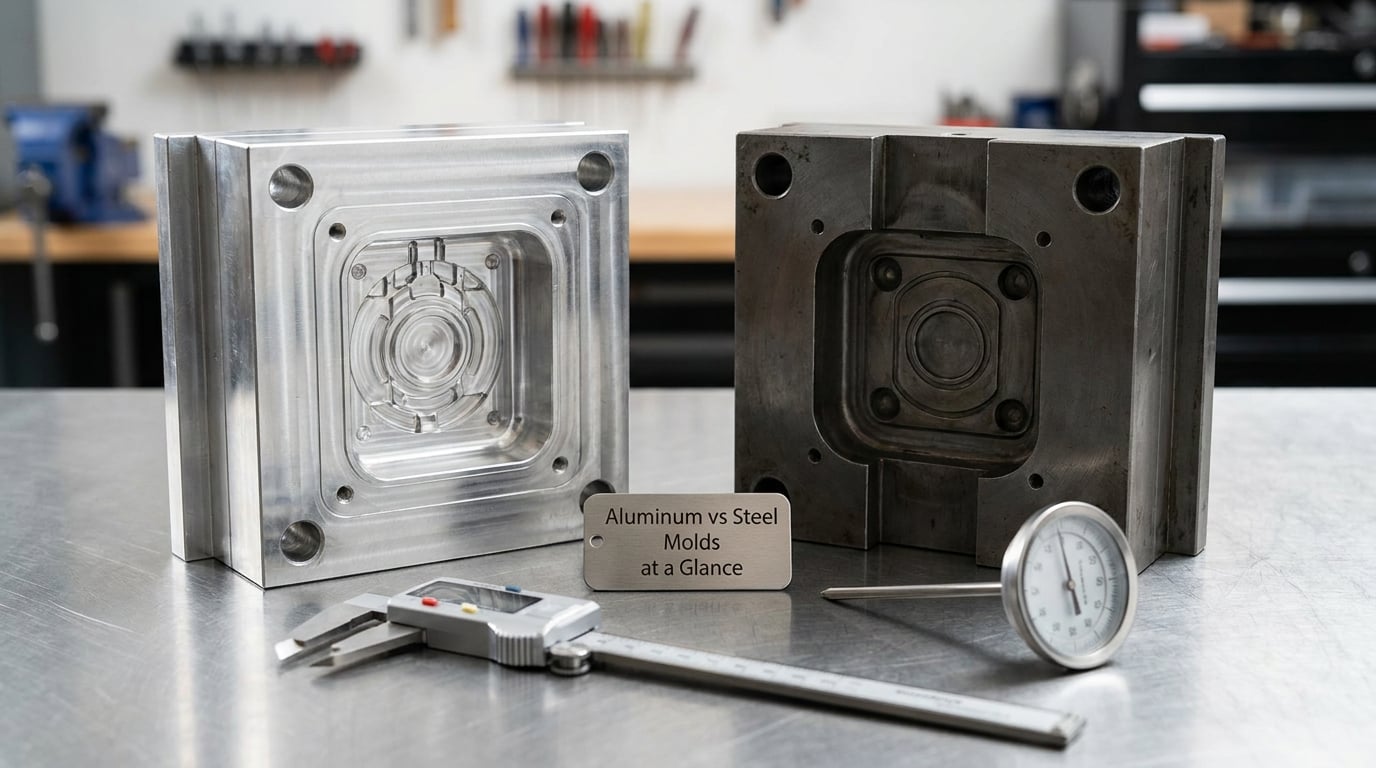
| Criterion | Aluminum | Steel |
|---|---|---|
| Material cost | Lower per pound and no heat treatment cycle | Higher, plus hardening and stress relief |
| Machining speed | 3 to 10 times faster to cut | Slow; EDM time is a large share of the build |
| Build lead time | 4-6 weeks small parts, 6-10 weeks large | 6-8 weeks, 8-12 large, plus 2-10 weeks for hardened grades |
| Tool life | 2,000 to 10,000 parts typical | 100,000+ parts, 1,000,000+ when hardened |
| Thermal conductivity | 130-160 W/m K | 29 W/m K for P20 |
| Weight | Roughly one third of steel | Heavier to machine, move and press-align |
| Dimensional stability | Expands about 23e-6 per K | About 12e-6 per K, tighter repeatability |
| Wear resistance | Good to about 150-190 HB Brinell before edges break down | P20, NAK80, H13 and 420 stainless cover the full range |
| Abrasive resin | Poor; glass fiber eats gates and cavity detail | Good with hardened or stainless grades |
| Design modification | Easy to add or cut material later | Possible, but welding risks temper and distortion |
| Corrosion | Coating or plating usually specified | Stainless available for food, medical and wash-down use |
| Best volume fit | Under roughly 50,000 units | Above roughly 100,000 units |
| Natural process fit | Thermoforming, prototypes, bridge production | Injection molding, die casting, overmolding |
Read that last row first, because it settles most arguments. If your process is thermoforming or die casting, you are choosing between mold families that were never really interchangeable in the first place.
What Is the Difference Between Aluminum and Steel Molds?
A mold is a heat exchanger with a shaped surface. Steel tooling is made from tool steels such as P20, a pre-hardened grade that machines well and resists wear; NAK80, which polishes to a fine SPI A-1 finish; H13, a hot-work tool steel for high-temperature applications; and 420 stainless where corrosion or medical contact matters.
Aluminum tooling comes from high-strength pre-hardened alloys. Al7075-T6 is the common structural choice, and QC-10 and Alumold are the pre-machined mold plate alloys built for this job. They arrive hard enough to cut a cavity, which means no distortion while the tool is being finished.
There is one more piece of context that changes how the comparison gets read. Most tools called aluminum molds are hybrids: a steel mold base, clamp plates, guide pins, bushings and an ejector system, with aluminum cavity inserts. The real decision is about cavity inserts, not the whole tool. Vendors quoting wildly different cost ratios for the same part are often quoting different numbers of cavities or different base configurations.
Aluminum vs Steel Mold Cost
Steel is more expensive to buy, but the gap is far smaller than most pages claim. One US shop puts the steel premium at 20-30% over aluminum for a comparable part, while offshore vendors quote 3 to 4.5 times. Both can be right because the ratio is driven by complexity, cavity count, region and whether heat treatment is included.
The honest cost model has five parts, and only the first is the material itself:
- Material and plate. Aluminum plate costs less per pound and skips the buyer’s cost of a pre-hardened grade that still has to be heat treated to full hardness.
- Machining and finishing. Aluminum cuts three to ten times faster, so labor hours drop sharply. This is often the largest single saving on a simple part.
- Heat treatment and EDM. Hardened steel adds a thermal cycle that can distort a large cavity, which means the tool is stress relieved and often cut by EDM afterward. Aluminum skips all of it.
- Maintenance and repair. Steel needs polishing, retexturing and re-shimming far less often. Aluminum needs rework sooner.
- Replacement. An aluminum tool replaced twice before a steel tool would be retired is the cost that quietly kills the savings.
The crossover most shops land on for non-abrasive resins sits between 40,000 and 60,000 parts. Below that band, the cheaper build and the lower per-part amortization usually favor aluminum. Above it, steel’s longer life wins. Practitioners are careful to add that the crossover is never a fixed shot count, and they are right.
Aluminum Mold Pros and Cons
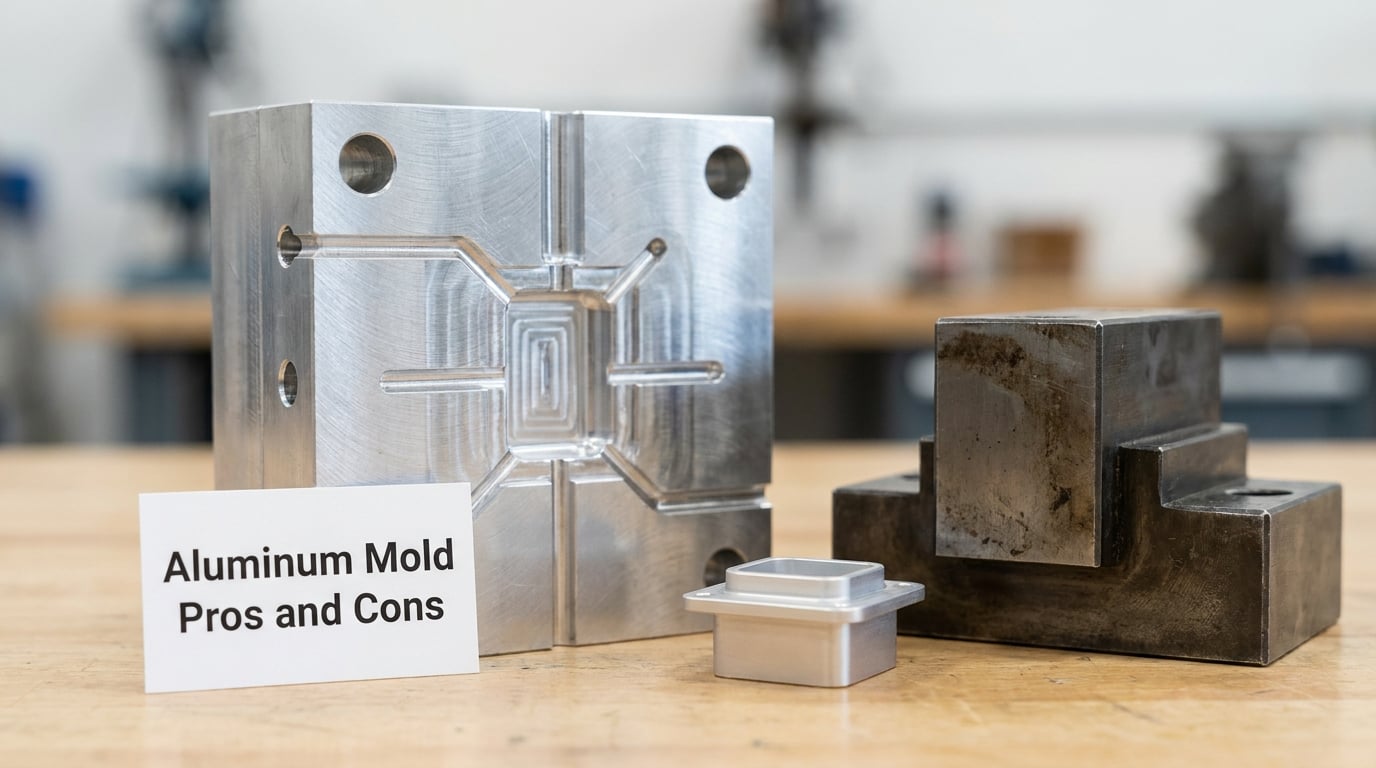
Aluminum wins on four things, and it wins them by wide margins.
It machines three to ten times faster than tool steel, which is where most of the cost and lead-time advantage comes from. It weighs about one third as much, so handling, press setup and moving the tool to a larger press are all easier. It is easy to modify, because you can add or remove material without the risk of cracking that comes with welding hardened steel. And it conducts heat roughly five times better than P20, so the part cools faster and the cycle can shorten.
The costs are just as real. Aluminum is roughly half as hard as tool steel, so edges and gates wear under abrasive resins, and glass fiber has been known to cause dimensional drift in a tool after about 15,000 shots. It expands about twice as much as steel over the same temperature swing, which can open a parting line and produce flash that a steel tool would hold. Welding it is genuinely risky: laser welding introduces porosity and can leave the local area roughly 40% softer than the surrounding tool.
That last point matters more than most pages admit. If your design is still moving, an aluminum tool is a good instrument for finding that out. It is a bad place to make permanent changes.
Steel Mold Pros and Cons
Steel’s case is about time, and it is the only argument that matters once a program reaches real volume.
Tool steels span a wide range of hardness, from pre-hardened P20 through NAK80 and H13 to hardened and stainless grades, so you can buy exactly the wear resistance the resin demands. They hold dimensions through hundreds of thousands of shots, resist glass-filled and mineral-filled resins that would destroy aluminum, and keep repeatability in a way aluminum cannot once the tool heats up.
What steel costs you is time and money at the front. The material and heat treatment add to the quote, the machining hours multiply, and a large cavity may need stress relief before and after hardening to stay within tolerance. Lead time stretches further for hardened grades. Modifications are harder, because welding can temper the surrounding tool and let it move.
There is also a quieter steel downside: it keeps its heat, so the cooling time term in the cycle is longer. Over a few thousand shots that is irrelevant. Over a few million it is a permanent line item on the machine.
Which Material Handles Heat and Cooling Better?
Aluminum. That is the plain answer, and it comes down to conductivity: 130-160 W/m K against 29 W/m K for P20, with beryllium copper available as a faster option for localized cooling in either material.
Faster cooling shortens the cooling term in the cycle, and the usual claim is a 30-40% cycle reduction. Treat that as an upper bound. Cycle time is the sum of injection, packing, cooling and ejection, and wall thickness, resin choice, channel layout, mold temperature and ejection balance all move the other terms. On a thin-wall part, aluminum can transform the cycle. On a thick part with a long flow path, it barely registers.
The double edge is worth planning for. Fast cooling of semi-crystalline resins such as polypropylene and nylon can lock in uneven shrinkage, and practitioners on injection molding forums report exactly that problem, along with a related concern about whether an aluminum insert can stay properly located in a steel fixture as the two metals grow at different rates.
How Do Mold Materials Affect Accuracy and Surface Finish?
Stiffness sets your repeatability. A softer tool moves under clamping pressure and deflection at the gate, so the part you get at shot 50,000 is not dimensionally the part you got at shot 500. Steel holds a stiffer frame, which is why tight-tolerance programs still end up in steel even when the volume looks moderate.
Thermal growth is the second factor. Aluminum’s higher expansion rate, roughly 23e-6 per K against 12e-6 for steel, changes cavity size as the tool heats. On a tight flash spec, a source in the research describes this producing around 0.03 mm of flash. Polished aluminum can also hold a very fine finish, and NAK80 and stainless hold theirs better over life, but the aluminum finish is the one most likely to be scuffed by a misplaced part or a knock during insert changes.
Texture transfer behaves the same way. A grain or texture that reads perfectly at first inspection on aluminum drifts as the cavity surface wears, and the drift shows up as a cosmetic defect long before it becomes a dimensional one.
Aluminum vs Steel Molds Pros and Cons for Accuracy and Finish
Choose steel when the part has a tight flash or shutoff requirement, a fine cosmetic surface that must stay consistent, or a tolerance the program cannot afford to see drift. Choose aluminum when the part is functional, tolerances are loose, and you would rather spend the money on cavity count than on tolerance capability.
Aluminum or Steel for Injection Molding, Thermoforming, and Die Casting?
For thermoforming, aluminum is the default. The process is dominated by heat transfer, the tooling sees moderate pressure, and the parts involved are usually short-run or prototype work. Steel shows up in thermoforming only for very large, high-pressure or high-repeat thermoformers where the tool takes a beating.
For prototypes and bridge production, aluminum is close to the default. You get a tool in weeks, run the validation builds, and let the design settle before committing to production steel. Practitioners note that teams are increasingly opening steel tools even for prototypes, and while that produces excellent parts, a few people in the injection molding community call it wasteful given how few shots the tool will see.
For production injection molding, steel is the default, especially above 100,000 units or with glass-filled resin. For die casting, steel is not a preference; it is the tool material, because the pressures and temperatures are outside what aluminum tolerates.
For overmolding and two-shot work, the answer depends on which process bonds the layers. Chemical and mechanical bonding both work in steel tools, and multi-shot thermal history argues for the stiffer, more stable material. The compromise many shops land on is hybrid tooling: steel inserts for the gate, shutoff and detail features that take wear, aluminum for the larger body of the cavity where cooling and machining speed matter.
How to Choose Between Aluminum and Steel Molds
Seven questions settle almost every case:
- What is the real part volume, and how confident are you in it? Volume under 50,000 with an unsettled design favors aluminum. Confident volume above 100,000 favors steel.
- Is the resin abrasive? Glass-filled, mineral-filled and carbon-filled resins decide this on their own.
- What temperature does the resin need? High-temperature engineering resins such as PEEK and PPS push toward steel.
- How tight are the tolerances and the flash spec? Tighter than a normal cavity-plus-steel-shim tolerance calls for the stiffer frame.
- Does the part weight and wall thickness leave room for a cooling advantage? Thin walls benefit from aluminum; thick parts do not.
- How likely is the design to change? Changes on an aluminum tool are cheap. Changes on hardened steel are not.
- Can your team maintain it? Aluminum needs more frequent attention, and a tool nobody services between now and the end of the program is a tool that will not hit its rated life.
When you request quotes, give the supplier the annual usage estimate, the resin with its filler content, the tolerance you need held over life, the surface finish class, and the design’s stability. Shops describe P20 and A-2 as forgiving to machine and stable in heat treat, so a clear spec gets a clear answer. A quote with no rationale behind it is the thing forum users complain about most often.
Two mistakes come up repeatedly. The first is committing steel capital before the design or the demand is proven. The second is the opposite: running glass-filled resin through aluminum because the tool was already built and watching the gate wear into the dimensional spec.
Aluminum vs Steel Molds: Which Should You Choose?
Choose aluminum for prototypes and design validation, for short runs under roughly 50,000 parts, for thermoforming, and for any program where the design is still moving. Choose steel for high-volume injection molding above 100,000 parts, for die casting, for abrasive and high-temperature resins, and for parts with tight tolerances and cosmetic surface requirements.
For a program heading somewhere in the middle, run the math with both numbers in front of you rather than arguing the material. Take the quoted build cost for each, divide by the expected volume, and add the maintenance and replacement expectation. The crossover for non-abrasive resins sits somewhere around 40,000 to 60,000 parts, and that is a starting point for the conversation rather than a rule.
And keep the hybrid option open. Plenty of the best answers in this topic are a steel mold base with steel inserts in the wear zones and aluminum where speed and cooling matter. Tooling decisions get easier when you stop treating them as a vote for one material.
Frequently Asked Questions
Are aluminum molds suitable for injection molding?
Yes, and they are used commercially for prototypes, bridge production and short runs under roughly 50,000 parts. Aluminum machines fast, cools the part faster and costs less to build, which makes it a good fit for a non-abrasive resin such as polypropylene or ABS. It stops being the right choice when the resin is glass-filled, the volume climbs, or the part needs tight tolerances held across hundreds of thousands of shots.
What is the difference between aluminum and steel mold costs?
Steel costs more up front, but published ratios vary from about 20-30% to as much as 3 to 4.5 times depending on region, complexity and cavity count. The gap is not all material: steel adds heat treatment, stress relief and often EDM time. Over the life of a program, steel usually costs less per part once volume passes roughly 40,000 to 60,000 parts.
Which material is better for thermoforming molds?
Aluminum, almost always. Thermoforming is dominated by heat transfer rather than clamp pressure, and aluminum conducts heat roughly five times better than P20 steel, so the sheet releases faster. Steel appears only in very large or high-repeat thermoformers where the tool takes mechanical abuse that aluminum would not survive. There is no realistic case where aluminum is the wrong answer here.
How long do aluminum and steel molds last?
A typical aluminum tool is built for 2,000 to 10,000 parts, though a well-designed aluminum tool with hardened steel inserts in the gate and shutoff areas can go well past that. Steel tools are usually specified for 100,000 parts and up, with hardened grades reaching 1,000,000 shots or more. Abrasive resins shorten the life of both, and glass-filled nylon is often what decides the material at 8,000 to 12,000 parts.
Can a steel mold use aluminum inserts?
Yes, and it is a common way to get the best of both. Steel mold base, steel inserts at the gate, shutoff and any high-wear detail, and aluminum for the larger cavity where cooling speed and machining time matter. Most tools described as aluminum molds already are hybrids, because the mold base, clamp plates and ejector system are steel regardless of what the cavity is made from.
Which material produces better plastic part accuracy?
Steel, for repeatability over long runs. It is stiffer under clamping pressure and expands about half as much over the same temperature rise, so dimensions hold from early shots to late ones. Aluminum starts more accurate because it does not deflect, then drifts as wear and thermal growth accumulate. For loose-tolerance functional parts, that difference rarely matters; for flash and cosmetic specs, it decides the answer.
Conclusion: Choose for the Production Requirement
Aluminum is the cheaper, faster-building, faster-cooling option, and it is the correct answer for prototypes, thermoforming, short runs and designs that are still moving. Steel is the slower, heavier, more expensive option, and it is the correct answer for high-volume injection molding, die casting, abrasive and high-temperature resins, and parts that must hold tight dimensions across a long run.
Before you order anything, write down four numbers: the annual part volume, the cycle time you need, the tightest tolerance on the print, and how much maintenance the tool will realistically get. Hand those to two or three shops and ask each one to justify its material choice against the volume. A supplier who can explain the reasoning is worth more than one who simply quotes steel because that is the default. And if the honest answer sits in the middle, ask about a hybrid tool with steel inserts in the wear zones before you spend the money on a full steel cavity. As of 2026, that conversation is where most of the well-informed decisions are landing.