
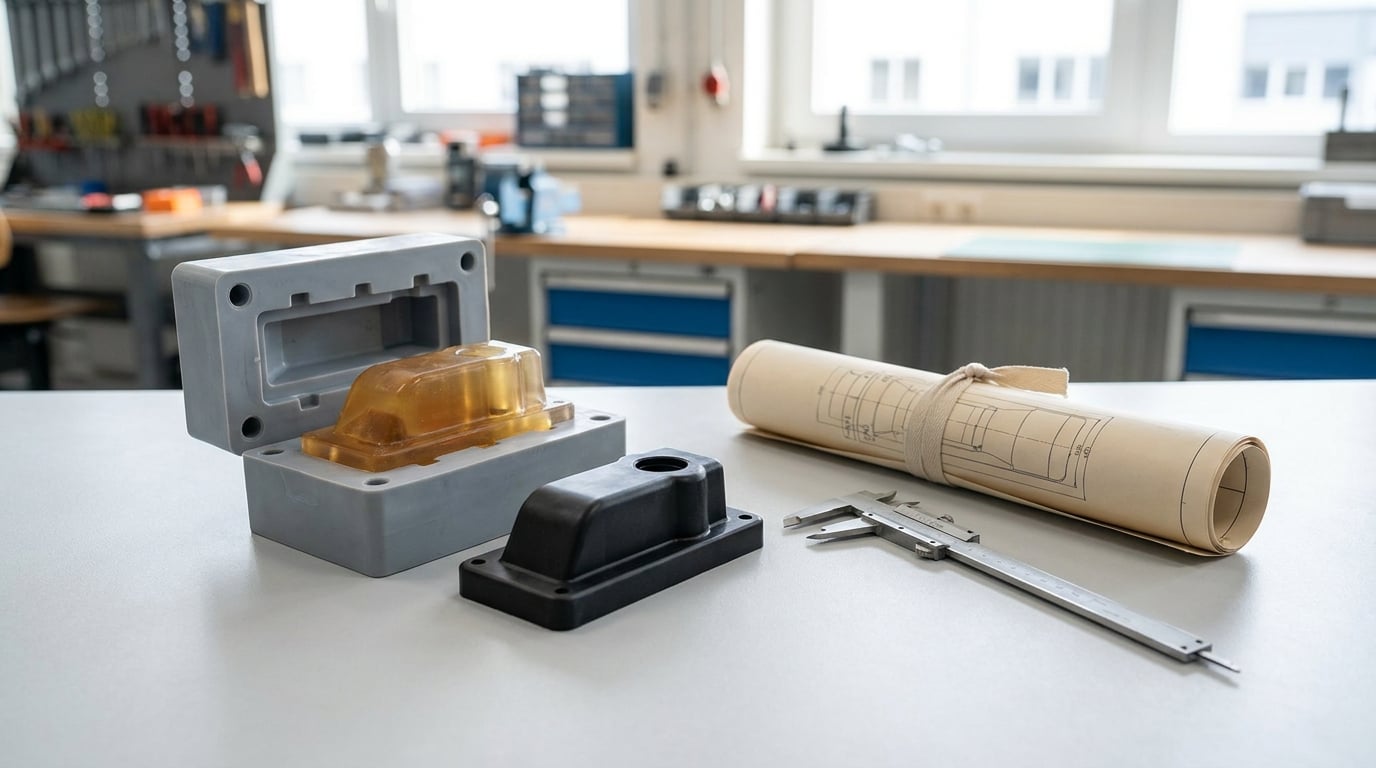
Use urethane casting instead of molding when you need a few hundred parts or fewer, the design is still moving, tolerances can live at roughly plus or minus 0.005 to 0.02 inch, and the geometry has a clean demolding path. Switch to molding when the part is standardized, the volume is committed in the thousands, and repeatability matters more than speed.
That is the short version. The longer version comes down to three numbers: how many parts you actually need, what one-time tooling you are willing to spend, and how tightly the part has to hold. Get those three answers from your team before you call a supplier, and the process decision practically makes itself.
The mistake I see most often is treating hard tooling as a milestone you are supposed to graduate to. It is not. Plenty of parts should never leave the silicone mold, and a few should never enter it.
Last reviewed for 2026.
Table of Contents
- When to Use Urethane Casting Instead of Molding at a Glance
- What Is the Difference Between Urethane Casting and Molding?
- Tooling and Upfront Cost
- Production Volume and Per-Part Economics
- Part Geometry, Complexity, and Design Changes
- Materials, Flexibility, and Performance
- Lead Time, Scale-Up, and Repeatability
- Quality, Finish, and Inspection Considerations
- When to use urethane casting instead of molding for appearance-sensitive parts
- Which Should You Choose?
- Frequently Asked Questions
- What are the key differences between urethane casting and injection molding?
- What is the difference between molding and casting?
- Can you cast urethane?
- Can urethane casting be used for production parts?
- What tolerance can you get with urethane casting?
- What are the downsides of urethane casting compared to molding?
- When should you move from urethane casting to injection molding?
- Conclusion
When to Use Urethane Casting Instead of Molding at a Glance
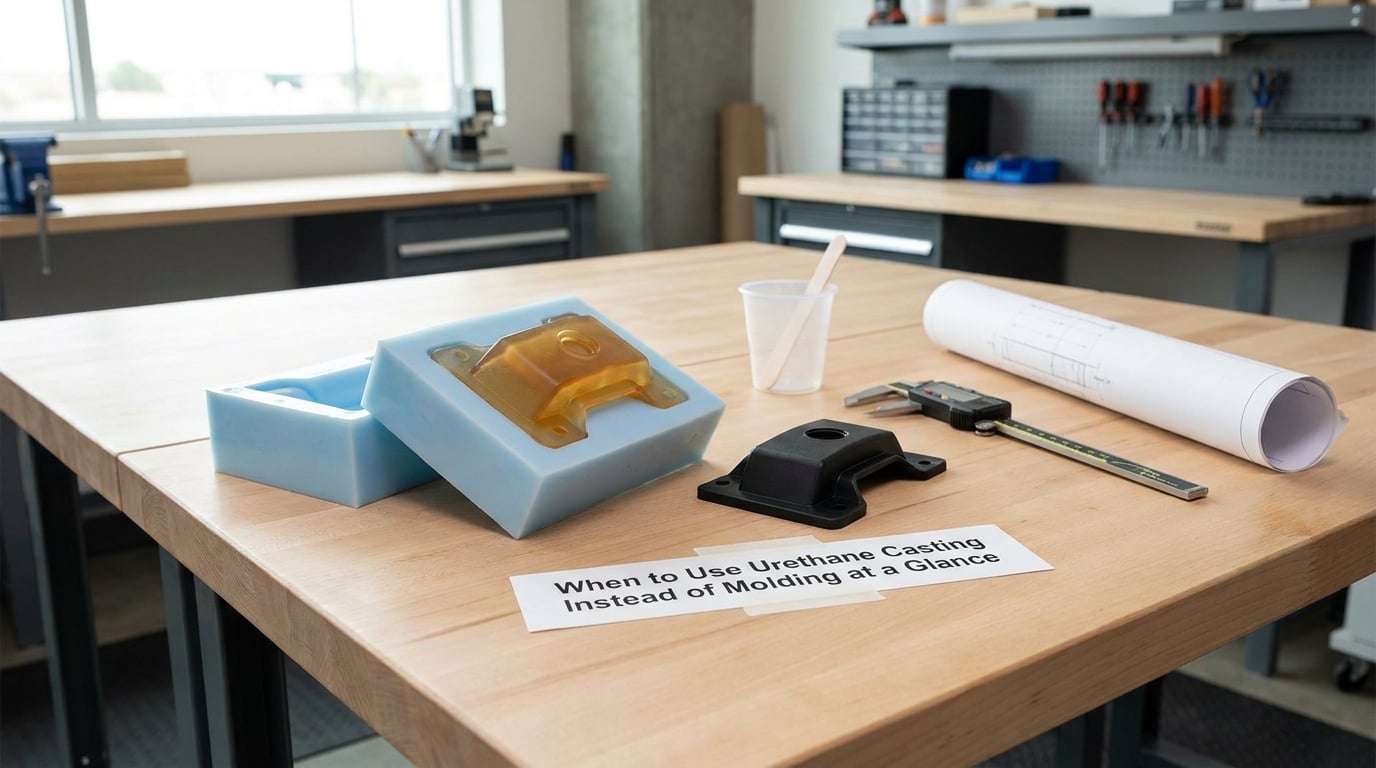
Choose urethane casting when volume, timing and design uncertainty all point the same way. Choose molding when the part is frozen and the volume is real. The table below lays out the differences that actually drive the decision.
| Factor | Urethane Casting | Molding (injection, compression, rotational) |
|---|---|---|
| Best fit | Prototypes, pilot runs, short-run spares, complex geometry | Standardized parts in committed, repeatable volume |
| Tooling | Silicone rubber mold from a machined or printed master | Dedicated aluminum or steel tool, cut for production |
| Typical volume band | One part to a few hundred | Thousands and up |
| Tooling lead time | Days | Weeks |
| First article | Fast; master plus mold plus cure | Slow; tool cut, machine set, first shot, corrections |
| Each additional part | Minutes to an hour, mostly labor and cure | Seconds, mostly machine time |
| Dimensional accuracy | About plus or minus 0.005 to 0.02 inch with good mold design | Comparable or tighter on the critical features, held shot to shot |
| Surface finish | Smooth, slight silicone texture, may need finishing | Consistent texture, gate or knockout marks |
| Mold life | Roughly 20 to 100 pulls before rework or replacement | Tens of thousands to hundreds of thousands of shots |
| Material range | Flexible, semi-rigid and rigid elastomers, wide durometer range | ABS, nylon, polycarbonate, polypropylene, composites |
| Impact and abrasion | Very tough, absorbs shock, wears slowly | Stiffer, harder, sometimes brittle depending on resin |
| Design changes | Cheap; cut a new master and make a new mold | Expensive; modify or re-cut the tool |
| Cost shape | High per part, low upfront | Low per part, high upfront |
Read the mold life row twice. A silicone mold is consumable tooling, and treating it as if it were a hard tool is how people end up with an unpleasant surprise in the middle of a pilot run.
What Is the Difference Between Urethane Casting and Molding?
Both processes make a finished part by filling a shaped cavity. The difference is what the cavity is made of, what goes into it, and how many times you can use it.
Urethane casting starts with a master model, usually CNC machined or SLA printed, that captures your geometry in finished form. A silicone rubber mold is made against that master, cured, and trimmed. Liquid urethane is then mixed, poured or vacuum drawn into the mold, cured, and the part is demolded and finished. Yes, you can cast urethane, and it is a genuinely repeatable process, not a rough approximation.
Molding uses a dedicated hard tool in steel or aluminum. Molten thermoplastic resin is injected under pressure, flows to fill the cavity, cools, and the part is ejected. The same tool then makes the next part, and the ten-thousandth, with almost identical dimensions.
That difference in cavity material explains almost everything else. Silicone is soft, cheap and fast to make, and it can capture fine detail. It also wears out, it flexes, and it cannot release a feature that locks the part inside. Hard tool steel is rigid, holds tolerance indefinitely and survives a punishing cycle time, but it costs far more and takes weeks to cut.
Neither process is universally better. One trades durability for speed and flexibility. The other trades upfront cost for repeatability.
Tooling and Upfront Cost
Casting is cheap to start because the tooling is soft. A printed or machined master plus a silicone mold and a setup charge is a fraction of what a production tool costs, and it arrives in days.
Molding is expensive to start because the tool is engineered for a specific part, cavity count, machine and cycle. It is also largely irreversible. Once that steel is cut and hardened, changing the geometry means modifying or replacing it.
Consider a handheld product where you are still working out the grip. Round it off, cast twenty parts, hand them to three users, and watch where thumbs land. Two weeks later the housing is different, and you are making another master and another mold. That is the loop casting was built for, and the cost of running it several times is still a fraction of a single tool cut.
The same product, frozen and shipping in volume, is a terrible casting candidate. You would be paying per-part labor forever, replacing silicone molds every few dozen pulls, and chasing consistency you do not need to chase.
Production Volume and Per-Part Economics
The economic crossover has a formula, and it is worth five minutes with a calculator. Compare total cost at N parts for each process.
Total casting cost equals the number of silicone molds you need times the cost per mold, plus N times the cost per cast part including labor. Molding cost is the tool plus N times the cost per molded part. Setting those equal gives you the break-even quantity.
Here is where people get their expectations wrong. Run honest numbers and the pure per-part crossover often lands far lower than the volume you are actually contemplating.
| Scenario | Tooling cost (relative units) | Cost per part, cast | Cost per part, molded | Breaks even at |
|---|---|---|---|---|
| Small complex part, high labor content, 40-pull molds | 1 | 6.0 | 1.0 | About 10 parts |
| Large simple part where casting labor dominates | 1 | 1.2 | 1.0 | About 200 parts |
| Mid-size part, moderate per-part gap | 1 | 2.0 | 1.0 | About 50 to 100 parts |
Read across the last column. The crossover is driven almost entirely by the gap between the cast and molded per-part cost, and that gap shrinks as parts get bigger and labor stops dominating. The tool size pushes the number up; the per-part gap pushes it down.
So why does the practical threshold usually sit in the hundreds rather than the tens? Forecast confidence, not arithmetic. Nobody commits to a hard tool for a design with three open engineering changes, and a cast run is a paid design-validation step as much as it is a supply decision. Practitioners describe the same workflow over and over: cast urethane first to prove the design, then tool for production.
Two things will move your number. A short silicone mold life means you buy several molds, which pushes casting cost up. A large, complex part pushes the tool cost up, which pushes molding cost up. Both belong in the spreadsheet, and neither is guesswork.
Real quotes vary with geometry, material, volume, finish and supplier capability. Use the formula to reason, then use quotes to decide.
Part Geometry, Complexity, and Design Changes
Geometry is the least forgiving criterion, and it is where designs quietly fail after the master is already machined.
When to use urethane casting instead of molding for complex shapes
Use urethane casting instead of molding for complex shapes when every undercut has a demolding path and every enclosed region has an opening. The test is simple: draw the direction the part must move to come out of the mold, and check that nothing hooks back against it. If you can slide the part off in one direction without forcing or cutting, silicone can hold it.
What cast urethane does well is detail. Fine ribs, sharp text, texture, thin logos and draft-free surfaces all reproduce faithfully, because silicone conforms to whatever the master carries. The same flexibility is the problem: a rigid silicone mold has to flex to release a locked feature, and it will tear at the corner instead.
Things to watch when specifying a cast part: add draft to walls that run parallel to the pull direction, avoid fully enclosed volumes such as a sealed hollow shell with no opening, keep wall thickness consistent, and set up venting so air can escape the last corner to fill. Thin walls need pressure control; vacuum casting handles them better than an open pour.
Molding standardizes the details instead. A hard tool enforces draft, consistent radii and uniform wall thickness, then holds those dimensions across an entire production run. For a standardized part that ships by the pallet, that predictability is the whole point.
Materials, Flexibility, and Performance
Material choice is often the real reason casting wins at medium volume, and it is the argument most often left out of these comparisons.
Cast urethane comes in a wide durometer range, from soft and flexible through semi-rigid to rigid, with most prototyping work landing in the 60A to 90A area. It takes abrasion far better than ABS or polypropylene, absorbs impact without cracking, and is genuinely tough. Reviewers and practitioners regularly report cast parts feeling tougher and standing up to more abuse than the injection-molded equivalent they had in mind, which sometimes justifies keeping the casting process longer than planned.
Insert molding and overmolding are straightforward in urethane, so metal studs, threaded inserts, seals and electronics can be captured in place. If your part needs a soft grip, a bumper, a seal or a vibration mount, molding in a rigid resin and adding a secondary elastomer is a more expensive and more complicated assembly.
Molding offers the opposite profile. Resin families such as ABS, nylon, polycarbonate and polypropylene bring long-term dimensional stability, low creep, a wide range of stiffness, and proven regulatory grades for medical, automotive and food contact. If your part must hold a dimension over years in a hot car or a sterilizable environment, validate the material before you validate the process.
The service conditions decide this, not preference.
Lead Time, Scale-Up, and Repeatability
Casting wins the first month almost every time. The master can be printed, the mold made and a functional part in hand within days, and each additional part takes as long as the cure and the finish work.
Molding wins the tenth month. Once a tool is proven, cycle times are measured in seconds, and batch consistency is a solved problem that a supplier runs every day.
The practical middle ground is bridge production. Make the first several hundred parts in urethane while the steel or aluminum tool is being cut, then switch over once the tool is validated. This is a well-established pattern, and it is the answer to the most common question on manufacturing forums: yes, running a cast prototype run before committing to injection tooling is worth it, because it fills real demand and pays for itself as a design validation exercise.
Cast parts also earn their place in places molding never reaches: assembly fixtures, jigs, handling tools, ergonomic models for user testing, appearance samples for trade shows, and low-volume spare parts for equipment that is no longer in production.
Be honest about consistency when you choose. Within a single mold and a well-run pour, parts match well. Across a replacement mold, expect small shifts, and plan inspection accordingly. Suppliers vary widely in how they handle this, so ask specifically what they measure and what their process capability looks like before you commit to a volume.
Quality, Finish, and Inspection Considerations
Quality is where expectations need setting. Cast urethane is not a lower grade of molded plastic; it is a different material behaving differently, and its defect modes are its own.
Expect to manage flash at the parting line, small bubbles from trapped air, occasional porosity near thick sections, slight shrinkage as the material cures, and a faint surface texture transferred from the silicone. Color consistency across molds is good but not identical, so approve a master sample rather than a photograph.
Molded parts arrive with their own list: gate marks or knockout marks, weld lines at flow junctions, flash at the tool parting line, and warpage from uneven packing. On a well-run tool these are controlled and predictable. On a casting they are managed by mold design, venting, mixing, vacuum and finishing labor.
When to use urethane casting instead of molding for appearance-sensitive parts
Use urethane casting instead of molding for appearance-sensitive parts when the finish needs to look right in a hand, but the part will never reach mass-market scrutiny. Show models, trade show samples, fit-and-form models and marketing renders photograph very well in cast urethane.
For a part that ships to customers in volume, appearance is a molding decision. Molded finish is uniform run to run, texture and gloss are controllable, and cosmetic defects are caught by a stable process rather than by hand inspection. Color also comes from pigmented resin, which is far easier to hold across large batches than pigmented liquid urethane.
If appearance is genuinely the priority and volume is not, say so early. A two-part mold with a higher-quality surface, a hand finish, or a painted or coated pass will get you closer than pouring a better master into the same silicone.
Which Should You Choose?
Use urethane casting for prototypes and design validation, for pilot runs and low-volume production, for short-run spares and aftermarket parts, for complex geometry that resists standard molding rules, and for anything that needs elastomeric toughness, a soft grip, or overmolded inserts.
Stay with molding for high-volume standardized parts, for anything where shot-to-shot repeatability is the product, for materials and finishes that only molding delivers, for tight tolerances on critical mating features held over years, and for parts destined for regulated industries with proven material grades.
There is a third option worth naming. 3D printing is faster and cheaper for fit checks, visual review and low-stress mechanism work, and CNC machining is better for tight-tolerance metal or aluminum features. Neither gives you the toughness of urethane, and neither scales. But if your part is simple and you only need three of them, printing is the honest answer and casting is overkill.
Score your project against these seven questions:
- How many parts, honestly? Under 100, casting almost always wins. Over 5,000, molding almost always wins. Between those, run the break-even formula.
- Is the design frozen? Open engineering changes argue strongly for silicone tooling.
- Does every feature release in one direction? Locked undercuts and sealed volumes disqualify a simple silicone mold.
- Do you need elastomer behavior? Flexibility, grip, abrasion and shock absorption point to urethane.
- What tolerance, and on which features? Plus or minus 0.01 inch is routine for a good casting. Tighter on a critical datum usually is not.
- How much does appearance matter? Cosmetic, in-hand finish favors casting. Uniform, high-volume finish favors molding.
- What is your real deadline? A tool cut is a multi-week commitment you cannot rush without paying more.
If you answered yes to the second and no to the third, cast. If you answered no to the second and no to the seventh, tool it.
Frequently Asked Questions
What are the key differences between urethane casting and injection molding?
Urethane casting fills a soft silicone rubber mold with liquid polyurethane, cures it, and reuses that mold for roughly 20 to 100 pulls. Injection molding fills a hard steel or aluminum tool with molten thermoplastic resin under pressure, cools, ejects, and repeats for tens of thousands of shots. Casting wins on tooling cost, lead time, toughness and design flexibility. Molding wins on per-part cost, repeatability, material range and cosmetic consistency.
What is the difference between molding and casting?
Casting forms a part by letting a liquid material solidify in a cavity, so the cavity only has to release the part once per cycle. Molding also forms a part in a cavity, but the tool is engineered to release it tens of thousands of times with consistent dimensions. In practice that means a soft consumable mold and per-part labor for casting, versus hard durable tooling and machine time for molding.
Can you cast urethane?
Yes. You need a master model, usually CNC machined or SLA printed, to make a silicone rubber mold, and then liquid urethane you mix and pour or vacuum draw into it. The mold cures, the part cures, and you demold and finish it. The same process handles insert molding and overmolding, so metal studs, threaded inserts and seals can be captured in place during the pour.
Can urethane casting be used for production parts?
Yes, but define what you mean by production. Cast urethane is widely used for pilot runs, bridge production while a hard tool is being cut, short-run spares, fixtures and aftermarket parts. Those are real orders, not throwaway prototypes. What it is not suited to is thousands of identical consumer parts at a low per-part cost, because each one carries labor and the mold keeps wearing out.
What tolerance can you get with urethane casting?
A well-designed silicone mold with careful mixing, venting and cure usually holds about plus or minus 0.005 to 0.02 inch. Shrinkage during cure and slight mold flex are the main sources of variation, so hold the important dimensions on features that are not thin or unsupported. If you need tighter than that on a mating feature, either machine that feature after casting or move to molding.
What are the downsides of urethane casting compared to molding?
Silicone molds are consumable and typically give only 20 to 100 good pulls before they need rework or replacement. Every part carries labor rather than machine time, so the per-part cost stays high at volume. Mold life, part consistency across a replacement mold, and cosmetic color matching all take more management than a running hard tool.
When should you move from urethane casting to injection molding?
Move when the design is frozen, the volume is committed, and you have validated that cast parts pass functional testing. A common trigger is simply running out of molds faster than the tool is ready. Bridge production handles that window: make the first few hundred parts in urethane while the aluminum or steel tool is cut, then switch once the tool is proven.
Conclusion
When to use urethane casting instead of molding comes down to a short list: you need parts now, you need fewer than a few hundred, the design is still changing, the part wants to be elastomeric, or the geometry is complex enough that soft tooling is the practical way to make it. Every one of those conditions points the same direction.
If none of them apply, tool it. A hard mold that runs for years is not an expense to avoid, it is an asset that quietly lowers your cost per part for as long as the product exists.
Your first step is unglamorous and decisive: write down the part geometry, the real annual volume, the material requirements, the tolerances, the finish and the date the parts are needed. Then send the same package to a qualified casting supplier and a qualified molding supplier and compare the quotes side by side. That comparison answers the question faster than any article, including this one.
Updated for 2026.