
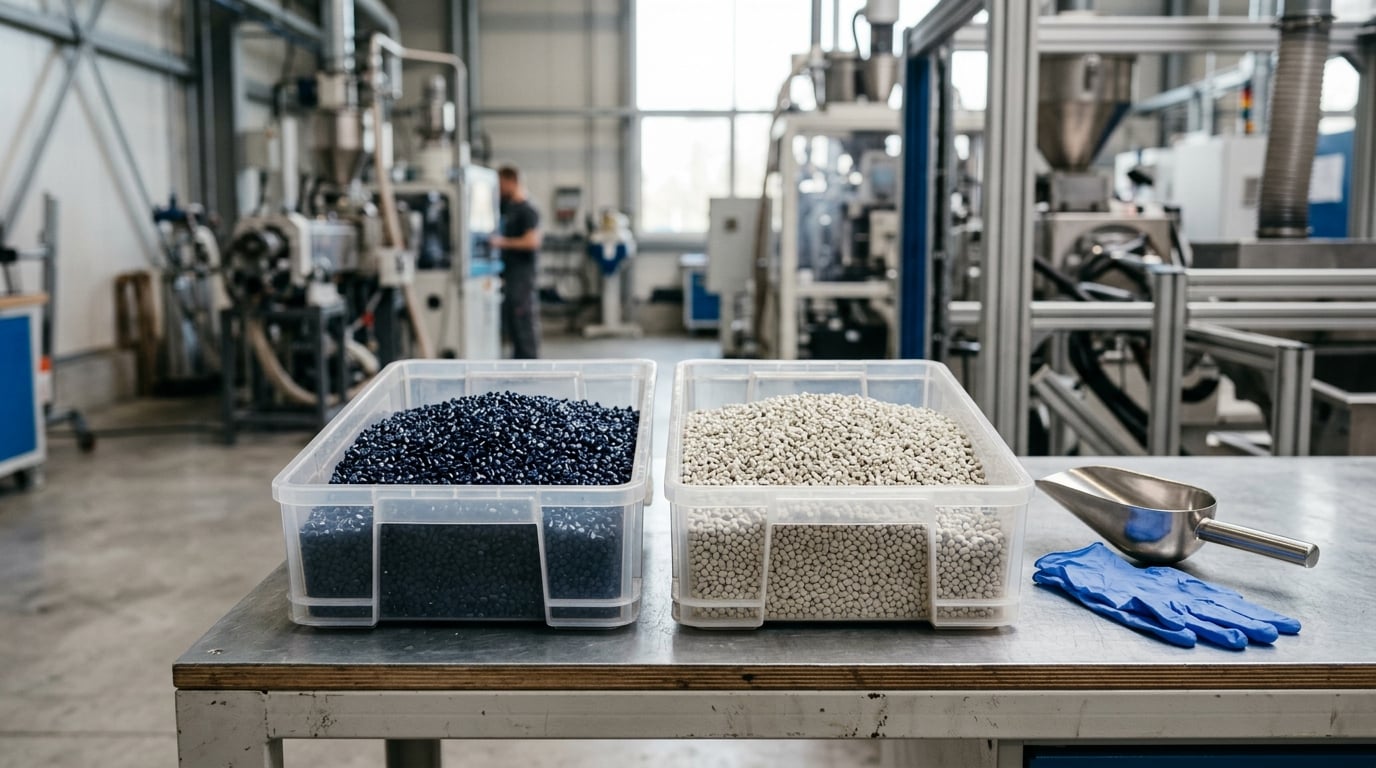
Short version: precolored resin wins on color consistency and simplicity, color masterbatch wins on cost, color count and flexibility. Most molding shops run masterbatch for the bulk of their work and precolored resin for the parts where a customer will reject a lot over a shade.
I have watched this argument play out in both directions. A plant ran everything on masterbatch and fought a cosmetic customer for two years. Another bought precolored for every color and watched inventory costs climb until they could not justify the colors that sold slowly. Neither approach is wrong on its own; the decision depends mostly on how many colors you run, how often you change them, and how fussy your customers are.
This guide covers the technical differences between the two materials, the real cost math including the 20 to 30 percent premium compounders typically charge for precolored resin, and a step-by-step way to pick the right one for your application. It reflects how the choice looked in 2026 for injection molders, packaging producers and procurement teams.
Table of Contents
- Color Masterbatch vs Precolored Resin at a Glance
- What Is the Difference Between Masterbatch and Precolored Resin?
- Color Control and Consistency
- Cost and Purchasing Flexibility
- Processing, Changeovers, and Production Efficiency
- Color Masterbatch vs Precolored Resin: Which Is Better?
- Quality, Storage, and Supply Chain Considerations
- How to Choose for Your Application
- Which Should You Choose?
- Frequently Asked Questions
- Conclusion
Color Masterbatch vs Precolored Resin at a Glance
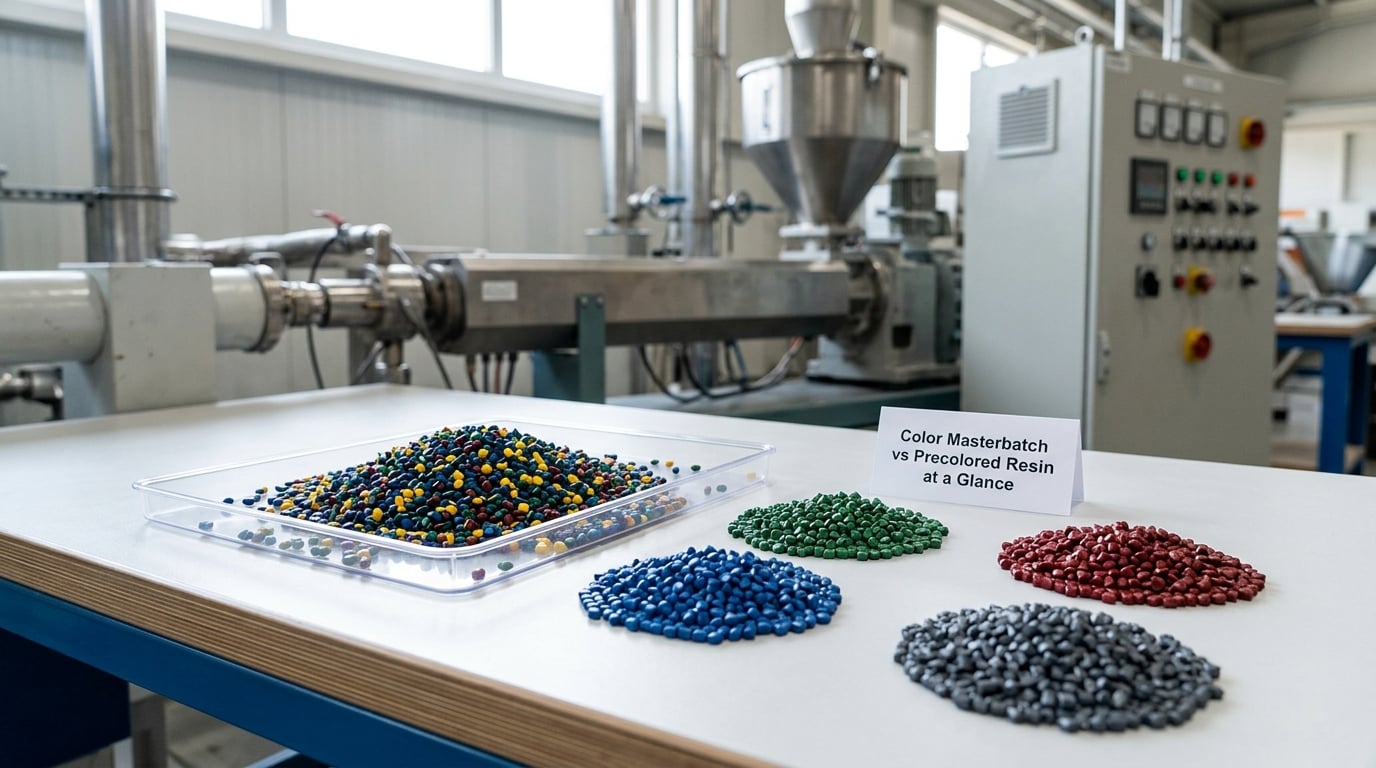
The short difference is that masterbatch gets its color at your machine, and precolored resin already has it before it arrives. Here is the side-by-side on the criteria that actually move the decision.
| Criterion | Color masterbatch | Precolored resin |
|---|---|---|
| Where color is added | At the press, by dosing concentrate into natural resin | At the compounder, on a twin-screw line before delivery |
| Color control | Adjustable at the machine; you set the let-down ratio | Fixed per formulation; you buy the color as specified |
| Batch-to-batch consistency | Good, but dependent on feeder calibration and mixing | Tightest available, since the same compounding run repeats |
| Purchase and storage cost | Lower per unit, plus a dosing setup and color inventory | Roughly 20 to 30 percent premium on material, fewer SKUs on hand |
| Processing flexibility | High: run many colors off one natural resin grade | Low: each color is a separate material to schedule and rotate |
| Changeover time | Longer: purge between colors, feeder cleanout, restart | Fast: run color to color with a short purge or none at all |
| Minimum order quantity | Often a few bags to a drum, depending on the supplier | Mill minimum commonly around 500 kg per custom color |
| Color-change capability | Add or swap a concentrate in minutes once approved | New color means a new compounding run and a new lead time |
| Logistics | Natural resin in bulk, small concentrate shipments | Larger freight volume per project, tied to supplier schedules |
| Best fit | Many colors, frequent changeovers, lower volume per color | Cosmetic critical parts, high volume per color, few colors |
What Is the Difference Between Masterbatch and Precolored Resin?
Color masterbatch is a concentrated pellet made of pigment dispersed into a carrier resin, added to natural resin at your machine. Precolored resin is the same base resin with pigment already compounded in by the supplier, delivered ready to mold.
A color masterbatch typically carries 20 to 40 percent pigment by weight. You let it down into natural resin at 2 to 4 percent, meaning a 2 percent let-down ratio needs two kilos of masterbatch for every 98 kilos of natural resin. The carrier resin should match your base resin, because a mismatch changes viscosity, shrinkage and impact strength in ways that show up later in assembly.
Precolored resin goes through a twin-screw compounder first. Pigment, carrier and base resin are combined and dispersed under heat and shear until the dispersion is tight, then pelletized. What arrives at your hopper is finished material. Nothing gets mixed at the press, which is exactly why its color holds so steady from run to run.
One piece of terminology confuses people in the field. Some suppliers call a dry pigment powder for small-volume coloring a toner, and others use the word loosely for any concentrate. When you weigh the three routes, color stability usually ranks precolored resin first, masterbatch in the middle, and loose toner last.
Color Control and Consistency
Precolored resin gives the tightest consistency because the dispersion happens once, in a controlled compounding run, and that recipe is then repeated. Masterbatch gives the most control, because you can raise or lower the let-down ratio and shift a shade without waiting on a compounder.
Color tolerance is usually written as a Delta E value, the numeric distance between two colors measured in the CIELab color space. Common commercial practice treats anything under 1.0 as effectively indistinguishable, under 2.0 as a normal working tolerance for molded parts, and above 3.0 as a visible difference most customers will notice.
Three things make a technically in-spec lot still look wrong. Metamerism means the two colors match under one light source and diverge under another, which is why approvals happen in a light booth under a controlled source such as D65. Texture changes perceived color, so a gloss versus matte finish will never read identically. And wall thickness matters, because a thicker section holds more pigment per unit of surface and looks darker than a thin rib on the same part.
Multi-cavity tools add another variable. A four-cavity tool running masterbatch depends on fill consistency across all four, and a precolored tool removes one source of variance but not cavity-to-cavity flow differences. If a customer is judging the tool and not the material, approve a color on a multi-cavity shot rather than a hand-poured sample.
There is a genuine disagreement in the field worth naming. Some suppliers argue masterbatch gives more uniform color in polypropylene and polyethylene than precolored resin. The technical case runs the other way, because a compounding line disperses pigment far more aggressively than a molding machine’s plasticizing unit can. The supplier claim usually describes a masterbatch made on comparable equipment with comparable shear. Ask to see a Delta E report across three lots rather than take either side on faith.
Cost and Purchasing Flexibility
Precolored resin typically carries a 20 to 30 percent premium per unit of material over natural resin plus masterbatch. That gap shrinks as your volume per color rises, and it grows when you add the cost of purging material at every changeover.
To see where the break-even sits, index natural resin plus masterbatch at 100. A 20 percent premium puts precolored at 120 and a 30 percent premium puts it at 130. Then add the cost masterbatch imposes on you: purge material consumed at changeover, feeder calibration and lab-dip time, and a separate concentrate inventory to store and rotate.
Run the arithmetic against your own numbers rather than trusting a general rule. If purge losses on a changeover equal 3 percent of a week’s material, and you change colors weekly, the masterbatch route is carrying a real cost that erodes its advantage quickly. If you run one color for six months on a stable schedule, that same 3 percent is a rounding error and the premium is what matters.
The minimum order quantity is where precolored resin bites hardest. Custom colors commonly carry a mill minimum near 500 kg, and lead times of 2 to 4 weeks for a new color are common. A color that sells 40,000 parts a year justifies that easily. A regional color variant for one market does not, and you are likely to be holding that inventory long after the demand shifted.
Masterbatch loosens all of this. Suppliers will often ship from a few bags to a drum for an approved color, and adding a new market variant means one more approved concentrate rather than a new compounding run. The tradeoff is that you now own the dosing equipment, the feeder calibration routine and the approval process for every color you carry.
Processing, Changeovers, and Production Efficiency
Masterbatch adds a step precolored resin does not: metering. A gravimetric feeder weighs the concentrate in and corrects for the bulk-density differences between grades, while a volumetric feeder meters by volume and drifts as density changes. For cosmetic work, gravimetric is the only sane choice.
Mixing quality depends on the screw. A general-purpose screw plasticizes and mixes about as well as it stirs, and a mixing screw with added distributive elements is what breaks up pigment agglomerates. Back pressure and residence time do the rest. If the same formula looks right on the approved sample and wrong in production, screw design and back pressure are the first two things I would change.
Precolored resin runs like natural resin. No feeder, no extra mixing screw, no let-down ratio to get wrong, and throughput stays where the machine was set. That simplicity is worth a lot in a plant where one person covers changeovers on several machines.
Changeovers are where the two methods diverge most. Moving from one precolored grade to another is a hopper swap, often with no purge at all. Moving between masterbatch colors needs a purge, and purge order matters. Go dark to light, not light to dark, and give the barrel a short run before you judge the new color. Running a bright yellow through a barrel full of dark blue-green gives you streaks that look like a bad masterbatch when it is really just residue.
Over-dosing masterbatch is the other classic mistake. Past the recommended range, color strength stops improving, you waste concentrate, and the extra pigment load can raise brittleness, shift viscosity and cause visible specks where agglomerates never dispersed. Under-dosing gives weak, washed-out color that reads as a wrong pigment rather than a wrong ratio.
Color Masterbatch vs Precolored Resin: Which Is Better?
Precolored resin is better when color consistency is the product requirement and volume per color is high. Masterbatch is better when you run many colors, change often, or need formulation control that a fixed precolored grade cannot give.
Masterbatch wins on flexibility. You can tweak shade strength on the fly, layer a functional concentrate such as UV or flame retardant on top of the color, and adjust to a customer’s revision without a new compounding run. Some universal-carrier grades go into several base resins, which helps when you run a small spread of materials, but they cost a little more and disperse a little less well than a matched carrier.
Precolored resin wins on properties you do not have to think about. The compounder can add impact modifiers, UV stabilizers or nucleating agents during compounding, so the delivered material has a specification your process engineer can rely on instead of a recipe that only exists on a dosing sheet. Shrinkage and viscosity consistency usually tighten as a result, because the same pellets run every time.
Masterbatch carries the property risk. The carrier adds a small fraction of a second polymer into your part, and while 2 to 4 percent rarely moves a spec on its own, it can shift impact strength or dimensional stability enough to matter on a tight-tolerance part. Test before you standardize.
Recycled and PCR streams push the decision further. Reground material already carries mixed color, and bringing it to a target shade means either heavy masterbatch addition that can hit the property limits or a dedicated re-color compounding step that is essentially precolored resin made from your own scrap.
White and black masterbatch are the highest-use cases in both routes, and the economics favor precolored resin at high volume for white, where a light tint in the wrong direction is a rejected lot. Black behaves the opposite way: black hides small shade differences, so masterbatch is usually the more forgiving and cheaper choice.
Quality, Storage, and Supply Chain Considerations
Precolored resin is the simpler supply chain, because one supplier controls the whole formulation. You receive a lot number, a certificate of analysis and a known color. Your risk is concentrated in one place.
Masterbatch spreads risk across your base resin supplier, your concentrate supplier and your own dosing process. In exchange, you carry the inventory: concentrates have a shelf life, they need dry storage, and pigment settles in bags that sit long enough.
Moisture is the one issue that catches new masterbatch users. Pigment agglomerates that have absorbed moisture will not disperse properly and show up as specks, and wet pellets cause the usual processing problems on top. Keep concentrate sealed, keep base resin dry, and follow the drying spec for each material rather than assuming one drying time covers all of them.
Lot traceability matters more than most buyers expect. Ask every supplier for a TDS, an SDS, a COA per lot, and a written Delta E tolerance commitment. Ask for a retained sample of each approved lot so you can compare a future delivery against the standard your customer signed off on, rather than against your memory of it.
Request a dispersion sample before committing, and put a supplier RFQ checklist in place: base resin grade and origin, let-down ratio for the target color, pigment class, lightfastness and heat stability ratings, food-contact documentation where relevant, sample lead time, mill minimum, and the tolerance they will sign up to in writing.
How to Choose for Your Application
Decide by working through these six steps in order. The output is a written material specification you can put in front of a supplier, not a gut call.
- Define the requirement. Write down the resin family, the part’s cosmetic criticality, the required Delta E tolerance and any compliance needs such as food contact. Cosmetic-critical parts with tight tolerance push toward precolored resin; non-critical parts do not.
- Count colors and changeovers. Note the number of active colors per year and how many changes per month. Many colors with frequent changes favor masterbatch. Few colors on a stable schedule favor precolored resin.
- Calculate material needs per color. Divide annual demand by colors to get volume per color. Anything well under a mill minimum of roughly 500 kg is a poor candidate for custom precolored resin.
- Validate color and processability. Run a lab dip or a pressed sample, approve it in a light booth under a controlled source, then run a short production trial and measure Delta E across at least three lots. For masterbatch, do the same trial on the screw and back pressure you actually run.
- Compare total landed cost. Include material, purge loss, changeover labor, inventory carrying, scrap rate and rejection rate. Unit material price alone understates masterbatch and overstates precolored resin.
- Approve a supplier specification. Lock the base resin, the let-down ratio and tolerance, feeder and screw requirements, storage conditions and the documents required with every shipment.
Which Should You Choose?
Choose color masterbatch if you change colors often, run more than a handful of active colors, have lower volume per color, or want to adjust shade strength without waiting on a compounder. It is also the practical choice for multi-market color variants and prototype work.
Choose precolored resin if the part is cosmetic critical, one color runs at high volume, your customers reject lots over small shade differences, or your machines have no dosing capability and no plan to add it. The premium buys you a simpler process and a much shorter list of things that can go wrong at three in the morning.
A mixed approach is normal and often best. Many shops run precolored resin on the parts going to fussy customers and masterbatch on everything else, off the same base resin grade.
Frequently Asked Questions
Is precolored resin better than masterbatch?
Precolored resin gives tighter, more repeatable color because pigment is dispersed once on a compounding line and that recipe is repeated every time. Masterbatch gives more control, letting you adjust let-down ratio and shade strength at the machine, at a lower material cost. Precolored wins on consistency; masterbatch wins on flexibility, color count and cost.
How much masterbatch do I add to my resin?
Most color masterbatch is used at a 2 to 4 percent let-down ratio, meaning two kilos of concentrate per 98 kilos of natural resin. A concentrated pigment masterbatch may go in as low as 1 percent, while a low-loading white or filler masterbatch can run much higher. The supplier’s TDS gives the correct range for the specific grade, and color strength should be confirmed with a pressed sample.
What happens if too much pigment is added to resin?
Past the recommended let-down ratio, color strength stops improving and you simply waste concentrate. The extra pigment load can raise brittleness, shift viscosity and melt temperature, and leave visible specks where agglomerates never dispersed. Thick walls and high loading can also cause brittleness. If a part looks speckled or stiff, check the ratio before you change pigments.
Why is my injection molded part streaking?
Streaking usually comes from incomplete dispersion, an inadequate mixing screw, low back pressure, or residue from the previous color. Check the feeder is metering accurately and the barrel is properly purged, running dark to light rather than light to dark. Raising back pressure and residence time helps break up agglomerates. If streaks persist on a matching screw, precolored resin isolates the cause quickly.
What is the difference between a pigment and a colorant?
A colorant is the general term for anything that adds color. A pigment is an insoluble solid particle that scatters and absorbs light, so it stays put and gives good opacity and lightfastness. A dye dissolves in the polymer and gives brighter, more transparent color but can migrate, bleed or fade. Most industrial masterbatch uses pigments; powders and liquid colorants are often dye or pigment based.
Can you color fiberglass resin?
Not with the same products covered here. This comparison is about thermoplastics such as polypropylene, polyethylene, ABS, polystyrene and PET, where a pelletized concentrate works. Fiberglass resin is typically a thermoset, which cures rather than melts and cannot be melted and re-mixed through a plasticizing unit. Thermoset coloring uses pigment dispersed directly into the resin or gel coat before cure.
Conclusion
One rule covers most cases: if color consistency decides whether you get paid, buy precolored resin. If flexibility and cost decide, run masterbatch.
Start by writing down four things for each color you run: the required shade, the annual volume, the base resin, and how often you change over. That one page will tell you whether you are near a 500 kg mill minimum or far under it, and it is the document to take to suppliers when you request samples, tolerance commitments and a price. Then trial a validated masterbatch setup against the full cost of precolored resin on the same part, and let the numbers pick for you.