
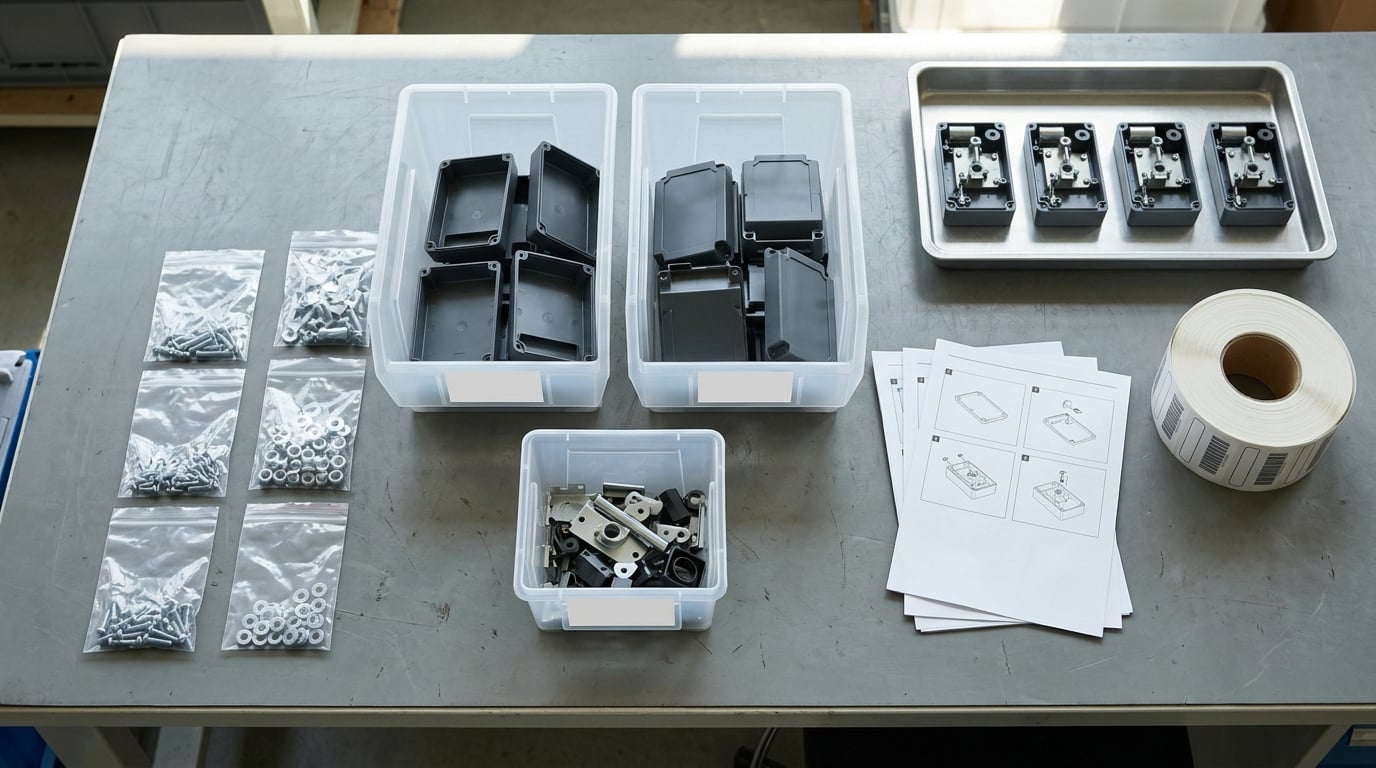
Kitting is the process of gathering the individual parts a job needs, each tracked under its own SKU, and combining them into one unit that has its own kit SKU. What kitting means in manufacturing, in plain terms: a kitter collects the components listed on a production order, verifies them, and presents them as a single handled item for the line, the work cell, or a customer pack-out. Nothing is joined yet. Assembly does the joining. Kitting simply gets the right parts into one place, in the right quantity, before anyone needs them.
The distinction matters more than it sounds. A plant that skips kitting is asking assembly operators to walk to a supermarket shelf, find six parts, and return to the station, eight times an hour. A plant that kits hands over one tote with a verified count and gets on with the build.
Updated for October 2026.
Table of Contents
- What Kitting Means in Manufacturing
- What Is a Manufacturing Kit?
- What Kitting Means in Manufacturing vs. Assembly
- How Kitting Works in a Manufacturing Operation
- When to Use Kitting in Manufacturing
- Benefits of Kitting for Manufacturers
- Kitting Types: Static, Dynamic, and Supplier- or Work-Cell-Based
- How to Set Up a Kitting Process
- Common Kitting Mistakes and How to Avoid Them
- Frequently Asked Questions
- Conclusion
What Kitting Means in Manufacturing
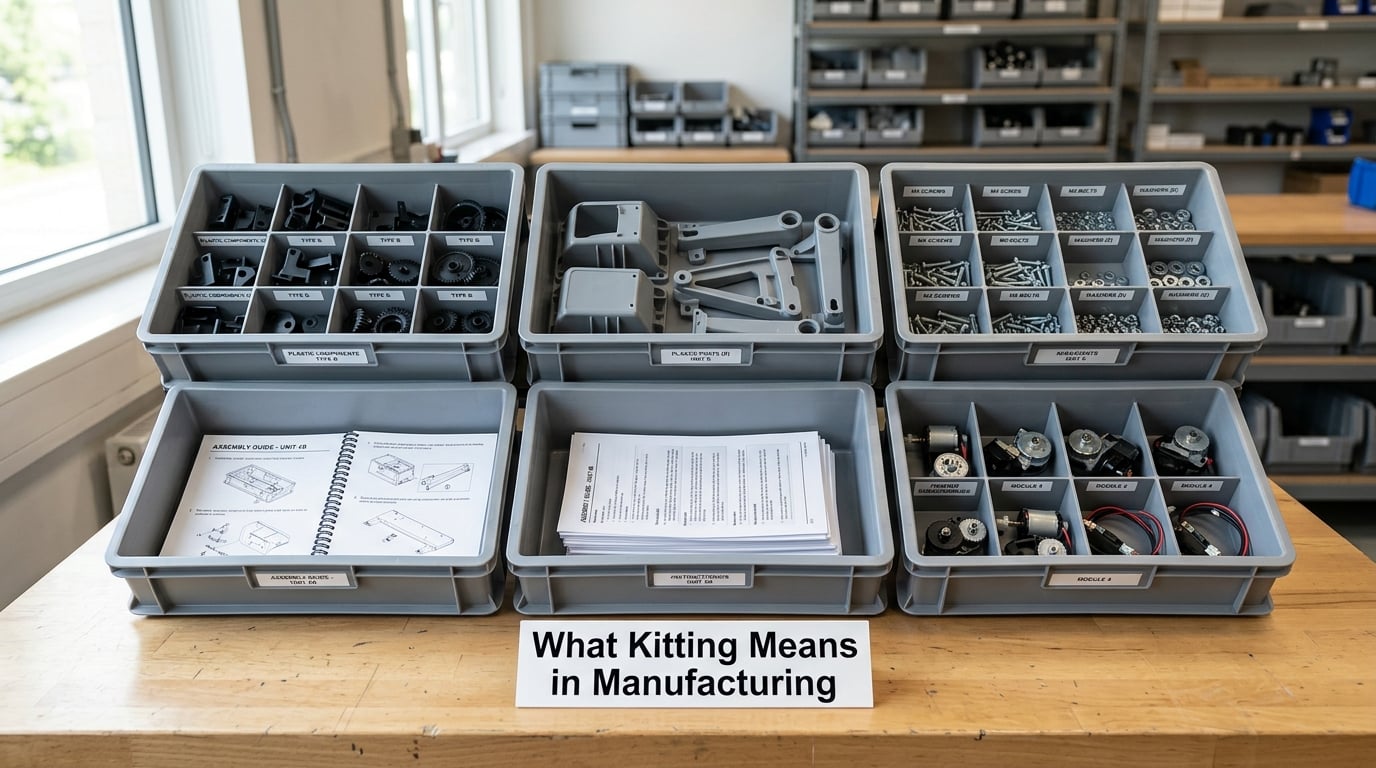
Beyond the collection step, kitting is the control function around collection. Someone has to decide what goes in, read the right revision of the bill of materials, confirm each part by scan or count, stage it in one container, and record what left inventory. That is what turns a pile of parts into a controlled kit.
Inside a plant, kitting serves four purposes at once. It feeds production by putting components at the line in the sequence they will be used. It supports assembly by handing over a verified set rather than a stack of bins. It simplifies packaging and fulfillment by grouping loose items into one sellable or shippable unit. And it creates traceability, because a kit SKU moves through the plant as a single thing until it is consumed.
What kitting means in manufacturing on the plant floor
On the floor, kitting usually happens in one of two places. A central kitting area picks kits in batches and pushes them to a line-side supermarket or a work cell. Or a dedicated kitter works inside the cell, filling a kit right before it is used, which is closer to just-in-time delivery and keeps WIP low.
The term gets used loosely in two very different senses. Warehouses and 3PLs mean pre-building kits in batches to a forecast. Automotive and aerospace plants mean supplying a line in sequence with a small buffer. Same word, different operational reality, and the right answer for one will be wrong for the other.
What Is a Manufacturing Kit?
A manufacturing kit is the collection of everything one production order or one finished unit needs, gathered under a single kit identifier. Contents vary by product, but a typical kit holds the component parts, the consumables and fasteners used during the build, documentation such as a work instruction or a traveler, the packaging and dunnage the unit ships in, and the labels that tie it all to the order.
Here is the part that surprises people. Kitting creates a new SKU. You had six component SKUs, and now a seventh exists: KIT-4471, a molded plastic enclosure kit. From that point the kit has its own inventory record, its own location, its own quality status. Its components are no longer individually available to other jobs until the kit is consumed or de-kitted.
Take a small injection-molded enclosure product. The bill of materials for one unit might list a base shell, a lid, four M3 screws, two standoffs, a foam gasket, a printed label, and an anti-static bag. A kitted version puts all eight into one labeled tote with a barcode that resolves to KIT-4471. The operator arrives, scans the tote, and the plant can immediately answer how many kits are complete, how many are staged, and how many components are still loose. Under per-pick management, that same information takes three inventory lookups and a clipboard.
Whether the kit stays in a tote, moves on a cart, or arrives in a corrugated tray matters less than the rule: one identifier, one location, one count.
What Kitting Means in Manufacturing vs. Assembly
The two are frequently quoted as the same service, which is where costing arguments go wrong. Kitting brings items together and identifies them as a unit. Assembly physically joins items, changes their state, and produces something that did not exist before. You can kit without ever assembling, and you can assemble from loose parts that were never kitted.
Bundling sits alongside both. Bundling is a packaging and marketing act: taking finished, sellable goods and presenting them as a set. Nothing is built. Kitting happens before or during production; bundling usually happens after it.
| Factor | Kitting | Assembly | Bundling |
|---|---|---|---|
| When it happens | Before or during production | During production | After production, at pack-out |
| What it does | Gathers and identifies parts as one unit | Joins parts into a new product | Presents finished goods as a set |
| Output | A kit with its own kit SKU | A finished good with a new value added | A multi-pack or bundle SKU |
| Labor intensity | Mostly material handling and verification | Direct skilled labor, highest of the three | Mostly packaging labor |
| Main risk | Wrong part, wrong revision, or a kit nobody ordered | Defect, rework, scrap | Mixed bundle shipped to a customer |
| Best for | Repetitive builds with many small parts | Products where parts must be joined | Retail sets, promotions, samples |
Ask any quote to separate the line items. A quote that bundles all three under one hourly rate is hiding which work you are actually buying, and it is the fastest way to miss a saving or a cost.
How Kitting Works in a Manufacturing Operation
The kitting process is a loop, not a straight line. It starts with a released production order and ends with a consumption record that updates inventory and feeds the next plan. Eight steps describe most implementations.
- Read the released order. The scheduler releases a work order and the planning system explodes it into component demand using the current bill of materials.
- Validate the BOM. Engineering confirms the revision is current. This is the gate that prevents an entire batch of kits from being built to a superseded design.
- Pick to the kit list. Loose components are collected from their storage locations, either by batch pick, wave pick, or a fixed replenishment route for high-use parts.
- Stage at the kitting station. Everything lands at one table with the kit traveler. Fixed-location staging for the job and kitted-location staging for the cell are both common.
- Verify. Each item is barcode scanned against the kit, and some operations add a weight check or a periodic audit sample for kits over a certain part count.
- Package and identify. The kit is closed into a tote, tray, or bag with a kit label carrying the kit SKU, order, quantity, and revision.
- Move it to the point of use. The kit goes to a line-side supermarket position, a work cell, or a pack-out station. This is line-side delivery.
- Confirm consumption. Scanning the kit as it is issued decrements the components, not the kit. Replenishment is triggered by the same signal.
Systems plug into the loop at specific points. MRP or ERP planning decides how many kits to build and against what demand. The WMS or warehouse management layer owns locations, picks, and staging. A barcode layer does verification. An MES or shop-floor control system records issue, consumption, and scrap at the line. The design goal is one identifier moving through all of them, so a kit never has to be described twice in two systems.
One term worth knowing: kit-at-pack. Instead of pre-building a kit, the components are staged as a set and combined at the pack-out station as part of the final order. It saves storage and reduces obsolete inventory, and it adds a step to the last operation before the unit leaves.
When to Use Kitting in Manufacturing
This is the part most explanations skip, and it is the part that decides whether kitting pays for itself. Kitting is worth the handling when the cost of getting it wrong or running short is higher than the cost of moving parts once extra. Strong candidates share a few traits.
Repetitive work with a stable bill of materials. The same eight parts, the same sequence, hundreds of times a week. Predictability is what makes verification cheap.
Many small, similar-looking components. Black screws in a black tray next to black standoffs is exactly the situation that produces a wrong-part pick, and a pick error on a line shows up as a stoppage minutes later.
Long component lists per unit. Above roughly a dozen line items, the operator’s travel and search time usually exceed the time to walk the kit over.
More than one work cell or line sharing the same components. One shared kitting point beats three cells each hunting the same shelf.
High mix, low volume, where setups dominate. In a low-volume, high-variety plant, kitting converts a setup problem into a picking problem, and picking problems are easier to standardise than setups.
Line-side pressure. When a line stops waiting on a supermarket replenishment, kitting that arrives with the order sequence is usually the cheapest fix available.
Components supplied in mixed form. When a supplier delivers a sub-assembly, hardware, and documentation separately, kitting consolidates them into the one item the plant can count.
Now the honest half. Kitting is a poor choice when volumes are low and every kit is different, because the verification and staging labor exceeds the picking it removes. It is a poor choice when the BOM is unstable, since kits built to last month may not match this month’s design. And it is a poor choice when a part is consumed straight from a pallet with no picking involved at all, which is a lot of high-volume, low-complexity lines.
A blunt test: if a worker could hand-assemble the job from a single bin without walking, kitting adds a step without removing one. A second test: if the same kit is built more than a few times a week and moves to more than one destination, the savings compound. The second test is usually the one that matters.
Benefits of Kitting for Manufacturers
Line-side availability. A sequenced kit arrives when the job is about to run, so the line waits on nothing. This is usually the benefit operators notice first.
Less search and motion. Every avoided trip to a rack is a saved walk. On a repetitive build the operator can spend most of the cycle on the build rather than on logistics.
Fewer wrong-part picks. A scan at the kitting station catches the error there, where it costs a rebuild of a kit, rather than at the line, where it costs a stoppage and a schedule recovery.
Cleaner training. A new operator follows a work instruction against a verified tote instead of learning where twelve part bins live. Learning curve time shortens, and the answer to a shortage question is a scan, not a search.
Clearer labor content. Kitting labor becomes a measurable line in the routing instead of an invisible cost spread across cycle time. That makes it visible when a kit has grown too heavy to be worth building.
Better costing and scheduling. One kit SKU with one standard cost is easier to plan against than eight component transactions. Component demand still comes from the BOM, so planning accuracy improves rather than degrades.
Freight and damage reduction. Parts travelling as one handled unit are handled once. For outbound packs moving to customers, fewer separate parcels per order is the difference between one carton and several.
Two honest qualifiers. Savings scale with volume and repetition, so a plant running four kits a day will see a fraction of what a plant running four hundred sees. And kitting does not fix an inaccurate inventory record. Kitting on top of bad inventory data just moves bad data around faster, which is worth checking before you commit to a station.
Kitting Types: Static, Dynamic, and Supplier- or Work-Cell-Based
Most plants run one of four models, and the useful question is which one your demand pattern supports.
Static kitting. Kits are built in batches against a forecast and held as finished inventory. Efficient in volume, and the fastest conversion of picking labor into a single handled unit, but it ties up space and carries real risk if the forecast is wrong.
Dynamic kitting. Kits are built to released demand rather than to a forecast, in small lots, often same day. Inventory risk drops sharply, labor becomes more variable, and per-kit cost usually runs higher than batch kitting.
Supplier or customer-provided kitting. The supplier delivers components in kit form, or a customer supplies kits for a program and you assemble against them. This removes a stocking decision from your building and pushes it to the party that owns the design.
Work-cell or line-side kitting. A dedicated kitter fills kits at the cell, just ahead of consumption, in build sequence. Lowest work-in-process, tightest coupling to the takt time, and the model most sensitive to a kitter being absent.
| Model | Trigger | Best for | Watch out for |
|---|---|---|---|
| Static / forecast-built | Batch build to forecast | High repeat volume, stable demand | Obsolete kits, storage footprint |
| Dynamic | Released orders, small lots | Volatile demand, short shelf life | Higher cost per kit, labor swings |
| Supplier-provided | Consignment or customer kit | Programs with an outside owner of the design | Revision control, lead time from supplier |
| Line-side / cell | Build sequence at the cell | Assembly lines with takt pressure | Single-point dependency on the kitter |
Many plants run two at once: dynamic kitting into a shared supermarket for general work, and line-side kitting for the highest-volume or highest-criticality families. That combination is usually the pragmatic answer.
How to Set Up a Kitting Process
Do this in order. Skipping to the station build is how plants end up with beautiful totes and wrong contents.
- Validate the bill of materials. Confirm the BOM is current, revision-controlled, and matches what the line actually consumes. Success check: no open engineering changes against the products you plan to kit.
- Define the kit rules. Write down what belongs in the kit, what stays loose, and what gets consumed at the cell rather than kitted. Success check: one page that an operator and a buyer both agree on.
- Choose identification and location. Pick a kit naming convention, a label format, and a staging location per kit, and make sure the WMS has a real location for it. Success check: a kit scan resolves to one location in the system.
- Pick a picking method. Batch or wave pick for volume, kitting-path picking for travel, fixed replenishment for fast movers. Success check: measured travel per kit, not an assumption.
- Set verification controls. Barcode scan on every line item for high-value or high-risk kits, weight verification where items are uniform, and periodic audit sampling on the rest. Success check: a known test kit builds correctly on a cold start.
- Pilot on one product family. Run a controlled kit for a defined period, ideally covering all shifts. Success check: pick accuracy and cycle time measured before and after, not assumed.
- Train operators. Cover the travel path, the scan discipline, and what to do when a part is short. Success check: a new person can build a kit correctly after one shift of instruction.
- Measure and adjust. Track labor hours per kit, pick errors, line-side shortages, and kit inventory turns. Success check: the kit earns its space, measured in turns rather than opinion.
Piloting on a single family is what keeps this reversible. If the numbers disappoint, you have lost a month, not a year.
Common Kitting Mistakes and How to Avoid Them
Building kits from an outdated BOM. A silent engineering change invalidates every kit already on the shelf. Fix: block kit creation against products with open engineering changes, and stamp the revision on the kit label.
Unclear or generic labels. A tote marked ENCLOSURE tells the operator nothing at a glance. Fix: label with kit SKU, order, quantity, and revision, and put the kit identifier in the same place every time.
Mixing revisions in one kit. Fix: segregate kits by revision and date, and quarantine anything from a superseded build rather than adding it to live inventory.
Excess handling. Moving parts from shelf to staging to line to cell three times adds nothing. Fix: map the path and remove a step where you can, while keeping verification where the error is cheapest to catch.
Incomplete documentation. A kit without a traveler or work instruction produces a correctly gathered, incorrectly built unit. Fix: treat the document as a kit line item and scan it like one.
Inaccurate inventory before you start. Kitting multiplies whatever state your records are in. Fix: cycle count the component locations for the pilot family first, and re-count before expanding.
Over-kitting or under-kitting. Over-kitting shows up as completed kits that never get consumed. Under-kitting shows up as line-side shortages. Fix: build against released demand rather than a forecast, size batches to a short window, and watch kit turns weekly in the pilot.
Poor replenishment. Kitting does not fix a supermarket that runs empty. Fix: treat the kitting station and the supermarket as one replenishment system with one trigger point.
Ignoring de-kitting. A returned kit has no sellable identity. Fix: decide in advance what a returned kit is worth, which component it goes back against, and who re-inventories it.
Letting kit and component SKUs both stay live. Double-counted inventory and confused margin reporting follow. Fix: agree which record is authoritative, and make sure only one is used for planning.
Two habits cover most of the ground: scan at the kitting station rather than at the line, and review kit inventory turns as a standing item until the process proves itself.
Frequently Asked Questions
Is kitting the same as assembly?
No. Kitting gathers and identifies existing parts as one unit, and assembly physically joins parts into a finished product. A plant can kit without ever assembling, and can assemble from loose parts that were never kitted. Quotes that price both under one line item usually hide which work you are buying.
What is the difference between a kit and a bill of materials?
The bill of materials is the recipe: the list of components and quantities needed to build one unit. The kit is the physical realisation of that recipe, gathered, verified and labelled under one kit SKU. The BOM drives planning and picking, while the kit is what a worker or machine actually picks, scans and moves.
When is kitting not cost-effective?
Kitting usually loses its value when volumes are low and nearly every kit is different, because verification and staging labor exceeds the picking it removes. It also loses value with an unstable BOM, where kits built early may not match the current design, and where a part is consumed straight from a pallet with no picking at all.
Should kitted materials be picked by hand or automatically?
Volume and part size decide it. Batch or wave picking with barcode verification covers most mid-volume plants, and fixed-path kitting picking cuts travel on repetitive work. Automation, whether voice, light, or weight-directed, pays off when the same kit is built many times a day and the part range is stable. Start manual with scans, then automate the step that shows up in your travel data.
How do you prevent the wrong parts from being included in a kit?
Scan every line item at the kitting station against the current BOM, stamp the revision on the kit label, and quarantine kits built against a superseded revision. Add a weight check for uniform items and periodic audit sampling on long kits. The point is to catch the error where it costs a kit rebuild rather than a line stoppage.
Does kitting work for low-volume manufacturing?
It can, but the model changes. Build kits against released orders rather than a forecast, keep the kit short, and consider work-cell kitting just ahead of use so nothing is held. In high-mix, low-volume plants kitting often helps most, because it converts a hard setup problem into a repeatable picking and verification step that anyone can be trained on.
Conclusion
What kitting means in manufacturing comes down to this: gather the right parts, verify them, and hand them over as one controlled unit before the job that needs them starts. It pays when work repeats, kits are long, and a wrong pick or a line-side shortage is expensive. It stops paying when kits are rare, unstable, or already sit in one bin.
Start small. Map one product family, confirm its BOM and how its parts actually move today, and pilot a controlled kit for a defined period. Measure pick accuracy, labor hours per kit, and line-side shortages before and after. If the numbers hold, widen the scope. If they don’t, you have lost a month and learned something worth more than the station would have saved you.