

Qualifying a new resin supplier means proving, with documented evidence, that a candidate’s material meets your specification lot after lot before that supplier goes on your approved supplier list. The work runs through eight stages: define the requirement, screen capability, test samples, audit the plant, validate the process, settle commercial terms, run a controlled production trial, and record a decision with requalification triggers attached. For a typical injection molding grade, expect six to twelve weeks of lab time, machine time, and paperwork.
Buyers often get this wrong in the same three ways. They accept a technical data sheet as proof of a specific lot, they compare commercial terms before the specification exists, and they treat one good sample as a qualification. Experienced quality engineers make the same point, and the honest answer is that a brochure, a sample, and a quote are the three least useful pieces of evidence in the whole process.
Below is the sequence I would walk a new supplier through, gate by gate. Adapt the thresholds to your polymer and your application, but keep the structure: evidence first, opinion last.
Table of Contents
- What You Need Before You Contact a Supplier
- Step-by-Step: How to Qualify a New Resin Supplier
- Step 1: How to Qualify a New Resin Supplier by Defining the Requirement
- Step 2: Screen Capability and Capacity
- Step 3: Evaluate Samples With a Defined Test Plan
- Step 4: Audit Quality, Traceability, and Compliance
- Step 5: Confirm Process Compatibility at Scale
- Step 6: Validate Commercial and Supply Terms
- Step 7: Run a Controlled Production Trial
- Step 8: Approve, Monitor, and Requalify
- Common Mistakes and How to Fix Them
- Frequently Asked Questions
- Should a resin distributor be qualified differently from the resin manufacturer?
- What is the best way to test samples from a new resin supplier?
- How much material is needed for a resin supplier trial?
- What quality certifications should a resin supplier provide?
- When does an approved resin supplier need to be requalified?
- Conclusion: Start With the Specification, Not the Sample
What You Need Before You Contact a Supplier
Qualification fails quietly when you start without a written requirement. Assemble these before the first call, because every supplier conversation becomes sharper once you can state a number.
- A material specification sheet covering polymer family, grade, additives, color, processing window, performance properties, and the tolerances you will accept.
- Part drawings and the critical-to-quality dimensions that the resin directly controls, such as shrinkage, warp, or flow-sensitive features.
- Test methods with conditions: temperature, load, conditioning time, and specimen geometry for anything you plan to measure yourself.
- Annual and peak volumes, plus the delivery profile across the year so capacity checks mean something.
- Compliance requirements that apply to your market, including any regulatory declaration your customer has demanded of you.
- A cross-functional team: a materials or process engineer who runs the technical work, a quality engineer who owns acceptance criteria, a purchasing or supply chain lead who owns commercial terms, and a receiving or quality representative who will run incoming inspection. Someone has to be the named approver.
- Regulatory or documentation requirements for your quality system, including what record you will file for each lot.
Specify by ASTM standard or by the equivalent standard for your polymer family wherever you can, rather than by brand. Brand lock-in creates supply risk and price risk, and a standard gives you a written language for qualifying a second source later.
Step-by-Step: How to Qualify a New Resin Supplier
Each stage below ends with a go or no-go decision and a written record. A stage cannot be skipped because the supplier is friendly, the grade is well known, or the tooling is already running.
Step 1: How to Qualify a New Resin Supplier by Defining the Requirement
Start by translating the part and the process into a supplier-facing resin specification. Name the polymer family and grade, the additive package, the color and color target, and the regulatory limits that apply to your market.
Then set the processing window you intend to use, the performance properties that actually matter to the application, and the acceptance tolerance for each one. Separate your release specifications, which you will measure on every incoming lot, from the typical values and characterization data the supplier publishes, because typical values are a catalogue convenience and not a limit.
Gate: if you cannot write a measurable requirement, you cannot qualify anyone against it.
Step 2: Screen Capability and Capacity
Before samples arrive, check that the supplier can make the material at all. Confirm the compounding or resin-production technology suits your polymer family and grade, and confirm relevant quality management certifications are current rather than historical.
Next, check volume realism. Ask what the plant’s realistic monthly output is, what share you would represent, and what the realistic lead time is for your annual volume profile. A supplier who promises your peak volume with no headroom explained is telling you what you want to hear. A supplier who asks about your forecast and cycle time is telling you something useful.
Gate: no evidence of capacity or a quality system means no samples, no matter how good the relationship is.
Step 3: Evaluate Samples With a Defined Test Plan
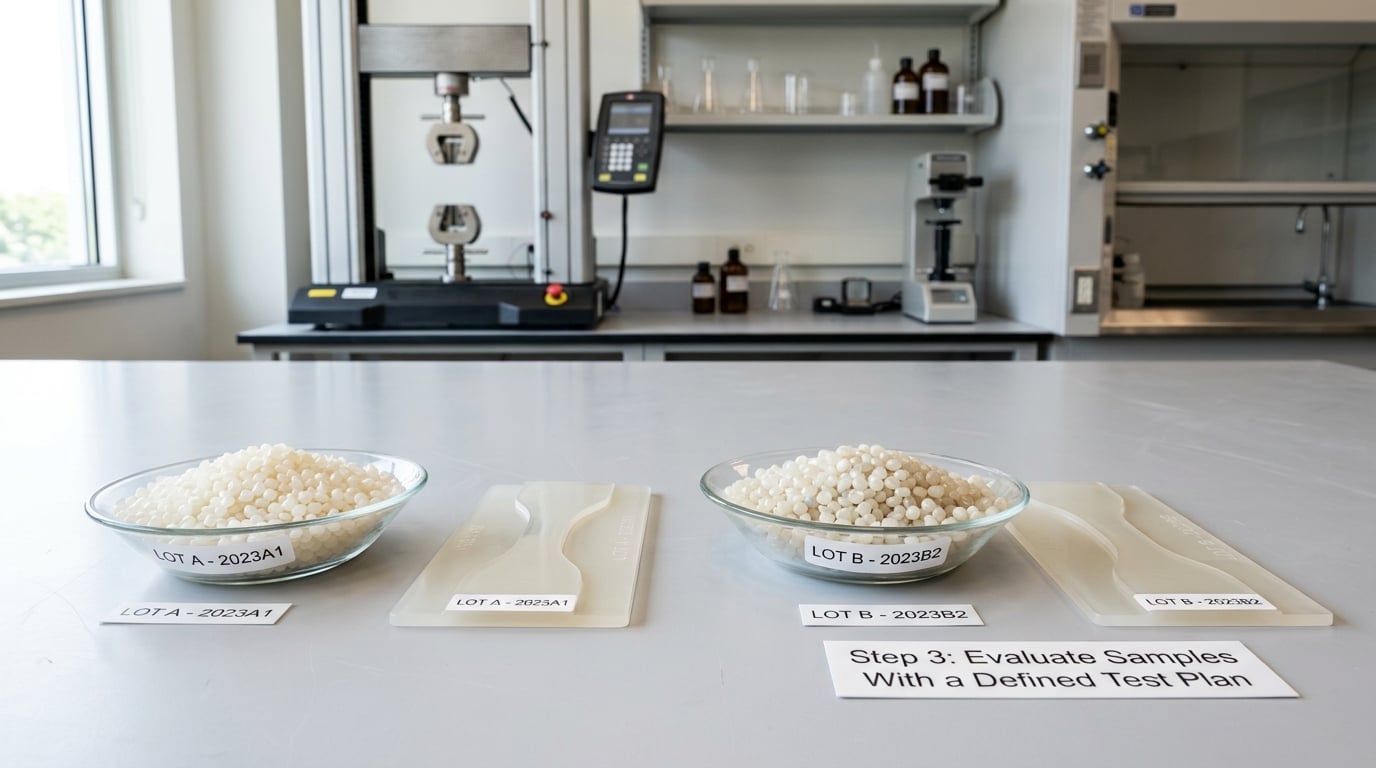
Request more than one lot. A single sample tells you almost nothing about consistency, because a single lot is one set of process conditions on one day. Two or three independently produced lots give you a real picture of how tightly the supplier controls the grade.
Write the test plan before the material arrives, and run it in a fixed order. Melt flow index first, because it is fast and catches viscosity drift. Then differential scanning calorimetry for glass transition temperature and crystalline structure. Then FTIR to confirm the composition fingerprint matches the expected polymer and additive package. Then moisture content, especially for hygroscopic grades where wet pellets cause splay and brittle parts. Then filler or fiber content and dispersion, and color where appearance is critical.
Mold standard plaques from each lot alongside your incumbent resin and compare processing behavior as much as properties: fill behavior, pressure at a given wall thickness, cooling consistency, and how stable the melt temperature stayed across the run. Record every deviation, because later you will need to explain why a lot passed or failed.
Gate: candidate lots that sit inside your release specification across multiple lots pass; lots that only meet typical values do not.
Step 4: Audit Quality, Traceability, and Compliance
Paperwork proves intent; an audit proves practice. Review the supplier’s quality system remotely or visit, and cover incoming raw material controls, production records, laboratory testing, equipment calibration, change notification, batch traceability, corrective action, storage conditions, and regulatory documentation.
The document comparison matters more than most buyers realize, because these three are routinely confused:
| Document | What it proves | What it does not prove |
|---|---|---|
| Technical data sheet | Typical values for a grade, usually at nominal conditions | Nothing about the lot in your hands |
| Certificate of analysis | Actual measured values for one production lot, with test methods and units | Long-term consistency or process capability |
| Safety data sheet | Handling, storage, and hazard information | Performance or composition fit for your part |
Adsorbing resin is a useful example: many suppliers can duplicate a competitor’s product, so a matching TDS proves nothing on its own. A complete certificate of analysis with stated test methods and units on each lot is the document that carries weight.
Gate: no traceability from your drum back to a production lot means you cannot write a recall story, so the supplier is not qualified.
Step 5: Confirm Process Compatibility at Scale

Lab data tells you what the material is. Only running it tells you how your process behaves. Mold the candidate resin on representative production equipment and document drying time and temperature, melt or flow behavior, cycle consistency across a long run, tooling wear rate, dimensional stability against your critical dimensions, cosmetic appearance, and scrap rate.
Where you can afford the time, run the same studies a converter would: a cavity balance check, a pressure loss study, a gate freeze study, a rheology curve, and a mold temperature study. These are exactly the studies that expose a resin which passes every datasheet number but will not hold dimensions on your part.
Gate: the resin must hold dimensions and cycle consistency on your tool, not on a test plaque in someone else’s lab.
Step 6: Validate Commercial and Supply Terms
Compare total landed cost, not the material line on the quote. Build the comparison from resin cost, freight, duties, packaging format, minimum order quantity, any tooling or processing charges, inventory you must hold, payment terms, and the mechanism by which cost adjustments are passed through.
Price per pound is not a qualification metric. A lower number paired with a longer lead time, a smaller minimum order quantity, or a 90-day payment term can quietly cost you more in working capital and scheduling than the material difference saved.
Also settle the commercial promises that matter when things go wrong: what notice you get on grade discontinuation, what happens to open orders, and who covers the cost of a requalification you did not ask for. Gate: terms must be written into the purchase agreement, not left to the account manager’s memory.
Step 7: Run a Controlled Production Trial
Plan the trial before it starts, in writing. Define lot sizes and how many lots, the parts to be produced, inspection criteria and measurement methods, acceptance thresholds for both dimensions and cosmetic defects, and the threshold for scrap. Decide how defects get communicated during the trial and what the rollback plan is if the trial fails.
Retain a sealed sample from every trial lot alongside your existing material. That retention sample is what you compare against later when a complaint arrives or when you need to prove the material has not changed.
Gate: the trial produces parts that meet the same criteria you apply to production, with an agreed disposition procedure for anything that falls short.
Step 8: Approve, Monitor, and Requalify
Write the qualification decision down. Who approved it, on what date, based on which lots, which test results, and which documents. List any open action items with owners and due dates, because a conditional approval with visible conditions is legitimate; a conditional approval with hidden conditions is a future nonconformance.
Then define the ongoing controls. Score the qualification so the next supplier comparison is repeatable:
| Criterion | Evidence required | Gate type | Pass condition |
|---|---|---|---|
| Specification match | Multi-lot COA plus in-house test data | Hard gate | Every lot inside release specification |
| Regulatory fit | Current declarations for your market | Hard gate | Document covers the application and date |
| Traceability | Lot coding and record retention during audit | Hard gate | Dummy traceable in both directions |
| Process capability | Trial and validation data on your equipment | Hard gate | Dimensions and cycle stable in spec |
| Capacity and lead time | Declared headroom and quoted lead time | Scored | Covers forecast with documented margin |
| Commercial terms | Landed cost model and agreement terms | Scored | Acceptable working capital and pass-through rules |
| Technical support | Demonstrated process support during the trial | Scored | Responds and assists beyond the sale |
| Supply history | References and years of consistent supply | Scored | References from your same application |
Hard gates first, then weighted scoring. A weighted average that hides one failed mandatory requirement is how bad material gets approved.
Set the requalification triggers before you need them. A change of manufacturing site, a formulation change, a change in analytical method, a change in packaging or preservation basis, or a change of ownership should each reopen the file. Reopening does not always mean starting over; it means re-running the affected gates and documenting why.
Common Mistakes and How to Fix Them
- Qualifying from a brochure. Fix: demand a certificate of analysis with test methods and units for every lot, and run your own first-lot tests. Typical values are not evidence.
- Comparing commercial terms before the specification exists. Fix: write the resin specification first. Quotes without a specification are not comparable.
- Accepting one good sample. Fix: qualify on at least two independently produced lots. Consistency is the whole point of approving a supplier.
- Skipping the audit. Fix: run a paper audit at minimum, and a site visit for any supplier on a critical part or in a regulated application.
- Ignoring change control. Fix: write change notification into the purchase agreement with a notice period, and define what happens when you receive one.
- Treating approval as permanent. Fix: schedule periodic scorecard reviews covering on-time delivery, defect rate, responsiveness to nonconformances, and open corrective actions.
- Running incoming inspection on every lot with full testing. Fix: verify the supplier’s own release testing, then audit it. Reserve your lab for reduced or variable inspection plans once capability is proven.
- Letting one department own qualification alone. Fix: give quality ownership of acceptance criteria and the approval record, engineering ownership of process validation, and purchasing ownership of terms. One approver, several contributors.
Three habits help more than the rest. Qualify a second source deliberately rather than in a panic, keeping the second resin inside the same tool and process window, because that is where the insurance value sits. Ask for references from molders running your same application in your same region. And treat responsiveness during a trial as a leading indicator of how the supplier will behave on a nonconformance three years from now.
Frequently Asked Questions
Should a resin distributor be qualified differently from the resin manufacturer?
Yes. You still run the same technical gates, but you qualify the distributor on additional evidence: lot traceability back to the manufacturing site, warehousing conditions, FIFO rotation, and written change notification commitments passed through from the producer. The distributor may not control compounding, so your audit should confirm where they source from and whether that source can change without notice.
What is the best way to test samples from a new resin supplier?
Request two or three independently produced lots, then run a fixed test plan in order: melt flow index first, then differential scanning calorimetry for glass transition temperature, FTIR for the composition fingerprint, moisture content, and filler or fiber content. Mold standard plaques from each lot next to your incumbent resin and compare both properties and processing behavior. Record conditions, because a number without a test condition is not a number.
How much material is needed for a resin supplier trial?
Enough to cover lab molding, your standard test plaque set, and a limited production run of the real part across every cavity in the tool. Plan on working with two or three separately produced lots rather than one, and keep a sealed retention sample from each. The exact quantity depends on part size, cycle time, and how many hours of production data you want before making the decision.
What quality certifications should a resin supplier provide?
Ask for a current quality management certification such as ISO 9001, plus documentation that matches your application: certificates of analysis with test methods and units, safety data sheets, regulatory declarations for your market, and written change notification terms. The certificates prove the system exists. The per-lot paperwork and your own audit of it are what prove the system works.
When does an approved resin supplier need to be requalified?
Reopen the file when something material changes: a different manufacturing site, a formulation or additive change, a change in analytical test method, new packaging or preservation, or a change of ownership. Also requalify after a supply interruption or a serious field nonconformance. You do not always restart from zero; you re-run the gates the change affects and document why those gates are sufficient.
Conclusion: Start With the Specification, Not the Sample
The first action is to write a measurable resin specification and a written test plan, because every later gate is checked against those two documents. Technical evidence, a process trial on your own equipment, audited quality and traceability controls, and written supply terms all have to support the decision before a supplier earns a place on your approved supplier list.
Approval is a snapshot, not a permanent state. Through 2026, supply chains keep changing hands, sites, and formulations faster than most qualification files do, so decide now what triggers a requalification and who signs it.