
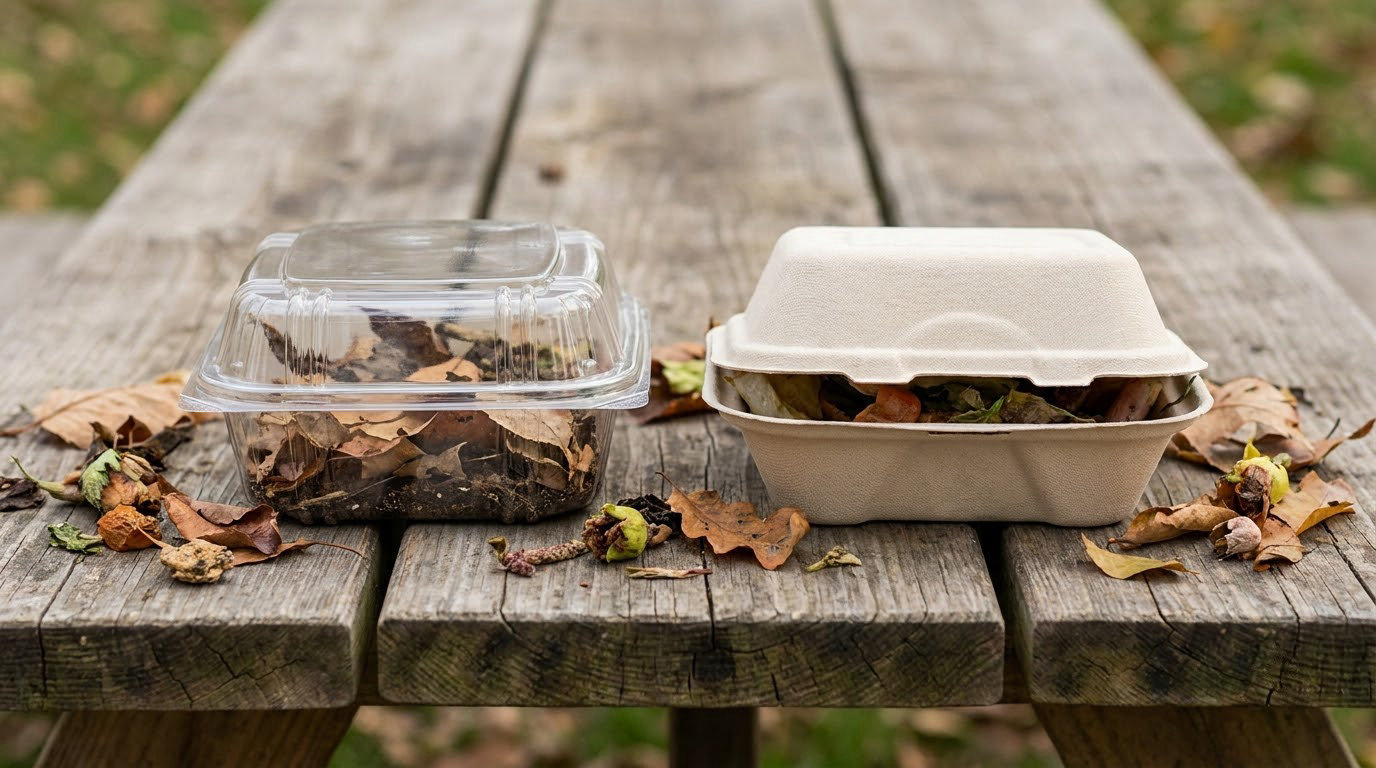
Short answer: choose PLA when the packaging is guaranteed to reach an industrial composting facility and you need clarity, rigidity and an easy processing route. Choose PHA when customers compost at home, when the pack sees heat and moisture, or when the packaging might end up in soil or water. In plain terms, PLA vs PHA for compostable packaging is decided less by performance than by which waste stream the pack actually lands in.
That is the part supplier websites tend to skip. Both polymers are called compostable, both are bio-based, and both cost more than the polyethylene they replace. They still behave very differently once the pack has been used and thrown away.
This guide covers the material differences, the composting conditions each one needs, the processing reality on a converting line, and a decision framework you can apply to a specific product.
Table of Contents
- PLA vs PHA for Compostable Packaging at a Glance
- What Are PLA and PHA?
- PLA vs PHA: Material and Performance Differences
- Which Material Is Easier to Compost?
- PLA vs PHA for Processing and Manufacturing
- PLA vs PHA Cost and Supply Considerations
- Where PLA and PHA Work Best in Packaging
- Which Should You Choose?
- Frequently Asked Questions
- Conclusion
PLA vs PHA for Compostable Packaging at a Glance
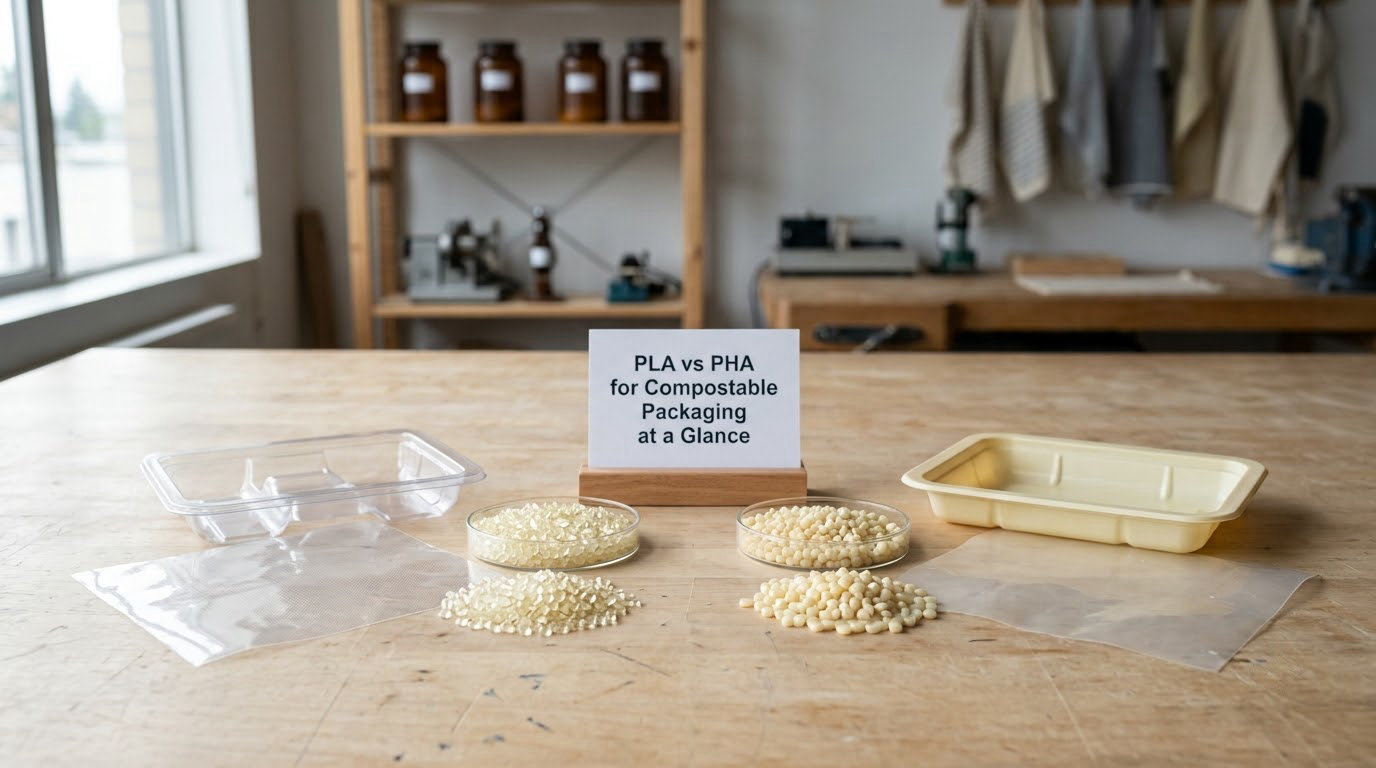
PLA is the cheaper, stiffer, clearer polymer with a narrow composting window. PHA is the tougher, more heat-tolerant polymer that biodegrades across a far wider range of environments, at a higher material cost and with fewer supply options.
| Criterion | PLA | PHA |
|---|---|---|
| Primary sugar source | Corn starch, sugarcane or cassava, fermented to lactic acid | Plant or vegetable oil, sugar or methane, fermented inside bacteria |
| Who makes the polymer | Chemical polymerisation of fermented lactic acid | Bacteria build and store the polymer inside their own cells |
| Feel and rigidity | Stiff, sometimes brittle, high modulus | More ductile, lower stiffness, closer to a soft plastics feel |
| Clarity | Water-clear, easy to print | Typically translucent to opaque in natural grades |
| Heat resistance | Low, softens near hot-drink service temperatures | Medium to high, grade dependent |
| Moisture barrier | Good, needs no coating for most dry goods | Good, comparable in most applications |
| Film and flexible formats | Needs blending for genuine flexibility | Better suited to blown film without heavy blending |
| Industrial composting | Yes, within the standard test window | Yes, usually faster |
| Home composting | Generally no | Yes, with certified grades |
| Soil and marine degradation | Very slow without controlled conditions | Yes, and the main reason buyers pay more |
| Uncontrolled landfill | Can persist for decades | Slow but more likely to break down over time |
| Food contact | Well established, widely approved | Approved, fewer jurisdictions and fewer grades |
| Material cost | Lower per unit weight | Noticeably higher per unit weight |
| Supplier base | Wide, multiple global producers | Narrower, concentrated in a few producers |
| Best fit | Cold cups, clear clamshells, cutlery, rigid thermoforms in areas with industrial composting | Bags and liners, coated paper, tougher films, marine-contact and home-compost markets |
Two rows carry most of the decision. Everything else is adjustment. If the pack reaches an industrial facility, PLA does its job at a lower cost. If it does not, PHA is the only one of the two that is designed to break down anyway.
What Are PLA and PHA?
PLA is polylactic acid, a polyester made by fermenting plant sugars into lactic acid and then polymerising it. Corn is the most common sugar source, with sugarcane and cassava used depending on region. It is not a modified petrochemical: the carbon in the molecule comes from a plant.
PHA is polyhydroxyalkanoate, a family of polyesters produced by bacteria and microalgae that store carbon inside their cells as a reserve. The commercial grades fall into families you will see quoted by converters: PHB, the basic homopolymer; PHBV, which adds valerate and brings better flexibility and heat tolerance; and PHBHHx, which pushes ductility further at the top end of the range.
Both are compostable bioplastics, which is a narrower claim than the packaging aisle suggests. Compostable means the material is designed to break down into biomass, carbon dioxide, water and minerals under a defined set of conditions, verified by a standard such as EN 13432, BPI Certified Compostable or ASTM D6400. It does not mean the material can be put anywhere.
One distinction trips up almost everyone. Bio-based describes where the carbon came from. Biodegradable describes what happens at end of life. A material can be bio-based and still last centuries, and a material made from fossil feedstock can break down in a designed facility. Keep the two ideas apart and most of the confusing labelling online makes sense.
PLA vs PHA: Material and Performance Differences
PLA is stiffer and clearer; PHA is more ductile and more tolerant of heat. That single sentence covers most of what changes on a packaging line, but the details matter where a pack fails.
Where PLA wins
Clarity is PLA’s strongest practical argument. Clear clamshells, deli containers and produce packs depend on it, and PHA in its natural form is usually a milky or opaque polymer. PLA also takes print beautifully and produces a crisp, rigid thermoform that holds a shape without much wall thickness, which is where the cost advantage comes from.
On stiffness, PLA is simply harder. For a rigid tray or a cold cup, that rigidity is the point. PLA also has a long, well-understood processing history on injection moulding and thermoforming equipment, so grade consistency is easier to manage on a high-volume line.
Where PHA wins
Ductility is PHA’s headline. It absorbs impact and puncture better than unreinforced PLA, which matters for bags, liners and anything that gets handled roughly or dropped. PLA in a film format usually needs a plasticiser or a PBAT blend to get real flexibility, and every blend adds a step.
Heat resistance follows from that chemistry. PHA grades tolerate hot liquid and hot fill noticeably better than PLA, which softens and warps around hot beverage service temperatures. If a pack holds a 60 degree coffee, PLA is the wrong resin unless the wall geometry supports it.
One caution on the other side: PHA is not uniformly heat-proof. The wide PHBV and PHBHHx grades behave very differently from basic PHB, and thermal stability during processing can be tight on some grades. Specify the grade, not the family name.
Which Material Is Easier to Compost?
PHA is easier to compost in more places, and PLA is easier to compost in exactly one place. Industrial composting runs at roughly 55 to 60 degrees Celsius with high microbial activity and a controlled moisture balance, which is the environment PLA was designed for. Standards such as EN 13432 require 90 percent disintegration within six months and full decomposition within about six months under those conditions, and PLA clears it comfortably.
Outside that window the picture changes. A home compost pile rarely sustains the temperature and bacterial activity needed to hydrolyse PLA polymer chains, and soil, seawater and landfill are slower again. Published estimates put PLA persistence in uncontrolled environments at 80 to 100 years. That figure is frequently misquoted as a certification claim; it is an estimate for a material sitting in a cold, dry, oxygen-poor environment with no composting process around it.
PHA is attacked by a much broader range of bacteria and fungi at ambient temperatures, which is why certified grades carry home-compost marks such as TUV OK Compost HOME or ABA AS 4736, and why marine-degradability claims attach to PHA rather than PLA. The forum consensus on r/3Dprinting makes the same point in plain language: sufficiently pure PHA does not strictly need to be composted at all, because ordinary bacteria will consume it, whereas PLA needs deliberate composting to start the process.
Compostability is not a property of the polymer alone. Four variables decide whether a real pack breaks down: thickness, since a thick moulded tray takes far longer than a thin film; surface area and shredding, which is why industrial facilities shred material; contamination with food or non-compostable coatings, which slows the whole batch; and the actual temperature reached. A well-made PLA cup in a good facility disappears in weeks. The same cup in a garden compost heap may look unchanged after a year.
PLA vs PHA for Processing and Manufacturing
PLA runs on equipment most converters already own. PHA asks for a little more discipline. The practical difference on the floor is small for a plant that handles polyolefins, and a nuisance for one that does not.
Both materials can be injection moulded, thermoformed or extruded, and both can be blown into film. PLA processes within a familiar window and its flow behaviour is well characterised, which is one reason it took the early compostable packaging market. PHA needs tighter control: the melt window is narrower, residence time matters more, and some grades are sensitive to shear and thermal history, so a machine left sitting in the barrel can degrade the melt before a run finishes.
Moisture is the other watch item. Polyesters of both families hydrolyse when wet, so incoming resin has to be dried before processing, and regrind ratios are kept modest. A converter new to bioplastics who skips the drying step will see a drop in molecular weight show up as brittle parts and weak seals, and will usually blame the resin.
Sealing and printing behave differently too. PLA seals readily at moderate temperatures and takes standard inks. PHA needs a higher set temperature and is more sensitive to dwell, so seal-window testing belongs in the development phase rather than at launch. On paper formats, the choice is architectural: a PLA lamination gives a moisture barrier but a compostable lamination is slower to break down and harder to separate, while a PHA coating is thinner, seals in conventional paper equipment and repulpability is not on the table for either.
Blending is where commercial reality sits. PLA plus PBAT is the standard route to a flexible or compostable bag, and PHA plus starch blends appear in similar formats. Blends let a converter hit a performance target, but they also mean the compostability claim now depends on every component, including the compatibiliser.
PLA vs PHA Cost and Supply Considerations
PLA costs less per unit weight than PHA, and that gap is wide enough that it decides many projects before performance is discussed. We deliberately do not quote figures here, because resin pricing moves quarter to quarter and any number we print would be stale within months.
PLA vs PHA for compostable packaging: what a switch really costs
The useful comparison is not the resin price per kilogram, it is the delivered cost of the finished pack. Thickness reduction can offset a higher resin price, since a stiffer material often needs a thinner wall to do the same job. Weight also moves freight costs per shipped unit. On the other side, a PHA grade that avoids a lamination step can pay for itself, and a PLA grade that has to be purged out of a shared extrusion line carries a downtime cost that never shows up in a spreadsheet.
Supply is the quieter issue. PLA has multiple global producers, deep grade ranges and established import channels, so a converter can usually qualify a second source. PHA production sits with a smaller number of producers, which means longer lead times, larger minimum order quantities and more exposure to a single plant outage. For a brand that needs the same compostable specification in five markets, that concentration is a real risk, not a footnote.
Additives, colourants and pigment masterbatches also narrow the PHA choice. A bright custom colour in a transparent PHA grade is harder to source than the equivalent in PLA. Development time, tooling changes and certification testing for a new grade belong in the total too, and they are frequently larger than the resin difference over a first order.
Where PLA and PHA Work Best in Packaging
Match the resin to the format, the fill temperature and the end-of-life route. Most specification errors come from choosing a material for its looks and then discovering the disposal route does not exist for the customer.
| Application | Better fit | Why |
|---|---|---|
| Cold drink cups and cold food containers | PLA | Rigidity, clarity and low material cost; no heat exposure to survive |
| Hot beverage cups and hot fill | PHA, or paper with a PHA coating | PLA softens and warps around hot liquid service |
| Clear clamshells and deli containers | PLA | Optical clarity is the whole point of the format |
| Compostable bags, liners and organic-waste bags | PHA or a PHA blend | Flexibility, tear resistance and behaviour when collection is inconsistent |
| Compostable pouches and flexible films | PHA, or PLA with PBAT | PHA gives ductility without a heavy plasticiser load |
| Produce labels and stickers | PLA | Short life, industrial composting in most markets, good print adhesion |
| Paper cup and food-service coatings | Both viable; PHA where heat matters | PLA coats cheaply, PHA adds hot-drink tolerance and thinner coverage |
| Marine-contact or soil-contact items | PHA | Certified degradation in the environments the item will actually reach |
| Tea bags, coffee capsules, cutlery | PLA | Short use life and reliable access to industrial composting in most markets |
Regulatory direction is nudging all of this. The EU packaging rules and single-use plastic restrictions, plus US state extended producer responsibility programmes, are pushing brand owners to document disposal routes rather than print a vague compostable claim. That documentation step is where a lot of PLA and PHA decisions get made now.
Which Should You Choose?
Choose PLA if industrial composting is genuinely available to your customer, and PHA if it is not. Everything after that is refinement. Work through these six questions before you talk to a supplier.
- Where does the pack actually end up? Confirm collection coverage in the markets you sell into. If a meaningful share of customers have no industrial composting access, PLA is a claim without a route.
- What is the shape and format? Rigid and clear means PLA. Flexible, tear-prone or puncture-exposed means PHA or a blend.
- What heat does it meet? Hot fill, hot beverage or hot dish service pushes you toward PHA. Cold or ambient use does not.
- What is the shelf life? Short life suits PLA. Long ambient or chilled life with a demanding barrier requirement is worth a PHA specification.
- What certifications do you need? Name the standard and the region before you compare resins, because not every PHA grade is certified for home composting and not every PLA grade is certified for your market.
- What is your supply tolerance? If you need several suppliers and short lead times, PLA is safer. If you can commit volume and accept fewer sources, PHA becomes viable.
The blunt version: choose PLA for clarity, rigidity and easier processing inside controlled compostable systems. Choose PHA when durability, broader composting conditions or tougher applications justify the added material cost and the supply constraints.
Frequently Asked Questions
What are the disadvantages of PHA plastic?
The honest list is cost, supply and consistency. PHA resin costs more per unit weight than PLA, production capacity sits with fewer suppliers, minimum order quantities are larger, and colour and transparency options are narrower. Heat resistance varies widely across the PHB, PHBV and PHBHHx families, so a poor grade choice shows up in service. PHA also has a narrower processing window and less line history than PLA. None of that makes it a bad material; it makes it a more specified decision.
Is PHA actually biodegradable?
Yes, and this is where PHA genuinely separates from PLA. PHA is broken down by a wide range of bacteria and fungi at ambient temperatures, so certified grades biodegrade in soil, home compost, industrial facilities and marine environments. The r/3Dprinting consensus is that sufficiently pure PHA is consumed by ordinary bacteria even without deliberate composting. For commercial claims you still need a certificate, because certification is what proves the grade, the thickness and the timeframe.
Is PLA 100% biodegradable?
Only under the right conditions. PLA is designed to hydrolyse in industrial composting at roughly 55 to 60 degrees Celsius with active microbial populations, and it passes EN 13432 requirements such as 90 percent disintegration within six months. In a landfill, in soil or in a home compost heap, decomposition is far slower, and published estimates put persistence in uncontrolled environments at 80 to 100 years. Certified compostable is a precise claim, not a universal one.
What is the best biodegradable food packaging?
There is no universal winner, and anyone naming one material for every food application is overselling. Clear cold-food clamshells suit PLA for rigidity and clarity. Hot beverage cups and hot-fill packs need PHA or a PHA-coated paper. Compostable bags and liners need the ductility of PHA. Above all, the best material is the one matching the disposal route your customer actually has, because a compostable pack in a landfill is just a plastic pack.
Do compostable bags leach microplastics?
Certified compostable materials are designed to mineralise rather than fragment, so in a working composting facility the polymer is consumed rather than left as microplastic. The risk appears when it does not reach that facility. A compostable bag landfilled or dropped in water still degrades and fragments the way conventional plastic does. That is why certified grades, correct thickness and a real collection route matter more than the word compostable printed on the pack.
What are the disadvantages of compostable packaging?
Five recur most often. It needs composting infrastructure that many populations do not have. Unit cost is higher than the conventional plastic it replaces. Contamination of conventional recycling streams is a real risk, since a PLA or PHA item in a PET batch is a genuine problem for reprocessors. Consumer confusion drives incorrect disposal. And lower heat resistance limits some applications. None of these disqualify the material, but all of them belong in the specification.
Conclusion
Decide the disposal route first, then pick the resin. If industrial composting is genuinely available where you sell, PLA gives you clarity, rigidity, a forgiving processing window and the lower material cost, and it is the right answer for cold applications, clear clamshells and rigid thermoforms.
If collection is patchy, if the pack meets heat, or if it could end up in soil or water, PHA is the sounder specification. You pay more per unit weight and accept fewer suppliers, and in exchange the pack breaks down in the environments it actually reaches. Specify the grade, confirm the certification for the market you are selling into, and test it in the real waste stream before you commit to a specification in 2026.