
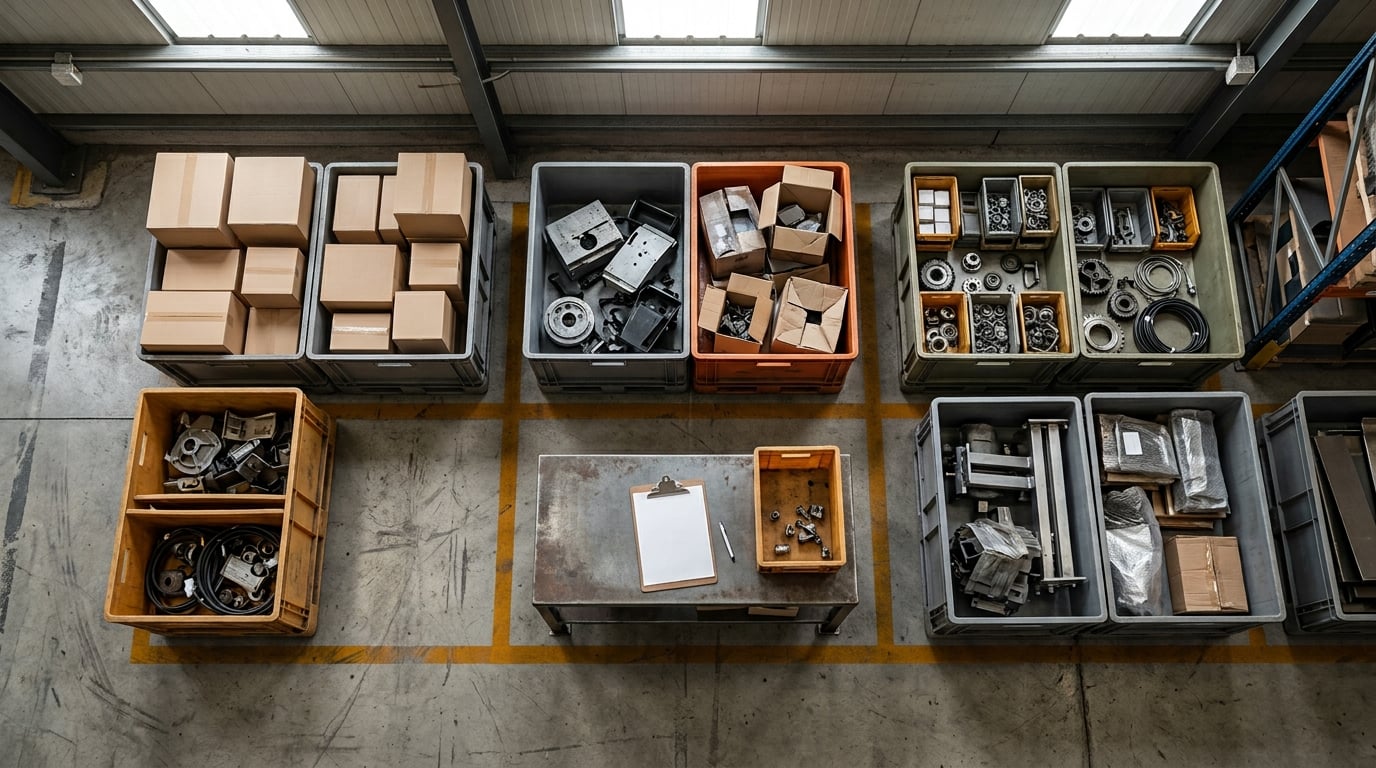
Reverse logistics process explained for manufacturers comes down to a chain of connected stages: something comes back, it gets authorized and received, it gets inspected and graded, someone decides what happens to it, and the result goes back into quality and finance records. In manufacturing that chain governs warranty claims, distributor returns, recalls, supplier recoveries and end-of-life take-back. It only works when each stage has a named owner and leaves a record behind.
Most plants I have read process documentation for treat the reverse side as whatever happens after the phone rings. It is a cost line, not a managed flow. The difference in the pages below is that the flow is designed, measured and closed, which is what turns a return into either recovered value or a piece of quality evidence.
Table of Contents
- Reverse Logistics Process Explained for Manufacturers: Definition and Goals
- What triggers a product return or recovery event?
- How should manufacturers plan the reverse logistics workflow?
- How are returned products received, identified, and inspected?
- What happens after inspection and disposition decisions?
- Which KPIs show whether reverse logistics is working?
- How can manufacturers control cost without weakening recovery outcomes?
- What compliance and risk controls apply to reverse logistics?
- What are the most common reverse logistics mistakes?
- Frequently Asked Questions
- What is reverse logistics in manufacturing?
- What is the difference between reverse logistics and returns management?
- How can manufacturers reduce reverse logistics costs?
- When is a returned product recycled instead of restocked?
- What should a manufacturer standardize first in its reverse logistics process?
- Conclusion
Reverse Logistics Process Explained for Manufacturers: Definition and Goals
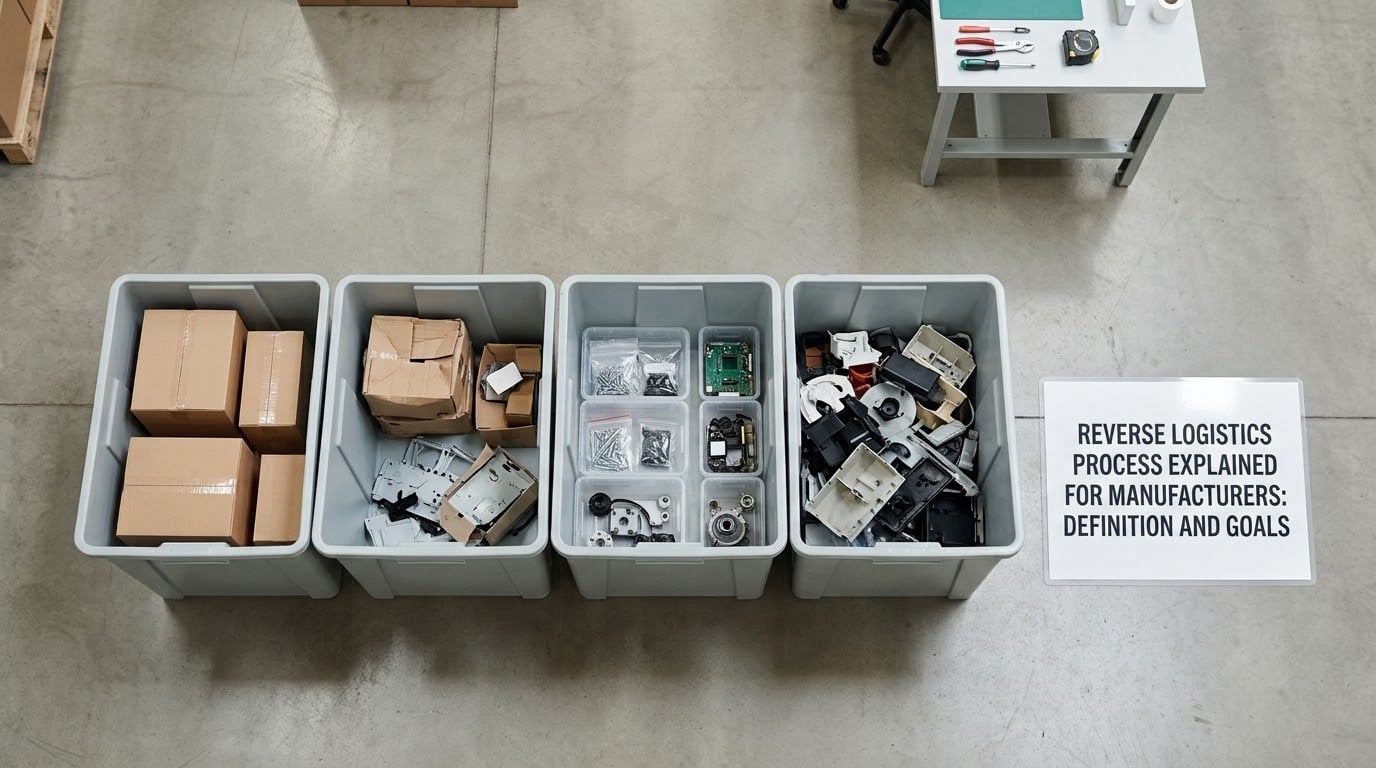
Reverse logistics is the movement and handling of products that travel back through the supply chain after they have reached their normal point of use, so the product can be returned, repaired, reworked, remanufactured, recaptured, recycled or disposed of responsibly. For a manufacturer, that includes everything from a distributor handing back unsold seasonal inventory to a field service team pulling a failed drive assembly off a machine at a customer site.
It is not the same as forward logistics. Forward logistics plans how raw materials and finished goods reach the customer, and it runs on forecasts, production schedules and fill rates. Reverse logistics plans against events nobody can forecast: one serial number, one failure mode, one date. The planning method has to be different, which is why a production schedule is a poor model for a return authorization queue.
It is also not the same as returns management. Returns management is the customer-facing front end of the reverse flow: the policy, the portal, the label, the customer communication. Reverse logistics is everything behind that, including receipt, inspection, disposition, financial recovery, supplier recovery, regulatory disposal and the feedback loop into engineering. A returns management system is one component; the process is the whole thing.
The goals of a managed reverse logistics process are narrower than most people assume, and naming them makes trade-offs easier. You are trying to keep the cost per return inside a number finance can plan for, recover as much value as the condition of the product allows, stop a bad product from reaching another customer, and meet the compliance and take-back obligations that come with the product, the material and the jurisdictions you sell into. Everything else is method.
The reverse logistics process explained for manufacturers
Nine stages, in order, make up the end-to-end flow. Most plants that struggle are not missing a stage, they are missing the hand-off between two of them.
- Trigger and intake. A return event is raised and logged the moment it is known: a distributor return authorization request, a field service claim, a recall notice, a supplier recovery, or an end-of-life take-back request.
- Return authorization. The request is checked against entitlement, contract terms, warranty limits and product condition expectations, then approved with an RMA number that identifies the transaction for everything downstream.
- Pickup and routing. A carrier and service level are chosen based on urgency, weight, packaging and destination, with scheduled pickups for routine returns and priority handling for safety or recall items.
- Receipt and identification. The item is matched to the RMA, the serial number or lot code is read, packaging condition is recorded, and photographs are taken before anything is opened.
- Inspection and grading. The product is checked against defined acceptance criteria for that item type, and the result is recorded as a condition grade with photographs and a written finding.
- Disposition decision. A single disposition code is assigned from an approved list: return to inventory, repair, rework, remanufacture, harvest parts, supplier recovery, recycle, donate, or controlled destruction.
- Disposition execution. The chosen route is carried out, with the work orders, vendor claims, material transfers and destruction records that the route requires.
- Financial settlement. Credit, replacement, scrap recovery, vendor recovery or chargeback is issued to the correct party, and the return closes in the ledger.
- Data capture and feedback. Reason codes, condition grades and failure findings are written back to quality, design and supplier management so the same defect stops being produced.
What triggers a product return or recovery event?
Triggers decide everything downstream: how urgent the event is, who owns it, where it routes and what records it needs. Classifying the trigger at intake is the cheapest control a plant has, because it is far easier to ask for a serial number once than to reconstruct it three weeks later.
The common manufacturing triggers are:
- Customer and distributor returns. Unsold seasonal inventory, over-order corrections, product ordered in error. Owner: channel or customer service. Low urgency, freight consolidation friendly.
- Defective parts and warranty claims. Failed components returned under warranty terms, often after a field replacement. Owner: warranty or field service. Medium urgency, needs a failure finding.
- Product recalls. A safety or quality-driven recovery of a defined population, often including items already installed in the field. Owner: quality and regulatory. Highest urgency, full traceability required.
- Supplier returns and vendor recovery. Material sent back to a supplier for credit or replacement, or components pulled from an inbound receipt as nonconforming. Owner: purchasing or supplier quality.
- Excess and obsolete inventory. Finished goods and slow-moving raw material that no longer fits the demand plan. Owner: inventory planning. Low urgency, highest volume, and the most under-measured trigger in most plants.
- Reusable packaging and totes. Returnable containers, pallets and dunnage that need condition checking before reissue. Owner: logistics.
- End-of-life take-back. Products withdrawn from service and returned under producer responsibility or contractual take-back terms. Owner: compliance or sustainability, with a documented destruction route.
A serialized machine removed from a customer’s production line and a case of unsold cartons sitting in a distributor’s warehouse are both returns. Only one of them can stop an injury if you handle it badly, and treating them with the same paperwork is how good processes break.
How should manufacturers plan the reverse logistics workflow?
Plan the reverse flow by product segment rather than by facility, because the handling, documentation and value profile of a $400 drive assembly and a $12 bracket are not comparable. Segmentation drives everything that follows, and most cost arguments in this area are really arguments about whether items were segmented correctly.
The planning elements that matter:
- Product segmentation. Group items by value, criticality, hazard status and return frequency, then give each segment its own authorization rules, service target and disposition authority.
- Return authorization rules. Written entry criteria per segment: what qualifies, who may approve it, what documentation is required, and what the customer receives.
- Routing rules. Which facility receives which item type. Repair centers, central warehouses and scrap handlers should not all be sent the same carton.
- Warehouse capacity and quarantine space. You need somewhere to hold uninspected product that is not the same place you hold releasable inventory.
- Carrier selection. Routine returns usually travel consolidated; safety-critical and warranty-urgent items usually travel priority. Both belong in the contract, with named service levels.
- Data fields. Decide at design time which fields you capture: RMA number, serial or lot, condition grade, reason code, disposition code, disposition date, and the person or system that set each one.
- Responsibility and cost sharing. Who pays the return freight, who authorizes the credit, who owns the response when a distributor is in the middle. Put it in the agreement, not in an email thread.
- Service targets. Time to disposition, time to credit, time to failure finding, each with a number attached.
- Contingency planning. What happens during a recall surge, a carrier failure, or a plant shutdown. Recall volume is not something you staff for on a normal day.
Here is how that lands for a real case. Picture an OEM customer returning a molded plastic component from an assembly they build: three hundred pieces, mixed lots, some scuffed, some with visible gate flash. The authorization requires a lot code and a reason per crate, not a single reason for the whole load. Routing sends intact pieces to the receiving dock and any piece with damage to a quarantine lane, because the second group cannot go back into inventory regardless of how small the damage looks. Freight moves on a scheduled weekly pickup rather than an urgent call, since the customer’s line is not waiting. Inspection happens at receipt against the drawing and the cosmetic specification, and each crate gets a condition grade and photographs before anything is booked back in. The crates that pass go to inventory with a receipt, the failing ones get a disposition code, and the reason data goes to the process engineer and the resin supplier in the same week.
How are returned products received, identified, and inspected?
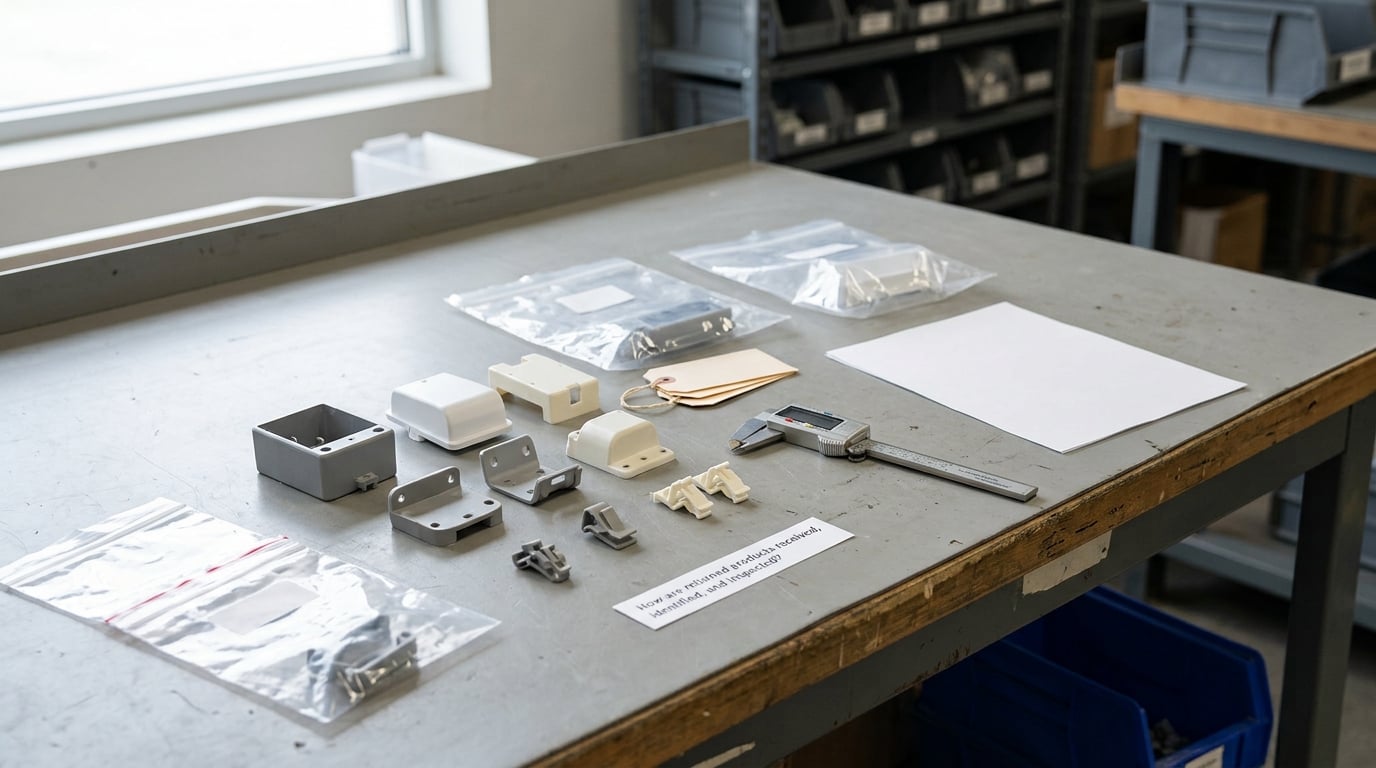
Receiving is where most reverse processes get vague, because the item arrives from outside your four walls and nobody is certain what it is or what condition it is in. Fix that at the dock, not in the disposition meeting three days later.
A workable receiving procedure does the same six things in the same order. Match the item to an open RMA or advance shipping notice, and quarantine anything with no match rather than guessing. Read and record the serial number, lot code or date code before the item is opened or cleaned. Photograph the packaging and the item as received, including any damage, because this is the only evidence that survives. Run a safety check first: leaking, sharp, pressurized, or otherwise hazardous product gets handled by trained staff in the right area, not put on a general receiving belt. Inspect against written acceptance criteria for that item type, with a sampling rule where volume makes 100 percent impractical. Then record the finding as a condition grade, a reason code and a written note, with photographs attached in the system.
Inspection criteria should be item-specific. “Good” is not a criterion. A cosmetic spec limit, a dimensional tolerance, a leak test result, a functional test result and a cleanliness requirement can each be the acceptance line for different product families, and a returned item either passes all applicable ones or it does not.
For failures that could recur across a population, add failure analysis: teardown, metallurgical or lab examination, or a supplier quality investigation. That is the step that turns a return into evidence rather than a disposal cost.
| Condition grade | What it means at receipt | Likely disposition |
|---|---|---|
| A – Unopened, complete | Sealed original packaging, all parts present, no evidence of use | Return to inventory, or resell as new if packaging is intact |
| B – Opened, unused | Packaging opened or missing, product complete and unused, documentation present | Return to inventory as open-box, or refurbish if presentation matters |
| C – Used, functional | Product has been operated, tests pass, wear consistent with normal service | Resell through the refurbished channel, or remanufacture |
| D – Used, repairable | Failed or degraded, but the failure is identified and repairable in house | Repair or rework, then return to service or to the refurbished channel |
| E – Damaged beyond repair | Physical damage or failure with no viable repair path | Harvest serviceable parts, then recycle or controlled destruction |
| F – Suspect or unidentifiable | No traceability, no documentation, tampered, or suspect condition | Quarantine, do not reissue, route for supplier recovery or destruction |
| H – Hazardous | Residual product, contamination, or regulated material present | Hazardous handling route, with disposal documentation and no resale |
Two habits keep this honest. Grade against the written criteria every time, not against a mood. And record the reason code at intake, while the person who opened the carton is standing there, because that is the cheapest quality data you will ever get and the easiest to lose.
What happens after inspection and disposition decisions?
The disposition decision is the fork in the process, and it should be a controlled list with a named authority, not a judgment call made in a corridor. Every route out of inspection needs its own paper trail, because each one commits the company to something different.
Return to inventory. Grade A and B product is booked back with a receipt that names the condition, so it does not quietly become new stock. Open-box status follows the item into picking and packing.
Repair or rework. A work order goes out with the failure finding attached, and the item returns to stock only after a test pass, not after the part is fitted. Rework is the right call when the fix is defined, repeatable and cheaper than replacement, which is the standard you should be able to show an auditor.
Warranty replacement or supplier recovery. The failed part goes to the responsible party, which may be your own supplier rather than you. A claim pack of purchase date, serial number, condition grade, photographs and the test result is assembled, and a credit or replacement is tracked to closure. Where the supplier disputes the cause, the failure analysis is the document that settles it.
Parts harvesting. On unrepairable items, serviceable components are pulled for the spare parts pool before anything is destroyed. It is a small recovery on each item and a meaningful total on a high-volume line, and it needs its own tracking so harvested parts are not confused with new inventory.
Recycling and controlled destruction. Material goes to a named processor with a record of weight or quantity and a certificate, and the certificate is what proves the recycling happened. Product subject to a recall or an intellectual property concern is destroyed under supervision, with a destruction certificate and witnesses recorded.
Consignment, donation or transfer. Unsold inventory can be moved to a secondary channel or another region rather than returned, which is often cheaper than a return and preserves the value. Donation of functional product carries its own handling and tax rules, so check them before you commit.
Chain of custody is what makes any of these defensible. From the moment an item is received until its final disposition, someone should be able to say where it was, who had it, what condition it was in and who authorized what happened to it. That record is what stops a warranty unit being resold onward, and it is what a regulator or a customer auditor will ask for first.
Which KPIs show whether reverse logistics is working?
A reverse process without measures drifts, because the work is invisible until someone complains or an invoice arrives. These nine numbers tell you whether the process is running, and every one of them has a source system you already have.
| Metric | How to calculate | What it tells you, and what to do with it |
|---|---|---|
| Return cycle time | Days from return authorization to final disposition | Total process speed. Rising cycle time usually means authorization or inspection is queueing, not moving. |
| Recovery rate | Value recovered divided by value returned, by value | The economic case in one number. Segment it by product family, because a blended rate hides everything. |
| Return rate | Returned value divided by value delivered, by value or by unit count | Product and channel health. A rise on one SKU is a quality signal before it is a logistics one. |
| Cost per return | Total reverse logistics cost divided by number of returns | Unit economics. Break it into freight, handling, inspection, disposal and credit to see which lever is real. |
| Inspection accuracy | Items correctly dispositioned at first inspection divided by items inspected | Quality of the grading decision. Low accuracy means rework loops and misdirected value. |
| Disposition mix | Share of returns in each disposition code | Whether value is being captured or thrown away. A rising scrap share is a red flag worth investigating. |
| Warranty failure rate | Warranty returns divided by products delivered, by model and by failure mode | Product reliability, and the trigger for supplier corrective action. |
| Freight cost per event | Return freight spend divided by number of return events | Consolidation and routing performance. Compare against the pickup schedule, not just month to month. |
| Closure rate | Returns closed with a completed financial and data action divided by returns received | Whether work is actually finished. Anything below full means open items aging somewhere without an owner. |
Report the first four monthly and the rest quarterly, split by segment. A single blended number across a whole plant tells you nothing you can act on.
How can manufacturers control cost without weakening recovery outcomes?
Cost control in reverse logistics is mostly about not paying premium freight for routine items and not spending inspection effort on things that have no value. Both require segmentation, and both are cheaper than the alternatives most plants try first.
- Route routine returns on a schedule. Fixed weekly pickup days at the top distributor and dealer locations turn single urgent movements into a predictable consolidated load. Expedited handling on a routine return is pure margin loss.
- Consolidate by destination and compatibility. Group returns that go to the same facility, same handling class, and can sit for a few days. The trade-off is repair urgency and storage cost, so set the hold window per segment rather than globally.
- Use regional return hubs. For high-volume dealer networks, a small regional consolidation point often beats moving everything to a single central plant, because it shortens the first leg and improves carrier options.
- Set disposition thresholds. Define the value at which inspection effort is worth it. Below the threshold, a simplified path and a fast disposition code are fine; above it, full grading, photographs and failure analysis pay for themselves.
- Write the cost split into supplier and distributor agreements. Who pays return freight, who pays inspection, who absorbs the loss on a defective lot. Ambiguity here becomes a monthly argument with an invoice attached.
- Use reusable transport packaging. Returnable containers and pallets protect the product in transit, cut damage rates, and remove packaging from the disposal stream on the next trip.
- Batch like dispositions. Group items going to the same rework cell or the same processor so setups, teardowns and certificates are amortized rather than repeated per item.
- Recover parts before scrapping. A harvest step on unrepairable items is inexpensive and often pays for the handling that produced them.
The principle underneath all of it: safety-critical and high-value items get controlled handling, documented custody and priority movement. Low-value consumables get a simplified path, a fast grade and a fast exit. Running either group through the other’s process is what makes reverse logistics expensive.
What compliance and risk controls apply to reverse logistics?
The obligations depend on the product, the material, the jurisdiction and the transaction, so treat the list below as the questions to ask rather than a fixed set of rules. Most of them become real in one of four situations: a recall, a hazardous material, an end-of-life product, or a product crossing a border.
- Product safety and recall traceability. You need to identify every affected item already in the field, recover or service them, and document what happened to each one. For an installed base you do not control, the record set has to come from your own distribution and service records, which is why recall traceability is a data problem as much as a logistics one.
- Environmental and extended producer responsibility rules. Take-back and recycling obligations, documentation requirements and reporting deadlines vary by country and by product category, and they apply to the party placing the product on that market.
- Hazardous material handling. Products with residual fuel, coolant, refrigerant, batteries, chemicals or pressurized content need licensed handling, labeled packaging, trained staff and disposal certificates.
- Export and cross-border restrictions. Used electrical equipment, batteries, electronics and certain chemicals are restricted or prohibited on some routes, and returning a product across a border can trigger duties and rules you did not anticipate.
- Data retention. Warranty records, recall files, inspection findings and disposal certificates carry retention requirements that usually outlast the warranty period itself. Keep them in a system that does not quietly delete them.
- Chain of custody records. Who held the item, when, in what condition, and who authorized the disposition. This is what you produce when a customer, insurer or regulator asks a question months later.
- Controlled destruction. For recalled, counterfeit-suspect or confidential products, destruction under supervision with a certificate, and no resale of the affected items into any channel.
Two risks sit outside the compliance list but cause real losses. Returns fraud and grey-market leakage: warranty items that come back and then get resold instead of scrapped, which leaves a known defect in front of another customer and a public safety problem for you. Control it with serialized marking, condition grading, and a destroyed-items list that never gets released back to stock. And uncontrolled refurbishment: a repaired item going back into service without the test evidence, which turns a returns problem into a liability problem.
What are the most common reverse logistics mistakes?
These seven account for most of the trouble I see described in practitioner discussions of manufacturer returns, and each has a straightforward fix.
- Authorization rules that do not exist in writing. People approve whatever the customer asks for, and the plant absorbs it. Fix: written entry criteria per product segment, with a named approver.
- Weak traceability. Serial numbers and lot codes are captured on some returns and not others, so a recall cannot be scoped. Fix: make the identifier a required field at receipt, and quarantine anything that cannot be matched to an RMA.
- Vague acceptance criteria. The inspector decides what good looks like, and two plants grade the same defect differently. Fix: written, item-specific inspection criteria and a condition grade scale with photographs as examples.
- Unauthorized dispositions. Anyone can scrap or return something to inventory because the rule is unwritten. Fix: a controlled disposition list where only named roles can assign certain codes.
- Inconsistent disposition data. One plant repairs what another scraps, and the reason codes differ, so no trend is visible. Fix: one disposition code list across all facilities, enforced in the system.
- The loop stays open. Returns data sits in the ERP and never reaches design, quality or supplier management, so the same defect is manufactured again. Fix: a defined monthly route of reason codes and failure findings to quality, with a corrective action trigger when a failure mode crosses a threshold.
- Unclear ownership and cost. Nobody owns the process between distributor, manufacturer and supplier, so items sit and costs get disputed. Fix: name the owner at each stage and write the cost split into the agreement.
Frequently Asked Questions
What is reverse logistics in manufacturing?
In manufacturing, reverse logistics is the planned flow of products moving back through the supply chain after use, so they can be returned, repaired, reworked, remanufactured, harvested for parts, recycled or disposed of. It covers customer and distributor returns, warranty claims, recalls, supplier recoveries, excess and obsolete inventory, and end-of-life take-back. The defining feature is that every stage has an owner, a record and a measured target.
What is the difference between reverse logistics and returns management?
Returns management is the customer-facing part of the flow: the policy, the portal, the authorization request, the label and the communication. Reverse logistics is everything behind that, including receiving, inspection and grading, disposition decisions, repair and rework, supplier recovery, financial settlement, compliance and the feedback loop into quality. A returns management system handles the front end; it does not run the process on its own.
How can manufacturers reduce reverse logistics costs?
Segment products by value, criticality and return frequency, then give each segment its own handling path. Consolidate routine returns onto scheduled pickups and regional hubs, and reserve expedited freight and priority handling for safety-critical items. Set a value threshold below which inspection is simplified, batch like dispositions to amortize setups, use reusable transport packaging to cut transit damage, and write the return freight and inspection cost split into supplier and distributor agreements.
When is a returned product recycled instead of restocked?
Restock only when the item passes the written acceptance criteria for that product family, is complete, is traceable to a serial number or lot, and has no safety or quality concern attached to it. Recycle when the product is materially damaged with no repair path, when it has reached end of life, when the material has recovery value, or when it is subject to a recall or an intellectual property restriction that rules out reissue. Document the decision and route with a processor certificate.
What should a manufacturer standardize first in its reverse logistics process?
Standardize the decision layer first, because everything else depends on it: one condition grade scale, one disposition code list, and one set of written acceptance criteria used at every facility. Then make the serial number or lot code a required field at receipt, and quarantine anything that cannot be matched to an open RMA. These three items fix the traceability and consistency problems that make every later improvement, from cost per return to warranty failure analysis, difficult.
Conclusion
The reverse logistics process explained for manufacturers is one connected flow: trigger, authorize, receive, inspect, grade, disposition, settle and feed the result back into quality. Run well, it returns value instead of absorbing cost, and it keeps known defects out of other customers’ hands. Do three things first: map your return triggers and rank them by urgency and value, write down who owns each stage and who pays the freight, and put a single condition grade scale and disposition code list in force across every facility. Then start measuring return cycle time, recovery rate, cost per return and warranty failure rate, because those four numbers are where the next improvement is hiding.