

There is no single federal label code for plastic packaging in the US. What you must print depends on what is inside the package, whether the package touches food, what you claim about it, and which states sell it. Plastic packaging labeling rules in the US are really a dozen rules layered on top of each other, and the label you approve is where all of them land at once.
Start by separating two things that most articles mix together. The FDA governs the safety and identity of the food and of the plastic that touches it. The FTC governs the claims you make about the package, including recyclable and compostable. Nothing the FDA requires puts a recycling triangle on a bottle, and nothing the FTC requires puts a nutrition panel on a tub.
This guide maps each label element to the rule that owns it, then gives you a review process you can actually run before artwork goes to a printer.
Table of Contents
- Plastic Packaging Labeling Rules in the US: What Applies?
- Which Agency or Law Governs the Label?
- Food Packaging and Contact Materials
- Consumer Products and Chemical Containers
- Recycling, Resin Codes, and Environmental Claims
- Required Label Information by Packaging Type
- How to Review a Plastic Packaging Label
- Label Placement, Size, and Legibility Requirements
- Common Plastic Packaging Labeling Mistakes
- A Compliance Checklist for Manufacturers and Packagers
- Frequently Asked Questions
- What are the labeling requirements for plastic food packaging in the US?
- Is the recycling symbol required on plastic packaging?
- Do food contact materials need FDA approval?
- What are the plastic packaging labeling rules in California?
- What is a Food Contact Notification?
- Who is responsible for label compliance when a supplier makes the package?
- Conclusion
Plastic Packaging Labeling Rules in the US: What Applies?
Requirements attach to three separate questions, and the answer changes depending on which one you are asking.
What is in the package. A frozen meal container, a bottle of dish soap, a bag of trash liners, and a cosmetic sample pouch each trigger a different set of rules. The product inside decides the label regime before the plastic does.
What the package touches. A container that holds food, an ingredient, or a food-contact surface falls under FDA food-contact rules. A retail shopping bag, a stretch wrap pallet cover, or an ecommerce mailer does not, even though it is made of the same polyethylene.
What you say about it. The words on the panel are separately regulated. Recyclable, recycled content, compostable, non-toxic, BPA-free, food safe, and FDA approved are all claims with different tests attached to them, and most of them sit with the FTC rather than the FDA.
Two things are true across nearly every category. The label has to be truthful, and the supporting records have to exist before the package is printed, not after a complaint arrives. Regulators do not care that you intended to file the migration study next quarter.
One more distinction matters for anyone working with converters and co-packers. A packaging supplier typically supplies resin, film, or containers. The party that puts the product in and sells it bears the labeling obligation. If you are the brand, the label is your problem even if a converter drew the first artwork.
Which Agency or Law Governs the Label?
Most packages fall under more than one authority at the same time. The table below maps the common label elements to the rule that governs each one.
| Label element | Who governs it | Where the rule lives |
|---|---|---|
| Food name and identity statement | FDA | 21 CFR 101.3 |
| Ingredient statement and allergen declaration | FDA | 21 CFR 101.4 |
| Nutrition panel | FDA | 21 CFR 101.9 |
| Net quantity of contents for food | FDA | 21 CFR 101.105 |
| Authorization of the plastic for food contact | FDA | 21 CFR 174 through 177 |
| Net quantity for a consumer commodity | FTC, state weights and measures | Fair Packaging and Labeling Act, 16 CFR 500 |
| Recyclable, recycled content, compostable claims | FTC | 16 CFR Part 260, the Green Guides |
| Deceptive or unsubstantiated marketing claims | FTC | Section 5 of the FTC Act |
| Pesticide registration, directions, and hazard statements | EPA under FIFRA | 40 CFR Part 156 |
| Workplace chemical hazard labels | OSHA | 29 CFR 1910.1200 |
| Shipping descriptions and markings | US Department of Transportation | 49 CFR shipping regulations |
| State recycling, packaging, and producer responsibility rules | State agencies, CalRecycle, state AGs | State statutes, varied by state |
| California chemical warnings | California OEHHA | Proposition 65 |
Two points from that table get skipped in most explanations. First, the FDA does not approve plastic packaging. It authorizes substances for use, and the authorization lives in the regulations or in a Food Contact Notification, not in an approval sticker. Second, the Green Guides are guidance on what claims are deceptive rather than a standalone statute, but the FTC uses them as the yardstick in enforcement and they are what most state laws reference.
State and local rules then add a layer underneath all of it. California alone runs recycling label rules, cookware and PFAS disclosure, a plastics circular economy statute, and Proposition 65 warnings. Producers in several other states now face extended producer responsibility programs with their own registration, reporting, and marking requirements. If you sell nationally, you need a state-by-state view, and there is no shortcut through that work.
Food Packaging and Contact Materials
Food is the most heavily regulated category, and it is where most plastic packaging questions originate. Two separate FDA questions live on the same package: is the food itself correctly labeled, and is the plastic authorized to touch it.
What must appear on food packaging
Under 21 CFR 101.3, a packaged food needs the name of the food in a form that identifies it, plus the name and place of business of the manufacturer, packer, or distributor. That is the identity statement, and it is the element most often rejected in import inspections.
Beyond identity, you need the ingredient statement in descending order of predominance, with the major allergen sources declared in parentheses under the ingredient names they come from, and a Nutrition Facts panel in the prescribed format and type size. Net quantity of contents appears in the lower third of the principal display panel. None of this is optional because the container is plastic.
Where a food is packaged in a container that is not sold with the food, the food itself still needs the name and place of business. You do not need to print the name of the tray on the tray if the carton the tray ships inside carries the identification, which is why many supermarket cases show a code on the film rather than a full label.
How a plastic gets authorized for food contact
A resin becomes a food contact substance through one of three routes. It is listed in the Code of Federal Regulations, most often in 21 CFR 177 for articles intended for contact with food. It is covered by an effective Food Contact Notification, which the manufacturer files with the FDA showing the intended use, the safety data, and the conditions of use. Or it is the subject of a prior sanction or effective exception for a food contact substance used before 1976.
A Food Contact Notification is not a label requirement. It is the manufacturer’s authorization record, and the practical effect is that the material is cleared for the use described in the notification. The FDA does not issue a certificate you print on the package, and there is no FDA-approved mark for a plastic container.
What you do have to be able to show is that the specific resin in your specific structure is cleared for the specific food and the specific conditions. A resin cleared for cold water at low temperatures is not automatically cleared for hot oil at 200 degrees. That distinction is where most formulator mistakes happen, and it is why the intended use conditions in your supplier documentation have to match your actual product.
What the FDA does not require you to put on the label
No federal law requires a recycling symbol, a resin code, or a disposal instruction on a food package. The FDA does not require you to print anything about the plastic’s environmental properties, and it does not require a compostable claim to be qualified.
The FDA also does not define or police the phrase food safe. That is a general safety claim, and once it appears on a package the FTC treats unsubstantiated safety and non-toxicity claims as deceptive. The same is true of BPA-free and phthalate-free, which are absence-of-substance claims that need documentation showing the substance is genuinely absent from the finished article, not merely absent from the resin.
Consumer Products and Chemical Containers
Non-food plastic is where the compliance load shifts from FDA to FTC, state law, and workplace rules. The plastic itself is rarely the problem. The claims and the hazard information are.
Any consumer commodity sold in the US needs an accurate net quantity declaration, and that is set by the Fair Packaging and Labeling Act and enforced by the FTC and by state weights-and-measures officials. Declared net quantity is the actual quantity, not the gross weight including packaging, and it has to be stated in both metric and US customary measures. Containers holding under a certain threshold of fluid are treated differently from larger ones under the FPLA, and the exemptions are narrower than most people assume.
Anything sold as a registered pesticide follows FIFRA rather than general consumer rules. EPA sets the label content, including the registered uses, directions for use, and hazard statements, and those items have to match what is on the approval. You cannot drop a hazard statement to make room for a front-panel marketing message, and repackaging a registered product into a new container can itself be a regulated act.
Solvent cleaners, degreasers, and chemical concentrates used in workplaces sit under the OSHA Hazard Communication standard, which sets requirements for container labels, including pictograms and hazard statements, and for the safety data sheet that supports them. Where a consumer product already carries a label that meets the standard’s content requirements, OSHA generally accepts that label rather than requiring a second one. Domestic plastic retail bags and mailers fall outside the food and chemical regimes entirely, which leaves state producer responsibility rules, claims substantiation, and any contract terms with the converter.
Shipping is a separate regime again. Dangerous goods markings and shipping descriptions under the Department of Transportation rules belong on the package or overpack when the material requires them, and they are evaluated against the actual contents at the time of shipment.
Recycling, Resin Codes, and Environmental Claims
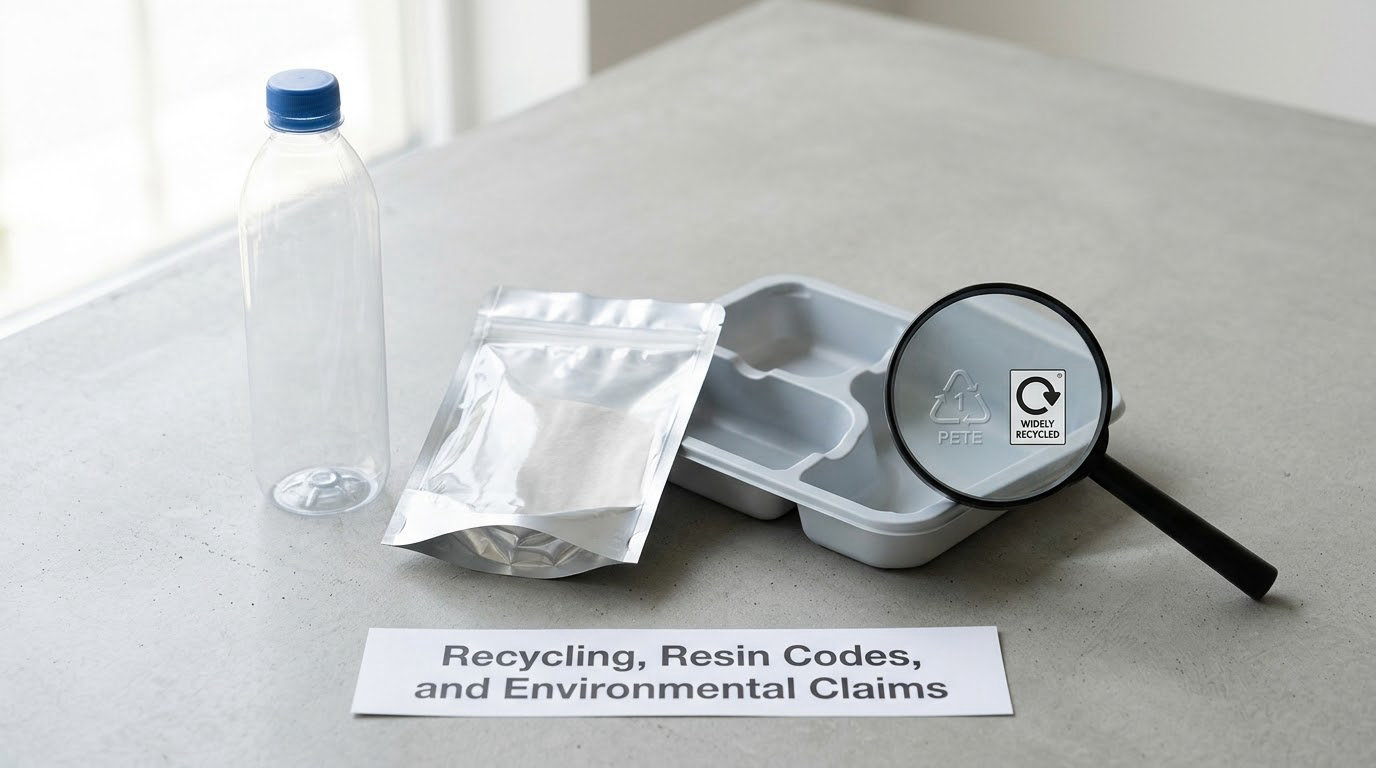
This is the section where the most widespread public belief is simply wrong, and correcting it is the fastest way to make your label compliant.
Is the recycling symbol required by law?
No. The resin identification code, the number inside the triangle of arrows with a resin abbreviation such as PET, HDPE, or PP, is a voluntary industry practice built on the ASTM D7611 standard. No federal statute requires it, and the FDA does not require it on food packaging. You may see it on millions of containers in the US market and none of them are non-compliant for lacking one.
There is one important exception. Once you print the code, the FTC’s position is that a manufacturer who uses the chasing-arrows symbol should do so in a way that does not mislead consumers, and a set of state statutes does convert the practice into a mandate for certain products and in certain jurisdictions. California is the most developed example. The practical rule for a national brand is that you print the code voluntarily and then treat it as if it were regulated, because state law frequently reads it that way.
What the FTC Green Guides actually say
The Green Guides at 16 CFR Part 260 give the FTC’s position on environmental marketing claims, and they are the reference most state statutes borrow from.
An unqualified recyclable claim, meaning the word recyclable with no qualifier attached, is only appropriate when a substantial majority of consumers have access to recycling facilities that will accept the item. An unqualified claim on a package sold in a state with no practical recycling program is exactly the kind of thing the FTC acts on. A qualified claim, one that names a specific program or facility, is more defensible but still needs support.
Recycled content claims are judged on the composition of the material. A post-consumer recycled content claim must be accurate about the proportion of post-consumer material in the package, and a claim about recycled material generally must reflect the whole package, not just one component unless the claim is clearly limited to that component.
Compostable and degradable claims have their own section of the Guides, and a product that is certified to a composting specification still cannot carry an unqualified claim that would lead a reasonable consumer to put it in a home compost bin if the certification does not cover that condition. Certifying a product does not authorize the wording on the label; the wording still has to be supported.
Two claims to watch specifically. FDA approved is a frequent and legally risky claim on food contact plastic, because the agency authorizes substances rather than approving finished containers. Non-toxic is a broad safety claim with no regulatory definition, and it is one of the claims most frequently challenged as deceptive.
State recycling and producer responsibility rules
States are where the rules are changing fastest. California’s plastics circular economy statute and the related labeling legislation tightened the conditions for recyclable and compostable claims and set separate requirements for the chasing-arrows symbol, with implementation dates that CalRecycle sets and phases in. Cookware sold in California carries its own disclosure obligations for PFAS and for certain origin and composition claims.
Other states have enacted extended producer responsibility statutes that require producers to register, report on volumes placed on the market, and in some cases finance or mark packaging for collection. Obligations are triggered by volume thresholds and by role, and the producer responsible for compliance is not always the same company that manufactured the package. If your volume is climbing, treat this as a live workstream rather than an annual compliance chore.
Required Label Information by Packaging Type
The table below maps the common plastic packaging formats to the information each one usually triggers and the documentation you need on file before printing.
| Packaging format | Information typically required | Documentation to have on file |
|---|---|---|
| Frozen or refrigerated food tub | Food identity, ingredients with allergens, Nutrition Facts, net quantity, storage instructions | Food contact authorization for the intended conditions of use, including frozen and refrigerated ranges |
| Ambient shelf-stable container, glass or plastic | Full food labeling plus any required date marking | Resin authorization matching time and temperature of use |
| Restaurant to-go container | Food identity and place of business when the food is not in original retail packaging | Authorization covering hot holding, since grease and heat accelerate migration |
| Produce or bakery bag | Food identity in some cases; otherwise claims substantiation only | Recyclability claim support scoped to realistic local collection |
| Trash bags and can liners | Net quantity, size designation, brand identity, directions for use | Resin authorization if any food-contact claim is made, otherwise none |
| Clamshell or tray, non-food | Net quantity where required, ingredient or material description if applicable, hazard warnings | Claim substantiation for recycled content, compostable, or non-toxic |
| Shrink wrap and stretch film | Usually no consumer label; overpack or shipping markings may apply | Material documentation and any contract-specific marking terms |
| Closure, cap, or pump component | Net contents of the whole package, not the closure alone | Compatibility and authorization documentation for the assembled article |
| Secondary packaging, shipper carton | Shipping marks, lot and date codes, distributor information | Distribution records and any state registration documentation |
| Pesticide container | EPA registered uses, directions, hazard statements, net contents | The approved label text and the registration number for the exact product |
How to Review a Plastic Packaging Label
This is the process I would hand a packaging designer or a regulatory lead on their first week. It runs in seven steps, and it is deliberately ordered so the expensive decisions come first.
- Classify the product and the package separately. Write down what is in it, whether anything in it is meant to be eaten or drunk, whether it is a pesticide, a chemical, or a household article, and which states it ships to. Every later step depends on this one, and it takes about ten minutes.
- Identify the governing rules. Use the agency table above and write down every rule that applies, federal and state. A product that ships to California usually adds obligations nobody thought about at the start.
- Confirm material authorization. For anything food contact, pull the supplier’s documentation and match the resin, the intended use, the food type, and the time and temperature conditions against the authorization. Mismatches here are the most common technical defect I see.
- Pull the claim inventory. List every claim printed anywhere on the package, panel, cap, insert, or carton. Recyclable, compostable, recycled content, BPA-free, food safe, non-toxic, and FDA approved all need their own evidence, and claims on a secondary panel count the same as claims on the front.
- Check the mandatory information set. Identity, ingredients and allergens, Nutrition Facts, net quantity, hazard information, storage and use directions, depending on the category you classified in step one.
- Check placement and durability. Confirm the required items sit where the governing rule expects them, in a type size and contrast that hold up on a printed surface.
- Freeze artwork with a version-controlled record. Approve a single file, keep the substantiation attached to it, and log the approval date. Label problems discovered at the retailer stage mean destroying inventory.
Label Placement, Size, and Legibility Requirements
Most rules that specify type size specify it in a way that surprises people. Federal food labeling generally defines the type size in terms of the height of the lowercase letter o in the font, measured against the height of the container, rather than in a single point size. The same is true of the area a Nutrition Facts panel must occupy. This is why a package can carry fully compliant text that looks small next to a marketing headline, and why increasing the headline while holding the panel fixed causes failures.
Where a rule requires something to be conspicuous, the test is generally whether a reasonable person buying the product would notice and understand it. Bold weights and a clear background beat a larger but low-contrast treatment. Where information must be in a specific panel, the panel must be that panel, not a back-of-package footnote in similar type.
Durability is the requirement people forget until a film label scuffs off in a wet cooler. Label statements tied to a specific package configuration have to survive the handling that package actually gets, and on a washable or reusable container, whether the information stays with the container for its useful life.
Exact specifications belong to the governing rule rather than to a general standard, and the rules genuinely differ from each other. Check the citation for the specific claim or product before you size anything.
Common Plastic Packaging Labeling Mistakes
Treating the recycling code as federally required. It is voluntary, and the resulting copy often overstates it. The fix is documentation stating where the code came from and confirming the resin is what the code says.
Printing an unqualified recyclable claim. A recyclable claim with no qualifier needs a substantial majority of consumers to have access to recycling. Fix it with a qualified claim tied to a named program, or drop it.
Saying compostable without a condition. Industrial composting certification does not support a claim that a consumer will put the item in a home compost bin. The wording has to match the certification’s conditions.
Claiming FDA approved. The agency authorizes food contact substances rather than approving finished containers, and this phrasing is one of the more common claims in the category. Replace it with a factual statement about the material if the point needs to be made.
Using food safe or non-toxic without a test. These are safety claims with no regulatory definition, so the FTC evaluates them as marketing claims. Substantiate them or remove them.
Leaving out a required item because the package is secondary. Food in a tub inside a labeled carton usually keeps the requirement off the tub, but a returnable or reusable container has no carton. Confirm the packaging configuration before you assume.
Net quantity on the wrong element. Declared net contents belongs on the retail package and reflects the contents, not the weight of the filled container. Caps and secondary components are not where the declaration goes.
Claim evidence in a drawer rather than a system. Most real failures come down to nobody owning the substantiation. Assign an owner and a review date at artwork approval.
A Compliance Checklist for Manufacturers and Packagers
Run this before releasing artwork to print. It is ordered so the expensive rework happens while the format is still a sketch.
- Product and package are classified separately, with the category recorded.
- Governing federal rules are listed with citations.
- State requirements are reviewed for every state where the product is sold, including producer responsibility registration and reporting thresholds.
- For food contact, the resin authorization matches the intended food, the time and temperature conditions, and the finished structure.
- For food, identity, ingredients, allergens, Nutrition Facts, net quantity, and date marking are all present and in the required format.
- Every claim on the package has a named owner and a substantiation file with a date.
- Recyclable and compostable claims are scoped to a real program and match any certification conditions.
- Absence-of-substance claims such as BPA-free are backed by documentation on the finished article.
- Prohibited and risky phrases have been removed, including FDA approved, non-toxic, eco-friendly, and safe for the environment without qualification.
- Pesticide, chemical, and workplace hazard labeling has been confirmed against its own governing standard.
- Net quantity and measurement declarations are verified for the actual fill volume.
- Placement, type size, contrast, and durability have been checked against the governing rule rather than by eye.
- Cap, insert, carton, and shipping overpack panels are included in the claim inventory.
- A single approved artwork version is archived with its substantiation and an approval date.
- Post-launch monitoring is scheduled for regulation changes in your highest-volume states.
Frequently Asked Questions
What are the labeling requirements for plastic food packaging in the US?
A plastic food container must carry the food’s identity, the manufacturer or distributor name and place of business, an ingredient statement with major allergens declared, a Nutrition Facts panel, and the net quantity of contents, all under FDA rules in 21 CFR Part 101. Separately, the plastic itself must be an authorized food contact substance under 21 CFR 174 through 177 or covered by an effective Food Contact Notification. No federal rule requires a recycling symbol or any environmental statement on the package.
Is the recycling symbol required on plastic packaging?
No. The resin identification code, the number and abbreviation inside the chasing-arrows triangle, is a voluntary industry practice based on the ASTM D7611 standard. Neither the FDA nor the FTC requires it as a general matter. The complication is that once you use it, the FTC will evaluate whether the symbol and the wording around it mislead consumers, and several state statutes treat the symbol as a regulated element.
Do food contact materials need FDA approval?
The FDA does not approve finished food containers or issue an approval mark you can print. Instead, a substance is authorized for food contact in one of three ways: it is listed in the Code of Federal Regulations, most often in 21 CFR 177; the manufacturer has an effective Food Contact Notification for that specific use; or it falls under a prior sanction. Your file should show which route applies and that the conditions of use match your product.
What are the plastic packaging labeling rules in California?
California layers several rules on top of federal requirements. Recycling and compostable claims face statutory conditions that are stricter than the FTC Green Guides, and the chasing-arrows symbol is regulated for certain products. Cookware must disclose PFAS and meet documentation rules for certain origin and composition claims. Proposition 65 may require chemical warnings, and the state plastics circular economy statute drives producer reporting and packaging obligations.
What is a Food Contact Notification?
A Food Contact Notification is the route a manufacturer uses to obtain FDA authorization for a new food contact substance rather than relying on an existing regulation listing. The notification identifies the substance, its intended uses, and the conditions of use, and is supported by safety data and a good manufacturing practice statement. It is a manufacturer filing, not a label item, and the substantiation belongs in your compliance file, not on the package.
Who is responsible for label compliance when a supplier makes the package?
The party that puts the product in and sells it, meaning the brand, owner, or distributor, carries the labeling obligation. A converter or resin supplier that only manufactures containers is usually not the responsible party, though it may be contractually required to supply documentation. If you are a co-packer producing to a brand’s specification, confirm in writing which party owns artwork approval, claim substantiation, and state producer responsibility registration.
Conclusion
Start with classification, not with artwork. Write down what is in the package, whether it is food contact, what every printed claim asserts, and which states receive it. From that one page you can map the governing rules and see which obligations are federal and which are state.
Then verify every claim before approving the file. Plastic packaging labeling rules in the US are much easier to satisfy at the design stage than after a pallet of finished containers has to be destroyed, and the cheapest fix is the one you make while the format is still a sketch. This is general compliance information rather than legal advice, and state requirements change, so verify citations against the current Code of Federal Regulations and your state agency guidance before you release a label.