
BPA-free plastics carry one narrow claim: the manufacturer did not intentionally add bisphenol A to that product. That is the entire content of the label. It is a statement about a single ingredient, not a certification that the item is non-toxic, chemical-free, or approved by any regulator for any condition of use.
The claim is genuinely useful, and for many applications it is a real improvement over the material it replaced. It is also routinely read as far more than it says. Teams that treat the label as a safety verdict end up approving materials they would otherwise have tested, and skipping the checks that actually predict performance.
So before the detail, here is what the phrase covers and what it does not:
- It does not mean bisphenol-free. BPS, BPF, BPAF and BPP share much of the same chemical structure and some of the same contested behaviour.
- It does not cover phthalates, PFAS, plasticizers, pigments, or any other additive in the formulation.
- It does not mean a regulator tested or approved the product. No agency certifies “BPA-free.”
- It says nothing about microplastic shedding, which is a separate exposure route the label does not touch.
- It does not certify performance under heat, long contact times, repeated dishwasher cycles, or physical damage.
For product designers, buyers, engineers and quality managers, the useful habit is to read BPA-free as one attribute in a specification, then check the rest: resin identity, additive package, contact conditions, and the migration testing that applies to the product in front of you.
Table of Contents
- What Does BPA-Free Plastics Actually Mean?
- What Is BPA and Why Is It Used in Plastics?
- Does BPA-Free Mean Safer for Everyone?
- Which Plastic Resins Are Commonly BPA-Free?
- How BPA-Free Is Different From Food-Safe or Food-Grade
- What BPA-Free Labels Do Not Guarantee
- How Manufacturers Verify BPA-Free Claims
- When BPA Matters Most in Manufacturing Decisions
- What Buyers Should Ask Suppliers
- Frequently Asked Questions
- Conclusion
What Does BPA-Free Plastics Actually Mean?
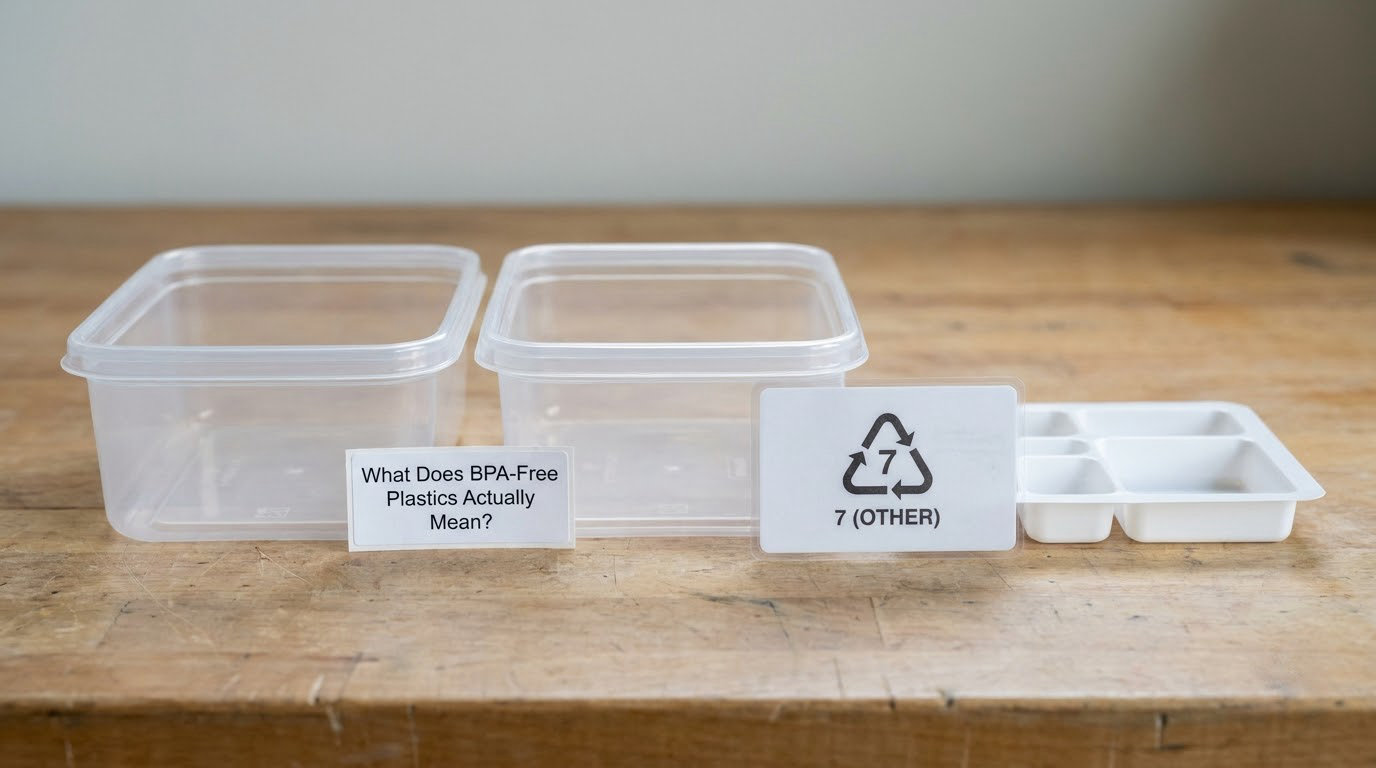
In practice, the claim describes composition at the time of manufacture. The resin grade, the additives and the colorants were selected without BPA as an intentionally added ingredient. That is a meaningful and testable statement about inputs, and it is the strongest thing the label offers.
It is not a statement about what is inside the finished part. Detecting agents in modern laboratories are sensitive enough to find BPA at trace levels in materials where nobody added it. Four things produce those readings, and none of them is fraud:
- Recycled feedstock. Post-consumer material carries a history, and the incoming stream may have held BPA-containing plastic previously.
- Environmental background. Dust, receipts handled near a work surface, and water can deposit residues before a part is even produced.
- Analytical sensitivity. Methods with lower detection limits find things that older methods missed entirely.
- Supply chain gaps. A sub-supplier of a masterbatch, coating or closure may use a formula that differs from what the primary supplier believes they specified.
In the US, no federal rule defines “BPA-free” or sets a limit for it in general consumer goods. The FDA has taken a different route on infant articles: it prohibited the addition of BPA to baby bottles, sippy cups, and infant feeding equipment, and withdrew certain existing authorizations for BPA in baby products. That is a targeted restriction on one chemical in one product category, not a general definition of the label.
The label also has no expiration. A product qualified for a set of conditions at the time it was built, and the resin grade can change years later without the packaging looking any different.
What Is BPA and Why Is It Used in Plastics?
BPA is bisphenol A, an organic compound built from two phenol rings joined by a central carbon. What makes it interesting to formulators is also what makes it contentious: its structure is close enough to some natural hormones that it can interfere with endocrine signalling in laboratory studies.
It is used as a building block in two very different product families. The first is polycarbonate, a rigid, clear, tough plastic used for hard bottles, baby bottles, blender jars, electronics housings, safety helmets, and reusable containers. The second is epoxy resin, which lines the inside of metal food cans, appears in powder-coat and can coatings, and is used in some dental and medical materials. A third, less visible use is in thermal paper: BPA has served as a developer in register receipts, some till rolls, and many shipping labels.
Worth being precise about scope. BPA is not the base polymer of most everyday packaging. Polyethylene (1 and 2 on the recycling triangle), high-density polyethylene, and polyethylene terephthalate (1) are made from other monomers and do not use BPA to build the base resin. Polycarbonate sits inside the “7 OTHER” category, which is a catch-all, not a verdict on safety.
Exposure is also not confined to plastic items. The can lining in your pantry, the receipt in your wallet, and dust in an old cupboard are all separate BPA sources. That matters when someone switches the bottle and assumes the problem is solved.
Does BPA-Free Mean Safer for Everyone?
Sometimes it means a lower exposure from that one source, and that is worth taking seriously. But BPA-free does not mean toxin-free, risk-free, or appropriate for every repeated-use condition.
The mainstream position from the FDA is that exposure to BPA at the concentrations currently found in food and consumer products is not expected to pose a safety concern. Academic researchers have argued for longer in a different direction, particularly around lower-dose, developmental and endocrine effects, and that disagreement is genuinely unresolved rather than a settled disagreement in either direction. If you are weighing personal health questions, your doctor or a registered dietitian is the right person, not a label or a forum post.
For a product team, the more useful variables are physical rather than chemical. Migration rises with temperature, with contact time, with the age of the part, and with surface damage. A product that is intact, used cold, and replaced on a schedule behaves very differently from the same part after two years of heating, scrubbing and dropping.
One more thing belongs in the same conversation. The best replacement is often the one that removes the material question entirely, which is why glass and stainless steel keep showing up in procurement conversations. That is a design and cost decision, not a safety certification.
Which Plastic Resins Are Commonly BPA-Free?
Most common packaging polymers never needed BPA, so the answer is often structural rather than a result of reformulation. The table below covers the materials a US buyer is most likely to specify, and the check that still applies to each one.
| Material | BPA in the base polymer | Typical applications | Heat and scratch notes | What a buyer still verifies |
|---|---|---|---|---|
| Polyethylene (PE, LDPE, HDPE) | No | Bottles, jugs, caps, liners, flexible film | Low heat tolerance, softens around boiling; dents and scratches easily | Additive package, including plasticizers and slip agents |
| Polypropylene (PP) | No | Containers, closures, hot-fill packs, cutlery | Tolerates boiling better than PE; more scratch resistant | Whether the grade suits repeated use or hot fill |
| Polyethylene terephthalate (PET) | No | Water and beverage bottles, food trays, clamshells | Heat sensitive; scratches cloud over time | Whether the application is single-use or reusable, which PET grades rarely are |
| PVC (vinyl) | Not as a monomer | Film, tubing, profiles, blister packs | Moderate heat resistance; requires plasticizers that are a separate question | Plasticizer type and any phthalate content |
| Polycarbonate (PC) | Yes, by design | Hard bottles, blender jars, medical housings, electronics | High heat tolerance, rigid, scratches less than PE but stress-cracks | Whether the grade is BPA-free or uses an alternate bisphenol such as BPF or BPAF |
| Bio-based and specialty (PLA, PHA, copolyester such as Tritan) | No | Drinkware, storage, coated items | Varies widely; copolyesters hold heat better than PLA, which is heat sensitive | Whether the substitute is a bisphenol, plus the full additive list |
The honest takeaway from that table is that only polycarbonate, and the specialized copolyesters built on related chemistry, put BPA into the picture directly. Everything else gets the claim almost by default.
How BPA-Free Is Different From Food-Safe or Food-Grade
They answer different questions. BPA-free asks what is not in the formulation. Food-contact compliance asks whether the material, as formulated and as used, is fit for a defined contact scenario over a defined time and temperature.
Food-contact evaluation reaches far past the base resin. It considers the additive package, colorants and masterbatch, processing aids, coatings, and the conditions of use. Migration testing then checks whether anything moves out of the material into food at a measurable rate under those conditions. A material can be BPA-free and still fail an overall migration limit, or pass one and still shed particles.
“Food-grade” and “food-safe” are the loosest terms in this area. Unless a document names a specific regulation, jurisdiction, and test method, they are marketing language rather than a certification grade. A supplier saying “food grade” has told you about intent, not about compliance.
“Microwave safe” is the same species of claim. It is normally a manufacturer declaration based on the resin’s temperature range and design, and it is not issued by a regulator. The useful follow-up question is whether the container is approved for a full covered load of liquid on a long cycle, or only for a short, partial one.
What BPA-Free Labels Do Not Guarantee
Most of the confusion in this category comes from inferences that the label does not support. None of these follow from the claim:
- That the product is free of bisphenols. Substitutes share the core structure, and some carry their own review history.
- That no endocrine-active compounds are present. Phthalates and other plasticizers are a separate class with a separate history.
- That the item is microplastic-free. Physical shedding is a property of the polymer, not of the additive list.
- That it is safe indefinitely under heat. The claim does not specify a temperature ceiling or a cycle count.
- That it is compostable or recyclable. Disposal behaviour is set by the polymer and the local sorting system, not by this claim.
- That it was tested by a regulator. The claim originates with the manufacturer, and documentation quality varies widely.
It is also worth naming three attributes that are often bundled into the same product story but are independent of it: recycled content, lower-carbon manufacturing, and compostability. A part can carry any of those and still be polycarbonate, still be single-use, and still need the temperature limits you already assumed.
How Manufacturers Verify BPA-Free Claims
There is a ladder here, and the rungs matter. Most credible programmes use several together rather than relying on one document.
- Supplier declarations from resin and additive suppliers, updated when formulations change.
- Incoming material controls on lot and batch, which is where recycled feedstock and supplier drift get caught.
- Bill-of-material review line by line, including the masterbatch, the closure, the gasket, and the coating on the inside of a lid.
- Certificate of analysis from the resin producer, which is a starting point and not a substitute for your own verification.
- Targeted BPA testing by an accredited laboratory against a stated limit of quantification, reported in writing.
- Migration testing on the finished article under the specific contact conditions the product is sold for.
- Finished-product testing on assembled units, because a compliant lid or seal can still change the answer for the whole product.
- Lot traceability, so a future complaint can be tied back to a resin batch.
Where to be sceptical: a supplier email, a marketing deck, or a certificate whose stated test method, date, and reporting limit are missing. A certificate of compliance that never names the standard it was tested to is a piece of paper, not a control.
When BPA Matters Most in Manufacturing Decisions
Rather than asking whether a product is BPA-free, assess the exposure. A short list of use cases is where the question is worth the engineering time:
- Infant and child products in contact with food or liquids, where the regulatory scrutiny and the exposure-to-body-weight ratio are both high.
- Repeated hot use, including microwave reheating and hot-fill applications, where temperature is the dominant driver of migration.
- Long-term storage of food or liquids, where contact time is measured in months rather than minutes.
- Medical and laboratory contexts, where material traceability and sterilization compatibility drive the decision more than the label does.
- Components in heat, such as near an appliance, in a vehicle, or in direct sun, where service temperature drives material choice.
When you do substitute, weigh the whole set of requirements, not just the bisphenol. Dimensional stability, temperature resistance, barrier performance, recyclability, dimensional consistency in a molded part, and validated processing conditions all shift when you change material. A resin that passes the chemistry question and fails on shrinkage will cost more than the risk it was solving.
What Buyers Should Ask Suppliers
Here is a checklist that works. Ask for it in writing, and expect answers that name numbers and documents rather than assurances.
- What is the polymer, and what is the specific resin grade?
- Is BPA present as an intentionally added substance in that grade, and is there a dated declaration saying so?
- Do any other bisphenols appear in the base resin or in the additive package? Name them.
- What colorants, masterbatches, coatings and processing aids are in the assembly?
- What food-contact declaration applies, and to which jurisdiction and standard?
- Which test methods were used, what is the detection limit, and who ran them?
- Are you testing the base resin, the finished article, or the assembled unit?
- What temperature, contact time and cycle count were the tests run at?
- Where is the product manufactured, and how much of the assembly is sourced externally?
- What is the change-control process when a supplier alters a formulation?
If a product combines several molded components, two different coatings, or a printed label and an adhesive, the claim gets weaker with each layer. Push the question down to the part level. The lid, the seal, the liner and the body are four different materials, and only one of them may carry a meaningful claim.
Two questions that get skipped and shouldn’t be: what is the detection limit on the test, and who defined the use conditions. A result reported at a limit of 100 parts per billion tells you much less about a hot-fill application than one reported at 1 part per billion, even when both come back “not detected.”
Frequently Asked Questions
Can BPA be found in a product labeled BPA-free?
Yes, sometimes. The claim means BPA was not intentionally added, not that detection at trace levels is impossible. Recycled feedstock, residues from the production environment, and laboratory methods sensitive enough to find very low levels can all turn up BPA. For most product decisions, a written supplier declaration paired with accredited testing at a stated limit of quantification gives a better answer than a detection alone.
Is a BPA-free plastic container safe for hot liquids?
BPA-free says nothing about temperature. The claim is a statement about ingredients, not a heat rating, and a container can be free of BPA and still be unsuitable for boiling liquid or long microwave cycles. Look for a stated temperature range or microwave declaration from the manufacturer, and match it to how the product will actually be used rather than how it will be advertised.
Are all BPA-free plastics recyclable?
No. Recyclability is a property of the polymer and the local sorting system, and the BPA-free claim plays no part in it. Polyethylene and polyethylene terephthalate recycle through well-established streams. Polycarbonate and copolyesters are technically recyclable but often lack collection routes, and some items are discarded after a single use regardless of resin. Check the municipality’s program before assuming anything is recovered.
Does BPA-free mean a product contains no plastic chemicals?
It does not, and this is the most common misreading of the label. A BPA-free plastic still contains a polymer, and that polymer carries its own additive package: plasticizers, stabilizers, pigments, slip agents, and any coating or printing on the surface. The claim rules out one ingredient as an intentional addition. It says nothing about any of the others, and nothing about microplastic shedding.
What documents should a supplier provide for a BPA-free claim?
Ask for four things: a dated declaration naming the resin grade and stating that BPA is not intentionally added, a list of the full additive package including any other bisphenols, a food-contact declaration tied to a named regulation and standard, and a laboratory report stating the test method, date, and limit of quantification. A certificate with no method and no reporting limit is a document, not a control.
Conclusion
Treat BPA-free as a defined material claim, not a safety certification. Before approving a product or a supplier, establish four things in order: the polymer and resin grade, the intended use, the contact conditions including temperature and duration, and the test that applies to that combination. Everything else on the label is marketing context.