

Choosing between foam and molded pulp packaging comes down to one trade-off: foam absorbs harder impacts and weighs less, while molded pulp gives you a custom cavity, a recyclable fibre end-of-life and a better unboxing moment. Pick foam for maximum shock protection on long or punishing routes; pick molded pulp when the product is moderately fragile, the route is short or dry, and your customers care what happens to the box afterwards.
Most teams get this wrong by comparing the two materials on unit cost alone. The insert that looks cheaper on the purchase order is not always cheaper once you count replacements, returns, freight weight and the tooling you had to buy. Updated for October 2026, this guide walks through how to choose between foam and molded pulp packaging using the criteria that actually predict damage in transit.
It is written for packaging engineers, procurement managers, DTC operators and sustainability leads who have to spec an insert, defend the choice internally and live with the damage rate afterwards.
Table of Contents
- How to Choose Between Foam and Molded Pulp Packaging at a Glance
- What Protects the Product Better?
- How Do Weight, Dimensions and Shipping Conditions Affect the Choice?
- Which Material Is More Cost-Effective?
- How Do Foam and Molded Pulp Compare on Environmental Impact?
- Can Each Material Be Customized for Your Product?
- How Do You Choose Between Foam and Molded Pulp Packaging?
- Which Should You Choose by Use Case?
- Frequently Asked Questions
- Is molded pulp better than foam for packaging?
- Which packaging is cheaper, molded pulp or foam?
- Can molded pulp packaging be recycled or composted?
- Is foam packaging suitable for food and medical products?
- How much does custom molded pulp packaging cost compared with foam inserts?
- How do I test foam and molded pulp inserts for shipping damage?
- Conclusion: Make the First Choice by Product Risk
How to Choose Between Foam and Molded Pulp Packaging at a Glance
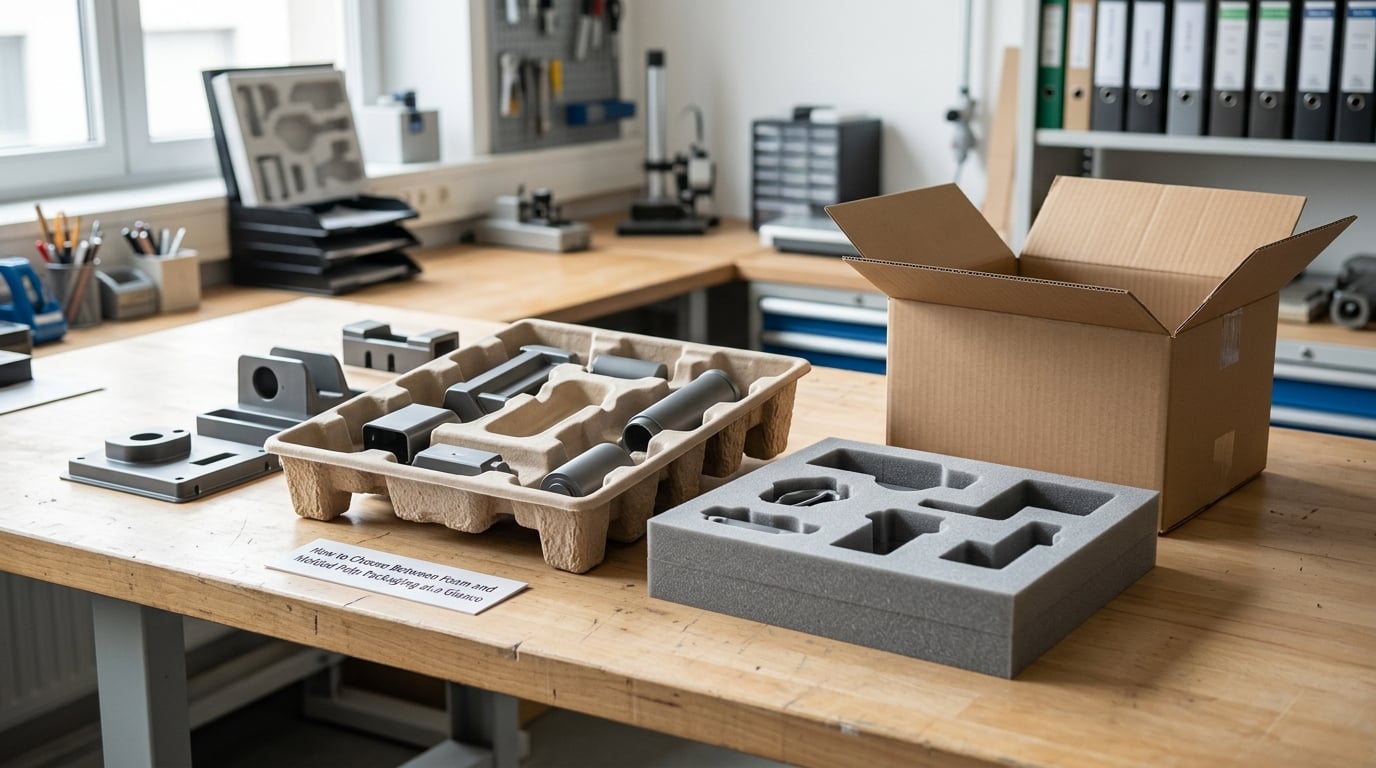
Here is the short version: foam wins on impact absorption, weight and precision cut; molded pulp wins on end-of-life, surface finish, tooling cost at moderate volumes and dimensional control in the box.
| Criterion | Foam (EPS, EPE, EPP, EVA, PE) | Molded pulp |
|---|---|---|
| Shock absorption on hard drops | Excellent, especially closed-cell PE and EVA | Good, drops off on high-energy corner impacts |
| Compression strength | Returns to shape after moderate crush | Holds shape well when dry, weak once damp |
| Vibration damping | Good, tuned by density and cell structure | Very good, fibre matrix absorbs road vibration |
| Weight for the same protection | Lighter | Heavier, which adds dimensional weight |
| Fit tolerance | Die-cut to a fraction of a millimetre | Tolerance is looser; cavities must be designed with a snug fit |
| Surface finish | Visible cells, can shed beads, softer look | Fibrous, paper-like, premium by default |
| Moisture exposure | Unaffected by humidity | Softens and loses rigidity when wet |
| Tooling | Die cutting for sheets, moulding for beads | One custom steel mould, longer lead time |
| Minimum order quantity | Low for sheet goods | Typically in the thousands for a custom mould |
| Custom 3D cavities | Yes, with moulded beads or CNC | Yes, this is what the process is built for |
| Recyclability | Mostly not; EPS is difficult, some PE is | Widely recyclable when uncoated and fibre-clean |
| Compostability | No | Often yes, if the coating is compostable too |
| Regulatory pressure | Under active restriction in several markets | Favoured by plastic rules and EPR schemes |
The one-line rule: choose foam if the product fails catastrophically and the route is long, humid or dropped a lot. Choose molded pulp if the product is moderately fragile, the journey is short or dry, and the box is photographed before it is thrown away.
A few signals push toward one material or the other more or less hard:
Choose foam if:
- The product is glass, ceramic, a hard drive, a lens or a calibrated instrument that must not shift at all.
- Parcels travel through a parcel network with many manual handling events and unknown stacking.
- Humidity is high, the route is long-haul, or cartons sit on a dock.
- You ship by weight and every gram counts against dimensional weight.
- Volumes are low and you need parts this month, not in twelve weeks.
Choose molded pulp if:
- Your product is a bottle, jar, tin, small appliance or accessory with a stable shape.
- Your customers open the box and your presentation matters as much as survival.
- Extended producer responsibility fees, plastic bans or store audits are part of your reality.
- You want a single-material, curbside-recyclable pack with no mixed plastics.
- Your volume is high enough to spread a custom mould across tens of thousands of units.
What Protects the Product Better?
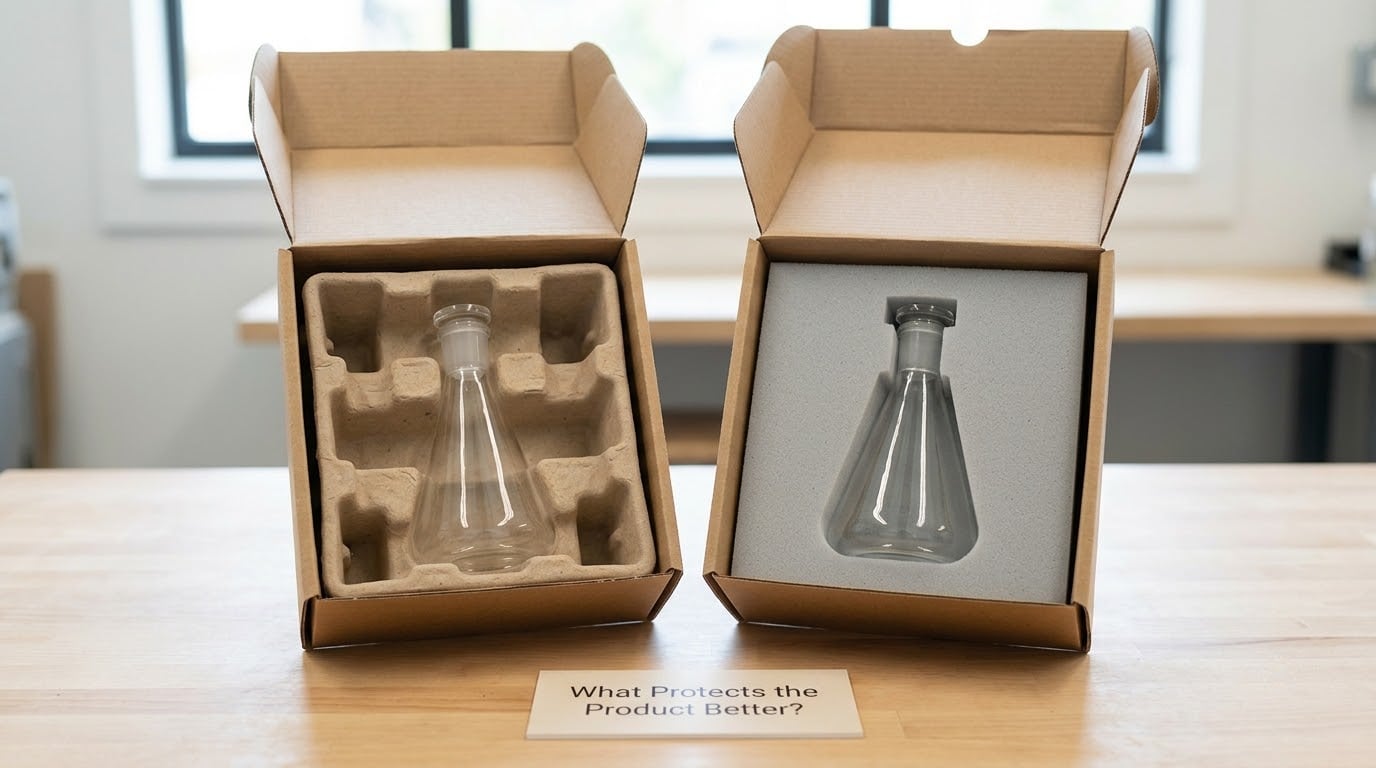
Foam protects better when the energy of the impact is high, because a closed-cell structure compresses progressively and absorbs the shock instead of passing it straight through. Molded pulp protects better against distributed loads, vibration and abrasion, because a fibre matrix spreads the load across the whole tray rather than concentrating it in one contact point.
Foam is the stronger performer on drop energy. A die-cut EVA or polyethylene insert wraps the product in a continuous skin, so there is no air gap anywhere for the part to rattle in. A gap of two or three millimetres between a cavity wall and the product is enough to let it move, and movement is where most breakage starts.
Compression and stacking
Pulp trays are strong in compression while dry, and their ribs and support points can carry real load. Foam recovers its shape after a moderate crush better than fibre does, but it can be cut through by a sharp corner or a pallet strap. Under a full pallet load, a well-designed pulp tray often outperforms a thin foam sheet.
Fit and cavity design
Foam gives you tighter tolerances because a die or CNC cut defines the edge precisely. Pulp is moulded wet and dried under pressure, so it lands slightly outside nominal and needs a snug, slightly generous cavity with rounded edges so the end user can actually get the product out. A tray that fits perfectly but needs a knife to open is a return waiting to happen.
Surface finish
This is where the difference is most visible and least technical. Foam leaves cell structure on the product and can shed beads. A pulp tray presents a clean, paper-like, textured surface, which is why it keeps appearing in beauty, fragrance and electronics-ad accessory packaging.
The clearest data point comes from a mid-market skincare brand that ran a 1,000-shipment trial of three insert systems for glass jars. Damage ran 2.6% with bubble wrap plus kraft, 0.9% with molded pulp and 0.4% with a custom die-cut EPE foam insert, while the inserts themselves stepped up in cost in the same order. The useful part is what they did with the result: they kept pulp for standard direct-to-consumer orders and kept foam for the high-value subscription boxes where breakage was most expensive.
How Do Weight, Dimensions and Shipping Conditions Affect the Choice?
Weight matters twice: it hits the product’s own material budget and it hits your freight bill, because parcel carriers bill on the greater of actual weight and dimensional weight.
Pulp is the heavier material for a given level of protection. A tray that weighs 180 g where a foam insert weighs 60 g can push a parcel across a dimensional weight threshold, and the freight delta can exceed the saving on the insert itself. Run the numbers on your own carrier rate sheet before you commit, because the dimensional divisor and the surcharges differ by carrier and by service level.
Pack-out volume is the same problem from a different angle. A loose foam sheet can be sized down to the product, while a pulp tray has a fixed footprint set by the mould. If the tray is noticeably larger than the item, the outer carton grows too, and you have bought protection you are not using.
Conditions shift the balance more than buyers expect. Foam does not care about humidity; pulp does. On coastal routes, seasonal rain delays, containerised export and anything that sits in a warehouse before dispatch, uncoated pulp loses stiffness. Three things fix it: a water-resistant coating, a plastic or cellulose liner bag, or a desiccant in the carton. All three improve protection and all three weaken the compostable claim, which you need to know before you print it on the box.
Long-haul freight and export add another factor: pallets sit under load for weeks. That favours pulp trays with proper ribs, and favours foam that is thick enough not to crease.
Which Material Is More Cost-Effective?
Foam is cheaper to buy up front at low volume; molded pulp is cheaper to buy per unit at high volume, and the crossover depends on tooling and freight rather than on resin or fibre prices.
Sheet foam and die-cut parts carry almost no tooling beyond a die, so you can order a few hundred and move. A custom pulp tray needs a steel mould, and that cost lands before the first production run. The saving then comes from buying the tray in volume at a lower unit price, and from not buying a separate bag, wrap or loose fill alongside it.
Costs that get missed in a simple comparison:
- Freight from the added weight of pulp inserts, especially on dimensional-weight parcels.
- Warehouse volume: bulky inserts mean fewer cartons per rack and per pallet position.
- Returns and replacements, which dwarf unit price on a high-value item.
- Tooling revisions. Every design change after the first sample is a change to the mould, not a drawing tweak.
- Minimum order quantities. A custom tray locks you to a forecast, so slow sellers hold cash in trays.
The number worth building is cost per intact delivery: insert cost plus freight delta, divided by the share of parcels that arrive undamaged. If a foam insert costs more per unit but cuts damage from 2% to 0.5%, it is usually the cheaper system on a high-value product and the more expensive one on a cheap product. That calculation is what the skincare brand above was really doing when it split the two channels.
How Do Foam and Molded Pulp Compare on Environmental Impact?
Molded pulp has the stronger environmental case in almost every scenario, but the honest version comes with three caveats that a supplier brochure will not mention.
Uncoated molded pulp made from recycled paper fibre is accepted in most paper recycling streams and breaks down in home or industrial composting, depending on the coating. It carries no fossil feedstock and no plastic additive. Foam does the opposite: it is fossil-based, it does not compost, and EPS in particular is difficult and expensive to reprocess. That is why expanded polystyrene is under active restriction in several markets, and why extended producer responsibility schemes charge more for it.
The caveats. First, coatings and laminates added for moisture resistance can push a pulp tray out of the paper stream entirely, so a “compostable” tray with a plastic film is neither recyclable nor compostable in most real systems. Second, pulp is heavier, so more of it moves per unit shipped, which is a real and sometimes overlooked part of the footprint. Third, both materials land in the same municipal bin in most households. Customers rarely separate an insert from the carton, so a good end-of-life claim depends on disposal instructions that people actually read.
That last point is worth a moment. The benefit is real but it is conditional on behaviour, and only one of the two materials leaves you in a better position if the customer does nothing.
Can Each Material Be Customized for Your Product?
Both are highly customizable; they just get there by different routes, and the speed of iteration differs sharply.
Molded pulp is moulded wet into a steel tool, so the cavity, the ribs, the corner reinforcement and the outer flange are all defined in the same operation. You can shape the inside of a fragrance bottle neck, add a pull tab, or build a tray that holds a cable and a charger in separate pockets. Branding is straightforward: natural kraft, black or coloured pulp, debossed or embossed marks, and a printed sleeve. The limitation is tolerance. Fibre moulding is not a machining process, so design around a snug fit with clearances rather than precision interference.
Foam customises in three ways. Die-cut sheet gives fast, low-cost changes and a precise cut. Moulded beads give true three-dimensional cavities, with a tooling cost and lead time of their own. CNC or waterjet cutting handles short runs and unusual shapes without a die. Colour and branding are easier: black and coloured foams, and printed laminates if you need graphics.
For prototyping, both are quicker than production. Pulp can be approximated with a CNC-cut or vacuum-formed shell for fit testing, and foam can be cut by hand. Neither prototype tells you how the real part behaves in a drop test, which is exactly why prototypes are for fit and production parts are for validation.
How Do You Choose Between Foam and Molded Pulp Packaging?
Six steps get you to a defensible answer, in this order.
- List the failure modes. Write down what actually breaks and how: crushing, dropping, vibration, abrasion, puncture, moisture. The dominant failure mode picks the material more reliably than any preference.
- Weigh the route. Sort your shipments by distance, handling events and humidity. If the routes are mixed, you may need two insert systems rather than one compromise.
- Check the moisture exposure. Coastal, seasonal, export or unheated warehouse storage points to foam, or to a coated or lined pulp tray with the eco claim adjusted accordingly.
- Model cost per intact delivery. Insert cost, freight delta from weight and volume, and the damage and return rate you are trying to fix, over a realistic annual volume.
- Confirm tooling, MOQ and lead time. Ask for the mould cost, the minimum order quantity, the sample timeline and what each revision costs. Get dimensions and product weight to the supplier before anyone quotes a unit price.
- Test before you commit. Run drop, vibration, compression and humidity tests on production-equivalent parts, not on hand-cut prototypes.
On that last step, ISTA procedures for parcel delivery give you a repeatable laboratory method rather than a shrug. A drop test tells you the height the pack survives, a vibration test covers the road and conveyor environment, a compression test checks stacked boxes and pallets, and a humidity conditioning step reveals whether the pulp tray softens before the product is damaged.
Two habits separate a good test programme from a wasted one. Test the worst case, not the average: the heaviest product revision, the longest route, the wettest carton. And inspect every failure, because a broken part tells you where the energy entered, and a tray that is intact but shows a scuff ring tells you the tolerance is off by a hair.
Which Should You Choose by Use Case?
Here is the mapping most teams end up with once the real data is in.
| Product or scenario | Better fit | Why |
|---|---|---|
| Small electronics and accessories | Molded pulp | Precision cavity, clean finish, customers keep the box |
| Hard drives, lenses, instruments | Foam (EVA or PE) | Highest shock attenuation for high-value parts |
| Glass jars, bottles, cosmetics | Molded pulp | Cradles round shapes and presents well; works for fragrance and skincare |
| High-value subscription boxes | Foam | Breakage cost justifies the higher insert cost |
| Medical devices and consumables | Either, to a spec | Cleanability and validation requirements often decide it; moulded pulp suits single-use kits |
| Food service and catering trays | Molded pulp | Food-contact grades exist; foam faces restrictions in several markets |
| Automotive parts and hardware | Molded pulp or fibreboard | Compression and stacking matter more than drop performance |
| Export and long-haul freight | Coated pulp or foam | Humidity and dock storage decide; test the full cycle |
| Heavy, non-fragile items | Neither, usually | Strapping, partitions or fibreboard solve it more cheaply |
That last row matters. Plenty of products fit neither material well, and forcing them into a foam cut or a mould costs money and solves nothing. Paper honeycomb, moulded wood fibre, bagasse, mycelium and simple corrugated partitions cover a lot of the middle ground, and for heavy or oddly shaped items they usually win outright.
Frequently Asked Questions
Is molded pulp better than foam for packaging?
Neither is better in general. Molded pulp wins for moderately fragile products on short or dry routes, for presentation and for recyclability. Foam wins for high-value fragile items, long or humid routes, tight dimensional-weight parcels and low volumes where you need parts quickly. The right question is which failure mode your product has.
Which packaging is cheaper, molded pulp or foam?
Foam is cheaper at low volume because sheet goods need little more than a die. Molded pulp is cheaper per unit at high volume once a custom mould exists, and it removes the need for extra wrap or loose fill. Freight can flip the answer: pulp inserts are heavier and may push a parcel past a dimensional-weight threshold.
Can molded pulp packaging be recycled or composted?
Uncoated molded pulp made from recycled paper fibre is generally accepted in paper recycling streams and many grades compost. Add a plastic coating, laminate or adhesive liner for moisture resistance and it may leave the paper stream entirely, so a compostable claim only holds when every layer is compostable. Print disposal instructions on the box.
Is foam packaging suitable for food and medical products?
It depends on the grade and the market. EPS and some foams are restricted for food contact in several regions, and expanded polystyrene is under active regulatory pressure. Medical use usually demands validated materials, cleanability and documentation, which can rule foam out. Check the specific grade, the coating and your local rules before specifying.
How much does custom molded pulp packaging cost compared with foam inserts?
A custom molded pulp tray adds a one-off steel mould charge and typically a minimum order quantity in the thousands, which front-loads the cost. Foam sheet inserts need a small die and accept low volumes. Compare total landed cost per intact delivery, not the unit price of the insert alone, including freight, storage and replacements.
How do I test foam and molded pulp inserts for shipping damage?
Run drop, vibration, compression and humidity tests on production-equivalent samples, following ISTA procedures where they apply. Test the heaviest product revision and the wettest carton, not the average unit, and inspect every failure so the damage tells you where the energy entered. Validate the chosen material before mass production, not after.
Conclusion: Make the First Choice by Product Risk
Start with how your product fails, not with which material you prefer. Severe impact on a long, damp route points to foam; moderate fragility on a short route with a photographed unboxing points to molded pulp. Then prove it with drop, vibration, compression and humidity testing on production-equivalent samples before you buy the mould.