
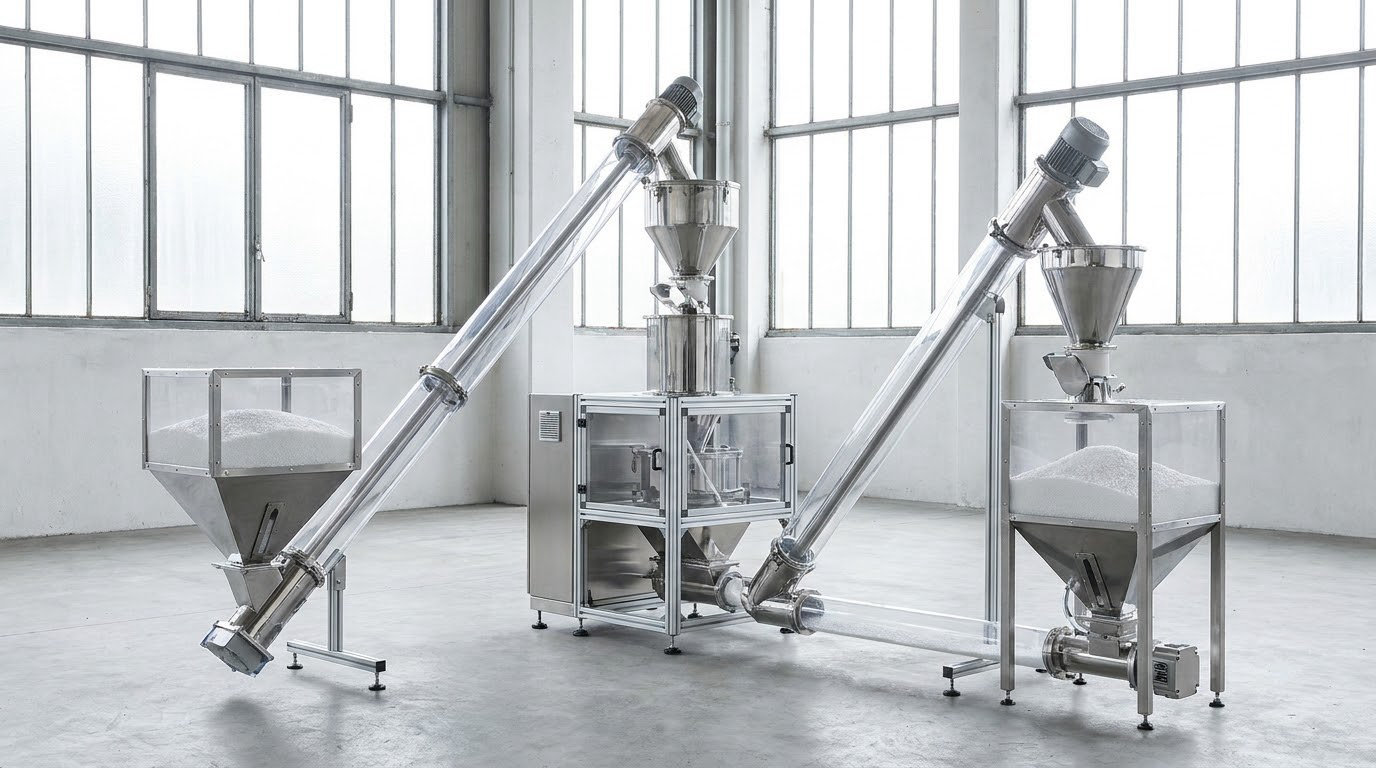
Material handling systems for resin are the connected equipment a plastics processor uses to receive, store, convey, dry, blend and meter plastic resin from the delivery dock to the throat of the processing machine. In practice that means railcar or bulk-truck unloading, bulk storage silos or surge bins, pneumatic or screw conveying lines, drying hoppers, and blending or dosing units working as one path.
Most of the cost and most of the headaches in a molding or extrusion plant sit in that path, not in the machine. Get it wrong and resin arrives damp, dusty or mixed with the wrong grade, and you find out at the first reject. Get it right and one operator runs thirty silos from a single screen, changeovers stop eating a shift, and bulk buying becomes a genuine cost advantage rather than a spreadsheet rumor.
What follows walks the whole route: what the system is, how material moves through it, which equipment options exist, how to choose between them, and what to measure once it is running. Updated for 2026.
Table of Contents
- What Is a Material Handling System for Resin?
- How Does a Resin Handling System Work?
- Material Handling Systems for Resin: Main Equipment Options
- How Do You Choose Conveying Equipment?
- Which Storage Method Is Best for Different Resin Forms?
- How Do Hoppers, Feeders, and Blending Systems Work?
- What Safety and Environmental Controls Are Required?
- How Do You Prevent Resin Contamination and Product Defects?
- What Performance Data Should You Track?
- How Do You Plan Installation, Validation, and Maintenance?
- Frequently Asked Questions
- What is the best conveying system for plastic resin?
- Is pneumatic conveying suitable for glass-filled or hygroscopic resin?
- Do resin handling systems need explosion protection?
- How accurate are gravimetric resin feeders?
- Should bulk resin be stored in silos, supersacks, or totes?
- How often should resin handling equipment be cleaned and inspected?
- Conclusion
What Is a Material Handling System for Resin?
A resin material handling system has one job: move plastic from where it arrives to where the machine needs it, without damaging the material or losing control of it. That covers the fill point, the storage vessel, the conveying line, any drying or blending step, and the metering device that finally hands resin to the machine.
It is worth separating two things that get mixed together in conversations. Bulk resin handling deals with loose pellets moving by silo, bin, pipe or auger. Packaging handling deals with bags, super sacks and gaylords being moved, tilted, emptied and discarded. A plant often runs both for a while, and the switch from one to the other is where the economics live.
| System stage | What it does | Typical equipment |
|---|---|---|
| Receiving | Moves resin off the railcar or bulk truck into the plant | Railcar puller or pusher, vacuum unload blower, fill point with filtration |
| Storage | Holds a working reserve of resin | Welded, bolted or spiral silos, indoor surge bins, super sacks, gaylords |
| Conveying | Carries resin from storage to the machine area | Pneumatic vacuum lines, flexible screw, solid-core screw, belt |
| Drying and blending | Removes moisture and meters in color or additives | Drying hoppers, take-off boxes, blending cones, gravimetric feeders |
| Feeding | Delivers a controlled rate to the process | Auger feeders, loss-in-weight feeders, gravimetric blender |
Most vendors sell one or two of these stages well. Nobody assembles the whole path for you, which is why plants end up with a silo from one supplier, a take-off box from another and a blender from a third, and integration gaps between them.
How Does a Resin Handling System Work?
Resin arrives by railcar or bulk truck. A railcar commonly carries around 200,000 pounds, a bulk truck roughly 40,000 pounds, so the receiving end is sized in tens of thousands of pounds per movement rather than per bag.
From the truck or railcar, resin goes up through a fill point with dust filtration and a pressure-vacuum relief valve, and lands in a silo or surge bin. It is stored there in bulk until a machine needs it, which is the whole point: buying in bulk and holding a reserve protects you when resin prices spike or a supplier misses a date.
Resin is drawn out of the bottom of the vessel by gravity through a hopper cone, and the cone angle decides whether the material moves. Too shallow and the resin bridges or forms a rathole, a hollow core that leaves most of the silo empty while the machine runs. Too steep and you are paying for unused cone volume.
From the take-off point, resin travels to the machine area. Hygroscopic grades such as polyamide, polycarbonate and PET pass through a drying hopper first, where heated air brings the pellets to a defined moisture level before they enter the process. Non-hygroscopic grades often skip that step.
Colorants, masterbatch, regrind and additives are metered in at a blending cone or loss-in-weight blender positioned just ahead of the machine. The feeder weighs what it dispenses rather than counting screw revolutions, so a recipe holds accuracy even as pellet bulk density shifts with lot and temperature.
Everything above is tied together by controls. The control system interlocks so a machine can only draw resin from an assigned vessel, stops the fill point if the target silo is already full, and records what was consumed against which lot. Those records are what let a plant trace a defect back to a resin lot three weeks earlier.
Material Handling Systems for Resin: Main Equipment Options
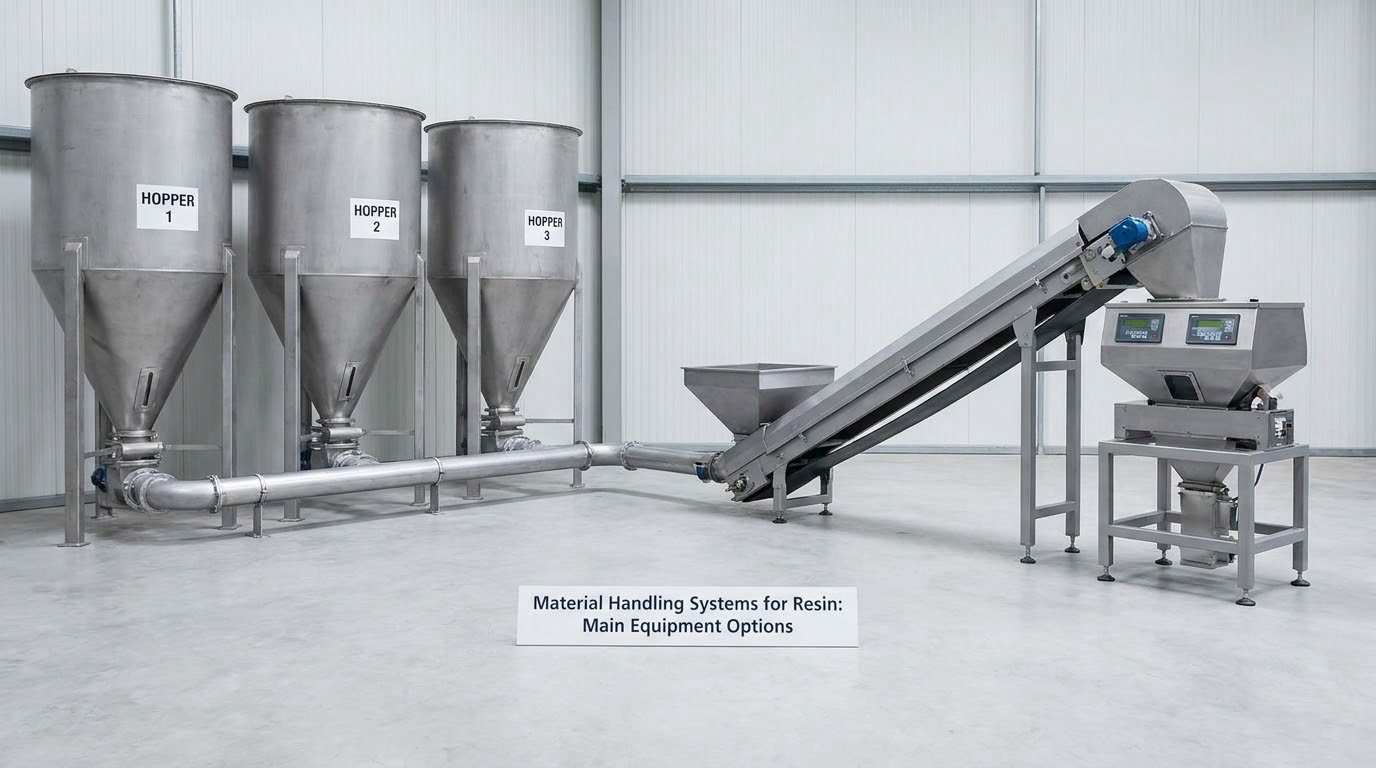
Four approaches cover almost every plant. Manual handling with forklift and gaylord tilter is the entry point for small operations. Pneumatic systems dominate bulk-to-machine transfer. Mechanical conveyors handle the long, high-volume runs. Gravimetric systems sit at the end of the chain where dosing accuracy matters more than distance.
| Approach | Resin form | Throughput | Dosing accuracy | Dust exposure | Relative cost | Best use |
|---|---|---|---|---|---|---|
| Manual and packaging | Bagged, super sack, gaylord | Low | Operator dependent | Highest | Lowest | Low-volume, multi-grade, trial materials |
| Pneumatic vacuum | Pellets and regrind | Medium to high | Good, load-cell controlled | Low when closed | Medium | Machine-side feeding, low-pressure systems |
| Mechanical screw | Pellets, regrind, additive | High | Volumetric; good with load cells | Low | Medium | Long runs, dockside transfer, harsh material |
| Gravimetric loss-in-weight | Virgin, masterbatch, additive | Low to medium per unit | Highest | Minimal | Highest | Multi-line feeding, color and additive recipes |
The rows blur in a well-designed plant. Many processors run a screw line from the dock to a central bank of machines and a pneumatic branch from there to individual machines, so bulk transport and accurate dosing are separate problems solved by separate devices.
How Do You Choose Conveying Equipment?

Start with the resin, not the equipment. Bulk density, flowability, hygroscopicity and abrasive content decide more than preference does. Free-flowing homopolymer pellets behave well in almost anything. Fluffy low-density grades, flake, or regrind with fines will bridge in a shallow cone and pack in a dense pneumatic line.
Then come four numbers: transfer distance, required rate, available vertical rise, and how often the route changes. Gravity does the work for free when a silo sits above the machine, and every foot of elevation you build in is a foot of lift a pump has to fight. Pneumatic vacuum systems shine at medium distances with multiple drop points. Flexible screw works well for moderate distances and awkward routes, and it is easy to inspect and clear. Solid-core screw handles the highest volumes and the longest runs but is not where you want it if the resin is fragile or if you need frequent cleanouts.
Layout decides a lot. A line that crosses a walkway needs guarding. A line that runs near a control cabinet raises static and access questions. Vertical space above the silo is often the real constraint, since tall equipment needs ladders, platforms and clearance for filling trucks or railcars.
Cleaning requirement is the one people forget during a purchase and regret within a year. If the system handles regrind, color or multiple grades, ask how you get a brush or a vacuum hose into every transition, and how long a full clean takes. A line that cannot be cleaned is a line that will carry the previous color forward.
Finally, plan for growth. Conveying routes designed around today’s five machines tend to be the ones people have to tear out to add a sixth. Leaving a spare drop point and enough electrical and air capacity costs far less than a retrofit.
Which Storage Method Is Best for Different Resin Forms?
Storage choice is a question of volume, grade count and how much risk you can carry. A plant running two grades at modest volume can do very well with indoor surge bins and super sacks. A plant running dozens of grades across several lines needs silos, because the real constraint becomes traceability rather than capacity.
Bulk storage in a silo holds far more than packaging can and removes the labor of staging, forklift traffic and packaging waste. It also concentrates the consequences of a fill error, which is why point-of-delivery verification matters so much. Verify by weight, with load cells at the fill point, and reconcile against the bill of lading before the resin is committed to a vessel.
Super sacks and bulk bags sit in the middle. They protect hygroscopic material reasonably well when the bag is intact and lifted dry, and they allow small lot sizes. Their weakness is exposed liner surfaces, handling damage and a lot of manual handling around the bag frame.
Gaylords and totes suit low volume, trial grades and materials with unusual flow behavior. They are also the worst option for hygroscopic grades left open, since condensation forms on the bag walls as temperature swings overnight.
Day-use bins and surge bins serve a different purpose: they decouple the silo discharge from the machine so a brief interruption in conveying does not stall production. They are not long-term storage and should be sized for a shift, not a week.
Whatever the vessel, run first-in first-out discipline and keep hygroscopic grades off the floor in a room where condensate can form. FIFO sounds obvious until you find four half-full silos and a grade nobody can identify.
How Do Hoppers, Feeders, and Blending Systems Work?
Hopper sizing starts with bulk density. Usable capacity equals usable cubic feet multiplied by material bulk density, and most grades sit somewhere in the 35 to 45 pound per cubic foot range. Published silo capacity tables usually quote nominal volume, so the usable figure is typically meaningfully lower, and it is the usable number that determines how long a line runs before the next truck.
Venting matters as much as volume. Every vessel needs a filtered vent, because filling and discharging move air, and resin fines plus that moving air are what put dust in a plant. Pressure-vacuum relief valves protect the silo from over-pressure and vacuum collapse; mushroom vents are common on storage silos while the machine-side hoppers usually route to process air.
Volumetric feeders dose by displacement, so their output tracks bulk density. When pellet density shifts with lot, temperature or regrind fraction, a volumetric feeder quietly feeds less. Gravimetric feeders correct for that by weighing the hopper on load cells and adjusting the drive to hold a set mass flow, which is why multi-line plants with tight color tolerances run gravimetric.
Loss-in-weight blending takes it a step further. Several feeders above a single blending cone deliver in sequence to a common recipe, and the blender’s total loss of weight is what the controller reads. That architecture handles color, additive and regrind recipes in one place and gives an accurate total per batch.
Level detection completes the picture. Rotating paddle switches work for high and low points in almost any material, continuous radar or capacitance sensors fill in the middle, and load cells under the vessel legs give you inventory by weight. The best systems use more than one method, because a single failed sensor should not read as an empty silo.
None of this is accurate until it is calibrated. Gravimetric feeders drift as the load cell ages and as the material changes, so a documented check against a known weight at start of shift is cheap insurance.
What Safety and Environmental Controls Are Required?
Polymer pellets are a combustible dust. Fine enough, suspended in air and near an ignition source, polyethylene and polypropylene dust will propagate a flash fire. Whether your specific material and particle size triggers a formal combustible dust hazard analysis is a question for your qualified engineer under the standards that apply in your country, and it is worth answering explicitly rather than assuming.
Static is the other half of the risk. Pellets moving through a pipe generate charge, so conductive hoses, bonded and grounded equipment, and antistatic flexible connectors matter on every take-off line. Metal silos are inherently grounded; plastic components in the path are not, and that is where charge builds up.
Engineering controls come before procedure. Closed conveying limits airborne dust at the source. Guarded screw couplings and shafts prevent entanglement. Pressure-vacuum relief protects vessels. Access ladders on silos need cages, platforms need guardrails and toe boards, and skirt doors should lock. Silo fill points need filtration sized for the fill rate, and operators need a way to know a vessel is safe to enter.
For people: lockout and tagout for any entry or jam clearing, a written dust housekeeping schedule, and eye and respiratory protection where dust can be generated. Housekeeping matters more than people expect, because settled pellet dust on a beam or a motor is stored fuel that a single event can ignite.
For the environment, keep pellets out of floor drains, contain spills with sweepable dry cleanup rather than water where possible, and route collected fines back into regrind streams instead of landfill. Fine handling losses on a bulk system are small in percentage terms, which is exactly why nobody measures them until someone does.
How Do You Prevent Resin Contamination and Product Defects?
Contamination control in resin handling is mostly identification discipline, and the discipline is cheap compared to the recall it replaces. Every vessel should carry a visible label tied to a system record, and every transfer should be checked against that label. The common failure is not a broken silo, it is a gray tote of unknown regrind sitting next to the line on a Friday afternoon.
Lot traceability runs through the whole path. Capture the supplier lot at receipt, which vessel received it, which machine consumed it, and which shipments of finished product ran on it. That chain is what makes a recall a hundred pallets instead of the entire year.
Segregation is the practical tool. Keep regrind in dedicated vessels, never in a flexible line shared with virgin resin, and label the ratio at the point where regrind is introduced. A dedicated additive line removes the most common source of cross-contamination complaints.
Watch dead spots. Hopper cones, elbows and take-off boxes hold material that never flows, and that material ages. On hygroscopic grades a wetted dead spot can seed a moisture problem that shows up days later in parts that look fine. Design for cleanability, schedule the clean, and log it.
Material compatibility closes the loop. Stainless or aluminum for food-contact or medical grades, lined or epoxy-interior carbon steel for general purpose, and never bare carbon steel where rust flakes can reach product. Confirm interior finish with the resin supplier, not just the equipment supplier.
Verify the system works with a first-article check after any changeover: confirm vessel identity on the control screen, run a measured quantity through a loss-in-weight feeder and check the reading against a scale, and inspect the first output for moisture spec and color.
What Performance Data Should You Track?
Handling systems fail gradually, and most owners only notice at the end of the shift. A short list of metrics turns complaints into trends.
| Metric | Why it matters | What a good trend looks like |
|---|---|---|
| Throughput per transfer | Confirms the system meets line demand | Stable at or above rated rate |
| Dosing accuracy | Catches feeder drift before parts do | Within recipe tolerance, checked weekly |
| Unplanned downtime | Conveying faults masquerade as machine faults | Trending down after each fix |
| Differential pressure in a pneumatic line | Early warning of filter loading or line wear | Flat between cleanings, then a step |
| Fill level and days of reserve | Tells you when to order, not after you stock out | No vessel under a set minimum |
| Energy use per pound conveyed | Reveals leaks and blocked lines | Flat or falling |
| Spills and dust events | Concentration at fill points and take-offs | Rare and shrinking |
| Inventory turnover by grade | Flags slow-moving and forgotten stock | Old lots consumed or written off deliberately |
| Clean-down time | Shows real cost of changeover | Down after procedure changes |
| Nonconforming batches traced to material | Closes the loop between handling and quality | Fewer and better explained |
Pick five of these, review them monthly, and write down what you changed. The value comes from the record, not the dashboard.
How Do You Plan Installation, Validation, and Maintenance?
Start with a site assessment that answers physical questions: floor loading capacity, ceiling and door clearances, the path a railcar or truck must travel, where dust collection and compressed air are available, and where the machines will sit in five years rather than today. Silo footprints are large, and moving one after installation is a major project.
Model capacity next, per grade and per line. Sum line consumption by hours run, add the surge you want for a truck or railcar delivery interval, and check that the result matches what your vendor quoted as usable capacity, not nominal. Extra grades often demand more vessels rather than bigger ones, and separate vessels keep grades apart.
Integration is where projects slip. Agree who supplies the control panel, which signals go where, what the PLC interface looks like, how recipes are created, and what happens when a level sensor fails. Write these down before the purchase order, not during commissioning.
Commission against a written checklist: fill each vessel and verify the load-cell total against the delivery weight, confirm level switches at high and low set points, run each conveying route end to end, verify interlock behavior when a vessel is empty, check dust collection at the fill point under load, and document the as-built drawings and settings.
Train operators on the system they will actually run, including how to read a filter differential, how to clear a blockage safely, and how to verify a vessel before a changeover. Then set a preventive maintenance schedule covering flexible hose inspection, auger and screw flight wear, load cell calibration checks, filter changes, door seals, and ladder and platform hardware.
Finally, keep the records. Every silo needs a file: drawings, material certificates, coating and interior finish specification, load cell calibration history, spare parts list, and the vendor’s contact details. Equipment is replaced or moved eventually, and the file is what makes that survivable.
Frequently Asked Questions
What is the best conveying system for plastic resin?
There is no single best option, and the resin decides more than the plant does. Pneumatic vacuum suits machine-side feeding at medium distance with several drop points. Flexible screw fits moderate runs and awkward routes and is easy to clean. Solid-core screw handles the highest volumes and longest runs. Dense or fragile material and dusty regrind push you toward mechanical or gravity choices. Decide from bulk density, distance, rate, cleaning needs and future drop points.
Is pneumatic conveying suitable for glass-filled or hygroscopic resin?
It can be, with care. Glass-filled grades are abrasive, so choose hardened components, an appropriate line diameter and a design that limits velocity at impact points where filler can break off and end up downstream. Hygroscopic grades such as polyamide, polycarbonate and PET should pass through a drying hopper before the conveying step that feeds the machine, so the line moves dry pellets rather than wet ones. Confirm both points with your resin supplier.
Do resin handling systems need explosion protection?
That depends on material, particle size, concentration and your facility. Many polymer pellets are combustible dust, and fine material plus suspended concentration plus an ignition source is the formula for a flash fire. Some plants need dust hazard analysis, conductive grounding, collection and housekeeping controls, and pressure-vacuum relief on vessels; higher-risk installations may need further protection. Have a qualified engineer assess your specific materials and layout rather than guessing.
How accurate are gravimetric resin feeders?
Well-built loss-in-weight feeders typically hold a few tenths of a percent of set point, which is well inside normal process needs, provided they are calibrated and the material has not changed substantially. Volumetric feeders are cheaper but track bulk density, so they drift when pellet density shifts with lot, temperature or regrind fraction. A weekly check against a known weight catches most drift before parts show it.
Should bulk resin be stored in silos, supersacks, or totes?
Match the vessel to volume and grade count. Silos make sense for high-volume, multi-line plants and remove packaging waste and staging labor, but they concentrate fill errors and need point-of-delivery verification. Super sacks suit moderate volume and hygroscopic grades when lifted dry and kept sealed. Gaylords and totes work for low volume, trial grades and awkward materials, but they are the worst option for hygroscopic grades stored open overnight.
How often should resin handling equipment be cleaned and inspected?
Follow the resin supplier’s guidance and your own changeover pattern rather than a fixed calendar alone. Inspect flexible hoses, auger flights, door seals, filters and ladder hardware on a documented schedule, and clean the system whenever grades or colors change. Hygroscopic resin lines deserve a moisture check before and after any cleaning. Log every clean-down, because the time cost is usually the number that justifies a better system.
Conclusion
Material handling systems for resin are the link between what you buy and what the machine actually processes, and every stage of that link affects cost, quality and uptime. Start by documenting five things: the resin properties including bulk density and hygroscopicity, real throughput per line, how many grades and how often you change them, where contamination and moisture risk sits, and how much floor space and vertical height you actually have.
Those five answers usually make the equipment decisions for you. Once they are written down, you can put a real system together, spec it for a request for quotation, and judge the replies on the same criteria instead of on the best-sounding brochure.