
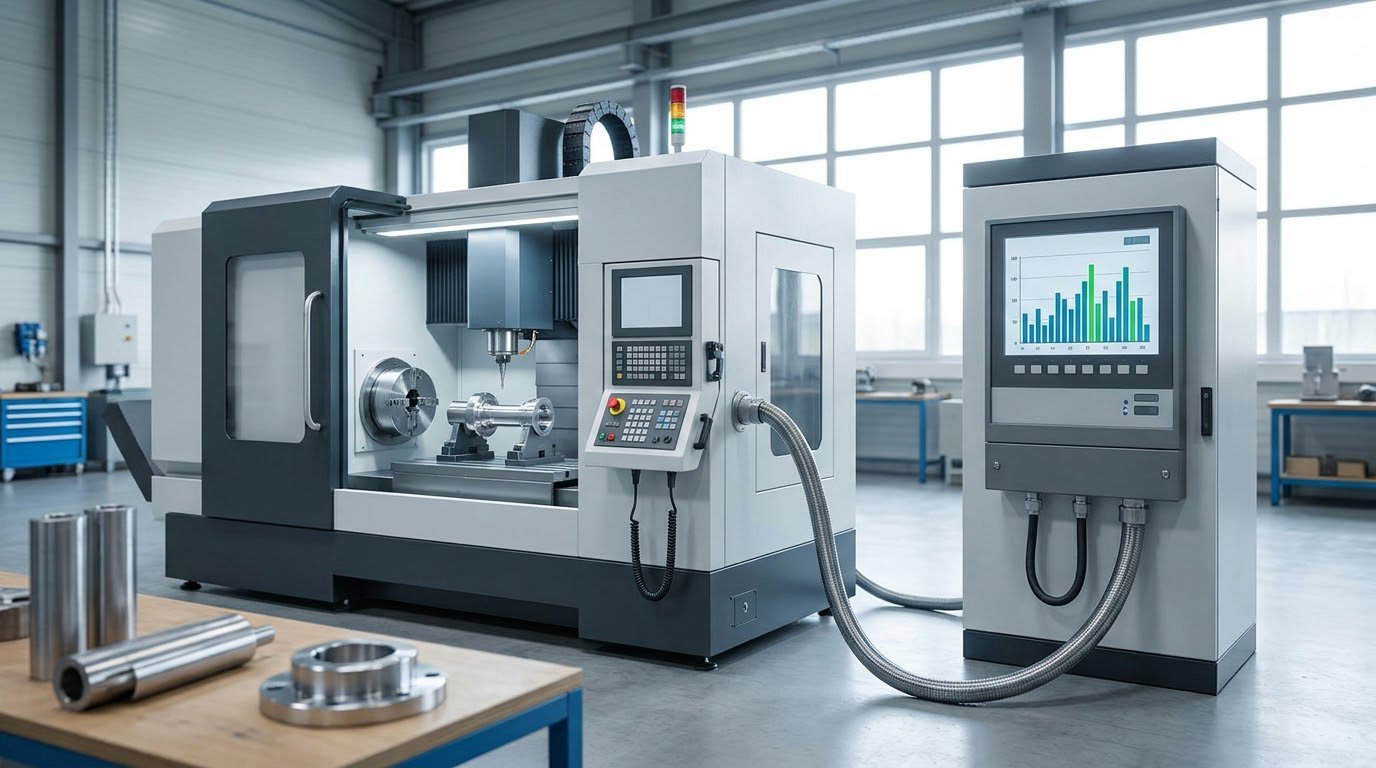
To calculate factory energy cost per part, you need the machine’s average power draw in kilowatts, your real electricity rate, and the number of good parts produced per hour. Multiply the first two and divide by the third. Scrap, setup and idle time are absorbed automatically once the denominator is saleable parts rather than theoretical output. The desk work takes about two hours, plus one on-floor measurement most plants do not have yet.
Most wrong numbers are not an arithmetic failure. It is that nobody measured the machine, so the nameplate got used instead, and a nameplate tells you supply or transformer capacity rather than what the machine draws while it is cutting. A shop treating a 25 kVA lathe plate as its consumption will price power it never buys.
Below is the method in the order you should actually run it: what data to collect, how to convert it, how to allocate it, and how to check the result against a real invoice.
Table of Contents
- What You Need Before You Start
- Step-by-Step: How to Calculate Factory Energy Cost per Part
- Step 1: Define the Product and Factory Energy Boundary
- Step 2: Gather Meter, Utility, and Production Data
- Step 3: Calculate Total Factory Energy Cost
- Step 4: Separate Variable and Fixed Energy Loads
- Step 5: Allocate Energy to the Part
- Step 6: Adjust for Scrap, Rework, and Downtime
- Step 7: Validate and Update the Cost
- Where Energy Sits in the Total Cost per Part
- kVA, kW and Power Factor
- Common Mistakes That Inflate or Deflate Your Number
- Frequently Asked Questions
- What is the simplest way to calculate factory energy cost per part?
- Should factory energy cost include electricity demand charges and fixed building utilities?
- How should shared machines be allocated when several products use the same equipment?
- Do scrap and rework increase the energy cost per finished part?
- How do I calculate energy cost per part when the factory uses multiple energy sources?
- How can I use factory energy cost per part for pricing and process improvement?
- Conclusion
What You Need Before You Start

Six inputs produce the whole calculation. Anything you cannot source for one of them is an assumption, and assumptions belong in a separate column so a reviewer can challenge them.
| Input | Unit | Where to get it |
|---|---|---|
| Average power draw | kW | Interval meter, DIN-rail submeter, or clamp meter on the machine |
| Blended energy rate | per kWh | Utility tariff sheet plus a month of invoice totals divided by kWh used |
| Demand charge | per kW per month | The tariff schedule, applied to your billed peak |
| Run hours | hours per month | Machine counter, shift log, or estimated schedule |
| Sustained output | good parts per hour | Production records from an actual run, not the brochure cycle |
| First-pass yield | percent | Scrap and rework log over the same period |
Two more inputs make the result complete rather than merely correct: the standby draw in kW for every hour the machine is not producing, and the share of plant-level load you intend to allocate to this part.
Step-by-Step: How to Calculate Factory Energy Cost per Part
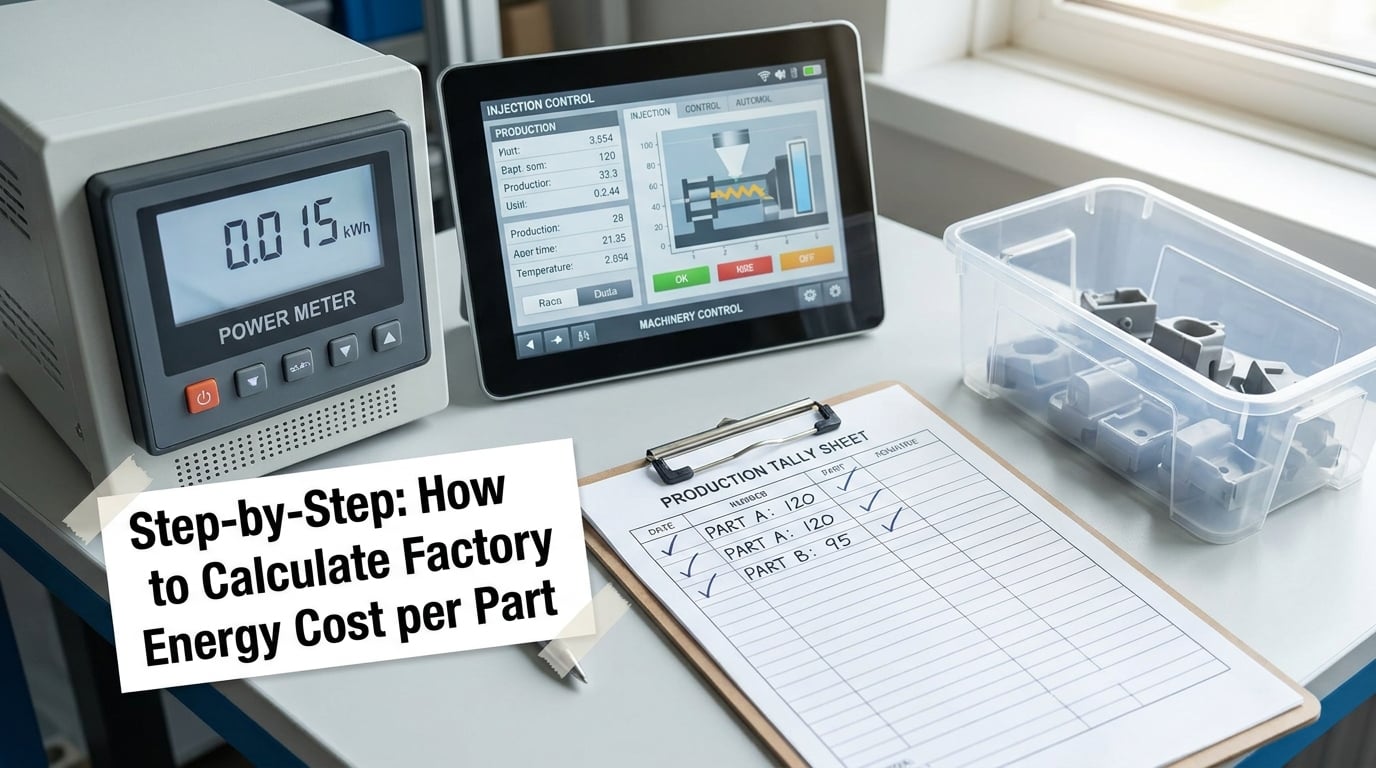
Run the seven steps in sequence. Skipping straight to the division in Step 5 is what produces the facility-average number that cannot be defended in a quoting meeting.
Step 1: Define the Product and Factory Energy Boundary
Decide up front which number you are building, because the three versions answer different questions and mixing them is the most common structural error. Direct energy covers the machine itself. Allocated process energy adds shared equipment serving the same part. Fully loaded factory energy adds compressed air, HVAC, lighting and building load on top.
Write the boundary down as a list of named equipment before you gather anything. A reader who cannot see exactly what is inside the boundary will assume it is larger than it is, and every downstream number inherits that doubt.
Step 2: Gather Meter, Utility, and Production Data
Pull interval meter data for the machine if you have it. Thirty days of 15-minute intervals gives you a load curve, which is far more useful than a single average because it separates cutting draw from standby draw on its own.
If you have no machine metering, the options in ascending cost and accuracy are: the nameplate, which is a ceiling rather than a measurement; a supplier datasheet average; a clamp meter sampled during a representative cut; a DIN-rail consumption meter with current transformers on all three legs, which is the option shop owners keep recommending on Practical Machinist when this comes up; or interval data from a plant-level system.
For production, use what the line actually produced. A 42-second cycle that yields two parts sounds like 171 parts an hour until you subtract the 8 percent that went to scrap, the changeovers, and the 20 minutes the cell waited on material.
Step 3: Calculate Total Factory Energy Cost
Total energy cost is consumption multiplied by rate, then demand and standing charges added on top. Multiply billed kWh by your blended per-kWh rate, add the demand charge from billed peak demand in kW, and add any standing or connection charge.
Do not assume a flat rate. Industrial tariffs often price different hours differently, and running the same shift differently can change the rate you actually pay. Compute your blended rate from a recent invoice by dividing total energy charges by total kWh, which folds every tariff band into a single defensible number.
Step 4: Separate Variable and Fixed Energy Loads
Variable load scales with output: spindles, heaters, hydraulics, compressors running against production. Fixed load does not: lighting, HVAC in a heated building, standby controllers, and idle machines that draw all shift.
The split changes how the cost behaves. Variable energy belongs in your per-part cost and moves with volume. Fixed and standby draw belongs in the period overhead pool, because it does not go away when you make fewer parts. Mixing them produces a number that swings wildly between a good month and a bad one.
Step 5: Allocate Energy to the Part
The core calculation is three lines. Energy cost per hour equals average kW times the blended rate per kWh. Energy cost per good part equals energy cost per hour divided by good parts per hour. Fully loaded cost per part adds your allocated share of plant-level energy.
Worked through with a CNC cell: a measured 7.5 kW average draw at 11.4 cents per kWh gives 0.855 dollars of energy cost per running hour. Sustained good output of 158 parts an hour, after scrap and downtime, gives about 0.0054 dollars per part, or roughly half a cent.
Compressed air belongs in the same chain if the machine uses it. A 30 kW compressor delivering 300 cubic feet per minute works out to 0.0114 dollars per cubic foot of delivered air once you divide by the airflow and multiply by the electricity rate, so a part consuming half a cubic foot of free air carries half that figure.
Step 6: Adjust for Scrap, Rework, and Downtime
Nothing here is an adjustment if you divide by good parts from the start. That is the whole reason the denominator matters: a rejected part consumed the same 42 seconds of spindle time as an accepted one, and it must carry the energy cost of both.
What you do still need to handle separately is restart energy. Cold starts, warm-up cycles and reheat after a long stop are real consumption that a straight-line average can understate on short runs, and you can size them by comparing a meter total for a long run against one for a short run of the same cycle.
Step 7: Validate and Update the Cost
Reconcile against the invoice. Take your calculated kWh for the period, compare it with billed kWh for the whole facility, and expect your share to land somewhere sensible. If your machine’s modeled kWh sits above total facility kWh, an input is wrong.
Then set a refresh trigger. Utility rates, product mix, tooling, cycle times and shift schedules all move, and a per-part figure built eighteen months ago describes a plant that no longer exists. Rebuild it whenever the tariff changes or you buy a new machine, and spot-check a submeter reading quarterly.
Where Energy Sits in the Total Cost per Part
Energy is one line among several, and for a machining cell it is usually a small one. For a hydraulic or thermal process it can be a double-digit share, which is why separating it out matters before you start negotiating. Stated as a stack, a cost per part is material, plus direct labor, plus direct energy, plus tooling amortized over its life, plus maintenance, plus allocated overhead, plus investment recovery.
Keep machine rate and energy cost per part apart in your models. A machine rate bundles depreciation, interest, footprint, consumables, overhead and profit into one hourly figure, and it is the right number for quoting machine time. Energy cost per part is the diagnostic number. It is the one you can move by changing how the machine runs, which is why it earns its own line.
kVA, kW and Power Factor
No, they are not the same. kW is real power, kVA is apparent power, and the ratio between them is the power factor. A machine rated 10 kVA at a power factor of 0.8 draws roughly 8 kW, not 10 and not 5.
Three-phase arithmetic trips people up here, so it is worth stating plainly: 10 kVA at 380 V three-phase is about 10,000 W. The figure of 5,776 W that circulates in machinist forums comes from dividing an already balanced three-phase quantity by three a second time. If you see that number in an estimate, ask where it came from.
Common Mistakes That Inflate or Deflate Your Number
These eight account for most of the figures that come apart under review, and each has a straightforward fix.
- Using the nameplate as consumption. It is supply capacity. Measure, or apply a defensible utilization assumption and label it as one.
- Conflating kVA with kW. Multiply by the power factor, and never divide a balanced three-phase kVA by three again.
- Dividing by gross output. Use good parts after scrap, rework and downtime.
- Ignoring standby draw. A cell sitting idle through a shift can consume a meaningful share of its annual total. Measure it or estimate it and put it in overhead, not per-part.
- Using a flat per-kWh rate. Blend your tariff and account for demand charges, or your cost per part will drift from the invoice.
- Mixing periods. Energy for August, output for the week the surge ran, scrap from last quarter. Everything has to come from the same window.
- Treating all load as variable. Lighting and HVAC do not scale with output and will distort the per-part figure at low volume.
- Leaving allocation assumptions undocumented. If nobody can see how compressed air or floor space was split, the number cannot survive review.
One rule catches most of these: if a number is an assumption rather than a reading, write it down as an assumption. Precision targets differ by use. Pricing a job needs roughly plus or minus 10 percent. Justifying a capital purchase needs submetering on the candidate machine and nothing less, because that is the whole basis of the claim.
Frequently Asked Questions
What is the simplest way to calculate factory energy cost per part?
Multiply the machine’s average power draw in kW by your blended electricity rate per kWh, then divide by good parts produced per hour. That gives direct energy cost per part. Add compressed air, HVAC and lighting only if you need a fully loaded factory figure rather than a machine figure.
Should factory energy cost include electricity demand charges and fixed building utilities?
Keep them separate. Variable kWh times rate is the part that scales with output and belongs in your per-part cost. Demand charges and building load are driven by peak and by hours of operation, not by part count, so they belong in period overhead recovered across all production. Mixing them makes the per-part figure swing with volume.
How should shared machines be allocated when several products use the same equipment?
Allocate by the allocation driver that actually varies, usually machine run time or good parts. Track run time per part on each product and divide the shared machine’s total energy by total allocated run time to get a rate per machine-hour, then apply it per part. Document the driver so the allocation can be audited.
Do scrap and rework increase the energy cost per finished part?
Yes, and only if your denominator counts good parts. A rejected part consumes the same cycle time as an accepted one, so the same energy is spread across fewer saleable pieces. If you divide by gross output instead, scrap becomes invisible and your per-part energy cost will be understated.
How do I calculate energy cost per part when the factory uses multiple energy sources?
Calculate each source separately, since they are billed differently. Electricity uses kWh times your blended rate. Natural gas and steam use their own consumption units times their own rates. Compressed air converts to cost per cubic foot by dividing compressor kW by delivered airflow, then multiplying by the electricity rate. Sum the per-part figures.
How can I use factory energy cost per part for pricing and process improvement?
For pricing, add it as its own line so a change in material or labor does not hide an energy problem. For process improvement, track it over time per part. A falling figure means the process got more efficient; a per-part figure that rises while output rises points at standby draw, scrap or a tariff change rather than production.
Conclusion
Start by establishing a production-period baseline: metered kWh for the machine, blended rate from a recent invoice, and good parts from the same window. Divide total energy cost by saleable parts using run-time allocation, reconcile the result against billed kWh, and write down every assumption you made along the way. Once that number exists, it becomes the cheapest improvement lever in the plant, because it is the one cost line you can change by how you run the equipment. This method is current as of 2026 and worth rebuilding whenever your utility tariff or product mix changes.