
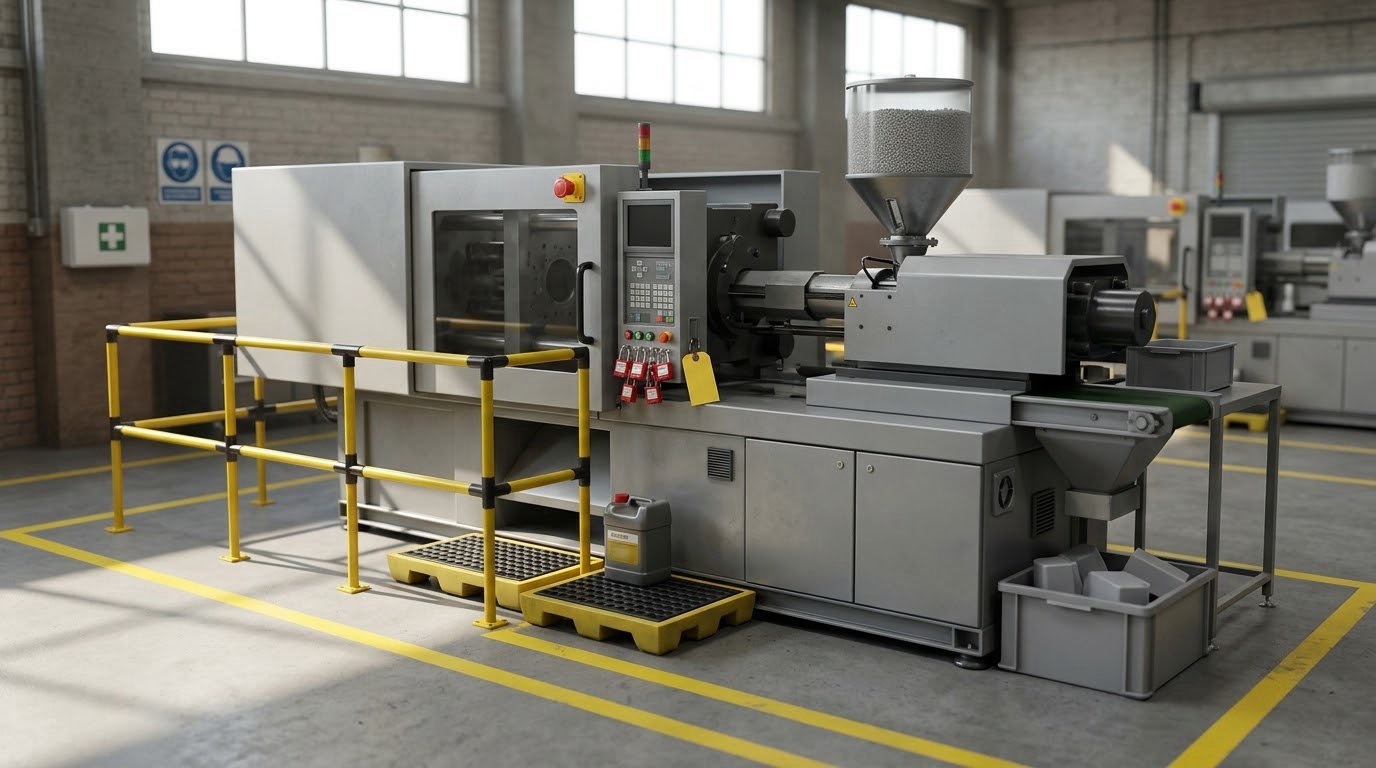
OSHA requirements for a plastics plant are the federal worker safety rules in 29 CFR Part 1910 that apply to injection molding, extrusion, blow molding, resin handling, and maintenance work. In practice that means guarding the clamping area, controlling hazardous energy before anyone opens a mold, telling workers what is in every drum of additive, and keeping records that prove you did it. There is no single OSHA rule written for plastics plants, so compliance is an operation-by-operation mapping job.
I have sat through enough plant audits to know where the trouble shows up first. It is rarely the exotic hazard. It is the 1998 molding machine with a welded-up gate interlock, the hydraulic hose repaired with a mismatched fitting that drops fluid onto the walkway, and the new operator who started on Monday and was still guessing on Friday what the regrind SOP said.
This guide maps the rules to the work as it is actually run on a molding floor. If you are sizing a dryer for hygroscopic resin, choosing a resin dryer for hygroscopic plastics is a separate process question, but the dryer still sits inside your ventilation and lockout scope. One note before we start: this is general information, not legal advice, and requirements differ by state, by equipment, and by the formulation you run.
Table of Contents
- OSHA Requirements for a Plastics Plant by Area
- Which OSHA Standards Apply to Plastics Manufacturing?
- What Must Be Controlled Around Plastic Molding Equipment?
- How Do Lockout, Tagout, and Machine Maintenance Work?
- What OSHA Rules Apply to Resins, Additives, and Chemical Handling?
- Which Ventilation, Heat, and Exposure Controls Are Required? Molded plastic is a heat and fume problem, and ventilation is the primary control. Local exhaust ventilation is the more reliable option because it captures the fume at the source, at the barrel, at the purge panel, at the grinder feed, and at the compounding line. General dilution ventilation helps with ambient odor and heat but is a weak control for a contaminant with a low exposure limit. 1910.94 governs ventilation for abrasive blasting, grinding, and polishing, and applies where those operations are part of finishing work. Two limits worth stating plainly. Odor is not a measurement, and a resin that smells fine at the aisle can still put a worker over a limit at the hopper. And a well-ventilated mold area is not a ventilated compounding area or a lab hood situation; a lab working with organic solvents needs local capture, not dilution. What about heat and radiant exposure? Barrel, mold, and hot runner surfaces put radiant heat into the work area continuously, and a plant with poor air movement holds heat at head height. Evaluate heat stress as an exposure, provide water and recovery areas, and note that a dry polymer still produces fume during thermal degradation, which is the real reason purge events and cleaning are controlled tasks. Air monitoring belongs in the plan, not in the exception file; if you have not measured the additive, you have not evaluated the exposure. What PPE Do Plastics Plant Employees Need?
- What Else Must a Plastics Plant Control?
- What Records, Training, and Inspections Should a Plant Maintain?
- How Can a Plastics Plant Build and Verify Its OSHA Program?
- Frequently Asked Questions
- Do all plastics plants have the same OSHA requirements?
- Is OSHA certification required for a plastics manufacturing plant?
- How should a plastics plant approach OSHA machine guarding requirements?
- When is respiratory protection required in a plastics plant?
- What should a plastics manufacturer do after receiving an OSHA citation?
- Conclusion: Start With the Highest-Risk Plastics Operations
OSHA Requirements for a Plastics Plant by Area
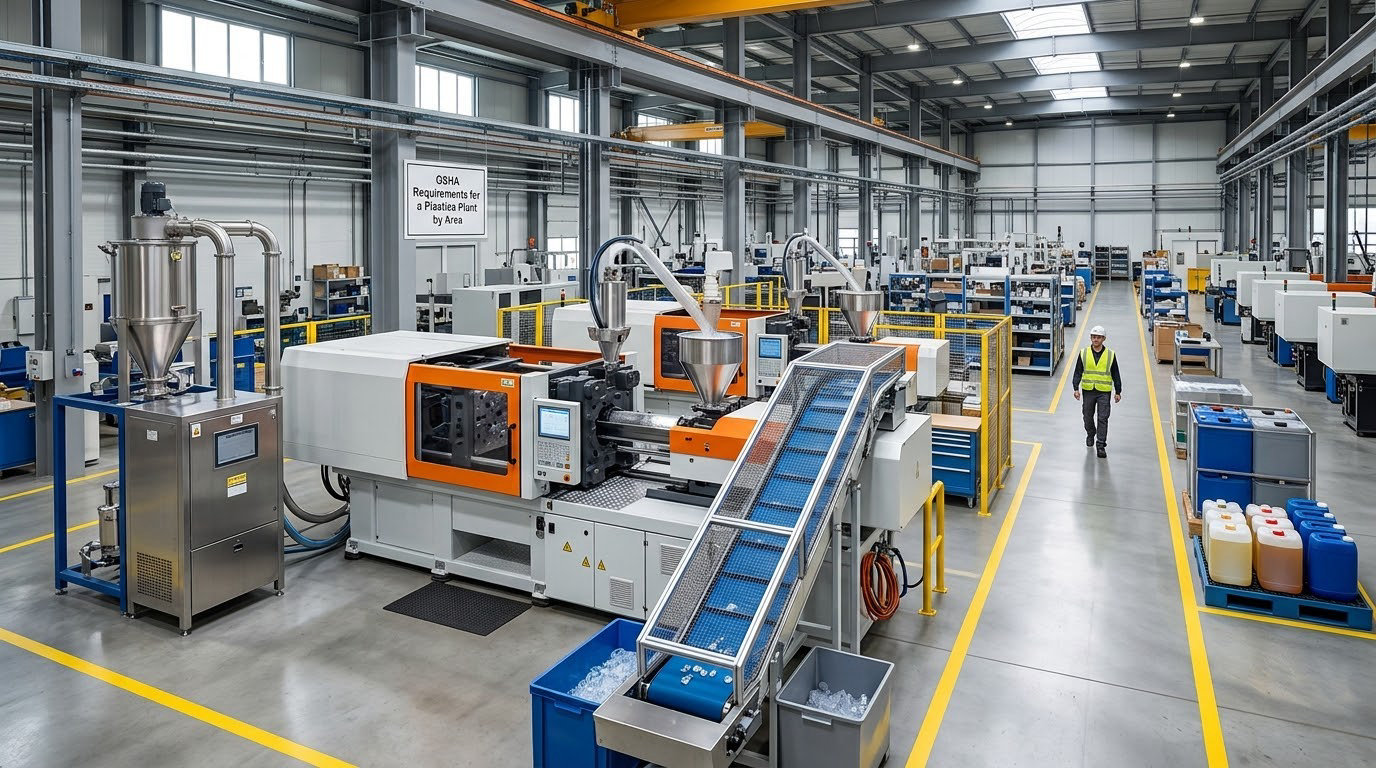
The requirements for a plastics plant divide cleanly by plant area, and each area carries its own set of governing clauses. The table below maps the eight areas most plants have, the hazards that drive citations in each, and what an inspector expects to see when they walk that area.
| Plant area | Typical hazards | Governing 29 CFR 1910 clauses | What compliance looks like |
|---|---|---|---|
| Molding and extrusion lines | Point of operation, nip points, flying parts and scrap, hot surfaces, hydraulic and pneumatic energy | 1910.212, 1910.147, 1910.219, 1910.253 | Guards and interlocks verified, written energy control procedure, hot surface guarding and warning labels |
| Mold changeover and die change | Crush and shear hazards at the clamp, stored gravity energy, stored air, hung tools | 1910.147, 1910.212 | Zero energy verification recorded before a guard is removed, job safety analysis for the change |
| Robot cells and automation | Unguarded robot motion, bypassed gates, personnel inside the cell | 1910.212, 1910.147 | Interlocked gates on a safety rated control circuit, presence sensing, documented risk assessment |
| Resin storage and conveying | Bin and silo entry, engulfment, dust accumulation, pellet handling, forklift traffic | 1910.146, 1910.38, 1910.1200, 1910.178 | Permit entry program for hoppers and silos, combustible dust housekeeping, marked traffic lanes |
| Compounding, blending, and regrind | Dust, heat, fumes, chemical exposure, hot melt, fire | 1910.94, 1910.1200, 1910.106 | Local exhaust at the feed point, hazard communication program, written operating procedure |
| Maintenance and utility rooms | Unexpected energization, electrical contact, hot work, stored pressure | 1910.147, 1910.333, 1910.147(c)(4) | Written procedure per machine, group lockout box, authorized employee training records |
| Shipping, receiving, and the floor | Powered industrial trucks, pedestrian interaction, manual handling, falls | 1910.178, 1910.176, 1910.22, 1910.95 | Pedestrian segregation, operator training, fall protection at elevated work surfaces |
| Quality lab and office | Solvent use, ventilation, ergonomic strain, egress | 1910.1200, 1910.94, 1910.146 where applicable | Chemical inventory, SDS access, lab hoods for solvent work, clear exit routes |
Two things stand out. First, energy control and machine guarding appear in nearly every row, which is why they are the two most frequently cited standards in plastics manufacturing. Second, the requirements for a plastics plant change the moment you add a process, so a plant that adds compounding or blow molding cannot reuse the hazard assessment it wrote for molding alone.
What are the OSHA manufacturing requirements in short?
The OSHA manufacturing requirements that hit a plastics plant hardest are machine guarding under 1910.212, hazardous energy control under 1910.147, hazard communication under 1910.1200, personal protective equipment under 1910.132, and the walking-working surface and emergency action plan rules under 1910.22 and 1910.38. Noise, respiratory protection, confined space, and powered industrial trucks add further obligations where the exposure exists.
Which OSHA Standards Apply to Plastics Manufacturing?
OSHA applies to a plastics processor through two routes: specific mandatory standards in 29 CFR Part 1910, and the General Duty Clause, Section 5(a)(1) of the OSH Act. A plant has to satisfy both. Where a specific standard exists, it is a defense; where none does, the General Duty Clause still requires a hazard recognized as likely to cause serious harm, and a feasible means to prevent it.
Mandatory standards, first. 1910.212 sets the general machine guarding requirements for all machines, requiring guards on point of operation, ingoing nip points, rotating parts, flying parts, and points where stock is thrown. 1910.147 covers the control of hazardous energy. 1910.1200 covers hazard communication. 1910.132 covers PPE. 1910.146 covers permit-required confined spaces. 1910.95 covers occupational noise exposure. 1910.38 covers emergency action plans, and 1910.39 covers fire prevention planning. 1910.22 covers walking-working surfaces, 1910.33 covers electrical utilization, 1910.106 covers flammable and combustible liquids, and 1904 sets injury and illness recordkeeping.
How do voluntary standards fit in?
Consensus standards are guidance unless OSHA has incorporated them by reference into a mandatory standard. The ANSI/PLASTICS B151 series is the clearest example, and it is where plants get confused. B151.1 covers horizontal injection molding machines, B151.7 covers extrusion machines, B151.29 covers vertical clamp machines, B151.31 covers blowmolding machines, and B151.3 covers robots with injection molding machines. These are excellent engineering references, and they describe a risk assessment that any competent safeguard design needs. But following B151 does not by itself satisfy an OSHA clause, and an older 2014 edition cited in an audit response is not a current standard reference.
The practical approach: use B151 as the design input, then verify the installed safeguard against 1910.212 and the applicable B151 part on its own terms. If a machine predates the current B151 edition, say so in writing and document what compensating measures are in place.
Does the same rule apply in every state?
Not quite. State plan states such as California, Michigan, and Washington operate their own OSHA-approved programs, and a private sector employer there is inspected by the state agency rather than federal OSHA. State plans are frequently at least as strict as federal rules, and in a few areas stricter. Confirm which agency covers your facility before you assume federal 1910 is the whole rulebook.
What Must Be Controlled Around Plastic Molding Equipment?
Point of operation guarding is the core requirement, and on a horizontal injection molding machine it covers the clamping area, the nozzle and hot runner, and the tie bar area. 1910.212(a)(1) requires guarding against point of operation, ingoing nip points, rotating parts, flying parts, and hazards created by stock being thrown, cut, or thrown under power. The clamping area guard has to be interlocked so the cycle cannot run with the gate open.
A guard that an operator can defeat with a screwdriver on the second shift is not a guard in practice. Safety consultants who work in molding plants report that older machines frequently lack redundant safety control circuits, which is exactly why the risk assessment has to be documented per machine rather than assumed across a fleet.
What else creates hazard around molding equipment?
Nip points at the clamp, the screw and barrel during rotation, and the tie bars. Flying parts and scrap, which is why screens and hopper guards matter. Hot surfaces at the barrel, nozzle, hot runner, and mold, all of which need guarding or warning marking under the general machine and materials handling rules. Hydraulic and pneumatic energy, including accumulators that hold pressure after the power is off. Presses and dies, including die carts and changeover carts in the mold bay, which need to be secured against movement. Robots, which need interlocked fences or presence sensing on a safety rated control circuit. Conveyors, which fall under 1910.212 and 1910.219 alongside mechanical power transmission equipment.
How should maintenance approach these machines?
Treat preventive maintenance as part of the safety control system, not just uptime work. A documented preventive maintenance schedule that includes guard function checks, interlock testing, and hot runner temperature verification gives you both a maintenance record and safety evidence. Record overruns and dropped cycles in the injection molding process at all, and read the signal: a machine that routinely times out is a machine that will eventually be run with a bypassed guard to keep production moving.
How Do Lockout, Tagout, and Machine Maintenance Work?
29 CFR 1910.147 requires an energy control program for any servicing or maintenance where unexpected energization or release of stored energy could injure a person. In a plastics plant, that covers mold changes, die changes, clearing jams, adjusting hot runners, and any work inside the clamp, the hopper, or the guard envelope. A lock and a tag serve different purposes: the lock keeps the energy isolating device from being re-energized, and the tag tells everyone else why it is off.
Here is the seven step procedure as it runs on a molding line.
- Prepare. Identify every energy source for the specific machine, including electrical, mechanical, hydraulic, pneumatic, gravity, thermal, and any stored or residual energy.
- Notify. Tell affected employees that the equipment is going down and for how long.
- Shut down. Run the normal or specific shutdown procedure, including setting the machine to a safe condition and cycling out stored air and pressure.
- Isolate. Locate and operate the energy isolating device, then physically lock and tag it. A control panel button is not an isolating device.
- Release or restrain. Bleed accumulators, block hydraulic and pneumatic lines, and restrain gravity loads such as a raised clamp or a die cart on an incline.
- Verify zero energy. Attempt a normal start, or test with a meter or try-start, to confirm the isolation actually holds before anyone touches the machine.
- Restore. Inspect the area, confirm everyone is clear, remove locks and tags, and re-energize in the documented order.
When can you skip the full lockout?
Only under 1910.147(a)(2)(ii), minor servicing exceptions, and only where the task uses alternative measures and the work is routine, repetitive, and performed with a recognized alternative method. An operator clearing a short purge of scrap through a guarded opening with the guard in place may fit. Reaching into a clamp to clear a jam never does. Industry consultants working in injection molding make the same point: a full lockout is genuinely hard on some older machines, which is precisely why a documented risk assessment for the alternative method has to exist before the day anyone needs it, not on the day it is used.
Lockout and tagout also depend on people. 1910.147(c)(2) defines a qualified person, and 1910.147(c)(4) requires the employer to train authorized employees before they perform servicing. In most plants that means an annual refresher plus a documented authorization list. A repair contractor performing warranty work is not your employee, and a temporary worker is not automatically covered by your training program.
What OSHA Rules Apply to Resins, Additives, and Chemical Handling?
Resins, pigments, concentrates, solvents, cleaners, mold release agents, and flame retardants all fall under 1910.1200, the hazard communication standard. The rule is straightforward and it is enforced constantly: evaluate the hazard, write or obtain a safety data sheet for every hazardous chemical, ensure the SDS is accessible to every employee who works with it, and train on the contents before the first shift. Written procedures, container labels, and training are not optional extras in this area.
Do plastic pellets and additives need their own SDS treatment?
It depends on the formulation, and that is the part plants skip. A commodity resin in a clean, undegraded state is often low hazard. A masterbatch concentrate carries pigment chemistry that may be far more hazardous than the base resin, and a regrind stream can contain degradation products and additive residue that nobody characterised. The same is true for mold releases, which frequently contain solvents or fluorinated chemistry. Evaluate the specific formulation in your plant rather than assuming the resin family is harmless.
Label every secondary container and every hopper-mounted mixing station, keep the SDS binder or electronic system current, and give a new shift the chemical list for their area before they start. Where a material is flammable or corrosive, storage and secondary containment rules apply on top of HazCom.
Which Ventilation, Heat, and Exposure Controls Are Required?
Molded plastic is a heat and fume problem, and ventilation is the primary control. Local exhaust ventilation is the more reliable option because it captures the fume at the source, at the barrel, at the purge panel, at the grinder feed, and at the compounding line. General dilution ventilation helps with ambient odor and heat but is a weak control for a contaminant with a low exposure limit. 1910.94 governs ventilation for abrasive blasting, grinding, and polishing, and applies where those operations are part of finishing work.
Two limits worth stating plainly. Odor is not a measurement, and a resin that smells fine at the aisle can still put a worker over a limit at the hopper. And a well-ventilated mold area is not a ventilated compounding area or a lab hood situation; a lab working with organic solvents needs local capture, not dilution.
What about heat and radiant exposure?
Barrel, mold, and hot runner surfaces put radiant heat into the work area continuously, and a plant with poor air movement holds heat at head height. Evaluate heat stress as an exposure, provide water and recovery areas, and note that a dry polymer still produces fume during thermal degradation, which is the real reason purge events and cleaning are controlled tasks. Air monitoring belongs in the plan, not in the exception file; if you have not measured the additive, you have not evaluated the exposure.
What PPE Do Plastics Plant Employees Need?
PPE in a plastics plant is hazard-based, not uniform, and 1910.132 requires the employer to assess the workplace, determine required PPE, and provide it at no cost. 1910.132(f) requires a written PPE program documenting that assessment. Very few plants have one, and it is an easy citation to earn.
What PPE fits which hazard?
Eye and face protection for handling pellets, additives, and any splash risk, with a face shield for cleaning and purging work. Safety footwear rated for the environment, and with slip resistance where hydraulic fluid or water reaches the floor. Cut-resistant gloves for deburring, trimming, and handling sharp flash or sprue. Heat-resistant gloves rated for the actual part and tool temperature, and a clear rule about when to remove them near a rotating machine. Protective clothing where chemicals, dust, or hot melt can reach skin. Hearing protection where 1910.95 applies, and respiratory protection only under a written program with medical evaluation and fit testing.
One selection rule to say out loud: gloves are a benefit in a handling task and a hazard in a rotating one. A glove caught in a screw, a belt, or a robot gripper is why 1910.212-based task analysis beats a plant-wide glove rule. The same logic applies to a hearing defender that blocks an audible alarm.
What Else Must a Plastics Plant Control?
Beyond the big four, a plastics plant has a long secondary list, and most citations come from it. Powered industrial trucks fall under 1910.178, which requires operator training and evaluation, and the plant must address the interaction between trucks and pedestrians, which is where the injuries actually occur. Forklift awareness measures such as blue beacon lights, convex mirrors, and marked walkways help, and the underlying control is traffic segregation under 1910.176 and 1910.22.
Conveyors, overhead storage, and elevated work surfaces follow the walking-working surface and fall protection rules. Compressed air at point of use raises both a pressure and a cleanliness problem. Electrical work on molding machines, hot runner systems, and panels follows 1910.331 through 1910.335, and 1910.335(b) is the clause people ask about most: it requires safety signs and markings on equipment enclosures, and 1910.145 covers the pipe and container identification tags used for gas, air, and other lines.
Housekeeping matters more here than in most plants. 1910.22(a) requires surfaces kept clean, orderly, and sanitary, and dry, and 1910.22(a)(3) keeps passageways clear. In a molding plant that means reclaiming pellet dust and film off the floor, and it means fixing hydraulic leaks. Industry consultants working in plastics processing point repeatedly to leaking hydraulic fluid caused by hoses repaired with mismatched fittings instead of same rated hose and fittings. A leak is a housekeeping violation and a slip hazard in one event.
Resin silos, hoppers, and regrind systems can be permit-required confined spaces. 1910.146 applies when a space has limited entry, is not designed for continuous occupancy, and contains a serious engulfment hazard. Pellets flow and can bury a person, so most hoppers with a bridging problem qualify. Program, permit, attendant, and rescue plan or the plant should not enter at all.
Robotic cells deserve their own discipline. Interlocked gates must be on a safety rated control circuit, presence sensing must be correctly configured for the application, and nobody should ever be inside the cell with the drive power on. One widely reported fatality involved a young worker entering a cell with no working gates and no real training, and the reason was not that the automation failed. Someone bypassed the systems. A safety-rated circuit exists specifically to make that bypass visible and difficult.
Noise falls under 1910.95, and a high-tonnage plant with many machines on one floor can easily cross the action level, which triggers a hearing conservation program, monitoring, audiometry, and training. Ergonomics has no single federal ergonomic standard, but 1910 does set general duty expectations, and repetitive handling of parts, cartons, and 50 pound pellet bags is exactly where a hand or back injury gets recorded under 1904. Assembly operations that join parts, including ultrasonic welding and other energy-based joining, carry their own guarding and exposure questions; ultrasonic welding of plastics explained covers the process itself, while the safety scope follows the same guarding, energy control, and noise rules as the rest of the plant.
Finally, fire and egress. 1910.38 emergency action plans and 1910.39 fire prevention planning apply at thresholds tied to headcount and to the presence of flammable materials, and 1910.37 means exit routes and the fire protection plan have to stay usable. A locked door held open with a molding cart is an egress finding on its worst day, which is the day you need it.
What Records, Training, and Inspections Should a Plant Maintain?
Recordkeeping is where the paper trail decides whether a program exists or not. 1904 determines which injuries and illnesses you record and report, based on the general recording criteria, the days-away or restricted-work time threshold, and the medical treatment and loss of consciousness criteria. What it does not cover is the rest of your program, which is where the rest of the records sit.
Keep training records that show who was trained, on what, by whom, and when. That covers HazCom under 1910.1200(h), the equipment-specific authorized and affected employee training under 1910.147(c)(4), powered industrial truck operator training and evaluation under 1910.178(l), fall protection and respiratory protection training, and the general hazard awareness training every new hire needs on day one. A new operator should leave their first week knowing the plant’s energy control rules, the chemical list for their area, the guarding rules for their machine, and the emergency procedures, not just how to run parts.
Keep exposure and assessment records: your written PPE program, your hazard communication program, your written energy control procedures, permit-required entry procedures, your written respiratory protection and hazard evaluation program, and any contaminant monitoring results. Keep the SDS file accessible and current. Keep machine inspection records, guard and interlock checks, preventive maintenance records, forklift training and evaluation files, and the required logs for permit entry and confined space rescue.
And keep the investigation records. Near misses, first aid events, equipment damage, and the corrective actions that followed are what a reviewer reads to judge whether your program works. Retention periods differ by standard, so confirm the period tied to each record type rather than picking a single plant wide number. Statistical process control belongs on the quality side of the house, but the same discipline applies here; if you want to see how a control chart works, Cpk versus Ppk and what plant managers need to know covers the reasoning.
How Can a Plastics Plant Build and Verify Its OSHA Program?
OSHA publishes a recommended framework for an effective safety and health program built on seven elements. Applied to a plastics plant, the seven elements are: leadership and worker participation, hazard identification and assessment, hazard prevention and control, safety and health training, program evaluation and continuous improvement, recordkeeping and reporting, and a written program with communication of its contents. None of the seven is optional in practice if you want a program that survives an inspection.
What does a workable compliance sequence look like?
- Identify the hazards. Walk every process, including resin receipt, drying, conveying, molding, finishing, rework, and scrap handling. Include maintenance, contractors, and the lab.
- Map the legal requirement. Attach the governing 29 CFR 1910 clause to each hazard, and note where a B151 part or another consensus standard informs the control design.
- Assign ownership. Every standard needs a named person, a review date, and a document location. Programs without an owner quietly stop being current.
- Evaluate controls. Prefer engineering controls over administrative ones and personal protective equipment, in that order, and confirm each control actually removes the hazard rather than only documenting intent.
- Train. Train to the hazard, to the specific machine, and to the specific chemical, then record it.
- Inspect. Run a documented walkthrough with a written checklist and a correction log with due dates.
- Investigate. Review near misses and incidents, find the root cause, and correct systemically rather than telling operators to be more careful.
- Re-verify. Confirm the fix held, then update the risk assessment and the training material.
Two pieces of honest advice. If a control question is unresolved, particularly around older machines with no redundant safety circuits, bring in a qualified safety professional or a machine safeguarding engineer rather than improvising. And if you face a legal question about a citation, an abatement deadline, or a state plan obligation, talk to counsel. Neither this guide nor any checklist replaces either of those.
Frequently Asked Questions
Do all plastics plants have the same OSHA requirements?
No. The same core standards apply across the industry, including machine guarding, hazardous energy control, hazard communication, and PPE, but the obligations that actually bite depend on your equipment, processes, and materials. Add compounding, blow molding, or a silo system and new requirements arrive with it. State plan states may also impose stricter rules than federal OSHA.
Is OSHA certification required for a plastics manufacturing plant?
No general certification exists. OSHA does not certify plants, processes, or safety programs, and there is no credential an employer must hold to operate. What is required is that you meet the applicable standards, which is demonstrated through documentation rather than a certificate. Some insurers or large customers may require outside audits, but those are commercial requirements, not OSHA requirements.
How should a plastics plant approach OSHA machine guarding requirements?
Start with the hazards the standard names: point of operation, ingoing nip points, rotating parts, flying parts and flying stock. Guard the clamping area, the screw and barrel, the tie bars, and the hot runner region, and interlock the clamp guard so the cycle cannot run with it open. Where a machine is older, document a machine specific risk assessment and any measures that make a bypass visible, rather than assuming a fleet wide policy covers it.
When is respiratory protection required in a plastics plant?
Respiratory protection is required when engineering controls cannot keep an airborne hazard below its exposure limit, and it cannot be used casually. Using it triggers a written program with a medical evaluation, a fit test, training, and maintenance for the specific respirator. Many plants only need it for short tasks such as purging, cleanup, or drum handling, so evaluate the task and prefer local exhaust ventilation first.
What should a plastics manufacturer do after receiving an OSHA citation?
Respond by the stated deadline, usually in writing through the required citation response process, and describe the correction, the interim protection, and the person accountable. Abate serious items first, since they carry the shortest correction windows, and keep evidence of the completed work. Do not contest and correct at the same time unless you mean it, and get qualified help on any legal question the citation raises.
Conclusion: Start With the Highest-Risk Plastics Operations
Start where the energy is. Walk the molding lines, the mold bay, the hoppers, and the maintenance shop, identify every energy, machine, chemical, heat, ergonomic, and exposure hazard in each process, and then verify the controls against the specific OSHA standard that governs it. Guard the clamp, write the energy control procedure per machine, label and document the chemicals, measure the exposure, and keep the training records. That sequence is the whole job.
Get a qualified safety professional or machine safeguarding engineer involved with any older equipment or unresolved control question, and take legal questions about citations, deadlines, or state plan obligations to counsel. Compliance for a plastics plant is a maintenance discipline, not a document you file once.