
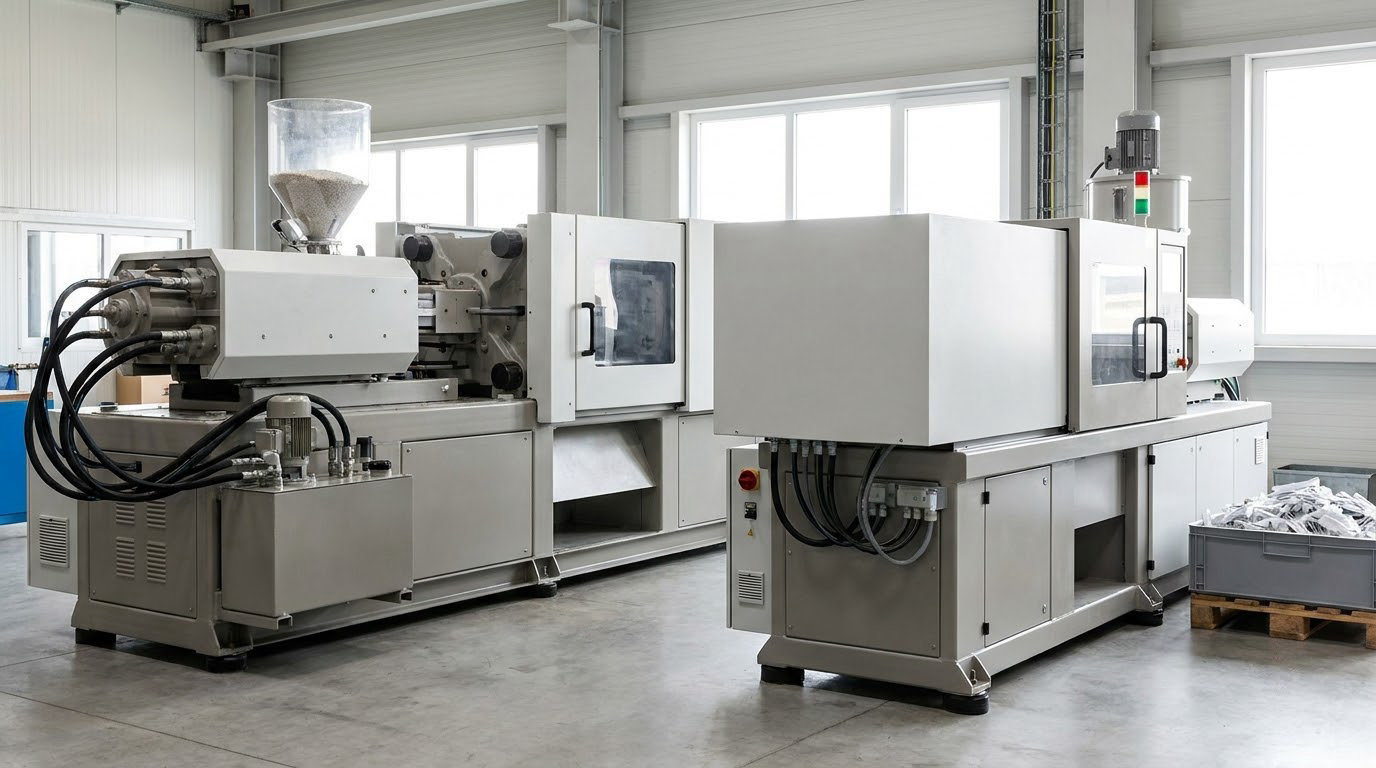
If you are trying to work out how to select a hydraulic vs electric molding machine, start with the part, the annual schedule, and your electricity rate, not with a brand preference. Electric drive wins on repeatability, idle energy draw, cleanliness and automation integration; hydraulic drive still wins on first cost, high-tonnage availability and repairability in a conventional plant.
Most of the bad purchasing decisions I have seen came from starting with the machine. Someone falls in love with the touchscreen, orders a beautiful 200-ton all-electric press, and then discovers the mold is a 300-ton structural part that needs clamping force no electric platform in that class can deliver.
This guide walks through the same sequence a good buyer follows: derive the clamp force from the projected part area, check the screw and shot capacity against the material, model the lifecycle economics at your real utilisation, then check who services the machine within driving distance. Drive type is the fourth decision, not the first.
Table of Contents
- How to Select a Hydraulic vs Electric Molding Machine at a Glance
- Clamp Force and Part Size Requirements
- Precision, Repeatability, and Cycle Performance
- Energy Use and Environmental Impact
- Controls, Automation, and Operator Experience
- Upfront Cost and Total Cost of Ownership
- Maintenance, Reliability, and Service Support
- Which Should You Choose?
- How to Select a Hydraulic vs Electric Molding Machine for Your Operation
- Frequently Asked Questions
- Are electric injection molding machines always cheaper to operate?
- Are hydraulic injection molding machines still worth buying?
- Which machine type is better for high-cavity, tight-tolerance molding?
- Does machine tonnage alone determine hydraulic or electric suitability?
- How much does electricity cost affect the choice?
- Should a small manufacturer buy electric or hydraulic first?
- Conclusion
How to Select a Hydraulic vs Electric Molding Machine at a Glance
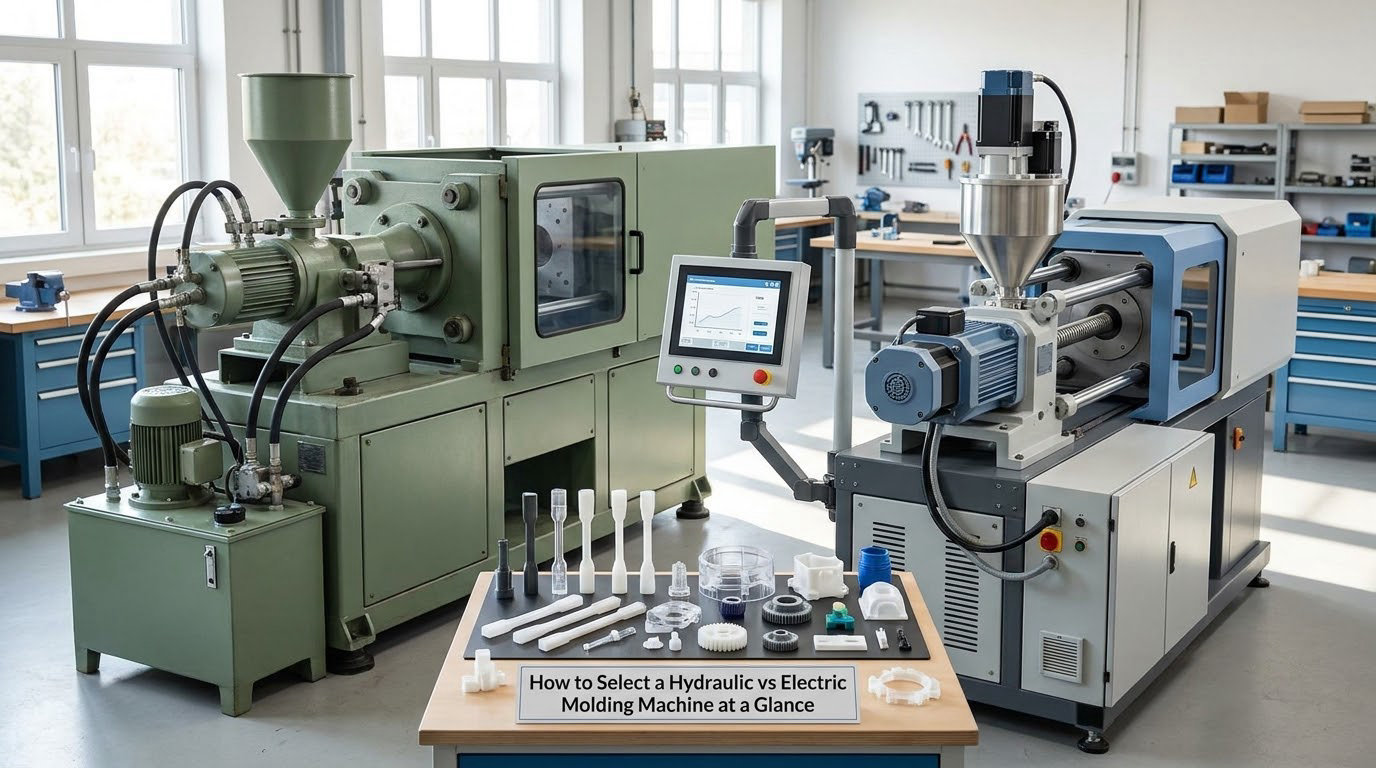
The short version: an electric machine converts electrical energy into axis movement only when the axis moves, while a hydraulic machine keeps a pump running and pushes oil through valves whether or not the machine is doing anything. Everything else in this table flows from that one difference.
| Criterion | Hydraulic drive | Electric drive |
|---|---|---|
| Clamp force range | Standard from small presses to several thousand tons | Commonly strongest below a few hundred tons, with higher tonnage available but narrower choice |
| Energy use | Continuous draw; pumps, heaters and valves run through idle | Power is drawn on demand; braking energy can be recovered |
| Idle draw | Typically the largest single waste in the plant | Very low, dominated by heaters and control power |
| Positioning repeatability | Around plus or minus 0.03 mm on typical machines | Around plus or minus 0.01 mm on typical machines |
| Dynamic response | Good, but limited by valve and oil behaviour | Very fast, with instant switch timing |
| Cycle-to-cycle weight variation | Acceptable for most parts; more drift on long runs if oil condition slips | Tighter, because injection profile is set by encoder position rather than oil flow |
| Noise | Pump noise plus relief valve hiss across the whole shop floor | Quieter during the cycle; the screw and hydraulic lines for tooling still make noise |
| Contamination risk | Hydraulic oil can mist, leak or transfer to parts near the tie bars | No oil in the clamp area, which matters for medical and cleanroom work |
| Routine maintenance | Oil analysis, filter changes, seals, pump and valve service | Greasing, drive and servo inspection, no oil changes |
| Upfront cost | Lower for the same class of capacity | Noticeably higher for the same class of capacity |
| Repair in a general maintenance shop | Any competent hydraulic shop can work on it | Needs servo and drive expertise, usually vendor-supported |
| Automation fit | Fine, but speed changes are blunter | Strong, with fast switch points and easy recipe recall |
| Best fit | Rugged, high-force, cost-sensitive, mature-shop production | Tight tolerances, high utilisation, clean rooms, automated cells, energy-conscious sites |
Here is the preliminary verdict before the detail. If your parts carry tight tolerances, your schedule runs the machine hard, your energy rate is high, or your customers audit the process, electric is usually worth the premium. If your parts are large, your volumes are lumpy, your plant is full of hydraulic presses already, and capital is the binding constraint, hydraulic is usually the more sensible purchase.
One correction to a common myth, because it changes how buyers think: tonnage by itself does not decide this. Electric platforms exist from very small machines to several thousand tons. The real constraints are the specific tonnage, the platen and tie-bar dimensions of your mold, and how few suppliers build the class you need.
Clamp Force and Part Size Requirements
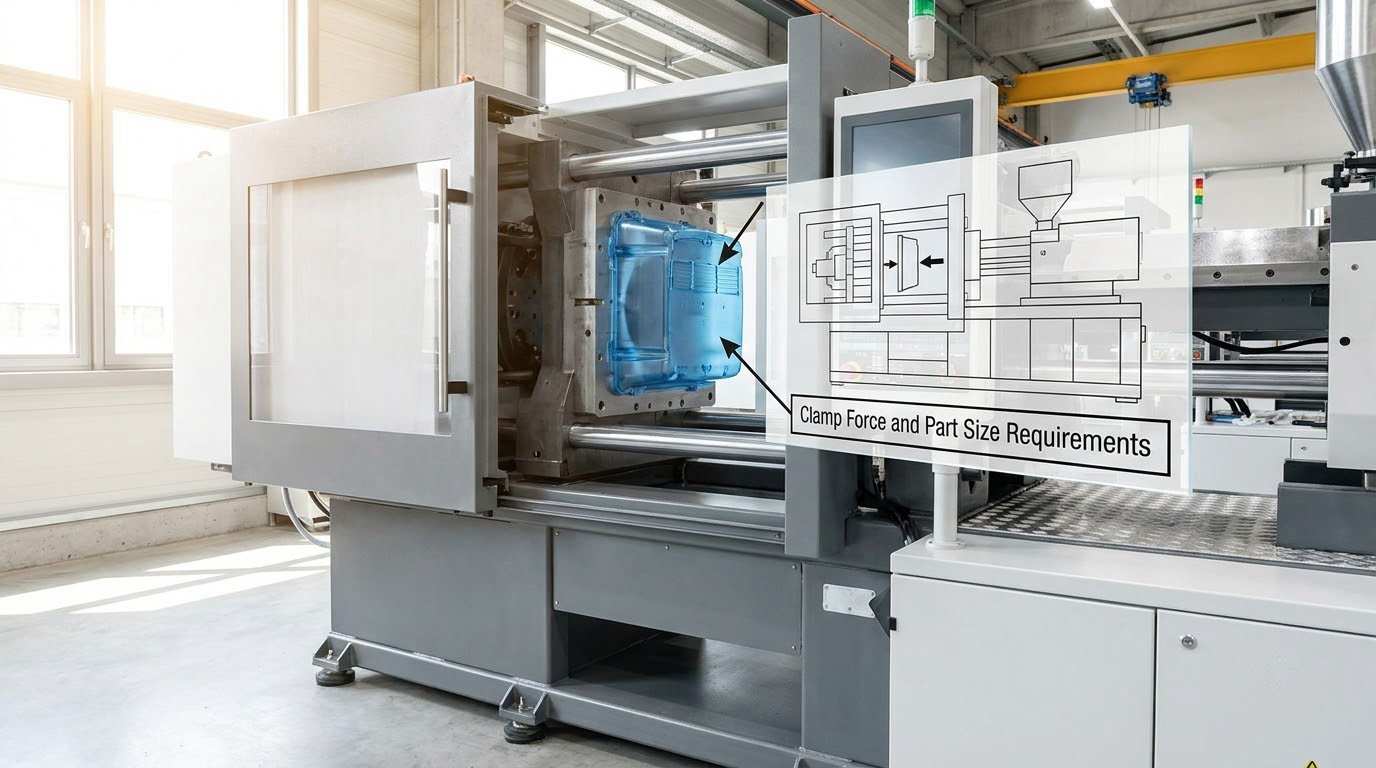
Clamp force comes from the pressure the material exerts on the mold parting line, and the standard way to estimate it is to multiply the projected part area by the cavity count and by a material-specific pressure figure. Add a safety margin of roughly ten to twenty percent for packing pressure and for any flash you are willing to tolerate.
The key point for this decision is that clamp force is a property of the part, not of the drive type. A 1,200-ton structural housing needs 1,200 tons whether the machine drives that force hydraulically or with servo motors. The difference is how many suppliers build that machine class and what it costs when they do.
Where the two diverge is in how force is delivered. A hydraulic press pushes with oil pressure across the whole platen, so a large part gets a large, uniform force, and hydraulic machines scale cleanly upward. An electric press uses servo motors turning ballscrews or direct drives to push the moving platen, which is why electric machines are often described as high force in a small footprint, and why they became common in the medical and electronics sectors first.
Three numbers have to be checked together, and most rejected quotes fail on one of them:
- Clamp force against projected area times cavities times material pressure, with your safety margin.
- Shot volume and shot weight against the part weight, so you are not feeding a 40 gram part into a machine that can deliver 900 grams. Oversized shot capacity slows recovery and wastes heat.
- Platen size, tie-bar spacing and daylight against the physical mold. This is where mold-to-machine fit catches people, and it has nothing to do with hydraulics or servos.
Tie bars matter more than buyers expect. A mold that fits the tonnage but exceeds the tie-bar spacing will not mount, and a mold that mounts but leaves no room for the ejector cylinders, hoses or a robot interface forces a redesign that costs far more than the machine.
There is one clamp-related argument for electric that does hold up: the electric machine holds position with a motor rather than a valve, so parting-line flash from a pressure dip is less common on thin-wall parts. On a medical connector or a thin-wall packaging preform, that can be the difference between a scrap rate you tolerate and one you do not.
And one that does not hold up: the belief that you must go hydraulic above a certain tonnage. Above roughly 500 or 600 tons, all-electric availability thins and price rises sharply, so the honest question becomes whether the supplier you trust builds an electric machine in your class at all. Some do. Many do not.
Precision, Repeatability, and Cycle Performance
Electric machines typically hold positioning repeatability around plus or minus 0.01 mm, where a conventional hydraulic machine sits nearer plus or minus 0.03 mm. That is a real difference and it is measurable, but the number alone will mislead you if you look at the wrong axis.
Injection unit repeatability is the axis that decides part weight. On a hydraulic machine, injection volume is a function of oil flow through a proportional valve, and that function drifts with oil temperature, oil condition and valve wear. On an electric machine, the screw position is set by a servo motor and an absolute encoder, so the volume is the same every stroke whether the machine is warm or cold.
Why that matters commercially: part weight variation is scrap. A part at plus or minus 0.5 percent of nominal weight is often fine, while a part at plus or minus 2 percent fails a functional check or a customer tolerance. The machine does not create good parts on its own, but it decides how much of your process window you have to fight for.
Dynamic response is the second difference. An electric machine can go from injection to hold to decompression in a few milliseconds, which matters for fast thin-wall cycles, high-speed packaging and any cycle where the previous stage is holding a position. A hydraulic machine catches up over most of the cycle, and the gap shows up mainly on very short cycles rather than on a 30-second part.
Be careful with the claim that electric runs faster cycles. The switch timing is faster, and the machine can hit a lower steady cycle floor. Whether that becomes a shorter cycle on your part depends on the slowest stage, which is usually cooling, and cooling is physics. If cooling sets your cycle, changing drive type will not move your output.
There is a third factor that outranks both: part quality is mostly decided by the mold, the material preparation and the process window you run. A poor gate layout, a worn screw tip or resin that has been sitting open in a hopper too long will produce the same bad parts on either drive type. If your repeatability problem is really a material problem, a new machine makes it worse, not better, because the bad parts are more consistent.
Where electric earns its money on repeatability:
- Medical and diagnostic housings where particulate and cosmetic defects are unacceptable.
- Multi-cavity molds running 8, 16 or 32 cavities, where one cavity drifting out means scrap on every cycle.
- Connectors and electronics housings with tight flatness and no flash tolerance.
- Cleanroom or food-adjacent work where hydraulic oil near the parting line is a real risk.
Where it does not: structural automotive parts, pallets, totes and housings with generous flash tolerance, where a durable hydraulic machine holds a stable process year after year with a basic preventive maintenance program.
Energy Use and Environmental Impact
Here is where the electric case is strongest and where the marketing gets sloppiest. A hydraulic machine’s pump runs whenever the machine is energised, so it burns power during a 4-hour lunch break and during the night. An electric machine’s servos draw power only while an axis moves, and during deceleration the drives can regenerate into a resistor or back into the building supply.
Realistic numbers, not vendor headlines. For short-cycle work in the medical, electronics and thin-wall packaging ranges, published comparisons commonly land between 30 and 60 percent lower energy per cycle for an electric machine, and closer to 20 to 40 percent on heavier, slower parts. Vendors quote figures of 50 to 70 percent and those are not always dishonest, but they are usually measured on a light machine with a fast cycle and a warm shop, which is not your shop.
So do the arithmetic yourself with four inputs:
- Average kWh per hour from each machine, measured with a clamp meter over a real shift, not read off a catalogue. Do this before you buy.
- Annual running hours, and separately, idle hours inside those hours.
- Your electricity rate per kWh, which varies more than most buyers assume.
- Any demand charge, which is the piece people forget. A cell of high-power presses starting together can push you into a higher tariff band, and that penalty appears whether the machines are running or idle.
Multiply and you get an annual energy cost. The difference between the two drive types, times your realistic asset life, is the energy component of your business case.
Then apply the honesty check: that saving is per machine, and it only appears if the machine runs. At 20 percent utilisation a cell of electric machines sits idle most of the time, which helps, but the fixed losses and the capital premium still have to be recovered from a small number of parts. At 80 percent utilisation the same electric machine is the obvious winner because the energy delta applies to every cycle.
Hydraulic equipment has one genuine environmental advantage and one disadvantage. It has no hazardous oil to dispose of, and no risk of an oil leak into a floor drain. It also produces heat that the plant has to remove, and in summer that heat load lands on the same chiller that has to cool your process water and your part.
Electric machines generate less waste heat and usually need less cooling capacity, which is a line item planners forget when they are looking at energy bills alone. For a plant running 24 hours a day in a hot climate, that second-order effect can matter as much as the kWh.
If your site runs on a renewable supply contract or has a corporate carbon target, the calculation changes shape again. Medical device and automotive supply chains increasingly audit energy per part, and an electric machine gives you a number to report. That is worth real money in some contracts and nothing at all in others, so ask whether your customers actually ask before you build it into the case.
Controls, Automation, and Operator Experience
Both drive types run on modern closed-loop control, and the difference is much smaller than it was a decade ago. What is still meaningfully different is how the machine behaves when you tell it to switch stages, and how much data it hands you afterwards.
On an electric machine, a switch point is a servo command. On a hydraulic machine, a switch point is a valve command, and the response to that valve is what creates the repeatability gap described earlier. The practical result is that a fast electric cell can run tight, complex sequences with predictable timing, and that predictability is what robot and vision systems need to work with.
Features that matter when you are comparing quotations:
- Recipe storage and recall. Can an operator pull a qualified recipe by name and have the machine restore position limits, temperature, pressure and speed without re-typing anything? On a mixed fleet, this is the difference between one person running three machines and three people each running one.
- Data logging and traceability. Per-cycle parameter capture with export to your quality system. Customer audits increasingly ask for this, and retrofitting it later means buying a retrofit.
- Process monitoring. Cavity pressure, cushion monitoring and parting-line detection tell you about the mold, not just the machine. That is genuinely useful when scrap climbs and nobody knows why.
- Alarm and diagnostic quality. An electric machine that trips on a servo fault can usually tell you what the fault is. Ask the vendor to show you the diagnostic screens before you sign, and ask to see the alarm list from a real customer.
- Robot and auxiliary interfaces. Standard digital in-out, safety relays, and OPC-UA or an equivalent open interface if you plan to connect to a plant system. Proprietary gateways are fine if the vendor keeps them alive for ten years, which is the question to ask.
On operator experience, the honest headline is that electric machines are easier to tune once set up and easier to run, but the first setup is a different skill. There is no oil temperature to stabilise and no pressure to re-trim after a week, which is genuinely nice. There is also a learning curve for the people who will commission and repair them.
That gap shows up in the shops, not on the spec sheet. Operators moving from hydraulic to electric usually get the process part quickly. The harder transition is for maintenance staff, who now need servo drive, encoder and bus knowledge alongside the mechanical skills. Vendors typically offer commissioning and training with the machine, and I would treat the depth of that training as a priced line item in the comparison, not a free extra.
For multi-plant operations, standardisation is worth real money. Fewer machine types means fewer spare parts SKUs, fewer software packages, fewer outside service contracts and fewer technicians who can only fix half your floor. Against that, an electric platform is easier to replicate identically plant to plant, so a large electric fleet is usually the easier one to keep consistent. Choose based on how many sites you have and how thin your maintenance bench is.
Upfront Cost and Total Cost of Ownership
Electric machines cost more to buy. How much more depends on the class, and the gap widens in the mid and high tonnage ranges where electric options are thin, because the supplier is pricing scarcity. For the same class of capacity and a similar feature set, buyers typically see a first cost somewhere between 20 and 60 percent higher.
That premium is the number everyone quotes. It is also the least useful number in the decision, because a machine is a five to ten year asset and the operating side of the ledger is larger. Build the comparison yourself with these lines:
- Acquisition. Purchase price or lease cost, plus financing cost over the term, plus freight, rigging and installation. Installation and commissioning are real and frequently underestimated.
- Utilities. Electricity for the machine, and any increase in cooling demand. Compressed air for ejectors and robotics is often a bigger line than people expect.
- Consumables and maintenance. Hydraulic oil analysis and filter changes for hydraulic; grease, drive inspection and battery or capacitor service for electric. Filters, seals and servo belts all add up quietly.
- Labour. Set-up and changeover time, operator hours, and the cost of troubleshooting time when a specialist has to travel.
- Scrap and yield. This is often the largest single line on a tight-tolerance part, and the reason an electric machine sometimes pays back in a year rather than never.
- Downtime. Unplanned stoppages, the cost of a service visit, and the value of the output you did not make.
- Tooling and changeover. A machine that reduces changeover time releases capacity without buying another machine, which is a benefit that never shows up in an energy calculation.
- Exit value. Used electric machines hold value well where local interest is high, and poorly where it is not. A hydraulic machine in a market with a large installed base can be easier to resell. Ask what has actually sold in your region, not what the vendor promises.
Once the lines are filled in, the break-even test is simple. Take the difference in first cost between the electric and the hydraulic option. Divide it by the annual saving in energy, maintenance and scrap combined. That number is your payback period in years, and it is far more honest than any published percentage.
Run that calculation at three utilisations: 50 percent, 75 percent and full load. A machine that only pays back at 90 percent utilisation is a machine that will disappoint you, because schedules slip and setups eat hours. If payback lands somewhere you are not comfortable with, there are two honest responses: buy hydraulic, or find a way to raise utilisation before committing.
Do not accept a vendor payback calculation built on the machine’s nameplate kW. Use your own clamp-meter data and your own annual hours. If you do not have clamp-meter data, that is a good reason to measure it on a comparable machine in the next plant you visit.
A worked example makes the mechanics easier to argue about internally. Take two 200-ton machines of equivalent capability, one hydraulic and one electric, and suppose the electric one costs 30 percent more at purchase. Say measured draw on the hydraulic machine works out to about $5,400 a year in electricity at your own rate, and the electric machine lands near $3,600 for the same schedule, a saving of $1,800. Maintenance and consumables might add another few hundred a year, and if tight tolerances cut scrap by even a tenth of a percent on a high-value part, that line can dwarf both.
On energy and maintenance alone, payback is $1,800 divided by 45 percent of the purchase premium, which for most shops lands somewhere past three years. Include scrap and it can drop under a year. That is why scrap is the line to measure rather than argue about: it is the one variable where a machine choice can change your cost base rather than merely trim it, and it is also the easiest to quantify because you already know your current reject rate and your part value.
Maintenance, Reliability, and Service Support
Hydraulic machines fail in ways that are well understood. Oil degrades and picks up metal, which wears pumps and valves. Seals harden and leak. Filters clog and cause pressure instability. Accumulator bladder failures show up as a drifting clamp force. Relief valves get adjusted by people who did not write down what they changed.
Electric machines fail in different places. Servo motors and drives age, capacitors and fans need service, encoders and bus connections drop out, and the ballscrews or belts that drive the axes wear. Good electric machines need greasing on a schedule and drive inspection periodically, but they do not need oil analysis, and they do not throw oil onto the floor.
Neither type is maintenance free. The difference is who can do the work. A hydraulic press is within reach of a general maintenance technician in almost any plant, and the consumables are commodity items you can buy anywhere. An electric press is a servo system, and a failed drive or encoder can mean a vendor technician travelling several hours with parts that took a day to arrive.
That makes service support the most underrated input in this decision, and the thing buyers most often skip. Before you sign, find out:
- How many trained technicians are within a few hours of your plant, and whether they cover electric drives as well as mechanics.
- What the guaranteed response time is in writing, and what it is after the warranty ends.
- How long the vendor holds parts for a machine at your age, and what the lead time is for the drives and servos specifically.
- Whether parts are stocked locally or shipped from the factory region, which can be the difference between a day and two weeks.
- Who owns the machine data and whether diagnostics are still available years after purchase.
People in the injection molding community consistently rank local service and spare parts availability above brand reputation when they talk about what they would buy next. The same people point out that a barrier screw or bimetallic screw, and a machine that has actually run in your region, tell you more about long-run consistency than a specification sheet does. It is reasonable to ask a vendor for references at similar tonnage in a similar material, and to check whether those references are in your country.
One practical warning about parts logistics: on less common brands, even a simple proximity switch can take weeks. If your operation cannot absorb a three-week wait for a small sensor, weight the vendor’s local stocking policy heavily, because an electric machine’s electrical spares list is longer than a hydraulic one’s.
Which Should You Choose?
Choose electric when most of these are true:
- Part tolerances are tight enough that weight variation or flash shows up as scrap or as a customer complaint.
- The machine will run hard, at high utilisation, across multiple shifts.
- Your electricity rate is high or your site is under an energy or carbon target.
- Cleanroom, medical or food-adjacent production rules out hydraulic oil near the parting line.
- You are automating the cell and want fast, repeatable switch timing and open data interfaces.
- Labour is tight and you want the lowest-touch machine available.
Choose hydraulic when most of these are true:
- Parts are large, structural, or generous about flash and weight variation.
- Your volumes are lumpy, seasonal, or your utilisation is low and unpredictable.
- Capital is the binding constraint and the payback case does not clear your hurdle rate.
- Your plant is full of hydraulic presses and your maintenance bench already knows how to service them.
- You need tonnage or platen sizes where electric suppliers are thin, or a non-standard configuration such as vertical insert molding.
- You want simple infrastructure: no exotic power quality requirements, no vendor-locked drives, no dependence on a single specialist.
How to Select a Hydraulic vs Electric Molding Machine for Your Operation
The process below works for any drive type, and it is the part most guides skip. Following it in order is how you avoid paying twice, once for the machine and once for the mold redesign.
- Document the hardest part you intend to run. Not the average part, the hardest one: largest projected area, tightest tolerance, most difficult material, highest cavity count, longest cooling. Design every proposal against that part. If a machine is only dimensioned for your average part, you will outgrow it in eighteen months.
- Write down the demand profile. Part weight, projected area, material and its viscosity, annual quantity, acceptable cycle time, tolerance on weight and dimensions, cosmetic requirements, and whether any customer audit or regulatory requirement applies.
- Build the mold-to-machine fit matrix before you talk to vendors. Platen size, tie-bar spacing, daylight, opening stroke, maximum mold weight, nozzle geometry, ejector layout, tie-bar clearance for hoses and robots, and how much room the auxiliaries need. This is where incompatible machines get eliminated, and it costs nothing to do.
- Get three comparable written proposals. Ask each vendor to quote against the same document, and ask them to normalise their specifications. Manufacturers measure cycle time, positioning accuracy and energy differently, so a raw comparison of brochures is not a comparison at all. Specify the standard, for example positioning accuracy measured at a defined pressure, and the test method for energy.
- Calculate the lifecycle economics yourself. Fill the cost lines from earlier in this guide with your own numbers, then run the break-even at 50, 75 and 100 percent utilisation. Do not use the vendor’s energy figure; use a clamp meter reading from a comparable machine.
- Verify service and spare parts support. Technician count and location, response time in writing, local parts stocking, drive and servo lead times, training scope, and what diagnostic access you keep after the warranty. Put the training scope in the purchase agreement.
- Run a representative production trial on the target machine. Use your real mold, your real material and your real cycle, and evaluate it against written acceptance criteria: validated cycle time, weight deviation across a long run, dimensional capability on critical features, cavity-to-cavity consistency, and energy per part at steady state. A short run proves nothing about parameter drift, so run long enough to see drift, ideally overnight.
- Set acceptance criteria in the contract. Cycle time, weight deviation, capability indices on named features, and the remedies if the machine misses them. This is the single highest-value line item on the whole list and the one buyers most often leave out.
On a mixed fleet, most shops that run both types use hydraulic for large, low-volume, rugged work and electric for precise, high-volume, automated work. That is a sound pattern, and it lets you start with whichever matches your dominant part rather than trying to force one drive type to do every job.
If you are moving from hydraulic to electric for the first time, plan the transition: budget for training, expect slower first months while operators build intuition for closed-loop tuning, and keep an experienced commissioning resource on call. Shops that skipped that step are the ones who ended up frustrated with a machine that was actually performing.
Frequently Asked Questions
Are electric injection molding machines always cheaper to operate?
No. Electric machines usually cost less to run per hour, mainly because a hydraulic pump draws power continuously while an electric machine draws only when an axis moves. But the saving depends on utilisation. At low utilisation the gap narrows, and the higher first cost may never be recovered. The honest test is to divide the price difference by your annual energy, maintenance and scrap saving, and check the result at your real running hours.
Are hydraulic injection molding machines still worth buying?
Very often, yes. They cost less to buy, scale to higher tonnage with more supplier choice, and any competent maintenance shop can service them. For large structural parts, lumpy volumes, tight capital budgets and plants already full of hydraulic presses, they remain the rational purchase. Electric equipment has taken the medical, electronics and thin-wall segments, not the whole market.
Which machine type is better for high-cavity, tight-tolerance molding?
Electric is usually the better fit. Position repeatability around plus or minus 0.01 mm and encoder-controlled injection volume keep cavity-to-cavity variation low, and the fast switch timing suits short cycles with many stages. The caveat is that the machine is only part of the answer: gating, cooling, cavity balance, screw design and material preparation decide tolerance more than drive type does.
Does machine tonnage alone determine hydraulic or electric suitability?
No, and this is a widespread misunderstanding. Tonnage is derived from your part’s projected area, cavity count and material, so the same part needs the same force from either drive type. What actually changes is availability and cost at that tonnage, plus platen size, tie-bar spacing and daylight, which are mold-fit questions rather than drive questions.
How much does electricity cost affect the choice?
It can decide the outcome, and it is often underestimated. Run the calculation four ways: measured kWh per hour from a comparable machine, your actual annual running hours, your real rate per kWh including any demand charge, and the hours the machine sits idle. Demand charges matter because a bank of high-power presses starting together can push a site into a higher tariff band regardless of output.
Should a small manufacturer buy electric or hydraulic first?
Start from your hardest part and your real utilisation. A small shop with short runs, low utilisation and a tight budget will usually get more production from a hydraulic machine. A small shop running tight-tolerance medical or connector parts on a tight schedule will usually regret a hydraulic machine. Whichever you choose, insist on a production trial on your own mold and written acceptance criteria before the purchase order.
Conclusion
Drive type is a consequence of your part, your schedule and your service situation, not a decision to make first. Electric earns its premium on tight tolerances, high utilisation, clean environments and automated cells. Hydraulic earns its place on high-force work, lumpy volumes, tight capital and plants that already know how to service it.
So do three things this month. Define your most demanding part in writing, including projected area, weight, material, cavities and tolerance. Measure real kWh per hour on a comparable machine in your own region and multiply by your actual annual hours. Then put the same document in front of three vendors and compare their proposals line by line.
Whichever direction you lean, insist on a production trial with your own mold before the purchase order, and write the acceptance criteria into the contract. That single step prevents most of the expensive mistakes buyers regret.