
Fixed, rotating and four-on/four-off are the three shift scheduling models most factories fall back on, and each one wins in a different situation: fixed crews suit predictable output, rotating shifts spread the burden of nights, and 4-on/4-off covers seven days without overtime. The right pick depends less on preference than on your production rhythm, coverage floor and how much schedule stability your crew needs.
Below is a working comparison of the models you will actually see on a plant floor in 2026, with hours per week, consecutive days on and overtime exposure spelled out, plus a decision framework you can apply to your own line.
Table of Contents
- Shift Scheduling Models for Factories at a Glance
- Fixed Shift Schedules
- Rotating Shift Schedules
- Four-on, Four-off and 4/2 Rotations
- Two-Shift and Three-Shift Factory Models
- Flexible or Demand-Based Shift Scheduling
- Which Should You Choose?
- Frequently Asked Questions
- Which shift scheduling model is best for a factory with stable production?
- How do 4-on/4-off schedules work in a factory?
- Are rotating shifts better than fixed shifts?
- How can a factory reduce overtime without reducing coverage?
- What shift schedule works best when demand changes by week?
- How should managers account for employee preferences and labor-law requirements?
- Conclusion
Shift Scheduling Models for Factories at a Glance
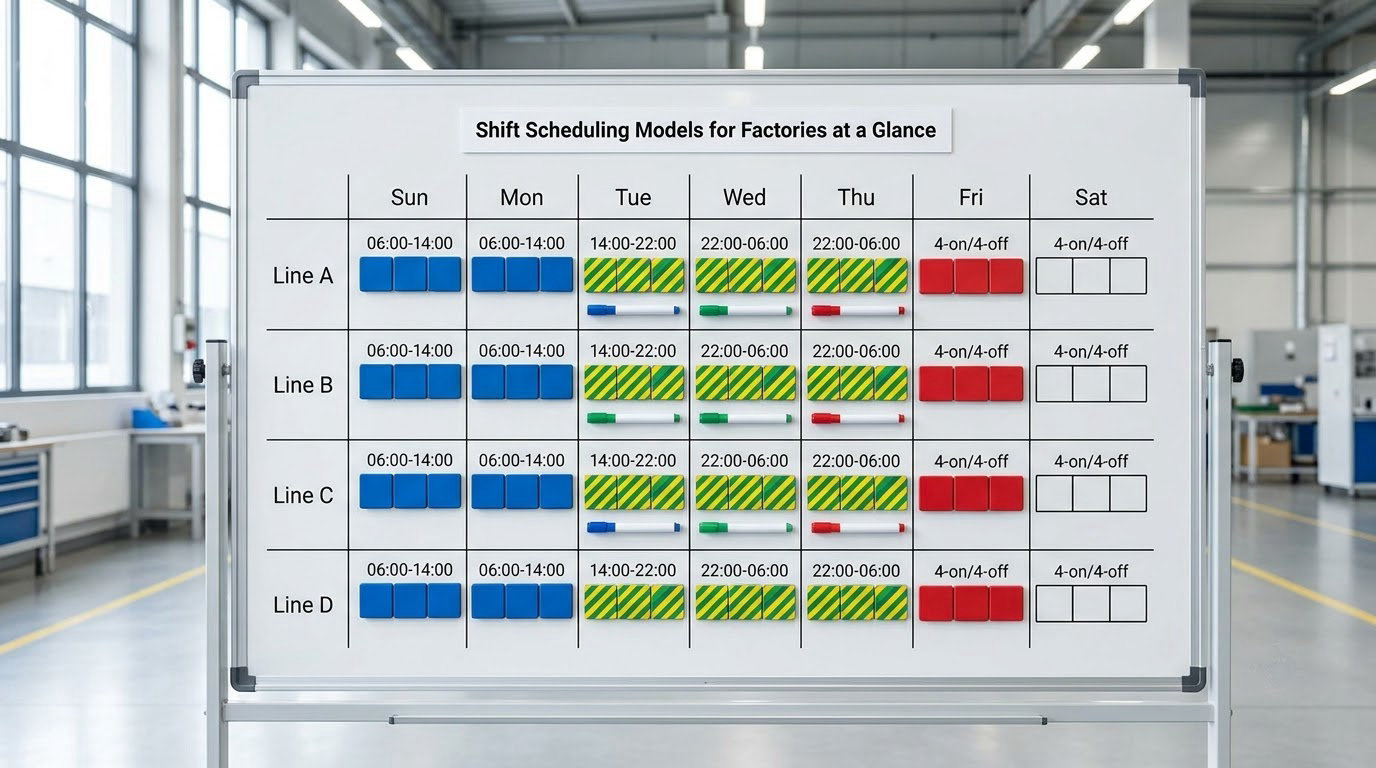
When you compare shift scheduling models for factories, you are comparing rota patterns that decide which crew works which days, so your coverage never depends on someone rebuilding the rota by hand each week. Here are the main models side by side, with hours per week calculated on 8-hour shifts unless noted.
| Model | Notation | Plain meaning | Hours per week | Consecutive days on | Overtime exposure | Best plant fit |
|---|---|---|---|---|---|---|
| Fixed day shift | Mon-Fri, 6:00-14:00 | Same start and end time every working day | 40 | 5 | Low | Single-shift plants, job shops, offices and support functions |
| Fixed two-shift | 06:00-14:00 and 14:00-22:00 | Same two crews, same times, all week | 40 | 5 | Low | Stable output with 16 hours of daily coverage |
| Rotating 2-2-3 | 2-2-3 | Two mornings, two afternoons, two nights, then a 3-day rest block | 40 | 2 | Medium | Mixed lines and light 24/7 coverage |
| Panama | 5-2-5-3 | Five mornings, two off, five afternoons, three nights off | about 37 | 5 | Medium | Plants wanting nights worked as a block rather than single turns |
| 5×2 | 5×2 | Five days on, two days off, repeating | 40 | 5 | Low on weekdays, higher for cover | Seasonal peaks needing a sixth and seventh day |
| 6×3 | 6×3 | Six days on, three days off, usually on 12-hour shifts | 48 | 6 | Low if crewed properly | High-utilisation plants running around the clock |
| 4-on/4-off | 4×4 (four on, four off) | Four 12-hour shifts on, four days off | 48 | 4 | Low | Continuous operations where nights must be covered |
| 4-on/2-off | 4×2 | Four shifts on, two off, cycling through days | 48 or 56 | 4 | Medium | Plants with overtime to fill and cross-trained crews |
| Demand-based | Variable | Hours added or removed weekly against orders | Varies | Varies | High if unplanned | High-mix low-volume shops and seasonal work |
Two figures in that table drive almost every decision. Consecutive days on is the fatigue variable, and hours per week is the labour cost variable, because overtime starts the moment a crew exceeds contracted hours without an adjustment.
What to Compare in Shift Scheduling Models for Factories
Compare models on eight things before you pick one. Start with demand stability, since a schedule built on last month’s order book will break the week something changes.
- Demand stability. Steady tonnage rewards fixed crews; lumpy orders punish them.
- Required coverage. Note the hours per day and days per week each line genuinely needs staffed.
- Skills coverage. Count how many people hold each critical qualification, because that sets your minimum crew size.
- Overtime exposure. Add up scheduled hours against contracted hours for a full cycle, not a single week.
- Handover timing. Long changeovers on complex product families waste skilled time.
- Compliance. Rest periods, weekly hour limits and union or works council agreements constrain what you can schedule.
- Employee preferences. Predictability and fairness on shift selection are retention levers, not soft extras.
- Absenteeism and cover depth. A model with no spare coverage fails on the first unplanned absence.
Fixed Shift Schedules
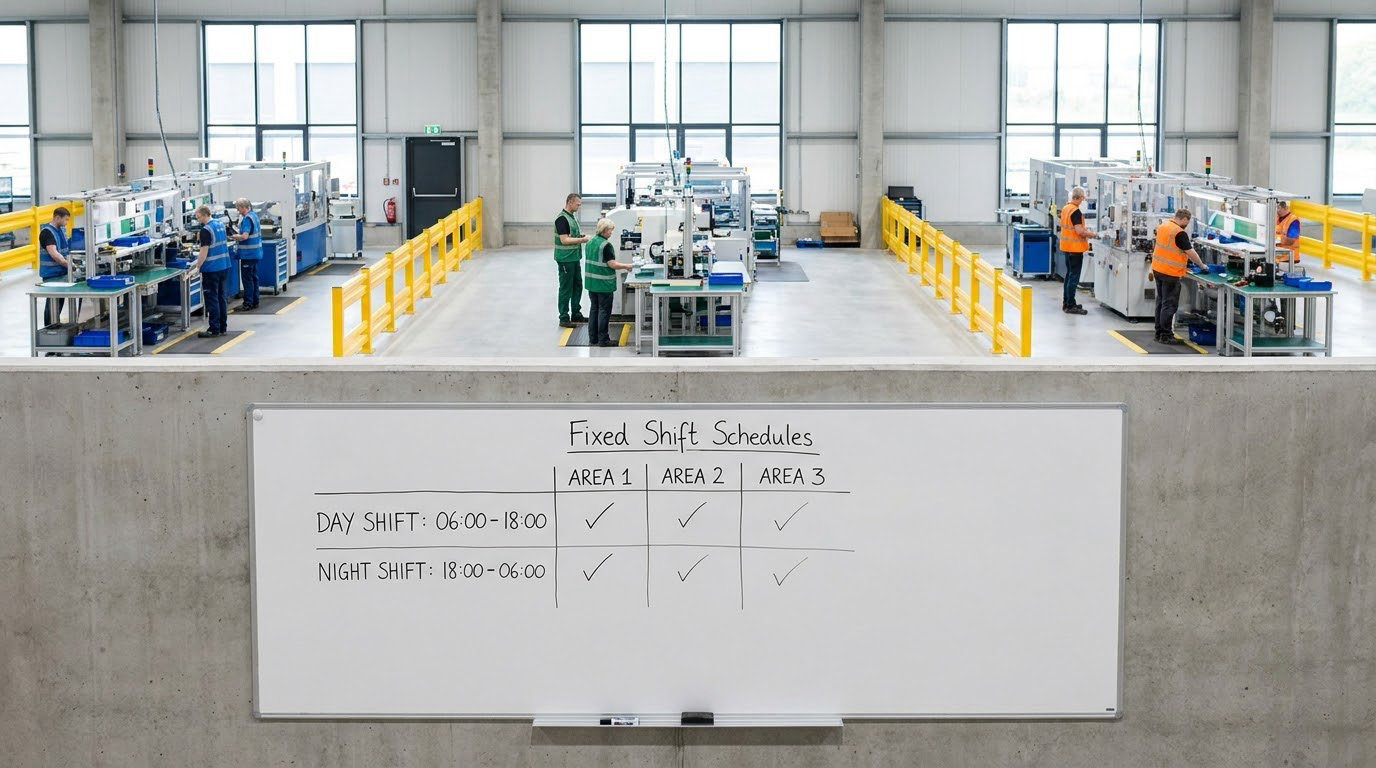
A fixed shift schedule keeps the same crew on the same start and end time every day, week in and week out. It is the simplest model to run and the easiest to communicate, which is why it stays the default in plants with predictable output.
The advantages are practical rather than abstract. Operators build muscle memory on set-up and changeover, supervision knows exactly who to call, and handover quality stays high because the same people meet at the same time. Absentee cover is also easier, since your replacement pool is trained on one shift pattern rather than four.
Fixed shifts fall apart in three situations. Demand swings above your baseline force overtime on a crew that has already worked a full week. Planned maintenance or a shutdown usually lands on a night or weekend, and a fixed crew is now out of alignment for weeks. And when one person leaves, you lose a trained operator for that exact shift until a replacement is hired and trained into it.
A quick way to test whether fixed is right: measure how many of your last 12 weeks fell within 10 percent of your average weekly output. Twelve or more means fixed schedules are defensible. Fewer than six means you are paying overtime premium for a schedule built on fiction.
Rotating Shift Schedules
A rotating shift schedule moves employees through day, afternoon and night assignments on a repeating cycle, so no one crew carries the night shift indefinitely. Models like 2-2-3 and 5-2-5-3 are rotating patterns, and rotation is the main tool plants use to keep turnover and night-shift attrition down.
The benefit is fairness and retention. Workers see that everyone does nights, and supervisors get a wider bench of people who can cover any shift. The cost is disruption: an operator who changes start time every two days loses sleep and takes longer to settle into a task.
Rotation frequency matters more than most plants realise. Quick-turn patterns such as 2-2-3 rotate several times a week and suit mixed, low-risk work where a new person can still meet output. Slow rotations of three or four weeks suit skilled roles on complex equipment, because the learning curve gets paid back inside one long run. Fast rotation on high-skill work is a mistake, and it shows up as more setup errors in the first hour of each new shift.
Then there is communication. A rotation nobody can see coming causes absenteeism and resentment, so publish the cycle far enough ahead that people can plan childcare and appointments around it.
Four-on, Four-off and 4/2 Rotations
Four-on/four-off means four consecutive 12-hour shifts on followed by four days off, repeating on an eight-day cycle. Two full crews of twelve-hour workers cover every hour of the week, each averaging 48 hours, and nobody works nights permanently because the pattern moves them through days and nights.
This is the go-to model for continuous operations that cannot stop, including press lines and process plants. It eliminates overtime in the steady state, it hands every worker roughly eight days off a month, and the eight-day cycle is simple enough to run on a whiteboard.
The trade-off is fatigue and handover. Twelve hours is a long stretch on your feet, and moving from day crew to night crew at the half-way point of a run is where mistakes cluster. A four-on/four-off crew also needs at least 1.3 people per staffed position to cover leave and absence without gaps, so plan the roster around that ratio rather than trimming it to save hours.
Four-on/two-off works similarly but gives only two rest days before the cycle repeats, pushing people to 48 or 56 hours a week. It makes sense when you have genuine overtime to fill or a hard seasonal peak, and it is a poor default because the recovery time is thin.
A 4-on/2-off run also suits crews who want long blocks of time off rather than scattered days, so it often wins retention contests in plants where people value uninterrupted holiday.
Two-Shift and Three-Shift Factory Models
Two-shift coverage means running a day and an afternoon crew back to back, usually 06:00 to 22:00. Three-shift coverage adds a night crew to reach 24 hours, or replaces the afternoon with a permanent night shift on a fixed pattern.
Two shifts fit stable production that does not justify a full night operation, and they cost less because you avoid the premium often attached to night work. Three shifts suit high-utilisation plants where an idle press or furnace burns money every hour, and where a skeleton crew alone cannot cover setup, changeover and quality checks.
Watch the handover design in both cases. A 22:00 changeover on a mixed product line is where the next shift inherits a dirty machine and missing documentation, and the cost shows up as scrap rather than downtime. Where the work is complex, it is often cheaper to buy an hour of overlap at handover than to add a fourth person.
Seasonal plants frequently move from two shifts to three, or from five days to seven days, for a few peak weeks. Plan that expansion as a documented temporary model with a review date, not as a permanent change people quietly assume will last.
Flexible or Demand-Based Shift Scheduling
Flexible scheduling adds or removes hours based on production demand, order backlog, absenteeism and machine availability rather than following a fixed cycle. In many plants this is a hybrid, where a stable core pattern covers the baseline and extra shifts sit on top of it.
Flexibility pays when your demand genuinely swings. It cuts the idle hours and overtime that a rigid rota forces on you, and it lets you cover absence without calling people in on their rest day. It also makes multi-line plants easier to run, since crews can be moved to the line that actually needs them.
The danger is drift. Flexibility without a documented core pattern produces a rota nobody can predict, and workers start missing shifts because they did not know they were working. That is how coverage gaps appear quietly and how overtime creeps back in. The second danger is fairness, since people on open shift bidding without clear rules produce their own arguments.
The workable compromise is a named baseline pattern plus a defined flex band, for example a 5×2 core with a published rule for adding a Saturday crew. Workers get predictability, and you keep the ability to respond in a week rather than a quarter.
Which Should You Choose?
Match the model to the production situation rather than to what another plant in your industry does. These pairings work in most cases.
- Predictable continuous production: 4-on/4-off with 12-hour shifts. It covers every hour, keeps hours near 48 a week and stops overtime.
- Seasonal manufacturing: 5×2 as the baseline, with temporary sixth and seventh days added for the peak and removed afterwards.
- High absenteeism: 5×2 or 6×3, because more crews mean more spare people to absorb absence without collapsing coverage.
- Multiple skill groups: a slower rotation, three or four weeks per step, so training is amortised across one long run.
- Low-volume, high-mix job shop: demand-based hours, because a fixed roster will always be wrong for a shop quoting one-off work.
- Balancing coverage with retention: rotating patterns with published cycles and seniority rules for picking desirable shifts.
- New plant or new supervisor: fixed shifts first, then rotate once the team is stable. Complexity before control is expensive.
Worked example on a 24/7 press line: a 4×4 crew of four works 48 hours with no planned overtime, while a 5×2 crew on 8-hour shifts reaches only about 33 hours of overnight coverage and needs a third crew or overtime to close the gap. The 4×4 wins on coverage and overtime, and loses on fatigue and crew size. If your line runs defect-sensitive work with heavy changeover, weigh that scrap exposure against the overtime saving before deciding.
If you want a written comparison you can take to your own leadership team, pull your last four quarters of weekly output and headcount first, then score each of these shift scheduling models for factories against the eight criteria above. The model that wins on paper usually matches the one your plant already half-runs, and moving to it is a smaller change than it looks.
Frequently Asked Questions
Which shift scheduling model is best for a factory with stable production?
A fixed schedule is the simplest fit when output barely moves week to week, because operators learn one routine and handover quality stays high. If the plant also needs round-the-clock coverage, add a 4-on/4-off pattern on 12-hour shifts, which holds every hour of the week at about 48 hours per person with no planned overtime. Check your last 12 weeks of output first. If most weeks fall within 10 percent of your average, the stable-output case holds.
How do 4-on/4-off schedules work in a factory?
A 4-on/4-off schedule runs four consecutive 12-hour shifts followed by four days off, repeating on an eight-day cycle. Two full crews alternate, so every hour of the week is covered and each person averages 48 hours. The pattern rotates people through day and night work, which spreads the burden instead of parking it on one crew. Plan for at least 1.3 people per staffed position so absence does not open a coverage gap.
Are rotating shifts better than fixed shifts?
Rotating shifts are better for retention and fairness, because nobody carries nights permanently and every crew learns more than one position. Fixed shifts are better for skill retention, predictable output and simple cover, since operators get deeper on one task and hand over to the same faces. Most stable plants mix the two: fixed day and afternoon crews, with rotation reserved for the night shift or for crews where cross-training is a goal.
How can a factory reduce overtime without reducing coverage?
Start by measuring scheduled hours against contracted hours across a full rota cycle, not one week, because weekly snapshots hide the gaps. Then staff to the minimum crew ratio that keeps a full backup, usually about 1.3 people per position, so absence no longer forces premium hours. Cross-train enough people to cover each shift, fix handover overlap so changeovers do not generate rework, and publish cycles early enough that people work their shifts rather than call out of them.
What shift schedule works best when demand changes by week?
A demand-based model works, but only when it sits on top of a published baseline pattern rather than replacing it. Use a stable core such as 5×2 for your baseline output, then add or remove shifts inside a published flex band as orders change. Without the core, workers cannot predict their own weeks, missed shifts rise and coverage gaps appear quietly. Set a review date so any temporary expansion returns to normal after the peak.
How should managers account for employee preferences and labor-law requirements?
Publish the cycle far enough ahead that workers can plan childcare and medical appointments, and write down how desirable shifts get allocated, including any seniority rules. Then check the pattern against rest period requirements, weekly hour limits and any collective agreement covering shift premiums or scheduling notice. Rules differ by country, state and works council, and they constrain overtime, night-work definitions and consecutive working limits before any operational preference is considered.
Conclusion
Every shift scheduling model trades the same three things against each other: coverage certainty, labour cost control and how much stability your crew needs to work well. That is the trade-off behind shift scheduling models for factories generally, and none of them resolves it on their own.
Before choosing, write down your required coverage by line, your demand pattern across the last year, your contracted hours, and what your people ask for. Then pick the simplest model that meets all four. You can always add rotation or flex later, and you cannot run a plant without coverage first.