
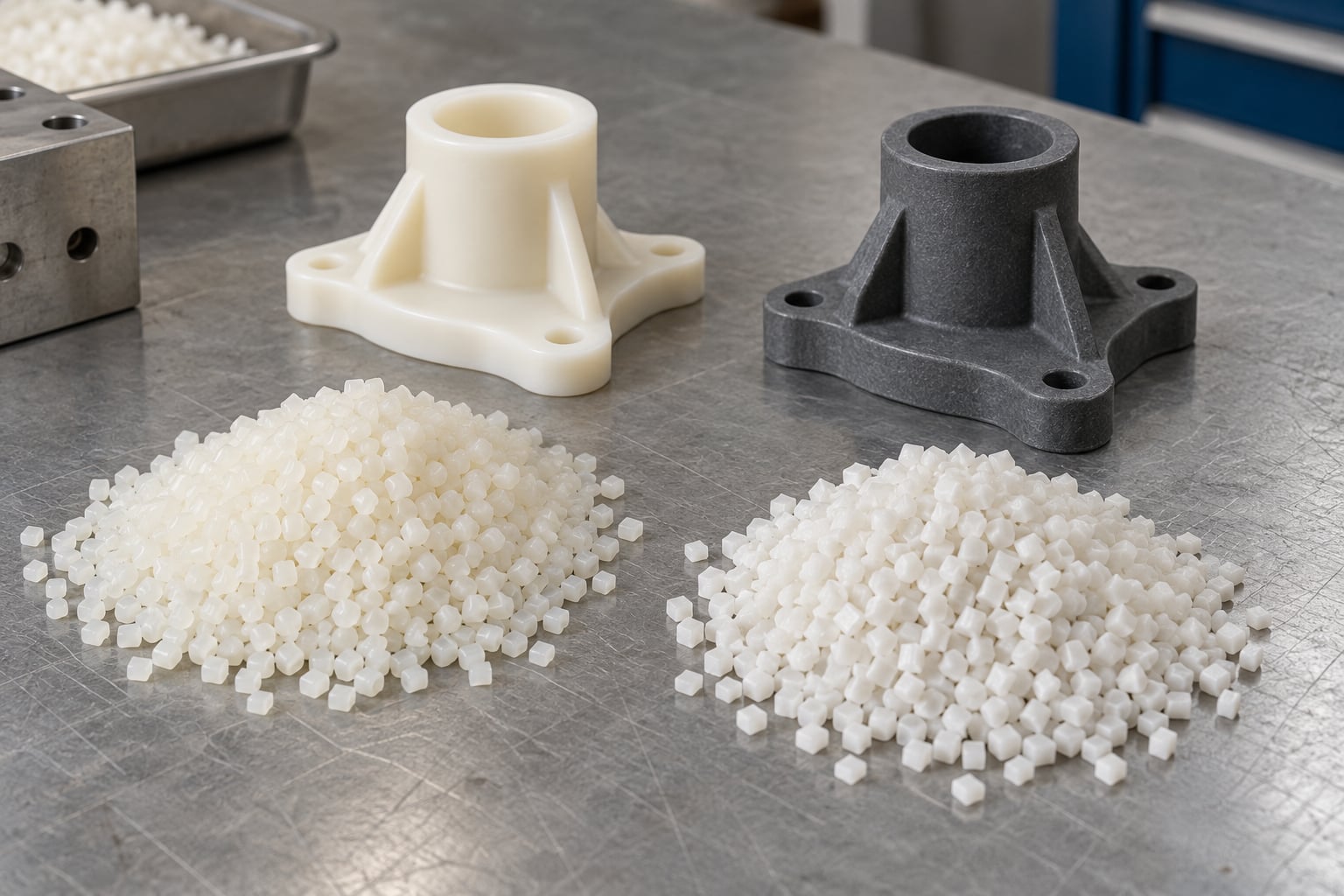
Nylon 6 vs nylon 66 differences come down to two different polyamide molecules built from different monomers. Nylon 6 (PA6) comes from a single six-carbon ring, caprolactam; nylon 66 (PA66, also written nylon 6/6) comes from two six-carbon monomers condensed together. Nylon 66 runs hotter, stiffer and more chemically stable; nylon 6 takes impact better, accepts a better surface finish and usually costs less per kilo.
Both are semi-crystalline engineering thermoplastics, both absorb water, and both mould well once they are dry. Picking wrong between them rarely causes a part to fail on the moulding floor. It shows up six months later as a bushing that has crept out of fit, a cover that warped after a hot car wash, or a gear that flexes where a rigid one was needed.
I have watched buyers argue this out over a one-line change on a drawing, so this guide settles it with numbers and use cases rather than opinion. Everything below is framed for engineers, buyers and plant teams specifying molded, machined or fiber components in 2026.
Table of Contents
- Nylon 6 vs Nylon 66 Differences at a Glance
- What the Names and Chemistry Mean
- Moisture Absorption and Dimensional Stability
- Strength, Stiffness, and Fatigue Performance
- Heat, Wear, and Chemical Resistance
- Processing and Manufacturing Considerations
- Cost, Availability, and Machining
- Nylon 6 vs Nylon 66 Applications
- Which Should You Choose?
- Frequently Asked Questions
- Conclusion
Nylon 6 vs Nylon 66 Differences at a Glance
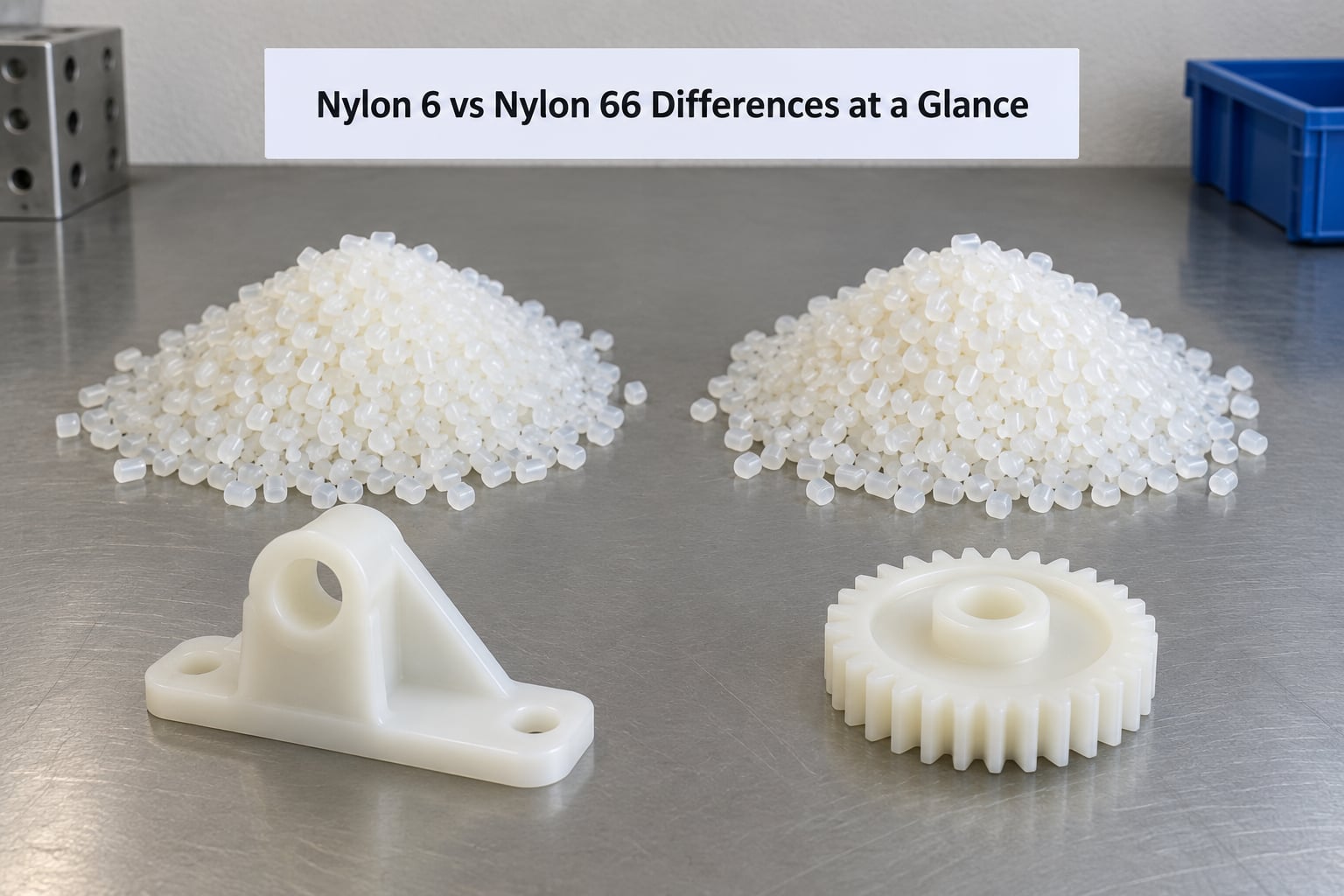
Values below are typical unfilled, unreinforced grades under standard test conditions. Grades vary by supplier, so treat this as a selection screen, not a substitute for the datasheet on the exact resin you are buying.
| Property | Nylon 6 (PA6) | Nylon 66 (PA66) |
|---|---|---|
| Built from | Caprolactam, one monomer | Adipic acid plus hexamethylenediamine |
| Polymerisation route | Ring-opening | Condensation (step growth) |
| Density | About 1.13-1.14 g/cm3 | About 1.12-1.14 g/cm3 |
| Melting point | About 220 C | About 260 C |
| Heat deflection temperature at 0.45 MPa, dry | About 150 C | About 180 C |
| Continuous service temperature (approx.) | 93 C (200 F) | 99 C (210 F) |
| Water absorption, 24 h immersion | About 7-9% | About 2-3% |
| Moulded crystallinity | About 50-60% | About 35-40% |
| Tensile strength, dry | About 75-85 MPa | About 80-95 MPa |
| Tensile modulus, dry | About 2.5-3.5 GPa | About 2.8-3.5 GPa |
| Behaviour once moisture conditioned | Modulus and strength fall sharply | Smaller reduction |
| Mould shrinkage, unfilled | About 1-2% | About 1.5-2% |
| Typical melt range for injection moulding | About 240-270 C | About 270-295 C |
| Impact and flex fatigue, wet | Retains more | Loses more |
| Acid resistance | Moderate | Better against strong acids |
| Melt temperature, cost and availability | Generally lower | Generally higher |
One line deserves emphasis before anything else. Wet strength is where the ranking flips. On dry datasheet values nylon 66 looks like the better material on almost every row, but a nylon 6 part sitting in a humid environment or a car wash keeps its toughness far better than its dry numbers suggest.
What the Names and Chemistry Mean
No, nylon 6 and nylon 66 are not the same material, and the naming trips people up constantly. PA6 and nylon 6 are the same polymer under two labels. PA66, nylon 66 and nylon 6/6 are all the same polymer too; the 6/6 form simply reflects that two six-carbon monomers build the chain.
The number in a polyamide name tells you how many carbon atoms sit in the monomer backbone. Caprolactam carries six carbons, which gives nylon its name. Adipic acid and hexamethylenediamine each carry six carbons, and because both are involved the name becomes 66, written as 6/6 or 6-6 in older material data sheets and supplier paperwork.
Nylon 66 was the first of the family, commercialised by DuPont in the 1930s. Nylon 6 followed from Paul Schlack’s work in Germany in 1939, built on the same amide bonding chemistry but reached by a different route. That is the whole family story: the amide linkage gives you toughness, toughness plus hydrogen bonding gives you nylon.
Both nylons share the properties buyers expect from a polyamide: high tensile strength, toughness, abrasion resistance, good electrical insulation at moderate moisture, chemical resistance to oils and fuels, low friction against itself and steel, and easy machining. The differences between them are refinements of that shared base, not different worlds.
Nylon 6 vs Nylon 66 Differences in Chemical Structure
Nylon 6 comes from opening a single ring. Caprolactam is a six-membered ring carrying an amide group; heat breaks the ring and the resulting chains link head to tail through amide bonds. Every repeat unit along the chain is identical.
Nylon 66 comes from a condensation reaction between a diacid and a diamine. Adipic acid plus hexamethylenediamine polymerise with loss of water, so the chain strictly alternates two units, one derived from each monomer.
That alternating backbone gives nylon 66 a higher concentration of amide groups per unit length. Nylon 6 has longer hydrocarbon stretches between amide bonds, so the chains pack into crystals more readily and nylon 6 reaches a higher crystallinity in a typical moulding cycle.
Higher crystallinity means lower water uptake, because water binds to the polar amide sites that are less accessible inside a tight crystal. This is the root cause of most of the differences that follow: nylon 6 absorbs several times more moisture, and nylon 66 tolerates heat and stiffness retention better. Hydrogen bonding also explains why nylon 66’s dry mechanical numbers sit slightly higher; published comparisons often cite nylon 66 as roughly 10 to 20 percent stronger in tension.
Crystallinity is not a fixed property either. It rises with faster cooling, longer cooling time and higher mould temperature, which is why two injection-moulded PA6 parts from different tools can behave differently on the same print.
Moisture Absorption and Dimensional Stability
Nylon 6 absorbs roughly two to three times more water than nylon 66, and in a part that tolerance matters more than the raw percentage suggests. A 2 mm wall in PA6 can grow by a few hundredths of a millimetre at full conditioning; an interference fit designed dry on PA6 will be tight once the part has lived in a humid plant or a wet climate.
The bigger issue is mechanical. Moisture plasticises the amorphous regions between crystals. A dry PA6 tensile modulus around 3 GPa can fall to roughly 1 GPa once conditioned, and tensile strength drops by nearly half. PA66 gives up less, though it still softens.
This is why published property values mislead. A datasheet tested dry and a datasheet tested at 50 percent relative humidity can disagree by a wide margin on the same grade. Ask the supplier which conditioning state the numbers came from before you compare two data sheets against each other.
Practical consequences for your part: avoid PA6 for press fits, snap fits and tight-tolerance assemblies unless the assembly is permanently dry. Reserve PA66 for parts that live outdoors, in kitchens and bathrooms, or in continuous contact with water. Expect a nylon 6 part that looks fine at moulding to be noticeably softer in service.
Strength, Stiffness, and Fatigue Performance
Nylon 66 wins on dry strength and stiffness; nylon 6 wins on impact, especially in the wet. Unfilled nylon 6 typically reaches 75 to 85 MPa tensile dry and nylon 66 around 80 to 95 MPa, so the strength gap is real but modest.
Modulus is where the gap widens. Unreinforced grades start within touching distance of each other at 2.5 to 3.5 GPa dry, but condition them and PA6 softens far more. If a part needs to hold a dimension under load all day, PA66 or a glass-filled grade is the safer bet.
Under cyclic loading the ranking changes with condition. Nylon 66 has long been the flex fatigue choice in dry applications, since its higher amide density holds the crystal domains together under repeated bending. Under moist conditions nylon 6 holds its impact strength and flex fatigue life better, which is why PA6 turns up in clips, bumpers and snap-fit covers that see condensation.
Glass fibre changes the picture. GF30 and GF33 grades raise stiffness several fold, cut mould shrinkage to roughly a third of unfilled values and pull moisture uptake down, because the fibre occupies space the water would otherwise reach. The relative advantage of PA66 narrows once both are glass filled. Our guide to glass filled nylon properties and when to use it covers the reinforcement decision in more detail.
Supplied unfilled, both materials are tough enough for gears and bearings. Add a self-lubricating filler such as molybdenum disulphide when you need long service life under continuous load.
Heat, Wear, and Chemical Resistance
Nylon 66 is the better choice on temperature, and the gap is consistent. Melting point sits around 260 C against roughly 220 C for nylon 6, heat deflection temperature at 0.45 MPa is about 180 C dry against about 150 C, and continuous service temperature is roughly 99 C against 93 C.
Check those deflection figures at 1.85 MPa too, where the gap closes and nylon 6 sits closer to 100 C. Published HDT depends heavily on span, fibre direction and conditioning, which is why two suppliers can quote very different numbers for what is nominally the same resin.
Wear resistance leans the same way. Nylon 66 is harder and more abrasion resistant, and in fibre form it outlasts nylon 6 in carpet and upholstery testing. Nylon 6 is not far behind for molded wear parts and often performs well because it holds impact in a damp environment where a stiffer PA66 part would chip.
On chemicals, treat both as good but not universal. Both resist oils, fuels, lubricants, hydrocarbons and many solvents, and both are attacked by strong acids, concentrated alkalis and hot water over long periods. Nylon 66 generally handles strong acids better than nylon 6. Both absorb ethanol and dilute acid slowly, which is why neither suits long-term storage of fermentation beverages or strong acids without checking first.
Neither material is inherently UV stable. Both need a stabilised or UV-rated grade for outdoor and under-hood service, and outdoors users do report nylon 66 holding up better than nylon 6 when parts are not stabilised.
Processing and Manufacturing Considerations
Nylon is hygroscopic, and water in the melt is the single most common cause of poor nylon parts. Both resins need drying before moulding: PA6 typically to 0.10 to 0.20% moisture, PA66 to 0.08 to 0.15%, usually several hours with a desiccant dryer in the 70 to 85 C range. Wet resin gives silver streaks, splay, bubbles and brittle parts that look fine until they snap.
Melt temperature sets the difference in the moulding room. PA6 typically runs 240 to 270 C, PA66 needs more heat at 270 to 295 C because of its higher melting point. Hold pressure and cooling time follow from crystallinity: nylon 66 has a slower crystallisation rate, so it often needs a longer time under pressure and in the mould to reach full crystallinity and stable dimensions.
Mould temperature matters as much as melt temperature. PA6 crystallises readily and fills at a lower mould temperature, which shortens cycle time. Higher mould temperatures and longer cooling times raise crystallinity and dimensional stability, at the cost of cycle time. PA66 moulds at the upper end of typical settings for the same reason.
For shrinkage allowance, design to about 1 to 2% for unfilled PA6 and 1.5 to 2% for unfilled PA66, and widen the tolerance band unless you are controlling the cooling profile closely. Glass filled grades shrink far less but show warpage risk along weld lines, which is a different problem to solve rather than a reason to avoid them.
One correction worth making because it appears on several supplier pages: nylon 6 is not only available as cast stock and nylon 66 is not only available as extruded stock. Both are mouldable and both are available in rod, sheet and tube. Cast and extruded describe particular processing routes for large machined parts, not a property of the chemistry. If you are buying machined bar and plate, ask for the specific grade rather than assuming the polymer name fixes the route.
Cost, Availability, and Machining
Nylon 6 is generally the less expensive resin, and it is produced in larger volume than nylon 66, so more grades and more stock sizes exist. Nylon 66 carries a premium that grows as you move into filled, low-moisture or high-precision grades.
Resin cost per kilo is not part cost. Filling nylon 6 with 30 percent glass closes most of the price gap with unfilled nylon 66 and can beat it on stiffness. Cycle time, scrap rate and post-machining often move total part cost more than the resin does, so compare on a finished-part basis.
Machining favours whichever grade holds its shape. Nylon 6 machines beautifully, cuts clean and does not need much support, but it moves with humidity, so a finished part may need conditioning or a finish pass after the environment has settled. Nylon 66 holds dimension better through a long machining cycle, which matters for large blanks where heat build-up and deflection are the limit.
Availability is straightforward for stock shapes in both. Injection-moulded parts of either resin are equally easy to source from a moulder. The gap opens up when you need a specific filled grade in a large volume, where nylon 66 specialist grades can be a longer lead item.
Nylon 6 vs Nylon 66 Applications
Nylon 6 (PA6) shows up where impact, finish and cost decide the job:
- Automotive interior and under-hood clips, covers and housings that see condensation rather than sustained heat
- Non-structural gears, bushings and rollers with moderate load and intermittent impact
- Cosmetic housings, bezels and covers, since PA6 takes a surface finish and holds colour well
- 3D printed prototypes and functional parts, where the lower melt range suits common printer hardware
- Power tool handles and appliance parts that need toughness over stiffness
- Textile uses including carpet fibre, hosiery and apparel, where nylon 6 dominates on price and dye affinity
Nylon 66 (PA66) earns its place where heat, stiffness and stability drive the design:
- Wear pads, wear strip and heavy-duty bushings in continuous load
- Cable sheaves, pulleys, thrust washers and valve seats
- Electrical switchgear components and circuit insulation boards
- Radiator caps, cooling system parts and any wet-heat exposed component
- Precision machined parts and assemblies with tight fits in variable humidity
- Tire cord, airbags, seat belts and other high-tenacity fibres
Neither material is the answer when low moisture pickup matters more than cost: PA11 and PA12 absorb far less water, and PA610 or PA1010 sit between PA6 and PA66 on both price and uptake. If your part lives in water or steam, those grades deserve a look before either of these two.
Which Should You Choose?
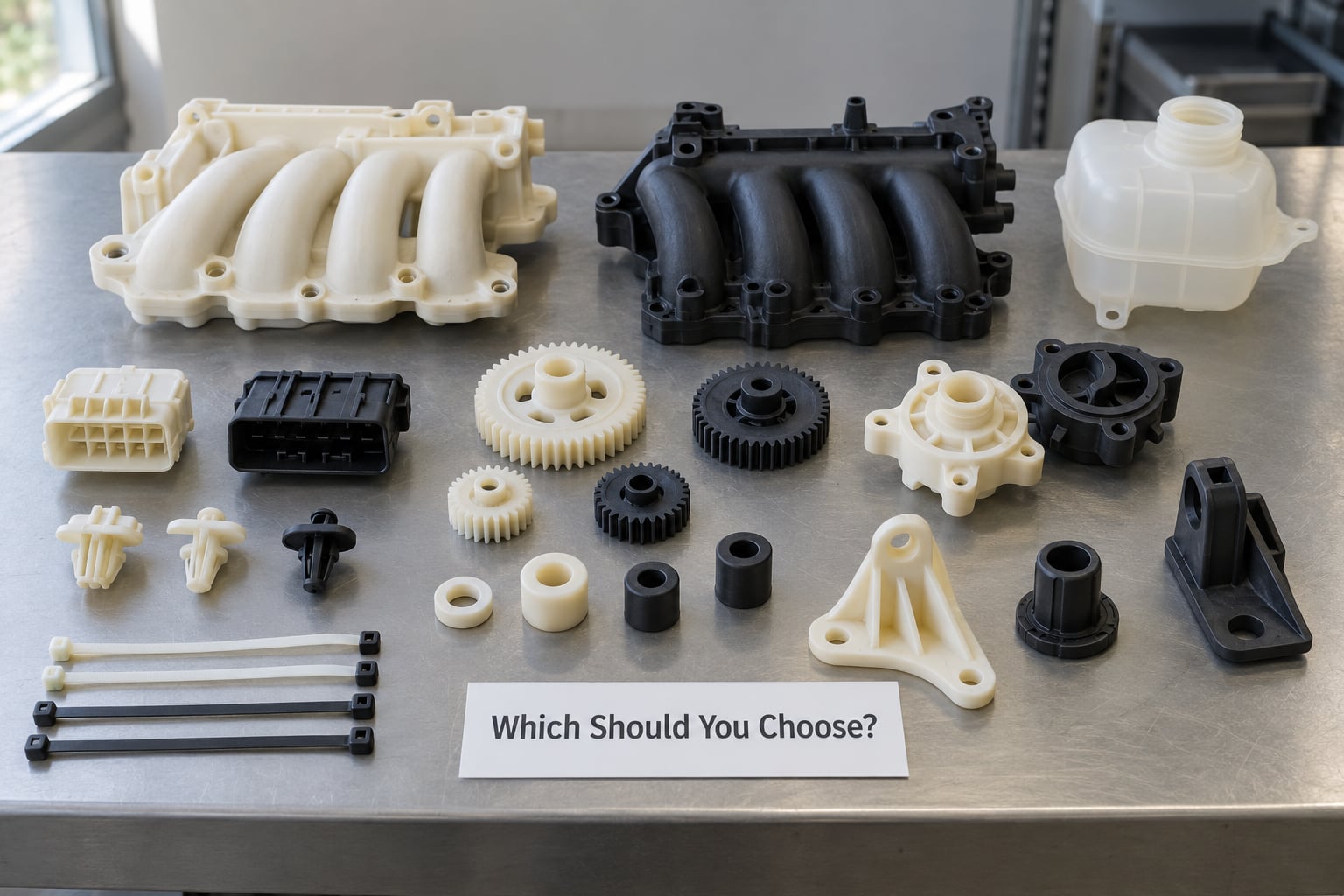
Choose nylon 6 when cost is a real constraint, the part takes impact rather than sustained load, you need a good cosmetic finish, or the environment is damp enough that wet toughness matters more than dry stiffness. Choose nylon 66 when the part runs hot, holds a dimension under load, sits in water or steam, or carries continuous fatigue loading.
Use this five-check list before you commit a grade:
- Max service temperature. Above roughly 90 C continuously, move to PA66 or a stabilised filled grade.
- Moisture exposure. Interference fits, seal faces and tight assemblies in a humid environment are a PA66 or low-moisture grade requirement.
- Impact or stiffness. Impact and snap-in behaviour, choose PA6. Dimensional rigidity under steady load, choose PA66.
- Shrinkage tolerance. Tight cosmetic or assembly tolerances favour PA66 unfilled, or either polymer glass filled to cut shrinkage.
- Cost per finished part. Compare filled grades and cycle time, not resin price per kilo.
A few claims floating around other comparison pages are worth correcting, because they lead to wrong selections. Nylon 6 is not more resistant to heat than nylon 66, it does not have the higher melting point, and it does not beat PA66 on acid resistance. What nylon 6 genuinely leads on is crystallinity, wet impact strength, wet flex fatigue, surface finish and resin price. Everything else on the property table points the other way.
That is also why a glass-filled PA6 grade often gets chosen over unfilled PA66 on tool handles and appliance parts: you pick up toughness, low uptake and stiffness at once, and the reinforcement closes most of the resin price gap.
If nylon is only one of your candidates, our piece on acetal vs nylon for gears and bearings covers when a different polymer wins outright on dimensional stability.
Frequently Asked Questions
Is nylon 6 or nylon 66 stronger?
Nylon 66 is stronger in tension when both are dry and unfilled, typically around 80 to 95 MPa against 75 to 85 MPa for nylon 6, and it holds more of that strength when it absorbs moisture. In a damp environment nylon 6 can behave the stronger material in practice because its toughness and flex fatigue life survive conditioning better. For continuously loaded parts, choose on stiffness and creep rather than on dry tensile figures alone.
Does glass-filled nylon 6 or nylon 66 absorb less moisture?
Glass fibre filling reduces moisture uptake in both polymers, because the fibre occupies volume that water would otherwise reach, and the filled surface slows absorption further. Filled PA6 still absorbs noticeably more than filled PA66 because its higher baseline uptake is unchanged. If your part lives in continuous water or steam, use PA12 or a low-moisture grade rather than relying on reinforcement alone.
Which nylon is better for precision machined parts?
Nylon 66 is usually the better answer for precision parts because it holds dimension more consistently as humidity changes and machines with less deflection over long cycles. Nylon 6 machines more easily and is fine for non-tight parts, but its higher moisture uptake means a finished part can move after machining. For tight fits, either condition the part before the final cut or specify PA66.
Is nylon 66 better than nylon 6 for electrical components?
For switchgear, terminal blocks and insulation boards, nylon 66 is usually specified because its lower moisture uptake keeps dielectric strength and insulation resistance more stable in humid conditions. Both materials are good insulators when dry, and both need stabilised grades for outdoor use. Neither is specified for high-voltage insulation without a voltage rating check on the exact grade.
Can nylon 6 or nylon 66 be used for continuous water exposure?
Continuous immersion in water is outside the comfortable range for both, since absorbed water plasticises the polymer and permanently reduces stiffness and strength. Nylon 66 tolerates short-term and intermittent wet service far better than nylon 6 because it absorbs less. For permanent immersion, wetted service or steam, look at PA11, PA12 or a glass reinforced grade instead, and confirm the grade with its supplier.
Conclusion
Both nylons are good engineering materials, and the choice is a trade rather than a contest. Start with moisture: if the part sees water, steam or humid air, pick nylon 66, because that single decision resolves most of the nylon 6 vs nylon 66 differences on the table above.
Before you release the print, write down the highest service temperature and the wettest condition the part will see. Match those two numbers to the grade, check the datasheet conditioning state, and prototype with the filled grade you actually intend to run.