
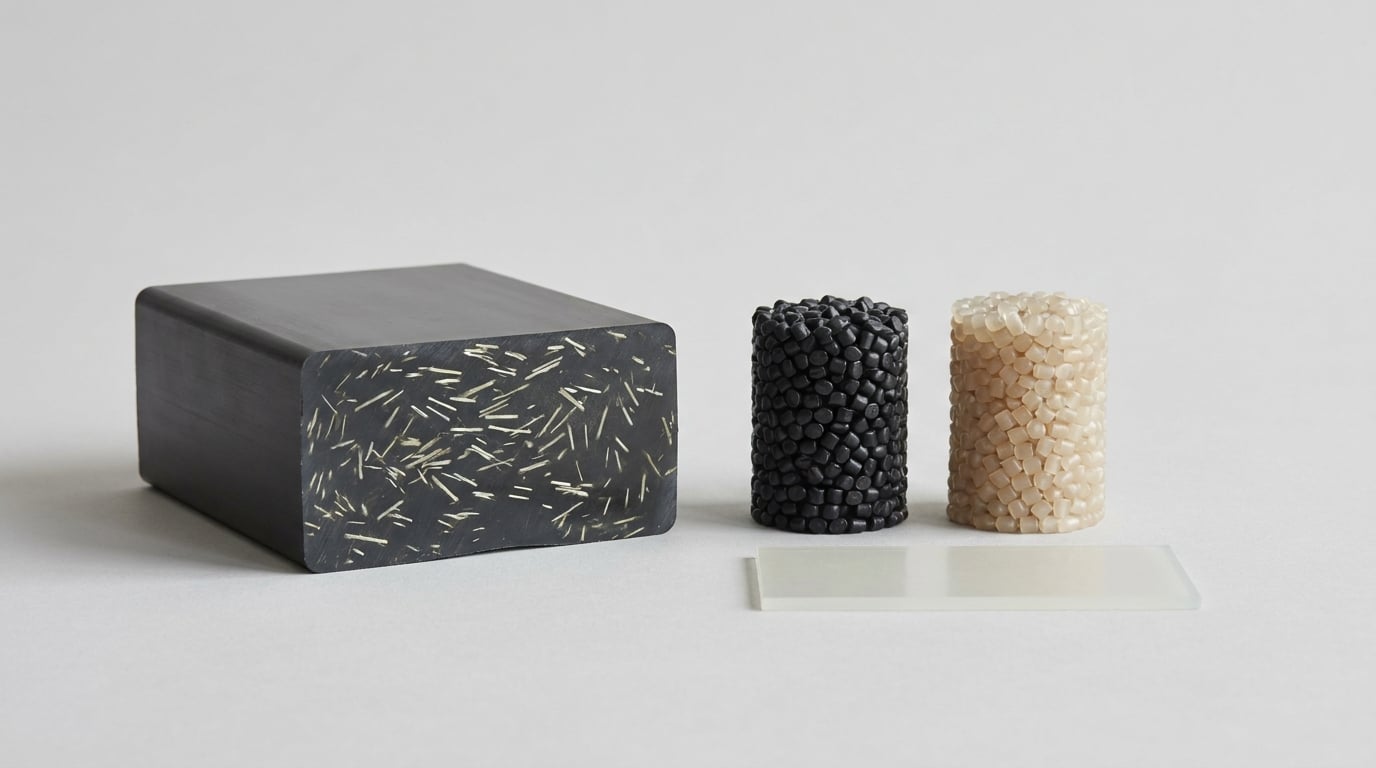
Glass filled nylon is a polyamide (PA6, PA66, PA12 or PA46) reinforced with 15% to 50% chopped glass fibre by weight, bonded to the matrix by a silane coupling agent so load transfers into the stiff fibre. That reinforcement raises flexural modulus roughly three to six times over unfilled resin and lifts heat deflection temperature from around 60-90 C into the 240-265 C band. It does almost nothing for impact toughness, and that trade is the whole story.
Below is a working guide to glass filled nylon properties: what the numbers mean for a moulded part, which grade to reach for, how the material behaves on the machine, and the situations where a different resin is the smarter call. Values are typical ranges for injection grades, so treat them as starting points to confirm against a supplier technical data sheet.
Table of Contents
- What Is Glass Filled Nylon?
- Glass Filled Nylon Properties at a Glance
- How Do the Key Properties Affect Molded Parts?
- What Are the Advantages and Disadvantages?
- When Should You Use Glass Filled Nylon?
- When Is Another Material a Better Choice?
- How Does Glass Filling Affect Injection Molding?
- How Do You Choose the Right Glass Filled Nylon Grade?
- Glass Filled Nylon vs Common Alternatives
- Frequently Asked Questions
- Is glass filled nylon stronger than unfilled nylon?
- What glass fiber percentage should I choose for an injection-molded part?
- Does glass filled nylon absorb more or less moisture than unfilled nylon?
- Does glass filling make nylon brittle?
- Can glass filled nylon be used for outdoor or continuously loaded parts?
- How much does glass filled nylon cost compared with unfilled nylon?
- Conclusion
What Is Glass Filled Nylon?
Glass filled nylon is not a separate plastic. It is an ordinary polyamide with chopped glass fibre added before it reaches the extruder, normally at 15, 20, 30, 33 or 50% by weight. Suppliers label it PA66-GF30 or PA6-GF30, where the letters after the dash are the base resin and the number is the glass percentage.
The fibre is not simply stirred into the melt. A silane-based sizing forms chemical bonds between silanol groups on the glass surface and the amine end groups of the polyamide chain, and that interface is what moves stress from the compliant matrix into the stiff fibre. Without good sizing you get a filled compound that is heavier and less stable but barely stiffer.
Fibre length matters as much as loading. Commercial injection grades use strands roughly 3-6 mm long, and shear in the barrel and the gate breaks them down to 200-500 µm by the time they reach the far wall of the part. Long-glass-fibre grades keep much longer fibres and are usually supplied as a separate compound or a long-fibre product rather than a standard injection pellet.
So the properties of any glass filled nylon are set by three things: the base resin, the glass percentage, and the geometry and fibre orientation the process produces. Change any one of them and the datasheet numbers move with it.
Glass Filled Nylon Properties at a Glance
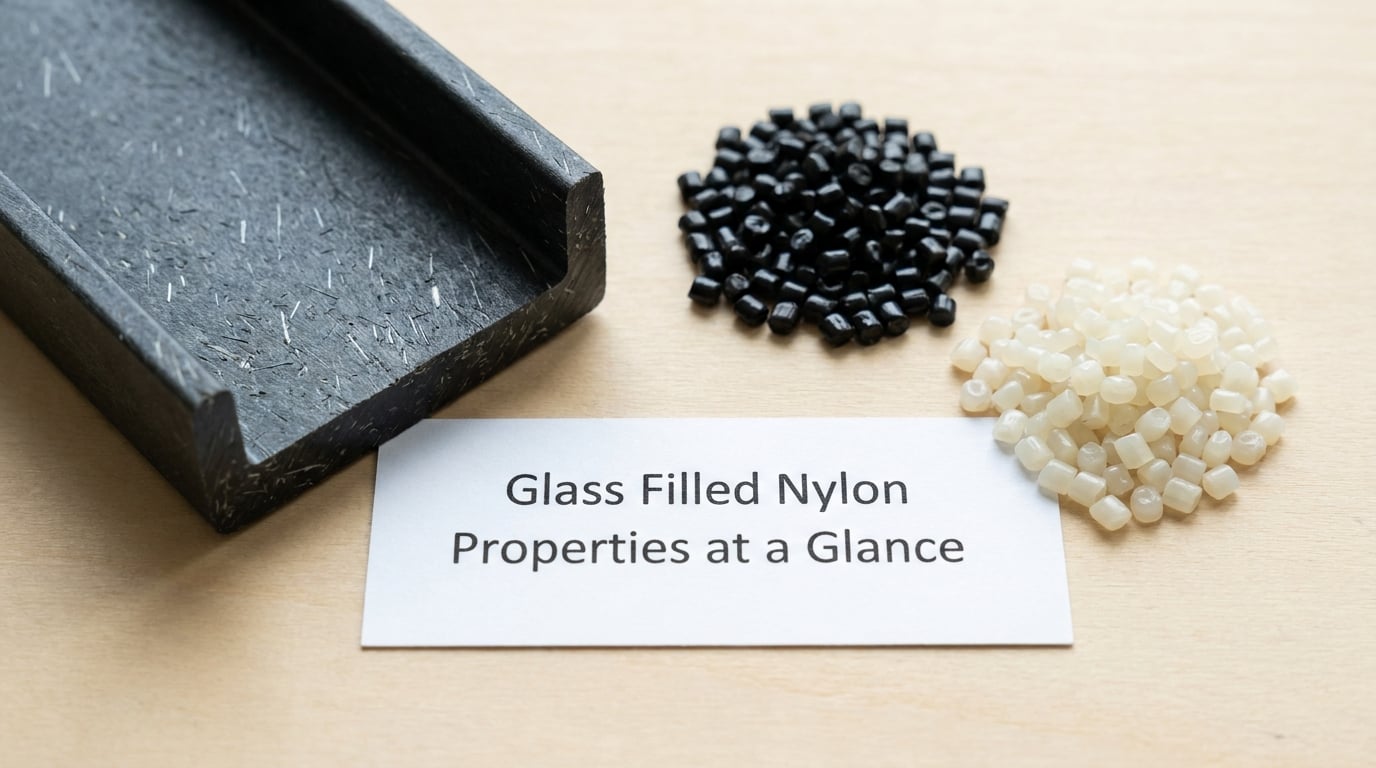
The table below puts a common unfilled polyamide next to three standard filled grades. Test methods matter when you read these figures: tensile per ASTM D638 or ISO 527, heat deflection at 1.82 MPa, moisture after 24 hours at 23 C.
| Property | PA66 unfilled | PA6-GF30 | PA66-GF30 | PA66-GF50 |
|---|---|---|---|---|
| Tensile strength (MPa) | 75-85 | 150-175 | 170-190 | 190-230 |
| Flexural modulus (GPa) | 2.8-3.5 | 8-10 | 9-12 | 13-16 |
| Elongation at break (%) | 100-300 | 2-4 | 2-4 | 1.5-3 |
| Notched impact (kJ/m2) | 3-6 | 4-7 | 4-7 | 4-7 |
| HDT at 1.82 MPa (C) | 70-90 | 210-230 | 240-260 | 250-265 |
| Moulding shrinkage, flow (%) | 0.8-1.5 | 0.2-0.4 | 0.2-0.5 | 0.2-0.4 |
| Moulding shrinkage, cross-flow (%) | 1.5-2.0 | 0.7-1.2 | 0.8-1.5 | 0.8-1.3 |
| Moisture uptake 24h/23C (%) | 2.5-3.0 | 1.4-2.0 | 1.5-2.0 | 1.1-1.5 |
| Density (g/cm3) | 1.14 | 1.36 | 1.37 | 1.50-1.55 |
| Moulded surface | Smooth, slight sheen | Matte, fine texture | Matte, fine texture | Matte, coarse texture |
| Tool wear rate | Low | Moderate | Moderate | High |
Two rows carry most of the argument. Flexural modulus and heat deflection jump by a factor of three or more, which is what makes a filled nylon competitive against die-cast metal. Elongation at break barely moves and notched impact is essentially flat, which is why a glass filled part snaps instead of bending.
How Do the Key Properties Affect Molded Parts?
Laboratory values only matter once you know which direction the load runs and how long it stays there. Here is how the main properties behave in a real component.
Glass Filled Nylon Properties That Vary by Grade
Glass content is the first variable. Moving from unfilled to GF30 delivers most of the stiffness and heat gain at modest added flow resistance. GF33 and GF50 add heat resistance and a further modulus step, but melt viscosity, brittleness, surface coarseness and abrasive wear on tooling all climb at the same time, and the property gain per unit of cost flattens past roughly 50%.
Base resin changes the rest. PA6 flows easily and moulds into complex geometry but absorbs the most water. PA66 is the general workhorse with better heat and lower uptake. PA12 absorbs very little and is the choice for humid environments or fuel and hydraulic lines. PA46 sits at the top of the temperature range and costs more. Fibre length, fibre orientation set by gate placement, sizing chemistry and any added flame retardant or impact modifier all shift the result again.
In service, that shows up as follows. Stiffness means a bracket holds its shape under load without steel ribs or a metal insert. Creep means deflection under a sustained load grows slowly rather than instantly, though stiffness still falls as the part approaches its heat deflection limit. Fatigue resistance improves in the low-to-medium stress range and then falls away, because stiff and brittle beats rubbery under small cyclic loads and loses under large ones. Thermal performance improves in deflection terms but fibre and matrix expand at different rates, so flat parts still distort. Wear against mating metal improves, but glass is not a bearing material and needs a formulated grade for sliding contact. Electrical insulation stays good, and tracking resistance can be better with certain formulations, so housings around live parts remain a natural fit.
What Are the Advantages and Disadvantages?
The advantages are real and mostly mechanical. You get three to six times the stiffness of unfilled nylon, roughly double the tensile strength, and a heat deflection temperature that moves from the neighbourhood of 70-90 C to somewhere between 200 and 265 C depending on the grade. Total shrinkage drops below 1% in most directions, moisture uptake falls by around a third because glass replaces hygroscopic polymer, cycles get shorter because less heat has to be pulled out of a stiffer, less shrinkable part, and density near 1.37 g/cm3 replaces zinc or aluminium without any machining.
The disadvantages follow the same physics. Shrinkage becomes anisotropic, typically 0.2-0.5% along flow and 0.8-1.5% across it, so parts warp and thin flat features bow. Ductility drops to a few percent elongation, so snap features, threads and sharp corners become crack starters. Weld lines carry roughly the strength of unfilled resin no matter how much glass is in the compound, and glass fibres are an abrasive that wears gates, runners and cavities, which pushes tool steel hardness upward. Surface finish is matte with visible fibre at high loadings, resin cost per kilo rises with glass content, and end-of-life recycling is harder because the glass fraction will not melt back into a usable unfilled stream.
When Should You Use Glass Filled Nylon?
Glass filled nylon earns its place when a part needs stiffness and heat resistance, is injection moulded in volume, and does not depend on ductility. The recurring applications all fit that description.
- Automotive under-hood brackets and intake manifolds — stiffness at 100 C and above rules out unfilled PA, and the low density cuts fastener load and fuel bill compared with die-cast metal.
- Electrical connector housings and terminal blocks — dimensional stability across a wide humidity range plus the ability to carry UL 94 V-0 grades and tracking-resistance formulations.
- Switchgear and circuit-breaker bodies — a part that is larger and more complex, run hotter, and needs good arc and tracking performance in an insulating material.
- Power tool and appliance housings — thin-wall shapes flow well at GF15 to GF20, and the matte texture hides the fibre that a gloss finish would reveal.
- Pump and valve bodies and industrial covers — resistance to steady chemical exposure plus a stiffness that holds flange alignment without a metal insert.
- SLS-printed prototypes and end-use parts — glass-filled PA12 powder gives the same stiffness and heat gains in a low-volume process with no mould tooling.
When Is Another Material a Better Choice?
Several cases call for a different answer, and they come up often.
Unfilled nylon is better when impact, snap-fit behaviour or a deep-drawn thin wall is the design driver, or when cosmetic surface finish drives the part. Carbon-filled nylon (PA-CF30) is stiffer, lighter and lower-shrinking than glass, and it suits stiffening ribs, high-end frames and applications where modulus per unit of volume matters, but it costs more, moulds less forgivingly and shows more surface fibre. Long-glass-fibre grades beat short fibre on creep, impact and repeated mechanical loading and are the choice for large structural panels and safety-relevant supports, at the cost of more expensive processing and harder to recycle material.
Beyond the nylon family, a representative engineering thermoplastic such as POM is harder, more wear resistant and dimensionally stable, and it remains the better answer for low-friction gear wheels and precision mechanisms. PPS, PBT or a thermoset handle sustained high temperatures and harsh chemical exposure. If you need a cosmetic, transparent, high-gloss part, glass filled nylon is the wrong material on appearance grounds alone, whatever it does mechanically.
How Does Glass Filling Affect Injection Molding?
Glass changes the machine, not just the material. Drying is the same requirement as any polyamide: PA6 and PA66 usually need several hours at around 80 C with dry air and a low dew point to get moisture well under 0.2%, and moisture in a filled compound shows up as splay and brittle streaks rather than the silver streaks of unfilled resin. PA12-GF is markedly less demanding.
Melt temperature typically runs in the 270-300 C region depending on resin, with mould temperatures around 60-100 C, and the useful window is narrower than for unfilled nylon. Higher injection and holding pressure are needed to pack the fibre-loaded melt and control shrinkage, and holding time matters more than usual because the pack has to fight fibre-reinforced stiffness. Longer cooling is sometimes needed, though stiffer parts often need less time overall, which is where the shorter cycle claim comes from.
Gate and runner layout deserves real attention, because fibre orientation follows flow. Place the gate so that the fibre ends up where the load is, not across it, and expect anisotropic shrinkage, flash at the gate from the stiffer melt, and warpage on large flat parts. Run a mould flow simulation before cutting steel; it will show weld-line locations, which are the weak feature in any glass filled nylon part. Tooling should be hardened steel such as H13 at 48-52 HRC rather than pre-hardened mould steel, or the fibres will polish and erode the cavity. Finally, state the conditioning state for any dimensioned feature, because nylon parts move with humidity long after they leave the tool.
How Do You Choose the Right Glass Filled Nylon Grade?
A workable selection runs in this order. Start with the load and define whether it is a static structural load, a snap or shock event, or a continuously held clamp. Then fix the service temperature and the worst-case humidity, and remember that HDT is a deflection limit at 1.82 MPa, not a melting point or a continuous-use rating. Next set the creep requirement, which is where short-glass grades and long-fibre grades separate. After that, check the geometry: welds, thin sections and sharp corners dictate the glass percentage more than the load often does.
The commercial side is just as important. Confirm the flame rating, any UL or automotive listing, the colour and UV stabiliser package, the melt flow index suited to your wall thickness, and the cycle time you are promising. Then ask the supplier for a named grade and a technical data sheet rather than a generic label, because the same designation can differ in heat stabilisation, impact modification and approvals between suppliers. Specify the conditioning state for inspected dimensions, and require lot traceability and a certificate of analysis.
Finally, compare cost per finished part at your volume rather than resin price per kilo. Glass filled nylon is never the cheapest resin, but the moulding cycle, the weight saving and the elimination of machining often win that argument back against metal.
Glass Filled Nylon vs Common Alternatives
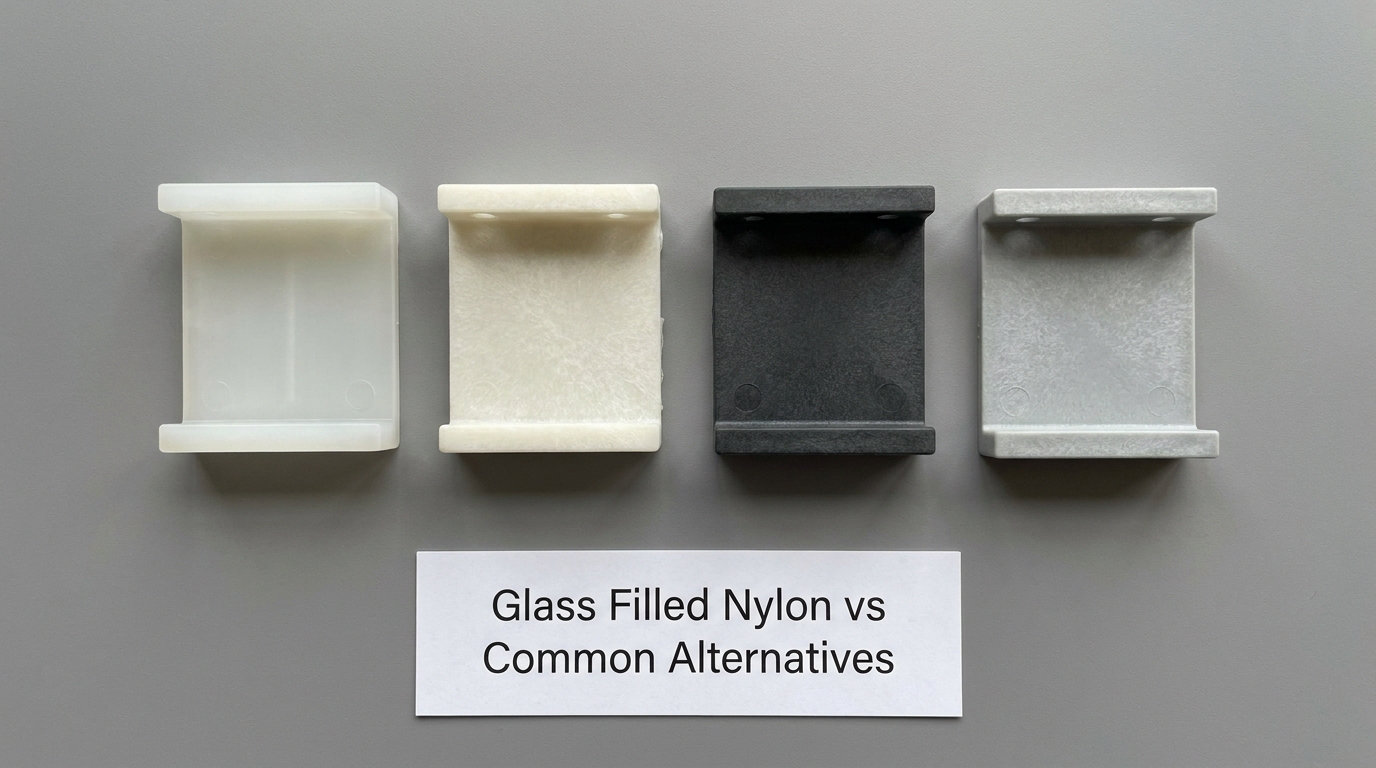
| Criterion | Unfilled PA66 | PA66-GF30 | PA-CF30 | Long-glass PA | POM |
|---|---|---|---|---|---|
| Flexural modulus (GPa) | 2.8-3.5 | 9-12 | 20-23 | 15-19 | 7-9 |
| HDT at 1.82 MPa (C) | 70-90 | 240-260 | 230-250 | 200-240 | 110-120 |
| Ductility | High | Low | Low | Moderate | Moderate |
| Moisture uptake | High | Moderate | Low-moderate | Moderate | Very low |
| Weld-line sensitivity | Low | High | High | High | Low |
| Tool wear | Low | Moderate | High | Moderate | Low |
| Processing ease | Easy | Moderate | Difficult | Difficult | Easy |
| Best for | Impact and thin walls | Structural housings, brackets | Stiff frames, ribbed parts | Creep-heavy structural parts | Gears, bushings, precision |
Read the last row as the summary. Glass filled nylon is the default answer for structural mouldings, while each neighbouring material wins a specific argument: unfilled for impact, carbon for maximum stiffness per unit of weight, long fibre for sustained loading, and acetal for sliding wear and tight tolerance.
Frequently Asked Questions
Is glass filled nylon stronger than unfilled nylon?
In tension and bending, yes, and by a wide margin. A typical PA66-GF30 runs 170-190 MPa tensile with a flexural modulus of 9-12 GPa, against roughly 75-85 MPa and 3 GPa unfilled. Impact tells the opposite story: notched values change little and elongation at break falls to a few percent, so glass filling is never a strength upgrade for a snapping or shock-loaded feature.
What glass fiber percentage should I choose for an injection-molded part?
GF30 is the sensible starting point for general structural work. GF15 and GF20 come in when thin walls, long flow paths or a cosmetic surface matter more than stiffness, while GF33 and GF50 target higher heat and load. Pick the lowest loading that meets your stiffness requirement, then confirm it in a mould flow simulation rather than adding glass for its own sake.
Does glass filled nylon absorb more or less moisture than unfilled nylon?
Less, because glass displaces hygroscopic polymer. A typical PA66 loses roughly a third of its uptake, from about 2.5-3.0% down to 1.5-2.0% at 24 hours and 23 C, and filled PA12 sits lower again. Absorption is still enough to move dimensions, so state the conditioning state for any critical fit or inspection limit.
Does glass filling make nylon brittle?
In the ductile sense, yes. Glass fibre is stiff and brittle, so a filled part fractures rather than bending, and elongation at break falls from well over 100% to a few percent. Sharp corners, thin sections and notches act as crack starters. Radius snap features generously, place gates to control fibre orientation, and use an impact-modified grade when the load is shock-like.
Can glass filled nylon be used for outdoor or continuously loaded parts?
For outdoor parts it works well, since glass limits moisture-driven growth and the matte surface hides weathering, though UV stabilisers are still needed for long colour life. For continuously loaded parts, check creep at the actual design temperature rather than trusting tensile figures. Stiffness holds better than unfilled nylon, but it still falls as service temperature approaches the heat deflection limit.
How much does glass filled nylon cost compared with unfilled nylon?
Resin cost per kilogram rises with glass loading, and high-loading PA12 grades sit above PA6-GF, so unfilled nylon wins on resin cost alone. The finished part often tells the opposite story. Against a die-cast zinc or aluminium component, a filled grade brings lower density, no machining and shorter cycles, so compare cost per finished part at your volume, not price per kilo.
Conclusion
Glass filled nylon is the right engineering choice when a moulded part has to stay stiff and dimensionally stable at a temperature unfilled nylon cannot survive, and when nothing in the design depends on ductility. It is the wrong choice for snap features, high-humidity precision fits, cosmetic surfaces and sustained service above roughly 250 C.
Start by writing down the load, the environment, the geometry and the constraints on the moulding machine. From there, pick a base resin, a glass loading, and a named supplier grade, then verify it on real parts in the conditioning state your customer will inspect.