

A corrective action report is the written record that proves a nonconformity was understood, contained, fixed at its source and stayed fixed. Knowing how to write a corrective action report matters because auditors do not judge your shop floor on intentions, they judge it on documented evidence, and most failed audits trace back to a report that jumped from the symptom straight to a retrained operator.
The good news is that the format is not complicated. What separates a report that passes from one that gets a finding is discipline: describe the problem in measurable terms, contain it before you investigate it, find the cause that explains why it happened and why nobody caught it, then assign owned actions with dates and proof.
For a plant team, the whole job usually takes two to six weeks depending on the severity. A minor in-process deviation with a known cause can be closed in days. A customer escape or a safety-related nonconformity gets a full investigation with cross-functional input and a formal effectiveness review.
Table of Contents
- What You Need Before You Start the Report
- Step-by-Step: How to Write a Corrective Action Report
- Common Mistakes in Corrective Action Reports
- Frequently Asked Questions
- What is the format of a corrective action report?
- Can you give me an example of a corrective action?
- What are the five steps of a corrective action?
- How do you verify corrective action effectiveness?
- What is the difference between a nonconformance report and a corrective action report?
- When should you use 8D instead of a simple action plan?
- Conclusion
What You Need Before You Start the Report
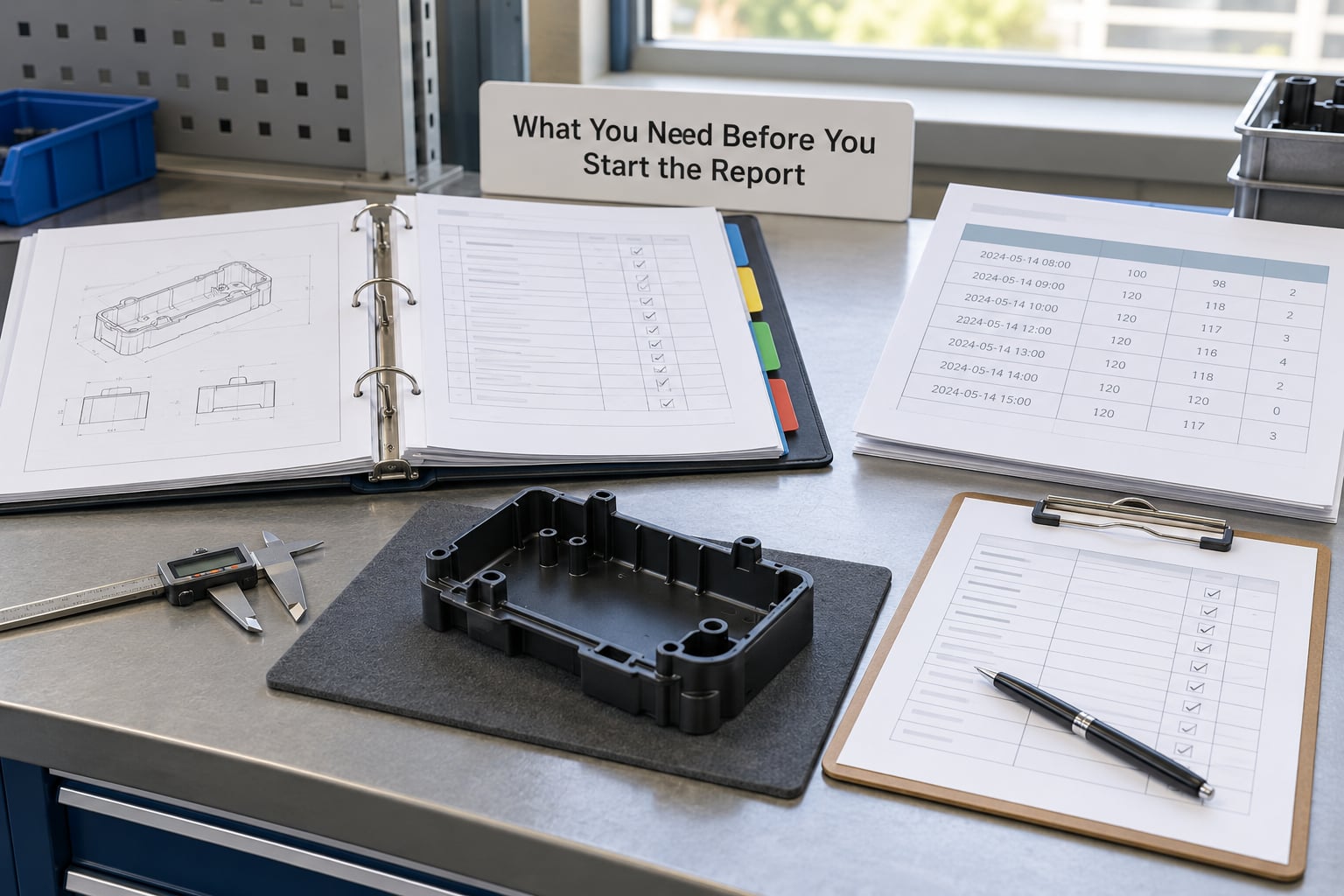
Assemble the paperwork first. Writing a corrective action report from memory is how companies end up with vague descriptions that no auditor can follow, so gather the source records before you open a blank form.
You need the nonconformance record or the event that triggered the report, which might be an internal audit finding, a customer complaint, an incoming inspection rejection, a process deviation or a field return. Along with that, pull the production and inspection records for the affected part or process, including quantities, batch or traceability data, inspection results and any SPC or capability charts covering the period.
Next, build a timeline. Note when the problem was first produced, when it was detected, and the gap between the two. That gap is the escape point, and it is usually where the most useful corrective action lives.
Then collect the human side of the input: who reported the issue, who worked the process, who owns the affected equipment or supplier, and who has the authority to change a work instruction or control parameter. A team without that authority cannot finish the job.
Finally, be clear about what verification will look like before you start. Decide what evidence will prove the fix worked and how much production volume you will need before judging it. ISO 9001:2015 clause 10.2 is explicit that you must retain documented evidence of the effectiveness of your corrective actions, so the criteria belong in the plan, not invented at the end.
Step-by-Step: How to Write a Corrective Action Report
1. Define the problem and its impact
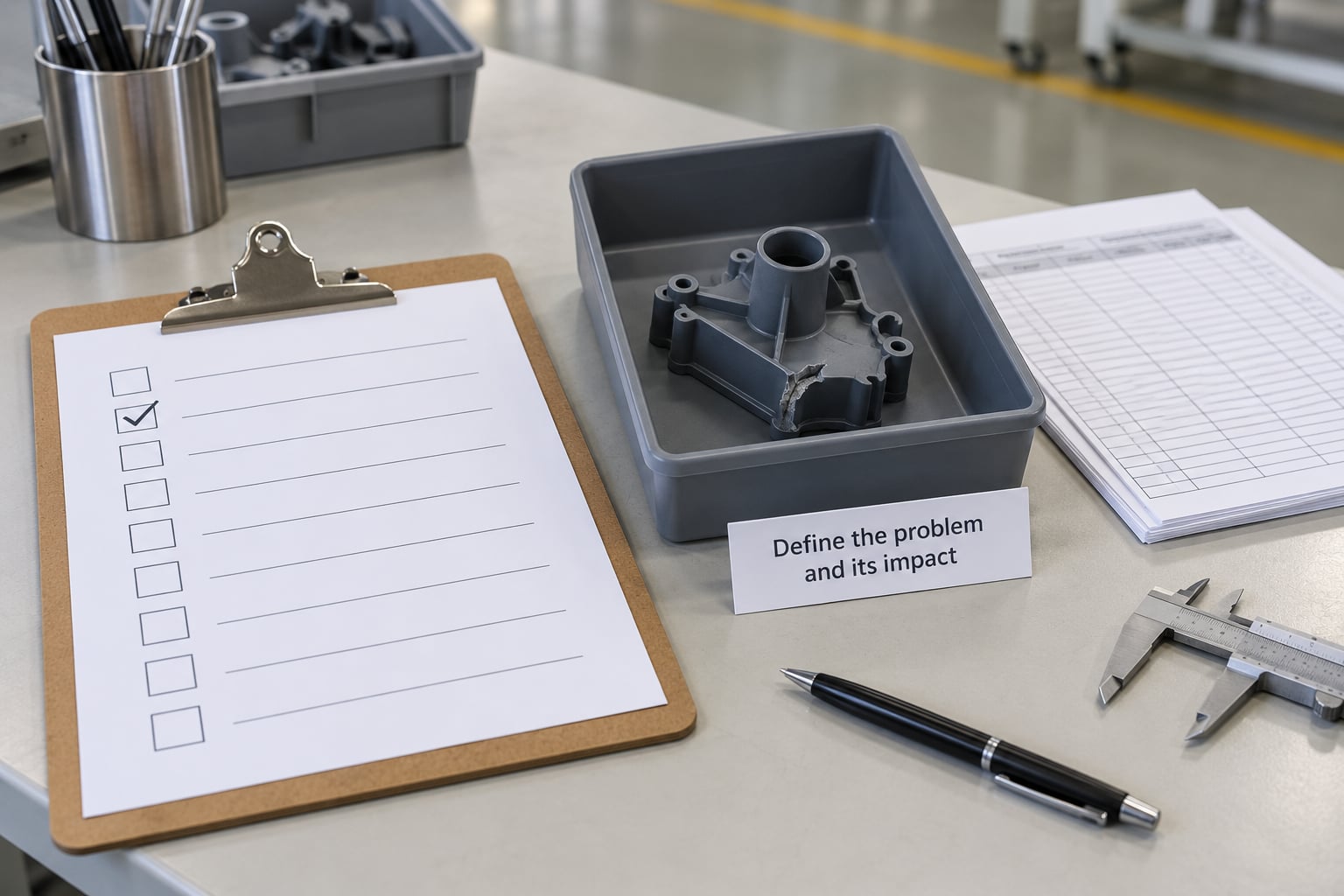
Write the problem statement as a fact, not a theory. Something like: “Between 14 and 27 August, 340 of 1,200 housings produced on Line 3 exceeded the 0.15 mm wall thickness limit at the rib, measured at 12 stations per part.” That sentence names the process, the window, the quantity and the measurement. Avoid assigning blame or assuming the root cause in this section, because the moment you name a cause the investigation stops looking.
Separate what is known from what is suspected. Describe the observed defect, the discovery point and the measured magnitude first. Then, in a separate line labelled as the suspected cause, record your current theory so reviewers can see it was a hypothesis and not a conclusion.
Run an Is / Is Not analysis next. State what the affected parts have in common and, just as importantly, what unaffected parts in the same window do not share. Material lot, shift, tool, operator and machine differences are the usual discriminators, and the answer often points you straight at the cause before you start asking why.
Quantify the impact where the data allows it: scrap, rework hours, replacement parts, freight, customer downtime or the number of units already shipped. If the product has left your building, say so plainly, because that changes the containment response in the next section.
2. Contain the issue and protect the customer
Containment comes before investigation, always. Your job here is to stop more defective product from reaching a customer while you work out why it happened.
Record what you physically did and when: sorted or quarantined on-hand inventory, held the work in process, placed a 100 percent inspection at the escape point, reworked or scrapped the affected units, and stopped or re-centred the equipment. Give each action an owner and a time stamp, because containment that cannot be reconstructed looks like an empty claim during an audit.
List the exposed scope. Which lots, which purchase orders, which shipments, which dates? Most plants underestimate this step and then have to reopen a closed report later. If product already shipped, state the customer, the quantity and the date, and log the notification you made.
Assign the risk level. A cosmetic defect caught before shipping, a dimensional defect that reached a customer and a safety-related nonconformity do not get the same response, and the escalation path should be written into your procedure. Quality professionals on industry forums consistently describe the same failure: low-risk issues that quietly accumulate until they trigger a formal investigation they were never sized for.
Finally, add the interim controls that stay in place while the investigation runs, and set a review date for them. Interim containment without an expiry date tends to become permanent, and the temporary extra inspection quietly turns into the new normal.
3. Investigate the root cause
Work from evidence, not from opinion. The strongest reports separate the occurrence cause, the reason the defect was produced, from the escape cause, the reason existing controls did not catch it. Fixing only the occurrence cause leaves you exposed the next time a different defect travels the same undetected path.
Pick the method that fits the problem. Five Whys works well for straightforward, repeatable problems where the chain of reasoning is short. A fishbone or Ishikawa diagram is better when several categories contribute, such as people, method, machine, material, measurement and environment. Pareto analysis of recent defect data tells you where to look first. Process capability numbers, an SPC chart or a comparative analysis against good units handle the cases where your instinct and the data disagree.
Talk to the people closest to the work. Operators, inspectors and line technicians usually hold the practical knowledge that explains why a defect appeared, and quality leads on the forum side repeatedly note that excluding them is the fastest way to reach a conclusion that sounds right on paper and fails on the floor.
Verify the cause before you accept it. Ask whether the identified condition, left alone, would reliably produce the defect you observed. If it would not, keep digging. Then ask the second question auditors ask: why was this not detected earlier, given the controls you had? That second answer is what turns a repair into a real corrective action.
Attach the analysis artifacts to the report. The fishbone diagram, the Whys table, the data extract. An unsupported statement of root cause is an opinion, and opinions do not survive an audit.
4. Define corrective actions and responsibilities
Each corrective action must do one job: remove the cause you confirmed. If an action does not trace back to a specific cause, it belongs in the containment section, not here.
Give every action a single accountable owner, not a department. Shared ownership is how deadlines slip quietly. Name the person, the deliverable, the due date and the resources they need, such as engineering time, a fixture modification or budget for a supplier visit.
Make the completion criteria measurable. “Update the work instruction” is weak. “Update WI-MOLD-114 to include the rib thickness check at the third station, train all three shifts, and confirm signoff by 15 November” tells a reviewer exactly when the action is done.
Think about side effects before you commit. New inspection steps slow the line, revised parameters shift other characteristics, and supplier changes land on someone else’s incoming inspection. Flag those effects in the report so the trade-off is a documented decision rather than a surprise.
5. Implement the actions and document results
As each action lands, attach the evidence: revised work instructions with revision numbers, new control parameters in the setup sheet, training records with names and dates, equipment or tooling changes, and supplier correspondence or a supplier corrective action request where the cause sits outside your building.
Update the process documents that carry the failure. If the control plan, PFMEA or inspection frequency did not catch this defect, a change to those documents belongs in the action list. Otherwise the same escape point stays open for the next problem to walk through.
Record what you checked during the first weeks of running the change, and what you found. If a plan adjustment brought flash or cycle time problems, say that here and show how you resolved it. Containment actions need checking too, since a 100 percent sort can introduce mix-ups or handling damage of its own.
One warning: completed activities prove work was done, not that the problem is fixed. Training delivered, instructions reissued and a fixture modified are all inputs. None of them is evidence of effectiveness, and treating them that way is the single most common reason corrective action reports get reopened.
6. Verify effectiveness and close the report
Verify against the criteria you set in Step 1, not against a feeling. Ask how much production has run since the change, how many parts were checked against the original defect definition, and whether any recurrence appeared.
Check volume. Zero defects in two days of production on a high-volume line proves very little, and reviewers spot that instantly. Look at enough output to make the result meaningful, and state the sample size in the report.
Look wider than the original defect. Verify the change has not simply moved the problem to a neighbouring characteristic, a different shift or the next process in the line, and check related processes that share the same risk.
Document remaining risk honestly. Where effectiveness is partial, say what monitoring will continue and for how long. Then obtain the signoff from quality or management, record the lessons learned, update the corrective action register and close the report with a formal approval date.
Common Mistakes in Corrective Action Reports
Vague problem statements. “Quality issues on the housing” tells a reviewer nothing. Add the part, the characteristic, the measured limit, the dates and the quantity, and the rest of the report becomes possible.
Stopping at correction. Re-sorting the inventory fixes the parts in front of you, not the process that produced them. Separate correction from corrective action on the form so nobody confuses the two, since ISO 9001 treats eliminating the cause as the requirement.
Unsupported root causes. “Operator error” is a conclusion without a cause, and it usually hides a control problem further upstream. Push past the human label to the condition that made the error likely or the check that should have caught it.
Blaming individuals. Naming and shaming produces defensive answers in interviews and no lasting process change. Describe roles and system conditions instead, which is both more accurate and more defensible in front of an auditor.
Actions that do not match the cause. Retraining after a machine setpoint drifted is a mismatch. Trace each action to a confirmed cause and reject the ones that cannot be linked.
No attached evidence. A report full of conclusions and zero attachments reads as a claim. Attach the data, the diagrams, the photos, the training records and the inspection results as you go.
Premature closure. Closing the moment the action is implemented is the fastest route to a repeat. Hold the report open through the verification period and set a scheduled review date before you start.
Ignoring the backlog. Quality teams report open corrective actions lingering for years because nobody owns the review. Work a fixed monthly review of aged items, and escalate the ones where the owner has changed roles or the evidence was never collected.
Frequently Asked Questions
What is the format of a corrective action report?
A corrective action report has seven core blocks: identification data such as report number, date, process and product; a factual problem statement with quantity and measurement; immediate containment actions; the root cause analysis with its supporting evidence; the corrective actions with owners and due dates; the implementation and training evidence; and the effectiveness verification with an approval signature. Most formats follow this order because auditors read it in that order.
Can you give me an example of a corrective action?
A moulded housing exceeded the rib wall thickness limit on Line 3 in August. Containment meant holding on-hand stock, adding inspection at final test and contacting the customer about two shipped lots. Root cause analysis found a cooling-time parameter on the mould that had been edited during a maintenance call and never restored. The corrective action reinstated the parameter, locked the setup sheet with a revision and trained all shifts. Effectiveness was confirmed over three weeks of production.
What are the five steps of a corrective action?
Most quality systems condense the method into five steps: identify the problem and document the nonconformity, contain it so no more defective product reaches the customer, determine the root cause, implement the action that removes that cause, and review the results to verify effectiveness. Some frameworks split the first stage into identifying and defining the problem, which gives six steps instead of five. Either version satisfies ISO 9001:2015 clause 10.2.
How do you verify corrective action effectiveness?
Set the criteria before you implement, then review enough production data to make them meaningful. Record the number of parts inspected since the change, the measurement used, and whether any recurrence of the original defect appeared. Check adjacent characteristics and the next process to confirm the fix did not simply move the problem. Keep the report open through that review period and attach the data as evidence.
What is the difference between a nonconformance report and a corrective action report?
A nonconformance report records that product or a process did not meet a requirement. A corrective action report goes further: it investigates why, changes the process so the cause cannot recur, and proves the change worked. A large share of plants run on nonconformance reports alone, which works for low-risk issues. The trigger to escalate is risk level or recurrence of the same nonconformance.
When should you use 8D instead of a simple action plan?
Use 8D when the issue escaped to a customer, involves a safety or regulatory requirement, spans departments or suppliers, or keeps recurring despite earlier corrections. A single-cause problem with a limited scope is better handled with a short action plan, because a full 8D on a trivial issue wastes the team’s time. In practice, automotive supply chains expect 8D for customer escapes with a full report typically completed within 30 days.
Conclusion
A workable corrective action report does four things and nothing else: it states the nonconformance as measured fact, contains the immediate risk to the customer, identifies a root cause supported by evidence, and assigns actions with owners, dates and proof of effectiveness. Everything else in the format exists to support those four things.
Start with the nonconformance record and the affected production data, not a blank form. Contain what is still in your control, then investigate with the people who do the work before you commit to a cause. If you follow that order, the report writes itself and the verification step becomes a matter of showing data rather of making an argument.