

A kanban system in manufacturing is a visual, pull-based way of controlling production, developed at Toyota, where cards or empty containers act as permission to make or move material. Nothing gets produced or shipped upstream until the next process actually uses it up, so the shop floor runs on real consumption instead of a forecast. In practice it means less work in process, smaller buffers and shorter lead times, provided demand is reasonably steady and changeovers are quick.
Most people meet the word through software boards first, and those boards have almost nothing to do with the factory version. What follows is the factory version: what the signals are, how many you need, how to work out that number, and where it goes wrong.
Table of Contents
- What is a kanban system in manufacturing?
- How a pull signal travels upstream on the shop floor
- What are the six rules of kanban?
- What types of kanban are there in manufacturing?
- What should be printed on a kanban card?
- How to calculate how many kanbans you need
- Kanban vs MRP vs CONWIP: which one fits your plant?
- What a kanban system delivers in manufacturing
- Why kanban fails on the shop floor
- How to implement a kanban system in manufacturing, step by step
- What metrics to track after go-live
- Is manufacturing kanban the same as software kanban?
- Frequently Asked Questions
- Conclusion
What is a kanban system in manufacturing?
The name is Japanese: kan means visual or sign, and ban means card or board. Toyota’s Taiichi Ohno developed the method over roughly fifteen years, drawing on the idea of a grocery supermarket where shelves are refilled only when an item is picked. He called the point-of-use storage point the supermarket, and the loop of signal-and-replenishment became the backbone of the Toyota Production System.
The glossary is short and worth getting right before the rest of this article:
- Pull system — a downstream process triggers upstream work instead of a planner pushing a schedule at it.
- Just-in-time (JIT) — producing and moving only what is needed, when it is needed, in the quantity needed.
- Work-in-progress (WIP) — material that has been started but not finished. Kanban caps it by design.
- Two-bin system — two containers of the same part; emptying the first one is the signal to refill it.
- CONWIP — constant work in progress, a signal-and-card system with a fixed cap on total jobs rather than per-part cards.
- Container — a standard quantity in a standard pack size, so replenishment is a repeatable trip rather than a judgement call.
The single idea to hold on to is that kanban is an authorisation mechanism. A card is not a request, it is the go-ahead, and the number of cards in circulation is a hard ceiling on how much material can exist between two steps.
How a pull signal travels upstream on the shop floor
Under MRP, the plan pushes work downstream. A central planner runs an explosion of demand, schedules a quantity, and the floor either keeps up or quietly builds a queue in front of the constraint. Signal batches and dates; that is the weakness of push.
Kanban inverts it. A downstream station takes what it needs. The empty container, or the card attached to it, travels back to the point where the material was produced or stored, and that empty signal is the authorisation to refill. The upstream step never makes more than the system allows, and it never makes it earlier than the signal demands.
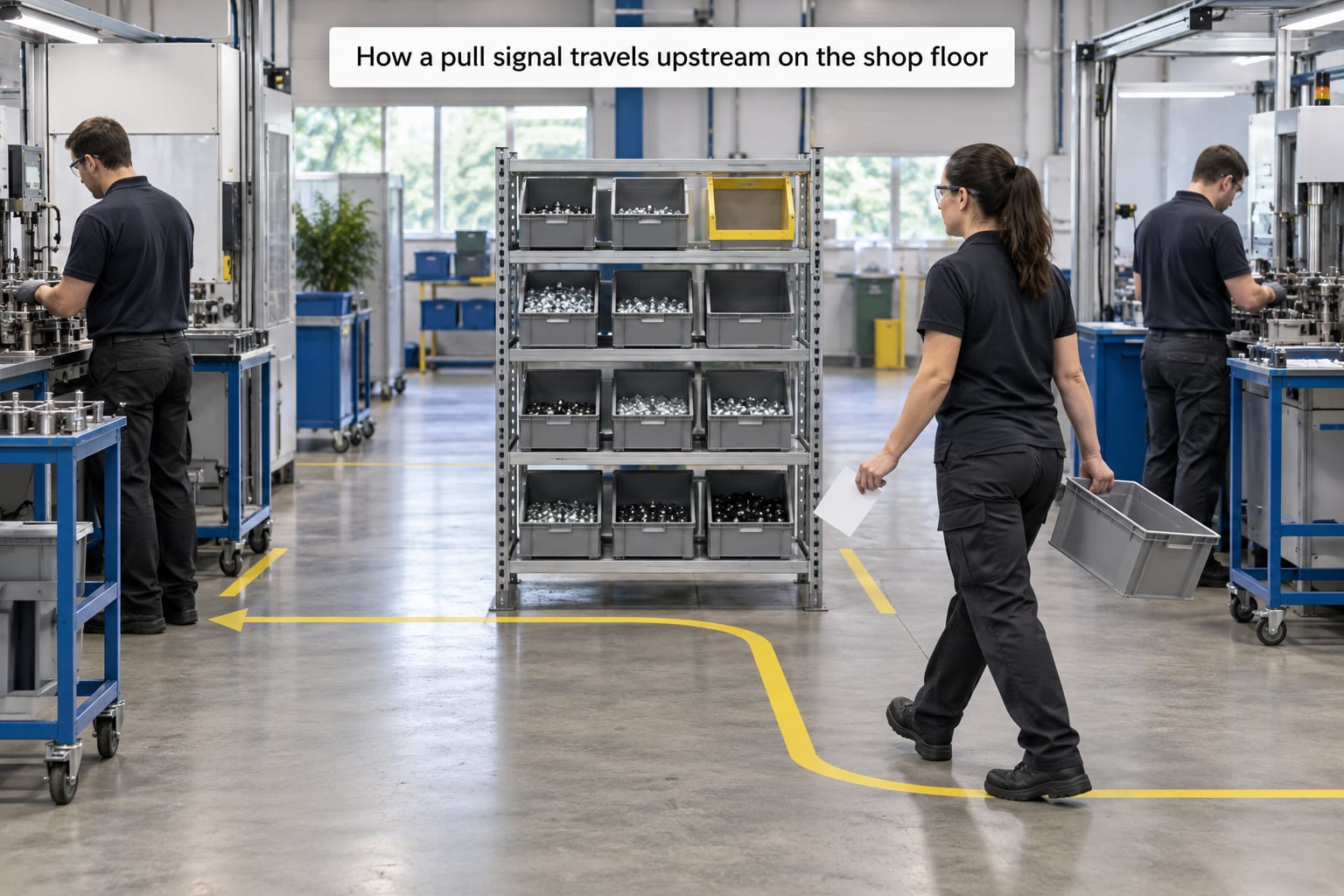
On a real floor the loop runs roughly like this:
- A parts bin at the assembly cell holds a full container.
- The operator consumes parts and empties the container.
- The empty container goes back to the supermarket rack, or the card is scanned and sent to the stores terminal.
- The stores clerk or upstream process sees the signal and prepares exactly one container’s worth.
- The filled container returns to the point of use, and the card comes back with it or is logged as returned.
One wrinkle worth naming: older descriptions draw the card going from the downstream station all the way back to the producing process. Plenty of plants today send the signal straight to the warehouse and let a route plan decide the sequence, which is faster and easier to audit. The control logic is identical.
Why the loop beats a schedule
Because the signal carries quantity and timing at once, error correcting happens every cycle. A jam downstream shows up as cards accumulating upstream within hours, not as a missed date three weeks later. That visibility is the real payoff, and it is why kanban is treated as a diagnostic tool before it is treated as an inventory method.
What are the six rules of kanban?
These come from Ohno and are the standard checklist. If a plant cannot meet them, it has a stability problem, not a kanban problem.
- Do not send more than the agreed quantity. Pull only what the downstream process needs, in the standard container.
- Work in small, defined quantities. Containers are counted, repeatable and usually tagged with the part and location.
- Start where it is needed. Begin with one station, one material and one route, then expand.
- Use signals at every level. Downstream, supermarket, producing process and purchasing all pull on the same signal, including the supplier.
- Never send defective material downstream. Quality failures stop the loop and leave nothing in the buffer to hide behind.
- Reduce quantities gradually. Tighten one step at a time, only when the loop has been stable long enough to trust it.
Rule six is the one most plants break first. The temptation to tighten immediately is strong because the visible inventory looks wasteful, and cutting buffer too fast is how a pilot turns into a stockout crisis.
What types of kanban are there in manufacturing?
There are two ways to answer this: the kinds of signal card, and the kinds of system you can build from them.
Kanban card types
| Card type | Who moves it | What it authorises |
|---|---|---|
| Production kanban (withdrawal) | Downstream station back to the producing step | Produce one container of that part, or withdraw one from the supermarket |
| Conveyance kanban | The worker who carries the material | Move one filled container from supermarket to point of use |
| Transportation kanban | Between supplier and plant | Deliver one container on the agreed route and cadence |
| External or supplier kanban | Supplier, often triggered by EDI or a scan | Produce and ship against the plant’s consumption, usually held on consignment |
In most plants the withdrawal and conveyance cards are combined into one. Four separate card types is a description of the classic model, not a requirement.
Forms the system takes
- Card-only kanban — paper cards in a card holder or card pocket. Cheap, visible, and the easiest place to start.
- Two-bin and three-bin — physical containers where the empty bin is the signal. Three-bin adds an overflow bin for demand spikes.
- Line-side supermarkets — a stocked rack fed by a route, where replenishment distance drives route design.
- Electronic kanban — barcode or RFID scans trigger a replenishment task in an MES, ERP or warehouse system. Same logic, real-time visibility, fewer trips on the floor.
- CONWIP — a fixed number of jobs allowed in the system regardless of part. Best where mix is high and part-level cards would be unmanageable.
What should be printed on a kanban card?
A card is small, so every field earns its place. A workable layout carries these fields:
- Part number and description — the number that matches the bill of material, plus a short text so nobody has to look it up.
- Point-of-use location — machine, line or cell code. This is what makes routing and distance measurable.
- Supply location — where the full container comes from: supermarket rack, machine, press or external supplier.
- Container quantity — how many pieces one container holds. Ambiguity here is the most common cause of drift.
- Card number of total — for example “3 of 5”, so operators can see the intended set size at a glance and spot a missing card.
- Replenishment route or frequency — how often and by what path material should arrive.
- Supplier or vendor code where the part is externally replenished.
Colour coding by family or by route speed helps on a mixed floor. Keep the card inside a clear pouch so it survives handling and grease, and laminate the ones on high-traffic routes.
How to calculate how many kanbans you need
The calculation sets the buffer size. It is a division, and the divisor is the container quantity you have chosen to standardise.
Number of kanbans = (Daily usage x (Replenishment lead time + Safety time)) / Container quantity
Here is how each piece is derived:
- Daily usage — average consumption at that point of use. Take real issue data over four to eight weeks and exclude known one-offs like a shutdown or a trial run.
- Replenishment lead time — the time from the empty container or card being released to the full container arriving at the point of use. Include waiting, transport, refilling and any approval.
- Safety time — a buffer for variability, often a percentage of lead time. Demand swings and occasional machine trouble justify more; a stable, high-frequency route justifies very little.
- Container quantity — the standardised pack size. Pick a size a worker can handle safely and refill without a machine.
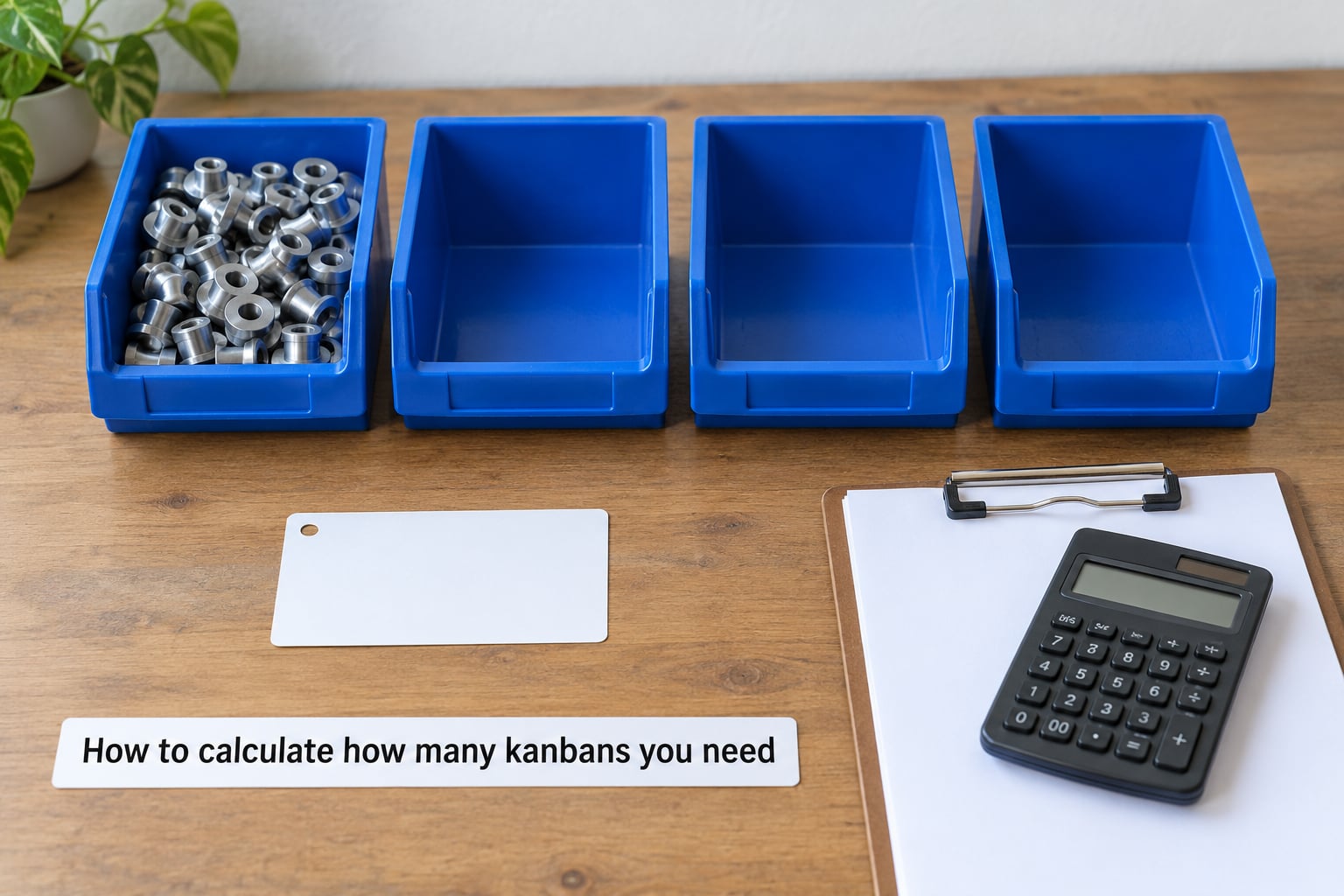
Worked example. A machined bracket is consumed at 120 pieces a day on one assembly cell. The store can refill and route the material in half a day, and the planner adds a safety margin of 10 percent of lead time. The standard container holds 30 pieces.
- Lead time: 0.5 day. Safety time: 0.5 x 0.10 = 0.05 day.
- Total cover: 120 x (0.5 + 0.05) = 120 x 0.55 = 66 pieces.
- Kanbans: 66 / 30 = 2.2, rounded up to 3 kanbans.
Three containers in circulation means at most 90 pieces can exist between the store and that cell, about three quarters of a day of cover. If the route actually takes four hours instead of 12, lead time halves, the calculation drops to 2 cards, and the loop now carries less material for the same protection.
How to measure lead time in kanban
Stamp the release and the arrival, log both, and average over at least a month. Then look at the spread rather than just the average. A route with a 4-hour average and a 3-day tail needs a bigger safety margin than one that reliably takes 6 hours, and that tail is usually a queue rather than a travel time. Walk the route yourself before you trust the number.
Keep the spreadsheet that holds this calculation. Re-run it monthly against actual consumption and lead time, and treat every change as a deliberate decision rather than a quiet edit.
Kanban vs MRP vs CONWIP: which one fits your plant?
| System | Best for | Strength | Weakness |
|---|---|---|---|
| Kanban | Repetitive part families, stable demand, low to moderate mix | Simple, visual, fast to run, self-correcting | Card counts drift; weak fit for engineering change and high variability |
| MRP | High mix, engineering-to-order, long lead-time purchased items | Plans to the BOM and order dates for complex assemblies | Batch and quantity slop propagate downstream; queues hide capacity problems |
| CONWIP | High mix, low volume, job-shop style flows | One global cap on jobs, no part-level card administration | Requires accurate routing and cycle time data; needs a system that can enforce the cap |
| Push-pull boundary | Plants with a mix of both | Pull the fast, repeatable families; plan the volatile ones | Requires discipline about which side of the line each item sits on |
Most working plants end up hybrid without calling it that. Pull the high-volume, stable, repetitive parts through kanban, and let MRP schedule the everything-else with long lead times, engineering changes or erratic demand.
What a kanban system delivers in manufacturing
The gains are mostly indirect, which surprises people expecting a headline number. Inventory in the loop falls, but so does the time it takes to spot a problem, and that is the mechanism.
- Lower inventory between steps — only a set number of containers can exist, so material stops pooling in front of a constraint.
- Shorter lead time — with smaller batches and faster feedback, the time from order to finished goods drops even though daily output is unchanged.
- Less overproduction — one of the seven wastes, and the one kanban attacks directly. Nobody is authorised to build ahead.
- Defects surface earlier — a quality failure stops the loop immediately, with no buffer to hide behind. It is an uncomfortable benefit and a real one.
- Freed space and fewer trips — the supermarkets that replace aisles are large, and route mileage is a number you can count.
Published results vary widely with the starting point. A medical device maker reported cutting its storage requirement by about a third, and another reported a 40 percent drop in active inventory, but those factories were carrying buffer built for a push system. A lean plant already running low inventory has less left to remove, and honest operators say so.
The number to watch early is cycle time, not the inventory figure. Inventory drops fastest in the first quarter and then flattens.
Why kanban fails on the shop floor
Most failures are behavioural or structural, not theoretical.
- Demand that will not hold still — high variability needs bigger buffers, and kanban then stops looking lean and starts looking like excessive inventory.
- Long changeovers — quick changeovers are a precondition. Without SMED work and a stable setup sequence, every run triggers a special, and the signals lie.
- Unreliable equipment — breakdowns create the exact surges the buffer was never sized for.
- Card drift — the number of cards quietly increases. Cards get photocopied, extra bins appear “for a rush job” and stay, and the system grows inventory back to where it started.
- Signals that stop coming back — if containers return without cards, or cards get logged without a physical move, you have lost the control loop.
- Using the bins as carry-alls — empty containers leave the building for coffee or a part from another line. It sounds trivial, and it is one of the most common reasons a pilot stalls.
- People bypassing it — a supervisor who pulls material early because a line is about to stop is solving a real problem, and is also deleting your cycle time data. Address the constraint rather than the signal.
- Suppliers treated as an exception — if purchasing still works from a forecast, the supplier’s reaction time sits outside your lead time calculation.
Start with looser quantities and tighten gradually. Practitioners who have lived through a failed rollout tend to give the same advice: get a stable loop first, cut the buffer later.
How to implement a kanban system in manufacturing, step by step
- Check the prerequisites. Stable demand, repeatable pack sizes, reasonably quick changeovers, capable operators and a supplier who can respond. If these are missing, fix them first and a kanban launch will look like a failure of the wrong thing.
- Pick one value stream and one material. A single part with high, consistent consumption, ideally one that travels a known route today.
- Map the route and measure it. Draw the current material flow, record distances and the actual replenishment cycle time, and use that as your lead time figure rather than an estimate.
- Choose the container quantity. Standardise the pack, label it, and make it easy to count.
- Calculate the number of kanbans. Start 30 to 50 percent above the calculated figure so the loop is forgiving while people learn.
- Design the card and the home. Every card needs a holder, a route code and a defined return point. If a card has no home, it will not come back.
- Run it in parallel for two to four weeks. Keep the existing system running, count how many containers actually move per day, and compare against the design intent.
- Cut one step, then watch. When the loop has held, reduce the card count by roughly 10 to 20 percent. Track cycle time and shortages before the next cut.
- Extend outward and connect purchasing. Add the next material, then the next cell, then bring suppliers into the loop with a frequency or an electronic signal.
A single part in one cell can show results in six to twelve weeks. A full plant conversion is a multi-year programme with staged reductions along the way, and anyone promising the whole floor in a quarter is selling something.
What metrics to track after go-live
| Metric | Why it matters | Early signal |
|---|---|---|
| Cycle time | The honest measure of flow improvement | Falls within the first few cycles if the loop is real |
| WIP | Confirms the cap is being respected | Flat or rising means card counts have drifted |
| Material turns | Turns the buffer into a ratio | Improves gradually, not overnight |
| On-time delivery | The commercial outcome | Should not slip; a slip means buffers were hiding a problem |
| Shortage events | Counts buffer misses and route failures | A rising count means lead time was under-measured |
| Replenishment lead time | Validates the calculation inputs | Compare weekly actuals against the assumed figure |
| Card returns on time | Shows whether the discipline holds | Anything below full return is a coaching item |
Review these weekly on the floor, not monthly in a meeting room. The walk itself is a control device.
Is manufacturing kanban the same as software kanban?
No, and the overlap causes a lot of confusion. Software kanban manages work items on a board, usually in software delivery, with columns, work-in-progress limits and a definition of done. Manufacturing kanban manages material and authorisation, usually in cardboard, with containers, routes and a supermarket.
| Point of comparison | Manufacturing kanban | Software kanban |
|---|---|---|
| Signal | Card or empty container | Card dragged between columns |
| What it limits | Material between processes | Work items in a state |
| Physical world | Containers, racks, routes, cycles | Tasks, tickets, servers |
| Time scale | Minutes to a day | Hours to weeks |
| Origin | Toyota, 1950s onward | David Anderson, 2000s |
Two related words come up in the same searches. Kanban and kaizen are not alternatives: kaizen is continuous small improvement, kanban is a specific control method, and most plants run both. Kanban and Six Sigma can coexist too — Six Sigma attacks variation in processes and measurements, while kanban attacks excess material and overproduction.
Frequently Asked Questions
What are the six rules of kanban?
The six rules from Taiichi Ohno are: do not send more than the agreed quantity, work in small defined quantities, start where kanban is most needed, use signals at every level including purchasing, never send defective material downstream, and reduce quantities gradually rather than all at once. They exist to stop the system drifting back toward batch production. Rule six is the one plants break first, because tightening the buffer feels like progress.
What are the two main types of kanban cards?
The two most common types are the production or withdrawal kanban, which authorises making or withdrawing one container of a part, and the conveyance kanban, which authorises moving that container from the supermarket to the point of use. Many plants combine them into a single card. A third form, the transportation kanban, covers delivery between supplier and plant.
How do you calculate the number of kanbans?
Divide daily usage multiplied by the replenishment lead time plus a safety time, by the container quantity. In the formula, daily usage comes from real issue data, lead time is the measured time from signal released to filled container received, and safety time covers variability. Round the result up. Start roughly 30 to 50 percent above the figure and tighten once the loop has held for several weeks.
How do you measure lead time in a kanban system?
Record the moment the empty container or card is released and the moment the filled one arrives at the point of use, then average over at least a month. Judge the spread as much as the average: a route with a fast average and an occasional multi-day tail needs more safety margin than a consistent one. A long tail usually means a queue, not travel time.
When should a factory use kanban instead of MRP?
Use kanban where demand is stable, the mix is low to moderate, changeovers are quick and the same parts repeat often. That is repetitive make-to-stock or make-to-order work: automotive, electronics, food, plastics, packaging. Keep MRP for high mix, engineering change and long-lead purchased items. Many plants run both, with a clear boundary between the pull families and the planned ones.
Why does kanban fail in manufacturing?
It usually fails on stability, not on theory. Variable demand, long changeovers, unreliable equipment and an unmeasured replenishment lead time all break the calculation underneath it. Behaviour adds more: card counts quietly increase, cards never come back, and empty bins get used as carry-alls. Start with looser quantities, keep the discipline visible on the floor, and tighten only after the loop has held.
Conclusion
Start with one part, one cell and one container quantity. Measure the real replenishment lead time instead of assuming it, run the loop loosely for a month, and let the numbers tell you whether your process is stable enough to tighten. Everything else — supermarkets, electronic signals, supplier integration — comes after that loop has held without anyone cheating it.