

Six Sigma belts are a ranked set of skill levels for process improvement, borrowed from martial arts and used to signal who can lead which size of improvement project. White Belt covers the basics, Green Belt runs scoped projects, Black Belt leads complex cross-functional ones, and Master Black Belt trains and coaches the rest. Most people meet the system through a quality or operations job, not through a training catalog.
What trips up newcomers is that a belt is a statement about hands-on scope, while a certification is just the paper proving somebody sat an exam. Those two get used interchangeably in sales conversations, which is where a lot of confusion comes from. If you know the difference, you can pick the next step that actually moves your career.
Here is the short version of the hierarchy, lowest to highest, before the detail:
- White Belt — understands the language and the vocabulary of Six Sigma; supports projects as a team member.
- Yellow Belt — knows the basic tools and can contribute to a DMAIC team, usually working Define, Measure and Control steps with guidance.
- Green Belt — leads a smaller, scoped improvement project end to end, often while keeping a day job.
- Black Belt — leads large, cross-functional projects with real cost of quality attached, and coaches Green Belts.
- Master Black Belt — owns the method across an organization, trains and certifies others, and works on enterprise-level problems.
Surrounding all of that sit three roles that are not belts at all: Champion, Process Owner and Executive Sponsor. We will come back to those, because treating them as belt levels is one of the most common online mistakes.
Table of Contents
- What Are the Six Sigma Belts?
- White Belt: The Foundation Role
- Green Belt: The Hands-On Improvement Role
- Black Belt: The Project Leadership Role
- Master Black Belt and Champion: The Strategic Roles
- Six Sigma Belt Levels at a Glance
- How Six Sigma Belts Differ From Lean Certifications
- What Skills Are Needed to Advance Through Six Sigma?
- How Do You Earn the Next Six Sigma Belt?
- Which Six Sigma Belt Is Right for Your Career?
- Frequently Asked Questions
- Is a Six Sigma belt the same as a Six Sigma certification?
- How long does it take to become a Six Sigma Green Belt?
- Does a Six Sigma Black Belt guarantee a higher salary?
- Can you use Six Sigma and Lean together?
- What does a Master Black Belt do differently from a Black Belt?
- Is a White Belt worth pursuing?
- Conclusion
What Are the Six Sigma Belts?
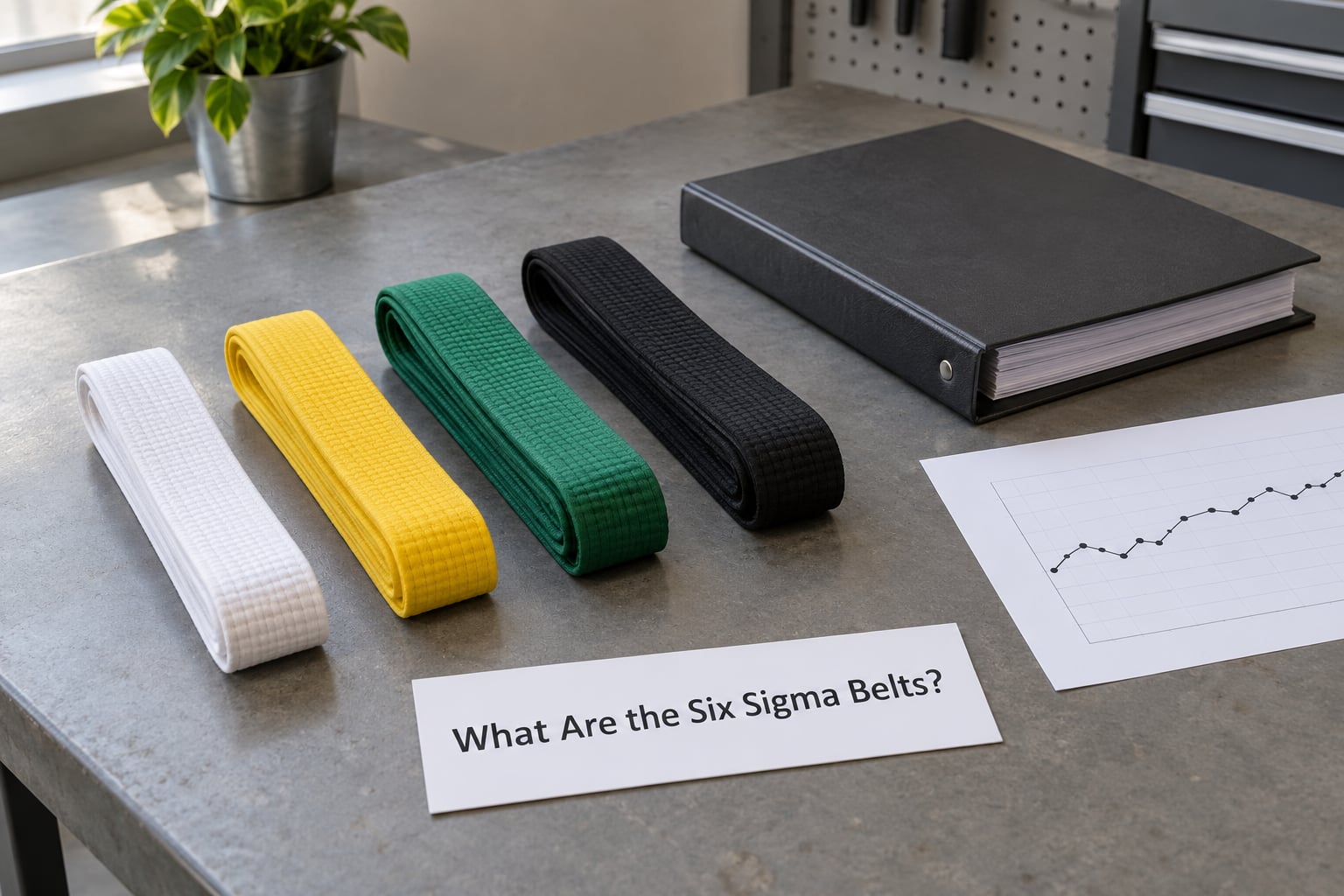
The belts are a way of ranking capability in a data-driven quality method. Six Sigma itself started at Motorola in 1986, and General Electric under Jack Welch made it famous in the 1990s by pushing it through every corner of the business. The name refers to the statistical target: roughly 3.4 defects per million opportunities, which works out to a process that is right about 99.99966% of the time.
Hitting that number is rarely the point. Most teams start far lower and improve by a long way, which is why Six Sigma projects are usually written up in terms of defect reduction and cost savings rather than sigma levels. Where the belt idea comes in is staffing: the hierarchy tells you who is qualified to run a project that touches three departments versus one that touches a single line.
That is the version of six sigma belts explained that matters when you are the one staffing a project: it says who is qualified to take on a problem that crosses three departments, and who is not yet ready for one.
The martial arts metaphor is deliberate and it carries meaning. A black belt in a dojo can teach, not just perform. A Black Belt in a plant is someone who can run the analysis and then hold the room while operators change how they work. The belt is shorthand for judgment earned through practice, which is exactly why a weekend certificate with no project behind it tends to carry so little weight with employers.
That brings up the distinction people ask about most. A belt is the capability level. A certification is one organization’s assessment of it. The ASQ (American Society for Quality) publishes a Body of Knowledge and awards credentials such as CQE and CSSQB through its exam process. The Council for Six Sigma Certification (CSSC) sells exam-only routes that candidates can prepare for independently. IASSC sits in between with its own body of knowledge and exam. A belt earned through a rigorous program and a certificate bought after an online quiz are not the same thing, no matter which logo is on it.
If you want to see the statistical thinking underneath it all, our guide to statistical sampling plans explained is a useful companion read.
Six Sigma Belts Explained in the DMAIC Order
DMAIC is the project cycle every belt level plugs into: Define the problem, Measure the current process, Analyze the data, Improve the process, then Control it so the gain sticks. Each belt owns a different depth of that cycle.
| DMAIC phase | Core activity | White | Yellow | Green | Black / Master Black |
|---|---|---|---|---|---|
| Define | Charter, scope, customer requirements, CTQs | Understands | Assists | Leads | Leads across functions |
| Measure | Data collection, capability study, MSA | Understands | Assists | Leads | Designs the study |
| Analyze | Root cause, hypothesis testing, regression | Understands | Basic tools only | Leads | Selects and validates methods |
| Improve | Solution design, pilots, DOE, change rollout | Understands | Contributes | Implements | Owns the change |
| Control | Control plans, dashboards, sustainment | Understands | Owns this step | Sets it up | Builds the system |
The same belt ladder read in order: White Belt knows enough to follow a project and avoid getting in the way. Yellow Belt can carry the Define, Measure and Control pieces under supervision and knows which tool answers which question. Green Belt owns a full project on a bounded scope, running the whole cycle on a process that sits within one function. Black Belt takes on multi-functional, high-cost problems where the analysis is genuinely hard and the political work is real. Master Black Belt does not run a bigger project than a Black Belt so much as it works at the level of the whole system, coaching Black Belts and setting how the method gets deployed.
Classic Six Sigma projects run DMAIC because they improve an existing process. New product and new process design use DMADV instead, where the final step is Verify rather than Control. Green Belts are usually trained on DMAIC and exposed to DMADV only lightly, while Black Belts get much deeper work in both.
White Belt: The Foundation Role
A White Belt exists to make you literate, not to make you a project lead. The training is short, often a single day or a few online hours, and it covers what Six Sigma is, what the belts mean, what DMAIC stands for, and how a project charter is read.
The practical value is comprehension. New hires, operators, supervisors and managers who attend a White Belt session can follow a project meeting, understand why a team is measuring a particular variable, and stop the recurring argument that the method is just cost-cutting in a nicer jacket. On a plant floor that alone is worth having, because it speeds up every decision around a project.
What it is not: scope authority. White Belts do not lead projects, do not sign off on statistical analysis, and do not carry improvement targets. In most programs the certificate is participation, not competency, and employers generally treat it that way. It makes sense as a low-cost way to test whether the field interests you before you spend real money on the next level.
Green Belt: The Hands-On Improvement Role
The Green Belt is where most improvement careers actually begin, and it is the workhorse level in plants that have deployed Six Sigma seriously. A Green Belt leads a small to mid-sized project, usually scoped to one process or one line, and usually alongside their existing job rather than as a full-time improvement role.
Typical responsibilities:
- Writing the project charter and holding a small team to the scope
- Mapping the current process and identifying where data is unreliable
- Collecting measurements, checking that the measurement system itself is capable first
- Running root cause analysis such as a fishbone diagram, a Pareto chart or a correlation check
- Supporting or running a design of experiments when the fix needs testing rather than opinion
- Implementing the change with the people who have to live with it
- Setting up a control plan and handing the sustained process to the process owner
Green Belt training usually lands somewhere around 40 hours of instruction, with some programs running wider and some narrower. A practitioner on r/manufacturing described roughly 40 hours as the standard baseline, which lines up with what most providers publish.
The thing that makes a Green Belt useful to an organization is judgment about tools. A Black Belt can choose between a regression model, a DOE and a capability study; a Green Belt learns to recognize which of those is needed, apply the simpler ones confidently, and escalate the harder ones. That is a real skill, and it is the one most lacking in teams that bought software but never trained anyone.
Black Belt: The Project Leadership Role
A Black Belt owns the projects nobody else can. These tend to span departments, carry meaningful cost of quality, and involve process steps that were never measured properly before. They are also the projects where the analysis is hardest and where resistance is strongest, because a Black Belt is usually proposing work that changes how several departments spend their day.
Responsibilities include selecting the right analytical approach rather than applying one tool to everything, coaching Green Belts through their smaller projects, running the change management piece, and making sure improvements survive after the project team disbands. On the last point, Black Belts are judged harder than most people expect. A gain that evaporates when the team scatters was never a real gain, and organizations that hand out Black Belts without control plans tend to lose credibility for the whole method within a year.
Black Belt programs are the longest of the standard tracks, commonly in the range of 100 to 200 training hours plus a completed project. Some employers run their own internal certification track, and those can be worth more than a vendor certificate because the sponsoring organization already knows how you work.
What a Black Belt does not do is manage a department. The belt covers project leadership and statistical depth. If your goal is running a quality department, you need the operational and people skills on top, and a belt will not supply them.
Master Black Belt and Champion: The Strategic Roles
Master Black Belt is a different job, not a bigger version of the Black Belt one. The MBB owns the methodology across an organization or region, trains and certifies internal belts, maintains the body of knowledge and scoring rubrics, coaches Black Belts on the hard projects, and works problems that are too large or too political for a single project team. When a plant has several Black Belts and Green Belts running in parallel, the Master Black Belt is what keeps them from drifting into five different improvement methods.
The Champion is not a belt and has no training attached to it. A Champion is an experienced leader, usually a plant manager, quality director or senior operations executive, who decides which problems are worth attacking, removes barriers that a project team cannot remove alone, and protects the method politically when budgets get tight. The distinction matters more than it sounds: a Champion brings authority and resources, a Black Belt brings analytical skill, and a project with one but not the other usually stalls.
Two more non-belt roles show up constantly. The Process Owner is the person who owns the process being improved, and they are accountable for sustaining the change after the project closes. The Executive Sponsor is the executive who funds the effort and owns the business result. If you see a job posting listing Champion, Process Owner or Executive Sponsor, those are roles someone fills in addition to whatever belt they hold, not a sixth level.
Six Sigma Belt Levels at a Glance
| Belt | Typical role | DMAIC coverage | Common training hours | Leads projects | Where it is used |
|---|---|---|---|---|---|
| White Belt | Team member, new hire, supervisor | Concepts only | 8 to 16 | No | Plant floor orientation, onboarding |
| Yellow Belt | Team contributor | Define, Measure, Control with support | 24 to 40 | No, supports one | Production cells, technician teams |
| Green Belt | Scoped improvement project lead | Full cycle on a bounded scope | 40 to 100 | Yes, part time | Quality, manufacturing engineering, supply chain |
| Black Belt | Complex project lead and coach | Full cycle, cross-functional, advanced methods | 100 to 200 plus project | Yes, full time often | Operations, quality, analytics, consulting |
| Master Black Belt | Method owner, trainer, enterprise coach | Portfolio and system level | 200 plus, project required | Coaches rather than only leads | Corporate CI, multi-site programs |
These hour figures are published ranges, not a standard. Certifying bodies set their own expectations and change them, so check the current requirements with whichever body you are considering before you commit to a program.
How Six Sigma Belts Differ From Lean Certifications
The two get sold as if they are rivals, and they are not. Lean removes waste and improves flow. Six Sigma reduces variation and defects. A plant that runs only Lean gets faster at a broken process; a plant that runs only Six Sigma gets a precise process nobody can actually ship on time.
In practice Lean Six Sigma blends both, and the belts inherit the blend. The tools differ too. Lean leans on value stream mapping, takt time, work instruction and standard work. Six Sigma leans on control charts, process capability analysis, hypothesis testing and design of experiments. Six Sigma projects typically deliver a quantified defect or capability number; Lean projects typically deliver cycle time, lead time or a waste reduction.
Roles split along similar lines. Lean certifications are more common outside manufacturing, in healthcare, logistics and service operations, where flow and waste are the visible problems. Six Sigma belts cluster in plants and quality functions where defect rates and cost of quality are the currency. If you want the waste vocabulary to go with the belts, our Lean manufacturing waste types guide covers the eight standard categories.
What Skills Are Needed to Advance Through Six Sigma?
Knowing which belt comes next is easy. Building the capability takes a specific, unglamorous set of skills, and most of them compound across levels.
- Statistics — distributions, standard deviation, confidence intervals and hypothesis testing. You do not need a math degree, but you do need to stop guessing.
- Measurement — knowing whether your gauge can tell good from bad before you trust a single data point.
- Process mapping — value stream maps and SIPOC diagrams, the fastest way to see where the actual problem lives.
- Root cause analysis — fishbone diagrams, 5 Whys, Pareto analysis, and the discipline to keep digging past the first plausible cause.
- Experimental design — running a small number of well-planned tests instead of changing four things at once.
- Facilitation — running a meeting where six people with different incentives agree on a next step.
- Project leadership — scope, budget, timeline, and the patience to sustain a change past the launch.
- Business judgment — costing the problem, sizing the benefit, and explaining why this project beats the other twelve on the list.
The last two decide whether you stall at Green Belt. Plenty of people can do the analysis. Far fewer can walk into a shift meeting and get a line operator to change a work instruction for the fifteenth time this year.
How Do You Earn the Next Six Sigma Belt?
Requirements vary by organization and by certifying body, so treat any specific hour count you hear as one provider’s rule rather than the rule. The general sequence looks like this:
- Pick the body first. ASQ, IASSC and the Council for Six Sigma Certification have different bodies of knowledge and different exams. Your target employer’s HR system may recognize one and not another, so ask before you pay.
- Complete the training. Classroom or online, delivered hours plus self-study. Shorter programs often pass through the material quickly; the deeper ones include worked project examples.
- Sit the exam. Typically multiple choice with case scenarios for Black Belt and above, timed, with a pass mark that varies by body.
- Run a real project. Many Black Belt and Master Black Belt paths require a completed project with a documented result and, sometimes, a presentation to a review panel. This is where the value is and where most shortcut programs skip.
- Get mentored. Practicum hours with an experienced Black Belt or MBB are common at the upper levels and are the single best predictor of whether you can actually do the work.
- Maintain it. Some credentials require recertification or continuing education credits on a cycle measured in years. Check the terms before you sign up.
One warning from the community side of things: a veteran on r/SixSigma put it plainly, that they would not pay for anything less than a Green Belt, and that a certificate from an unrecognized body is not worth much. Providers offering a Black Belt in a few days with no project requirement are selling participation, not capability.
Which Six Sigma Belt Is Right for Your Career?
Match the belt to the job you want next, not the one that looks most impressive on a resume.
- Operations or production supervision? Start with White or Yellow so you can read a project, then Green. Green is the level that gets you pulled onto improvement teams by default.
- Quality or manufacturing engineering? Go Green, then Black. This is the natural spine of the career and the combination most job descriptions ask for.
- Process or industrial engineering? Black Belt sits well on top of an engineering degree, especially for the statistical depth the role already assumes.
- Analytics or data? Your statistical background may carry you through Green faster than most, but you will still need facilitation and change management, which is where belts usually surprise people.
- Continuous improvement as a dedicated career? Green to Black, plus Lean credentials and TPM exposure, since uptime problems rarely fit a pure DMAIC frame. Our TPM total productive maintenance guide covers the eight pillars.
- Consulting? Black Belt first. Clients will send you into rooms where you have to be credible in the first ten minutes.
- Enterprise transformation? Master Black Belt, or Champion work if you are already a senior leader. Champions influence more projects than any individual belt holder.
- Career changer on a tight budget? White or Yellow as a low-cost test of the field, then Green when you know you want the projects. Several people in the forums use the entry level exactly that way.
The most common mistake is going straight to Black Belt because it is the one people recognize. A Black Belt earned without Green Belt project experience leaves you underprepared for the parts of the job that are not statistics, and you will feel it the first time a project stalls on politics.
Frequently Asked Questions
Is a Six Sigma belt the same as a Six Sigma certification?
No. A belt is the capability level a person holds within the method, and a certification is one organization’s assessment of that capability. The same belt level can be awarded by several bodies with different exams, hour requirements and rigor. Employers tend to care about the body that issued the certificate at least as much as the level, so check what your target employers recognize before enrolling.
How long does it take to become a Six Sigma Green Belt?
Most Green Belt programs take about 40 hours of instruction plus self-study, with some running wider and some narrower. Green Belt usually carries no formal project submission requirement at exam time, though a workplace project is strongly recommended. The bigger constraint is having a real process to improve while you train, since that is where the judgment actually gets built.
Does a Six Sigma Black Belt guarantee a higher salary?
Not on its own. A Black Belt tends to open doors into project leadership and quality roles, but pay depends on the industry, the employer and the rest of your profile. Practitioners on industry forums point out that documented project results and years of real experience carry more weight with recruiters than the certificate. Treat the belt as an accelerant, not a substitute for a track record.
Can you use Six Sigma and Lean together?
Yes, and most mature programs do exactly that. Lean removes waste and speeds up flow, while Six Sigma reduces variation and defects. Lean Six Sigma blends both, giving practitioners tools from each: value stream mapping and standard work from Lean, control charts and design of experiments from Six Sigma. Projects usually pick whichever lens fits the problem in front of them.
What does a Master Black Belt do differently from a Black Belt?
A Black Belt leads large, complex cross-functional projects and coaches Green Belts. A Master Black Belt owns the method itself, training and certifying internal practitioners, maintaining the body of knowledge, and tackling problems too large or too political for a single project team. Where a Black Belt owns a project, a Master Black Belt owns the portfolio and the standard.
Is a White Belt worth pursuing?
As a low-cost test of whether the field suits you, yes. White Belt training is short and cheap, and it teaches enough that you can follow a project meeting and understand the vocabulary. It will not change your job title, and hiring managers rarely weigh it heavily. Its real value is that you learn before you spend hundreds of hours on the next level.
Conclusion
The belt hierarchy is really a scope-of-impact ladder. White and Yellow Belts understand the method well enough to contribute, Green Belts run contained improvement projects, Black Belts lead the hard cross-functional ones, and Master Black Belts own the method and coach everyone else. Champion, Process Owner and Executive Sponsor are roles, not belts, and they decide whether projects get the resources to finish.
Most searches for six sigma belts explained want the same three things: what each level can actually do, how the levels sit against DMAIC, and which one to get next. The rest is detail worth knowing once you have picked a direction.
Your first move is simple: write down the job you want next, check which belt level that job description assumes, then pick a program from a body your target employers recognize. And line up a real project before you pay for anything, because that is where the belt actually becomes real.