
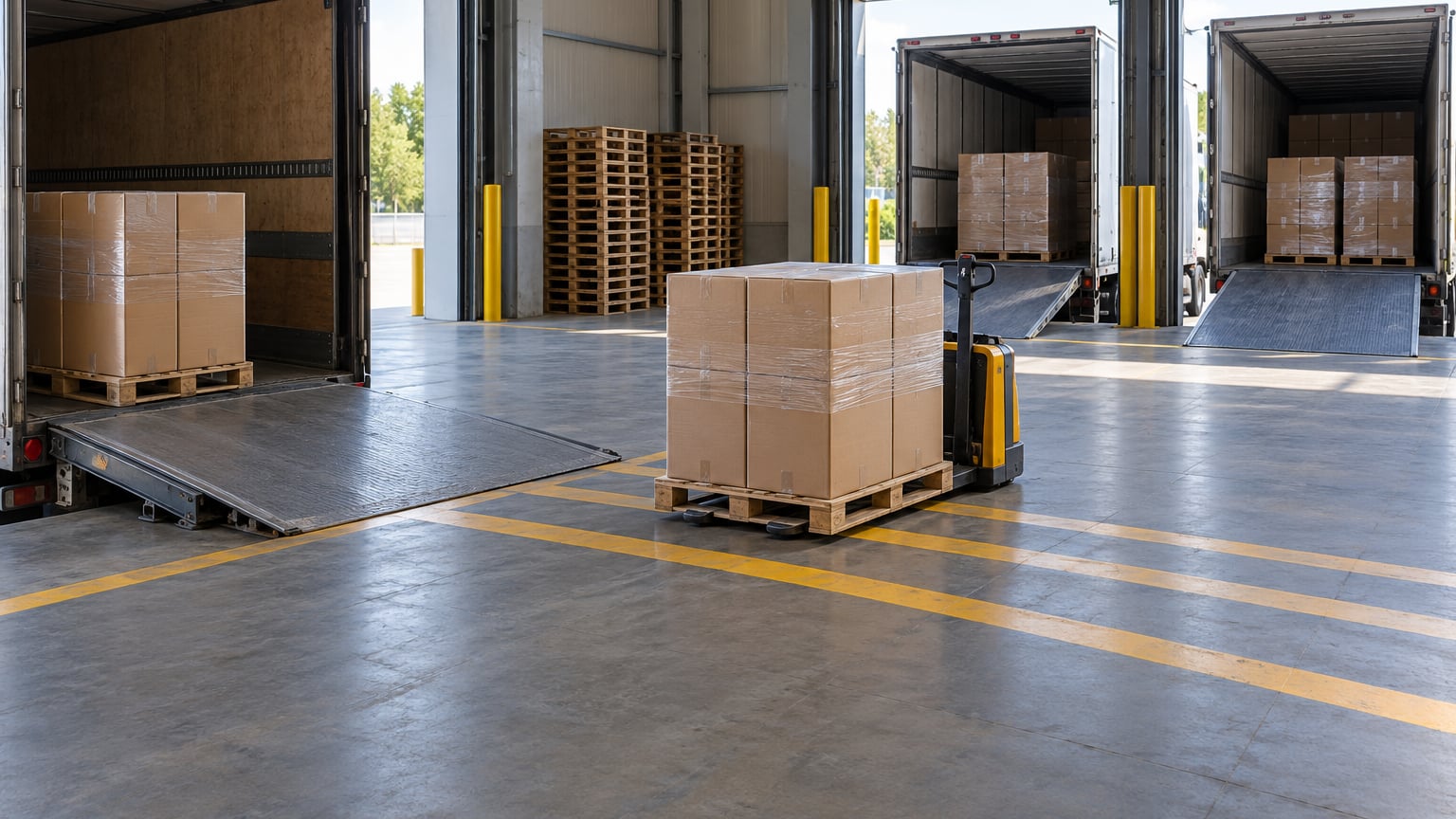
Cross docking explained in one sentence: it is the practice of unloading inbound freight at a dock, sorting it, and loading it straight onto outbound vehicles with little or no storage in between. Instead of a pallet sitting on a rack for three weeks, it moves across the facility in a few hours. That single change removes a storage step, cuts handling, and shortens lead time.
For manufacturing and supply chain teams, cross-docking is less a warehouse strategy than a timing discipline. It only works when inbound appointments, production schedules, and outbound requirements line up in the same window. This guide walks through what the process actually involves, the models that exist, the numbers worth measuring, and the situations where plain warehousing is the smarter call.
Table of Contents
- Cross Docking Explained: What It Is and How It Works
- How Does Cross Docking Work?
- How Cross Docking Differs From Warehousing and Distribution
- Types of Cross Docking Operations
- Cross Docking Benefits for Manufacturers
- When Cross Docking Makes Sense
- When Cross Docking Is Not the Best Option
- Key Metrics for Measuring Cross Docking Performance
- How to Implement Cross Docking Without Creating Bottlenecks
- Frequently Asked Questions
- What is the main purpose of cross docking?
- Is cross docking cheaper than warehousing?
- What is the difference between cross docking and a drop ship?
- How long should products remain at a cross-docking facility?
- Does cross docking require a warehouse management system?
- What products are best suited for cross docking?
- Conclusion
Cross Docking Explained: What It Is and How It Works
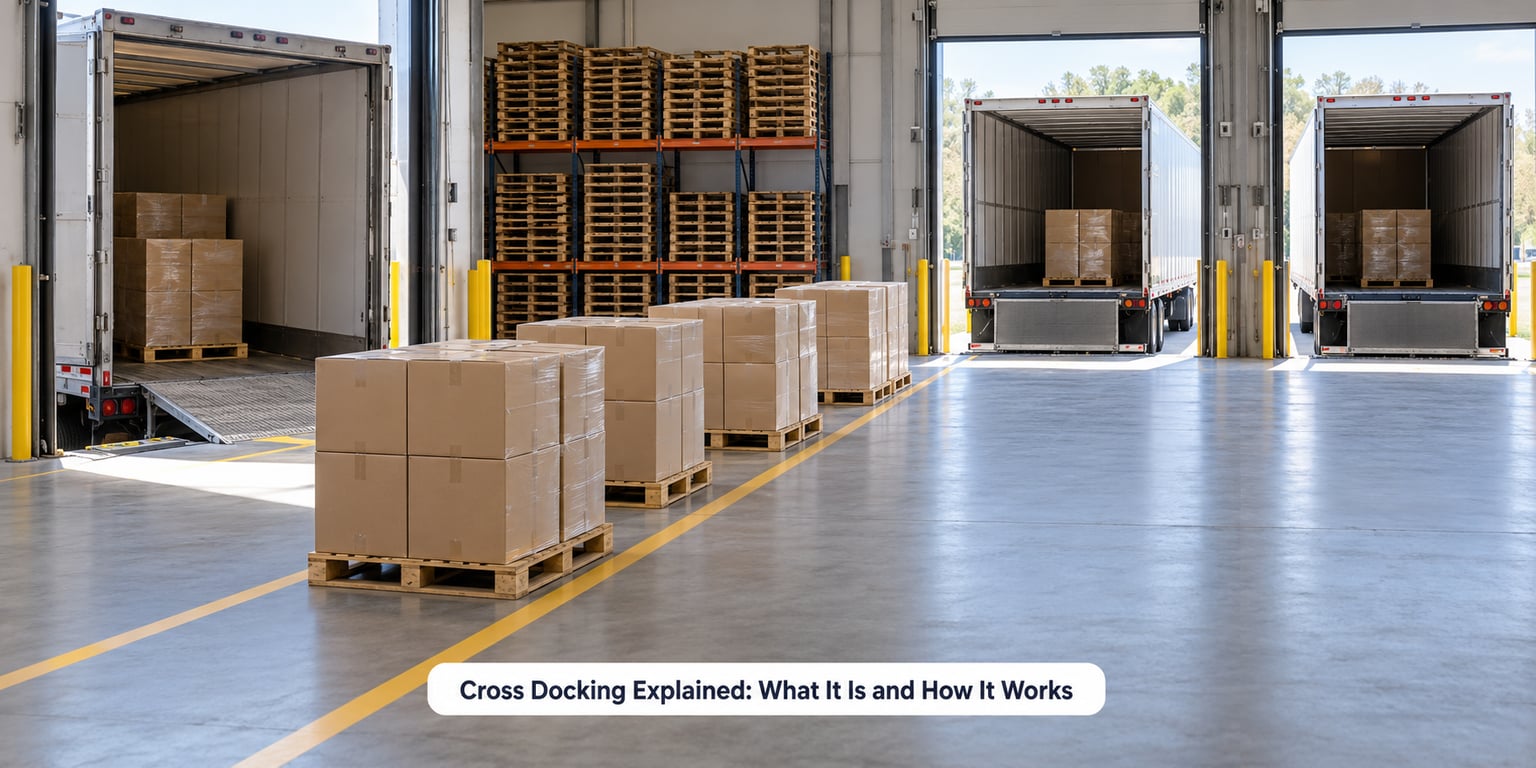
Cross-docking is a logistics practice in which inbound freight is unloaded, sorted, and immediately loaded onto outbound vehicles with little or no storage time. The name comes from the movement itself: goods travel across the building from the inbound dock to the outbound dock rather than into storage.
Its purpose is flow. In a conventional distribution center, receiving creates inventory that later has to be picked, staged, and shipped. Cross-docking collapses those steps into a single transfer, so the product spends hours on a dock instead of weeks in a building.
What makes it different from the alternatives
Direct shipping means one trailer goes from supplier straight to customer with no intermediate building. Cross-docking is the middle option: a facility still handles the freight, it just refuses to hold it.
Warehousing accepts goods into storage and releases them later against demand. Cross-docking accepts goods against a known outbound commitment and moves them on a fixed schedule.
Distribution-center picking breaks unit loads down to individual orders. A cross-dock usually preserves the unit load and only changes which trailer it belongs on, though de-palletising and re-palletising happen when destinations mix.
A good way to picture it: a hallway with a door on each side. Freight enters one door and exits the other. The hallway is the transfer lane, and the discipline is keeping it clear.
How Does Cross Docking Work?
The process runs in four phases, and every phase depends on the one before it. When a step slips, the freight sits on the floor and the whole schedule slips with it.
1. Schedule the inbound dock
Appointments are set before the trailer arrives, matched to the outbound departure windows and carrier cut-off times. Suppliers get a slot, not a vague promise to arrive in the morning.
2. Receive and unload
The trailer pulls to an assigned door and is unloaded by forklift, pallet jack, or conveyor. Unit loads that are going to a single destination often stay intact the whole way.
3. Scan, inspect, and sort
Every unit load gets a barcode or RFID read that confirms what it is and where it belongs. Goods requiring a quality check or temperature verification go to a conditioning area first, because an unverified load should never move.
4. Consolidate, load, and dispatch
Loads are built to the outbound order, staged in a marked lane, and loaded as the trailer presents itself. Trailer utilisation improves because small inbound shipments get combined into fuller outbound ones.
A worked manufacturing example
Consider an injection moulder running two shifts. Finished parts come off the line in returnable pallets and are wrapped by the packaging operation. A distributor’s truck arrives on a booked slot and takes the entire output directly to three retail store DCs 400 miles away.
Nothing goes into storage because the demand is committed before the parts exist. The plant’s shipping team scans each pallet at the door, groups them by destination, and the truck leaves within 90 minutes. If the store orders had been uncertain, those same pallets would have gone to a rack instead.
Operators working inbound cross-dock departments describe the environment as high volume and deadline-driven, where a missed scan or a mis-sort stalls everything behind it. That is the practical difference between cross-docking as a diagram and cross-docking as a shift.
How Cross Docking Differs From Warehousing and Distribution
The three models look similar from outside because all of them run receiving docks. The differences show up in storage duration, handling, and the information each one needs.
| Factor | Cross docking | Warehousing | Conventional distribution |
|---|---|---|---|
| Goods ownership | Usually retained by the shipper or carrier until transfer | Owned or held for a customer over time | Owned by the retailer or brand owner |
| Storage duration | Hours, rarely beyond 24 | Days to months | Days to months |
| Handling touches | Two: off the inbound, onto the outbound | Put away, pick, stage, load | Put away, pick, pack, stage, load |
| Order detail needed | Destination or stop, not SKU-level picking data | Full order lines, locations, priorities | Full order lines, locations, wave planning |
| Cost structure | Dock labour and transport, low fixed cost | Space, racking, handling, and carrying cost | Space, racking, systems, and picking labour |
| Trigger for release | Outbound vehicle is ready | Demand or replenishment signal | Order wave or replenishment rule |
| Best fit | Committed demand, fast movers, perishables, JIT lines | Uncertain demand, slow movers, service parts, seasonal build | Broad assortments serving many small orders |
The practical test is whether you know, before the freight arrives, exactly which outbound vehicle it belongs on. If you do, cross-docking fits. If the destination is still a guess, you are warehousing whether or not the building is called a warehouse.
Types of Cross Docking Operations
Three operational models cover most operations, and five named variants describe who benefits. They overlap, so a single plant can run two of them on the same dock.
The three operational models
Pre-distribution (direct) cross-docking moves inbound freight to outbound trailers before it enters storage. Retail replenishment is the classic case: store orders are already captured, so the truck is loaded straight to store DCs.
Consolidation cross-docking breaks a mixed inbound load apart by destination and rebuilds it into fuller outbound loads. This is the most common form, and it is where de-palletising and re-palletising show up.
Hybrid cross-docking applies the model selectively. Fast-moving SKUs cross-dock while slower lines go to storage, which is often the realistic answer for a mixed plant rather than a pure one.
Who runs the dock
In a company-operated model, your team owns inbound and outbound scheduling, scanning, and dispatch. Carrier-operated and 3PL-operated models move that work to a provider who already runs a hub network and can absorb volume swings, at the cost of less control.
The five named variants
Transport cross-docking happens at a carrier terminal between line-haul legs. Supplier cross-docking moves a supplier’s goods straight onto your outbound trailers without ever entering your inventory system. Opportunistic cross-docking uses whatever outbound capacity happens to be free. Retail cross-docking serves store replenishment. Production cross-docking feeds finished goods straight from a line to a trailer.
What complicates each model
Mixed pallets are the hardest case, because the sort has to happen before anything can move. Less-than-truckload freight arrives with less control over sequencing, so dwell time grows. Vendor-direct shipments add a fourth party whose appointment discipline you do not control, which is where most breakdowns occur.
Cross Docking Benefits for Manufacturers
The gains are real, but they come from removing work rather than adding speed. That distinction matters when you build the business case.
Faster flow and shorter lead time
Product reaches the customer hours after it leaves the line instead of days after it enters a rack. On a just-in-time line, that difference is the whole reason the schedule holds together.
Fewer touches, less damage
Every touch is a chance for a dropped pallet or a scuffed carton. Going off the inbound and onto the outbound halves the handling, and damaged components stop reaching assembly.
Lower holding cost and working capital
Inventory that never sits in a warehouse never carries storage, insurance, or obsolescence cost. On slow-moving lines, avoiding a long hold can be worth more than the transport saving.
Better trailer utilisation
Combining small inbound shipments into fuller outbound trailers cuts the number of vehicles in the network and spreads fixed driver and fuel cost over more units.
Inventory accuracy and responsiveness
Because every unit load is scanned at the door, records match reality better than a warehouse cycle count ever will. Shorter lead time also means you can react to a demand change in hours rather than a replenishment cycle.
When Cross Docking Makes Sense
Cross-docking fits when demand is committed, the product moves fast, and the transfer window is predictable. Those three conditions together are the test.
Packaging materials. Film, cartons, and labels arrive against a production schedule and feed the line directly. Holding them in a warehouse only separates them from the schedule.
Components and sub-assemblies. A supplier delivers full truckloads of identical part numbers to a line that consumes them within days. The material handling side of that flow is covered in material handling systems for resin explained.
Finished goods with committed orders. Retailer store orders or dealer allocations that exist before production ends give you the outbound manifest you need.
Urgent replenishment. When a store or a line runs short, a cross-dock lane can turn a two-day recovery into a same-day transfer.
Perishables and temperature-controlled goods. Time on the dock is time out of storage, so spoilage risk falls.
It also suits seasonal peaks, where a temporary facility moves volume without committing to permanent space.
When Cross Docking Is Not the Best Option
Cross-docking is the wrong tool whenever the outbound destination is uncertain or the value of the service depends on options. Five situations call for conventional warehousing.
Long or variable dwell. If a load waits more than a few hours for an outbound trailer, you are storing freight in the least efficient place available.
Unpredictable demand. Cross-docking needs committed orders. When demand swings week to week, holding inventory is what keeps service levels up.
Heavy value-added services. Labelling, kitting, serialisation, and rework need time, space, and equipment. Trying to do that inside a transfer window is how queues form. Handling that queue cleanly is part of the lean manufacturing waste types breakdown.
Complex consolidation. Building a multi-customer load to its last unit takes planning a cross-dock cannot absorb.
Slow-moving or high-value stock. Fast movers justify frequent movement. Slow movers tie up cash better in storage.
Practitioners are blunt about this: cross-docking is a simple concept with several important considerations. The physical idea almost never fails. Coordination and data capture do.
Key Metrics for Measuring Cross Docking Performance
If you measure nothing else, track the time freight spends between the inbound door and the outbound door. Everything else explains why that number moves.
| Metric | What it measures | Healthy range |
|---|---|---|
| Dock-to-stock time | Elapsed time from inbound door to outbound door | Under 24 hours, ideally a few |
| Dwell time | Time a specific unit load waits between moves | Minutes, not hours |
| Trailer turnaround | Time a trailer sits at the facility | Under 2 hours typical |
| Trailer utilisation | Percentage of outbound trailer capacity used | Above 85% |
| Sort accuracy | Loads sent to the correct destination first time | Above 99% |
| On-time dispatch | Outbound trailers leaving within the cut-off | Above 98% |
| Cost per shipment | Total dock and transport cost divided by shipments | Trending down over time |
| Inventory touched | Share of volume that enters storage | Under 10% for a mature flow |
Two numbers matter most early on. Dwell time tells you whether the process is actually cross-docking, and sort accuracy tells you whether it is doing so correctly. Missorts quietly convert a cross-dock into a slow warehouse.
How to Implement Cross Docking Without Creating Bottlenecks
Start small. Pick one product family with committed demand and one destination pair, and prove the flow before you touch the whole plant.
1. Map the flow before you move anything
Chart every inbound receipt, its timing, the destination, and the outbound window it must meet. Where those two windows overlap is where a cross-dock is possible. Where they do not overlap, no layout change will fix it.
2. Design the layout around doors, not aisles
Put the inbound and outbound doors where a load can travel in a straight line. Mark transfer lanes so a pallet never blocks a path, and keep the conditioning area for inspection away from the main lane.
3. Fix appointment discipline first
A booked slot with a cut-off time is what makes the rest work. Apply it to suppliers you do not control, and give carriers a turnaround standard they are measured against.
4. Get visibility into the door
Integrate scanning with your WMS or ERP so an inbound receipt automatically creates the outbound load. Common causes of breakdowns are mis-sorts, missed scans, and mislabelled freight, and all three are data capture failures.
Whether you build that flow in-house or hand it to a 3PL is a separate decision, and the make or buy reasoning is covered in make or buy decision analysis explained.
5. Staff for the peak, not the average
Cross-docking work is bursty. Two people can clear a normal morning and fail completely when four trailers land together. Plan labour around the appointment calendar and cross-train the team on scanning rules.
6. Write the sorting rules down
Mixed pallets, mixed destinations, and partial orders need a documented rule set that anyone on shift can apply without asking. Ambiguity here shows up as dwell time.
7. Plan for the missed trailer
Decide in advance where freight waits when the outbound vehicle does not show, and for how long. A defined overflow area keeps a delay from turning into a storage operation nobody planned for.
8. Review the metrics weekly
Track dwell time and sort accuracy at first, then widen to utilisation and on-time dispatch. Improve one constraint at a time, and change the appointment rules before adding equipment.
Frequently Asked Questions
What is the main purpose of cross docking?
The main purpose of cross docking is to move goods through a facility without storing them. Inbound freight is unloaded, sorted, and loaded onto outbound vehicles within hours, removing the storage and picking steps from the chain. That shortens lead time, cuts handling and damage, lowers holding costs, and raises trailer utilisation.
Is cross docking cheaper than warehousing?
Cross docking is usually cheaper per unit moved because it removes storage, racking, and picking labour from the flow. It also avoids carrying cost on inventory you have not sold yet. The trade-off is fixed cost: you need accurate appointments, scanning, and enough volume to keep dock labour productive, so thin or erratic flows can cost more.
What is the difference between cross docking and a drop ship?
A drop ship skips the seller’s warehouse entirely: the manufacturer ships straight to the customer, so the seller never touches the goods. Cross docking still routes freight through a facility, but that facility transfers loads rather than storing them. Drop shipping is about bypassing a partner; cross docking is about removing a storage step.
How long should products remain at a cross-docking facility?
Products should remain for hours, not days. Most operations aim for under 24 hours at the facility and minutes of dwell time for any single unit load. If freight waits longer than that for an outbound vehicle, the operation is storing inventory on the dock, which costs money and usually means the appointment schedule needs fixing.
Does cross docking require a warehouse management system?
Cross docking does not require a full warehouse management system, but it does require accurate data capture. Barcode or RFID scanning at the door, matched to outbound orders, is what prevents mis-sorts and missed shipments. Small operations can run on scanned handhelds and a solid appointment schedule; larger ones usually integrate scanning with WMS or ERP.
What products are best suited for cross docking?
Cross docking suits fast-moving products with committed demand, stable shipment sizes, and few perishable or high-value items. Typical fits include packaging materials, production components, finished goods allocated to known orders, retail replenishment, and temperature-controlled goods. Slow movers, volatile demand, and items needing kitting or rework belong in storage.
Conclusion
Cross docking delivers the most value when the destination is known before the freight arrives, the product moves fast, and the transfer window lines up with an outbound vehicle. Miss any one of those three and the dock turns into an expensive place to store inventory.
Start by mapping four things: your inbound receipts and their timing, the transfer windows that already exist, the outbound requirements for each product family, and your current baseline for dwell time and sort accuracy. That map tells you quickly which flows are genuine candidates and which were never a fit. Updated for 2026.