
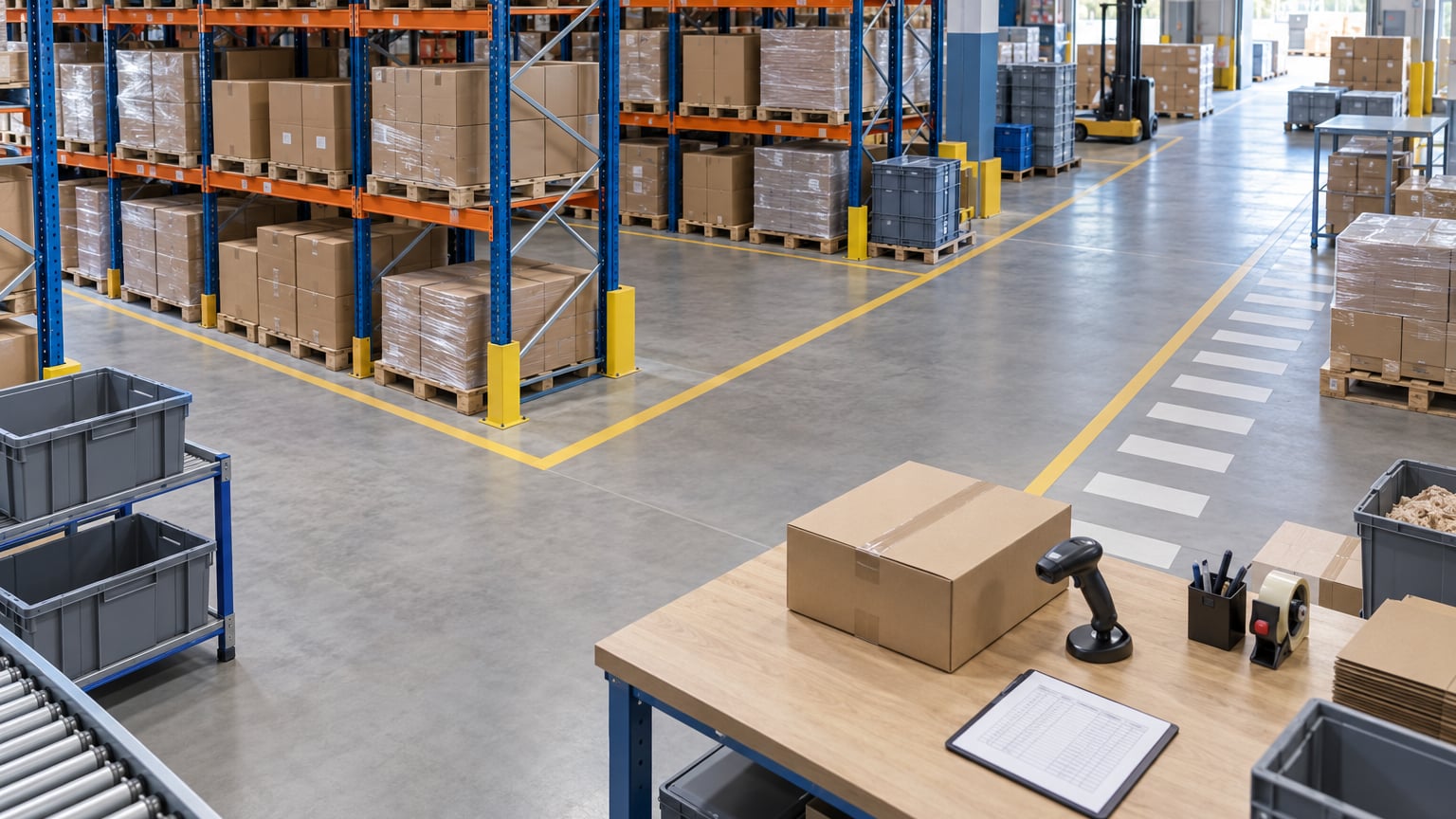
How to reduce warehouse operating costs comes down to one rule: measure before you cut. Build a cost-per-order and cost-per-pick baseline, find the largest line, and attack it in order — because direct labor usually runs 50 to 60 percent of a warehouse budget, and shaving travel, waiting, and extra handling moves that number faster than any equipment purchase. Most facilities see their first real savings inside a quarter, without a capital request.
The nine steps below take a warehouse from baseline to sustained reduction. They assume a working team of maybe five to fifteen people, no dedicated improvement department, and a spreadsheet most facilities already have. Skip the order and you will spend a capital budget fixing a process that was never stable.
One thread runs through everything below. Operators almost never describe their cost problem as a headcount problem; they describe it as empty-running — walking empty to fetch a carton, standing in a queue at pack, re-handling a pallet that was put away twice. Those minutes are paid for and produce nothing, and they are the cheapest thing in the building to remove.
Table of Contents
- What You Need
- Step-by-Step: How to Reduce Warehouse Operating Costs
- 1. Establish a warehouse cost baseline
- 2. Improve inventory accuracy and cut excess inventory
- 3. Reduce picking, packing, and put-away labor to cut warehouse operating costs
- 4. Improve warehouse layout and space utilization
- 5. Right-size staffing, schedules, and peak capacity
- 6. Lower equipment, maintenance, and energy expenses
- 7. Optimize packaging, receiving, and outbound freight
- 8. Use automation selectively
- 9. Control costs continuously with a savings dashboard
- Common Mistakes
- Frequently Asked Questions
- Which warehouse cost should a small facility tackle first?
- How do I reduce warehouse labor costs without cutting headcount?
- Is warehouse automation worth it for a small warehouse with no capital budget?
- Which warehouse KPIs should I report to leadership each month?
- How do you calculate cost per order when almost nothing is tracked?
- What is the difference between gross savings and realized savings?
- Conclusion
What You Need

Before changing anything, get four things in place. Anything less and you will be arguing from opinion instead of evidence when the finance team asks whether the saving was real.
Inventory records you trust. SKU count, locations, on-hand quantities, and unit cost. If your record accuracy sits below the high 90s, fixing accuracy is itself a cost project, because every other lever is measured through this data.
Labor reports by activity. Hours worked against hours paid, split across receiving, put-away, picking, packing, replenishment and rework. Overtime hours and premium hours called out separately. Most supervisors can produce this in a week even when the system does not report it cleanly.
Space utilization and layout. A current floor plan with storage locations, staging lanes, dock doors, travel paths and dead or low-density zones. Note cubic capacity as well as square footage, because tall empty air and low-density floor space are the same waste.
Equipment and cost data. Maintenance spend by asset, downtime hours, fuel or power draw, and the age of anything you are considering replacing. Add invoices for utilities, lease, insurance, supplies and freight so you can see the full cost picture in one place.
You also need two non-technical things. A named owner for each baseline metric — if nobody owns cost per order, it will drift — and a one-page process map of how an order actually moves from receipt to dispatch, written by the people doing the work rather than by someone drawing arrows from an office.
Step-by-Step: How to Reduce Warehouse Operating Costs
The sequence below runs from no-capital changes to capital projects, and each step carries its own verification measure. Record the number before you start and again 30 to 60 days after, because a cost reduction that quietly damages pick accuracy, on-time delivery or safety has moved cost into a place you were not measuring.
1. Establish a warehouse cost baseline
Divide total warehouse operating cost by the volume you serve. The three most useful versions are cost per order shipped, cost per pick, and cost per pallet position. Cost per order is the one leadership understands; cost per pick is the one that moves when you change how work is organised.
Then separate the costs into three behaviours. Fixed costs stay the same whether you ship 200 or 2,000 orders — lease, insurance, base salaries, software. Variable costs rise and fall with volume — overtime, freight, packaging, most hourly labor. Step-fixed costs jump when you cross a threshold and then sit flat, which is why a half-empty facility has an expensive unit cost.
| Cost line | Typical share of warehouse operating cost | Behaviour | First lever to pull |
|---|---|---|---|
| Direct and indirect labor | 50 to 60 percent | Step-fixed, then variable | Cut travel, waiting and extra handling |
| Building, rent and storage space | 10 to 20 percent | Fixed | Raise space utilization, revisit the lease |
| Inventory carrying cost | 8 to 15 percent | Variable | Turn inventory faster, cut slow movers |
| Utilities and energy | 3 to 8 percent | Step-fixed | Lighting retrofit, HVAC setpoint, leak checks |
| Equipment and maintenance | 4 to 6 percent | Step-fixed | Preventive maintenance, right-size the fleet |
| Packaging and handling supplies | 2 to 5 percent | Variable | Right-size cartons, reuse totes and pallets |
| Technology and systems | 2 to 4 percent | Fixed | Fix data capture before buying tools |
| Administration | 2 to 4 percent | Fixed | Clean up payroll and billing errors |
| Insurance and property tax | 1 to 3 percent | Fixed | Reduce leased square footage |
| Waste and shrinkage | 1 to 3 percent | Variable | Cycle counting, dock control |
Treat these shares as planning ranges, not targets. Fix a real baseline for your facility, then set five KPIs: cost per order, inventory turns, dock-to-stock time, overtime hours, and space utilization.
2. Improve inventory accuracy and cut excess inventory
Unreliable inventory creates cost three ways: workers travel to pick stock that is not there, capital sits in slow movers, and shrink goes unnoticed because nobody knows what should be on the shelf. A cycle-counting program — counting a slice of locations on a schedule rather than doing a full count twice a year — usually pays back within three to six months and replaces the annual count entirely once it is trusted.
Pair counting with bin-location discipline. If a location has no address, it has no count, and the discrepancy never closes. Then rationalise the SKU list: every SKU that has not shipped in a set period gets reviewed for liquidation, return to vendor, or relocation to low-cost storage.
Set replenishment points from actual demand rather than a rule of thumb, and lean on ABC analysis so the A items that drive most of your volume get the tightest control. Verify by comparing inventory accuracy, carrying cost, fill rate, and obsolete stock value before and after — if accuracy improved but obsolete stock grew, the program is only half working.
3. Reduce picking, packing, and put-away labor to cut warehouse operating costs
Labor is the biggest line, and most of it is travel and search. Start by observing: walk a shift and record how far a picker travels per order, how long they wait at pack, and how often they set down a cart to find a label or a second tape gun.
Then match the picking method to the order profile. Batch picking suits many small orders in one zone, zone picking splits the floor so people are not crossing it, and wave picking groups work by carrier or by cut-off time so dispatch runs without waiting. None of these win automatically — a stable process plus accurate locations beats a clever method every time.
Fix the workstation next. Packing benches at a working height, printers and scanners within reach, and a standard work sequence for each order type remove the small frictions that add up. Pick accuracy is the guardrail here; our guide to reducing warehouse picking errors covers the checks worth running alongside.
Validate the result with lines picked per labor hour, pick accuracy, travel distance per order, and order cycle time. A layout that makes people faster but less accurate has simply moved cost into returns and credits.
4. Improve warehouse layout and space utilization
Most warehouses hold more empty air and more empty floor than anyone planned for. Measure utilization by zone rather than by building average, because a building can look full while a quarter of the pick faces sits dead.
Four changes do most of the work. Give the fastest-moving items forward pick locations close to pack, move slow movers up into mezzanine or high-bay storage, shrink oversized travel aisles left over from a different forklift fleet, and reserve defined staging lanes so inbound pallets are not dropped in front of active pick paths.
Slotting rules matter more than the shelf type. Velocity-based slotting, updated on a schedule, keeps the logic from decaying as demand shifts — slotting optimization in a warehouse explained walks through the variables.
Measure receiving, storage, packing and dispatch separately before and after, then walk the floor during a shift rather than on a quiet Sunday. Congestion shows up in the hour when trucks arrive, not in the average.
5. Right-size staffing, schedules, and peak capacity
Labor cost problems are usually coverage problems wearing a headcount costume. A shift with too few people late in the day generates overtime, product damage from rushed work, and a morning queue nobody sees.
Build a workload forecast by day and by half-day rather than a weekly average, schedule to it, and cross-train enough people that any station has two qualified operators. Plan temporary labor for known peaks such as quarter-end or promotional windows instead of discovering the gap at 6 a.m., and check that every equipment operator is current on certification — unlicensed operation inflates workers’ comp claims and damages product, which is a cost line that arrives months later.
Confirm savings with labor hours per order, overtime hours, on-time completion, and the error rate. Add a staff pulse check, because a schedule that works on paper and not on the floor simply moves the problem. Never reach a labor cost target by removing coverage that safety requires.
6. Lower equipment, maintenance, and energy expenses
Three separate bills hide in this section. Maintenance: a preventive schedule tied to hours rather than calendar age, plus a log of breakdowns by asset, usually shows that two or three machines absorb most of your downtime and repair spend. Fleet: if you own five lift trucks and three idle, that is capital and maintenance you can release.
Energy responds to small changes faster than most managers expect. An LED retrofit commonly pays back somewhere around six to eighteen months depending on run hours and fixture age. A thermostat setpoint adjusted by a degree or two, sealing dock doors, and scheduling dock-door and charger use off-peak all reduce HVAC and lighting load for almost nothing.
Run a compressed-air leak check, since leaking fittings are a quiet annual cost, and put submeters on the largest energy users so you can see the number monthly. Verify with maintenance cost per operating hour, energy use per square foot, and equipment uptime.
7. Optimize packaging, receiving, and outbound freight
Packaging is a hidden multiplier: an oversized carton does not just cost more material, it takes more cube on the truck, more space in the trailer, and more handling at both ends. Set carton standards by SKU and hold them — 10 carton sizing mistakes that raise shipping costs lists the usual culprits. Reuse totes and pallets where the process allows it.
On the inbound side, book appointments so trucks arrive when the dock can work them, and stop the pattern where advance notices are ignored and drivers idle at the gate for hours. That idle time becomes detention charges or rate penalties later.
Outbound, consolidate orders that can share a carton, compare carriers on total cost rather than linehaul rate alone, and standardize documentation so billing errors do not generate credits and re-bills. Measure packaging cost per order, detention hours, freight cost per order, and on-time dispatch percentage.
8. Use automation selectively
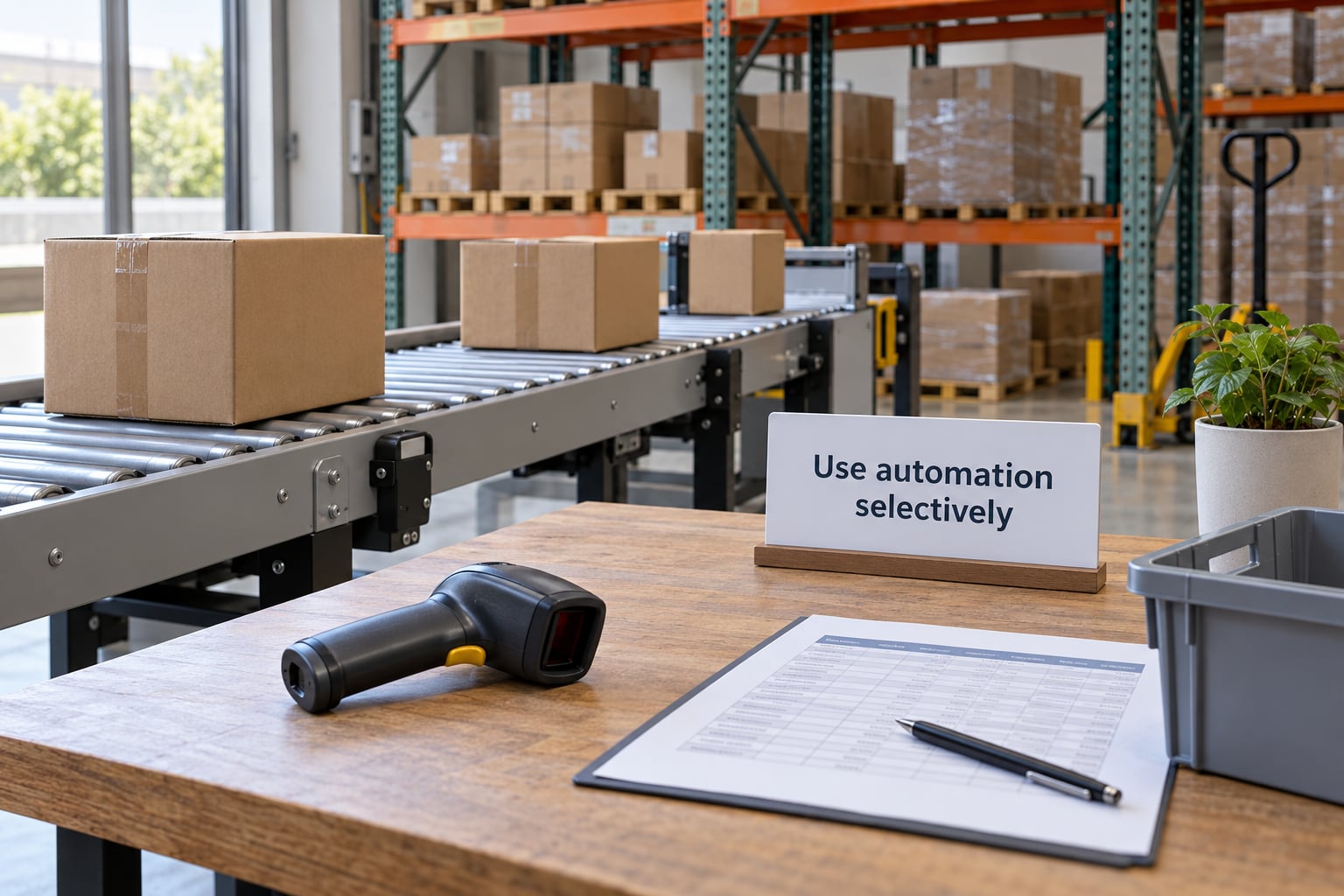
Automation is the most expensive way to automate a broken process. Barcode scanning, voice picking, put-to-light, conveyors, sortation, a warehouse management system, and robotics all have legitimate places — but only where volume, process stability, safety and payback support them.
Run two numbers before anything else. Total cost of ownership covers hardware, integration, spares, training and the productivity dip during go-live; a warehouse that loses output for three weeks during rollout has spent savings it never had. Payback is capital divided by the monthly savings, and if the honest number is longer than your planning horizon, the answer is a better process, not a faster picker.
For a small facility, the sequence usually runs: accurate locations first, scanning hardware second, software third, automation fourth. If the process is not stable, the automation simply fails faster and more expensively.
9. Control costs continuously with a savings dashboard
One page, one owner per metric, reviewed monthly, beats a quarterly program that nobody looks at. Put cost per order, labor hours per order, pick accuracy, inventory accuracy, on-time dispatch, overtime hours, space utilization and freight cost per order on it, each with a baseline column and a current column.
Log every initiative with four fields: estimated saving, realized saving, implementation cost, and the follow-up action. Estimated savings are what the project promised; realized savings are what showed up in the numbers after guardrails held. The gap between those two numbers is where most cost programs quietly fail.
Keep quality and safety guardrails next to the cost metrics so a saving that raises errors or incidents gets flagged. Then adjust: actions that created hidden cost get reworked or stopped, and the freed attention moves to the next-largest cost line.
Common Mistakes
Cutting labor before understanding workload. A headcount cut made before the travel and waiting are removed just moves the queue into overtime and errors. Fix: measure activity-level labor hours first, then right-size coverage to the forecast, and treat overtime hours as the first KPI.
Chasing headline savings. A projected saving written up in a proposal is not a saving. Fix: separate estimated from realized in the dashboard, and review realized numbers 60 days after go-live before you celebrate or cancel.
Changing layout without a process map. Reracking before anyone documents the real flow means you optimize the wrong paths. Fix: walk the floor during a live shift, draw the actual path, and redesign against it. Then re-measure the same zones.
Over-ordering equipment. Buying a fifth truck or a conveyor before utilization is known converts variable cost into fixed cost at exactly the wrong moment. Fix: check uptime and idle hours first, then look at total cost of ownership for anything with a payback longer than two years.
Ignoring safety, quality and service guardrails. Cycle counts, equipment certification, and accuracy checks look like overhead on a budget sheet, but removing them raises shrink, workers’ comp claims and returns later. Fix: hold those three as non-negotiable guardrails on every initiative.
Two habits keep this sustainable. Start with one measurable workflow — receiving or replenishment usually beats picking, because it has fewer variables — and finish it properly before opening a second. Then write down the standard that made it work and hand it to the next shift, because an unwritten standard gets rebuilt from scratch every time someone new is hired.
Frequently Asked Questions
Which warehouse cost should a small facility tackle first?
Travel and waiting time in picking and replenishment, because they carry no capital cost and show up within weeks. Watch empty-running specifically: time spent walking without a cart, waiting at pack, and searching for a location. Measure travel distance and labor hours per order for one week, fix the top two routes, then compare. Inventory accuracy is the usual second move, since a cycle-counting program also pays back in a few months and gives you trustworthy numbers for everything after it.
How do I reduce warehouse labor costs without cutting headcount?
Reduce the hours each task takes rather than the number of people doing it. Forecast workload by day and half-day, schedule to it, cross-train so every station has two qualified operators, and plan temporary labor for known peaks. Replenish pick faces in smaller, more regular batches so people stop walking back for stock, and standardize the pack sequence. Track labor hours per order and overtime hours as the test, and never reach the target by removing coverage that safety requires.
Is warehouse automation worth it for a small warehouse with no capital budget?
Usually not yet, and the reason is rarely the equipment. In most small facilities the constraint is process stability and data accuracy, not picking speed, so automation inherits every existing fault and adds training, integration and maintenance costs. Work in sequence instead: reliable bin locations, then barcode scanning hardware, then a warehouse management system, and only then consider conveyors, sortation or robotics. Run total cost of ownership and a payback calculation, including the output dip during go-live, before anything is signed.
Which warehouse KPIs should I report to leadership each month?
Five cover most of it: cost per order shipped, labor hours per order, inventory accuracy, on-time dispatch percentage, and space utilization. Add overtime hours, pick accuracy, dock-to-stock time and freight cost per order as a second tier. The useful format is baseline against current, one owner per metric, reviewed on the same day each month. Reporting a number with no owner and no baseline usually ends the conversation; a number with both keeps the improvement going.
How do you calculate cost per order when almost nothing is tracked?
Build it manually for two weeks before asking for software. Total the monthly warehouse spend across labor, rent and storage, utilities, equipment and maintenance, systems, administration, insurance, supplies and freight, then divide by orders shipped for the same month. Separate fixed from variable from step-fixed costs so you can see which lines react to volume. From there, derive cost per pick and labor hours per order from timesheets and order records, and automate the calculation once you know which inputs you actually need.
What is the difference between gross savings and realized savings?
Gross savings is what an initiative was projected to deliver when it was approved. Realized savings is what actually shows up in the financial numbers after implementation, once extra costs are subtracted and after quality and service guardrails held. The gap usually comes from training time, a productivity dip during go-live, extra overtime to cover the change, or savings that were counted twice. Track both in the same log and review realized results about 60 days after each project goes live.
Conclusion
Start tomorrow with one task: build the cost-per-order baseline and put labor hours per order next to it. Pick one measurable workflow, run a single improvement cycle on it with a number recorded before and after, and repeat before you spend capital on anything.
That is the real answer to how to reduce warehouse operating costs. It is not a list of cuts, and it is not a one-quarter project — it is a baseline, a sequence of measured changes, and a monthly review that keeps honest savings and discards the rest.