
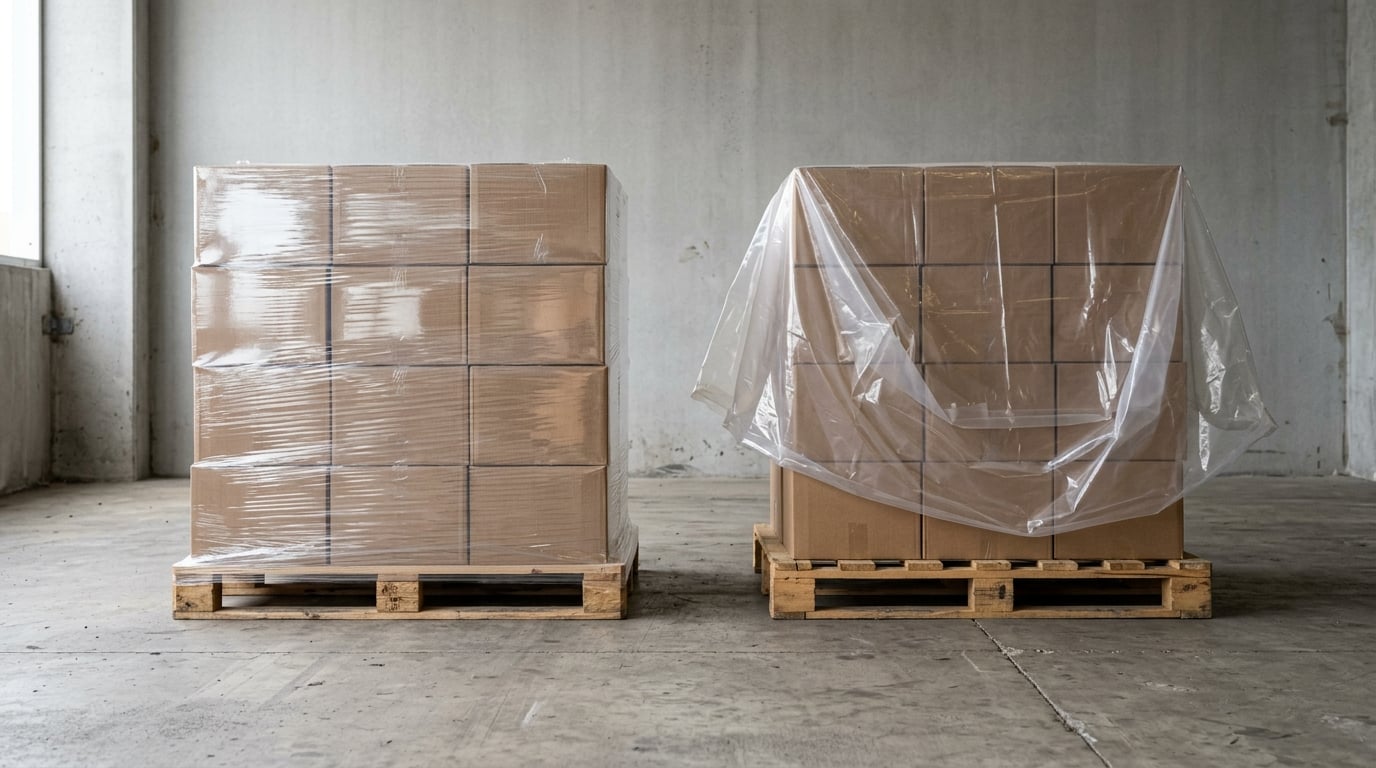
Stretch wrap and shrink wrap secure a pallet in two completely different ways, and for most warehouse work stretch wrap is the answer. Stretch film is pulled tight around the load with mechanical tension so it grips the product and the pallet together. Shrink film is draped on loose and then heated until it contracts into a sealed package. Here is how stretch wrap vs shrink wrap for pallet loads compares on load security, equipment, cost, and appearance.
Getting those two names straight matters more than it sounds. In an r/OSHA discussion about a load that tipped on a forklift, the film on the pallet turned out to be stretch wrap, not shrink wrap, because that is what most people call every roll of clear plastic. Order the wrong film for the job and the difference shows up as a crushed stack three days later.
Table of Contents
- Stretch Wrap vs Shrink Wrap for Pallet Loads at a Glance
- How Stretch Wrap and Shrink Wrap Work
- Strength, Stability, and Load Protection
- Which Method Looks Better on a Pallet Load?
- Cost, Film Usage, and Operating Considerations
- Which Should You Choose?
- Frequently Asked Questions
- Is stretch wrap or shrink wrap better for pallet loads?
- What is the difference between stretch wrap and shrink wrap?
- Can shrink wrap be used without a heat tunnel?
- Which film provides better load stability for warehouse shipping?
- How many layers of stretch wrap are needed for a pallet load?
- Can stretch film and shrink film be used on the same pallet?
- Conclusion
Stretch Wrap vs Shrink Wrap for Pallet Loads at a Glance
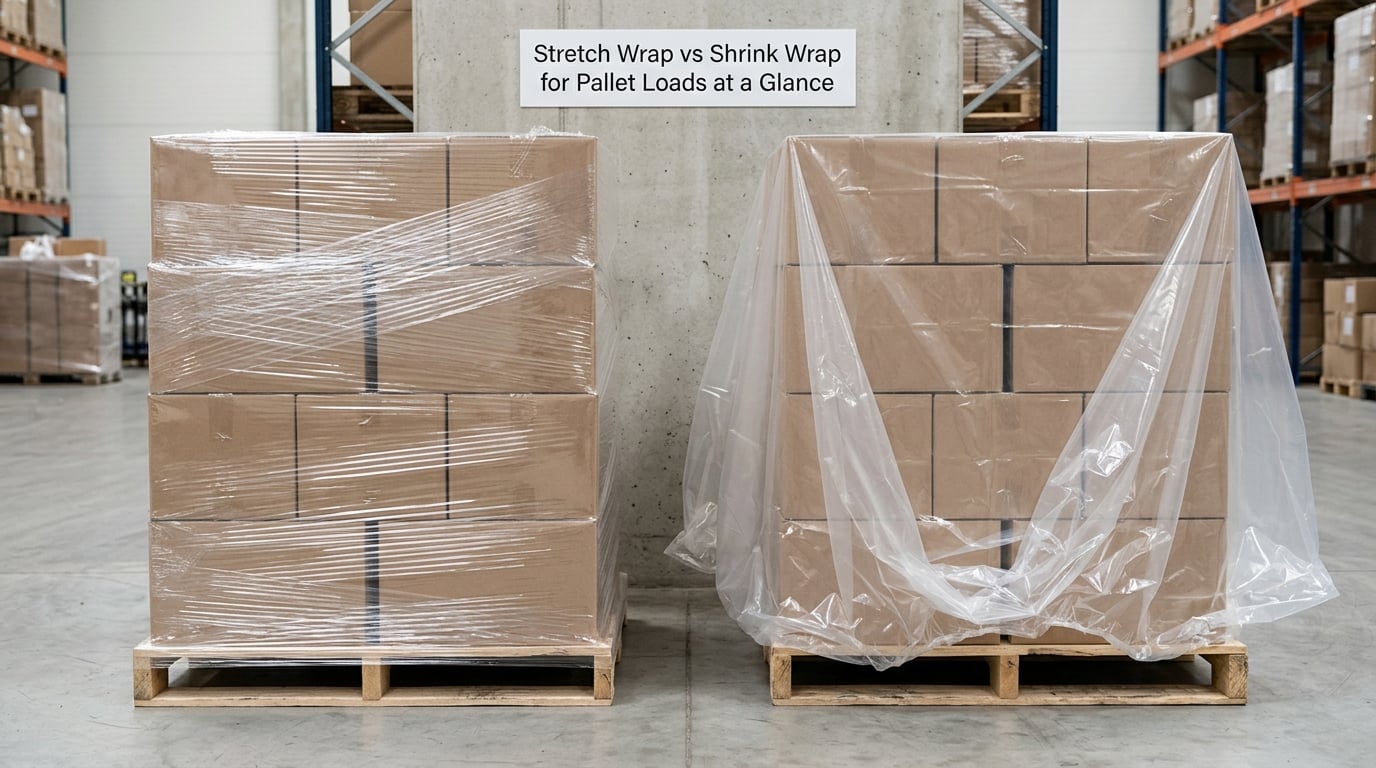
| Criterion | Stretch wrap | Shrink wrap |
|---|---|---|
| Material | LLDPE polyethylene, cast or blown | Polyolefin film that contracts when heated |
| How it is applied | Stretched under mechanical tension as it goes on | Draped loose, then heated to roughly 100-150C and cooled |
| Equipment | Hand dispenser, turntable, arm wrapper or automatic wrapper | Heat gun, shrink tunnel, or hood applicator |
| Load security | Binds the product to the pallet and controls load shift | Seals and presents the load; little effect on load shift |
| Crush resistance | Moderate; too much tension can damage boxes | Good, because the film hardens as it cools |
| Moisture and dust barrier | Light to moderate, depends on number of layers | Good, and it reads as tamper evident |
| Appearance | Clear, matte, clingy, often cloudy at high stretch | Glossy, tight, smooth, retail ready |
| Speed | Fast once a wrapper cycle is set | Slower; heat and cool-down add minutes |
| Relative cost | Film plus modest capital | Less film, more capital, power, and space |
| Best for | Warehouse, 3PL, manufacturing, cross-dock, road transport | Retail display, export loads, long outdoor storage, tamper-prone goods |
The one row that decides most decisions is load security. Everything else on this list is a preference you can argue about; load shift is a safety and damage problem with a real cost attached.
How Stretch Wrap and Shrink Wrap Work
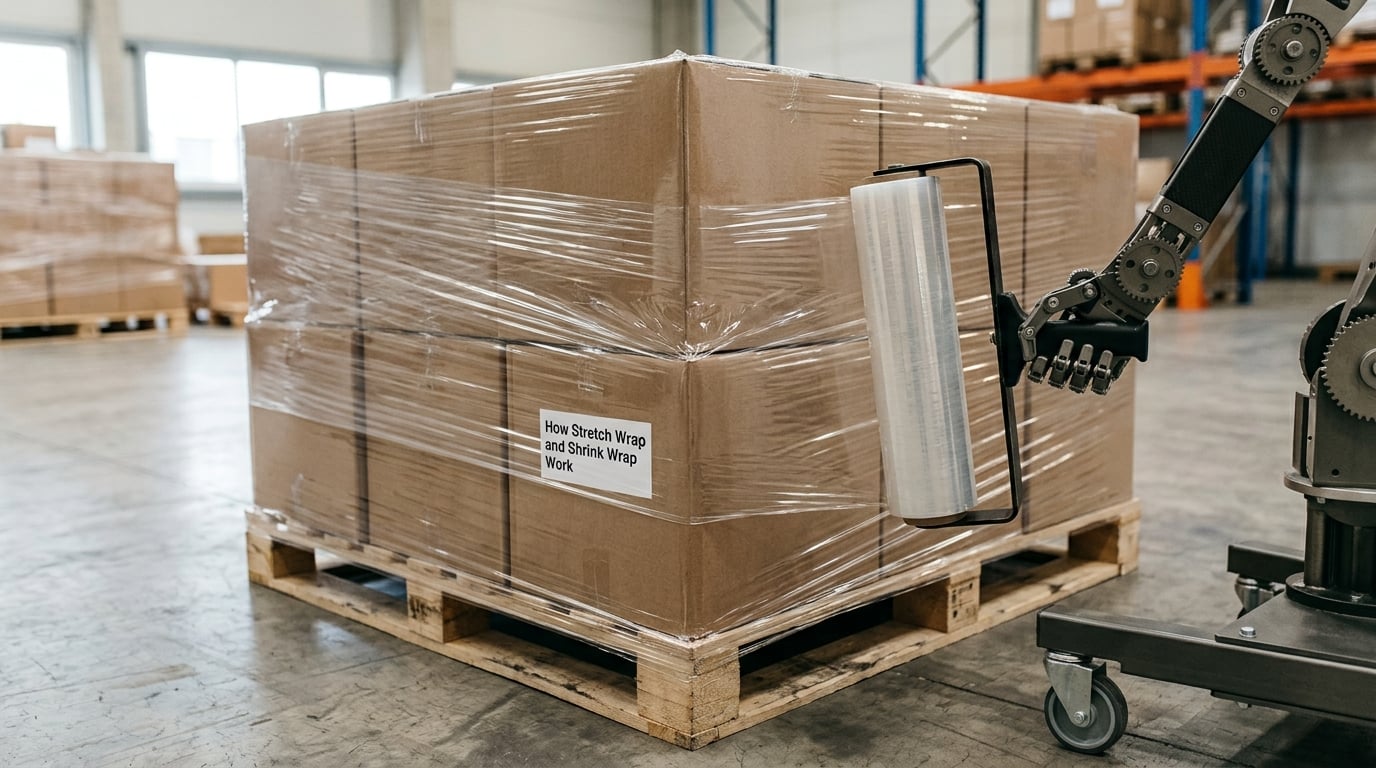
Stretch film works by mechanical force. As the roll turns, the film is pulled past a pre-stretch roller and stretched before it lands on the load. The film then tries to return to its original length, and that elastic recovery is what builds tension band after band until the whole load is squeezed onto the pallet.
That squeeze is the whole point. A taut wrap presses boxes and cartons together, so the stack behaves as one mass instead of a column of separate items waiting for a pothole.
Shrink film works by heat. You put a loose bag or hood over the load, blow hot air across it, and the film shrinks toward the shape of whatever is underneath, typically somewhere between 100 and 150C. Once it cools, the contraction locks in and the package is stiff and tight.
The film also clings to itself, which is where the confusion starts. It forms a genuinely tight package, so the load looks secure, but that seal says nothing about whether the boxes inside are bound to the pallet.
Which is exactly the point one poster on r/OSHA was making about a tipped load: the film everyone called shrink wrap was stretch wrap, and the terminology gap is why facilities order the wrong roll for the job.
Strength, Stability, and Load Protection
Stretch film carries load through tension. Cast film stretches further and clings tighter, which suits tall or irregular stacks, while blown film is tougher in the direction that resists punctures, which suits loads with sharp corners or rough boards. Gauge is the thickness, usually quoted in microns or in the older gauge system, and heavier loads need heavier film and more layers.
Load shift is where the difference becomes obvious. A well-applied stretch wrap keeps cartons locked to the deck, and users in the field consistently report that it holds a load to the pallet better than strapping alone. A shrink-wrapped load that has shifted internally can look perfect from the outside and still have a leaning stack inside, and the film will not warn you.
Neither method is free of failure. Too little tension and the wrap looks fine but the load walks and eventually tips. Too much tension and the boxes take the load instead of the film, so corners crush and cartons deform under a wrap that looks tight and reassuring. That crush pattern is a load shift that has not happened yet.
Edge retention is the other quiet factor. Stretch film grips the pallet deck and the bottom course of boxes, so it holds the full stack together. Shrink film on a load with gaps and voids bridges those gaps instead, which is fine for presentation and useless for stability.
For barrier performance, shrink film wins on a sealed package. Once heat-shrunk it resists dust, splash, and light tampering, and it keeps rain off a load sitting on an open dock. For outdoor storage over weeks, a UV-stabilized film matters more than the wrap method, whichever one you pick.
Stretch Wrap vs Shrink Wrap: Equipment and Process
Stretch wrapping runs on a small ladder of equipment. A hand dispenser suits low volume and one-off loads. A pallet turntable and a manual arm lets one operator wrap a load while it rotates. Automatic pallet wrappers take it further, with pre-stretch, variable layer counts, and cycle times in the range of under a minute for a standard load once the settings are dialled in.
Shrink wrapping asks for more from the building. A heat gun works for a small number of loads but depends entirely on the operator’s technique. A shrink tunnel is a fixed piece of equipment that needs power, floor space, a conveyor or cart in and out, and a warm-up cycle, and it only suits loads of roughly consistent size. A hood applicator drops a pre-sized hood over the pallet and shrinks it in place, which is the standard setup for retail and export shipments.
Labor tells the same story. A stretch-wrapped pallet is one cycle on a machine while the operator walks to the next load. A shrink-wrapped pallet is a hand or mechanical step, then a heat pass, then a cool-down before the load can be handled safely.
Which Method Looks Better on a Pallet Load?
Shrink film wins the appearance comparison, and it is not close. Heat-shrunk film is glossy and pulls tight into corners, so a display pallet looks finished. Stretch film is clear and functional, and heavily stretched film goes cloudy, which is why retail display pallets rarely get stretch-wrapped unless nobody has told them how it will photograph.
Shrink film also seals the bottom, so dust and insects stay out during long storage. Stretch wrap leaves open gaps at the base of the load, and it collects dust over time, which matters in food-grade environments where the wrap is not the main concern but the appearance is.
For handling and transport, appearance is close to irrelevant. A load that arrives in one piece is a better outcome than a beautiful load that tipped, and utilities on a yard truck are never impressed by gloss.
Cost, Film Usage, and Operating Considerations
Film is the visible cost, and stretch film usually wins that line because it uses more of it. A standard pallet wrapped to a 50 percent overlap typically consumes on the order of 800 to 1000 feet of 80 gauge film, while a shrink hood or bag covers the load with a single pre-sized piece.
Shrink film only looks cheaper if you ignore the rest of the bill. Heat equipment brings capital cost, three-phase power, floor space, maintenance, and warm-up time, and it ties up a bay that does nothing else while a load cools. Users comparing the two methods on real facilities keep landing on the same conclusion: shrink wrap is not cheaper once the equipment is counted.
Stretch film has its own hidden costs, mostly from doing it badly. Too few layers, too little overlap, and no edge protection means damage claims and tip-overs, and those cost far more than the extra roll. Upgrading gauge on a heavy or sharp-cornered load is usually cheaper than replacing crushed product.
On volume, automatic wrapping pays for itself on consistent, repeatable loads, while a heat tunnel only makes sense when the pallet mix is narrow and the volume is high enough to keep it running. Both methods vary by load size, facility volume, labor rates, and local energy costs, so a figure from another facility is a starting point, not an answer.
Both films are polyethylene and recyclable in the same streams, and post-consumer recycled content is available in both. A stretch wrap load can be collected by a recycling partner or handed to a reuse program, and a reusable wrap system trades a large upfront cost for many cycles when the loads are consistent and return on a regular route.
Which Should You Choose?
Choose stretch wrap when the load is moving through handling. That covers warehouse and 3PL palletizing, manufacturing outbound, cross-docking, and road transport on open trailers. It handles irregular and tall loads, it is fast, and the equipment footprint is small enough to fit into most dock layouts.
Choose shrink wrap when presentation and tamper resistance are the priority. That means retail display pallets going to a store floor, export and sea freight loads that sit in a container or on a dock for weeks, closed trailers, and goods where a broken seal is a problem. Retailers and shippers routinely over-wrap display pallets because nobody has explained that a shrink wrap will not secure the stack underneath it, so build the stack well and add edge protectors first.
Sometimes the answer is both. Stretch wrap the load, then drop a shrink hood over it for a retail-facing or high-risk shipment, which is a common hybrid and gets you load security plus a clean exterior. Strapping, corner boards, slip sheets, fabric wrap, and reusable wrap systems are the other options, and each trades speed for containment, reusability, or appearance in a different balance.
Frequently Asked Questions
Is stretch wrap or shrink wrap better for pallet loads?
Stretch wrap is better for most pallet loads. It binds the product to the deck and controls load shift during handling and transit, which is the failure that causes damage and tip-overs. Shrink wrap is better when presentation and tamper resistance matter, such as retail display pallets, export loads, or long outdoor storage, because heat-shrinking a load makes it tight, glossy, and difficult to open without obvious damage.
What is the difference between stretch wrap and shrink wrap?
Stretch wrap is LLDPE polyethylene film that is pulled tight around the load with mechanical tension, and its elastic recovery holds the stack to the pallet. Shrink wrap is a polyolefin film draped loosely over the load and heated to about 100-150C, where it contracts to fit the shape underneath and is cooled to lock in tension. One works by force, the other works by heat.
Can shrink wrap be used without a heat tunnel?
Yes, but only in certain situations. A heat gun or shrink lance can shrink a small number of loads by hand, and a pre-sized hood that is already close to the final dimensions can go on with less heat than a loose bag. A loose film bag over a full pallet needs controlled, even heat and a cool-down period to set, and doing that by hand is slow and inconsistent on a busy dock.
Which film provides better load stability for warehouse shipping?
Stretch film provides better load stability. Tension from wrapping presses the boxes together and grips the pallet deck, so the load behaves as one mass and resists shifting. A shrink-wrapped load can shift internally while still looking tight and undamaged from outside, because the film seals the package rather than binding the contents to the pallet. For irregular or top-heavy loads, add edge protectors and extra layers.
How many layers of stretch wrap are needed for a pallet load?
A stable, square, evenly weighted load usually needs three to four layers at a 50 percent overlap, with the bottom two anchored to the pallet. Heavier loads, tall stacks, sharp corners, and irregular builds need more film and often a higher gauge, plus edge protectors. Judge the result by feel rather than count: the wrap should be tight enough that the film does not slide when you push the top of the stack.
Can stretch film and shrink film be used on the same pallet?
Yes, and many facilities do it deliberately. Wrap the load in stretch film first to secure the boxes to the deck, then apply a shrink hood over the top for a retail-facing or high-tamper-risk shipment. You get load containment from the stretch film and a clean, sealed exterior from the hood. The order matters, because the shrink layer cannot fix a load that was already stacked badly.
Conclusion
Stretch wrap secures the load, shrink wrap seals and presents it, and that single difference decides almost every pallet job. Before you buy film, look at the load shape and weight, the environment it will sit in between pallets, the equipment and space you have, and how much the appearance matters to the receiver.