
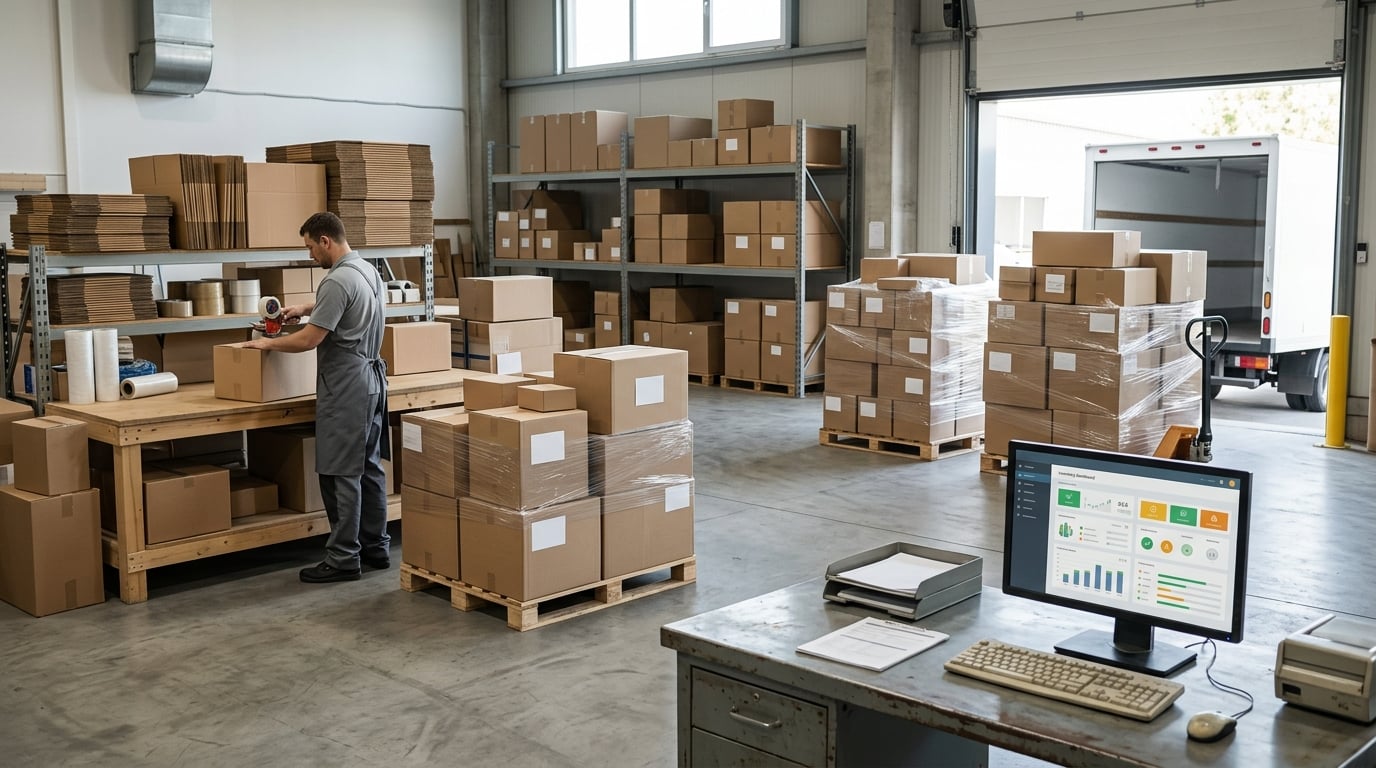
If you are weighing how to choose between 3PL and in-house fulfillment, the honest answer is that order volume decides most of it, and the pick-and-pack fee decides almost none of it. Most brands cross over somewhere between 200 and 500 orders a month, but the two models can tie at any volume once you price in carrier discounts, founder time, and the software you would have to buy yourself.
I have watched operators run this same comparison for weeks, building spreadsheets that carefully count pick fees and quietly ignore the eight other lines that actually move the number. The brands that get it right spend an afternoon writing down their real order profile, then compare fully loaded cost on both sides.
This guide walks through that comparison: what each model actually includes, where the costs hide, what control really costs you, and how to tell whether a hybrid arrangement makes more sense than picking one side.

Table of Contents
- How to Choose Between 3PL and In-House Fulfillment at a Glance
- What Is the Difference Between 3PL and In-House Fulfillment?
- Cost and Contract Requirements
- Control, Flexibility, and Service Quality
- Scalability, Technology, and Inventory Visibility
- Which Should You Choose?
- Frequently Asked Questions
- Conclusion
How to Choose Between 3PL and In-House Fulfillment at a Glance
The fastest way to narrow this down is to compare the two models line by line. Everything below is a real difference in cost structure and operational behavior, not a preference.
| Criterion | In-house fulfillment | 3PL fulfillment |
|---|---|---|
| Who owns the space | You lease or own it | The partner does |
| Cost shape | Mostly fixed: lease, salaried staff, equipment, software | Mostly variable: per-pick fees, storage, receiving, pass-throughs |
| Per-order cost below 200 orders a month | Cheaper on paper, once the fixed stack is spread thin | Usually higher, because minimums apply |
| Per-order cost above 1,000 orders a month | Flat cost falls sharply, but labor scales linearly | Flat per-pick rates plus volume carrier discounts |
| Control of packaging and process | Total, down to the tape | Whatever the agreement and the setup allow |
| Peak season capacity | You hire, train, and let people go | Existing staff, contracted for the rush |
| Technology | You select, buy, and maintain a WMS | Usually included, sometimes with integration fees |
| Carrier rate access | Retail rates, negotiated alone | Contracted rates across many carriers |
| Inventory visibility | Direct, if your counting is disciplined | Depends on on-hand file quality and reconciliation |
| Returns and reverse logistics | You decide the disposition | Often priced per return, sometimes per inspection |
| Commitment | Lease terms | Term contract, minimum monthly spend, storage minimums |
| Best fit | Low-to-moderate volume, unusual orders, tight margins | Growing volume, multi-channel, peak-heavy, multi-zone shipping |
Two rows on that table drive most decisions: the cost shape and the carrier rate access. The first explains why low volume favors in-house. The second explains why high volume eventually favors the partner, and it has almost nothing to do with pick fees.
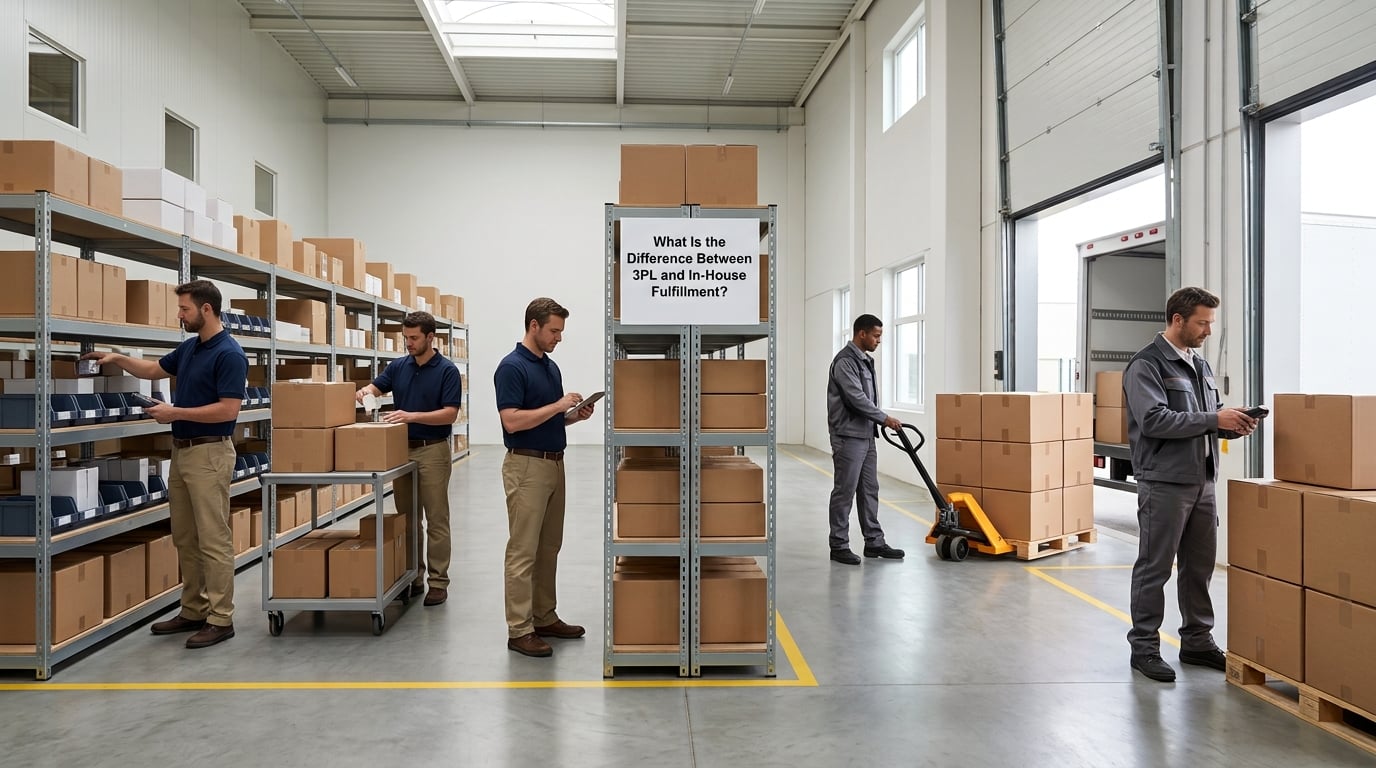
What Is the Difference Between 3PL and In-House Fulfillment?
In-house fulfillment means you own the operation: your space or a leased unit, your pickers and packers, your warehouse management system, your carrier accounts, and the responsibility for everything that goes wrong. A 3PL fulfillment partner does the same physical work inside its own facility, using its own staff, equipment, and carrier contracts, and bills you for the pieces it handles.
In-house fulfillment (self-fulfillment)
Self-fulfillment works because you can change anything without asking permission. That matters more than most guides admit, especially when your product is odd: kitted sets, personalized items, oversized pieces, fragile glass, case-pack wholesale, or something a generic warehouse would rather not touch.
You also keep the customer relationship’s tactile part. Branded packaging, a handwritten note, a surprise insert, a video in the box. Nobody has to approve it because there is nobody to approve it.
3PL fulfillment (third-party logistics)
A third-party logistics provider stores your inventory, receives inbound freight, picks and packs, prints labels, hands parcels to carriers, processes returns, and reports on all of it. You keep ownership of the goods. You give up daily control of the process and gain capacity you have not had to hire for.
The partner also brings something you cannot buy as a small shipper: negotiated carrier rates. A single account moving a few hundred parcels a month gets retail pricing. A partner moving that volume for dozens of clients gets contract pricing, and it passes some of that along.
The hybrid fulfillment model
A hybrid splits the work by order type rather than by company. Standard DTC parcel orders go to a partner while wholesale case-pack orders, kits, or personalized projects stay in-house. Brands running wholesale and retail accounts alongside a Shopify store use this arrangement and report it as manageable, provided the routing rules are written down before inventory moves.
Cost and Contract Requirements
Cost is where most comparisons go wrong, because both sides get counted partially. A 3PL quote often hides fees behind a headline pick rate. An in-house estimate often counts payroll and stops there. Neither is a useful number.
What in-house fulfillment really costs
Here is the full stack most people forget when they estimate in-house cost per order:
- Space. Industrial rent, plus utilities, property insurance, and maintenance on the unit.
- Labor. Hourly wages for pickers and packers, but also the receiving and returns work nobody counts as a pick.
- Payroll taxes and benefits. In most states these add a meaningful percentage on top of every wage, and they do not shrink when volume dips.
- Equipment. Packing tables, printers, scales, scanners, carts, a forklift or two, shrink wrap, a label printer that jams on the last big day.
- Software. A WMS, an account, implementation, and someone to keep it running.
- Management time. A real supervisor, or a founder doing supervision between other founder tasks.
- Recruiting and turnover. Fulfillment work churns. Every replacement costs training hours and ramp-up errors.
- Carrier rates. Whatever you can negotiate alone, which is usually a retail rate card.
- Opportunity cost. The hours you are not spending on marketing, product, or wholesale accounts because you are standing at a packing table.
That last line is the one operators argue about most, and it is the one that most often flips the answer. If a founder is doing fulfillment at 200 orders a month, that is roughly a full working day a week spent on a task a warehouse does better.
What a 3PL bills you for
3PL fulfillment is billed in components, and you should ask for every one of them in writing before you sign:
- Receiving fees, sometimes per pallet, per carton, or per labor hour, and sometimes all three.
- Storage, charged per pallet per month, per cubic foot, or per shelf location, often tiered so that slow-moving inventory costs more.
- Pick and pack, per order line or per order, with a separate fee for each additional item.
- Supplies, including boxes, tape, void fill, and the label stock.
- Pass-through shipping at your carrier rate or the partner’s negotiated rate, depending on the agreement.
- Returns processing, charged per unit received plus disposal, rework, or restocking labor.
- Minimum monthly spend, sometimes with a separate storage minimum that persists even in a slow month.
- Integration and onboarding, which can be a flat fee, an hourly project, or waived entirely.
Ask about surcharges too: peak season fees, residential delivery surcharges, oversize and additional-handling charges, address correction, and reweigh fees. Brands report that unexpected surcharges appearing on invoices is one of the most common complaints about working with a partner.
Where the crossover point usually sits
For most brands, the crossover sits between 200 and 500 orders a month, and the exact figure depends on your order profile rather than your order count. Ten orders of thirty items each is a very different workload from thirty orders of one item each.
The number that moves the crossover is orders per month relative to your fixed stack. At low volume, in-house fixed costs spread across few orders produce a high per-order figure, while the partner’s minimums do the same thing. As volume rises, the fixed costs wash out on both sides and what remains is the pick fee plus labor on one side, and the pick fee plus a better carrier rate on the other.
Two more effects push the crossover lower than people expect. The first is shipping zone spread: a single origin serving customers coast to coast pays zone 8 on a large share of orders, while a multi-location network cuts that. The second is peak season, when in-house means hiring and training temporary staff weeks before they are productive.
Contract terms that decide the outcome
The contract matters as much as the rate card. Look at term length, notice periods, minimum monthly spend, storage minimums, liability for loss or damage, insurance requirements on your inventory, audit rights, and what happens to your goods if the relationship ends.
Exit terms deserve particular attention, and they are usually glossed over. Ask how much notice is required, whether you can move inventory out on your own timeline, and whether there is a termination fee. Brands that switched later report that the exit conversation was harder than the signing.
Control, Flexibility, and Service Quality
Control is the honest dividing line. In-house fulfillment gives you total authority over procedure, staffing, packaging, carrier selection, exception handling, and what a customer hears when something goes wrong. A partner gives you influence, which is different and often enough.
Where in-house wins
Consistency is the real prize when you own the operation. You decide what goes in the box, how fast a priority order moves, and how a damaged item is handled. For a brand whose product is unusual, that control is not a nicety. Kitting, personalization, and wholesale case-pack work all require someone to make judgment calls during the day, and judgment calls travel badly through a ticket queue.
Custom packaging also belongs here. Branded boxes, tissue, inserts, and a printed card are cheap to do in-house and surprisingly hard to outsource, partly because the partner supplies the packing materials and partly because setup changes take time you may not have.
Small volumes are another clear win. Below roughly 200 orders a month, a partner’s minimums can exceed what the whole operation costs you to run, and at that level the founder or a part-time helper is often the most efficient labor you can hire.
Where a 3PL wins
A partner wins on consistency at volume. Twenty pickers working the same process produce steadier throughput than two pickers and a founder who is also trying to run the business. Order accuracy and ship-time targets get written into a service level agreement, which converts a vague hope into something with a remedy attached.
Exception handling is the second win. A lost parcel, a delivery attempt, a customer calling about a lost parcel: in-house, that is your problem and whoever picks up the phone. With a partner, it is a defined process, and better ones hand you a named contact instead of a ticket queue. Owners on both sides of this decision treat a named person as a bigger deal than a slightly lower rate.
Carrier relationships are the quiet third win. Negotiating rates, filing claims, and managing fuel surcharge adjustments are a full-time discipline at scale, and a partner already has the volume to make those conversations productive.
Scalability, Technology, and Inventory Visibility
Scalability is not just about adding staff. It is about adding staff, space, systems, and carriers at the same time without everything breaking, and that is where the two models separate most sharply.
Scaling through peak season
In-house fulfillment scales linearly. Another 2,000 orders in November means another 2,000 orders of picking, packing, and shipping, which means more hours, more space, and usually temporary hires who need training before they are fast. Owners describe the last two weeks of the year as the most expensive weeks of the year.
A partner scales the way a business with other clients on your category scales: they already hired, already bought the extra trailer hours, and already know which carriers get tight. Several sellers have said the 3PL costs them more per order and earns its keep entirely in the fourth quarter.
Technology and integrations
In-house means picking and implementing a WMS yourself, then keeping it integrated with your storefront, your marketplace listings, your accounting, and your customer support tool. Budget for the integration work, not just the license. Once it is running, you own the reporting, and reporting quality depends on whether anyone owns cycle counting.
A partner usually includes the WMS in the per-order fee and has already built connectors for the major storefronts and marketplaces. Multi-channel sellers on Shopify plus Amazon plus a marketplace report that partner integrations are easier than building the same connections themselves.
For wholesale and retail accounts, ask specifically about EDI. Transaction sets such as the 850 purchase order, the 855 acknowledgement, the 856 shipment notice, and the 810 invoice are routine work for some partners and unfamiliar territory for others. Retailer routing guides add another layer. Brands with real retail accounts describe messy EDI orders and routing requirements as a top operational frustration, and they are right to raise it before signing rather than after.
Inventory accuracy is the hidden test
This is where the decision often gets decided without anyone planning it. In-house, inventory accuracy depends on your own counting discipline: cycle counts, disciplined receiving, and a clear rule for damaged goods.
With a partner, accuracy depends on the on-hand file quality and on whether you reconcile it. Owners report that partner inventory reports need manual reconciliation every week, that inventory in transit between locations shows up in neither system, and that overselling shows up first at the worst possible moment. Ask how inventory is reported, how often, and what happens to your available-to-sell balance when a cycle count disagrees with the system.
One more number worth asking about is the order-to-SKU ratio. Some partners require four or five orders for every SKU they hold, because a catalog-heavy brand with many slow-moving SKUs costs them far more to manage than it pays. If your ratio is below that, expect to be told you are not a fit, which is better to learn during a sales conversation than during onboarding.
Which Should You Choose?
Use your order profile rather than a rule of thumb. Here is the framework I would walk through.
Choose in-house fulfillment when
- You are under about 200 orders a month, or the volume is irregular enough that fixed costs hurt.
- Your orders need kitting, personalization, or case-pack wholesale handling that a generic warehouse would push back on.
- Packaging and the unboxing experience are a deliberate part of your positioning.
- Product shape, fragility, or temperature requirements rule out shared warehouse space.
- Margins are thin enough that variable fees per order cannot be absorbed, even at a partner’s better carrier rate.
- Someone on your team genuinely wants to run fulfillment and has the hours to do it.
Choose a 3PL when
- You are growing past 500 orders a month, or growth is fast enough that hiring ahead of demand is frightening.
- Peak season represents a large share of annual revenue.
- You sell across multiple channels and want the marketplace and storefront integrations handled for you.
- Your customers sit far from you and shipping zone spread is eating margin.
- Retails, direct-to-consumer, and returns all need to run at once without the team doubling in size.
- Founder and team time is better spent on product, marketing, and wholesale relationships.
- You want carrier contract pricing you cannot get as a single account.
Run a hybrid when the order types are genuinely different
A hybrid makes sense when your orders do not share a profile. Keep wholesale case-pack orders, kits, and personalized work in-house, and send standard DTC parcel orders to a partner. Write the routing rules before inventory moves: order type, channel, and destination decide who handles it.
Two warnings on hybrids. First, split shipments get worse when inventory sits in two places, so set the allocation rule in advance and keep a single source of truth for available-to-sell inventory. Second, watch the contract terms of both sides, because two vendors means two minimums and two sets of surcharges.
Know when to switch
Switching is not a verdict on your current setup, it is a response to a trigger. Common ones: order volume passing 400 a month and climbing, a warehouse lease renewal coming up, a peak season that broke the operation, a carrier contract you can no longer match, or a team that is exhausted. Founders who moved to a partner usually point at time saved rather than money saved as the return, which is worth weighing honestly if you enjoy the work.
If you do switch, sequence it carefully. Freeze new orders, count inventory against the physical count, confirm the partner’s on-hand numbers match before moving a single pallet, and keep your storefront from accepting orders until live inventory in the new system has been verified. Overselling during cutover is the most common complaint about the transition, and it is entirely preventable.
Frequently Asked Questions
What are the disadvantages of using a 3PL?
The main drawbacks are loss of daily control, per-order fees that run higher at low volume, minimum monthly commitments, and dependence on someone else’s reporting accuracy. You also give up direct control over packaging and exception handling, and you inherit surcharges such as peak season and residential delivery charges that you did not negotiate directly. None of these are dealbreakers, but they belong in the calculation.
What is the typical fulfillment fee for a 3PL service?
Fees are quoted per order and broken into components rather than one number. A partner typically charges receiving fees, monthly storage per pallet or location, a pick and pack fee per order, supplies, pass-through shipping at your or their carrier rate, and per-unit returns processing. Always ask for surcharges and minimums in writing, because the headline pick rate rarely describes the full invoice.
What does 3PL fulfillment mean?
3PL fulfillment means an outside company stores your inventory, receives inbound freight, picks and packs orders, hands parcels to carriers, and processes returns on your behalf. You keep ownership of the goods and pay per-order and storage fees. In exchange, you gain capacity, staffing, technology, and carrier rates you would struggle to negotiate as a single shipper.
Is a 3PL the same as a warehouse?
No. A warehouse is the space. A 3PL is the company providing the space, the labor, the systems, and the carrier relationships, and it usually operates its own facility with many clients inside it. That distinction matters because a 3PL can move your inventory between its own locations, add staff for peak, and handle returns without you managing any of it.
How does a 3PL make money?
A 3PL earns on the fees it bills each client: receiving, storage, pick and pack, packaging supplies, value-added services like kitting, and returns processing. On shipping, the partner either passes the cost through at your rate or retains a spread on negotiated rates. Volume discounts improve as you grow, so the account that cost a partner little at 200 orders a month is more valuable to them at 5,000.
When should an ecommerce brand switch to a 3PL?
Most brands switch somewhere between 200 and 500 orders a month, or earlier if peak season carries a large share of annual revenue. Other triggers: a lease renewal coming up, orders spread across multiple channels, shipping zone spread hurting margin, or founders and staff spending more time packing than growing the business. Compare fully loaded cost on both sides before deciding, not just the pick fee.
Conclusion
Pick a model after you have written five numbers on paper: your average orders per month, your average order line count, your share of revenue that lands in the fourth quarter, your fully loaded in-house cost per order including management time, and your realistic 3PL cost per order at the same volume with every surcharge listed.
If the two land within a few percent, decide on control and capacity rather than arithmetic. Unusual orders, custom packaging, and thin margins argue for in-house. Growth, multiple channels, peak dependency, and shipping zone spread argue for a partner. When your wholesale and DTC orders do not look alike, a hybrid with written routing rules beats both.
Then run the numbers again in 2026, because volume changes faster than contracts do.