
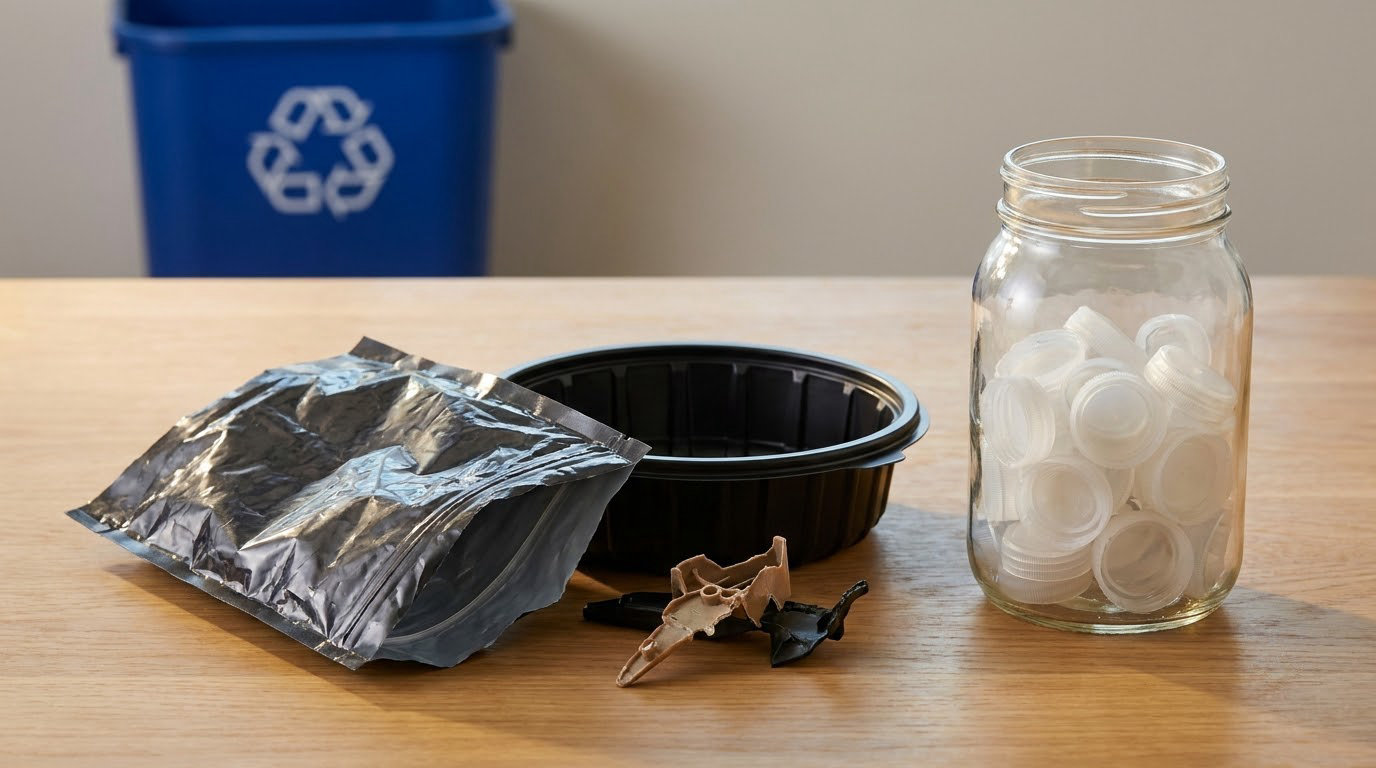
Some plastics cannot be recycled because the recycling loop needs a clean, single-polymer stream that a processor can sort, melt, filter and sell. It fails when the chemistry cannot be reversed, when materials are fused together or too contaminated to separate, or when nobody will pay for the recovered output. Every claim on a label is a promise about chemistry, and most rejections are about logistics and money.
It helps to picture recycling as a chain with five links: someone collects the material, a sorting facility identifies it, a processor cleans and regenerates it, a buyer pays for the bale or flake, and a converter turns it into a new product. Break any one link and the material leaves the loop. That is why the same polymer can be a success in one stream and a failure in another, and why a resin code on a bottle tells you far less than people assume.
The rest of this guide works through the seven causes in order of how often they end a recovery attempt, with the resin chemistry behind each one.
Table of Contents
- What Does It Mean for a Plastic to Be Recyclable?
- Which Plastic Resins Are Commonly Recycled?
- Why Some Plastics Cannot Be Recycled
- Why Contamination and Mixed Materials Reduce Recycling Yields
- What Is the Difference Between Technical and Economic Recyclability?
- How Manufacturers Can Improve Plastic Recyclability
- Frequently Asked Questions
- Conclusion
What Does It Mean for a Plastic to Be Recyclable?
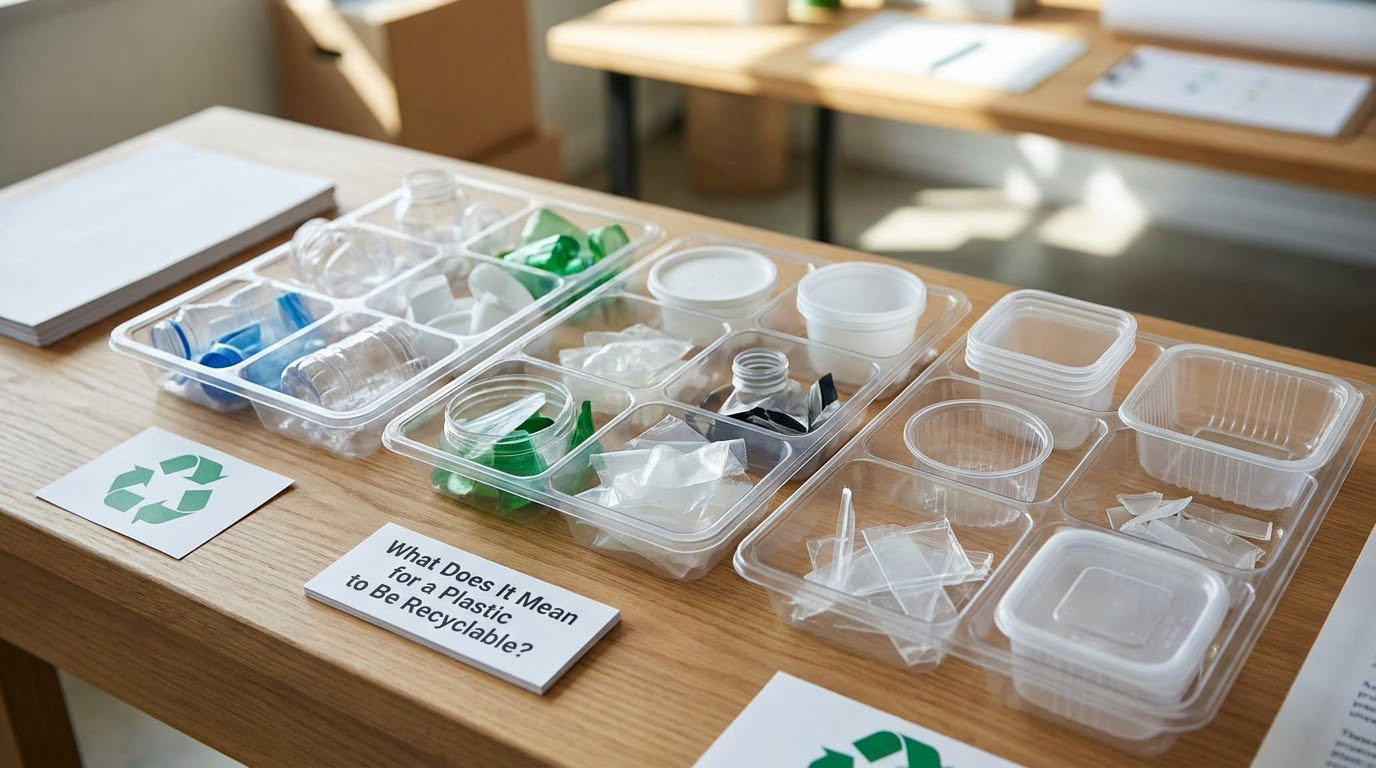
A plastic is technically recyclable when its polymer can be melted and remoulded without destroying the chain of molecules, or when a chemical process can rebuild the original monomer from it. It is economically recyclable when doing all of that collection, sorting, washing, colour removal, transport and reprocessing costs less than the recovered material is worth on the open market.
It is routinely recycled when both of those are true in practice, at scale, in the streams that actually exist. That third category is much smaller than the first two, and it is the one that determines what happens to the item in your bin this week.
The distinction matters because the first two change with the item’s form, colour, size and cleanliness, not just its chemistry. A clear PET beverage bottle is a high-grade, food-contact stream with a deep market. A PET tray from a ready meal is the same polymer, but the black dye, the multilayer lid and the food residue push it into a different and much weaker stream.
That is the single most useful idea in this article: recyclability is stream-specific, not resin-specific. A material can be fully recyclable in theory and worthless in the stream you actually produce.
Which Plastic Resins Are Commonly Recycled?
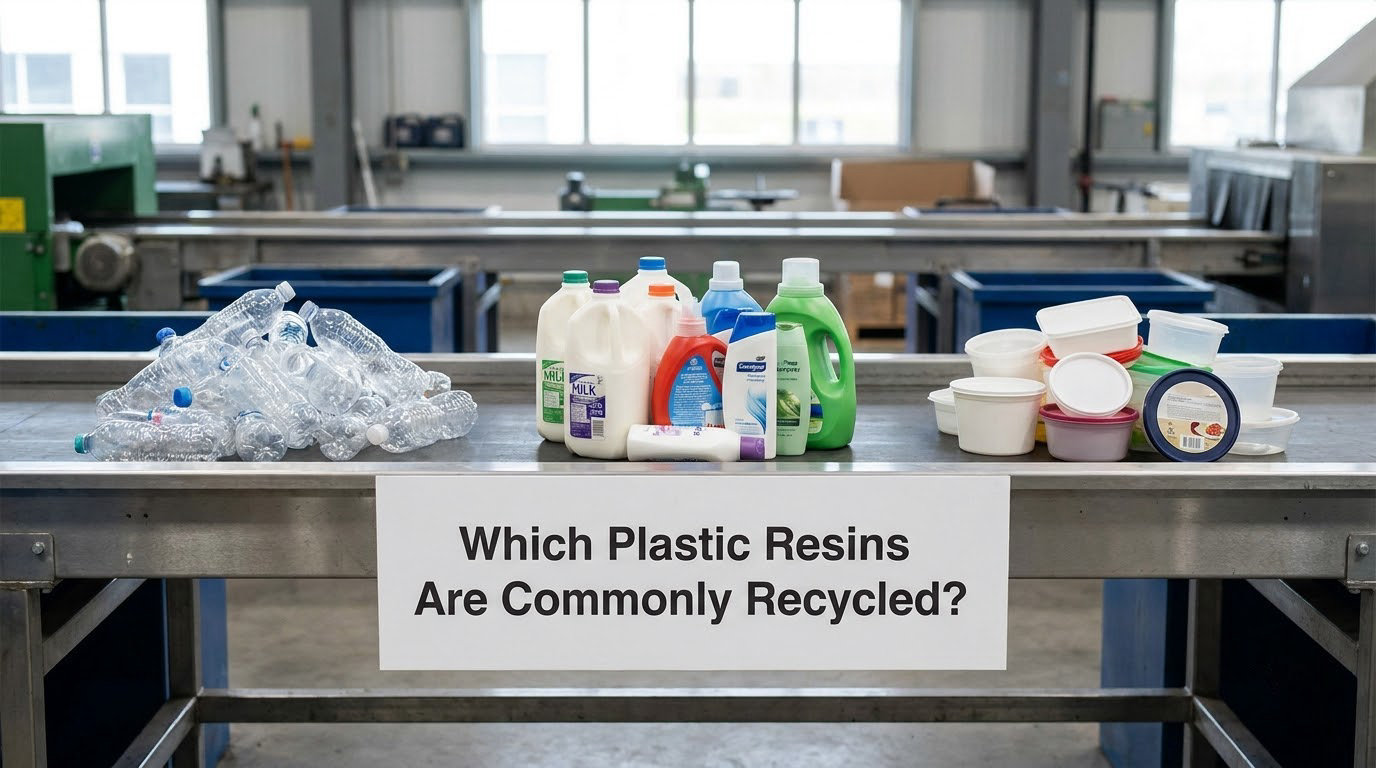
Only two resin families have dependable end markets in most curbside systems: PET and HDPE. Everything else is recovered somewhere, but the destinations are narrower, the buyers more specialised, and the specifications tighter. The table below shows the practical picture rather than the label claim.
| Resin | Typical applications | Status in mainstream systems | Main limitation |
|---|---|---|---|
| PET | Beverage bottles, food trays, clamshells, polyester fibre | Routinely recycled; the deepest and most stable market | Trays and clamshells are usually coloured or multi-material, so they leave the bottle stream |
| HDPE | Milk jugs, detergent bottles, caps, drums, pipe | Routinely recycled; strong demand for non-food uses | Coloured and opaque grades sort together and are judged more strictly |
| LDPE | Film, bags, liners, stretch wrap, flexible packaging | Recovered mainly through store drop-off programmes | Film tangles around sorting equipment, so it is banned from curbside bins |
| PP | Caps, tubs, crates, straws, food containers, textiles | Growing; accepted in many curbside programs | Often collected as a low-grade mix with limited food-contact outlets |
| PS | Packaging foam, rigid trays, cups, insulation, cases | Limited; EPS foam needs densification before transport pays | Light, brittle and expensive to move; very low value per tonne |
| PVC | Pipe, conduit, blister packs, cling film, medical and chemical containers | Mostly excluded from curbside; specialist recovery only | Chlorine contaminates an entire PET or HDPE batch, and heating PVC releases harmful gases |
| ABS | Appliance housings, car parts, safety helmets, pipe fittings | Closed-loop take-back in industry; rarely curbside | Heavily blended with other polymers and glass fibre, which is hard to remove |
| Polycarbonate | Drinking bottles, safety glasses, housings, lenses | Technically recyclable, rarely collected | Part of resin code 7, which mixes many different polymers into one category |
| Bioplastics (PLA, PHA, starch blends) | Compostable cutlery, films, coatings, printed parts | Not recycled in curbside systems; usually routed to industrial composting | Contaminates conventional streams and needs controlled conditions to break down |
The Resin Identification Code, standardised as ASTM D7611, sits inside the chasing-arrows symbol and tells you which polymer family the item was made from. It also has a second value: number 7 means the item is made of more than one material, which is the code’s way of saying the layers cannot be separated economically.
What the code never tells you is whether the item is accepted where you live, whether its form suits the equipment, or whether a buyer exists for the colour and grade you produce. A resin code is a chemistry label, not a recycling grade, and treating it as a promise is the origin of most wishcycling.
Why Some Plastics Cannot Be Recycled
Strip away the confusion and there are seven causes. Most items that fail do so because of the first four, which are physical and chemical problems, while the last three are commercial problems that can end a technically sound material just as effectively.
- The polymer chemistry cannot be reversed. Cross-linked thermosets such as epoxy, polyurethane, phenolic and melamine form permanent covalent bonds between chains. Heat does not soften them, it destroys them, so the item cannot re-enter a melt stream no matter how clean it is.
- The material degraded during use. UV exposure, thermal ageing, repeated processing, hydrolysis and chain scission shorten the polymer chains. A degraded part reaches its melt strength limit earlier, discolours and embrittles, and often fails the buyer’s specification.
- Contamination ruins the batch, not just the item. Food residue, liquids, textiles and dirt raise ash and moisture content, which is exactly what reprocessors sell material on. One bad load can downgrade an entire bale.
- Separation is physically impossible or uneconomic. Multi-layer laminates, bonded multi-material parts, and non-black pigmented plastics defeat density separation and optical sorting. A thin polymer, an aluminium layer and an adhesive cannot be peeled apart at commercial speed.
- Additives and fillers are incompatible with the new process. Flame retardants, plasticisers, stabilisers, glass fibre and pigment carry through each cycle and can block filters, raise viscosity, or make the regrind unsuitable for the intended application.
- Processing costs exceed the value of the output. Collection, sorting, washing, colour removal, densification and transport all cost money, and for light or low-grade material the bale can be worth less than the handling.
- No end market exists at the required quality. Buyers specify colour, intrinsic viscosity, ash content and contamination limits. When no buyer will pay for the grade produced, material is discarded before it is even reprocessed.
How Polymer Structure and Processing Affect Recycling
A thermoplastic holds its chains together with weak secondary bonds, so heat lets them slide past each other and the solid softens into a melt. Once cooled and moulded again, it behaves almost like the original part. That reversibility is the entire basis of mechanical recycling.
A thermoset is different. During curing, reactive groups on neighbouring chains form permanent covalent bonds, and the network is locked in place. The butter versus hard-boiled egg analogy works for the first stage: butter softens and re-forms, and a cooked egg does not. The chemistry is harsher than the analogy suggests, because heating a thermoset does not merely stop it melting, it decomposes the polymer into gases, char and corrosive acidic vapours.
| Property | Thermoplastic | Thermoset |
|---|---|---|
| Bonding between chains | Weak secondary bonds that break and reform | Permanent covalent cross-links |
| Behaviour on heating | Softens into a melt, can be remoulded | Does not melt; decomposes into gases and char |
| Typical examples | PE, PP, PET, PVC, PS, polycarbonate | Epoxy, polyurethane, phenolic, melamine, unsaturated polyester |
| Common uses | Bottles, films, packaging, pipe, automotive panels | Composites, electronics housings, coatings, adhesives |
| Recycling route | Mechanical melt processing, sometimes depolymerisation | Limited to filler reuse or chemical feedstock recovery |
Even within a thermoplastic, structure decides the outcome. Crystallinity changes the melting range and shrinkage, so highly crystalline grades need tighter temperature control than amorphous ones. Molecular weight governs strength and intrinsic viscosity, and it is the value buyers check first because it cannot be rebuilt by simple melting.
Forming conditions matter as much as the polymer. Excess shear, oxygen and residence time in the barrel break chains during the first moulding, so a well-behaved polymer can already arrive at the recycling line with a reduced molecular weight. Multi-pass processing through extrusion and injection then subtracts more, which is why mechanical recycling produces a downward quality spiral rather than a closed loop.
Each generation loses some intrinsic viscosity, picks up more colour and off-gassing from previous additives, and embrittles. Recyclers manage this with virgin material, chain extenders and blending, which is exactly why most recycled plastic is not food grade even when the resin code says PET.
What the Chemical Chain Does to Sorting Accuracy
Before any of that, the material has to be identified. At a material recovery facility, containers arrive mixed in a single stream and pass through screens, ballistic separators and near-infrared optical sorters. The sorter shines a light at the plastic and reads the absorption pattern the polymer produces, then ejects matching items into the right bunker.
That method fails in three predictable ways. Carbon black absorbs across almost the whole near-infrared range, so black plastic is effectively invisible to the sensor and ends up in the residue. Small items such as caps, straws and rigid rings fall through the screen apertures before reaching the sorter. And film tangles around the equipment before it can be ejected cleanly, which is the technical reason bags and wraps are excluded from curbside collection.
Then there is the sorting error that costs the most. A single PVC item in a PET bale raises the chlorine content, and reprocessors will reject the whole load rather than risk hydrolysing PET into a dark, unusable melt. Municipal guidance often says an item is recyclable while the facility that receives it says something different, and the facility is the one that decides.
| Category | Why it is rejected | What to do instead |
|---|---|---|
| Bags, cling film and bubble wrap | Tangles sorting equipment and jams screen packs; thin film has almost no value per tonne | Store drop-off bins for film, or a manufacturer or retailer take-back scheme |
| Expanded polystyrene foam | Too light to transport economically until densified, and it shatters into blowing agent and beads during shredding | Mail-back programmes, specialist EPS densifiers, or general waste where none exist |
| PVC items and rigid film | Chlorine contaminates PET and HDPE batches; heating PVC releases harmful gases | Hazardous or specialist waste for chemical and medical containers, specialist pipe recovery for construction PVC |
| Multi-layer flexible packaging | Bonded polymer, adhesive and aluminium layers cannot be separated at commercial speed | Store drop-off where accepted; otherwise general waste, and design out the laminate for the next run |
| Black plastic | Carbon black pigment absorbs near-infrared light, so optical sorters cannot identify it | General waste, unless the local program runs a dedicated black plastic line |
| Small rigid formats | Fall through screens, are lost in the process, and have no bale value | Replace with a design that keeps parts attached or offers a return route |
| Compostable and bioplastic packaging | Degrades only in industrial composting conditions, and contaminates conventional streams if it is binned | Certified industrial composting or specialist collection; never curbside |
Why Contamination and Mixed Materials Reduce Recycling Yields
Contamination is easier to describe than to measure. It means anything in the stream that is not the target polymer, or that carries dirt, moisture or ash into the melt. Labels, tape, caps, sleeves, adhesives, food residue, textiles and garden soil all qualify.
None of these is fatal on its own. A little paper fibre can be removed in the wash stage, and a small amount of colour is tolerated in a downgraded grade. The problem is cumulative, because reprocessors sell material on measurable properties: intrinsic viscosity, melt flow index, colour, moisture and ash content.
Wet organic waste raises moisture and produces odours and microbial growth in stored bales. Mixed polymers do not blend, so an immiscible fraction stays as inclusions that weaken the moulded part and raise rejection rates at the end user. Glass, metal and multi-layer film act as contaminants that damage cutting equipment and cause stoppages. The economic result is simple: reprocessors apply a discount for every specification they fail, and if the material misses the buyer’s tolerance, it has no value at all.
What wishcycling does to a whole load of recycling
Wishcycling means putting an item in the bin on the hopeful theory that it is recyclable. The item is a small fraction of the load, but sorting and processing are batch operations, so the consequences apply to the whole bale rather than to the one contaminated object.
Residents describe curbside loads rejected for bags, textiles and mixed trash, and that is the most common complaint in recycling forums. The practical rule is unglamorous: if your program does not list the item on its own accepted-materials page, and you cannot confirm it locally, it goes in the bin. Guessing does not help anyone, and a clean load protects the material of every household on the route.
It also helps to separate the three recycling routes clearly. Mechanical recycling physically separates and melts material, and it needs a clean, sorted, single-polymer stream. Chemical recycling, including depolymerisation and pyrolysis, breaks polymers down to monomers or feedstocks, which widens the feedstock but does not rescue mixed or contaminated streams cheaply. Energy recovery combusts plastic for its energy, which reduces landfill volume but is not recycling and does not recover the material.
What Is the Difference Between Technical and Economic Recyclability?
Most disagreement about plastic comes from collapsing these two ideas into one. A material can pass every chemical test and still have nowhere to go, and the reason is almost always cost rather than physics.
Technical recyclability: the material can be reprocessed
Technically recyclable means a defined process exists that turns the material back into usable feedstock: melting and remoulding, densification, solvent dissolution, or depolymerisation back to a monomer. Engineering teams assess this with specification data, not marketing claims, including intrinsic viscosity, ash content, contamination tolerance, colour range and melt flow behaviour.
Post-industrial scrap sits at the easy end of this spectrum. It is clean, consistent and often made on the same equipment that will reprocess it, which is why closed-loop recovery in packaging and textiles is well established. Post-consumer material is the difficult end, because it arrives mixed, dirty and of unknown age.
Economic recyclability: someone will pay for the output
Economically recyclable means the full cost stack stays below the value of the recovered material. That stack includes collection and transport, sorting and bale formation, washing and deinking, colour removal, densification, reprocessing, testing and certification, plus the cost of rejecting loads that fail specification.
Virgin plastic competes on that calculation every time. Because most virgin resin is made from hydrocarbon feedstocks, cheap oil makes virgin material inexpensive and recycled material hard to sell, and the recycled price can fall below the cost of recovering it. Rules that mandate recycled content or extended producer responsibility change this balance, which is why policy is now the main lever manufacturers have.
Sort grades and demand also concentrate. Clear PET bottle grade attracts fibre and food-grade buyers, while mixed coloured PET in a bulky rigid mix has few outlets and is often diverted. A material that is technically recyclable may have exactly one buyer, and when that buyer changes grade requirements, the outlet disappears.
For anyone specifying packaging for 2026, the useful question is not whether a material is theoretically recyclable. It is whether the collection stream that receives it, the equipment in that facility, and the buyer downstream all agree on the same specification.
How Manufacturers Can Improve Plastic Recyclability
None of the seven causes is fixed by wishful thinking at the end of the chain, which is why design decisions do more for recyclability than consumer behaviour ever will. The changes below are the ones that repeatedly show up in successful mono-material redesigns.
What a material recovery facility can actually handle
Reduce the number of materials in a pack wherever the performance allows. A pack built from one polymer family sorts into one stream, while a two-material pack has to survive a sorting error before it can even be reprocessed.
Choose mono-material constructions over laminates and multi-layer barriers when the shelf-life and barrier requirements allow it. If a barrier is genuinely needed, specify a clear, documented structure with a known recycling route rather than an adhesive-bonded laminate with no named outlet.
Keep colour simple. Clear and light colours sort reliably; black pigment defeats near-infrared identification, and unusual deep shades land in the same mixed grade with limited buyers.
Avoid unnecessary labels, adhesives, sleeves and mixed closures. Every one of them is a material in the stream that a facility has to identify and remove, and each adds a chance for the pack to be rejected.
Size the parts for the equipment. Oversized items jam screens, undersized items fall through them, and flexible elements such as straps, ties and film should be designed to detach into a captured stream or eliminated.
Document every additive. Flame retardants, plasticisers, stabilisers, pigments and mineral or glass fillers carry through each cycle, and an undocumented additive is one a buyer cannot assess, so the whole material is discounted or refused.
Validate recycled content rather than assuming compatibility. Run trial batches, check the melt and the mechanical properties, and confirm the source stream actually delivers the grade you specified before you commit to a claim.
Finally, ask your local authority or material recovery facility for its actual accepted-material list rather than a national summary, and ask a recycling partner to review the specification before tooling is committed. Local programs change their accepted lists without much notice, and a design that relies on yesterday’s list is a design that ends up in landfill.
Frequently Asked Questions
Can thermoset plastics be recycled?
Not by remelting them. Thermosets such as epoxy, polyurethane, phenolic and melamine are cross-linked with permanent covalent bonds, so heating does not soften the resin, it breaks the polymer down into gases and char. Shredded thermoset scrap can be reused as filler in new thermoset products, or sent to chemical feedstock processes, but the item cannot re-enter a melt stream the way a PET bottle does.
Can plastic code 7 be recycled?
Sometimes, and it depends entirely on which polymer sits behind the number. Code 7 covers polycarbonate, ABS, nylon and bioplastics such as PLA and PHA, which is why it is the only category with no single material. Polycarbonate and ABS are technically recyclable but rarely accepted curbside, while PLA and PHA are usually designed for industrial composting instead of mechanical recycling.
Is it true that 91% of plastic is never recycled?
Roughly, with caveats. A widely cited 2017 study estimated that only about 9% of all plastic ever produced had been recycled, which leaves 91% to landfill, incineration or the environment. The figure counts material from the 1950s onward, treats incineration as not recycling, and hides the fact that some polymers are recycled many times while others never are. Read it as a direction of travel rather than a per-item rate.
What is the most difficult material to recycle?
Multi-layer flexible packaging is usually cited as the hardest. Separating a thin polymer, an aluminium layer and an adhesive into clean streams costs more than the recovered material is worth, and the layers are bonded rather than simply stacked. Multi-material products such as laminated cartons and PVC-gated film run a close second, since no mechanical process can pull them apart without destroying the value.
Why can’t all plastics be recycled?
Because recycling is a chain, and every link can break. The material must be collected, identified, separated from everything else, cleaned, melted without degrading, and sold to a buyer willing to process it. Most plastic fails at one of those steps rather than at the chemistry alone, which is why a perfectly recyclable resin in the wrong shape, colour or condition still leaves the loop.
Does the recycling triangle symbol mean an item is recyclable?
No. The chasing-arrows symbol, standardised as the Resin Identification Code under ASTM D7611, identifies the polymer family and whether the item is made of more than one material. It says nothing about whether your local program accepts the item, whether the equipment can handle its form, or whether a buyer exists for the grade. That mismatch is where most wishcycling comes from.
Conclusion
Plastics fail recycling for seven reasons: cross-linked chemistry that cannot be reversed, degradation during use, contamination, separation that is impossible or too expensive, incompatible additives, processing costs above the material’s value, and no buyer for the grade produced. Four of those are physical problems the material carries from the moulding shop, and three are market problems that no amount of consumer effort can fix.
Start with the basics. Identify the exact resin rather than trusting the chasing-arrows symbol, check what your local program actually collects and processes this year, keep contamination out of the bin, and treat film, foam, black plastic, PVC and multi-layer packs as items that need a dedicated route such as store drop-off, take-back, specialist or hazardous waste.
If you specify or buy packaging, the conversation belongs earlier than end of life. Ask a qualified recycling partner to review the material and format against the stream that will actually receive it, and compare the recovery options while the design is still editable. That single step prevents more plastic waste than any bin sticker ever has.