

Customs documentation basics for importing parts come down to a short list of records: a commercial invoice, a packing list, a bill of lading or air waybill, proof of origin, and the entry filings built on top of them. CBP reads those records to decide what your goods are, what they are worth, and where they came from. Get one field wrong or let two documents disagree, and the shipment stops.
That last part is what surprises new importers. The hold is rarely about the parts themselves. It is about a description that says “parts,” a weight that does not match the bill of lading, or a country of origin that changes between the invoice and the certificate. Those are clerical problems, and they are entirely within your control.
I have watched importers spend more time choosing a carrier than building their customs file, which is backwards. The mode of transport barely affects how long clearance takes. Documentation completeness does.
What follows is the file, document by document, in the order it gets built. It assumes US inbound shipments, since that is the most common case for parts buyers. If you are shipping into the EU or UK, the shape is similar but the regime and the forms are different, and I flag that where it matters.
Table of Contents
- What Customs Documentation Basics for Importing Parts Cover
- Which Documents Are Usually Required for Imported Parts?
- How to Prepare a Complete Commercial Invoice for Parts
- How to Create an Accurate Packing List and Shipment Record
- How to Determine the Customs Value and Country of Origin
- How to Check Part Classifications, Duties, and Restricted Materials
- What US Importers Should Do Before and During Shipment
- How to Avoid Customs Documentation Errors and Delays
- Frequently Asked Questions
- Conclusion
What Customs Documentation Basics for Importing Parts Cover
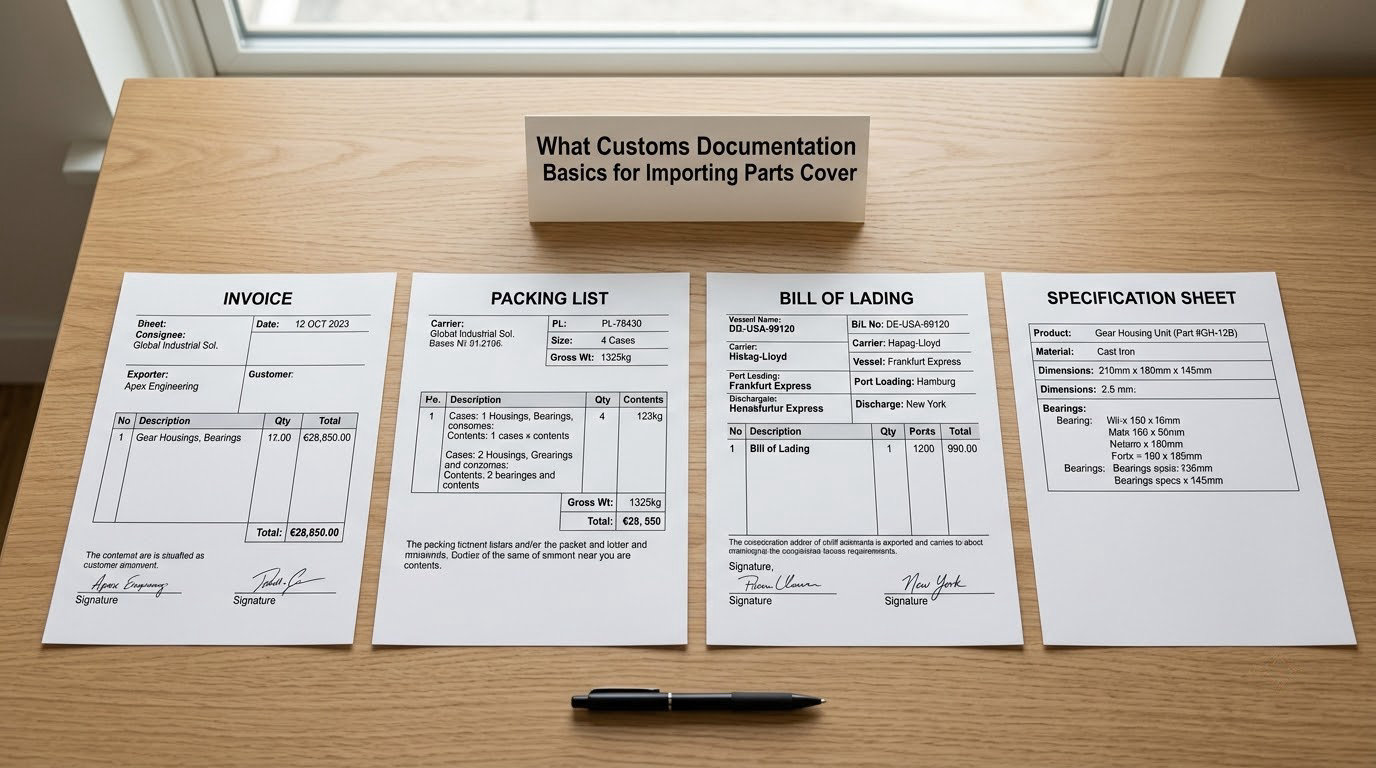
There are two layers here, and most confusion comes from mixing them. The first layer is the customs record: the documents CBP and your broker actually work from to clear the entry. The second layer is the supporting business record: the purchase order, the supplier’s specification sheet, the inspection reports, the internal approvals.
The customs layer is short and mandatory. The business layer is where most of the real work sits, and most of it is optional as far as CBP is concerned but non-negotiable as far as your customer, your insurer, or your quality system is concerned.
The two layers: customs records and business records
A purchase order is a business record. It tells your supplier what to build and what to charge you, and under most Incoterms it also functions as the contract document. It is not a customs invoice, no matter how similar the layout looks, because it describes an agreement rather than a shipment that crossed a border.
The same applies to a quotation, a proforma invoice, and a supplier’s internal packing record. All of them are useful. None of them clears an entry.
What changes the requirement set
No two parts imports have the same paperwork. Four variables move the requirement set, and it is worth naming them before you build anything:
- Shipment value. Low-value informal entries carry a much smaller set than formal entries, and the treatment of the same goods changes once the value crosses the threshold where additional data is required.
- Country of origin. Preferential tariff treatment under a trade agreement adds certification requirements that do not apply to goods from other origins.
- Product type. A precision polymer component, a stamped steel bracket, and a can of parts cleaner do not travel the same paper trail. Regulated and hazardous materials add their own documentation.
- Your role. Importer of record, buyer, broker, or freight forwarder. Each role touches a different subset of the file, and the obligations sit with the importer of record even when the supplier prepares the paperwork.
The core records at a glance
| Record | Typical owner | What it establishes | When it is due |
|---|---|---|---|
| Purchase order | Buyer with the supplier | Scope, price, Incoterm, drawing revision | Before production starts |
| Commercial invoice | Seller or the importer’s broker | Value, description, origin, parties | Before cargo is loaded |
| Packing list | Seller | Carton count, weights, package marks | With the invoice, before loading |
| Bill of lading or air waybill | Carrier through the forwarder | The transport contract and the shipment record | At or after loading |
| Certificate of origin | Chamber of commerce or issuing authority | Preferential tariff eligibility, when claimed | With the invoice if a preference is claimed |
| Power of attorney | Importer of record to the broker | Authority to act and file on your behalf | Before the first entry |
| Customs bond | Importer of record through a surety | Guarantee of duty payment and compliance | Before the entry is filed |
| Importer security filing | Importer of record, or the forwarder on their behalf | Advance cargo data before arrival | At least 24 hours before loading at origin |
| Entry summary | Broker, filed electronically | The formal declaration, classification, and duty | At or before arrival |
| Quality and technical records | Seller and the buyer’s quality team | Material, conformance, traceability | Before release to the line |
If you are building this file for molded or resin parts, the material and process detail matters as much as the paperwork. GD and T basics for plastic parts is a useful reference for describing a molded part precisely enough to invoice it.
Which Documents Are Usually Required for Imported Parts?
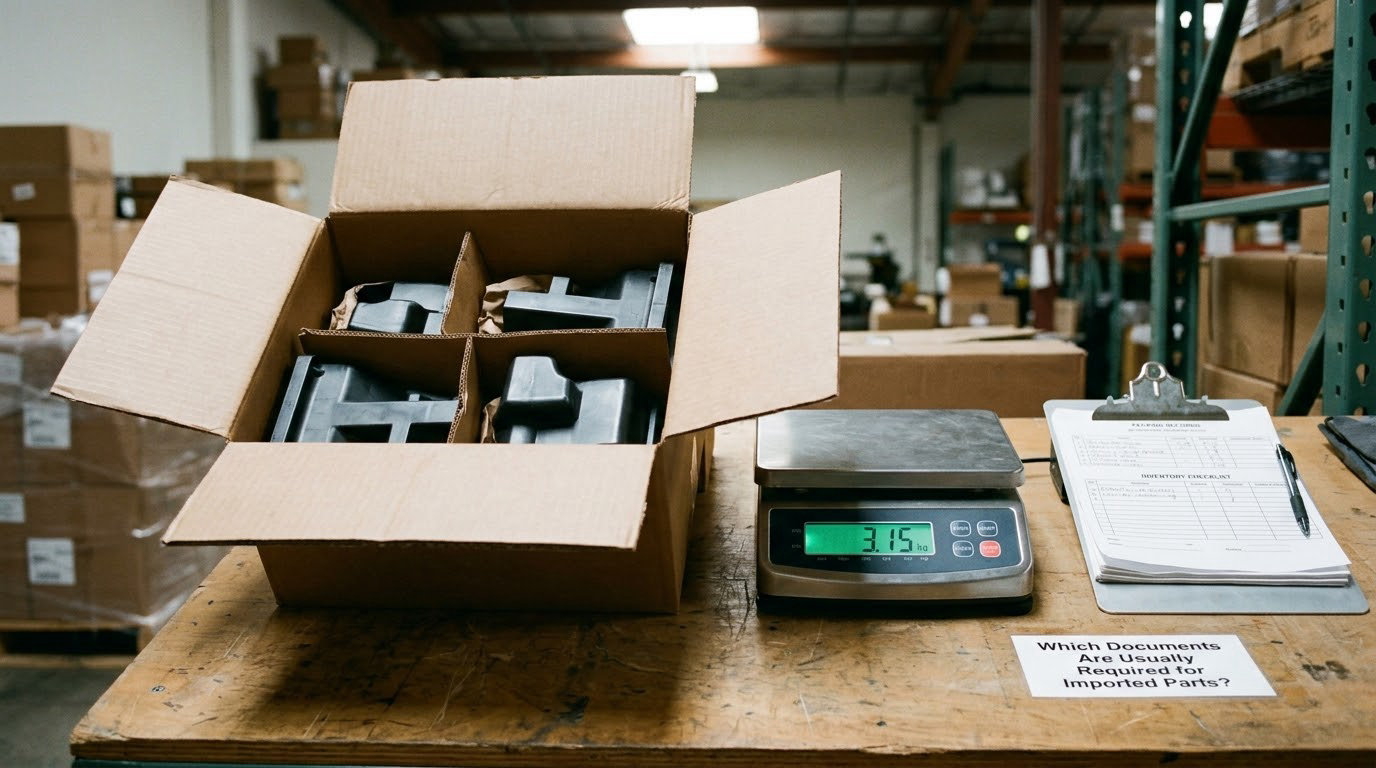
For a commercial shipment of parts into the US, eight documents cover the vast majority of cases:
- Commercial invoice. The foundation record. It states who is selling, who is buying, what the goods are, what they are worth, and where they were made.
- Packing list. The physical description of the shipment: cartons, weights, dimensions, package marks, and the part numbers inside.
- Bill of lading or air waybill. The transport document. For ocean freight it is also a title document; for air it is a receipt and contract of carriage.
- Purchase order. Your own record of what was ordered. Useful for reconciliation even though it is not a customs document.
- Certificate of origin. Required when you are claiming a preferential tariff rate, and useful as supporting evidence even when you are not.
- Power of attorney. Authorizes your broker to sign and file on your behalf as importer of record.
- Customs bond. Either a single-entry bond for one shipment or a continuous bond covering a period of activity.
- Importer security filing. Advance data filed at least 24 hours before the cargo is loaded at origin, covering ten data elements and two parties.
That is the floor, not the ceiling. The exact requirement depends on the importing country, the transportation method, the product, and any trade agreement you are using.
Documents that depend on the product or the lane
Some shipments need more. Parts that are dimensionally controlled, plated, heat-treated, or destined for a regulated end use may need a certificate of conformance, a material test report, or a first article inspection report to satisfy your customer’s quality system even though CBP will not ask for them at the port.
Separate treatment applies to dangerous goods. Parts cleaners, aerosol coatings, treated wood, and certain resins add a dangerous goods declaration and safety data sheets, and those travel with the carrier rather than the broker’s entry packet. When in doubt about a material, ask the supplier for the safety data sheet before the booking, not after the container is on the water.
Sample and prototype parts sit in their own category. They follow the same rules as anything else, which is the reason small-quantity shipments are the hardest to get right economically. The fixed cost of a formal import process does not shrink when the shipment does.
How to Prepare a Complete Commercial Invoice for Parts
A complete commercial invoice for parts carries ten elements. Anything missing is a reason for a query, and a query is a reason for a hold.
- Full legal name and address of the seller, including contact details
- Full legal name and address of the buyer, with the importer of record named if it differs
- Invoice number and invoice date
- Currency of the transaction and the agreed Incoterm with its named place
- Product description specific enough to identify the goods, including part number, material, and function
- Quantity and unit of measure per line
- Unit price and extended line value
- Country of origin, stated per line where the shipment contains mixed origins
- Any assists, tooling, engineering, or other charges included in the price
- Terms of payment, for the importer’s own record
Weak versus strong part descriptions
This is the single most common hold trigger, and the fix costs nothing. Compare these:
| Weak | Better | Best |
|---|---|---|
| Plastic parts | Injection molded parts, ABS | Injection molded ABS housing, part number H-2210, non-food grade, 5000 pieces |
| Metal parts | Steel brackets, zinc plated | Stamped cold-rolled steel mounting bracket, part number MB-114, zinc plated per drawing rev C, 12000 pieces |
| Samples | Sample parts, 5 pieces | Five prototype enclosures, machined aluminum, for evaluation only, not for resale |
| Machined components | Aluminum components | CNC machined 6061-T6 aluminum standoff, part number SO-88, anodized clear, 2000 pieces |
Notice what changes. The part number ties the invoice line to your drawing and your purchase order. The material tells the classifier what the object is made of. The function or end use tells the classifier what it does. The quantity and unit of measure let the CBP officer reconcile the invoice against the packing list and, eventually, against the actual cartons.
“Samples” is not a description, it is a claim about status, and it invites the question of what the goods actually are. Describe the goods and note the intended use separately.
Unit price, assists, tooling and related charges
Value is not always the price on the invoice line. Customs value generally starts with the price actually paid or payable for the imported goods, and it can include certain additions such as assists, tooling supplied to the producer, engineering work undertaken elsewhere, and royalties or license fees the buyer owes related to the imported goods.
The case that catches people out is tooling. If you send a mold to an Asian molder, use it for several years to make parts, and then the parts arrive with a per-piece price that assumes the tooling was free, the tool itself may need to be accounted for in the valuation of the parts you import. Tooling you buy outright and import separately is a different matter, and the documentation looks different.
Ship the tooling invoice along with the parts invoice. It saves a conversation later.
How to Create an Accurate Packing List and Shipment Record
The packing list should correspond to the physical shipment line by line, and every line should correspond to a line on the commercial invoice. Not approximately. Line by line.
What goes in it: number of cartons and pallets, gross and net weight per carton or in total, carton dimensions, container or carton numbers, seal numbers, package marks, and for each carton the part numbers, quantities, and, where the packing is heterogeneous, which carton holds which part.
Weight is the field that triggers physical examinations. If the packing list declares a total gross weight and the bill of lading declares a different one, that discrepancy is visible before anything is opened. A mismatch of a few kilograms reads as normal. A mismatch of several hundred reads as an invitation to inspect the container, and an examination of a container of parts is a very different cost from a document review.
The unit of measure deserves its own check. A supplier who invoices in pieces and packs in bags will have a packing list showing 50 bags while the invoice shows 5,000 pieces. Both are accurate. Neither matches the other at a glance, and reconciling them is manual work. State both, and state the relationship.
The bill of lading and the air waybill are transport documents, not substitutes for the invoice. The bill of lading describes the shipment as the carrier received it and serves as the contract of carriage. On ocean freight it can function as a document of title, which is why a bank providing documentary credit will ask for it. The air waybill is a receipt and a contract of carriage but not a title document. Neither carries the commercial terms, and neither should be used to supply detail the invoice is missing.
How to Determine the Customs Value and Country of Origin
Valuation and origin are two separate determinations, and each has its own logic. Neither can be inferred from the other.
Customs value starts from the transaction value, the price actually paid or payable for the goods, supported by the commercial invoice and any underlying contracts. Adjustments can be made for assists, tooling, engineering, royalties, and certain freight and insurance treatment depending on the Incoterm. Where buyer and seller are related, the relationship gets examined and the value can be accepted, accepted with an adjustment, or rejected in favor of a different valuation method.
That is why under-declaring is a bad trade. A transaction value that cannot be supported by real documents invites a valuation review, and a review can reach back to the contract, the tooling arrangement, and the payment records. If a value turns out to have been understated after the fact, the correction is not quiet. Importers with a few shipments behind them describe this as the single scariest part of a first import.
Why origin is separate from the shipping country
Country of origin is about where the goods were made, not where they were shipped from. A container that leaves Vietnam, transships in Singapore, and arrives in Oakland from Korea still has the origin of where the parts were produced. And that matters in two directions: it determines whether you can claim a preferential tariff rate, and it determines whether additional duties apply.
The prevailing test for a non-preferential claim is substantial transformation: has the good been changed into a different good, with a new name, character, and use, through manufacturing operations? Worked examples from parts importing:
- A raw polymer pellet imported from one country and injection molded into a finished housing in another: the molded housing is a transformed good, and the origin follows the molding operation.
- A coil of cold-rolled steel imported and then stamped, bent, and plated into a finished bracket: the stamping and plating can constitute substantial transformation.
- A bracket machined from bar stock that is imported, machined lightly, and surface finished: cutting corners, drilling, tapping, or plating alone often does not rise to a new good, and the origin stays with the bar stock.
The distinction between the second and third examples is where a lot of value quietly changes hands. Ask the supplier in writing what operations happen in which country, and get it on the certificate rather than in an email.
Transshipment also gets attention in review. Routing goods through a third country to disguise the origin is a serious matter, and a certificate of origin listing a trading company instead of the actual factory is a well-known flag. The certificate should reflect the real production site.
How to Check Part Classifications, Duties, and Restricted Materials
Imported parts need a defensible tariff classification, and the code you choose sets the duty rate, the screening requirements, and sometimes whether the goods can be imported at all.
Classification is a determination of what the good is under the Harmonized System, and the analysis follows a legal order: first the material, then the function, then the design, then the intended use as a tie-breaker. For molded and machined components, the material usually wins the first pass. For a specialized part that performs a distinct function regardless of material, the function argument is stronger.
Three consistency rules save trouble. The code should match across the commercial invoice, the certificate of origin, and the importer security filing. The description should support the code, not merely sit next to it. And the code should be one your broker can defend in writing if someone asks six months later, because they will ask.
Duty is calculated as the tariff rate applied to the customs value, with additional tariffs layered on top where they apply. Section 301 duties on goods of Chinese origin are the most visible example in parts importing today. Anti-dumping and countervailing duty orders cover specific products from specific countries, and a stamped metal bracket or a particular resin can fall inside an order that the importer did not know existed. These rates are substantial and they are not negotiable after the fact.
Restrictions are a separate axis from duty. Medical and food-contact parts, aerospace parts, and anything subject to export control rules carry their own requirements, and a mistake here is not a billing problem. If a part is regulated in its end use, get a compliance opinion before you buy, not after the container lands.
For any large or first-time shipment, have the classification confirmed by a licensed customs broker or a qualified trade-compliance professional before the goods ship. The conversation is cheap compared with a retroactive assessment.
What US Importers Should Do Before and During Shipment
A workable import runs in order. Here is the sequence I would follow, and the point at which each thing has to happen.
Before the goods are produced
- Confirm the supplier’s legal identity. Registered company name, registered address, and the actual production site. If the seller is a trading company, ask where the goods are made and get the answer in writing.
- Agree the classification and origin in the purchase order. Fix the HTS code, the country of origin, and the drawing revision before anyone cuts material.
- Decide who the importer of record is. This determines who needs a bond, a power of attorney, and a customs account, and it needs a decision before the first shipment, not during it.
- Set the value basis. Confirm what is included in the unit price, how tooling is treated, and what shipping terms apply.
- Agree the inspection package. Decide up front what inspection and material reports come with the parts.
Between production and loading
- Request the commercial invoice and packing list as drafts. Read them against your purchase order before they are issued. Catching a wrong origin here costs nothing.
- File the importer security filing. At least 24 hours before the cargo is loaded at origin, covering ten data elements and two parties. Filing it any time before arrival is a common and costly misunderstanding, and the penalties for late or missing data escalate per violation.
- Confirm the certificate of origin if you are claiming a preferential rate, and confirm the issuing body and the production address on it.
- Inspect the packaging. Check that cartons are labeled, that marks match the packing list, and that no carton is unaccounted for at stuffing.
- Send the broker a clean file. Roughly five business days before arrival. A broker working from a complete, reconciled packet clears faster than one working from pieces.
One practical note on Incoterms: a delivered-duty-paid term does not move the legal responsibility to the seller. The importer of record is still liable for accuracy of the declaration even when the supplier prepares every document. This trips up people who assume a DDP shipment is hands-off.
On arrival
Watch for the entry record, the release notice, and any request for additional information. Response time is the variable you control here, and a fast answer to a document query is what separates a same-week release from a multi-week hold.
How to Avoid Customs Documentation Errors and Delays
Almost every delay I have seen traces back to one of these. Each has a straightforward correction.
| Error | What it causes | Correction |
|---|---|---|
| Part named inconsistently across documents | Query, then document review | Pick one part number and one description per line and use it everywhere |
| Country of origin missing or ambiguous | Hold pending verification | State origin per line, and match it to the certificate |
| Quantity or value wrong on the invoice | Reconciliation request, possible valuation review | Reconcile the invoice against the purchase order and the packing list before issuance |
| Unclear unit of measure | Manual reconciliation, slower release | State pieces, sets, and bags separately with the relationship between them |
| Incomplete supplier address | Vendor verification, return of the packet | Full registered address and a contact, verified before shipping |
| Unsigned or undated documents | Document rejected as incomplete | Signature, date, and reference numbers on every page |
| Purchase order submitted as the invoice | Entry cannot be built | Use a commercial invoice that describes the actual shipment |
| Weights disagree between packing list and bill of lading | Physical examination risk | Reweigh or re-declare before the container is sealed |
Before the goods ship, run this final check:
- Every part number on the purchase order appears on the invoice and the packing list.
- Every line carries a quantity, a unit, a unit price, a currency, and a country of origin.
- The invoice and the certificate of origin name the same production site.
- The classification you agreed is the one on every document.
- Weights and carton counts on the packing list match what the forwarder will put on the bill of lading.
- The importer of record, bond, and power of attorney are in place.
- The importer security filing is scheduled for at least 24 hours before loading.
For molded parts, the description you write on the invoice should read the same way you describe the part internally. A vague internal description produces a vague invoice. Our notes on what causes sink marks in injection molded parts are a reminder that the physical part and the paperwork part should be described with the same precision.
Frequently Asked Questions
Can a purchase order replace a commercial invoice for customs clearance?
No. A purchase order describes the agreement to buy, not a shipment that crossed a border, so it cannot be used to build an entry. CBP needs a commercial invoice showing the goods actually shipped, their value, and their country of origin. A proforma invoice or quotation is not a substitute either. In practice you can build a compliant invoice from the purchase order, but the document has to exist in its own right.
When do I need a customs broker for a parts import?
For a first shipment, always. The broker handles classification, entry filing, and the interaction with CBP, and a defensible classification protects you if duties are later questioned. Ongoing, a broker is still worthwhile once the shipment value or part count justifies the fixed cost. If you act as your own importer of record you still need a bond, a customs account, and electronic filing capability, which is why most small importers start with a broker.
What should I do if imported parts arrive damaged?
Document the damage before the containers are moved, photograph cartons and internal packing, and record the seal numbers. Note the damage on the delivery receipt and the bill of lading before signing, since a clean signature can waive the right to claim. Then notify your broker and your cargo insurer immediately, because claims are generally time-limited. Separately, flag a quality complaint with the supplier, since damage in transit and damage at the factory are handled by different documents.
How long should I keep customs import records?
US importers generally keep import records for five years from the date of entry, and many companies retain them longer because of audit, warranty, and contractual obligations. A sensible rule is to keep the complete customs file for as long as you might need to answer a duty, valuation, or marking question, and to keep quality and inspection records for the life of the part. Store the set together, not scattered across a supplier folder and an email thread.
Do parts that look like ordinary hardware need special documentation?
Often, yes. Regulated end uses, food-contact materials, medical devices, and aerospace components can pull documentation requirements that have nothing to do with how ordinary the part looks. Certain metal parts from specific countries can also fall inside anti-dumping or countervailing duty orders, which is a duty question rather than a paperwork one. If a part is going into a regulated application, tell your supplier and your broker before you order, not when the entry is filed.
Conclusion
Start by gathering the information that decides everything else: the supplier’s legal identity, the real production site, a part number and material description precise enough to classify, a value basis that survives review, and a shipping plan with dates. Once that exists, the documents are mostly formatting.
When a shipment is complex, high in value, or carrying parts that touch a regulated end use, have the records reviewed by a customs broker or a trade-compliance professional before the goods leave. That review is the cheapest line item in the whole import, and it is the one that decides whether a shipment clears in days or sits.
For high-temperature polymer parts, the material choice drives the paperwork as much as the design. PEEK versus ULTEM for high temperature parts is a useful comparison to have in hand before the invoice description is written.